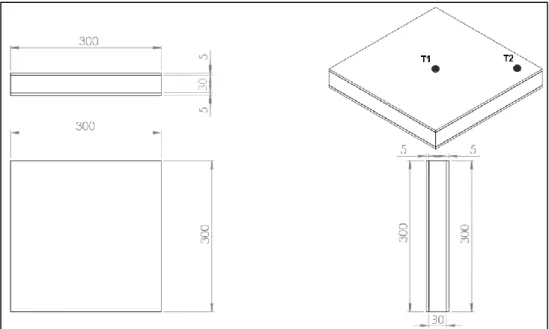
This dissertation/thesis entitled “DEVELOPMENT OF NOVEL INTUMESCENT FIRE-RESISTANT DURABLE FOR 2-HOUR FIRE DOOR” was prepared by JESSICA JONG KWANG YIN and submitted in partial fulfillment of the requirements for the degree of Master of Science in Engineering at Abdul Universiti. Rahman. 55 3.7 Coating samples are immersed in distilled water 57 3.8 Dimensions (in mm) of the designed fire rating. Weight of coating after immersion (g) Wo Weight of coating before immersion (g) b Width of test specimen (mm).
Background of Research
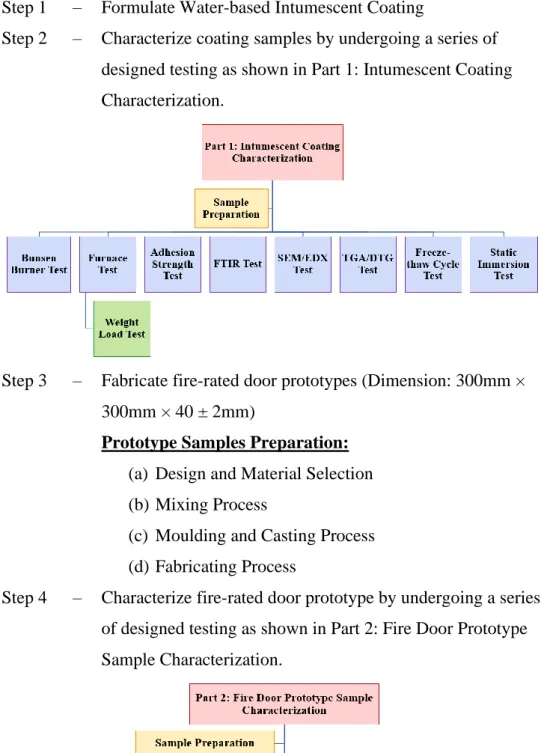
The objective of this experimental research is to design, manufacture and test prototypes of fire-resistant doors with dimensions of 300 mm × 300 mm × 40 ±2 mm. The fire resistance performance and material behavior of water-based intumescent coatings (W-IC) are characterized and evaluated by a series of tests such as furnace test, Bunsen burner test, adhesion strength test, Fourier transform infrared spectroscopic test (FTIR). , scanning electron microscope (SEM) analysis test, energy dispersive X-ray spectroscopy (EDX) test, thermogravimetric analysis (TGA) test, differential thermogravimetry (DTG) test, freeze-thaw cycle test and static immersion test. In the final phase, the fire performance of the fire door prototypes is physically evaluated through a small-scale fire test and a three-point bending test.
Introduction: This chapter consists of background and motivation of research, aims and objectives, experimental research scopes, problem
There are total five chapters in this experimental research report and each of the chapters contains several sub-chapters as detailed below.
Research Methodology: This chapter is discussing the methods used to determine the fire retardancy and mechanical, chemical and physical
12 Chapter 4 – Results and Discussion: This chapter is the central part of this research which included illustration, analysis, characterization and discussion regarding the results and data obtained from each technical test.
Conclusion and Recommendations: This chapter is covered with the conclusions, recommendations and suggestions for future research
Introduction
- Commercial Fire-rated Door (Gypsum Board)
- Binder
As mentioned earlier, flame retardant additives are one of the main ingredients used to make water-based (W-IC) intumescent coatings. Each of the ingredients has its own contribution and properties to the fire-resistant performance of intumescent coatings. With the right amount of the flame retardant ingredients, this can improve the intumescent coating.
Introduction
- Materials Preparation
- Sample Preparation
- Scanning Electron Microscopy (SEM) Analysis
- Energy-dispersive X-ray (EDX) Spectroscopy Test
- Freeze-thaw Cycle Test
- Prototypes Preparation
- Three-point Flexural Test
Therefore, using laboratory techniques to test IC performance compensates for limited testing methods. Most standard testing, such as National Fire Protection Association (NFPA) 252, NFPA 80, UL10B, is performed to test fire-rated door assemblies as a whole, which includes the door, hardware, glazing and frame as an assembly, although some components are usually tested separately tested by a nationally recognized testing agency that is listed, marked and/or classified for use in fire door assemblies (Havel, 2013). 45 parts of NFPA 252 (Standard Methods of Fire Tests for Door Assemblies) and BS 476 Part 7 (Fire Test of Building Materials) for doors only are used to evaluate and characterize the fire resistant door samples in this experimental investigation.
High flexural strength of fire rated door can lead to high durability of the fire rated door. Therefore, the formulation of the flame retardant additives was fixed at the ratio of 2:1:1 in this experimental research. To date, there is no standard test to study the strength of the charcoal sample.
The samples were first coated with a thickness of 2 ±0.2 mm intumescent coating samples on one side of the cylindrical steel rod. The test is to determine the coating sample's ability to withstand the highly destructive forces of cyclic freezing and thawing. In addition to that, commercial fire-rated door prototype (i.e. plasterboard) is also manufactured with the same dimensions as the prototypes, P1 – P5 for ease of comparison.
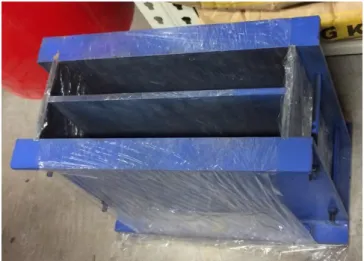
Cast iron mold shown in Figure 3.10 is used to fabricate W-IB as the core of the fire-rated door prototype in this experimental research with a dimension of 300 mm × 300 mm × 40 mm each.
Introduction
Part 1: Sample Characterization of Intumescent Coating
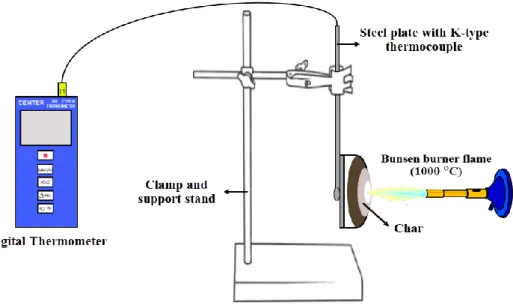
- Bunsen Burner Test
- Furnace Test
- Weight Load Test
- Adhesion Strength Test
- Fourier-transform Infrared (FTIR) Spectroscopy Test
- Surface Morphology of Char Layer of Coated Samples
- Energy-dispersive X-ray (EDX) Spectroscopy
- Freeze-thaw Cycle Test
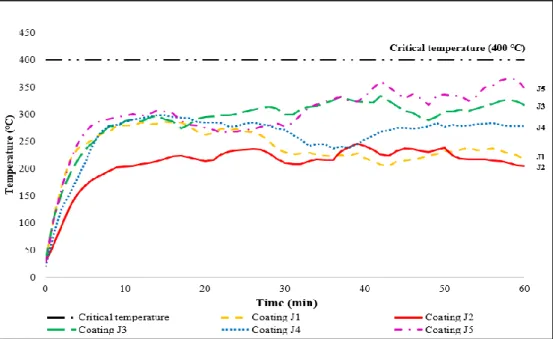
The char combined with the positive effects of the flame retardant additives, the swelling binder and fillers (3 wt. On the second observation, the coating sample J5 has indicated the highest equilibrium temperature of 325 ºC, and almost reached the critical temperature (400) ºC) after 40 minutes after the fire exposure Based on the results obtained, it was observed that the coal layers in the coating samples J3, J4 and J5 with the addition of magnesium hydroxide turned out to be slightly lower in the thicknesses of.
The expansion value of the thickness of charred layer of coating samples J4 and J5 is measured to be 0.4 mm and 1.2 mm, respectively. The strength of the charred layer of the coating sample J2 would withstand the maximum load of up to 650 g compared to the coating samples J1 (400 g) and J5 (600 g), respectively. This specific test was performed to determine the adhesion strength of the coated samples.
The increase in adhesion strength of the coating sample J5 was due to the strong bond strength between the steel substrate surface and VA copolymer binder with the addition of Mg(OH)2 and CaCO3 fillers, which effectively dissipate stresses. From the SEM surface morphologies as depicted in Figure 4.6, the orange color indicated the holes and voids in the carbon layer of the coated samples. The fire and heat propagated to the crack lines on the foam structure can also lead to a poor fire protection performance of the layer (Beh et al., 2019).
Therefore, the fire resistance performance, indicating the fire resistance competence of the carbonized layer, is highly dependent on the physical structure of the coating (Toro et al., 2007).
Static Immersion Test
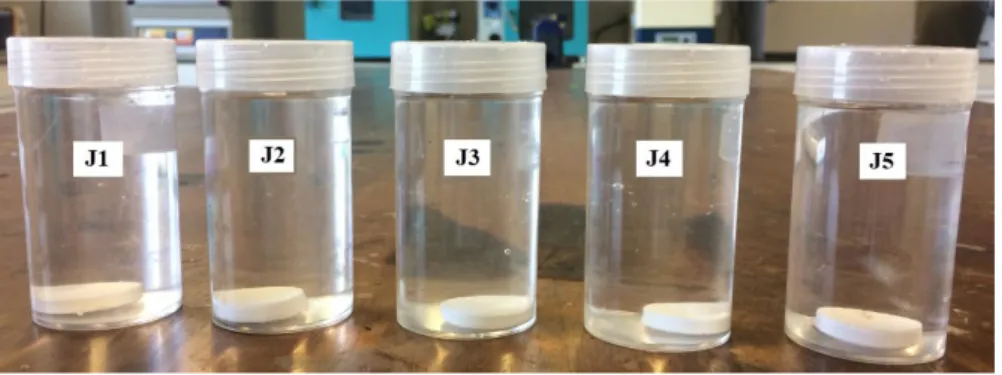
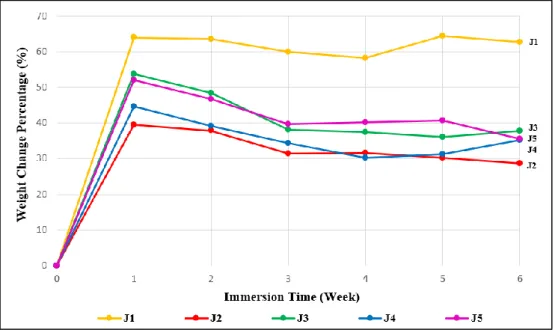
This static immersion test is to determine the relative water resistance performance of the coating surfaces. Therefore, it is important to evaluate the water resistance of the coating samples using this static immersion test. Water can penetrate into pore structures of the coating leading to increase in weight of the coating samples during the penetration process (Yew et al., 2015).
Migration process can only take place on the condition that some of the hydrophilic flame retardant materials that can migrate out of the coating and dissolve in water, resulting in weight loss of the coating (Yew et al.). The reason that both permeation and migration processes occurred in coating samples during the immersion test is that distilled water can destroy the components of hydrophilic flame retardant materials and easily break the bonds of polymer binder, resulting in a significant reduction in the water resistance of fire resistant coatings (Yew et al., 2015). This is due to the addition of Al(OH)3 and CES filler to the flame retardant additives and VAC emulsion which could retard water permeation and migration of flame retardant materials due to poor water solubility leading to an improvement in resisting water permeation and coating migration ability.
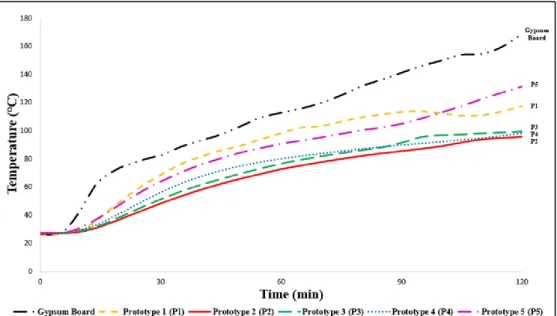
In conclusion, the degree of permeation and migration processes that took place in the coating samples during the tests can provide significant evidence to justify the water resistance of the coating. The temperature of the uncoated IC cement board reached 231 ºC after 120 minutes, while the temperature of the coated IC cement board reached 123.2 ºC after 120 minutes. The results obtained show that the presence of the IC prolongs the ignition time of the test samples and this has proven that IC can be used in fire door applications as it can retard and delay the fire during fire.
95 Previously, the commercial fire rated door is composed of cement board because it has low thermal conductivity which can protect the lower part of the structure for a sufficient period when the fire.
Small Scale Fire Test
- Density of the Prototypes
This may be due to the physical and chemical reactions of the intumescent binder during the fire test. As a building safety requirement, the safety and the reliability of the fire door are the key aspects to determine the effectiveness during the outbreak of the fire. The fire resistance test is therefore to characterize and identify the ability of the fire rated door prototypes to survive at a specified fire condition for a certain duration without suffering any integrity breach or any significant leakage.
98 Figure 4.13: Temperature rise estimates at the center (T1) and edge (T2) of the P2 prototype and the commercial prototype. This particular test is used to determine the behavior of the material in terms of mechanical properties of prototype fire rated doors. Doors tend to bend from their support frame due to a non-uniform distribution of temperature and/or impact force from opening and closing the door, which can lead to the spread of flame and smoke when there is a fire outbreak.
Flexural modulus is intended to determine the stiffness of the prototypes during the first step of the bending process. 102 Based on the results of the bending stress-strain curve as observed, it is known that the higher the bending stress and bending strain, the prototype will not easily break due to the high impact force caused by the bending stress and the resistance of the bending stress. struggle to resist it being broken easily. By observing the failure during the first crack, it can be indicated that the ductility of the drywall prototype was very low.
The bending behavior of the plasterboard prototype was completely linear (fully elastic behavior) without any plastic behavior.
Conclusions
These tests confirmed that test samples J2 with additional aluminum hydroxide and CES fillers in the swelling binder indicated the highest residual weight and also promoted antioxidation of the coatings. In this experimental research, coating sample J2 showed the least changes in weight percentage, and this has indicated that J2 with the addition of aluminum hydroxide and CES fillers could have delayed the penetration of water and migration of flame retardant materials due to its poor solubility in water, leading to improve the water resistance of the coating. One of the possible approaches for future work is to further improve the content of the flame retardant materials.
Formulate different combinations of flame retardant ingredients to develop and improve the fire protection performance and material properties of the inflatable cover as well as the fire resistant board. Synthesis and characterization of the flame retardant properties and corrosion resistance of Schiff's base compounds incorporated into organic coating. Characterization of the thermal decomposition of two types of plywood with a cone calorimeter - FTIR apparatus.
A Study of the Mechanism of Flame Retardation and Smoke Suppression in Polymers Filled with Magnesium Hydroxide. Effects of nano-biofiller on the fire-resistant and mechanical properties of water-based intumescent coatings. Advances in Organic Coatings The formulation and study of the thermal stability and mechanical properties of an acrylic coating.
The formulation and study of the thermal stability and mechanical properties of an acrylic coating using chicken eggshells as a new biofiller.