265
WELL-BEING OF PARTICIPANTS: A CASE STUDY OF PAKISTAN
Khaliq Ahmad, Adewale Abideen Adeyemi Muhammad Nauman Khan
Abstract
Poverty is considered one of the basic problems confronted by the developing and underdeveloped countries of the world including Muslim majority countries like Pakistan. During the last two decades, microfinance institutions have been rapidly established all around the world on the premise that they can alleviate poverty.
These institutions open new horizons of economic development. But majority of Muslim populace yearn for Islamic products over conventional microfinance products on account of religious injunctions against paying interest. This paper attempts to analyze the multilevel impact of Islamic microfinance on two Pakistani cities (Multan and Lahore) poor population. This has three dimensions at (i) household level, (ii) enterprise level and (iii) religious, social &
ethical levels. Primary data has been collected from the program participants of microfinance institutions in Pakistan, Akhuwat and Wasil Foundations, by employing cross-sectional design with stratified random sampling method. Pearson’s Chi-Square χ2, Yates Continuity Correction, Cramer’s V (φ) and Odds Ratio are used to quantify the difference between established clients (more than one year) and new clients (less than one year). The results of the study support the wide literature on a belief that microfinance can significantly improve the socio-economic and religious status of the participants.
Keywords: Microfinance, Islamic Finance, Poverty, Pakistan, Socio-economic, Religious.
1. INTRODUCTION
The World today consists of 56 Muslim countries with over 1.2 Billion people all around the world. Except for the few countries from the Middle East and South East Asia there is high and growing poverty rate in the remaining Muslim countries1. It is estimated that more than 322 million poor population of the world that earn income of below 1.25$ a day live in the Organisation of Islamic Conference (OIC) countries (SESRIC, 2015). As mentioned by Zulkhibri (2016)
2 poverty seems to be the pivotal problem around which other social issues confronting the Muslim world such as beggary, human trafficking, street crime, civil war, terrorism etc. also rotate. Even worrying is the concern raised in Adewale and Hassan (2014)3 that this social menace is assuming if not already assumed a dynastic dimension in which case the consequential psychological insecurity and emotional upset it leaves in its trail transmit across generations4.
The pervasiveness of poverty in the Muslim world would have made any OIC member a viable candidate of focus. This is because most countries have come up with policy frameworks, among which is Islamic Microfinance aimed at addressing the issue of poverty using a platform that is in line with the Islamic tenets of financing.
However, without being prejudicial to the prevalence and relevance of poverty alleviation studies in other OIC member countries, this paper focuses on the case of Pakistan for following obvious reasons5.
1 Tawfik El Seif (2013) argued that there may be a high incidence of undeclared poverty even among the GCC countries.
2 M. Zulkhibri, "Islamic Finance, Financial Inclusion Policy and Financial Inclusion: Evidence from Muslim Countries." IRTI Working Paper 1437-01 (2016).
3 A.A. Adewale, and M.K. Hassan. "Islamic Microfinancing." In Handbook on Islam and Economic Life, by M.K. Hassan and M.K. (Eds) Lewis, 417-434. UK:
Edward Elgar Publishing. (2014).
4 Ibid.
5 Adewale and Hassan (2014) presented some Islamic Microfinance programmes across the Muslim world
267
Available statistics shows that Pakistan is relatively relevant for a study like this. Pakistan is the sixth largest populated country in the world and second largest populated country in the Islamic world with 191.71 million inhabitants. More than 61% of the population is still living in rural areas. Working age population (15-59 years) has also witnessed an increase from 54% in 1998 to 60% in 2015.
Similarly, the country has also witnessed growth in the population, and the labor force (MOF, 2015).
According to Pakistan Microfinance Network there are 42 registered Microfinance providers. The combined assets of Pakistan’
microfinance industry are approximately PKR 105.4 billion (USD 1.036 billion).The gross loan portfolio (GLP) is PKR 63.5 billion (USD 0.624 billion), while outreach stands at approximately 2.997 million active borrowers, and 2.998 million active depositors (Pakistan Microfinance Review, 2014). However, majority of Microfinance institutions (MFIs) are interest based. This may have negative implication for the financial inclusion of the devout but poor Muslims who may reluctantly participate in interest (riba) based Microfinance Program. As such, there is a re-invigorated drive towards poverty alleviation via Islamic microfinance in Pakistan.
Among the Islamic microfinance institutions (IsMFIs) working in Pakistan, two are relatively renowned: Wasil Foundation and Akhuwat. Both IsMFIs not only provide financial assistance based on Shari’ah principle but also provide proper trainings and technical assistance to their clients. The former, which was established in 2009, is interested in relatively successful micro and small enterprises (MSEs) that need Islamic financing to grow thereby entering into equity financing with such MSEs. As at 2016 it has about 6,127 clients. The latter, on the other hand was established in 2001 and focuses on micro-business start-ups that require benevolent loans to kick-start their business ideas. As at 2016, it has about 154,921 clients.
There have been claims and counter claims that these two IsMFIs have positive impact on the lives of their clients. Such claims and rebuttal are not based on any empirical investigation. Rather, views expressed derive from the numerous studies that evaluated the impact of conventional microfinance on the individuals’ income,
expenditures, children education, health and employment status in Pakistan (Shirazi, 20126; Noreen, et al. 20117; Saboor, Husain and Munir 20098; Shirazi 2009)9. To the best knowledge of the authors, impact of Islamic Microfinance on poverty eradication of individuals, at household, social and enterprise level are rare and largely conceptual. The few that exist such as (Rahman 201010; Asmawati and Ahmad 201511; and Mulyaningsih, et al. 2015)12 not only used single impact indicator but also have conflicting results. As such, to a very large extent, what researchers have been able to produce is nothing more than a virtual cacophony of protests and acclaims, which further exposes several latent conflicts, gaps and uncertainties in the analyses and conception Islamic microfinance and its implication for poverty alleviation.
This research study is, therefore, an attempt to fill this gap that exists in the empirical literature. This study nevertheless is focused on the evaluation of Islamic microfinance visible impacts on its participants’ social and ethical dispositions. Hence the real aim is primarily to help improve rather than prove the impact of Islamic micro-financing as platform to realizing both the spirit and mechanics of providing financial services to the Muslim poor masses.
6 N. S. Shirazi, "Targeting and Socio-Economic Impact of Microfinance: A Case Study of Pakistan." Islamic Economic Studies 20 no 2, (2012), 1-28.
7 U. Noreen, Imran, A. Zaheer, and I. Saif. "Impact of Microfinance on Poverty: A Case of Pakistan." World Applied Sciences Journal 12, no.6 (2011), 877-883.
8 A. Saboor, M. Husain and M. Munir. "Impact of Micro Credit in Alleviating Poverty: An Insight from Rural Rawalpindi, Pakistan." Pakistan Journal of Life and Social Science, 7 no.1 (2009), 90-97.
9 N. S. Shirazi and Khan, A. "Role of Pakistan Poverty Alleviation Fund in Poverty Alleviation: A case of Pakistan." Pakistan Economic and Social Review 47 no. 2, (2009), 215-228.
10 M. M. Rahman, "Islamic Micro-Finance Programme and its Impact on Rural Poverty Alleviation." International Journal of Banking and Finance, 7, no.1 (2010).
11 A. Asmawati and S. Ahmad. "Impact of Islamic Microfinance on Improving the Income and Poverty Reduction on Microenterprises in Province Aceh: Case Study in Baitul Qiradh Aceh." Kontekstualita, 30 no. 2 (2015).
12 Y. Mulyaningsih, N. Nuryartono, R. Oktaviani and C. M. Firdausy. "The Impact of Access to Islamic microfinance Institutions (Islamic MFI) on Poverty Alleviation in Rural Bogor West Java, Indonesia: A Propensity Score Matching Approach."
Global Journal of Commerce and Management Perspective 4 no. 5, (2015), 9-16.
269
2. Islamic Microfinance and Poverty Alleviation
After enjoying a substantial growth in the Islamic finance industry, especially in the last 30 years there is a need to revisit its targets by laying more emphasis on the social economic development as well as catering for the needs of the poor who often lacks financial citizenship. This call made by Zamir Iqbal (1997) is still very relevant today. To this extent, the relative importance of IsMFIs to providing services such as credit, savings, venture equity, insurance and remittance on a micro scale through the use of Islamic financial instruments within the limitations of Shari’ah cannot be overemphasised.
The basis for and the truthfulness of Islamic Microfinance is derived from the teachings of Qur’an and Sunnah. Islamic Microfinance objective is to make as many Muslim entrepreneurs and not Muslim debtors. Islam wants to break the vicious circle of poverty of poor and provide them with a solid financial footing so that they are made to ask favours from the Creator of this universe, Allah swt only. As such, the poor is restrained from begging from people or to spread their hands in front of others for the basic needs.
No doubt charity has much importance in the Islamic strategy of poverty alleviation. In fact, Islam strongly encourages able Muslims to give charity with the assurances that they will find its reward manifold from Allah. However, on the flip side Islam also wants that beneficiaries do not depend on perpetual charity. Instead they should rely on their own latent talents and physical wellbeing to mitigate the incidence of poverty except that it is absolutely impossible for such persons to earn their livelihood by involving in permissible wealth generating activities.
In a famous hadith, Prophet Muhammad (saw) guides the basic principle of Islamic strategy of alleviating poverty from the society is through economic empowerment.
“A man of the Ansar came to the Prophet (saw) and begged from him. He (the Prophet) asked: Have you nothing in your house? He replied: Yes, a piece of cloth, a part of which we wear and a part of which we spread (on the ground), and a wooden bowl from which we
drink water.
He said: Bring them to me. He then brought these articles to him and he (the Prophet) took them in his hands and asked: Who will buy these? A man said: I shall buy them for one dirham. He said twice or thrice:
Who will offer more than one dirham? A man said: I shall buy them for two dirhams.
He gave these to him and took the two dirhams and, giving them to the Ansari, he said: Buy food with one of them and hand it to your family, and buy an axe and bring it to me. He then brought it to him. The Apostle of Allah (saw) fixed a handle on it with his own hands and said: Go, gather firewood and sell it, and do not let me see you for a fortnight. The man went away and gathered firewood and sold it. When he had earned ten dirhams, he came to him and bought a garment with some of them and food with the others.
The Apostle of Allah (saw) then said: This is better for you than that begging for this should come as a spot on your face on the Day of Judgment. Begging is right only for three people: one who is in grinding poverty, one who is seriously in debt, or one who is responsible for compensation and finds it difficult to pay”13
This hadith reveals that Islam encourages economic empowerment and entrepreneurship and discourages begging. In the era of companions of Prophet Muhammad (saw) the Baitulmal was used to assist the poor. At the time of Ottoman Empire cash waqf was established for lending small amounts to individuals that had less resources (Cizakca 2007)14. So this may be viewed as the inception of modern Islamic microfinance institutions. But today’s formal
13 Abu Dawood, bk.9, no.1637.
14 M. Cizakca, Incorporated Cash Waqfs and Mudarabah: Islamic Nonbank Financial Instruments from the Past to the Future in Non-Bank Financial Institutions: Islamic Alternatives. Jeddah: Islamic Research and Training Institute, IDB. (2007).
271
Islamic Microfinance institutions are the recent development of applying Islamic finance principles in the sense of the conventional microfinance.
The Islamic microfinance is provided based on two different modes: Mission-based modes and Market-based modes.
Mission-based modes are used normally for providing social safety net to destitute or the extremely poor. They also include capacity building initiatives that provide technical trainings and temporary start-up support. In Islam Zakah, Sadaqah, Waqf and Qard-e-Hassan are used as Mission-based modes. Market-based Modes are used for wealth creation and economic empowerment primarily through Musharkah, Mudarbah, Murabaha, Ijarah, Salam, Istasna as Market based modes.
3. Islamic Microfinance and Poverty Alleviation in Pakistan In Pakistan and for the specific purpose of this study, two providers of Islamic microfinance are vis. Akhuwat Foundation and Wasil Foundation are the focus of this study.
3.1 Akhuwat Foundation
Akhuwat is a well-established name in the Islamic Microfinance industry in Pakistan. It was established in 2001 at Lahore by giving a 10,000 PKR loan to a widow on Qard-e-Hasan basis. Akhuwat is inspired from the concept of ‘Mwakhaat’ or brotherhood of Madina in whichAnsars (local residents of Medina) and the Muhajirun (immigrants from Mecca) became the brothers of each other and one Ansar brother willing to share half of his wealth with his Muhajir brother who was an immigrant. Akhuwat wants to instil the same concept of Mwakhaat in its operation.
Akhuwat methodology of lending is based on interest free benevolent loans and Qard-e-Hasan is the mode of such lending.
Before 2011, PKR 100 (1.14 USD) was charged as registration fee to meet the operational cost. This fee has since been waived as Akhuwat’s operational efficiency increases. For reducing the operational cost extreme simplicity has been adopted in the form of plain offices, use of religious places for the loan disbursements and engaging the volunteers in the workforce. The objective of the
Akhuwat is to provide social guidance and entrepreneurship training for the capacity building of the program participants along with the disbursement of loans on the basis of Qard-e-Hassan to uplift the poor from poverty and gradually converting the borrowers into eventual future donors.
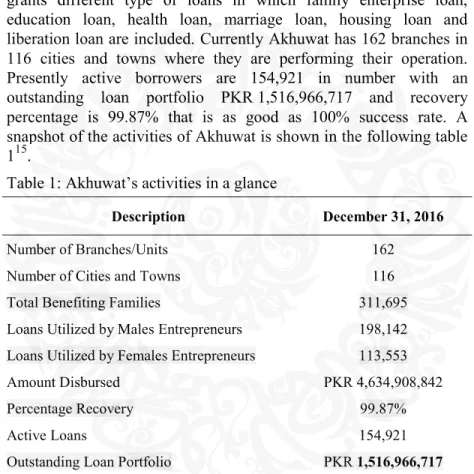
Akhuwat has its head office in Lahore, Pakistan. Akhuwat grants different type of loans in which family enterprise loan, education loan, health loan, marriage loan, housing loan and liberation loan are included. Currently Akhuwat has 162 branches in 116 cities and towns where they are performing their operation.
Presently active borrowers are 154,921 in number with an outstanding loan portfolio PKR 1,516,966,717 and recovery percentage is 99.87% that is as good as 100% success rate. A snapshot of the activities of Akhuwat is shown in the following table 115.
Table 1: Akhuwat’s activities in a glance
Description December 31, 2016
Number of Branches/Units 162
Number of Cities and Towns 116
Total Benefiting Families 311,695
Loans Utilized by Males Entrepreneurs 198,142 Loans Utilized by Females Entrepreneurs 113,553
Amount Disbursed PKR 4,634,908,842
Percentage Recovery 99.87%
Active Loans 154,921
Outstanding Loan Portfolio PKR 1,516,966,717 3.2 Wasil Foundation
Wasil Foundation is the second renowned Islamic microfinance institution in Pakistan. It was established in 1992 with the name of
15 Akhuwat, http://www.akhuwat.org.pk/ accessed on May 15, 2017
273
Centre for Women Co-Operative Development (CWCD). In 2009, CWCD converted its operation from conventional microfinance to Islamic microfinance and changed its name to Wasil Foundation. The objective of the organization is to “economically empower poor communities and facilitate them in developing their businesses through Micro Credit and Enterprise Development Programs”. In Pakistan, Wasil Foundation is the pioneer IsMFI that successfully launched profit based Islamic mode of finances; Ijara, Murabaha, Diminishing Musharaka, Istisna and Sala’m are such examples in its list of operational products. Wasil Foundation has its own separate Shari’ah Advisory Board that monitors the operation of the organization.
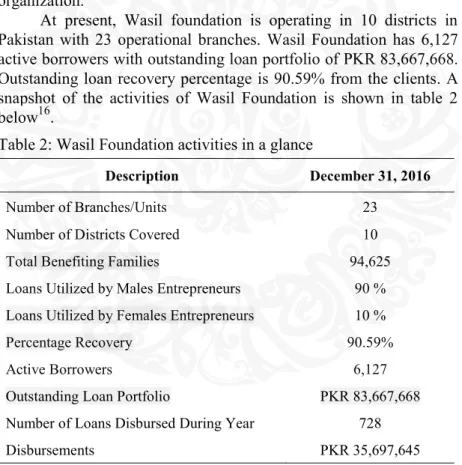
At present, Wasil foundation is operating in 10 districts in Pakistan with 23 operational branches. Wasil Foundation has 6,127 active borrowers with outstanding loan portfolio of PKR 83,667,668.
Outstanding loan recovery percentage is 90.59% from the clients. A snapshot of the activities of Wasil Foundation is shown in table 2 below16.
Table 2: Wasil Foundation activities in a glance
Description December 31, 2016
Number of Branches/Units 23
Number of Districts Covered 10
Total Benefiting Families 94,625
Loans Utilized by Males Entrepreneurs 90 % Loans Utilized by Females Entrepreneurs 10 %
Percentage Recovery 90.59%
Active Borrowers 6,127
Outstanding Loan Portfolio PKR 83,667,668 Number of Loans Disbursed During Year 728
Disbursements PKR 35,697,645
16 Wasil Foundation, http://www.wasil.org.pk/, accessed on May 15, 2017
4. ASSESSMENT OF ISLAMIC MICROFINANCE IMPACTS Rulindo and Pramanik (2013)17 conducted study to evaluate the impact of Islamic microfinance on the participants’ material wellbeing and their religious and spiritual enhancement in Indonesia.
The findings of this study found that Islamic microfinance is able to provide significant impact on improvement of clients’ income and poverty status. In addition, this study also found that higher spirituality level brings more wealth, while having higher religiosity may enhance clients’ economic performance.
Mahmood, Fatima, Khan and Qamar (2015)18 conducted a study to evaluate the impact of three Islamic microfinance programs in Lahore, Pakistan. They found the positive impact on monthly incomes and expenditures of households, development in assets holdings, and poverty levels reduction of the target respondents.
Similarly many studies on the impact assessment and ample research work regarding economic improvements have been done in different parts of the world. In Pakistan specifically, microfinance seems to be a growing industry especially since the last decade. But empirical assessment on ground realities is lacking. As such, very limited research work has been done on impact assessment of Islamic microfinance on poor populace in Pakistan. This study fills this gap of the research and investigates the impact of Islamic microfinance especially on the participants’ religious, social and ethical dimensions. Sequel to these studies in Islamic microfinance, the following conceptual model (Figure- 1) was developed that guides the conduct of this present research.
17 R. Rulindo and A.H. Pramanik. "Finding a Way to Enhance Impact of Islamic Microfinance: The Role of Spiritual and Religious Enhancement Programmes."
Developing Country Studies, 3 no. 7 (2013).
18 H. Z. Mahmood, M. Fatima, M. Khan and M.A. Qamar. "Islamic Microfinance and Poverty Alleviation: An Empirical Ascertainment from Pakistan." Journal of Islamic Economics, Banking and Finance, 11 no.2, (April-June 2015).
275 Figure 1: Proposed Research Model
Source: Authors’ own compilation
5. Methodology
This study is based on the positivism research paradigm given that it is based on quantitative data and it uses scientific experimental methods for generation of knowledge that ensures a bridge in the gap between subjective biases and objective reality (Dash 2005)19. In line with the positivist stance, a quantitative research design is also adopted in this study. Without prejudice to the popularity of longitudinal studies for impact assessment in microfinance, this study adopts the cross-sectional method. This approach is used in instances where data is collected once through survey. Sekaran (2003)20 opined that it is useful when there is a time, cost and effort constraint.
Hair and Anderson (2010)21 reckoned that majority of the researches
19 N. K. Dash, “Selection of the Research Paradigm and Methodology”, accessed
from http://www.celt.mmu.ac.uk/
researchmethods/Modules/Selection_of_methodology/. (Manchester, England:
Manchester Metropolitan University, 2005).
20 U. Sekaran, Research Methods for Business: A Skill-Building Approach. 4/e.
(USA: John Willey and Sons, 2003).
21 J. B. Hair and R.E. Anderson. Multivariate Data Analysis: A global perspective.
in social science depend on cross-sectional surveys because at one point of time they can evaualte all related variables. Many well established practitioner organizations and academic researchers also use cross-sectional approach in their microfinance impact assessment studies (Samer et. Al., 2015; Pitt and Khandker, 199822; Duong and Nghiem, 201423, Hamad andFernald, 201424).
The population of focus in this study are the clients of both Akhuwat and Wasil foundation in both Lahore and Multan districts, Pakistan. Both districts are divided into four areas administratively.
Each area has 7 to 10 branch offices. In this study, five branch offices are randomly selected from each area. Sample of program participants are selected after collecting data from the branch offices.
Households are divided into 2 groups, matured and new clients. A list of program participants is collected from the selected branch offices along with their demographic data like age, gender, frequency of getting loan, time of program participation and number of dependents. From this list, 500 program participants are selected randomly for conducting the interviews. In the event that a selected respondent is not available for interview, a random selection of another respondent program participant is made as a replacement since we have the list of all participants of that area.
The sample selection in impact assessment studies could be based on clients only in which case a self-report of noticeable impact of their participation in micro-financing could be elicited. Otherwise, a comparative analysis between participants and non-participants in a microfinance programme could also be conducted. A third option is applied in this research. This involves a comparison between “mature clients’ and ‘incoming clients”. This approach seems to be the most promising of the cross-sectional approaches. In this approach, the
(Upper Saddle River, New Jersey: Pearson., 2010).
22 M. Pitt and S. Khandker. "The impact of group-based credit programs on poor households in Bangladesh: Does the gender of participants matter?" The Journal of Political Economy, 106 no. 5 (1998), 958-996.
23 H.A. Duong and H.S. Nghiem. "Effects of Microfinance on Poverty Reduction in Vietnam: A Pseudo-Panel Data Analysis." Journal of Accounting, Finance and Economics 4 no. 2 (2014), 58-67.
24 R. Hamad and L.C.H. Fernald. "Microcredit participation and women’s health:
results from a cross-sectional study in Peru." Int. J Equity Health. 14, no.62 (2014).
277
comparison group consists of the program’s incoming clients. They characterize the best comparison group because they have not been in the program since long enough to show an impact; yet they are comparable “types” of people as those in the client’s sample because they also joined the program after fulfilling basic criteria for participation. Furthermore, it is easier to select a comparison group from existing lists of incoming clients than to choosing non-clients at random from the local population.
Based on consideration of the statistical power, statistical significance, and effect size, the sample size calculator from the
social science research website
Raosoft25,was used in order to calculate the sample size for the study.
On the basis of estimated confidence level 95% and acceptable error margin 5%, as the total population size of both IsMFIs was 167,818 program participants, 384 should be the minimum sample size for conducting this study.Empirical studies pointed out that in the survey questionnaire a sufficient response rate remained between 60% and 90% (Hossain, 199826; Coleman, 199927). In this study the survey is conducted with the assistance of trained survey assistants under the researcher’s supervision. About 80% response rate was expected so the study sample should be (384/.80) 482.
Data so obtained from the adopted questionnaire from Copestake (2002) is subjected to statistical analysis using both the descriptive and inferential statistical tools in SPSS. Specifically in the current study, Chi-square tests - Pearson Chi-Square and Yates’
continuity correction, Cramér's V and Odds Ratio - are used for quantifying the impact of Islamic microfinance. This is based on two main facts. First, according to Mayers (2013) these are the most relevant tests given that most of the data elicited are categorical and non-parametric in nature, and the intent is to come up with explained relationships based on odds ratio among variables rather than draw a causal inference. Moreover, these methods have been used in most
25 Raosoft, accessed from http://www.raosoft.com/samplesize.html
26 Hossain, M. Credit for Alleviation of Rural Poverty: the Grameen Bank in Bangladesh. (Washington DC: IFPRI, 1998).
27 B. E. Coleman, "The Impact of Group Lending in Northeast Thailand." Journal of Development Economics 60 (1999), 105-141.
commissioned studies by multi-lateral agencies to assess hypothesised relationships similar to those tested in this research (Copestake et al, 2002).
6. Results of the Study
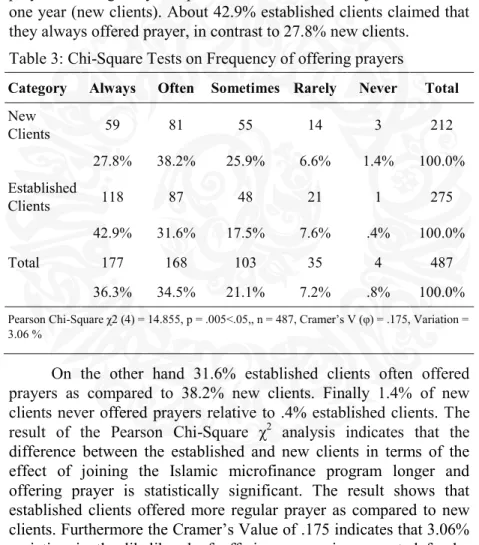
The table 3 indicate that those clients who joined Islamic microfinance for more than one year (established clients), offered prayer more regularly compared to those clients who joined less than one year (new clients). About 42.9% established clients claimed that they always offered prayer, in contrast to 27.8% new clients.
Table 3: Chi-Square Tests on Frequency of offering prayers
Category Always Often Sometimes Rarely Never Total
New Clients 59 81 55 14 3 212
27.8% 38.2% 25.9% 6.6% 1.4% 100.0%
Established
Clients 118 87 48 21 1 275
42.9% 31.6% 17.5% 7.6% .4% 100.0%
Total 177 168 103 35 4 487
36.3% 34.5% 21.1% 7.2% .8% 100.0%
Pearson Chi-Square χ2 (4) = 14.855, p = .005<.05,, n = 487, Cramer’s V (φ) = .175, Variation = 3.06 %
On the other hand 31.6% established clients often offered prayers as compared to 38.2% new clients. Finally 1.4% of new clients never offered prayers relative to .4% established clients. The result of the Pearson Chi-Square χ2 analysis indicates that the difference between the established and new clients in terms of the effect of joining the Islamic microfinance program longer and offering prayer is statistically significant. The result shows that established clients offered more regular prayer as compared to new clients. Furthermore the Cramer’s Value of .175 indicates that 3.06%
variation in the likelihood of offering prayer is accounted for by
279
joining the Islamic microfinance program for a long time.
Table Error! No text of specified style in document.: Chi-Square Tests on improvements in knowledge of reciting Holy Qur’an
Category Always Often Sometimes Rarely Never Total
Clients New 80 55 39 19 19 212
37.7% 25.9% 18.4% 9.0% 9.0% 100.0%
Established
Clients 127 91 25 12 20 275
46.2% 33.1% 9.1% 4.4% 7.3% 100.0%
Total 207 146 64 31 39 487
42.5% 30.0% 13.1% 6.4% 8.0% 100.0%
Pearson Chi-Square χ2 (4) = 16.341, p = .003<.05, n= 487, Cramer’s V (φ) = .183, Variation = 3.35%
Table 4 indicated that the established clients have more improvement on how to recite the Holy Qur’an in contrast to the new clients. Approximately 80% of the established clients indicated that they have improved in their recitation of the Holy Qur’an versus to 63% of the new clients as shown in the first two left side columns of the table. However, 9% of the new clients indicate they do not know how to recite the Holy Qur’an as compared to 7.3% established clients. With a p-value .003<.05 of Pearson Chi-Square χ2 analyses, it is pointed out in the table that clients who joined Islamic microfinance program for a long period are likely to be more proficient in how to recite the Holy Qur’an as compared to new clients. A statistically significant difference between two groups is noted in this regard. In addition the Cramer’s Value of .183 indicate the 3.35% variation in the likelihood of improvement in knowing how to recite the Holy Qur’an is accounted for by joining the Islamic microfinance program for a long time.
Table 5: Chi-Square Tests Frequency of Reciting Holy Qur’an Category Always Often Sometimes Rarely Never Total
New Clients 30 58 68 28 28 212
14.2% 27.4% 32.1% 13.2% 13.2% 100.0%
Established
Clients 72 80 68 24 31 275
26.2% 29.1% 24.7% 8.7% 11.3% 100.0%
Total 102 138 136 52 59 487
20.9% 28.3% 27.9% 10.7% 12.1% 100.0%
Pearson Chi-Square χ2 (4) = 13.335, p = .010<.05, n = 487, Cramer’s V (φ) = .165, Variation = 2.72%
Table 5 indicated the frequency of clients’ recitation of the Holy Qur’an due of joining the Islamic microfinance programme.
The table shows that overall most of the clients frequently recites the Holy Qur’an. Moreover, a significant difference exists between the established clients and their new client counterparts, in this regard.
Specifically, about 26.2% established clients indicate they frequently recite the Holy Qur’an compared to 14.2% new clients. On the other side, only 9% new clients indicate otherwise in contrast to 9.8%
established clients. Also 27.4% of the new clients often recited the Holy Qur’an relative to the 29.1% of the established clients.
However, 13.2% of the new clients never recited the Holy Qur’an in comparison to 11.3% established clients. Results of Pearson Chi-Square χ2 analyses indicate a significant difference between the two groups. The table clearly indicates that clients who joined Islamic microfinance program for a long period are likely to recite the Holy Qur’an more regularly as compared to new clients.
Moreover, the Cramer’s Value of .165 points out that 2.72%
variation in the likelihood of reciting the Holy Qur’an is accounted for by joining the Islamic microfinance program for a long time.
281
Table Error! No text of specified style in document.1: Chi-Square Tests on Observing Ramadan and Voluntary Fast
Category Always Often Sometimes Rarely Never Total
New Clients 79 50 44 24 15 212
37.3% 23.6% 20.8% 11.3% 7.1% 100.0%
Established
Clients 107 94 33 19 22 275
38.9% 34.2% 12.0% 6.9% 8.0% 100.0%
Total 186 144 77 43 37 487
38.2% 29.6% 15.8% 8.8% 7.6% 100.0%
Pearson Chi-Square χ2 (4) = 13.208, p = .010<.05, n = 487, Cramer’s V (φ) = .165, Variation = 2.72 %
As a corollary to the results shown in table 5 above, table 6 indicated the established clients seem to engage more voluntary fasting in contrast to the new clients. About 38.9% of the established clients claimed that they always observed fast in the month of Ramadan and other voluntary fasting in comparison with 37.3% new clients. On the other side, 23.6% of the new clients often observed fast in contrast to 34.2% established clients. However 7.1% of the new clients never observed voluntary fast compared to the 8%
established clients. Furthermore, an empirical assessment of the facts above is carried out based on a Pearson χ2 test. The results obtained indicate a low p-value = .010<.05 which points out that those clients who joined Islamic microfinance program for a long period are more likely to observe both the compulsory and voluntary fasting compared to their new clients cohorts.. The Cramer’s Value of .165 signalized the 2.72% variation in the likelihood of observing fast regularly by joining the Islamic microfinance program for a long time.
Table 7: Chi-Square Tests on Inviting People towards Islamic Activities
Category Always Often Sometimes Rarely Never Total
New Clients 39 79 44 36 14 212
18.4% 37.3% 20.8% 17.0% 6.6% 100.0%
Established
Clients 68 115 61 18 13 275
24.7% 41.8% 22.2% 6.5% 4.7% 100.0%
Total 107 194 105 54 27 487
22.0% 39.8% 21.6% 11.1% 5.5% 100.0%
Pearson Chi-Square χ2 (4) = 15.438, p = .004<.05, n = 487, Cramer’s V (φ) = .178, Variation
= 3.17 %
The above table 7 provides description that those clients who joined Islamic microfinance for more than one year, invited people more towards Islamic activities compare to those clients who joined less than one year. Around 24.7% established clients claimed that they always invite people towards Islamic activities in contrast to 18.4% new clients. On the other hand 41.8% established clients often invited people towards Islamic activities as compared to 37.3% new clients. However, 6.6% of new clients never invited people towards Islamic activities relative to 4.7% established clients. The result of the Pearson Chi-Square χ2 analyses indicates the difference, in terms of the effect of joining the Islamic microfinance program longer and inviting people towards Islamic activities, is statistically significant.
The table shows that established clients invited people more towards Islamic activities as compared to new clients. Furthermore the Cramer’s Value of .178 indicated the 3.17% variation in the likelihood of inviting people more towards Islamic activities was accounted for by joining the Islamic microfinance program for a long time.
Table 8: Chi-Square Tests on Involvement in Interest-based loans
283
Category Always Often Sometimes Rarely Never Total
New Clients 2 9 12 6 183 212
.9% 4.2% 5.7% 2.8% 86.3% 100.0%
Established
Clients 5 11 9 11 239 275
1.8% 4.0% 3.3% 4.0% 86.9% 100.0%
Total 7 20 21 17 422 487
1.4% 4.1% 4.3% 3.5% 86.7% 100.0%
Pearson Chi-Square χ2 (4) = 2.712, p = .607>.05, n = 487, Cramer’s V (φ) = .075, Variation
= .56%
Table 8 provides detail on the involvement of the respondents in interest bearing financial transactions. Results obtained indicate that majority of the established clients and new clients do not involve in getting interest bearing loans. Approximately 87% of the established clients claimed that they never took interest based loans from any other institution compared to 86% of the new clients as shown in the first right side columns of the table. Also 09% of the new clients told that they always got interest based loans as compared to 1.8% established clients. Furthermore, an empirical assessment of the facts above is carried out based on a Pearson χ2 test. The results obtained indicate a high p-value = .607<.05 which points out that those clients who joined Islamic microfinance program for a long period are less likely to interest bearing activities compared to their new clients cohorts. Nonetheless, no significant difference is observed between two groups in this regard. In addition the Cramer’s Value of .075 indicate that.56% variation in the likelihood of not getting involved in interest bearing financial activities is accounted for by joining the Islamic microfinance program for a long time.
Table 9: Chi-Square Tests on Spouses’ Islamic dressing
Category Always Often Sometimes Rarely Never Total
New Clients 42 89 33 10 38 212
19.8% 42.0% 15.6% 4.7% 17.9% 100.0%
Established
Clients 41 109 47 18 60 275
14.9% 39.6% 17.1% 6.5% 21.8% 100.0%
Total 83 198 80 28 98 487
17.0% 40.7% 16.4% 5.7% 20.1% 100.0%
Pearson Chi-Square χ2 (4) = 3.617, p = .460>.05, n = 487, Cramer’s V (φ) = .086, Variation
= .74%
Table 9 shows that majority of the established clients and new clients (or their spouses) put on hijab. No statistically significant difference is noted between the two groups in this regard. Around 14.9% of the established clients indicate that they always wear the hijab in contrast to 19.8% new clients. Also 42.0% of the new clients often wear the hijab relative to the 39.6% of the established clients.
However, 17.9% of the new clients never wore the hijab in comparison to 21.8% established clients. The result of Pearson Chi-Square χ2 analyses with a p-value = .460>.05 suggest no significant difference between the two groups. This result clearly shows that clients who joined Islamic microfinance program for a long period are likely not to be different from the new clients in terms of wearing the hijab compared to new clients. Moreover the Cramer’s Value of .086 points out that .74% variation in the likelihood of wearing hijab is accounted for by joining the Islamic microfinance program for a long time.
285
Table 11: Chi-Square Tests on Getting Dowry on Marriage
Category Always Often Sometimes Rarely Never Total
New Clients 93 80 36 2 1 212
43.9% 37.7% 17.0% .9% .5% 100.0%
Established
Clients 107 108 49 2 9 275
38.9% 39.3% 17.8% .7% 3.3% 100.0%
Total 200 188 85 4 10 487
41.1% 38.6% 17.5% .8% 2.1% 100.0%
Pearson Chi-Square χ2 (4) = 5.480, p = .241>.05, n = 487, Cramer’s V (φ) = .106, Variation
= 1.12 %
Table 11 provides the details that both the established clients as well as the new clients are involved in getting dowry on marriage.
No statistically significant difference is observed between them in this aspect. Specifically, about 38.9% of the established clients claim that they always get dowry on the marriage in comparison with 43.9% new clients. On the other side, 37.7% of the new clients often gets dowry on the marriage in contrast to 39.3% established clients.
However .5% of the new clients never got dowry on the marriage compared to the 3.3% established clients. With a high p-value = .241>.05 of Pearson Chi-Square χ2 analysis, the null hypothesis of no difference between the two groups vis-à-vis getting dowry on marriage cannot be rejected. This clearly indicates that clients who joined Islamic microfinance program for a long period got dowry on the marriage in the same fashion as the new clients. The Cramer’s Value of .106 shows that 1.12% variation in the likelihood of getting dowry on the marriage is explained by joining the Islamic microfinance program for a long time.
Table 12: Chi-Square Tests on Frequency of Having Misunderstanding with Spouse
Category Always Often Sometimes Rarely Never Total
New Clients 26 63 63 20 40 212
12.3% 29.7% 29.7% 9.4% 18.9% 100.0%
Established
Clients 41 69 88 44 33 275
14.9% 25.1% 32.0% 16.0% 12.0% 100.0%
Total 67 132 151 64 73 487
13.8% 27.1% 31.0% 13.1% 15.0% 100.0%
Pearson Chi-Square χ2 (4) = 9.449, p = .051>.05, n = 487, Cramer’s V (φ) = .139, Variation = 1.93%
The table 12 above depicts that clients who joined Islamic microfinance program for more than 1 year are not statistically and significantly different from the new clients in terms of having misunderstanding with their spouse. Around 14.9% established clients claimed that they always had misunderstanding with spouse, in contrast of 12.3% new clients. On the other hand 25.1%
established clients often had misunderstanding with spouse as compared to 29.7% new clients. Finally 18.9% of new clients never had misunderstanding with spouse relative to 12.0% established clients. The result of the Pearson χ2 (4) = 9.449, p-value = .051>.05 indicates that no significant difference between the two groups in terms of the effect of joining the Islamic microfinance program longer and misunderstanding with spouse. Furthermore the Cramer’s Value of .139 indicates that 1.93% variation in the likelihood of less misunderstanding with spouse is accounted for by joining the Islamic microfinance program for a long time.
287
Table 13: Chi-Square Tests on Involvement in Social Activities Category Always Often Sometimes Rarely Never Total
New Clients 52 108 48 3 1 212
24.5% 50.9% 22.6% 1.4% .5% 100.0%
Established
Clients 107 135 28 4 1 275
38.9% 49.1% 10.2% 1.5% .4% 100.0%
Total 159 243 76 7 2 487
32.6% 49.9% 15.6% 1.4% .4% 100.0%
Pearson Chi-Square χ2 (4) = 19.609, p = .001<.05, n = 487, Cramer’s V (φ) = .201, Variation = 4.04%
Table 13 shows that the established clients are involved more in the social activities in contrast to new clients. Approximately 88%
of the established clients indicate that they always or often involved in the social activities compared to 75% of the new clients as shown in the first two left side columns of the above table. However, only 1.9% of the new clients and established clients were rarely or never involved in social activities. Empirically assessing the above fact via the Pearson Chi-Square χ2 analyses results in a low p-value .001<.05.
This point out that clients who joined Islamic microfinance program for a long period are likely to be involve more in the social activities as compared to new clients. A statistically significant difference between two groups is noted in this regard. In addition, the Cramer’s Value of .201 indicates that 4.04% variation in the likelihood of involving more in the social activities is accounted for by joining the Islamic microfinance program for a long time.
Table 14: Chi-Square Tests on Treating People with Respect and Courtesy
Category Always Often Sometimes Rarely Never Total
New Clients 62 101 46 3 0 212
29.2% 47.6% 21.7% 1.4% .0% 100.0%
Established
Clients 142 115 15 2 1 275
51.6% 41.8% 5.5% .7% .4% 100.0%
Total 204 216 61 5 1 487
41.9% 44.4% 12.5% 1.0% .2% 100.0%
Pearson Chi-Square χ2 (4) = 41.783, p = .000<.05, n = 487, Cramer’s V (φ) = .293, Variation = 8.58%
Table 14 provides descriptive evidence that overall established clients treat people with more respect and courtesy as compared to their counterparts. About 51.6% of the established clients always treat people with respect and courtesy in contrast to 29.2% new clients. About 47.6% of the new clients often treat people with respect and courtesy relative to the 41.8% of the established clients.
Moreover, 21.7% of the new clients sometimes treat people with respect and courtesy in comparison with 5.5% established clients.
Results of the Pearson Chi-Square χ2 analysis suggest a statistically significant difference exists between the two groups. It clearly indicates that clients who joined Islamic microfinance program for a long period are likely to treat people with more respect and courtesy as compared to new clients. Moreover the Cramer’s Value of .293 points out that 8.58% variation in the likelihood of treating people with more respect and courtesy is accounted for by joining the Islamic microfinance program for a long time.
289
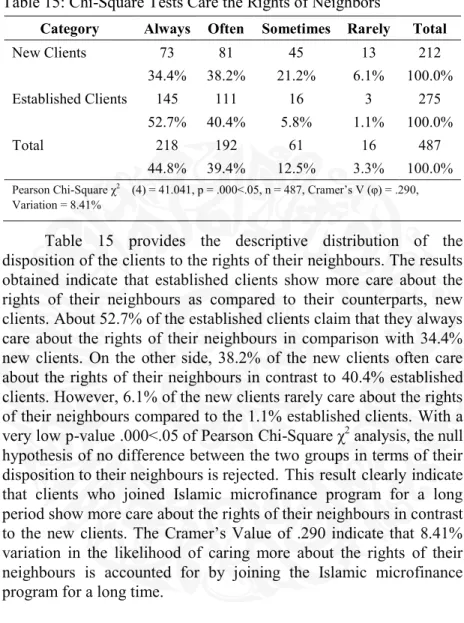
Table 15: Chi-Square Tests Care the Rights of Neighbors
Category Always Often Sometimes Rarely Total
New Clients 73 81 45 13 212
34.4% 38.2% 21.2% 6.1% 100.0%
Established Clients 145 111 16 3 275 52.7% 40.4% 5.8% 1.1% 100.0%
Total 218 192 61 16 487
44.8% 39.4% 12.5% 3.3% 100.0%
Pearson Chi-Square χ2 (4) = 41.041, p = .000<.05, n = 487, Cramer’s V (φ) = .290, Variation = 8.41%
Table 15 provides the descriptive distribution of the disposition of the clients to the rights of their neighbours. The results obtained indicate that established clients show more care about the rights of their neighbours as compared to their counterparts, new clients. About 52.7% of the established clients claim that they always care about the rights of their neighbours in comparison with 34.4%
new clients. On the other side, 38.2% of the new clients often care about the rights of their neighbours in contrast to 40.4% established clients. However, 6.1% of the new clients rarely care about the rights of their neighbours compared to the 1.1% established clients. With a very low p-value .000<.05 of Pearson Chi-Square χ2 analysis, the null hypothesis of no difference between the two groups in terms of their disposition to their neighbours is rejected. This result clearly indicate that clients who joined Islamic microfinance program for a long period show more care about the rights of their neighbours in contrast to the new clients. The Cramer’s Value of .290 indicate that 8.41%
variation in the likelihood of caring more about the rights of their neighbours is accounted for by joining the Islamic microfinance program for a long time.
Table 16: Chi-Square Tests on Respect to Parents and Fulfilling their Needs
Category Always Often Sometimes Rarely Never Total
New Clients 71 79 48 10 4 212
33.5% 37.3% 22.6% 4.7% 1.9% 100.0%
Established
Clients 161 84 22 3 5 275
58.5% 30.5% 8.0% 1.1% 1.8% 100.0%
Total 232 163 70 13 9 487
47.6% 33.5% 14.4% 2.7% 1.8% 100.0%
Pearson Chi-Square χ2 (4) = 41.143, p = .000<.05, n = 487, Cramer’s V (φ) = .291, Variation = 8.47%
The table 16 above provides a description that established clients give more respect to their parents and fulfilled their needs when compared to the new clients. Specifically, 58.5% established clients claim that they always gave respect to their parents and fulfilled their needs, in contrast of 33.5% new clients. On the other hand 30.5% established clients often gave respect to their parents and fulfilled their needs as compared to 37.3% new clients. The p-value = .000<.05 of the Pearson Chi-Square χ2 analysis indicate that the difference, in terms of the effect of joining the Islamic microfinance program longer and giving more respect to their parents and fulfilled their needs, was statistically significant. It showed that established clients gave more respect to their parents and fulfilled their needs as compare to new clients. Furthermore the Cramer’s Value of .291 indicate that 8.47% variation in the likelihood of giving more respect to their parents and fulfilling their needs is accounted for by joining the Islamic microfinance program for a long time.
291
Table 17: Chi-Square Tests on Keeping Surroundings Clean
Category Always Often Sometimes Rarely Never Total
New Clients 87 87 33 4 1 212
41.0% 41.0% 15.6% 1.9% .5% 100.0%
Established
Clients 157 102 15 1 0 275
57.1% 37.1% 5.5% .4% .0% 100.0%
Total 244 189 48 5 1 487
50.1% 38.8% 9.9% 1.0% .2% 100.0%
Pearson Chi-Square χ2 (4) = 23.058, p = .000<.05, n = 487, Cramer’s V (φ) = .218, Variation = 4.75%
Table 17 provides descriptive evidence that the established clients kept a cleaner surroundings in contrast of new clients. About 57.1% of the established clients indicate that they kept cleaner and surroundings and maintained proper sanitation compared to 41% of the new clients. On the other hand 37.1% of the established clients often kept cleaner surroundings compared to 41% new clients. With a low p-value .000<.05 of Pearson Chi-Square χ2 analysis points out that clients who joined Islamic microfinance program for a long period are likely to keep cleaner environments and engage actively in sanitation of their surroundings compared to new clients. A statistically significant difference between two groups is noted in this regard. In addition the Cramer’s Value of .218 indicate that 4.75%
variation in the likelihood of keeping cleaner surroundings is accounted for by joining the Islamic microfinance program for a long time.
Table 18: Chi-Square Tests on Keeping Commitments
Category Always Often Sometimes Rarely Never Total
New Clients 82 81 32 16 1 212
38.7% 38.2% 15.1% 7.5% .5% 100.0%
Established
Clients 157 112 5 0 1 275
57.1% 40.7% 1.8% .0% .4% 100.0%
Total 239 193 37 16 2 487
49.1% 39.6% 7.6% 3.3% .4% 100.0%
Pearson Chi-Square χ2 (4) = 57.022, p = .000<.05, n = 487, Cramer’s V (φ) = .342, Variation = 11.70%
As shown in Table 18 above, in general terms the established clients keep their commitments more compared to their new client counterparts. Specifically, about 57.1% of the established clients always keep their commitments in contrast to 38.7% new clients.
Moreover, about 38.2% of the new clients often keep their commitments relative to the 40.7% of the established clients. With a p-value = .000<.05 of Pearson Chi-Square χ2 analysis, a statistically significant difference exists between the two groups. It is clearly indicated that clients who joined Islamic microfinance program for a long period are likely to keep their commitments more as compared to new clients. Moreover the Cramer’s Value of .342 points out that 11.70% variation in the likelihood of keeping their commitments more is accounted for by joining the Islamic microfinance program for a long time.
293
Table 19: Chi-Square Tests on Feeling of Barakah after Getting Islamic Microfinance
Category Always Often Sometimes Rarely Never Total
New Clients 130 50 20 8 4 212
61.3% 23.6% 9.4% 3.8% 1.9% 100.0%
Established
Clients 201 64 6 3 1 275
73.1% 23.3% 2.2% 1.1% .4% 100.0%
Total 331 114 26 11 5 487
68.0% 23.4% 5.3% 2.3% 1.0% 100.0%
Pearson Chi-Square χ2 (4) = 20.758, p = .000<.05, n = 487, Cramer’s V (φ) = .206, Variation = 4.24%
Table 19 above provide descriptive evidence that established clients felt more barakah (an Islamic term meant as if sufficient for human needs) after getting Islamic microfinance as compared to their new client counterparts. Specifically, about 73.1% of the established clients claim that they always felt barakah after getting Islamic microfinance in comparison with 61.3% new clients. On the other side, 23.6% of the new clients often felt barakah in contrast to 23.3%
established clients. However 1.9% of the new clients never felt barakah after getting Islamic microfinance compared to the .4%
established clients. With a very low p-value .000<.05 of Pearson Chi-Square χ2 analysis, the null hypothesis that no difference exists between the established clients and the new clients in relation to the feeling of barakah upon having access to microfinance is rejected.
This clearly indicates that clients who joined Islamic microfinance program for a long period they felt more barakah after getting Islamic microfinance in contrast to the new clients. The Cramer’s Value of .206 provides evidence that 4.24% variation in the likelihood of feeling more barakah after getting Islamic microfinance is accounted for by joining the Islamic microfinance program for a long time.
Table 20: Summary of Impact on Religious, Social and Ethical Levels
Serial
No. Hypothesis Significance
Level
p-value Pearson Chi-Square
Decision
RSE1 Offer Prayer 0.05 .005 Accepted
RSE2 Know how to recite Holy Qur’an 0.05 .003 Accepted
RSE3 Recite Holy Qur’an 0.05 .010 Accepted
RSE4 Observe Fast 0.05 .010 Accepted
RSE5 Invite people towards Islamic
activities 0.05 .004 Accepted
RSE6 Involve in interest loans 0.05 .607 Rejected
RSE7 You (your spouse) maintain Hijab 0.05 .460 Rejected
RSE8 Getting dowry on marriage 0.05 .241 Rejected
RSE9 Have misunderstanding with spouse 0.05 .051 Rejected RSE10 Involve in social activities 0.05 .001 Accepted RSE11 Treat people with respect and
courtesy 0.05 .000 Accepted
RSE12 Care the rights of your Neighbors 0.05 .000 Accepted RSE13 Respect your parents and fulfill their
needs 0.05 .000 Accepted
RSE14 Keep clean your surroundings 0.05 .000 Accepted
RSE15 Keep your commitments 0.05 .000 Accepted
RSE16 Feel barakah after getting Islamic
microfinance 0.05 .000 Accepted
The table 20 above summarises the overall impact in a nutshell that Islam not only emphasizes the materialistic wellbeing but also wants to improve the religious, social, spiritual and ethical conditions of the human being. In this study, opinions of the Islamic microfinance program participants was sought out about their awareness and practice of sixteen different religious, social and ethical activities. A five point Likert scale was used in order to