The Position OJ Islamic Law In The Four Southern Border Provinces OJ Thailand
THE POSITION OF ISLAMIC LAW IN THE FOUR SOUTHERN BORDER PROVINCES OF
THAILAND*
Sulaiman Dorloh**
Abstrak
Kerlas kerja ini membahaskan pelaksanaan undang-undang Islam di Thailand, khususnya di empat wilayah Melayu Selatan Thailand, melalui institusi Qadi yang lebih dikenali sebagai institusi Dato ' Yutitham. Beberapa persoalan dasar dikemukakan dalam kajian ini yang mendapati bahawa bidang kuasa yang diberikan kepada institusi Qadi ini hanya terbatas kepada pelaksanaan undang-undang keluarga dan pusaka Islam di kalangan penduduk Islam di selatan Thailand. Isu perlantikan dan kelayakan seseorang Qadi juga dikemukakan dalam kajian Int.
INTRODUCTION
Thailand is a democratic country with the king as Head of the State. I There are many provisions in the revised Constitution of the Kingdom of Thai land, 1997 that provides the principles of democracy such as the protection of rights and liberties of the people,2 public participation in government, decentralization and local government. The National laws of the country are applied to the Muslims in Thailand in addition to the fact that
*
This paper is a revised version of the paper presented in the Seminar on Shari' ah and Democracy: The Southeast Asia Experience, organized by the Centre for Contemporary Islamic Studies and the Konrad-Adenaur-Stiftung Foundation, Singapore, March 13-14,2004. The writer would like to extend his gratitude and acknowledgement to Mohd. Zain
Abd. Rahman for his interest to comments and edit this paper
** Senior lecturer at the College of Islamic Studies. Prince ofSongkhla University. Pattani Campus, Thailand. He is currently pursuing his doctorate study at Ahmad Ibrahim Kulliyyah of Law, International Islamic University Malaysia (I1UM)
See Section 2, Constitution of the Kingdom of Thailand, 1997.
See Chapter III, Constitution of the Kingdom of Thailand, 1997.
Jllrnal Syariah. /4.2 [2006} /-2/
the government considers Islamic law as a special law for the Muslims in the southern part of the country. This paper attempts to investigate the position of Islamic Law (Shari 'ah) in Thailand legal system in order to reveal the extent to which the Thai government has recognized the law of the Muslims in the dominated southern provinces known as the four southern border provinces of Thailand.
HISTORICAL OVERVIEW
Thailand legal system is based on various legal systems. Each with its own patterns: the traditional legal system and the western legal system. With regard to the Islamic legal system, it has been applied in Thailand since the first arrival of the Muslim traders from Persia, India, and the Malay Peninsula during the Ayuthaya dynasty.' It is reported that Pracau Songtham (1602-1627) of Ayuthaya Dynasty who impressed with the achievements of the Persian traders, had appointed Shaykh Ahmad, a Persian Muslim trader to become the king's advi ser4 with regard to the Muslims affairs in Ayuthaya.5
The administration of the Muslims affairs in Ayuthaya was regulated by these mostly foreign Persian traders. When there was a dispute amongst the Muslims, Shaykh Ahmad, acted on behalf of the king, became an Islamic arbitrator in sarn krom tha kwa.6 Another important area of arbitration was marriage. When a Muslim trader
Ayuthaya was considered as the second dynasty in the history of Siam (now Thailand).
There were four dynasties with regard to the history of Thailand namely, Sukhothai Dynasty (1238-1378), Ayudhya Dynasty (1350-1767), Thonburi Dynasty (1767-1782), and Rattanakosin Dynasty (1782-till present).
This appointment was lasted until the reign of King Pra Chao Prasat Thong of Ayuthaya Dynasty (1602-1655). He is the first Chularajmontri of Thailand which is equivalent to Shaykh ai-Islam who carried the title of Chao Phraya Sheikh Ahmad Rattana Rajesti. At present the Thai king has already appointed 17 persons to be Churajmontri(Shaykh a/- Islam}. They were considered as the highest leaders of the Muslims in Thailand having its responsibilities in responding between the government officials and the Muslim Communities. See Swa Vilaiwan (2001), Chularajmontri. Bangkok: Chareun Phon, pp. 28- 29. See also Imtiyaz Yusuf( 1998), "Islam and Democracy in Thailand: Reforming the Office ofChularajmontri/Shaikh ai-Islam". Journal o{ls/amic studies 9: 2, pp. 277-98; Bukhari Bin Raman (1978), Islamic Law. Bangkok: Ramkhamheang University Press, p. 56.
Den Tohmina (1997), Shariah Court. [S.I.]: [S.n.], p. 7. See also Prayurasak Jalayanateja (1998), Muslim in Thailand Bangkok: The Foundation ofIslamic Center of Thailand, p. 13.
It means "Court in the Department of (Right) Harbor".
The Position OJ Islamic Law In The Four Southern Border Provinces OJ Thailand
intended to marry with a local girl, the latter had to convert into [slam. Thus the marriage would then be conducted according to the [slamic law. The products of such unions became part of the new and expanding Muslim communities in Thai[and. From these examples, it can be inferred that the [slamic law existed independently as a regulating force within the Muslim community. [t grew and developed side by side with the culture of the Thai Buddhist people who lived in the city of Ayuthaya.
The position of the [slamic law in the Patani7 Kingdom can be explained in the following manner. Historically, Patani is reported to adopt [slam since the end of the 15th century.
Prior to [slam, Hinduism and Buddhism were the religions of the Patani inhabitants.
The [slamization of Patani was carried out by the Pasai Muslims who came to Patani to conduct trade in the Patani seaport. Shaykh Sa'id, from Pasai was asked by the Patani King, Phraya Tu Nakpa to cure his skin disease. The King promised, in the present of his ministers, officers and subjects, that he would embrace [slam ifhis skin disease was cured. However, the King failed to keep his promise after the disease was cured. When he was afflicted by the same disease for the third time, he had later on embraced Islam after he was cured and was renamed by Shaykh Sa'id as Sultan
/sma'it Shah 2illullah Fit-Alam.s
After the conquest of the Muslim Patani by the Siamese Monarch in 1789, Muslim communities had organized themselves as the administrative units of the Thai Kingdom while retaining the Muslim character of Patani. It was reported that there was a hierarchy of reI igious authority that played a significant role in preach ing and preserving Islam. As the ecclesiastical head, the Sultan of Pat ani appointed a mufti as his religious counselor. Under the supervision of, the mufti, there was a qadi who acts as an [slamic judge of the district as well as the reI igious adviser to the district head. At the district level, there were the imam, khatib and bita/ of the various mosques in the districts. This classification demonstrated the differences in the responsibilities and the functions of the sultan, mufti, qadi, imam, khatib, and bi/iil in the implementation oflslamic law in the kingdom.9
The word Pattani with double "tt" is transliterated from the Thai spelling. It is officially referred to a southern border province of the Thai Kingdom, whereas the word "Patani"
with one "t" is the Malay version indicated the Malay city-state. In this paper, the word Patani will be employed. See W.K. Che Man (1990), Muslim Separatism: The Moros of Southern Philippines and the Malay of Southern Thailand. Singapore: Oxford University Press, pp. 40-41.
A. Bangnara (1977), Fatani Dahulu dan Sekarang Patani: Penal Penyelidikan Angkatan al-Fatani, p. 34.
W.K. Che Man (1990), op. cit., pp. 40-41.
Jurnal Syariah. 14:2 [2006} 1-21
At the district level, there were imams whose function as judges in solving and settling certain disputes, as they conducted sessions on the verandah of the mosque or in their homes. If they could not settle the problem, they would refer to the Islamic Rei igious Committee Council (IRCC). This practice can still be seen until today. Below is the organizational structure of the Narathiwat Islamic Religious Committee Council (NIRCC).
Figure I
The Organizational Structure of
the Narathiwat Islamic Religious Committee Council (NIRCC)
The Committee of the Majlis
The President of the Majlis
Source: Report on the Narathiwat Islamic Religious Committee Council (NIRCC)
THE SHARI'AH COURT IN THE LEGAL SYSTEM OF THAILAND
The Shari'ah court in Thailand is the symbol of the position of Islamic law and the power of the Muslims in Thailand. It has a long history in the Thai legal system.
Talking about Shari 'ah court in Thailand, one must trace it back to the position of the Muslim arbitration in the Court of the Department of the Right Harbor during the reign of the Pracau Songtham (1602-1627). Whenever there arose a dispute amongst the Muslims, the case would be entrusted to the person who has had a special knowledge on Islamic law. As a result, Pracau Songtham allowed the establishment of Sam
The Position OJ Islamic Law In The Four Southern Border Provinces OJ Thailand
Krom Tha Kwa in order to try and hear cases including matrimonial cases of the Muslims who lived in the city of Ayuthaya and in the seven principalities of Southern Thailand, such as Pattani, Nongchick, Yaring, Saiburi, Yala, Raman and Ragae.lo During the reign of King Chulalongkorn or Rama V (1868-1910), the Rule of Administration in the Seven Principalities 1902 was enacted and a special court for the Muslims was set up as part of the Provincial Court. This rule remains until today and section 32 of the rule provides that:
The Criminal Code and the Civil Code shall be applied to Thai citizens except in civil cases concerning husbands and wives, and inheritance cases in which both parties are the Muslims or a Muslim is a defendant, in such cases, the Islamic law shall be applied.
Having the special courts existed alongside the Provincial Courts, it was criticized by many Muslim intellectuals in the past. According to them, the special court should be independent and the Muslim judges should be given full authority to hear and try Muslims' cases. In 1909, the Anglo-Siamese Treaty was signed. By virtue of this treaty, the Siamese form of administration was gradually integrated in the Kingdom of Patani. The Kingdom of Pat ani was incorporated as part of the Thai Buddhist state.
Following the incorporation of Patani as part of the Thai Buddhist country, the Thai government then issued the Royal Decree which, inter alia, stated that:
No law shall be passed unless by specific royal consent"
In 1938, the Islamic law and the special court were abolished by the autocratic Prime Minister Field Marshall Phibul Songkhram who ruled Thailand from 1938-1944 by replacing with the Emergency Decree Amending.12 This emergency decree provides,
10 These seven principalities known as Khet Jet Huamuang were set up in 1815. However, in 1906, they were combined into four provinces namely Patani, Yala, Saiburi and Ra-nge. And again in 1933, these four provinces were recombined into only three provinces which last long until today. They are, namely, Pattani, Yala and Narathiwat. See Tej Bunnag (1977).
The Provincial Administration of Siam /892- /9 /5: The Ministry of the Interior under Prince Damrong Rajanubhab. Kuala Lumpur: Oxford University Press.
II Uthai Hirayanto (n.d.), Pandin Thai: Changwat Chai Daen Paktai (Thailand: Southern Border Provinces. Bangkok: Local Administration Department of Interior, p. 28. See also Surin Pitsuwan (1985), Islam and Malay Nationalism: A Case Study of the Malay-Muslim o.fSouthern Thailand. Bangkok: Thai Kadi Research Institute, Thammasat University.
JI/rnal Syariah. l.t.:! [:!006} /-21
inter alia, all citizens are subjected to the Thai civil law irrespective of their origins or religions. The following Phibul Songkram's rise to power, the Shari 'ah law governing Muslim marriage and inheritance rights was set aside in favour of the Thai Buddhist law of marriage and inheritance.13
In fact, the abolition of the Islamic law in Thailand had no doubt created a confrontation between the Muslim leaders and the government and it contradicts with the Thai Constitution.14ln order to appease this volatile situation, the government has introduced the new acton the application of the Islamic law in the four Muslim dominated provinces of Pattani, Narathiwat, Yala and Satul. This act was enacted in 2486 B.E. (1946).15 Section 3 of the act provides that:
Islamic family law and inheritance shall be applied in the Court of the First Instance in Pattani, Narathiwat, Yala, and Satul where Muslims are both the plaintiff and the defendants or a Muslims files the request in non-contentious cases.
Hence, by virtue of this act, the Muslims who lived in the four border provinces of Thailand were once more again allowed to apply Islamic law as previously practiced. THE ROLES AND QUALIFICATIONS OF THE DATO' YUTHITHAM IN THE PROVINCIAL COURTS
In order to further assimilate the Muslims into the Thai polity, the office of the Dalo' Yuthilham was introduced. According to the Rule of the Administration in the seven principalities of 1902, the title of the Muslim judge was called "tok kali ".16 This title was first employed by the Thai government to refer to a Muslim judge. In 1917 the Ministry of justice has changed the title of the ' tok ka/i' to Dato ' Yuthilham. 17 The
12 Act Promulgating the Provision of Book V and VI of the Civil and Commercial Code of 1943.
For further details on the Thai administration during Field Marchal Phibul Songkhram, see Kobkua Suwannathat-Pian (1995), Thailand's Durable Premier: Phibun through Three Decades /932-1957. Kuala Lumpur: Oxford University Press.
I.l Andrew Forbes (1982), "Thailand Muslim Minorities: Assimilation, Succession or Coexistence?" Asia Survey 22: 2, pp. 1056-1073
14 See Sections 5, 9 and section 38 of the Constitution of the Kingdom of Thailand, 1997.
I~ This act was issued on 3rd December 2489 B. E. (1946).
16 A letter issued by the Ministry of Justice No: 30/4353 dated 24'11 September 1917.
The Posilion OJ Islamic Lalli In The Four Soulhem Border Provinces OJ Thailand
term "Yuthitham" is a Thai word which means justice whereas the word "Data'" is a Malay word which is referring to a venerable person. However, the Malay Muslims in the south usually call the Muslimjudges as "tak kadi"
The common duty of the Data' Yuthitham is to give advice to the Thai civil judges on family and inheritance cases involving M usl ims, but the final judgment would be del ivered by the Thai judges. The qualifications of the Data' Yuthitham are as follows:
1. He must be well-versed in the Quran particularly the verses dealing with marriage and inheritance.18
2. He must be able to converse in the Thai language fluently and received education at least the secondary school level.19
3. He shall not be less than 30 years 01d.20
Those qualifications as proposed by the government suggested that the Data' Yuthitham could not carry out their function as an ordinary judge for it does not reflect the ability ofbecoming ajudge. As a result, the applicants had lost their confidence if their cases were tried by the Data' Yuthithams since those qual ifications as stated above do not meet with the actual qualification that has been set in the Holy Qur'an. Besides, the Data' Yuthithams had received a different treatment in term of appointment, dismissal, promotion of position and their salary. The appointment and dismissal ofajudge is usually made by His Majesty King,21 subjected to the consent by the judicial committee.22 However the appointment and the dismissal of the Data' Yuthithams are made by the Minister of Justi ce23 since the title of the Data' Yuthitham is less important as compared to the Thai civil judge.
With regard to the Role of the Data' Yuthitham, as explained above, it is provided in section 32 of the Rule of Administration in the Seven Principalities 1902, which, inter alia, stated that:
17 Datok Aziz Benhawan (1988), "The Education and Train ing ofShariah Judges and Lawyers".
Paper presented at the 5'1. SEAS Conference, Singapore, 26-28 February, 1988, p. 2. See also Datok Aziz Benhawan (1990), "Kadhi di Selatan Thai", Shariah Law Journal, pp. 65-72.
18 See Section 44 (2) of the Judicial Officer Act 1934.
19 Section 44.
20 Section 44 (I). See also http:www.judiciary.go.th/eng/thejudiciary.htm.
21 See Section 192, Constitution of the Kingdom of Thailand, 1997.
22 Ibid. First para. of 193.
23 See Section 44 of Judicial Officer Act 1978.
24 See Section 193, second para of the Constitution of The Kingdom of Thailand, 1997.
Jurna/ Syariah. /4.2 {2(}(}6} /-2/
The Criminal Code and the Civil Code shall be applied except in civil cases concerning husbands and wives, and inheritance in which Muslim are both the plaintiff and the defendant, or only a defendant, in such a case, the Islamic law shall be applied and decided by the Dato' Yuthitham who has knowledge of the Qur 'an and enjoys the respect of the people.
While the salary and the promotion of an ordinary judge are subjected to the approval by the Judicial Committee,24 the salary and the promotion of the Dato' Yuthitham depend on the consent by the Ministry of Justice.25 This is due to the fact that the Dato' Yuthitham does not really qualify to be ajudge whereby the qualifications for the Dato' Yuthitham are lower than the civi I judge. The Thai civi I judge, for example, has to pass the examination set by the Thai Bar Council whereas it is not required for
the Dato' Yuthitham.
From what we can see above, it is proven that there is no proper Islamic Judicial system in the four southern border provinces of Thailand. Though there existed Dato' Yuthitham, but he is actually not ajudge but an adviser to the judge. In other words, the Dato 'Yuthitham is not a full-fledged judge. As a democratic country, the government of Thailand must consider these issues in attempting to upgrade the status of the Dato' Yuthitham in the four southern border provinces of Thailand.
THE HIERARCHY OF THE COURTS IN THAILAND AND THE PROPOSED SHARl'AH COURT
According to the Law of the Organization of the Court of Justice 1934, the Thai courts are divided into the Court of the First Instance, the Court of Appeal and the Supreme Court. There are about 140 Courts of the First Instance throughout the Kingdom of Thailand. In Bangkok Metropolis, there are, for example, the Civil Court, the Criminal Court, the Juvenile and Family Court, the Central Labour Court, and the Central Tax Court, including Kwaeng Courts which have jurisdiction over minor civil cases and criminal cases with maximum punishment of imprisonment not exceeding 3 years or fine not exceeding 60,000 baht.26
25 See Section 45 Judicial Officer Act, 1978.
26 See Government and Politics-Judiciary and Justice Administration, in http: sunsite.au.ac.th/
thai land/government/j udi .htm I.
The Position OJ Islamic Law In The Four Southern Border Provinces OJ Thailand
Cases on family issues and inheritance of the Muslims in the four southern border provinces of Thailand are tried by the Provincial Courts (PC) which is under the jurisdiction ofthe Court of the First Instance. Thejurisdiction of the Provincial Courts ofPattani, Narathiwat, Yala and Satul are extended to hear and try Islamic law cases.
The law provides that the Provincial Courts must decide cases by two judges. However, in the case of Islamic law they are assisted by two Dato' Yuthithams.
According to what has been mentioned above, it becomes clear that the Shari 'ah Court, as understood by many people in the south is non-existent for the Dato Yuthitham has no liberty to decide the Muslims' cases. Moreover, it is not proper to establish Shari'ah Court under the Provincial courts since it will effect the present hierarchy of the court. As a matter of fact, the Provincial Courts have already had two more important courts, the Juvenile and Family Court as well as the Specialized Courts. In addition to that, there are four Specialized Courts in Thailand, namely the Labour Court, the Tax Court, the Intellectual Property and International Trade Court, and the Bankruptcy Court. Judges in the Specialized Courts are appointed from the judges who possess competent knowledge in their respective matters.
Since the government has recognized the special courts under the Provincial Courts, the Shari 'ah Court for the Muslims in Thailand can also be categorized as a special court in order to open a room for a Muslim who possesses a competent knowledge in the Islamic law to become ajudge. More importantly, since Thailand is a Democratic Country, the establishment of the Shari 'ah Court is deemed necessary for the Muslim community in this country.
Figure 2
I Court ofJusticel934 I
I I
I
Court or First Instance Icourt of Appeal I I Supreme Court II I
II
rJ-u-Ve-n-ile-&-F--'a-m-iIY-C-Ou-r't I I Specialized courtsl - Labour Court
Tax Court
Intellectual Propelty and International COUl1 Trade Court
,- Bankruptcy Court - - Shari 'ah Court
JlIrnal Syariah. 14.2 [2()()6} 1-21
MAJLIS UGAMA ISLAM7 A: D THE PROVINCIAL COURTS28
As has been mentioned earlier. he imam of a respective mosque can hear and try simple cases involving the matrl lonial disputes. When a person passed away, his or her remaining family would rei Jest assistance from the imam to give advice with regard to the distribution of the j, heritance to the heirs.
When the imam faced difficulty · n advising on certain disputes, he will then propose the case to the IRCC. However, I le IRCC has not apparently set any rules on how to advise. In practice, the advice I! 'ew and developed to fulfill the requests from the Muslim community for assistancl 29 Research conducted in 1998 by the local doctorate students revealed that the IRCC vas not only giving advices but also deciding cases on ta1aq, fa 'llq, faskh, khulu' a:i well as cases involving real disputes. The IRCC, at the same time, is also issuingfill4las30 on certain issues.}' This practice, in fact, can be seen until today.
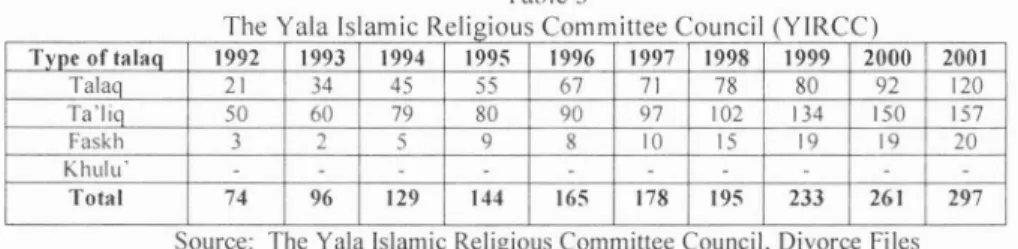
Statistics of various cases on m~III'imonial matters which have been decided by IRCC from 1992 to 200 I are shown if' rable 1,2 and 3 respectively.
27 This institution was formed in ;1( cordance with the Patronage of the Islamic Act of2488 B.E. (1945). When General Chalalit Yongchaiyudh becomes the Prime Minister, this act was replaced by the Royal Act COl1cerning the Administration of Islamic Organization 2540 B.E. (1997). Under this act, the Committee for the provincial Court for Islamic Affairs (PCIA) was formed to give advice and to aid the provincial governor in all matters relating to Islam.
28 In every province, there is one provincial Court. However, according to the hierarchy ofthe Court in Thailand, the provincial Court was called the Court of the First Instance. According to the Constitutional Court of Justice Act, article 14 (2) provides that the Provincial Courts have its jurisdiction according 10 the Act on establishing the provincial Court. Generally speaking, the Provincial Courts have the authority to hear and try the cases throughout the province.
29 Article 26 (II) of the Royal Act 1997 provides, inler alia, the provincial Islamic Religious Committee has the power to compromise disputes concerning family and inheritance according to Islamic rules when there is a request from the Muslims.
3D It is an Arabic word which means a religious ruling. Previously a fatwa in Thailand can be issued by the Islamic ReligioLis Council of the respective province but at present it can only be issued by the Shaykh aI-Islam (Chularajmontri).
31 See The Narathiwat Islamic Religious Council, requestingfatwas on lafaz cerai, Thursday 18th February, 1992.
The Position Of Islamic Law In The Four SOllthern Border Provinces Of Thailand
Table I
The Patani Islamic Religious Committee Council (PIRCC)
Type of talaq 1992 1993 1994 1995 1996 1997 1998 1999 2000 2001
Talaq 38 45 60 68 75 85 101 120 125 135
Ta'liq 84 80 63 89 97 93 131 118 120 130
Faskh - 2 - - 3 -
Khlllll' - - - - - - -
Total 122 125 125 157 172 178 232 241 245 265
Source: The Patanl Islamic ReligIOus COillillitlee: Matrimonial Files
Table 2
The Narathiwat Islamic Religious Committee Council (NIRCC) Type of ta laq 1992 1993 1994 1995 1996 1997 1998 1999 2000 2001
Talaq 45 60 79 84 97 103 120 128 130 150
Ta'liq 89 70 56 90 102 106 100 160 159 130
Faskh 6 7 10 9 13 10 17 12 IS 19
Khulu' I - - - - - - - -
Total 141 137 145 183 212 219 237 300 304 299
Source: The Narathlwat Islamic Religious COillillittee Council: Divorce Files
Table 3 e a a s amlc e IgIOuS
Th Y I I I " R I" C ommlttee C ounci "I (YIRCC)
Type of talaq 1992 1993 1994 1995 1996 1997 1998 1999 2000 2001
Talaq 21 34 45 55 67 71 78 80 92 120
Ta'liq 50 60 79 80 90 97 102 134 ISO 157
Faskh 3 2 5 9 8 10 IS 19 19 20
Khlllll' - - - - -
Total 74 96 129 144 165 178 195 233 261 297
" "
Source: The Yala Islamic Religious Committee Council, Divorce Files
In 1993, the Patani Islamic Religious Committee Council has recorded 80 people who filed the fa 'liq cases (conditional divorce) and in 2003, it went up to 130 people.
As forfaskh case (divorce at the instance ofa wife), 9 people filed faskh cases in 1999. Most ofthe matrimonial cases were filed in the NIRC. Beside the cases that were filed by the Muslims in the Narathiwat, there are also a number of matrimonial cases filed by Malaysian citizens ranging from ta1aq (divorce at the instance of a husband), fa 'llq (conditional divorce ),faskh (divorce at the instance of a wife) and khulu '(divorce by redemption), for they want to escape from unnecessary investigation and strict procedures.
The statistics given above showed that the PIRCC had already settled a large number of matrimonial cases. Thus, we can infer that the Muslims who went to the IRCC
Jurnal Syariah. 14:2 [2006} 1-21
were not merely to seek advice but also to seek legal solution regarding to the matrimonial disputes. Normally, the IRCC would assist the aggravated party and call the witnesses to confirm the allegation. However, before deciding on any cases, the IRCC often for practical purpose took on the role of bringing both parties involved to try to make peace (sulh) instead of seeking legal solution. All these took place even though the committee did not have power to take legal action in such cases.
However, by providing unofficial legal assistance, the IRCC was able to help in solving all those matrimonial disputes.
In the ta 'llq cases, when the complaint is filed, the IRCC would inquire into why the complaint was being made and whether the parties had taken the necessary step to bring about the reconciliation. This requirement is stipulated explicitly in the Qur'an (4: 35). In the case where the committee satisfied with the answers given by the wife, the committee shall ask her to fill a complaint in a letter of petition or claimant form provided by the committee.32 The committee shall serve a notice on the husband by stating the grounds of the ta 'lzq that "on a certain date his wife has made a complaint to the IRCC that the husband had deserted her for more than four months". In the event where the husband failed to appear before the IRCC, the committee shall presume that the husband has agreed with the wife's complaint. The committee will then fix the date for hearing, and the wife must produce before the committee two reliable witnesses who knew the circumstances of the case. After that the committee would ask the wife to take an oath. Once the oath had been recorded, the committee would issue the ta 'llq divorce certificate to the wife.33
Ln
the case of the desertion, the committee shall grant the di vorce to the wife according to the terms and conditions as stated in the marriage certificate as long as the wife's claims do not appear doubtful, otherwise the committee may dismiss such claims.The normal period of desertion which is fixed by the IRCC is six months; nevertheless if the wife can prove that the husband has deserted her for at least four months, the Committee will accept the claims. In the case of Norma Binti Abdullah v Omar Bin Haji Othman,34 after the claim was accepted, the committee found that the defendant
12 See Surat Pengaduan Ta '/iq (a letter of ta '/lq complaint).
JJ In this certificate, the committee shall state the divorce that has been affected based on the complaint received and the 'iddah commencement date.
The Position Of Islamic Lalli In The Four Southern Border Provinces Of Thailand
had deserted the plaintiff for 10 months beginning from 24th September, 1991. The defendant was, therefore, divorced with one (alaq.
Ill-treatment of plaintiffby the defendant could be a ground of divorce ta 'liq, as in the Ni-Nab Binti Tuan Muda v Daud Bin Samat. 35 The plaintiff made a report to the NIRCC that the defendant had slapped her face in front of her children on 18th June 1992. The defendant came to NIRCC and admitted that he had done so. The Committee, however, decided that the divorce would be dissolved based on ta 'llq agreement since the husband has breached the condition that had been given by him to his wife after a marriage contract had been concluded.
A husband is obliged to provide food, clothes and lodging. Ifhe fails, a wife may claim for the maintenance or ask the IRCC to dissolve her marriage. In A -edah Binti Abdul Karim v CikMamat Bin Safeh,36 the plaintiff asked the NIRCC to dissolve her marriage by faskh because the defendant had deserted her for a period of one year and six months. She told the Committee that her husband had failed to provide food and clothes for her. Furthermore, he had not paid a deferred dowry amounting 10,000 Baht. As a result, the committee ordered the marriage to be dissolved by faskh.37
Where constant quarrels occur, the committee shall advice the disputed parties to enter into the conciliation process. In Ramlah Haji Hamid vs. A bdul Rahman Bin Jali, 38 the plaintiff told the committee that she had been married with the defendant for four years with dowry of25,330.00 baht. After the marriage, the defendant has involved in gambling and has stolen her money amounting 7,000.00 baht.
The plaintiff asked the committee to dissolve the marriage. However, the defendant refused to divorce the plaintiff. Finally, the case was brought to the conciliatory committee which then advised the plaintiffto live with the defendant but the plaintiff
34 The Narathiwat Islamic Religious Committee Council, Ta' liq case, file no: 93/1992.
35 The Narathiwat Islamic Religious Committee Council, Ta'lJq case, file no: 48/1992.
36 The Narathiwat Islamic Religious Committee Council, Faskh case, file no: 80/1992.
37 The decision, as mentioned in the document, was made based on the jiqh book entitled Ghayat al-A(rah, page 28, chapter 5 on Faskh. However, the name of author of the book was not mentioned. See the Narathuwat Islamic Religious Council, Divorce byfaskh.
38 The Narathiwat Islamic religious Committee Council, Divorce by redemption, file no: 36/
1989
JlIrnal Syariah. 14:2 [2006} 1-21
still disagreed with the advice of the Conciliatory Committee (CC). The plaintiff later on sued the defendant for divorce by redemption (KhulU ') amounting 12,665 baht as proposed by the Cc. The plaintiff agreed to pay that amount on Thursday, 17th August, 1989 on the condition that the defendant must return her money of7,000 Baht. The defendant agreed and the Committee ordered the marriage to be dissolved by redemption as required by the plaintiff.
In Kiah Ahmad vs. Mat Jusah Abdullatif,39 the plaintiff in this case has made a report to the NIRCC that the defendant has beaten her, disallowed her to visit her relatives' house and failed to provide sufficient money to her. Therefore, the plaintiff asked the committee to dissolve her marriage by redemption with the amount of money 5,000 baht. Once the defendant has accepted it, then, the committee can order the marriage to be dissolved as requested by the plaintiff.
However, there are several instants where the Muslims had filed their cases directly to the Provincial court. As for the Data' Yuthitham, they felt strongly that the authority to decide matrimonial cases should still be with the Provincial courts since the government has appointed the Data' Yuthitham to hear and try the matrimonial cases in the four southern border provinces ofThailand.40 Thus, the Data' Yuthithams were of the opinion that the IRCC had no authority to deliberate on the matrimonial disputes ofthe Muslims in those four provinces.41
With regard to the Data' Yuthitham, there are no set of rules on how the Data . Yuthitham should decide on and advise in the matrimonial cases. In practice whenever a matrimonial case involving Muslims is filed in the Provincial Courts, the Court registrar will propose the case to the Data' Yuhitham who will then examine the facts of the case and send it to the Thai civil judge to be brought to the court for deliberation. The advice given by the Data' Yuthitham on Islamic law would cover and deal with all types of inheritance and divorce, i.e. (alaq ,ta 'llq ,faskh problems
39 Narathiwat Islamic religious Council, no citation.
40 Article 3 of Act on the application oflslamic Law in Patani, Narathiwat, Yala and Satul, Act of2486 B.E. (1946) which provides, infer alia. that the Data' Yuthitham shall have the right to apply Islamic law only
41 Interview with Dato' Ismail Che, Data' Yuthitham. at the Patani Provincial Court, on 25,h July, 1999.
The Position OJ Islamic Law In The Four Southern Border Provinces OJ Thailand
that have been put forward by the parties concerned. In giving advice, the Data' Yuthithams have always relied onjiqh books in their own collection as well as on the code of Family law and law of inheritance code of 1941. The Data' Yuthitham must rely on it as it is stated in the preamble of the codified code which reads:
This law (the code) was compiled in accordance with the Holy Qur'an and the Islamic religious books, therefore, when there were family and inheritance disputes the Data' Yuthitham must refer to it. If the code was silent, the Data' Yuthitham must refer to the Thai Civil and Commercial Law Code as well as the Thai Civil Procedure Code as long as it does not repudiate to the code. This is because both laws were supreme laws of the Country.
However, in practice, there were some cases where the Data' Yuthitham did not actually rely on the code in deciding the case as it has beenjustified in the case of Mari- Yea Tayi '@ Manea vs. Hama' Tayi. 42 The applicant in this case, Mrs. Mari- Yea had filed a suit against her husband by alleging that her husband has deserted her and her children for more than two years. The learned Data' Yuthitham ofthe Yala Provincial Court held that the applicant had a right to get her marriage dissolved in accordance with article 1516 (4) of the Thai Civil and Commercial Law Code 1935.43 In fact, the matrimonial cases filed in the Provincial court are not so many. A statistic from the survey revealed that from 1943 to 1947, there was no single matrimonial case filed at the provincial courts. However, in 1950, there were not more than five cases per year that had been decided by the Data' Yuthitham.44
42 Yala Provincial Court case, Civi I Suit No: 215/2544 B.E. (2001). See also a decided case of Miyea Yamthong@ Masamea v Asi Masamea, Patani provincial Court case, Civil Suit No:
185/2537 B.E. (1994).
43 It provides "if one spouse has deserted the other for more than one year or has fai led to give proper maintenance and support, the later may enter a claim for divorce".
44 See Arong Suthasasna (1987), "Shari'ah and Codification - Thailand Experience", Shariah Law Journal, pp. 142-143. See also Ahmad Omar Chapakia (200 I), "Peranan Ulama' Fatani Dalam Politik: Kajian Kes Haji Sulong Bin Abd. Kadir", paper presented in the Seminar Nadwah Ulama' Nusantara I, Kuala Lumpur, 19-20 May 2001, p. 2.
Jurnal Syariah. 14:2 [2006} 1-21
There were few reasons why Muslims were reluctant to file suit at the provincial courts. Firstly, no appeal is allowed since the decision of the Data' Yuthitham shall be fina1.45 In respect to that, criticism was made by the secretary of the Central Islamic Committee of Thailand as follows:
In fact a person who has been appointed as the Data' Yuthitham is only an ordinary person. Thus, in carrying out his duty as a judge, there shall be a mistake. If he decides the case wrongly, the plaintiff wi II be responsible and he wi II never be given the right to defend h is right.
Suppose, if this case is being tried in the ordinary court, the judge will surely allow the plaintiff to make an appeal, as such I think the right to make an appeal shall be given to the plaintiff if it is discovered that the decision of the Data 'Yuthitham is wrongly given. Thus, the justice is served to the plaintiff.46
Secondly, the Data' Yuthitham is not given the authority to decide the case but he is given the privilege to sit on the bench and give an advice on the Islamic law only.47 And lastly, the plaintiff has to incur excessive expenses in hiring lawyers. As for the IRCC, no such expenses are required.
Below is the statistics on the matrimonial cases filed in the Provincial Courts in the three border provinces of Thailand from 1992 to 2001. The result of decided cases in the three dominated Muslim provinces is shown in Table 4,5 and 6 respectively.
45 See article 4 clause 3 of the act on the application oflslamic law in Patani, Narathiwat, Yala, and Satul, Act of2489 B.E. (1946)
46 Khacat Phai Burut Phat (2SI9B.E.), Thai Muslim. Bangkok: Prea Pittaya, pp. 329-330.
47 See Section 4 of the act on the application of Islamic law in Patani, Narathiwat, Yala, and Satul, 2489 B.E. (1984).
The Position Of Islamic Law In The Four Southern Border Provinces Of Thailand
Table 4
The Yala Provincial Court (YPC)
Type of cases 1992 1993 1994 1995 1996 1997 1998 1999 2000 2001
Divorce case 5 7 12 IS 14 18 19 14 20 25
Inheritance 3 5 7 9 9 10 12 16 18 19
cases
Custody of 5 8 9 9 12 17 19 20 25 28
Child
Total 13 20 28 33 35 45 50 50 63 72
, -
Source: The ottlce Director, The Yala Provincial Court Table 5
The Narathiwat Provincial Court (NPC)
Type of cases 1992 1993 1994 1995 1996 1997 1998 1999 2000 2001
Divorce case 6 8 10 IS 16 19 25 27 30 35
I nheri tance 4 5 7 6 8 10 12 14 IS 16
cases
Custody of 4 5 7 9 10 12 II 12 10 14
Child
Total 14 18 24 30 34 41 48 53 55 65
Source: The office of the Court Director, The Narathlwat Provincial Court Table 6
The Pattani Provincial Court ( PPC )
Type of cases 1992 1993 1994 1995 1996 1997 1998 1999 2000 2001
Divorce case 5 8 II 10 12 14 18 19 20 21
Inheritance 2 5 6 7 8 10 II 13 14 16
cases
Custody of 4 6 8 9 9 12 16 17 19 19
Child
Total II 19 25 26 29 36 45 49 53 56
Source: The office of Court Director, The Pattanl Provincial Court
Based on the statistics, it is clearly demonstrated that the Provincial Courts of Narathiwat, Pattani and Yala solved lesser number of the matrimonial cases of the Muslims in the south as compared with the IRCC. It should also be pointed out that there was a strong tendency amongst the Muslims in the south to go to the IRCC to settle their marital disputes rather than to go to the Provincial Courts.
The matrimonial cases which are frequently decided by the Provincial Courts fall under the category of the divorce by desertion. It is observed that the provincial court is not consistent in applying the law, though it is the Dato ' Yuthitham
s
duty toapply Islamic law. The example can be seen in the case of Mariyea Tayi '@ Menea
Jurnal Syariah. 14:2 [2006J 1-21
vs. Hama Tayi '.48 In this case, the plaintiff requested her marriage to be dissolved by ta 'liq based on laft ta 'liq which is attached on the marriage certificate, issued by YIRCC. The wife then filed a suit at YPC by alleging that her husband had deserted her and her children for over two years. The learned Dato ' Yuthitham granted a divorce by relying section 1516 (3) of the Thai Civil and Commercial Law Code 1935 which stated to the effect that:
If a spouse has deserted the other for more than one year or has failed to give proper maintenance and support the later, she may enter a claim for divorce.
However, in Nuriyah vs. Ma 'ripeng Che Leh sease, 49 the learned Dato 'Yuthitham applied Islamic law as it was embodied in the code of the Muslim Family Law and the Law of Inheritance code 1941. In this case, the plaintiff, Miss Nuriyah, had applied to the Patani Provincial Court to confirm a ta1aq by fa 'llq under article 92 (4) ofthe Muslim Family Law and the Law ofInheritance Code 1941, by arguing that the husband had pronounced the conditional divorce or fa 'lfq and the defendant had failed to comply with it, by willfully deserting her for a period of six months.
Moreover, he had not given maintenance to the plaintiff and her children. The leamed Data' Yuthitham ofthe PPC advised the Thaijudge and stated that the plaintiff was entitled a divorce in accordance to the ta 'llq agreement which has been given before the imam. The coilli then ruled in favour of the plaintiff.
Whenever the husband has maintained or treated another woman as his wife, the plaintiff may file a petition for a divorce from her husband on the ground of shiqaq50
or disagreement. In Siti Nuriyah @ Sumaiyah Ma 'ding vs. Ibrahim Ma'ding,51 the learned Data' Yuhitham, Dato' Ni Wea Ali Ni Loh, who advised the case was of the opinion that since the defendant had maintained another woman as his wife, the plaintiff would enter a claim for divorce according to section 1516 (1) of the Thai
48 Yala Provincial Court, Civil Suit No: 215/200 I.
49 The Patani Provincial Court, Civil SuitNo: 787/1999.
50 The word shiqiiq is the Arabic word which means to break into two. The juristic meaning of shiqaq is discord and conflict between the spouses. Its principle is derived from the Holy Qur'an (4: 35).
51 The Narathiwat Provincial Court, Civil Suit No: 8/1997.
The Position OJ Islamic Law In The Four Southern Border Provinces OJ Thailand
Civil and the Commercial Law Code 1935,as grOlmds for a dissolution of the marriage.
The court then ruled in the favour of the plaintiff.
THE CONCILIATORY BODY
Both institutions, the Provincial Courts and the Provincial Islamic Religious Committee Council seemed to agree to establish the conciliatory body in order to prevent the marriage from breaking down and to maintain the relationship between the plaintiff and the defendant after the divorce had been granted. From its inception, the main task of the Provincial Islamic Religious Committee Council has been to compromise disputes concerning family and inheritance. This noble job was later on recognized by the Patronage ofIslamic Act of2488 B.E. (1945). This act which was renamed as the Royal Act Concerning the Administration ofIslamic Organization 2540 B.E.
(1945) provides that:
The Provincial Islamic Religious Committee has the power to compromise disputes concerning family and inheritance according to the Islamic rules2
It is observed that this act is silent about the appointment of the arbitrators, its qualifications and the procedures of handling the conciliation session. As a result, the IRCC has to adopt a conventional approach wherever the act is silent. In N arathiwat, for example, the normal practice is that when complaint was lodged, the IRCC shall direct the parties to enter for reconciliation before the conciliatory committee. If the Conciliatory Committee is unable to persuade the parties to resume marriage life together, the committee will ask the husband to pronounce the divorce.53 From this practice, it is observed that the appointment of Hakam or arbitrator is overlooked by the committee whereas the importance of /fakam is clearly mentioned in the Holy Qur'an.54
52 See Article 26 (II) of the Royal Act.
S] Ma-Useng Pador Kampong (1993), Peranan Majelis Ugama Islam Narathiwat Dalam Mengembangkan Islamiyah Di Propinsi Narathiwat Thailand Selatan. Unpublished M.A Thesis, Institute Agama Islam Negeri Sunan Kalijaga, Yogyakatya, Indonesia, p. 47. See also a decided case ofRahimah Haj i Hamid, Narathiwat Islamic Religious Committee Council, No. case: 36/2532 B.E. (1989).
54 See the Holy Qur'an (4: 35).
JurnalSyariah. 14:2 [2006} 1-21
Looking at the importance of this institution, the Ministry of Justice has issued the rule for the Administration of the Court of Justice in the matter of conciliation of the disputes B.E. 2544 (2001). According to this rule, the qualifications of the
arbitrator are as follows:
1. He must have a basic knowledge in Sciences, Economics and Law.
2. He must be 25 years old.
3. He must be morally excellent.
4. He must not become an incompetent person by the judgment of the court.
5. He has never been sentenced to be imprisonment unless in negligence cases. 55
The responsibility ofthe arbitrator is to reconcile and to compromise the disputed parties. 56 In exercising his duty, no coercion is allowed.57 This conciliation process is conducted before the case being brought to the court. If the arbitrator failed to reconcile or compromise, the arbitrator in charge will send a report to the court.
From the discussion above, it is noticed that both institutions are working hard to settle the matrimonial disputes through the conciliatory process in order to prevent from marriage breakdown. Whether or not this body can work effectively, it depends on the role played by the arbitrators during the conciliation session. As for the qualifications of the arbitrators that have been laid down in the rules, it seems that there is a possibility in reducing the numbers ofthe marriage breakdown in the four southern border provinces of Thailand.
CONCLUSION
From the above discussion, we can conclude that the Islamic law is considered as the law for the Muslims in Thailand. However, after 1902, the Islamic law was considered as the law for the Muslims in only certain provinces by virtue of many acts i. e. the Rule of Administration in the Seven Principalities of 1902, the Patronage
55 See No. 28 of the rules and regulation for the administration of the court of justice in the matter of the reconci liation of the disputes.
56 Ibid. Rule no. 32 (I) (2).
57 Ibid. Rule no. 32 (3).
The Position OJ Islamic Lalli In The Foul' Southern Border Provinces OJ Thailand
ofIslamicAct of 1945, and the Application of the Islamic Law in Patani, Narathiwat, Yala and Satul Act of 1946. In other words, the Muslims in Thailand are governed by two different sets oflaws - one is the Islamic law and the other is the secular law.
With regard to the Islamic law, it was administered by two different institutions, the provincial courts and the Islamic Religious Councils. In fact, the Muslims are in a complex position, that is when they want to apply the Islamic law especially in settling their matrimonial disputes, they always confused as to whether to rely on the state law or the Islamic law. As for the latter, the decision depends on the Data' Yuthithams whereby their decision is absolute and no appeal is allowed. Meanwhile the decision of the former depends on the Thai civil judges. As a result, the decision given is totally different from that of the Thai civil judges since they applies the Thai civil law code though they are assisted by the Data' Yuthithams. This problem, from our points of view, can be solved through the establishment of the Shari 'ah Court and the upgrading of the position of the Islamic law in the Thai legal system.