It will use farmers, farmers' organizations and research institutions, especially the State Colleges and Universities, in carrying out research for the use of the Ministry and its clients, especially the farmers/fishermen and other rural workers.”. Results of evaluation of collected FGRGs in the Philippines against major insect pests 426 and diseases, 2019 Wet Season. Philippine Seed Board (PSB) - now the National Seed Industry 459 Council (NSIC) registered rice varieties in the Philippines from 1990 to 2022.
In the Philippines, farmers select, plant and maintain their own rice lines/varieties that thrive in their areas. Farmers' preference for indigenous varieties is influenced by their own cultural and management practices and selection criteria, such as resistance to certain pests and diseases, eating quality and easy availability of such materials in the locality. Rice Lines in Irrigated and Rainfed Lowland Areas of the Philippines", which explored, collected and evaluated farmers' rice lines/varieties in irrigated and rainfed areas of the country for selection, phenotypic evaluation and genetic characterization.
Message
Acknowledgment
Executive Summary
1 CHAPTER Rice Farming, Variety Improvement, Research, and Development in the
The Philippines is the ninth largest rice producer in the world, accounting for 2.8% of global rice production. Collaboration continues with major agencies of the Ministry of Agriculture as well as state universities and colleges to address issues and concerns in rice production in the country. These should be part of the mainstream of agriculture in the Philippines, and should be instituted by the farmers themselves.
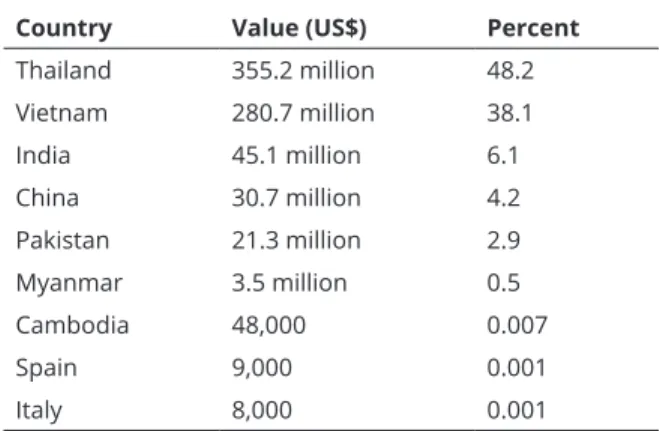
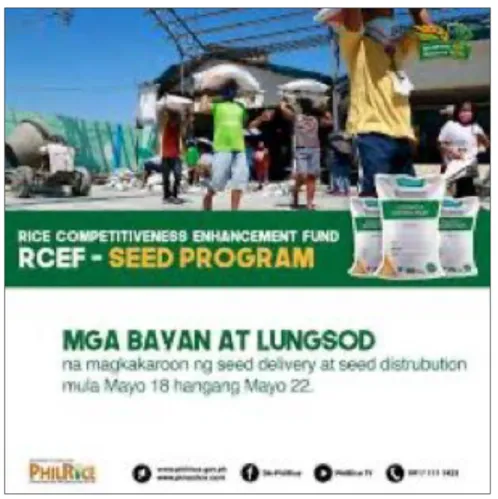
Looking at this data alone, it can be assumed that the Philippines is one of the importing countries in the world. With the continued strong support from the local government units (LGUs), it is expected that seed deliveries will be improved in the coming planting seasons. It is hoped that the local rice industry will become favorable for growth and development for future generations in the coming decades.
The training aims to develop farmers' diagnostic and technical skills in managing their farms and integrating new techniques into rice production practices. DA-PhilRice (2020) reported that in addition to these training programs, RCEF-RESP (Rice Extension Services Program) also distributed production guides to farmer beneficiaries. About 400,000 farmers have already received the guide on modern rice farming during seed distribution activities.
In June 2020, under the extension program of RCEF, DA-PhilRice distributed the pamphlet "Gabay sa Makabagong Pagpalayan" along with seeds given to the farmers. This system is a dynamic set of rice crop management practices that guides farmers and agricultural workers in rice production by providing key control elements. Several versions of the booklet explaining the concepts, principles and key controls have already been published in different local languages.
2 CHAPTER Farmer-Grown Rice Genotypes Collected in Different Regions
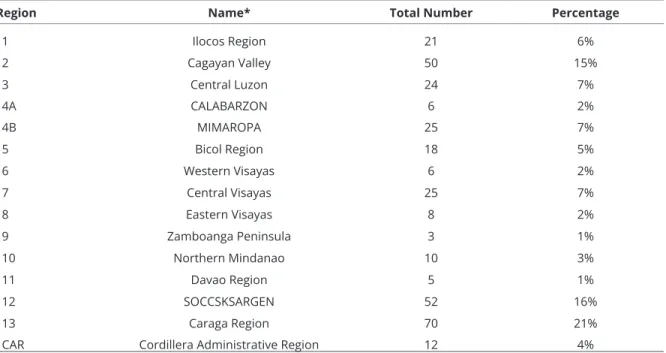
Most of the FGRG was collected in farmers' fields, cooperatives and seed growers in close collaboration with partner local government units (LGU) at the regional, provincial, municipal and barangay levels. It is noted that most of the FGRG collected in Caraga came from one farmer (82%). Among the limitations of the project is the zero collection of the Autonomous Region of Bangsamoro in Muslim Mindanao (BARMM) and the National Capital Region (NCR) (table 2).
Further analysis as presented in the other chapters will focus on the similarities and differences between the entries. Some of the rice genotypes were selections from existing released varieties and were essentially derived varieties (EDV), while others were released varieties that were uniquely named for marketability. The Batac branch, Dryland Agriculture Research Center of PhilRice, collected and documented FGRG in the irrigated and rainfed lowland areas of the five provinces it covers (Ilocos Norte, Ilocos Sur and La Union in Region 1; and Apayao and Abra in the Cordillera.

FGRGs collected from Cordillera and Ilocos Regions
Eight genotypes of Ilocos Norte emerged from the irrigated rice ecosystem; seven from Ilocos Sur; and six each from Apayao, Abra and La Union. Cagayan Valley is the Philippines' second largest rice-producing region in terms of planted and harvested area. It is bordered by the Pacific Ocean to the east, by Nueva Ecija to the south, by Quezon to the southeast, and the Caraballo and Cordillera mountain ranges to the west.
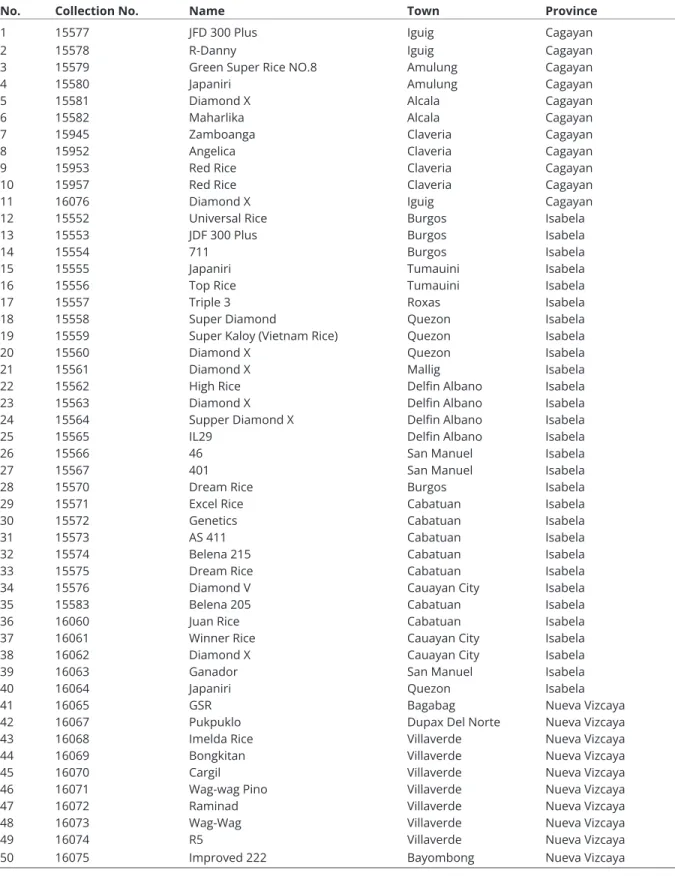
Its Cagayan River is the country's longest river with a drainage area of approximately 27,000 square kilometers (www.region02.nia.gov. ph), and serves as the main source of irrigation for 177,069 ha of rice fields (www.region02.nia.gov .ph). It has a type 2 climate with two seasons - the wet from May to October and the dry from November to April. Fifty FGRG were collected in three provinces as shown in Table 4: 29 from Isabela, 11 from Cagayan and 10 from Nueva Vizcaya.

FGRGs collected from Cagayan Valley (Region 2)
The majority of FGRG users were identified to be from Isabela, with 68% of the total from Region 2. The high number is associated with the large area planted to rice and the large number of seed growers producing and sellers , which distributes FGRG in the province. Central Luzon, the top rice-producing region and dubbed the "Rice Granary of the Philippines," consists of seven provinces: Aurora, Bataan, Bulacan, Nueva Ecija, Pampanga, Tarlac, and Zambales.
It is expected that most farmers in this region would adopt proven rice technologies that include the use of certified seeds that have passed through the official seed system by the National Seed Industry Council. Despite the presence and active technological promotion and dissemination of DA-PhilRice in the region, unregistered rice varieties or FGRGs are proliferating. This may be due to the small number of seed growers in these provinces and stronger promotion of different popular seeds.
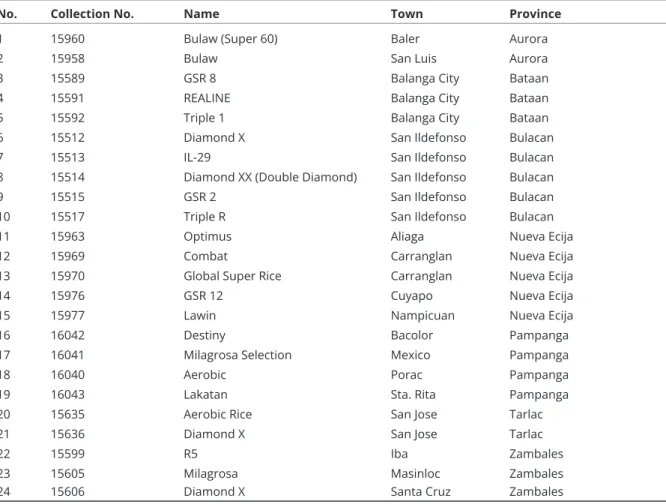
FGRGs collected from Central Luzon (Region 3)
The collection of FGRGs from June 2016 to March 2018 began in close collaboration with the provinces, municipalities and barangays in the DA-PhilRice area of responsibility. A total of 24 FGRGs were collected in irrigated areas, mostly from Bulacan (22%) and Nueva Ecija (22%); Aurora and Tarlac had at least 9% each. Most of these FGRGs were used only for second cropping in one to two season plantations (Table 5).
CALABARZON consists of five provinces: Cavite, Laguna, Batangas, Rizal and Quezon with a total rice area of 32,661 ha. MIMAROPA also has five provinces: Oriental/Occidental Mindoro, Marinduque, Romblon and Palawan with a total rice area of 31,521 ha (PSA, 2017). The collection for Region 4A did not represent all provinces, as areas far from seed producers and areas with expected higher FGRG were prioritized (Table 6).
FGRGs collected from
CALABARZON (Region 4A) and MIMAROPA (Region 4B)
The Bicol region consists of six provinces: Albay, Camarines Norte/Sur, Sorsogon, Catanduanes, and Masbate with a total rice area of 123,629 ha (PSA, 2017). Eastern Visayas comprises the island of Samar (Northern, Western and Eastern Samar); Leyte Island (Leyte and Southern Leyte); and the island province of Biliran with a total rice area of 100,940 ha. The activities were fully coordinated with the offices of the provincial, municipal or city farmer in the area.
The municipal farmers helped identify the barangays and farmers from whom collection was advisable. A total of 18 FGRG were collected from five towns in Camarines Sur (50%), one town in Sorsogon (22%), and three municipalities in Albay. Eight FGRG were collected from three municipalities and one city in Samar (6) and one city in Leyte (2) (Table 7).

FGRGs collected from Bicol Region (Region 5) and Eastern Visayas
Collections were conducted in three provinces in Region 5 and two provinces in Region 8 from November 2016 to March 2018.
Region 8)
Rainfed and irrigated rice areas in both regions include mountainous, sloping, undulating and flat lands in remote and urban communities. FGRG was mostly collected from the rainfed and irrigated rice ecosystems of Negros Occidental/Oriental, and Bohol. Twenty-five FGRG came from Central Visayas, and six from Western Visayas, especially in Negros Occidental's Bago City (2), San Carlos City (1), Ilog (2), and Cauayan (1).
Negros Oriental had the most FGRG (83%); Bohol (4%) had the least, specifically in Batuan, Bilar and Dagohoy.

FGRGs Collected from Western Visayas (Region 6) and Central
The collected FGRGs indicate the extent of use and promotion of certified rice seeds in the areas.

FGRGs collected from Zamboanga Peninsula (Region 9) and
SOCCSKSARGEN (Region 12)
Adu dagiti mabigbigbig nga agmulmula iti bukel nga aktibo kadagiti kangrunaan a probinsia ti pagay ti Mindanao (Bukidnon, Agusan Del Sur, Surigao Del Sur, Davao De Oro ken Davao Del Norte). Ti Santa Josefa (70%) idiay Agusan Del Sur ket addaan idi ti kaaduan nga FGRG kadagiti amin a siudad ken probinsia kadagiti tallo a rehion. Dagiti lima nga FGRG ti Davao Region ket taga-Davao De Oro, Davao Del Norte ken Davao Del Sur.
In Agusan Del Norte, where PhilRice Agusan is located, only two FGRGs were collected from RT Romualdez. Three towns in Agusan Del Sur contributed the most FGRG: Prosperidad (3), Santa Josefa (57) and Bunuan (2). Most of the FGRGs collected in the Caraga region came from a farmer-scientist engaged in organic farming and breeding.
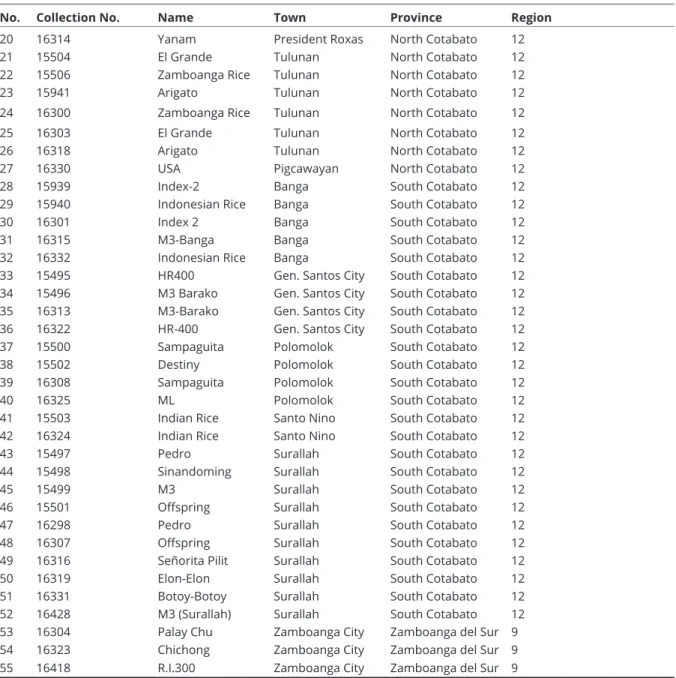
FGRGs collected from Northern Mindanao (Region 10), Davao (Region 11), and
Most farmers in Davao De Oro are far from seed growers and traders therefore dictated which varieties to plant and where to get them (Table 10).
Caraga (Region 13)
Most of the rice genotypes were grown in an irrigated lowland ecosystem with two seasons, dry and wet (http://duckduckbro. com/2018/07/planting-calendar-for-the-philippines/). About 8% of the farmer-sources of rice genotypes chose this trait as the main reason for choosing a particular FGRG. Branding and name play in rice genotypes People have been proven to believe in the power of popularity.
Most often, products that are sold in the market or anywhere else focus on marketing. In analyzing the naming of FGRGs collected in farmers' fields, at least four main categories are observed: recorded as rice, folk names, name of person or place, and special features. Another way to name FGRG is to use the name of a person or place that is typical of the traditional rice varieties stored in the DA-PhilRice Genebank.

CONCLUSION
Isabela, Nueva Vizcaya, daya a paset ti Probinsia ti Bantay, abagatan a Quezon, Peninsula Bondoc, Masbate, Romblon, amianan a daya a Panay, daya a Negros, tengnga ken abagatan a Cebu, paset ti amianan a Mindanao, ken kaaduan iti daya a Palawan. Dagiti lugar a masakupan ket ti Batanes, amianan a daya a Luzon, akindaya a Camarines Norte ken Camarines Sur, Albay, daya a Mindoro, Marinduque, akinlaud a Leyte, amianan a Negros, ken kaaduan ti tengnga, daya, ken abagatan a Mindanao. Ti kaadda dagiti barayti ti pagay a nasirib ken naandur iti klima ti maysa kadagiti kangrunaan a makatulong a mangdaer iti panagbalbaliw ti klima.
Unfortunately, farmers did not receive sufficient support for the use of FGRG, which could have been different if they had used climate-smart released varieties. This naming trend could indicate that these rice genotypes are either equal to or better than their counterparts. Another type of naming is the use of popular names that depict a vision of the implication of using these FGRG, such as: MASIGASIG 88 (high performance);.
RECOMMENDATIONS
FGRG COLLECTIONS FROM CORDILLERA AND REGION 1
FGRG COLLECTIONS FROM REGION 2
FGRG COLLECTIONS FROM REGION 3
FGRG COLLECTIONS FROM REGIONS 4A AND 4B
FGRG COLLECTIONS FROM REGIONS 5 AND 8
![Figure 2. Palay production, harvest area, and yield in 2016-2018 (Philippine Statistics Authority [PSA] Report, June 2019).](https://thumb-ap.123doks.com/thumbv2/filepdforg/10973535.0/16.918.91.744.607.955/figure-palay-production-harvest-philippine-statistics-authority-report.webp)