This paper examines the ongoing growth of modern retail formats as driven by supply and demand conditions. The increase in the share of the food category in retail sales for the leading grocers is also predicted for 2011. In fact, high underemployment rate in the country led to the beginning of the informal sector and its increasing share in the labor force (NAPC) , 2002).
This sector in which micro and small industries flourish includes the informal sector of the 'underground economy'. This sector contributed 30%. The availability of credit card facilities in modern retail also improves consumer purchasing power. Malling, coupled with the increasing purchasing power of the Filipinos, has been a factor in the establishment of modern shopping channels in malls.

Supply Conditions
These retail channels also address the demand of the consumers for food variety in a clean environment. Expansion of the large retailers in the country was possible because of the relatively low cost of occupying space. In Makati Central Business District, the monthly rental rate per square meter is USD26 as of the first quarter of 2007.
The increase in rental rates in the country is also one of the lowest in the region at an average of 1.55% in prime areas. By using the best available technology, they can also lower their transaction costs. In fact, most of the supermarkets in the Philippines have installed point of sale (POS) scanner systems.
One of the main advantages in installing an embedded computer system in retail is guaranteed shelf availability. Most consumers choose to purchase food items elsewhere in the event of unavailability rather than purchasing substitute products (ECR, 2005). The outcome of the study was evaluated and several measures were implemented to address the issues arising from the study.
Furthermore, the considered retailer's market share should be significant in order to obtain relevant information for market analysis. The use of the integrated computer system is only one of the issues that this organization discusses and improves.
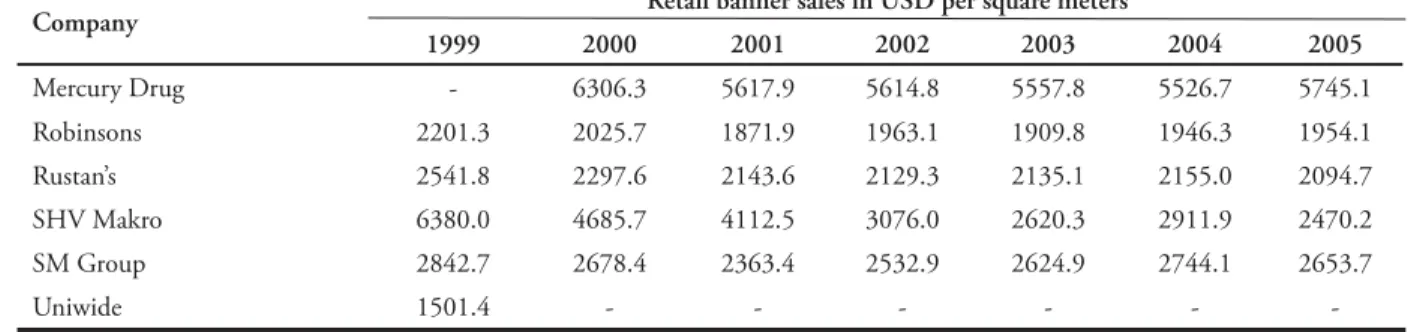
Some of the conditions of RA 8762 which are considered restrictive by some investors may be the reasons for the lack of foreign sellers in the Philippine market. There is no minimum capital requirement in Singapore and Hong Kong, while capitalization in Th Ailand is 10 times lower than that of the Philippines. There are other items in RA 8762 which may also affect the decision of foreign sellers to invest in the country.
However, foreign retailers (category D) specializing in high-end or luxury products are allowed to own 100% of the company if they meet the minimum requirement of USD 250,000. Other qualifications are the foreign investor's 5-year retail history and declared reciprocity of rights with the country where the retailer is incorporated. The result of the survey conducted by the Gallup Organization in April 2002 for the members of the American Chamber of Commerce showed that 92% were dissatisfied or extremely dissatisfied with the level of corruption in the country.
The USAID-funded survey of domestic and foreign-invested entities indicates the prevalence of corruption. High security costs are incurred, as wayward shoppers are only apprehended once they have left the store's premises. In addition, most large retailers have built a joint business venture with the foreign retailers to handle the expected entry of the foreign retailers (DFAT, 2002).
China is the largest global producer of FFVs, producing 50% of the world's vegetables and 16% of fruits. Efficiency is seen to increase as the purchasing power of the company is strengthened.
Change in the Procurement System of the Modern Retail Formats
In inbound logistics alone, 72% of suppliers to the companies surveyed comply with the companies' quality program standards. Furthermore, 75% of companies place more importance on the assessment of the quality of raw materials and intermediate goods compared to the other materials (SGV, 2001). Standards imposed by the retailers have presented the small producers with a great challenge (Boselie et al., 2003; cited in Concepcion et al., 2006).
Along with this, long-term relationship partnerships have become crucial to meet the non-price demands, as effective communication is needed (Concepcion et al., 2006). To be competitive in the retail industry, they dealt with few suppliers to minimize transaction costs (Digal et al., 2004). These suppliers are given the assurance that all the necessary fruit and vegetables will be purchased from them (Concepcion et al., 2006).
Gomez Farms, one of the major market specialists, supplies almost all the major supermarket chains in the country. This farm has an advantage over the other competitors as it can be sourced from its own farm and from other sources such as vegetable consolidators, domestic suppliers and importers (Concepcion et al., 2006). The supermarket suppliers ensure that they supply all the fresh produce requirements of the supermarket chains.
Supermarkets set higher standards for their FFV suppliers to ensure product quality on the shelves. Trust is necessary as prices in commodity markets are highly volatile and player sizes vary.
Eff ects of the Change in Procurement System to the Upstream Level
An example is that of Makro, which practices regional purchases for other stores in the country. Among these changes is also included the decrease in the volume of FFVs sold in the mentioned markets. A staff at the market shared that even if he works for the said market, he buys FFV from Puregold.
The situation in the traditional wholesale market is exacerbated when various traders in the major markets engage in unfair practices such as involvement in collusion or cartel (Manila Bulletin, 2006). As of May 2008, there are 77 of these bagsakan in the Philippines; 33 of them are in Metro Manila and the remaining 44 in the other regions. There is no conclusive evidence pointing to its role in improving the traditional market.
Another initiative of the government is to help and encourage players in the traditional market to improve the efficiency and physical facilities of their markets is to provide Model awards with monetary equivalents for both public and private markets ("Model markets", 2005) . Since statistics show that the average farm size (from 3.6 ha in 1971 to 2.2 ha in 2002) in the Philippines is becoming smaller, small-scale farmers are adversely affected by the change in the procurement system. In the cluster, there is the exchange of technology and market information among the cluster members.
Those farmers who are willing to commit to consistent delivery and quality commodities and investment in specific assets are able to participate in the supply chain. However, some of the benefits can only be availed through membership, such as consistent access to the market, use of facilities and technical assistance (Concepcion et al., 2006).

Conclusions
It serves as a channel not only for agricultural products but also for non-agricultural items. It requires members to be eligible for a production plan, which is a very new concept for most farmers. Those who were not willing to commit to a certain volume of production at a certain time were expelled from the association.
The excluded farmers, by choice or lack of financial resources, sell their products on spot markets. They remain price takers, while wholesalers and retailers, who have better information, benefit from this arrangement. However, it is suspected that the restrictions in RA 8762 are the reasons for the non-participation of foreign retailers in the country.
It was also speculated that the established vendors were able to maintain their dominance through modernization, expansion and widening of product lines through importation. These supply and demand conditions, along with government intervention, affect the structure and behavior of firms in the marketplace. Modern retailers have established business relationships with cooperatives that include small-scale farmers as they dominate the agricultural sector.
To help these marginalized farmers, the government continued with initiatives such as the construction of baranggay bagsakan stations to promote traditional markets as “model markets”. This could only partially address the concerns faced by these farmers. It is important that the government mitigates the impact of the change in the public procurement system on farmers with appropriate policies.
Paper presented at the Annual Pacific Food System Outlook Meeting of the Pacific Economic Cooperation Council (PECC), Kunming, China, 11–13 May 2005. Changes in the organization of food marketing systems in Southeast Asia: A preliminary assessment . Paper presented at the 18th Industrial Marketing and Purchasing (IMP) Conference, Curtin University of Technology, Perth, Australia, 2002.
Governing Markets: Keys to Smallholder Inclusion in the Dynamic Vegetable Market: The Case of NorminVeggies in the Philippines. Governing Markets: Ensuring Small Producer Participation in Restructured National and Regional Agri-Food Systems: The Case of the Philippines. Growth in high-value agriculture in Asia and the emergence of vertical linkages with farmers.
Contribution to the workshop "Connecting small producers with markets: old and new challenges." Consumer advocacy, food safety and the environment in a developing tropical economy: The case of the Philippines. Retail explosion: The retail industry may just be the next driver of economic growth in the country.