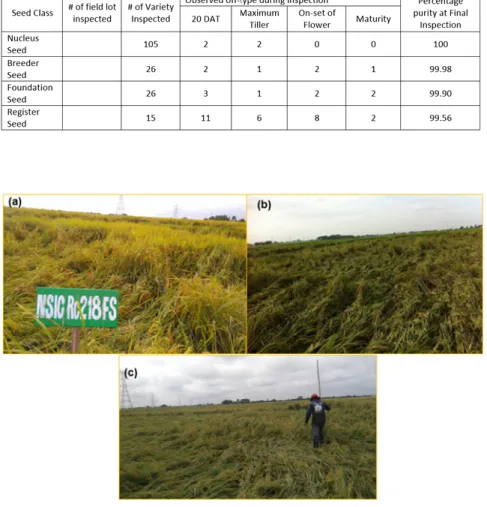
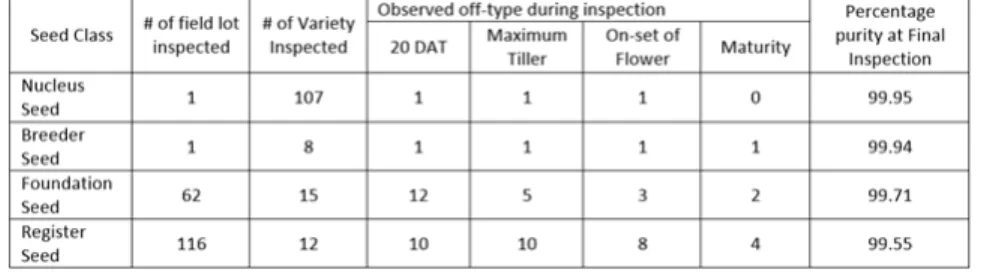
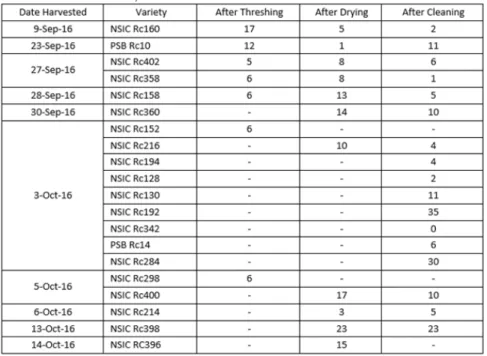
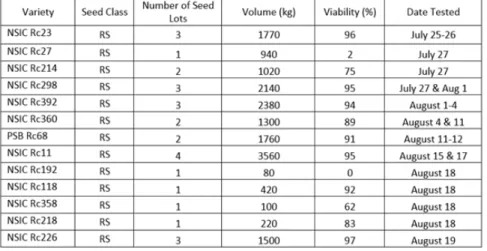
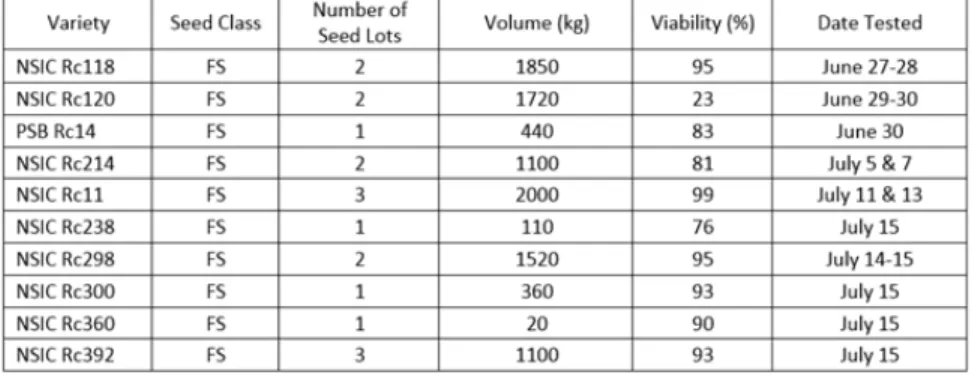
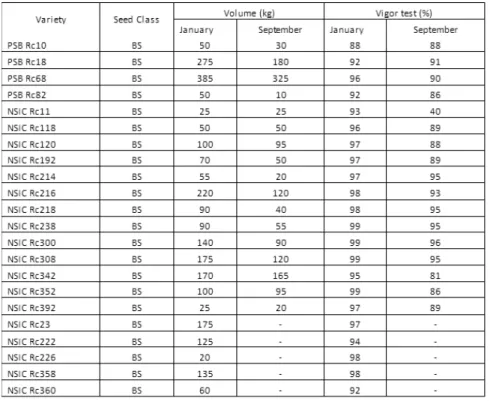
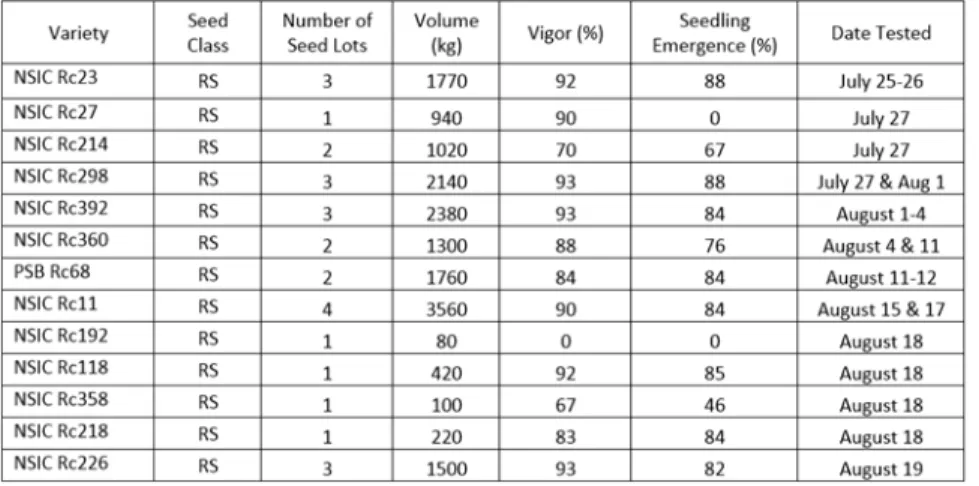
Despite the high percentage of purity in the country at the final inspection, all post-harvest operations must be done properly to ensure a high percentage of passage of the seed lots produced during seed certification by BPI-NSQCS. The purity of the seed produced is done in the field before harvest through field inspection and after harvest, specifically after threshing, drying and seed cleaning. Varietal purity testing is done regularly to assure customers of the high quality seeds upon purchase.
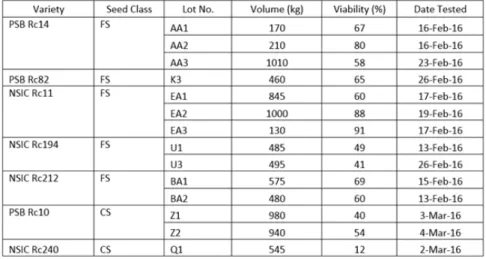
The seedling emergence test was also conducted to evaluate the performance of the varieties when planted in soil. The results show that there is a decrease in germination percentage when tested in the real field environment (Table 18). The growth test (GOT) is one of the methods for assessing the genetic purity of crops.
Twenty-two of twenty-seven of the total seed sets tested had genetic purity of 97% or higher. The genetic purity of PRUP TG102 seed sets tested in the DS2016 GOT exceeded the required genetic purity (Table 20). From the GOT of the parental lines tested, 25 seed sets had seed genetic purity of 97% or higher.
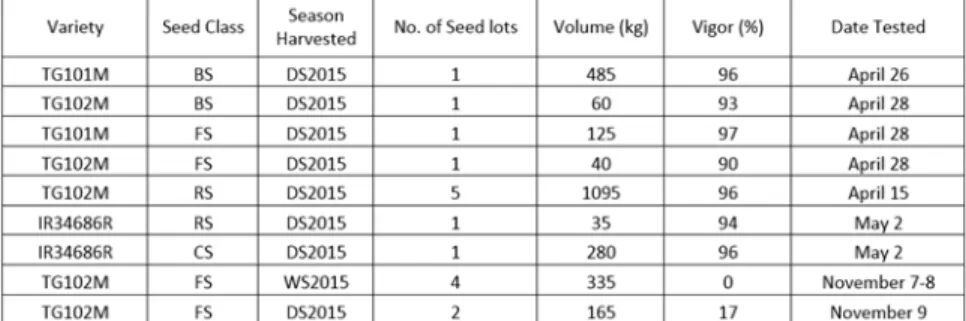
Based on the results of the grow-out test conducted in WS2016, PRUP TG102 seed lots (DSB P1 – P5) produced in Negros were found to be problematic seed lots.

Development/Improvement of pre-harvest and post- harvest technologies for commercial seed production
After one year of observation, hybrid seed production in the wet season produced higher seed set than the dry season, given the larger area used in the wet season (25 m2) than in the dry season (5 m2). A greater number of pollen grains attached to the stigma was observed in plots treated with GA3+Gly+BA+MeJa. Here we review the field, paying attention to previous approaches, but emphasizing recent developments in the search for new management strategies to increase the production of hybrid seeds with practical applications in the field of researchers and farmers.
Increased seed yield in SxP seed production of NSIC Rc202H (Mestizo 19) by increasing pollen parent plant density. A seed yield of at least 1 t/ha is considered to be the threshold of profitability in Philippine hybrid seed production. Currently, the ratio of lines in S x P seed production is 3:10 with only three pollen donor lines potentially pollinating 10 lines of TGMS lines (S lines) resulting in a large number of unpollinated S lines.
Therefore, this study aims to increase the percentage of seed set by increasing the population density of the pollen source and reducing the number of S-line rows. Control plots were established in parallel with S x P seed production to determine the possibility of self-pollination in S lines. Yield and yield components were obtained from S-line rows, while only yield component data were collected for P-line.
Analysis of variance and mean comparison for significant difference for grain yield and yield component was done using Statistical Tool for Agricultural Research (STAR). The highest grain yield in rows was observed in 3:6 and 3:8, which may be attributed to the ability of pollen from the rows of the P line to saturate the rows of the S line less, thus increasing the percentage of pollination of S-line flowers resulting in increased seed set or spikelet fertility. Seed placement of S-line rows is highly correlated with grain yield, so the higher the seed placement, the higher the grain yield of S-lines.
Apparently, S lines adjacent to P rows tend to have higher seed set than rows towards the inner rows regardless of the row ratio (Figure 14). Grain yield response of different S:P row ratios with mean comparison using Duncan's Multiple Range Test (DMRT). Seeding of M19 S x P with different S:P row ratios with plant spacing of 15x15 between rows for both S lines and P lines.

Hybrid Basic Seed Production and hybrid seed research
Determining the best location and optimal time of year/season for seed production and quality. In Davao del Sur, 0.2 ha were planted to produce S x P NSIC Rc446H seeds under protocol number 1 where. Based on the participant's observations, S x P seed production in Davao del Sur can only be done in the wet season because long cold spells occur during the dry season.
Flowering behavior and seed production performance of hybrid parental lines at different locations and seasons. Despite the many public hybrids released by NSIC, only the parental NSIC Rc446H lines were planted in S x P seed production at five locations. The average yield for the A x B seed production plots was 700 to 900 kg/ha during the dry season.
Breeding seed production for the S line of Mestiso 20, PRUP TG102 was undertaken at the MFE site in Benguet. S line foundation seed requirements for nationwide SxP seed production were produced under group management. As of July 11, 2016, a total of 75 kg of reproductive seeds of PRUP TG102 (Mestiso 20) were sent to PhilRice stations in Isabela, Negros and CMU for foundation seed production.
Drawing up a control plot (CP) is an additional function in the seed certification of TGMS SXP's hybrid seed production. A 0.25 ha SXP seed production plot of Mestiso 19 was established in the field following the standard protocol for TGMS hybrid seed production. For the dry season, only the seed production plot of Mestiso 19 (PRUP TG101xTG101M) was planted due to area and insulation limitations.
Pollen harvesting and storage strategies to increase pollination and yield in hybrid seed production of Mestiso 19. This study will develop a simple procedure for pollen collection, dehydration and long-term storage to increase the efficiency of hybrid seed production. Further optimization procedures in both collection time and storage conditions need to be performed in replicates for another season to determine the most efficient method of pollen harvesting important for hybrid seed production.

Figure 16. Pollen viability (A) and germination rate ( as affected by different media and time of collection
NCT - National Cooperative Testing NFA - National Food Authority NGO - Non-Governmental Organization NE - Natural Enemies. RQCS - Rice Quality Grading Software RS4D - Rice Science for Development RSO - Rice Sufficiency Officer RFL - Rainfed RTV - Tungro Rice Virus. Field purity assessment of cultivar seed produced by BDO and PBBD in different seed classes during the 2016 WS inspection.
Seed unit assessments of PRUP TG102 seed lots produced in DS2016 using the SSR marker RM127. Seed unit assessments of PRUP TG101 seed lots produced in DS2016 using the SSR marker RM127. Seed unit assessment of PRUP TG102 seed lots produced in DS2016 using the SSR marker RM127, RM1 and RM511 previously identified as informative markers.
Pollen survival (A), germination rate (B) and tube length (C) as affected by different media and collection time.