NISIT PONGSTABHON
A THEMATIC PAPER SUBMITTED IN PARTIAL FULFILLMENT OF THE REQUIREMENTS FOR THE DEGREE OF MASTER OF MANAGEMENT
COLLEGE OF MANAGEMENT MAHIDOL UNIVERSITY
2019
COPYRIGHT OF MAHIDOL UNIVERSITY
Thematic paper entitled
HONEYBEE SUSTAINABLE LEADERSHIP:
A CASE STUDY IN AUTOMOTIVE TIRE INDUSTRY was submitted to the College of Management, Mahidol University
for the degree of Master of Management on
January 12, 2019
……….….…..………
Assoc . Prof . Sooksan Kantabutra, Ph . D .
Advisor
……….….…..………
Duangporn Arbhasil, Ph . D .
Dean
College of Management Mahidol University
……….………….…..………
Mr. Nisit Pongstabhon Candidate
……….
Assoc. Prof. Vichita Ractham, Ph.D.
Chairperson
……….….…..………
Asst. Prof. Decha Dechawatanapaisal, Ph.D.
Committee member
ACKNOWLEDGEMENTS
First of all, I would like to express my gratitude for my thematic paper advisor, Assoc. Prof. Sooksan Kantabutra, Ph.D. for his dedication and support throughout my research and completion of this thematic paper and the introduction to important frameworks. Therefore, the paper would not be completed without Assoc.
Prof. Sooksan Kantabutra as my advisor.
Moreover, I would like to express my thanks to every participant evolved in the interview and pretests.
And lastly, I would like to thank you my family for supportive actions and encouragement.
Nisit Pongstabhon
HONEYBEE SUSTAINABLE LEADERSHIP:
A CASE STUDY IN AUTOMOTIVE TIRE INDUSTRY NISIT PONGSTABHON 5949153
M.M. (MARKETING AND MANAGEMENT)
THEMATIC PAPER ADVISORY COMMITTEE: ASSOC. PROF. SOOKSAN KANTABUTRA, Ph.D., ASSOC. PROF. VICHITA RACTHAM, Ph.D., ASST.
PROF. DECHA DECHAWATANAPAISAL, Ph.D.
ABSTRACT
The purpose of this study is to find out the hypothesis of how the firm in automotive tire industry is doing in terms of sustainable leadership. The hypotheses were test by interview and data collection from 15 stakeholders of the company by using questionnaire derived from 23 elements of Honeybee framework.
The result of the study found 10 elements that is considered as opposite to Honeybee approach and provided recommendation in the conclusion part.
KEY WORDS: Honeybee/Sustainable leadership/Automotive Tire
66 pages
CONTENTS
Page
ACKNOWLEDGEMENTS ii
ABSTRACT iii
LIST OF TABLES vi
LIST OF FIGURES vii
CHAPTER I INTRODUCTION 1
1.1 Problem Statement 1
1.2 Overview of Thailand automotive tire market 1
1.3 The differences of top three western tire brands 2
1.4 Market disruptions and changes in 2018: Automotive tire business 3
1.5 Giants companies who have trouble with change 4
CHAPTER II LITERATURE REVIEW 6
2.1 Anglo/US vs Rhineland Capitalism 6
2.2 What is Sustainable Leadership? 8
2.3 Sustainable Leadership: Locust vs Honeybee Approaches 8
2.3.1 Principle 1: Taking a long-term perspective 10
2.3.2 Principle 2: Investing in people 10
2.3.3 Principle 3: Adapting the organizational culture 10
2.3.4 Principle 4: Being innovative 11
2.3.5 Principle 5: Exhibiting social and environmental 11
responsibility 2.3.6 Principle 6: Behaving ethically 11
2.4 The objective of the study 14
2.5 Research questions 14
CHAPTER III METHODOLOGY 15
3.1 Research Design – Structured, Personal Interview 15
3.2 Sampling method 16
3.3 Research instruments 17
3.4 Method of data collection 17
CONTENTS (cont.)
Page
3.5 Ensuring data validity 18
3.6 Research reliability and limitation 18
CHAPTER IV FINDINGS DISSCUSSION 20
4.1 The Interview 20
4.2 Demographic of interviewee 20
4.3 Using Honeybee Sustainable Leadership framework 21
to analyze findings 4.3.1 Principle 1: Long-term perspective 22
4.3.2 Principle 2: Staff development 24
4.3.3 Principle 3: Organizational culture 26
4.3.4 Principle 4: Innovation 27
4.3.5 Principle 5: Social responsibility 28
4.3.6 Principle 6: Ethical behavior 29
4.4 Benefit from Honeybee 23 elements / 6 components analysis 30
4.4.1 Least Evident 30
4.4.2 Moderately Evident 30
4.5 24th question – The extra question 31
CHAPTER V RECOMMENDATION AND CONCLUSION 32
5.1 Recommendation 32
5.2 Conclusion 33
REFERENCES 35
APPENDICES 37
Appendix A: Interview Questions 38
Appendix B: List and details of sample 40
Appendix C: Interview Result 41
Appendix D: Consolidated The firm 65
BIOGRAPHY 66
LIST OF TABLES
Table Page
2.1 Honeybee Sustainable leadership's 23 elements 12
3.1 Sample group plan 16
4.1 Demographic of interviewee 20
4.2 Honeybee SL evidence – The studied firm 21
5.1 The “Least evident” group 32
5.2 The “Moderately evident” group 33
LIST OF FIGURES
Figure Page
4.1 The firm's stock price Jan 2015 – 2019 23
CHAPTER I INTRODUCTION
1.1 Problem Statement
The studied firm has been in the automotive tire business for over 50 years.
As time passes by, there emerge many questions that why the market share has been falling to competitors. Are the firm's business practice and policy setting set course to support a long term growth for its own sustainability? The research paper would like to use the Honeybee Sustainable Leadership framework to understand the company's doing in the industry by the influence from emerging trends of the study of the company's sustainability.
1.2 Overview of Thailand automotive tire market
In the past, the top three large western brands are the ones who conquer Thailand's tire market. They mainly drive revenue and seek market share by using product based supply push strategy. Meaning that the products are developed for around the globe and sell in the same pattern globally. These type of firm will have a similar strategy when conducting business across the region. That was 20 years ago when things, especially profit, are sweet for tire business. Nowadays, the top brands now facing a lot of competition from companies in SEA and China. Over 200 brands of the Chinese market has invaded Thailand market and some settle the factory here in Thailand. This time will be the test for which brand can adapt better to the disruption by Chinese brands and other brands in South East Asia.
The industry has expanded by excess competitions in every year. The
overall picture of Thailand's automotive tire business for 2018 is now having more than
50 brands of automotive tire comparing to only 5 brands available in the market 20 years
ago. This means that many capital investors from around the world see the opportunities
to invest in Thailand's rubber for automotive tires and move. In November 2012, over
US$700-million (Bt24.5 billion) THB invested by one of the top 3 China brands to set
up a tire factory in Rayong province in November 2012. (Ongdee, 2016). The Chinese Brand has been successfully developing its dealer network and begin the take the market share.
1.3 The differences of top three western tire brands
While the top three have different strong points that can capture the buyer's heart, the value of the brand to customers are totally different. The brand in 1st ranking has the highest value for both commercial and replacement tire. Most importantly, in the present, the first brand is accepted as the strongest tires for a pick-up truck that, although illegal, carries over 3-4 tonners per round of delivery. Moreover, as the first brand and the number one brand in Thailand's cement business has shared investment in the past, it is also widely accepted that the first brand is used in executive cars for the cement company. The brand became the top brand in Thailand's market and still is today. The second brand has the highest value in terms of passenger cars that have a cheaper price than the first brand. The 2nd ranking brand, regarding from Japan, has equipped with precise skills and new machinery. From my 4 years of experience in the field, most of its tires have very stable numbers when it comes to rotational balance.
This is very important for the end user as they drive up to 120 km/hr. the steering wheel should not have any vibrations at all. Most of the time, the tires from top two brands need a very low adjustment when it comes to fitting to wheels. The 3rd ranking tire brand in the market or the firm in our study has established a factory and find itself in SET as a public company. Overall, the three brands have found themselves as the top three brands of the market.
The main strategy that top brands use is using the brand itself to lead via marketing campaign for a customer to purchase. There are many ways to use the brand.
The way that Goodyear used in communication is to tell the end-user that the brand is
number one in the US and ranked 3rd of the world. Such a strategy will create a high
expectation for the product. There is evidence that the strategy will struggle to adapt
to changes in the market. This is because a higher level of business decision making will
be made in the headquarter only, not regional office. In that sense, the regional office
will have to push the issue upward to the upper level than they have in the office to
follow through the decision making. Sometimes, the market doesn't have time for that
and make the firm failed to serve the market as it should. Not empowering Thailand's branch to perform an action to serve the stakeholders is one of the results from this.
Which will eventually not able to sustain its market share and lose to their smaller, but more adaptive competitors.
Before the research is conducted, the researcher set a hypothesis that the 3rd ranking brand in the study is a locust type. The A short run profit-focused approach used by a large traditional strategic planned company. And is it possible that these large but conservative, can change and adapt into a more Honeybee-like sustainable development? Many researchers issued documents and call this as an opposite to honeybee. They are often called a locust type. One of their similarity is how the strategy and policies are made. Normally, the process of issuing new policy will be done by head office, who acts like headquarter. The HQ office will send out policies to be implemented globally, the same for every region This sounds like a great ideal of how business should be operated across the globe, but then we cannot forget the fact that each region, each country has its own differences, requirements, a special way to treat customers or end-users. Or is there anything we can understand about the firm that has a strong tendency for short-run profitable, to be converted into a longer term, stable growth effort of sustainable leadership.
1.4 Market disruptions and changes in 2018: Automotive tire business
In 2018, it is accepted widely that market disruption happens every day and
everywhere. Western firms who claimed to be the market leaders are constantly
challenged by Chinese brand that imitates the strategy, product, and other methods. The
fact that China is the factory of the world makes believe that they can produce at almost
the same quality but with half price. In real life, the product itself may not be as good
as westerners. But it is the lower price that already makes decisions for the end-user. A
trial use due to half price happens every corner of the world, even in the USA. For
example, China brands are gaining its advantage of being large scale automotive tire
producer to produce more and more to catch up with the economy of scale, resulting in
their product selling at ⅕ of Goodyear tires (number 1 brand of automotive tires in the
USA) for the same size and similar tire pattern.
Nowadays, there is evidence that customer in tire market does not look for just the highest quality product, but the product that brings about the best value for their money. In the past where the customer does not have so many choices, they must have to pick one of the 5 brands those are available in the market. They will look for the best tire that can fit
1.5 Giants companies who have trouble with change
There are many evidence of large companies those used to almost monopolized the market, we will see a lot of examples of how the giant company has their market share "stolen" by smaller firms. Is it the confident they had in the past that made them unaware of the growing threat to their existence, or is it just simply that they were too big to notice the market changes and had to continue their own way. Be it companies who conquered the world of mobile phone, photocopy machine, or raw film for photographing, those firms share one simple flaw that is unaware of the market changes. In the late 1970s, Xerox and Motorola were too big to notice that the value of the product to the customer has changed. Consumers were demanding flexible products/services to serve their specific needs. However, the large successful firm at that time did not notice this and had not been prepared. This can be concluded that the companies are the prisoners to their own success (Wright, Van Der Heijden, Bradfield, Burt & Cairns, 2004). Meaning that it is their past success that refrains them from developing new skills, new products to match the needs of this evolving world.
Kodak is one of the best examples when speaking of the company those once rule the industry. Before 2003, things were on a very bright side for the company.
Every photographer needs a frequent visit to their stores/dealers to get films or have their film printed. The market shares of Kodak in 1997 went up to 27% around the world, while Fuji was much smaller. That means one-third of every camera equipment and film will have to be under Kodak brand. It was a market leader once digital disruption hasn't arrived yet. In fact, Kodak was the one who invested handheld self- contained digital camera back in 1975 (“Kodak gets back in the picture”, 2005).
By phrasing "Giant", the fact that they once ruled the market of their own
product purely answer the consumer's needs. A lot of investment and risks were passed
on from years to years in the company before created such an impact to the world. It is
the beauty of what made them become an icon of their field. It takes a lot of efforts from their people and millions of brilliant ideas to make that happen. Those Giant shares one common trait which is the ability to display vision to their stakeholders and invest in time, money, and people to bring those vision to a valued product or the end-users. Some people called those "Giant" company who failed the market as "Dinosaur" as they do not adapt, or sometimes, did not know how to adapt to changes. Some changes are disruptions that are strong enough to drive out those large firms of the market, or out of the spotlight back to the shade behind newcomers who considered as rising stars (Denning, 2014).
"Or is it just that the firms did not plan their business to be
"sustainable" enough to survive the disruptions?"
CHAPTER II
LITERATURE REVIEW
In the study of "Honeybee Sustainable Leadership: A Case Study in Automotive Tire Industry", the researcher will use concepts, frameworks, and theories as stated below
1. Anglo/US vs Rhineland capitalism
2. Sustainable Leadership: Locust vs Honeybee Approaches 3. What is Sustainable Leadership?
2.1 Anglo/US vs Rhineland Capitalism
The differences between Anglo/US and Rhineland Management style are tremendous. They do not share the same value of the business or the sense of sustainability. I would like to begin with the Anglo/US or the other word, the Neo American model.
For Anglo/US capitalism, there is evidence that the type of capitalism began
in the US, not in the EU. The main idea is that the management team of a firm needs to
do anything to maximize shareholder's value. The simplest way to do so is not by using
the financial measurement such as earning per share or a more predictive financial
measure instrument, instead, they do so by discounting the future cash flow stream of
business make the shareholder satisfied (Avery, 2005). The method that the
management team can do is to conduct the business in any way that the firm can generate
the highest profit on any other's loss. Nature is one of the beings that seems to make the
most loss. By continuing to focus on the company's stock price and short term profit
maximization to comfort the shareholder, the firm gets closer to being "focused on their
own interest". Employees are seen as equipment to generate money. The managers will
get the incentives and bonuses regarding what they can do for the shareholder and
ultimately, following the Anglo/US capitalism. But if they fail to do so, they will be
replaced by another person who can do the job. Its supplier, customer, and other
stakeholders other than management and shareholder have not shared the highest profit that the firm generates. In other word, those people will be the tools and ladder for the firm to climb over to the target they set to satisfy the shareholders. This will yield a much higher turnover rate than its counterpart.
The firm who conform to this Anglo/US capitalism has been reported for not caring for pollution to nature. Before the factory standards are enforced, their factory is focused to minimize cost and maximize their profit but not responsible for pollutions.
Anglo/US then became the phrase "business as usual" (Avery, 2005). On the other hand, the Rhineland capitalism stays on the other side of the business world. The name was generated from the 1959 conference in Bad Godesberg, Germany. The conference included the banks of Germany when the Democrats committed to the idea of protection and promoting private ownership. The approach of Rhineland capitalism is associated with long term investments, promoting innovations, and securing the "trust" of stakeholder (Avery, 2005). The main idea is that the company is expected to serve the community and stabilizing the society along its business conducts. Nature preserving is one of the core ideas. The type of capitalism not only tend to save nature but to promote rebuild what has been lost, such as replanting trees. In order to promote sustainability, the firms under Rhineland will conduct and create events for corporate social responsibility or be updated into corporate social value in the present. This is a more social dimension and vision-based approach for a business doing, not just "business as usual"
Moreover, Rhineland capitalism tends to look at employees an asset.
Sometimes that belong to the firms and can be fostered, and grow. This makes the Rhineland capitalism not only sustain the nature and its long term profitability but to sustain its employee competency to stay competitive in the market. One of the most important aspect when competing with the fierce market is to have the knowledge and business insight within the firm. Employee loyalty is not what you can buy with money.
A bought talent will not benefit the firm as a loyal employee who has been embedded, fostered, and grew into a strong leader from with the company. This will create a lower turnover rate.
The focus of the business is not with maximizing the profit and interest of
the shareholder but to look at the overall picture of every stakeholder. It blurs the
boundaries between business and society, which cannot be easily copied by other firms
(Avery, 2005). Two good examples, of the Rhineland capitalism, are Porsche and BMW, the two most successful automotive brands in the world's history as well recognized market leaders. Their successes are not possible to imitate.
2.2 What is Sustainable Leadership?
Sustainable leadership is simply the leadership that is good enough to sustain itself in the business world, along with its followers. Simple as that, the leadership should take into account principles and practices that are strictly follow the vision and its pursuit of the future. This includes the practices those consider the stakeholder as a whole while dealing with both internal and external force in the struggle to survive the challenges. To sustain means to continue living and to keep on living, the firms must keep on developing. The ability to convince followers and new generations to pursue the same goal is sustainable leadership. According to Gayle C. Avery, it is also, not just being green, being green is just a part of it (Avery, 2005). There is no magic formula to it but to deeply analyze the elements to enhance the firm, in order to be more sustained in the future (Gerard, McMillan and D’Annunzio-Green 2017).
2.3 Sustainable Leadership: Locust vs Honeybee Approaches
Now that the different type of capitalisms has been discussed. I would like to move on to the next topic which is the two types of Sustainable Leadership – The Locust and Honeybee approach. The two types are derived from the Anglo/US and Rhineland Capitalism as the theme are seemed too much of the regional and should not be understood in that sense. The two management styles should be distinguished by the importance of each of the firm's practice (Avery & Bergsteiner, 2011).
Anglo/US has been noted as Locust approach due to its nature of
consuming, obtain, and thirst to response for its master (shareholder). It reflects a
ruthless way of business that generates a return in terms of profit and stock price
increased at any cost for the society. Focused on short term profit, the firms under this
philosophy can generate a short term profit and dividends for the investor, at the cost of
the loss of society. In make sense for business as usual, but usually leave pollutions to
air and water, and to the society (Avery & Bergsteiner, 2011).
On the other hand, Rhineland approaches are noted as the Honeybee approach. A form of business practice that focuses on sharing among the stakeholders; including supplier, owner, employees – and also, included society as a whole. It is a more sophisticated way to conduct business that requires much effort and time to consider but yield a quicker response and longer sustainably term of profit. Speaking of sustainability, the Honeybee approach yields a better future for the environment, as one of the most important factors in society. The firms under this philosophy tend to carefully listen to the voice of society to not harming them, in return the society give back to the firm as in the form of supportive action. The two sides work together to form a bond that cannot easily break, with the government's subsidiary in the middle to watch over the well- being of each party (Laburn, 2011).
The Honeybee Sustainable Leadership derives from the theory of contrast between Honeybee and Locust style, creating 23 dimensions of business practices to distinguish and understand in the depth of management styles. The Honeybee approach has been engaged with so many industries, especially in Thailand's top companies. The practice has been done in one of the top 3 universities in Thailand (Mahidol University), one of Thailand's top telecommunication firm (True Corporation), and one of the most renowned company in South East Asia (SCG Thailand). Honeybee practice brings about the deeper understanding of how sustaining the business is operating and how it will grow sustainably in the market for both internally and externally. While aiming the company to be sustained from the inside, the environment and society are also taken into account while business is conducted. There are pieces of evidence that the company who scored high in SL: Honeybee approach will have long term survivability or in another word, enduring the economic crisis. Although the company is backed by the top conglomerate firm of Thailand, True Corp has survived much major decision making to get to the lead of industry changes that did not guarantee short term profit maximization.
True has converged all of its existing telecommunication services into one brand and able to adopt a new strategy while still leading the business (Kantabutra, 2012)
Avery and Bergstein's separated principles into six categories for sustainable leadership practices in order to enhance and maintain business performance.
The following six principles will be the core idea of finding discussions in the next
chapter
2.3.1 Principle 1: Taking a long-term perspective
Shareholder first's perspective is not a Honeybee Sustainable leadership; it is focused on the short term as it is Locust-typed management style. However, if the company focuses too much on the long run, the cash flow will surely dry-out. Now the perspective has to be balanced, but long term must be the priority. This is to prevent the action to pursue the short term financial goal that can put the company in danger for the coming years. When CEO makes an important decision with long term focused, a Honeybee approach, will help the firm to higher chance to stay competitive and survive in market disruptions and economic crisis (Kantabutra & Siebenhuner, 2011)
2.3.2 Principle 2: Investing in people
Honeybee firms will take a long time and concentration on developing its people. The company will need to spend its resource, time and attention to develop its people non-selectively. The action is to expand the competency of the company as a whole and yet, retaining its people at the same time. If having employees leaving at a high turnover rate is risking the company's internal knowledge, then how about CEO leaving? The CEO leave often create disruptions inside the firm and its effects will expand to customers, suppliers, and competitors. Thus, devaluing and de-promote the competitiveness of the firm in the market. By sustaining its people, the company can grow together with its people and promoting them to a higher position, a formal leader.
Internal promote is not just a myth for Honeybee company, but a must to keep on developing the people from within. Buying talent is not the first option for a sustaining leadership company.
2.3.3 Principle 3: Adapting the organizational culture
Firms with Honeybee approach will create and preserve its culture. The
culture then provides its people to a way of how company conducts business. If integrity
is the core of the company's culture, one will confirm and tends to keep it that way. Not
to break the culture, only if the culture is fostered and nurtured by the employees. It
often shared by having the special meaning toward the employees, so that they will keep
it. The culture is seemed to be managed through vision, a passage from generations to
generations. And to be used in recruiting new people to join the firm, as they should
share the same type of culture.
2.3.4 Principle 4: Being innovative
The firm with Honeybee mindset tends to stay innovative in two dimensions. One is the product or service itself, due to the sustaining company must stay competitive. And to do that, the firm must provide the product that gives the market something to talk about, something new and keeps on evolving. It is not just about research and development, not about cashing in for good things out. It is the providing solution to the customer via innovations, inventions (Avery, 2005). Another innovative aspect is the management itself. Managing a sustainable firm will need to stay active for the changes in the market and ready to adapt to it. Innovative management does not leave the old practices behind but learns from it. In order to stay innovated, yet supportive of new product for the evolving market requires high attention and resource to serve the long term goal. The result is the sustainability, and able to pursuit rapid innovation if needed.
2.3.5 Principle 5: Exhibiting social and environmental responsibility The firm with long term sustainable mindset will look for the stability of the whole stakeholder circle. Not just business-as-usual that gains > remains > but not sustain. One fact about the company who is considerably Honeybee approach is that the firm is loved by the community where it operates and along the market. AIS (one of Thailand's top three telecommunication firms) is one good example that its CSR programs are extensive and well suited for situations. The firm exhibits its attention to the well-being of the society by providing services when needed the most. Many national disasters and events in Thailand are helped by the telecom company to expand the broadcast of signal with free services, just to help the people to get to contact each other, Tropical Storm Pabuk is the most updated example of AIS's care of the society in terms of extra range of service but free of charge. However, normal CSR programs such as planting trees and protecting the environment are still top of the Honeybee's firm action. Most important is the relationship between the firm and the rest of the society, not just the trading and making profit.
2.3.6 Principle 6: Behaving ethically
Derived from the six principles, the company will be analyzed via Honeybee
Sustainable Leadership framework. The framework consists of 23 elements to be
observed, interviewed, and coded in order to analyze the sustainable development pieces of evidence in the Honeybee approach. The 23 elements are detailed and distinguish the differences below to determine which "side" the company has been on, and see what will need to be developed in the future.
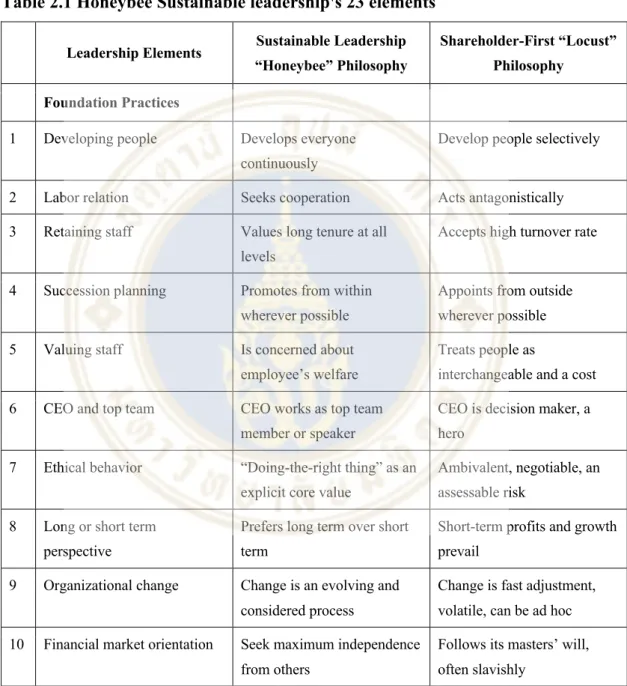
Table 2.1 Honeybee Sustainable leadership's 23 elements
Leadership Elements Sustainable Leadership
“Honeybee” Philosophy
Shareholder-First “Locust”
Philosophy Foundation Practices
1 Developing people Develops everyone continuously
Develop people selectively
2 Labor relation Seeks cooperation Acts antagonistically 3 Retaining staff Values long tenure at all
levels
Accepts high turnover rate
4 Succession planning Promotes from within wherever possible
Appoints from outside wherever possible 5 Valuing staff Is concerned about
employee’s welfare
Treats people as
interchangeable and a cost 6 CEO and top team CEO works as top team
member or speaker
CEO is decision maker, a hero
7 Ethical behavior “Doing-the-right thing” as an explicit core value
Ambivalent, negotiable, an assessable risk
8 Long or short term perspective
Prefers long term over short term
Short-term profits and growth prevail
9 Organizational change Change is an evolving and considered process
Change is fast adjustment, volatile, can be ad hoc 10 Financial market orientation Seek maximum independence
from others
Follows its masters’ will, often slavishly
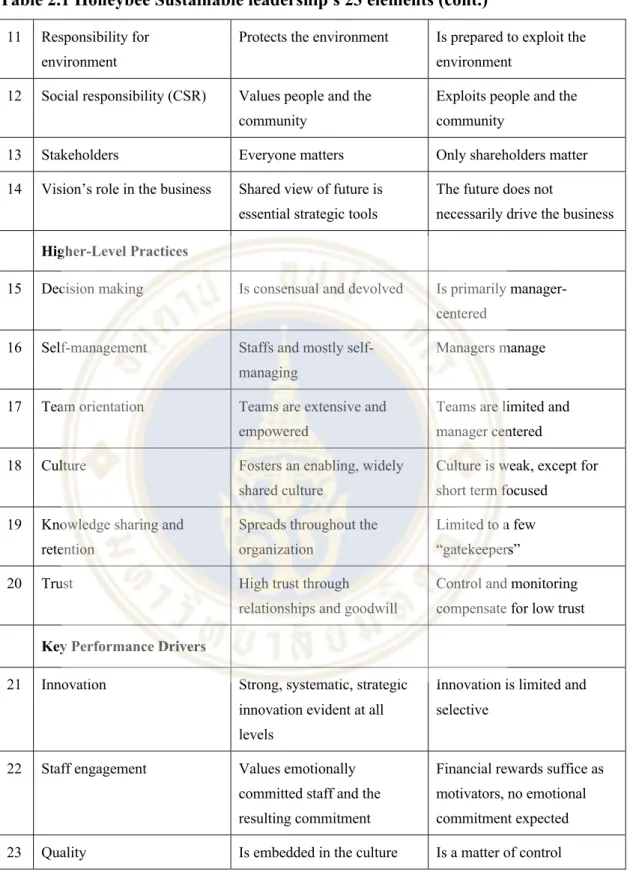
Table 2.1 Honeybee Sustainable leadership's 23 elements (cont.)
11 Responsibility for environment
Protects the environment Is prepared to exploit the environment
12 Social responsibility (CSR) Values people and the community
Exploits people and the community
13 Stakeholders Everyone matters Only shareholders matter
14 Vision’s role in the business Shared view of future is essential strategic tools
The future does not
necessarily drive the business Higher-Level Practices
15 Decision making Is consensual and devolved Is primarily manager- centered
16 Self-management Staffs and mostly self- managing
Managers manage
17 Team orientation Teams are extensive and empowered
Teams are limited and manager centered
18 Culture Fosters an enabling, widely
shared culture
Culture is weak, except for short term focused
19 Knowledge sharing and retention
Spreads throughout the organization
Limited to a few
“gatekeepers”
20 Trust High trust through
relationships and goodwill
Control and monitoring compensate for low trust Key Performance Drivers
21 Innovation Strong, systematic, strategic innovation evident at all levels
Innovation is limited and selective
22 Staff engagement Values emotionally committed staff and the resulting commitment
Financial rewards suffice as motivators, no emotional commitment expected 23 Quality Is embedded in the culture Is a matter of control
2.4 The objective of the study
1. To seek an understanding of the studied firm's management style in terms of Sustainable Leadership: Honeybee vs Locust
2. To explore the elements of management style and performance of the firm.
2.5 Research questions - What do we look for in this research/interview?
1. Is the management style of the studied firm based on a Honeybee or Locust approach?
2. What are the elements that show the type of approach in the case study firm?
3. How can Honeybee Sustainable Leadership understandings help to
enhance the firm's performance?
CHAPTER III
RESEARCH METHODOLOGY
Chapter 3 discussed research methods and the design of this research. In the quest to uncover the answer to research questions that relate the Honeybee SL to the firm management style stated in the last part of chapter 2. The first part discusses the research design in terms of the overall picture. Then move to discuss the sampling method or how the sample aims to have in the interviews.
3.1 Research Design – Structured, Personal Interview
As far as the 23 principle framework to be used in analyzing the company,
the researcher has decided to use a qualitative research method. Thus, a personal
interview is conducted with 24 open-ended short questionnaires. With 23 of the
questions derived from the elements of Honeybee Sustainable Leadership, the 24th
question seeks to find the possible development of how the firm operates. Such 24th
question is to find "how to improve the working process within the firm, in their own
opinion. The survey is conducted with employees and some of its stakeholder. The data
will then have collected and recorded by Google form for the ease of analyzing and
bring the data into use. Coding will be focused on the 23 elements of Honeybee
sustainable leadership. Ranking from foundation practice, higher level practice, and key
performance driver, none of the question arrangement has skipped, nor cross the line up
from the original framework of Honeybee Sustainable Leadership for keeping its
functionality and efficiency when working with coding the findings detail data. The data
shown as findings will then be concluded and summarized. Then will be put into use of
the recommendations later on.
3.2 Sampling method
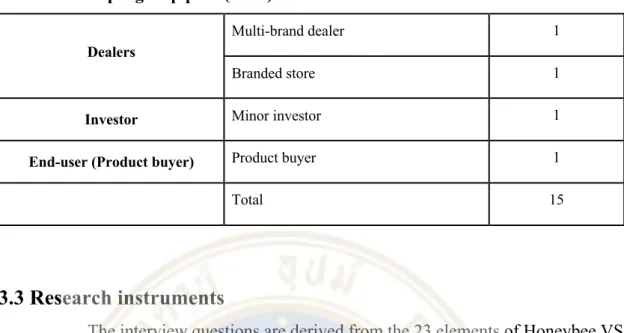
As the researcher will conduct an internal, structured interview with a total of 10 employees and five of its stakeholders (n=15). For the employee side, the sample group will consist of managers and employees depends on the availability due to the busy nature of working for the firm. The researcher has selected the sample group based on the variety of specialization and different experience that those samples have. Each function has encountered different angle of management and how the firm conducts the business and can be concluded into a more meaningful contribution to the research. The functions are namely, sales, marketing, supply chain, leadership team, and customer service. One main criterion is the samples must be working for the firm at the moment and has been employed for more than 2 years. This gives a more accurate result for the interview and will be giving a good recommendation for the future of the company while succeeding the ability to reach the answers those are valid to the research.
Moreover, the stakeholder sides will have to be included as well. One dealer of each category is interviewed, namely, multi-brand retailer and the branded store.
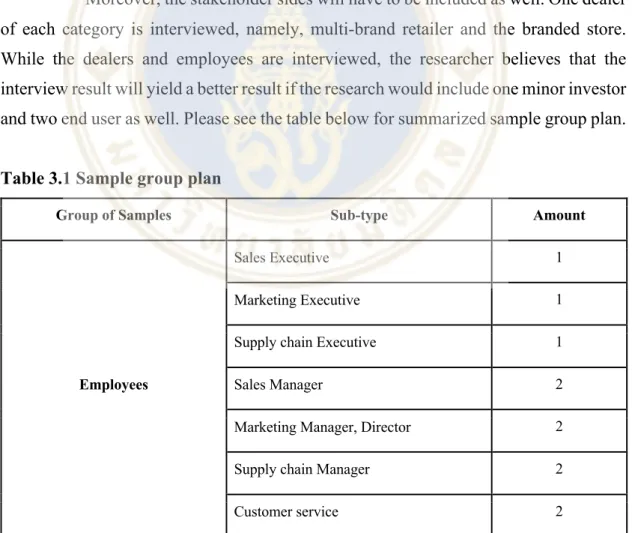
While the dealers and employees are interviewed, the researcher believes that the interview result will yield a better result if the research would include one minor investor and two end user as well. Please see the table below for summarized sample group plan.
Table 3.1 Sample group plan
Group of Samples Sub-type Amount
Employees
Sales Executive 1
Marketing Executive 1
Supply chain Executive 1
Sales Manager 2
Marketing Manager, Director 2
Supply chain Manager 2
Customer service 2
Table 3.1 Sample group plan (cont.)
Dealers
Multi-brand dealer 1
Branded store 1
Investor Minor investor 1
End-user (Product buyer) Product buyer 1
Total 15
3.3 Research instruments
The interview questions are derived from the 23 elements of Honeybee VS Locust sustainable leadership. And each element is label just below the question.
Furthermore, the researcher wants to understand more of would could be done in the future for the company. The last question (24) will require the interviewee to give out their own idea of how the firm should develop in the future.
The interview questions are input into google form for further pre-test and data collection. The interviewees are expected to share his/her insight of those elements.
Then, the answers will be collected and coded for further benefit to this research.
Moreover, the coded response will be included in what research has been exposed to in real life. Therefore, personal observation is added as well, in order to collaborate the findings into one single piece. And then, the findings will be analyzed for rating lease evident, moderately evident, and most (strongly) evident. Apart from that, the results are to be used into a recommendation for further development of the firm's strategic management, as a walk toward a more Honeybee-like SL.
3.4 Method of data collection
The researcher uses Avery's Honeybee Vs Locust Sustainable Leadership
framework to study the company. The study of which the researcher seeks
understanding of how the firm is doing as Locust or Honeybee type. The researcher
believes that emailing the set of the interview in advance is a must. Especially for
customers, dealers, and investors who do not know the internal ways of management.
In the appointed date for each interviewee, data are collected by direct interview. The researcher sits down with each interviewee and clearly explain the question derived from Honeybee Sustainable Leadership. The answer is initially answered in Thai, then translated into the researcher's Google form for data consolidation. Then the responses or the answers are extracted in excel form for further data coding in the next chapter.
3.5 Ensuring data validity
As the interview question set is prepared in Google form for the ease of data extraction, it is also easy to pre-test the interview as well. Once the researcher has finished the prototype of the research interview question, the researcher has tested with colleagues and other students for flaw detection. The reason why I decided to use other student is that the interview will need to include investor, customers, and end-users who do not know anything about the internal of the firm. The pre-test was to see if the questions will confuse the interviewee or gives a bad impression for them.
The pre-test's result has shown that the testers can understand well of the directions and what the research is needed. However, the minor misunderstandings such as English to Thai translation will be done by close guidance of interviewer. Some questions are revised to fit more of the understanding and to match the role of each individual who joins the interview. The second pre-test was done with a refined interview set. The tester can now fully understand the questions well and continue with positive results.
3.6 Research reliability and limitation
As researcher is also an employee, the research has removed himself out of
any bias and any interruption with the interviews. Also, the limited number of samples
is 15 compares to 500+ employees. Generalizations cannot be derived from case studies
(Kantabutra, 2011). Further research must be conducted if the researcher requires more
information for generalizations. Firms who have crossed culture into Thailand's market
from its mother company as Anglo/US may not share similarities in terms of
management. There might be some company to operate in Thailand while using the
brand name from Anglo/US, its mother Company, but using Rhineland management style.
The time management for each interview is quite tight, due to the busy working hour at the firm's office. The average time per interview is 8-10 minutes per interview, which is quite short. It is worth mentioning that, the higher level of management of the sample, the higher level of bias toward answers to questions.
Therefore, the overall picture of the interview must be reviewed to find out the answer.
CHAPTER IV
FINDINGS DISCUSSION
4.1 The interview
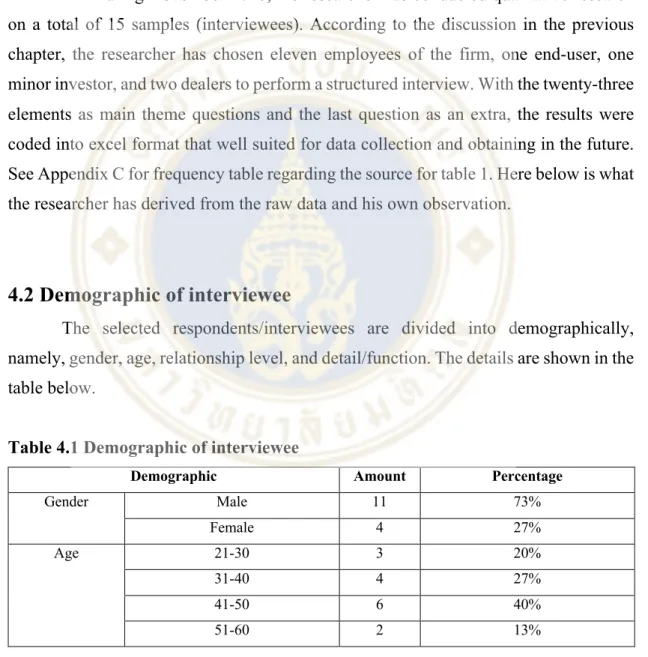
During November 2018, the researcher has conducted qualitative research on a total of 15 samples (interviewees). According to the discussion in the previous chapter, the researcher has chosen eleven employees of the firm, one end-user, one minor investor, and two dealers to perform a structured interview. With the twenty-three elements as main theme questions and the last question as an extra, the results were coded into excel format that well suited for data collection and obtaining in the future.
See Appendix C for frequency table regarding the source for table 1. Here below is what the researcher has derived from the raw data and his own observation.
4.2 Demographic of interviewee
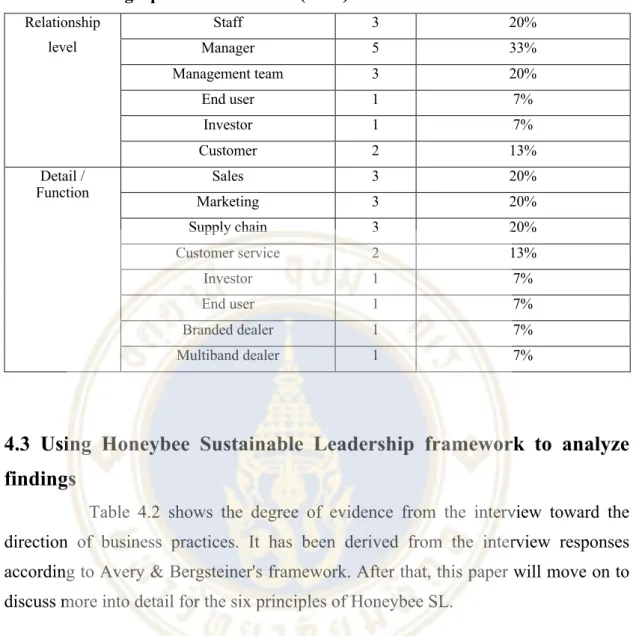
The selected respondents/interviewees are divided into demographically, namely, gender, age, relationship level, and detail/function. The details are shown in the table below.
Table 4.1 Demographic of interviewee
Demographic Amount Percentage
Gender Male 11 73%
Female 4 27%
Age 21-30 3 20%
31-40 4 27%
41-50 6 40%
51-60 2 13%
Table 4.1 Demographic of interviewee (cont.)
Relationship level
Staff 3 20%
Manager 5 33%
Management team 3 20%
End user 1 7%
Investor 1 7%
Customer 2 13%
Detail /
Function Sales 3 20%
Marketing 3 20%
Supply chain 3 20%
Customer service 2 13%
Investor 1 7%
End user 1 7%
Branded dealer 1 7%
Multiband dealer 1 7%
4.3 Using Honeybee Sustainable Leadership framework to analyze findings
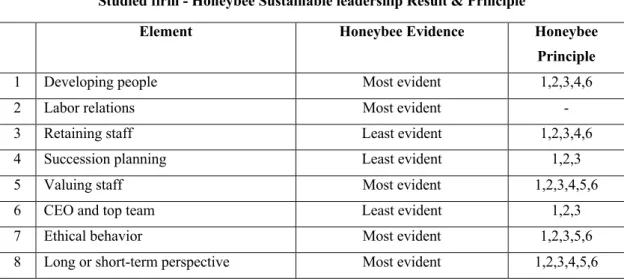
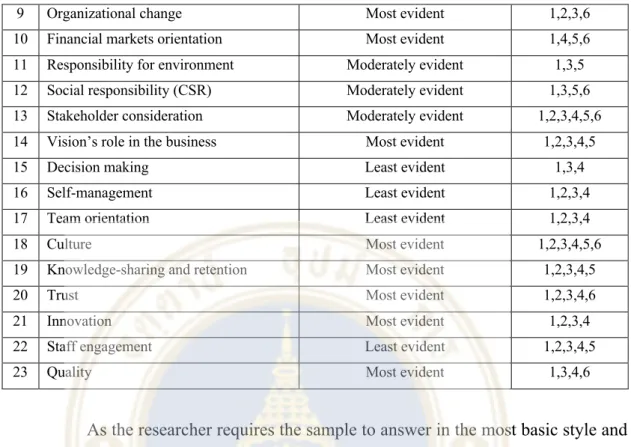
Table 4.2 shows the degree of evidence from the interview toward the direction of business practices. It has been derived from the interview responses according to Avery & Bergsteiner's framework. After that, this paper will move on to discuss more into detail for the six principles of Honeybee SL.
Table 4.2 Honeybee SL evidence – The studied firm
Studied firm - Honeybee Sustainable leadership Result & Principle
Element Honeybee Evidence Honeybee
Principle
1 Developing people Most evident 1,2,3,4,6
2 Labor relations Most evident -
3 Retaining staff Least evident 1,2,3,4,6
4 Succession planning Least evident 1,2,3
5 Valuing staff Most evident 1,2,3,4,5,6
6 CEO and top team Least evident 1,2,3
7 Ethical behavior Most evident 1,2,3,5,6
8 Long or short-term perspective Most evident 1,2,3,4,5,6
Table 4.2 Honeybee SL evidence – The studied firm (cont.)
9 Organizational change Most evident 1,2,3,6
10 Financial markets orientation Most evident 1,4,5,6
11 Responsibility for environment Moderately evident 1,3,5 12 Social responsibility (CSR) Moderately evident 1,3,5,6 13 Stakeholder consideration Moderately evident 1,2,3,4,5,6
14 Vision’s role in the business Most evident 1,2,3,4,5
15 Decision making Least evident 1,3,4
16 Self-management Least evident 1,2,3,4
17 Team orientation Least evident 1,2,3,4
18 Culture Most evident 1,2,3,4,5,6
19 Knowledge-sharing and retention Most evident 1,2,3,4,5
20 Trust Most evident 1,2,3,4,6
21 Innovation Most evident 1,2,3,4
22 Staff engagement Least evident 1,2,3,4,5
23 Quality Most evident 1,3,4,6