WHAT FACTORS DRIVE THE REPURCHASE INTENTION TO BUY YOUR ONLINE PRODUCTS IN THAILAND?
NUTTIYA AKARABOONLERTYOT
A THEMATIC PAPER SUBMITTED IN PARTIAL FULFILLMENT OF THE REQUIREMENTS FOR THE DEGREE OF MASTER OF MANAGEMENT
COLLEGE OF MANAGEMENT MAHIDOL UNIVERSITY
2019
COPYRIGHT OF MAHIDOL UNIVERSITY
Thematic paper entitled
WHAT FACTORS DRIVE THE REPURCHASE INTENTION TO BUY YOUR ONLINE PRODUCTS IN THAILAND?
was submitted to the College of Management, Mahidol University for the degree of Master of Management
on
September 7, 2019
...
Miss Nuttiya Akaraboonlertyot Candidate
... ...
Asst. Prof. Randall M.Shannon, Assoc. Prof. Astrid Kainzbauer,
Ph.D. Ph.D.
Advisor Chairperson
... ...
Duangporn Arbhasil, Dr. Ronald Thesenvitz,
Ph.D. Ph.D.
Dean Committee member
College of Management Mahidol University
ACKNOWLEDGEMENTS
Firstly, I would like to express my sincere gratitude to my advisor Asst. Prof.
Randall M.Shannon for continuous support of my thematic paper, and his statistical analysis guidance. He always response quickly on my questions in e-mail and also in the face-to face meeting at CMMU university for discussing with him. I am appreciated for that.
I would like to thank my family: my parents and my sister for supporting me spiritually throughout writing this thematic paper and my master degree life in general.
My sincere thanks especially goes to my father who gave this greatest master’s degree financial support and encouragement.
Last but not the least, I thank my 20C classmates for supporting me to get through the difficulty of thematic paper together, and all the fun we have had in this two years.
Nuttiya Akaraboonlertyot
WHAT FACTORS DRIVE THE REPURCHASE INTENTION TO BUY YOUR ONLINE PRODUCTS IN THAILAND?
NUTTIYA AKARABOONLERTYOT 6049137
M.M. (ENTREPRENEURSHIP MANAGEMENT)
THEMATIC PAPER ADVISORY COMMITTEE: ASST. PROF. RANDALL M.SHANNON, Ph.D., ASSOC. PROF. ASTRID KAINZBAUER, Ph.D., RONALD THESENVITZ, Ph.D.
ABSTRACT
The purpose of this study was to find the specific factors that related to Thai customer repurchase intention in online clothes shopping by using research models. This study emphasizes the relationship of online service quality on customer satisfaction and trust on repurchase intention in online shopping business and focuses on online purchasers of clothing who live in Thailand.
This thematic paper uses qualitative methodology by collecting data from 123 respondents who had experience online clothes shopping in the past two months and are living in Thailand. The data collected were analyzed using descriptive statistics and inferential statistics. This could imply that online customers will repurchase the clothes if the retailers build them satisfied and trust while making the transactions.
Moreover, the way to make customer satisfaction is the shop provides an online service quality to them. This correlations result is considered that “customers who trust the online clothes shop and want to repurchase” is moderately relates to “satisfied customers or who thinks this online shop provides good service and then they want to repurchase”.
KEY WORDS: Online shopping/ Clothes/ Repurchase intention/ E-commerce
38 pages
CONTENTS
Page
ACKNOWLEDGEMENTS ii
ABSTRACT iii
LIST OF TABLES vi
LIST OF FIGURES vii
CHAPTER I INTRODUCTION 1
1.1 Background 1
1.2 Problem Statement 1
1.3 Research Objectives 2
1.4 Research Scope 2
CHAPTER II LITERATURE REVIEW 3
2.1 Repurchase Intention 3
2.2 Customer Satisfaction 6
2.3 Online Service Quality 8
2.4 Trust 8
CHAPTER III RESEARCH METHODOLOGY 10
3.1 Research Design 10
3.2 Data Collection Methodology 10
CHAPTER IV RESULT 12
4.1 Descriptive statistics 12
4.1.1 The sample profiles 12
4.1.2 The personal behavior towards online shopping 15 4.1.3 Descriptive data analysis among Key Constructs 18 4.2 Inferential statistics (correlation analysis) 21
4.3 Discussion and Implications 23
CONTENTS (cont.)
Page
CHAPTER V RECOMMENDATIONS AND CONCLUSION 25
5.1 Conclusion 25
5.2 Recommendations to managers 26
5.3 Limitations and Future Research 27
APPENDIX 28
REFERENCES 33
BIOGRAPHY 38
LIST OF TABLES
Table Page
1 Summary of Measures 19
2 Rotated Component Matrix (before factor analysis) 21
3 Last Rotated Component Matrix 22
4 Correlations analysis 23
LIST OF FIGURES
Figure Page
1 The age of respondents 13
2 The education level of respondents 13
3 The occupation level of respondents 14
4 The income level of respondents 14
5 The main reason for shopping online clothes 15
6 The repurchase frequencies of online clothes 16
7 Repurchase frequencies of online clothes 17
8 The social platform of customer interaction 17
9 Customer interaction with online retailers 18
CHAPTER I INTRODUCTION
1.1 Background
Online shopping statistics in Thailand
According to Thailand Ecommerce Insights (2019), the digital users in Thailand up to 2019 are 12.1 million people and increasing to 13.9 million, representing a 25 percent of total population, e-commerce users by 2021. In Thailand, the number of Internet users has risen moderately. The online spending is approximately 243 USD per person. From Statista Market Forecast (2019), the number of e-commerce market revenue in Thailand is 4,375 USD in 2019, and it is expected to grow about 15 percent
Online shopping statistics for clothes
The Fashion product category, includes apparel, shoes, accessories, and bags, is the second market share at 525 million USD, followed the leading electronics segment (Thailand Ecommerce Insights, 2019). From Statista Market Forecast (2019), the forecast of revenue growth rate in fashion segment between 2019 and 2023 is 10.5 percent.
1.2 Problem Statement
This trend of online shopping is increasing, thus the company not only focuses on this opportunity but also other main aspects for sustainability of the online- retailing business. Along with the competitive market of online business, including existing retailers and new entrants in the country and outside. The online retailers consider having a competitive advantage and look into the online service quality and
trust. The company wants satisfied customers with their product, and then they would have repurchase intention.
1.3 Research Objectives
To understand the relationship between online service quality and trust towards customer satisfaction and repurchase intention, the author has proposed the two objectives.
1.3.1 To identify the influence of the online service quality on customer satisfaction.
1.3.2 To identify the relationship between customer satisfaction and repurchase intention in online shopping.
1.3.3 To identify the effect of trust to repurchase intention.
1.4 Research Scope
This study emphasizes the customer satisfaction and repurchase intention in online shopping business and focuses on online purchasers of clothing who live in Thailand. A survey questionnaire is designed to collect data from the Thai online purchasers that have experience in shopping online.
This research will identify the relationship of online service quality and trust on customer satisfaction and repurchase intention. It also provides customer insights for the online retailers. It will answer “What factors drive the repurchase intention to buy your online products in Thailand?”.
CHAPTER II
LITERATURE REVIEW
According to the online retailing, business is not hard to entry and highly competitive in the online industry, the key success factor for the sustainability of the online company is “customer satisfaction“ and “repurchase intention." Keeping the satisfaction of existing customers and new customers play a crucial role in the success of the online retailing company due to the high cost of attracting new customers and retaining the existing customers (Gefen, 2002). Repurchase intention provides benefits to business by creating a competitive advantage, employee morale and increasing profit and growth (Reichheld, 1996). In this research paper aims to investigate what factors contribute to customer satisfaction and repurchase intention in the context of online clothing shopping by customers in Thailand. The conceptual framework will be discussed precisely below.
2.1 Repurchase Intention
The concept of repurchase intention has received attention from the marketing literature (Parasuraman & Grewal, 2000; Hellier et al., 2003; Lacey et al., 2007) that can be concluded the definition of repurchase intention as a customer’s willingness to pay more for a product or service from the same brand from their past experiences, the situation at that moment and circumstances. In e-commerce, consumers easily switch the brand to buy attractive alternatives without cost with multiple choices of competitors. The three factors of online customers concerned are visiting the site, buying the product and leveling up the customer status to loyalty that can make a huge profit to business and growth (Liu & Xiao, 2008).
Repurchase intention and Loyalty
From Barroso and Martin, 1999 supported that the customer loyalty is the next step beyond satisfaction or emotional state, and the loyalty has four main aspects are a satisfied customer; customer received the value of the product, consumer repeating the buying and recommendation the brand to others. So the meaning between loyalty and repurchase intention is not exactly the same, but they seem to have a relationship as a measuring procedure result. The conceptualization of loyalty measures by repurchase intention from a behavioral approach. (Zeithaml et al., 1996).
The importance of repurchase intention is resulting in actual repurchase behavior and leads to company profitability (Helgesen, 2006). The repurchase behavior leads to long term loyalty then increasing the company’s profit and growth (Hellier et al., 2003). The repurchase is in the behavior intention of loyalty that is an intermediate state in decision making represent an intention to purchase and repurchase (Mittal &
Kamakura, 2001).
Traditional Loyalty
The prior studies revealed the customer loyalty concept would still be an argument though it is the extensive research topic in the marketing literature. The definition of traditional loyalty suggested divides in two points of views (Saura, Francés, Contrí & Blasco, 2008). First, customer loyalty has the same meaning as the repetitive purchase behavior of consumers. Another point of view is included in the attitude aspect of loyalty. Many studies state in the first aspect, for example, loyalty is defined as a deep commitment to repurchase a product or service consistently even though the situation causes potentially changing brand (Cater and Zabkar, 2009). Loyalty is repetitively buying the same subjects, although the circumstance changing (Jeong & Lee, 2010). And Loyalty customers are who continue to buy the products (Buttle & Burton, 2002).
Several research papers supporting the second point of view, adding attitude.
Loyalty is defined as the favorable attitude of the customer to a company or brand or
product, and they have repeated purchase behavior (Anderson and Srinivasan, 2003).
Customer loyalties are repurchasing and a positive attitude to the brand and how to make loyalty meet the customer needs or wants more than other companies (Oliver, 1997).
According to Yang and Peterson, 2004, customer loyalty can be explained in three purchase process to a brand over time that are preferential, attitudinal and behavioral process. From the attitudinal process aspect, loyal customers want to keep a relationship with the online retailers but in the behavioral, perspective is focused on what is the ratio of times the customer purchased the same product to the total number of buying in that industry.
From the previous studies, the author concluded that measuring customer loyalty would predict from repurchase behavior and attitudinal elements of the customers that are their intention and belief.
Online Loyalty (e-loyalty)
From the high penetration of the online e-commerce market, online loyalty is more considered. The online shopper often considered on behavioral loyalty towards on the website, for instance, time spending or repeat visit to the website without any purchasing of the customers, gathering or exchanging information with vendors or doing some transactions. The study found that online shoppers usually search the detail of product on a website but by the product in the shop. From this, the real situation hardly determined the actual loyalty of consumers (Wind et al., 2002). Therefore, online behavioral loyalty conceptualization and measurement are more complex than traditional loyalty as well as in terms of repurchase intention (Smith, 2000).
The importance of online loyalty to the company was studied. The loyalty consumers support the online company in many ways, for example; they like to visit website more than new customers tend to purchase products more and more times, want to search the business information, be tolerated with competitor's advertising and create a word-of-mouth to close relationships (Reichheld & Schefter, 2000; Jiang &
Rosenbloom, 2005). From the importance of repurchase intention, this study would like to measure a repurchase intention concept in online shopping business for sustainability.
2.2 Customer Satisfaction
The definition of customer satisfaction is a degree that compares the perceived performance of the product with the expectation of the customer (Kotler &
Armstrong, 2012). Satisfaction is defined as the customers’ sensation influencing attitude change and purchase intention (Chen, 2012). Customer satisfaction means a person’s evaluations the substantial sensed value of product against their expectations. If the level of actual perceived value is above than their expectation, the satisfaction of customers will happen (Zeithaml et al., 2006). Oliver, (2017) states that customer satisfaction as the customer’s fulfillment reaction from product, product attributes or consumption-related fulfillment. Moreover, pleased customers tend to buy the same product repeatedly, tolerate competitive alternatives and create a powerful word of mouth advertising to others (Zeithaml et al. 1996). The fulfilled customers will behave like loyalty to a brand more than others in the time limited or fewer information conditions (Gommans, et al., 2001). According to the study, the types of satisfaction are separated into product satisfaction, process satisfaction and post-purchase satisfaction (Yi, 1990).
Nevertheless, the repurchase intention of gratified consumers provides a competitive advantage to online business (Hellier et al., 2003). From the prior study, the high level of satisfaction of product can provide the company’s profitability about 2.6 times of income from the fully satisfied customers’ word of mouth and in contrast, the dissatisfied customers can decrease approximately 18 times in sales. It means that the satisfaction level of the consumer affects companies' revenue (Nelson, 2012). Thus the company would consider how to satisfy what the customers’ desire due to the company performance changing and monitor the satisfaction to compete with companies in the Internet shopping market.
Expectation disconfirmation theory (EDT)
The theoretical model named EDT found that consumer behavior in the post- purchase has a favorable influence on repurchase intention and customer satisfaction.
Customers evaluate a gap of the expectations with the actual perceived value of the product to clear or negative disconfirmation. The positive disconfirmation or the product is outperformed than expectation can produce customer satisfaction in continued usage (Oliver, 1980).
Customer Satisfaction in the online business
In the online shopping market, customer satisfaction is defined as a level of satisfaction in past buying experience from an online company (Anderson & Srinivasan, 2003). Creating the satisfaction of online customers is complicated when compared to the traditional market because it has a lot of inputs to meet the needs of online shoppers, for instance, the customers have more time to collect, compare information and decide to purchase products (Gommans, et al., 2001). The relationship between the consumers and online retailers would be stronger than the offline market due to the users can seek other alternatives easier (Shankar et al., 2003).
Customer Satisfaction and Repurchase intention
Previous studies suggest that customer satisfaction and repurchase intention is a positive relationship. Satisfaction is an important variable for generating repurchase intention towards a brand. The high level of satisfaction influences high repurchase intention of consumers and thus company having a profit (Kim et al., 2012). In an offline environment, satisfied customers are likely to keep a relationship with the online retailer in the long term (Hellier et al., 2001). As well as in the online environment, the study revealed that customer satisfaction in the Internet store results in positively loyalty to the store (Yang & Peterson, 2004). Another study claimed in the same way that customer satisfaction and trust are major factors to influence customers’ intention repurchasing online products (Chen et al., 2009). In the online setting, high-quality customer
relationship with the online brand contributes the customer loyalty (Harris & Goode, 2004). Otherwise, there is a minority of finding shown a weak relationship between customer satisfaction and loyalty (Taylor & Hunter 2003). Thus this study will investigate the relationship between online shopping satisfaction and repurchase intention.
2.3 Online Service Quality
Online service quality is defined as customer assessment in electronic service delivery quality in online shopping setting (Lee & Lin, 2005). Service quality plays an important role in Internet business due to not need personally communication.
And in terms of the online service, the company was suggested to provide full stages of the buying process so the firm can respond to customers quickly and meet the customer need, for instance, searching data, ordering, delivering and returning (on-time delivery and getting the product correctly in the promised situation) (Ahn et al., 2007). In addition, the factors of online service include order easily and the capability to answer a consumer's complaint (Khalifa & Liu, 2007).
Service quality and Customer satisfaction
In an online community, the service quality refers to customer satisfaction as a result of comparing their customer perception with the actual performance of the online product (Ahn et al., 2007). Moreover, perceived service quality has positive impacts on customer satisfaction, which later leading repurchase intention and continuous use (Lee & Lin, 2005). The online service quality is a significant factor in the company’s competency and competitive advantage (Santos, 2003). Therefore, online retailers would measure their online service quality performance in the customer perspective and improve the problems suddenly.
2.4 Trust
Trust has been considered a key factor for establishing a lasting quality relationship between buyers and service providers and maintaining in the long run (Dwyer et al., 1987). Online shopper perception of trust is a customer believe that the commitments of the company will be a secret, and the online retailer performs role responsibility well (Flavian et al., 2006). In the online business, customers may not know the service result before purchasing, or it is hard to detect service performance thus the online trust is important in the Internet market to reduce customers’ anxiety and perceptions of risk and belief in online retailers. When consumers trust in the brand, it will gain customer satisfaction further (Trawick and Swan 1981).
Trust and Repurchase intention
Online trusting beliefs contribute a strong impact repurchase intention and attitudinal loyalty, such as customer preference, willingness to buy a product from an online retailer and more frequent visit online site (Flavian et al., 2006).
CHAPTER III
RESEARCH METHODOLOGY
3.1 Research Design
This study will use a quantitative research approach and explore the factors that affect the repurchase intention of online clothes shopping business in Thailand.
Nevertheless, it seeks out the criteria to support sustainability of the online company.
It will be distributed online questionnaires because I only want to talk with people who have shopped online, thus an online questionnaire is logical. Nevertheless, it saves the time to collect and analyze the data, in a limited timeframe.
The research divided into three criteria that are Online Service Quality, Trust, and Customer Satisfaction. These criteria could be shown the relations between each variable and then lead to the repurchase intention.
3.2 Data Collection Methodology
Population
This research population focuses on people who buy the online clothes in last two months and live in Thailand. This target group is quite high-potential customers with having a buying online experience thus they can provide the information that which factors drive them to next purchasing clothes. And this group can answer the questionnaire easily.
Sampling
The online questionnaires are randomly distributed with sample size of 100 respondents. Location of respondents is limited to living in Thailand, to understand the Thai culture and consumer behavior and avoid biasing of culture and geographic.
Data Collection
The research approach is the online close-ended questionnaire due to the short data collection period. There are five parts of questions: Introduction, Screening question, General Question, Specific question, and Demographic question, which contains 26 questions. The questionnaire is in the appendix.
Data Analysis
This research will analyze the data with Descriptive analysis (amount, percentage, and mean) to calculate and test the variables that are related to the repurchase intention and then summarize the important factors that relates to the topic.
CHAPTER IV RESULT
The data collected were analyzed using descriptive statistics (amount of, percentage, and mean) and inferential statistics (correlation analysis) to calculate the variables that are related to the customer satisfaction and repurchase intention. The 123 sets of data were collected from the respondents who had experience online clothes shopping in the past two months and are living in Thailand via the online Google form.
4.1 Descriptive statistics
4.1.1 The sample profiles
The descriptive data analysis result is started with the sample profiles, including age, education level, occupation, income and their personal behavior towards online shopping such as the reason of shopping online clothes, the repurchase frequencies, criteria to repurchase online clothes, social platform of customer interaction and customer interaction with online retailers.
According to the age, most of the respondents were between 25 and 34 years (85%), 10% of the respondents were between 35 and 55 years, 5% of the respondents were between 18 and 24 years, and none of those aged above 55 years old.
Figure 1 The age of respondents
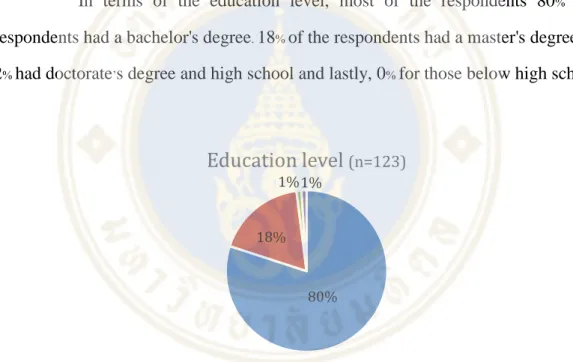
In terms of the education level, most of the respondents 80% of the respondents had a bachelor's degree. 18% of the respondents had a master's degree. Each 2% had doctorate’s degree and high school and lastly, 0% for those below high school.
Figure 2 The education level of respondents
As for occupation of the respondents, 84% were employees. 12% were self- employed, 2% of the respondents were students. Each 1% was unemployed and retired.
85%
10%
5%
Age
(n=123)25 - 34 years85% 35 - 55 years 18 - 24 years
80%
18%
1%1%
Education level
(n=123)bachelor's degree master's degree doctorate's degree high school
Figure 3 The occupation level of respondents
In respect to income of the respondents in THB, the income between 30,001 and 60,000 constituted the highest number of respondents at 39%, followed by income between 15,000 and 30,000 (26%), the highest income or more than 90,000, has the number of respondents at 17%, 15% of the respondents were between 60,001 and 90,000 and for below 15,000, the number of respondents was 3%.
Figure 4 The income level of respondents
84%
12%
2%1%1%
Occupation
(n=123)employee self-employed students unemployed retired
39%
26%
17%
15%
3%
Income
(THB, n=123)30,001 - 60,000 15,000 - 30,000 more than 90,000 60,001 - 90,000 below 15,000
4.1.2 The personal behavior towards online shopping
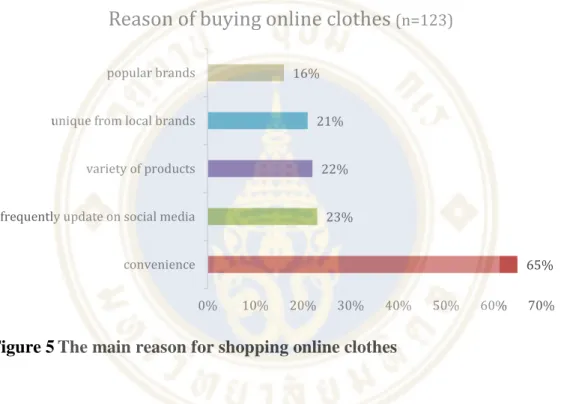
The author collected the reason of buying clothes in the online with multiple choices. The main reason for shopping online clothes is a convenience at 65% of the number of respondents, followed by frequently update on social media 23%, 22% of respondents selected the variety of products, 21% of respondents chose unique from local brands, and for the popular brands, the number of respondents was 16%.
Figure 5 The main reason for shopping online clothes
From the repurchase frequencies of online clothes in the past two-month result, half of the respondents shopped one to two times per month. 21% of respondents bought less than once a month, followed by who spent on online clothes three to four times a month at 19%, and 10% of respondents paid more than four times a week.
65%
23%
22%
21%
16%
0% 10% 20% 30% 40% 50% 60% 70%
convenience frequently update on social media variety of products unique from local brands popular brands
Reason of buying online clothes
(n=123)Figure 6 The repurchase frequencies of online clothes
Criteria of repurchasing online clothes are several reasons so the author used the multiple choices to collect this data. It found that the main criterion for repurchasing clothes in the online platform is good quality of products at 63%. The second reason is reasonable price that 55% of respondents selected. Followed by each 23% of respondents chose that are good online service and customers like a brand. 11% of respondents think the popularity of shop in social media. There is 8% of people who did this survey selected advertising. And only 3% of them think that Corporate Social Responsibility is one of their criteria.
50%
21%
19%
10%
Repurchase frequencies of online clothes in the past two-month
(n=123)1 - 2 times/month less than once a month 3 - 4 times/month more than 4 times/month
Figure 7 Repurchase frequencies of online clothes
Using the multiple-choice selection in topic of Social platform of customer interaction, the author saw that three important platforms were Facebook, Instagram and Line at 48%, 43% and 34% respectively. Other platforms were application at 13% of respondents and 4% of them used Website.
Figure 8 The social platform of customer interaction
63%
55%
23%
23%
11%
8%
3%
0% 10% 20% 30% 40% 50% 60% 70%
good quality reasonable price good online service customers like a brand popularity of shop in social media advertising Corporate Social Responsibility
Criteria of repurchasing online clothes
(n=123)48%
43%
34%
13%
4%
0% 10% 20% 30% 40% 50% 60%
Facebook Instagram
Line application
website
Social platform of customer interaction
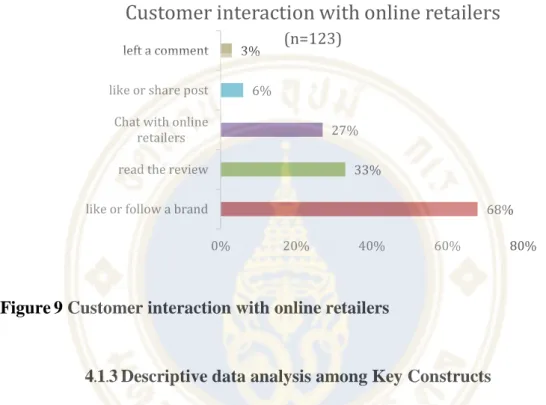
(n=123)Customer interaction with online retailers with the multiple choices had 68%
of respondents like or follow a brand. 33% of the respondents selected reading the review.
Chatting with online retailers was chosen by 27% of respondents. Only 6% and 3% of respondents interact with the online shops by liking or sharing post and left a comment.
Figure 9 Customer interaction with online retailers
4.1.3 Descriptive data analysis among Key Constructs
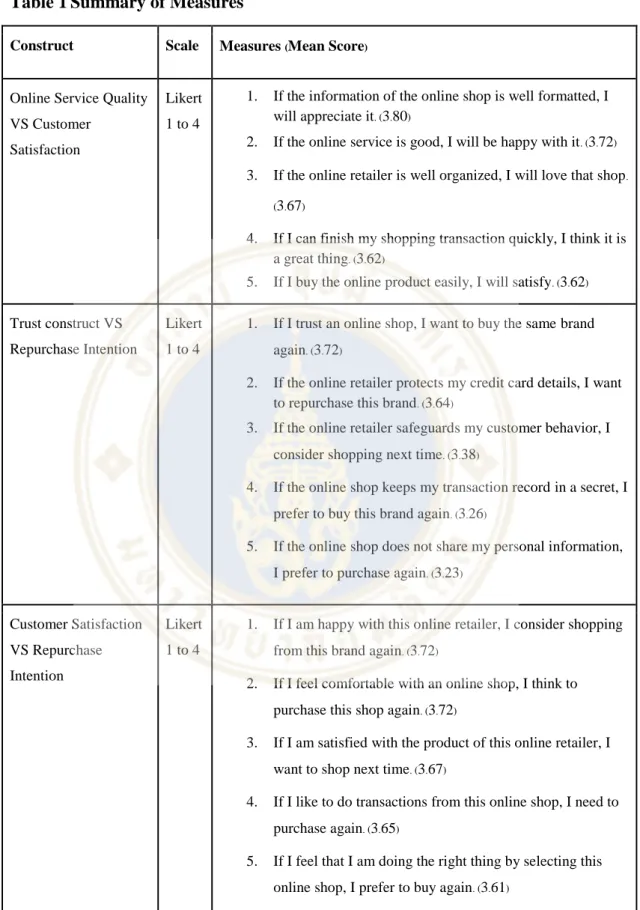
There are three constructs, which were proposed to examine how the customers see the importance of relationship between Online service quality and Customer satisfaction, the relationship of Trust and Repurchase intention, and the relationship between Customer satisfaction and Repurchase intention. This data was used the descriptive analysis in a mean score. The details are provided in Table 1.
68%
33%
27%
6%
3%
0% 20% 40% 60% 80%
like or follow a brand read the review Chat with online
retailers like or share post
left a comment
Customer interaction with online retailers
(n=123)
Table 1 Summary of Measures
Construct Scale Measures (Mean Score)
Online Service Quality VS Customer
Satisfaction
Likert 1 to 4
1. If the information of the online shop is well formatted, I will appreciate it. (3.80)
2. If the online service is good, I will be happy with it. (3.72) 3. If the online retailer is well organized, I will love that shop.
(3.67)
4. If I can finish my shopping transaction quickly, I think it is a great thing. (3.62)
5. If I buy the online product easily, I will satisfy. (3.62)
Trust construct VS Repurchase Intention
Likert 1 to 4
1. If I trust an online shop, I want to buy the same brand again. (3.72)
2. If the online retailer protects my credit card details, I want to repurchase this brand. (3.64)
3. If the online retailer safeguards my customer behavior, I consider shopping next time. (3.38)
4. If the online shop keeps my transaction record in a secret, I prefer to buy this brand again. (3.26)
5. If the online shop does not share my personal information, I prefer to purchase again. (3.23)
Customer Satisfaction VS Repurchase Intention
Likert 1 to 4
1. If I am happy with this online retailer, I consider shopping from this brand again. (3.72)
2. If I feel comfortable with an online shop, I think to purchase this shop again. (3.72)
3. If I am satisfied with the product of this online retailer, I want to shop next time. (3.67)
4. If I like to do transactions from this online shop, I need to purchase again. (3.65)
5. If I feel that I am doing the right thing by selecting this online shop, I prefer to buy again. (3.61)
From the results of constructs, measurement analysis suggests that all three reflective measurement constructs had important relationship between Online service
quality and Customer satisfaction, the relationship of Trust and Repurchase intention, and the relationship between Customer satisfaction and Repurchase intention with the average mean score at 3.69, 3.45, and 3.67, respectively. This could imply that online customers will repurchase the clothes if the retailers build them satisfied and trust while making the transactions. Moreover, the way to make customer satisfaction is the shop provides an online service quality to them.
Among the three constructs, the highest mean score range is the relationship between online service quality and Customer satisfaction, 3.62 to 3.80. It means that people think that online service quality tends to build the Customer satisfaction more than others. For more details of this relationship, it contains five questions that are If I buy the online product easily, I will satisfy (Mean score 3.62). If the online service is good, I will be happy with it (Mean score 3.72). If I can finish my shopping transaction quickly, I think it is a great thing (Mean score 3.62). If the information of the online shop is well formatted, I will appreciate it (Mean score 3.80). And If the online retailer is well organized, I will love that shop (Mean score 3.67).
The relationship of Trust and Repurchase intention is the latest mean score in range of 3.23 to 3.72. It can be acknowledged that respondents think that trust may build the repurchase intention vaguely in some dimensions such as protecting the personal information, customers’ transaction data and their shopping behavior. Even so, the financial issue is important data that the customers want to protect them. The details of these five questions of the relationship of Trust and Repurchase intention is If I trust an online shop, I want to buy the same brand again (Mean score 3.72). If the online retailer safeguards my customer behavior, I consider shopping next time (Mean score 3.38). If the online shop does not share my personal information, I prefer to purchase again (Mean score 3.23). If the online retailer protects my credit card details, I want to repurchase this brand (Mean score 3.64). And If the online shop keeps my transaction record in a secret, I prefer to buy this brand again (Mean score 3.26).
4.2 Inferential statistics (correlation analysis)
The author started with fifteen questions in terms of constructs (three components) in factor analysis process and set the factor analysis to cut the factors that are less than 0.4 score.
Table 2 Rotated Component Matrix (before factor analysis)
Constructs Component1 Component2 Component3 Component4
If the on5 shop keeps my transaction record in a secret, I prefer to buy this brand again.
0.886
If the on5 retailer safeguards my customer behavior, I consider shopping next time.
0.868
If the on5 shop does not share my personal information, I prefer to purchase again.
0.804
If the on5 retailer protects my credit card details, I want to repurchase this brand.
0.612
If the information of the on5 shop is well formatted, I will appreciate it.
0.723
If I feel comfortable with an on5 shop, I think to purchase this shop again.
0.718
If I am satisfied with the product of this on5 retailer, I want to shop next time.
0.622
If I buy the on5 product easily, I will satisfy. 0.602
If the on5 retailer is well organized, I will love that shop.
0.598
If the on5 service is good, I will be happy with it.
0.536
Extraction Method: Principal Component Analysis.
Rotation Method: Varimax with Kaiser Normalization.
a. Rotation converged in 13 iterations.
Then the author cut cross-loading and non-relevant questions in each component to ten questions for five runs of factor analysis. These ten questions can divided to two components. Components are “Trust makes repurchase intention” and
“Good online service or happy customers makes repurchase intention”. This picture
below is the last version of Rotated Component Matrix and prepared to run correlation analysis further.
Table 3 Last Rotated Component Matrix
Constructs Component1 Component2 Component3 Component4
If the on5 shop keeps my transaction record in a secret, I prefer to buy this brand again.
0.886
If the on5 retailer safeguards my customer behavior, I consider shopping next time.
0.868
If the on5 shop does not share my personal information, I prefer to purchase again.
0.804
If the on5 retailer protects my credit card details, I want to repurchase this brand.
0.612
If the information of the on5 shop is well formatted, I will appreciate it.
0.723
If I feel comfortable with an on5 shop, I think to purchase this shop again.
0.718
If I am satisfied with the product of this on5 retailer, I want to shop next time.
0.622
If I buy the on5 product easily, I will satisfy. 0.602
If the on5 retailer is well organized, I will love that shop.
0.598
If the on5 service is good, I will be happy with it.
0.536
Extraction Method: Principal Component Analysis.
Rotation Method: Varimax with Kaiser Normalization.
a Rotation converged in 13 iterations.
After the factor analysis, the result is two components which use the correlations analysis to find out the relation among factors. And this correlation score is 0.526. This positive correlation means that there is some relationship between the two factors. This positive correlation score is medium level of correlation.
Table 4 Correlations analysis
This correlations result is considered that “customers who trust the online cloths shop and want to repurchase” is moderately relates to “satisfied customers or who thinks this online shop provides good service and then they want to repurchase”.
4.3 Discussion and Implications
Popularity of online shopping is an opportunity for customers because online competition is much more intense, and it is easier for customers to compare product characteristics in online. This study analyses the importance of the repurchasing process of online shop clothes by understanding the constructs of the online services quality, customer satisfaction, trust affecting repurchase intention. It is important for the
trustmakesrep urchase
goodservice orhappymak erepurchase Pearson Correlation 1 .526**
Sig. (2-tailed) 0
N 123 123
Pearson Correlation .526** 1
Sig. (2-tailed) 0
N 123 123
Correlations
trustmakesrepurchase
goodserviceorhappymaker epurchase
**. Correlation is significant at the 0.01 level (2-tailed).
online business to seek out the factors of repurchase intention that can lead survival of business (Wu et al., 2014).
This study demonstrates that online service quality, customer satisfaction and trust toward an Internet retailer are important for gaining repurchase intention. The online retailer must improve these attributes to gain sustainability and a competitive advantage among the market. Therefore, the higher the online service quality is, the higher the customer satisfaction response will be. Online retailers should try to improve customer satisfaction to induce consumers’ repurchase intention. Nevertheless, the online retailers establish trust of customers which leads to make customers buy products again.
The online retailers should improve their online service and trust images to secure repurchase intention. For instance, they could pay attention to an online service quality assurance program to control the service performance. On the other hand, regular providing the true intention to customers is a key point for making their trust.
CHAPTER V
RECOMMENDATIONS AND CONCLUSION
5.1 Conclusion
This research was focused on the importance of customer satisfaction and trust because they have significant influence on repurchase intention, factor of assuring online business success. Furthermore, the study focused on the relationship between service qualities towards customer satisfaction. The number of the sample population was 123 respondents who live in Thailand and experienced online clothes shopping in the past two months. The results indicated that there are two components in correlation analysis. This correlations result is considered that “customers who trust the online cloths shop and want to repurchase” is moderately relates to “satisfied customers or who thinks this online shop provides good service and then they want to repurchase”. For more detail, firstly, when the customers like an online service quality or they prefer to satisfy and then buy the product or service again. As well as, while the consumers trust on the online brand, they would like to have a repurchase intention. The customer satisfaction and trust are the factors that provide a positive influence on the repurchase intention and there is some positive relation among these two factors.
In the online clothes retailers' aspect, it is significant that the shop should have a good online service quality by having a supporting system to make a transition process easily and quickly. The information of the products served to customers is well- organized to facilitate the customer when shopping and made them happy. When the customers feel comfortable with an online shop, they think to purchase this shop again.
These results provided that the repurchase intention was fulfilled by the customer satisfaction and indirectly affected by online service quality. Therefore, it is important
for the online retailers keeps up the customer satisfaction levels and improves it as a key factor for retaining the old customers.
Customers on online clothes shops not only pay attention to customer satisfaction, but also the trust to a brand. They gave importance on how well the retailers made them trust on. If the online retailer protects the customers’ financial data like credit card details, they want to repurchase this brand. The results showed that the trust could make the customers determine repurchase products.
5.2 Recommendations to managers
Accordingly, online shops need to invest in online service quality, customer satisfaction, and financial security that had a strong effect on repurchase intention.
Managers should strengthen a customer satisfaction level towards online service quality of the brand and reinforce repurchase intention with the making trust of a brand to customers. Online service quality aspect could be achieved by making the transaction easily and finished with in few minutes, and information is well-formatted. These actions can make the customers are convenient and satisfied while using the online platform and further towards repurchase intention. Online service quality and customer satisfaction are the core concepts for growth of online business.
The managers of the online company should also develop the new strategies to support security of the online payments and privacy guarantee of the customer information. They should inform customers through the use of their personal data. It could benefit the company by creating trust then made them buy products more. This tactic helps to retain their customers and result in having the opportunity to sustain a business in the face of fierce competition.
5.3 Limitations and Future Research
As for the limitations of this study were few constructs to measure the importance of customer satisfaction and repurchase intention, the strength of its effects on satisfaction and repurchase intention, which could be different for diverse product categories, and the speed of changing context. This quick changing restricts the validity of the result at that period of time. For example, the customers increase online shopping experience thus it affects their customer behavior. This research was analyzed with descriptive analysis, but the result will be clearly if running data with multiple regression to know how the constructs related.
Future study could be extended the antecedents of the proposed model explaining factors that influence on customer satisfaction and repurchase intention and analyze by the multiple regression.
APPENDIX
1. Introduction will explain the objective and time spending of the survey.
2. Screening question will explore the target groups who buy the online clothes in last two months and live in Thailand.
Screening questions (Yes-No question and If respondents select No, they will be cut out the study)
- Are you living in Thailand now?
( ) Yes
( ) No, thank you for your surveying.
- Did you buy online clothes in the past two months?
( ) Yes
( ) No, thank you for your surveying.
3. General question will ask about customer behavior. Both the purchasing online clothes behavior and the interaction of customers with the social platform can lead to buying the products.
General questions (multiple choice) 3.1 Reasons of buying online clothes - popularity brands
- variety of products
- convenience
- frequently update on social media - unique from local brands
- others
3.2 Repurchase frequencies of online clothes in the past two months - less than once a month
- 1-2 times a month - 3-4 times a month
- more than 4 times a month
3.3 Criteria of repurchasing online clothes - Corporate Social Responsibility (CSR) - good quality of products
- good online service - like a brand
- advertising - reasonable price
- popularity in social media
3.4 Social platform of customer interaction (can choose more than one) - Facebook
- Instagram - Website - Application - Line
3.5 Interaction with online shops - like a page/ follow a brand
- like/ share post - left comment - read reviews
- chat with online retailers - others
4. Specific question will find out in the detail of variables according to the conceptual framework. The variables are Online Service Quality, Trust, and Customer Satisfaction. It provides a four-point Likert scale, represents the level of importance.
1 is Not at all important 2 is Not very important 3 is Somewhat important 4 is Extremely important
Specific questions are separated into three constructs: Online Service Quality, Trust, and Customer Satisfaction.
4.1 Online Service Quality construct VS Customer Satisfaction - If I buy the online product easily, I will satisfy.
- If the online service is good, I will be happy with it.
- If I can finish my shopping transaction quickly, I think it is a great thing.
- If the information of the online shop is well formatted, I will appreciate it.
- If the online retailer is well organized, I will love that shop.
4.2 Trust construct VS Repurchase Intention
- If I trust an online shop, I want to buy the same brand again.
- If the online retailer safeguards my customer behavior, I consider shopping next time.
- If the online shop does not share my personal information, I prefer to purchase again.
- If the online retailer protects my credit card details, I want to repurchase this brand.
- If the online shop keeps my transaction record in a secret, I prefer to buy this brand again.
4.3 Customer Satisfaction construct VS Repurchase Intention
- If I am happy with this online retailer, I consider shopping from this brand again.
- If I feel comfortable with an online shop, I think to purchase this shop again.
- If I am satisfied with the product of this online retailer, I want to shop next time.
- If I feel that I am doing the right thing by selecting this online shop, I prefer to buy again.
- If I like to do transactions from this online shop, I need to purchase again.
5. Demographic questions will collect the general information about the respondents.
- Age
( ) 18-24 years old ( ) 25-34 years old ( ) 35-55 years old
( ) More than 55 years old - Education level
( ) Elementary School or below ( ) High School
( ) Bachelor Degree ( ) Master Degree ( ) Doctorate Degree - Occupation
( ) Full-time or Part-time employment ( ) Self-employed
( ) Unemployed ( ) Retired ( ) Student - Income
( ) Less than THB15,000 ( ) THB15,000 – THB 30,000 ( ) THB 30,001 – THB 60,000 ( ) THB 60,001 – THB 90,000 ( ) More than THB 90,000
REFERENCES
Ahn, T., Ryu, S. & Han, I.; “The impact of web quality and playfulness on user acceptance of online retailing,” Inf. & Manag., vol. 44(3), pp. 263-275, 2007.
Anderson, R. and Srinivasan, S. (2003), “E-satisfaction and e-loyalty: a contingency framework”, Psychology & Marketing, Vol. 20 No. 2, pp. 123-38.
Barroso, C. and Martı´n, E. (1999), “Nivel de servicio y retencio´n de clientes: el caso de la banca en Espan˜a”, Revista Espan˜ola de Investigacio´n de Marketing ESIC, Vol. 3 No. 1, pp. 9-36.
Carroll, A. B. (1979). A three-dimensional conceptual model of corporate performance.
The Academy of Management Review, 4(4), 497–505.
Chen, Y.Y.; “Why do consumers go internet shopping again? Understanding the antecedents of repurchase intention,” J. of Org. Compu. and Electronic Commerce, vol. 2(1), pp. 38-63, 2012.
Chen, Y., Shang, R. & Kao, C.; “The effects of information overload on consumers’
subjective state towards buying decision in the Internet shopping environment,” Electronic Commerce Res. & Appl., vol. 8(1), pp. 48-58, 2009.
Dwyer, F.R., Schurr, P.H. and Oh, S. (1987), “Developing buyer-seller relationships”, Journal of Marketing, Vol. 5 No. 2, pp. 11-27.
ECommerce - Thailand | Statista Market Forecast. (n.d.). Retrieved June 18, 2019, from https://www.statista.com/outlook/243/126/ecommerce/thailand?currency=usd Eisingerich, A. B., Rubera, G., Seifert, M., & Bhardwaj, G. (2011). Doing good and
doing better despite negative information? The role of corporate social responsibility in consumer resistance to negative information. Journal of Service Research, 14(1), 60–75.
Flavian, C., Guinaliu, M. and Gurrea, R. (2006), “The role played by perceived usability, satisfaction and consumer trust on website loyalty”, Information and Management, Vol. 43 No. 1, pp. 1-14.
Fliess, B., Lee, H., Dubreuil, O. L., & Agatiello, O. R. (2007). CSR and trade: Informing consumers about social and environmental conditions of globalised production. OECD Trade Policy Papers, Part 1(47). Paris: OECD.
Freeman, R. E., Wicks, A. C., & Parmar, B. (2004). Stakeholder theory and the corporate objective revisited. Organization Science, 15(3), 364–369.
Gefen, D.; “Customer loyalty in e-commerce,” J. of the Association for Information Systems, vol. 3, pp. 27-51, 2002.
Gommans, M., Krishnan, K. S. & Scheffold, K.B. (2001). From Brand Loyalty to ELoyalty: A Conceptual Framework. Journal of Economic and Social Research, 3(1), 43-58.
Harris, L. C., & Goode, M. M. H. (2004). The four levels of loyalty and the pivotal role of trust: A study of online service dynamics. Journal of Retailing, 80(2), 139–
158.
Helgesen, Ø. (2006), “Are loyal customers profitable? Customer satisfaction, customer (action) loyalty and customer profitability at the individual level”, Journal of Marketing Management, Vol. 22 Nos 3-4, pp. 245-266.
Hellier, P., Geursen, G., Carr, R. & Rickard, J.; “Customer repurchase intention: a general structural equation model,” European J. of Marketing, vol.
37(11/12), pp. 1762-1800, 2003.
Hellier, P.K., Gus, M.G., Rodney, A.C. and John, A.R. (2001), “Customer repurchase intention: a general structural equation model”, European Journal of Marketing, Vol. 37 Nos 11/12, pp. 1762-800.
Jeong, Y., & Lee, Y. (2010). A study on the customer satisfaction and customer loyalty of furniture purchaser in on-line shop. The Asian Journal on Quality, 11(2), 146-156.
Jiang, P. & R. Rosenbloom.; “Customer intention to return online: Price perceptions, attribute-level performance, and satisfaction unfolding over time,”
European J. of Marketing, vol. 39, 1/2, pp. 150174, 2005.
Khalifa, M. & Liu, M.; “Online consumer retention: contingent effects of online shopping habit and online shopping experience,” European J. of Information Systems, vol. 16(6), pp. 780-792, 2007.
Kim, C., Galliers, R.D., Shin, N., Ryoo, J.H. & Kim, J.; “Factors influencing Internet shopping value and customer repurchase intention,” Electronic Commerce Res. and Applications, vol. 11, pp. 374-387, 2012.
Kotler, P., & Armstrong, G. (2012). Principles of Marketing. Edinburgh Gate, England:
Pearson Education Limited. 14th edition.
Lacey, R., Suh, J. & Morgan, R.M.; “Differential effects of preferential treatment levels on relational outcomes,” J. of Service Res., vol. 9(3), pp. 241- 256, 2007.
Lee, G., & Lin, H. (2005). Customer perceptions of e-service quality in online shopping.
International Journal of Retail & Distribution Management, 33(2), 161-176.
Liu, M. & Xiao, Y.; “Reach on relationship between consumer satisfaction and web consumer shopping behavior,” Int. J. of Bus. Res., vol. 8(5), pp. 127-135, 2008.
Mittal, V. & Kamakura, W. (2001). Satisfaction, Repurchase Intent, and Repurchase Behavior: Investigating the Moderating Effect of Customer Characteristic.
Journal of Marketing Research, 38(1), 131-143. 329.
Nelson, R. (2012). The importance of customer satisfaction. Retrieved June 6, 2019, from http://www.wparesearch.com/uncategorized/the-importance-ofcustomer- satisfaction/
Oliver, R. (1997). Satisfaction: A Behavioral Perspective on The Consumer., New York:
McGraw-Hill.
Oliver, R. L. (1980). A cognitive model of the antecedents and consequences of satisfaction decisions. Journal of Marketing Research, 17(4), 460–469.
Parasuraman, A. & Grewal, D.; “The impact of technology on the quality-value-loyalty chain: A research agenda,” J. of Academic of Marketing Sci, vol. 28, pp.
168-174, 2000.
Pe´rez, A., Garcı´a de los Salmones, M. M., & Rodrı´guez del Bosque, I. (2013). The effect of corporate associations on consumer behaviour. European Journal of Marketing, 47(1/2), 218–238.
Pirsch, J., Gupta, S., & Grau, S. L. (2007). A framework for understanding corporate social responsibility programs as a continuum: An exploratory study. Journal of Business Ethics, 70(2), 125–140.
Porter, M. E., & Kramer, M. R. (2006). Strategy and society. Harvard Business Review, 84(12), 78–92.
Reichheld, F.F., Schefter, P.; “E-loyalty: Your secret weapon on the websites,” Harvard bus. rev., vol. 78(4), pp. 105-113, 2000.
Santos, J. (2003). E-Service Quality: A Model of Virtual Service Quality Dimensions.
Managing Service Quality, 13(3), 233-246.
Saura, I. G., Francés, D. S., Contrí, G.B. and Blasco, M. F. (2008). Logistics service quality:
a new way to loyalty. Industrial Management & Data Systems, 108(5), 650- 668.
Shankar, V., Smith, A. and Rangaswamy, A. (2003), “Customer satisfaction and loyalty in online and offline environments”, International Journal of Research in Marketing, Vol. 20 No. 2, pp. 153-75.
Smith, E. R. (2000). E-Loyalty. New York: Harper Collins. Taylor, S. A. and Hunter, G.
(2003). An exploratory investigation into the antecedents of satisfaction,
brand attitude, and loyalty within the (B2B) eCRM industry. Journal of Consumer Satisfaction, Dissatisfaction and Complaining Behaviour, 16-19.
Thailand eCommerce Insights |13.9 Million Online Shoppers in Thailand by 2021.
(2017, May 16). Retrieved June 18, 2019, from
https://www.eshopworld.com/blog/thailand-ecommerce-insights/
Trawick, F., & Swan, J. E. (1981). Satisfaction related to predictive vs. desired expectation. In L. D. Ralph & H. K. Hunt (Eds.), New findings on customer satisfaction and complaining (pp. 7–12). Bloomington: Indiana University School of Business.
Turker, D. (2009). Measuring corporate social responsibility: A scale development study.
Journal of Business Ethics, 85(4), 411–427.
Wind, Y., Mahajan, V., Gunther, R.E., 2002. Convergence Marketing: Strategies for Reaching the New Hybrid Consumer. Prentice Hall, New Jersey, NJ.
Yang, Z. and Peterson, R.T. (2004), “Customer perceived value, satisfaction, and loyalty:
the role of switching costs”, Psychology & Marketing, Vol. 21 No. 10, pp.
799-822.
Yi, Y., “A critical review of consumer satisfaction,” Rev. of marketing 1990, Chicago:
American Marketing Association, pp. 68-123, 1990.
Zeithaml, V., Bitner, M., & Gremler, D. (2006).Services Marketing: Integrating customer focus across the firm. Singapore: McGraw-Hill Education (Asia).
4th Edition.
Zeithaml, V. A.,Berry,L.L.,& Parasuraman,A.(1996).thebehavioral consequences of service quality. Journal of Marketing, 60, 31–46.
Zeithaml, V.A., Berry, L.L. and Parasuraman, A. (1996), “The behavioural consequences of service quality”, Journal of Marketing, Vol. 60 No. 2, pp. 31-46.