FACTORS INFLUENCING PEOPLE TO PURCHASE A BUSINESS FORMAT FRANCHISE IN THAILAND
KAMONNAT BUBPASIRI
A THEMATIC PAPER SUBMITTED IN PARTIAL FULFILLMENT OF THE REQUIREMENTS FOR THE DEGREE OF MASTER OF MANAGEMENT
COLLEGE OF MANAGEMENT MAHIDOL UNIVERSITY
2021
COPYRIGHT OF MAHIDOL UNIVERSITY
Thematic paper entitled
FACTORS INFLUENCING PEOPLE TO PURCHASE A BUSINESS FORMAT FRANCHISE IN THAILAND
was submitted to the College of Management, Mahidol University for the degree of Master of Management
on
September 12, 2021
……….….…..………
Assoc. Prof. Dr. Nathasit Gerdsri, Ph.D.
Advisor
……….….…..………
Assoc. Prof. Vichita Ractham, Ph.D.
Dean
College of Management Mahidol University
……….………….…..………
Miss Kamonnat Bubpasiri Candidate
……….….…..………
Assoc. Prof. Winai Wongsurawat, Ph.D.
Chairperson
……….….…..………
Nisit Manotungvorapun, Ph.D.
Committee member
ACKNOWLEDGEMENTS
The completion of this research could not be possible without the marvelous recommendation from Assoc. Prof. Dr. Nathasit Gersri, the advisor of the research. He helps me develop the idea of the main purpose of the research and complete the analysis properly.
In addition, I would like to thank the respondents who intended to complete the questionnaire. It means a lot to the research. The factor analysis could not be completed easily, if the respondents do not pay attention to the questions.
Furthermore, I would like to thank all of my friends who always help and support me even though they also have a hard time sometimes. I could not reach this step easily without them.
Finally, I would like to thank my family who support whatever I want to do and do not ruin my dream.
Kamonnat Bubpsiri
FACTORS INFLUENCING PEOPLE TO PURCHASE A BUSINESS FORMAT FRANCHISE IN THAILAND
KAMONNAT BUBPASIRI 6249153
M.M. (ENTREPRENEURSHIP MANAGEMENT)
THEMATIC PAPER ADVISORY COMMITTEE: ASSOC. PROF. NATHASIT GERDSRI, Ph.D., ASSOC. PROF. WINAI WONGSURAWAT, Ph.D., NISIT MANOTUNGVORAPUN, Ph.D.
ABSTRACT
Due to the average income of Thai people in 2020 from the National Statistical Office Thailand (NSO), people earn income less than expenses. It is reasonable when comparing with the number of Thailand's franchise business growth from the Department of Business Development (DBD). It is 20% increasing each year.
It can state that people are interested in earning more money and franchise business is a strong alternative to invest. This study aims to help Thai entrepreneurs to know factors which motivate people to purchase a business format franchise to establish or develop a franchise to be successful. The research used a quantitative methodology by surveying 224 people. After collecting the data, the analysis was analyzed by factor analysis and multiple regression to find the significant factors from SPSS, the statistical tool.
KEY WORDS: Franchise / Franchisor / Franchisee / Entrepreneur/Business Format Franchise
25 pages
CONTENTS
Page
ACKNOWLEDGEMENTS ii
ABSTRACT iii
LIST OF TABLES vi
LIST OF FIGURES vii
CHAPTER I INTRODUCTION 1
CHAPTER II LITERATURE REVIEW 3
2.1 Franchisor’s Performance 3
2.1.1 Brand reputation 3
2.1.2 Financial 4
2.1.3 Franchisor support 4
2.1.4 Operation 4
2.1.5 Brand differentiation 5
2.1.6 Transferability 5
2.1.7 Systematization 5
2.2 Franchisee’s Performance 5
2.2.1 Absorptive capacity 5
2.2.2 Social capital 5
2.2.3 Managerial capability 6
CHAPTER III RESEARCH METHODOLOGY 7
3.1 Research Approach 7
3.2 Data Collection 7
3.2.1 Existing franchisee and Experienced franchisee 7
3.2.2 Interested to be a franchisee 8
3.2.3 Not interested to be a franchisee 8
3.3 Survey Questions 8
CONTENTS (cont.)
Page
CHAPTER IV DATA ANALYSIS 11
4.1 Factor Analysis 11
4.1.1 Total Variance Explained 12
4.1.2 Scree Plot 13
4.1.3 Rotated Component Matrix 14
4.2 Multiple Regression 17
4.2.1 Descriptive Statistics 17
4.2.2 Model Summary 18
4.2.3 ANOVA 18
4.2.4 Coefficients 19
CHAPTER V CONCLUSION AND RECOMMENDATIONS 20
5.1 Conclusion 20
5.2 Discussion 21
5.3 Recommendation 22
5.4 Limitation 22
5.5 Future Research 23
REFERENCES 24
BIOGRAPHY 25
LIST OF TABLES
Table Page
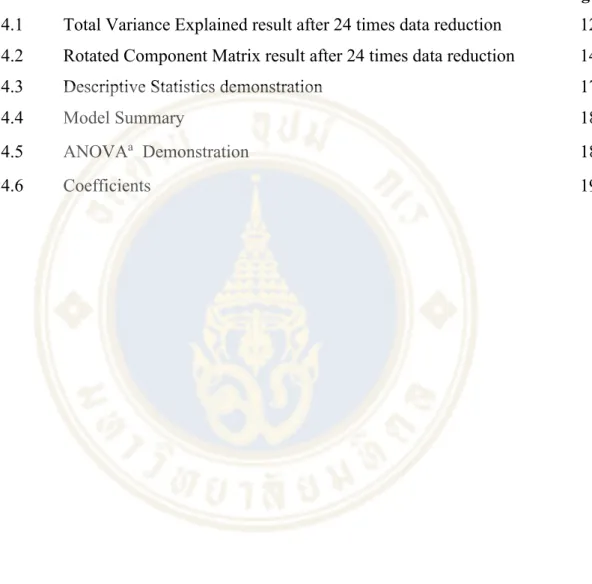
4.1 Total Variance Explained result after 24 times data reduction 12 4.2 Rotated Component Matrix result after 24 times data reduction 14
4.3 Descriptive Statistics demonstration 17
4.4 Model Summary 18
4.5 ANOVAa Demonstration 18
4.6 Coefficients 19
LIST OF FIGURES
Figure Page
2.1 The study of factors influencing people to purchase a business format franchise in Thailand.
6
4.1 Scree Plot result after 24 times data reduction 13
CHAPTER I INTRODUCTION
According to the statistical yearbook 2020 from the National Statistical Office Thailand (NSO), which the Bank of Thailand (BOT) announced, the average income of Thai people in 2020 is 14,409.18 baht. While the monthly average household expense is 21,329 baht. It is clear that the average income is significantly less than the average expense. To save money seems to be incredible in this situation if people still get the amount of income mentioned above.
Having alternatives to gain more income apart from the current job is common nowadays. Referring to Thailand's franchise business growth from the Department of Business Development (DBD) annual report 2020, it increases 20%
steadily each year on average. It has about 600 franchise businesses in Thailand with 100,000 branches all over Thailand. The interesting point is that the number of new franchisees is 15,000 - 20,000 each year. Therefore, it can assume that people are interested in investing in franchise business continuously.
There are many types of franchises that cannot tell how many of them are true statements. We see the common types in the market include distribution franchise, business format franchise, and investment franchise. The distribution franchise and investment franchise are big scale franchises that the investor needs to invest much money in the business. On the other hand, the business format franchise is easy to access because it is small to moderate scale. These are examples of business format franchise industries; fast-food restaurants, dine-in restaurants, bakery shops, shipping services, car care services, laundry machine service. The business format franchise provides the marketing strategy, quality standard, trademark, and operation to get the Franchisee's royalty fee, making the fastest growth compared to others (Frantine Lafontaine and Magaret E. Slade, 1998 ). The study of Weerapong Smanutthanon (2015) mentions that people who have a passion for being an entrepreneur but have never experienced doing business before, decide to purchase a franchise to start doing business.
The number of new franchisees each year, cited in the second paragraph, is an opportunity for people interested in initiating their own business and aiming to expand the business as a franchise in the future. It can also be an opportunity for people who have an existing business or a franchisor right now but need room to improve or develop the business to be a successful franchisor.
This study aims to help Thai entrepreneurs know the key success factors in doing a business format franchise. Suppose the entrepreneur establishes a successful business and wants to expand the business as a franchisor. In that case, the objectives and elements do not match the consumer's needs, which means the future Franchisee might fail as a franchisor role. This research will help determine the factors influencing people to purchase a business format franchise in Thailand by using the conceptual framework from the detailed franchise business literature review.
CHAPTER II LITERATURE REVIEW
According to the Department of Business Development (DBD) annual report 2020, Thailand's franchise business growth has increased 20% continuously on average. In 2020, the number of Thai franchisors was more than 600, and the number of branches was approximately 100,000. Each year the number of newcomers in the franchise business is extended to 15,000 - 20,000 franchisees. A business format franchise is one of the franchise types that could quickly grow compared with other franchise types. It provides the marketing strategy, quality standard, trademark, and operation to get the Franchisee's royalty fee ( Frantine Lafontaine and Magaret E. Slade, 1998 ). According to Weerapong Smanutthanon's (2015) study, people who are passionate about entrepreneurship but have no experience decide to buy a business format franchise that has already set the support system to start doing business. Thus, this research proposes to understand the intention to purchase a business format franchise in Thailand. The factors that influence people to decide on purchasing refer to literature reviews study. This study uses a conceptual framework from the literature reviews as the analysis.
2.1 Franchisor’s Performance
2.1.1 Brand reputation
Among franchise restaurants in Thailand, the most impact on franchisees' intention to buy the franchise is Brand reputation. It leads to a high number of customers and also high profit, which the Franchisee could get good financial results later (Weerapong Smanutthanon, 2015). A strong brand reputation franchise can also engage the local market easier than the small business, which needs more time to achieve it (Ehsan Asgharian Bourkheili, 2015 ). When people do not see the authentic product, it
seems to be hard to trust. Having many followers via social media channels can help the franchise gain trust from customers quickly (Sarita Kovatana, 2017).
2.1.2 Financial
Weerapong Smanutthanon (2015) stated that the second rank that the respondents scored to the influencing factor is very close to the first rank. "Financial" is what attracts the Franchisee to purchase the franchise. What the franchisees expect is to get a high return while investing in low investment and low risk. The financial factor also relates to the profitable system of the franchise. The profitable system significantly impacts the Franchisee's Performance and leads the Franchisee to survive in the market (Ehsan Asgharian Bourkheili, 2015).
2.1.3 Franchisor support
Based on Piyathida Praditbatuga (2006), many respondents prefer to purchase a franchise instead of establishing their own business to get the franchisor's support. (Ehsan Asgharian Bourkheili, 2015), the support includes training, raw material providing, and advertising. Even though the training is one of the franchisor's support, the franchisees pay less focus on it. They expect the guideline and the standard procedure instead of training (Weerapong Smanutthanon, 2015). On the other hand, the respondents prefer the support from the franchisor by providing raw materials in the franchise to save time and advertising the franchise to build customer's rationality in the local market and save operational costs.
2.1.4 Operation
Since the study of Weerapong Smanutthanon (2015) and Ehsan Asgharian Bourkheili (2015) focus only on restaurant franchises, the operation of the restaurant should not be complicated. The respondents have little concern about this factor; having clear instructions and contracts is enough for them. Apparently, it shows that people need a simple operation, so if the franchise has a complicated operation, it might decrease the buying intention of the Franchisee.
To be unique and different from others is one of the factors that the franchisees use to decide on purchasing a franchise because it can be an attractive point to gain customers' attention (Weerapong Smanutthanon, 2015).
2.1.6 Transferability
Worawit Srisawasdi (2015) stated that a successful franchise should have good transferability, which can adjust everywhere the franchise is located. So, the business can expand easily.
2.1.7 Systematization
The highest score from Worawit Srisawasdi's (2015) study, the key success factor in assessing the franchisability of restaurant franchises in Thailand is systematization. A good franchise system leads to good operation because the franchisor can work closely with the Franchisee and shape the operation to be on track easily.
2.2 Franchisee’s Performance
2.2.1 Absorptive capacity
In the competitive environment, the Franchisee with low absorptive capacity might not build a good performance because the Franchisee should keep learning new knowledge to adjust and manage the business; otherwise, the franchise cannot win against the franchisee competitors (Ehsan Asgharian Bourkheili, 2015).
2.2.2 Social capital
Ehsan Asgharian Bourkheili's (2015) study insists that even though the franchise has a strong brand reputation, to engage the new customers, the critical key is connection. Having social capital leads to good opportunities to get customers easily compared with none.
2.2.3 Managerial capability
Having managerial capability helps the Franchisee know others which means employees, so that the Franchisee can manage and deliver adequate tasks to each employee very well (Ehsan Asgharian Bourkheili, 2015).
Based on the literature reviews, the conceptual framework determines two types of aspects that influence people to purchase the business format franchise in Thailand, including Franchisor's Performance and Franchisee's Performance. The Franchisor's Performance consists of brand reputation, financial, franchisor support, operation, brand differentiation, transferability, and systematization. The Franchisee's Performance consists of absorptive capacity, social capital, and managerial capability.
To summarize these aspects that impact the intention to buy, ten factors are mentioned as the various restaurant industry studies mentioned. Therefore, this study will clarify the factors in general, not just the restaurant franchise.
Figure 2.1 The study of factors influencing people to purchase a business format franchise in Thailand.
Franchisor’s Performance 1. Brand reputation 2. Financial
3. Franchisor support 4. Operation
5. Brand differentiation 6. Transferability 7. Systematization
Franchisee’s Performance
1. Absorptive capacity 2. Social capital
3. Managerial capability
Factors influencing people to purchase a business format franchise in Thailand
CHAPTER III
RESEARCH METHODOLOGY
3.1 Research Approach
This study was conducted to discover the factors that impact Franchisee's intention to purchase a business format franchise. The purpose is to help the entrepreneur know how to distribute or develop the business format franchise to attract the Franchisee from the buyer's point of view. Although many industries are joining the franchise platform nowadays, almost all existing research focuses only on the restaurant industry. This quantitative research will study the factors in general. So, all franchise industries can learn from it.
3.2 Data Collection
The selected methodology of this study is a survey that used the Google form to collect the data via an online channel. The researcher chose SPSS software to analyze the factors influencing people to purchase a business format franchise after getting the results from 224 respondents. The data collected from three groups of people, including
3.2.1 Existing franchisee and Experienced franchisee
This group of people has real experience in doing a business format franchise. They have already confronted the decision-making part and obstacle in the franchise before. So, this study gets clear answers which are close to real-life from this group.
3.2.2 Interested to be a franchisee
Those interested in becoming a franchisee are passionate about doing a business and close to the decision-making step. This group of people gives the opinion from the expected needs.
3.2.3 Not interested to be a franchisee
Basically, some people are not interested in doing business or in a franchise business. This group of people might not have the expected points of doing Franchisee in mind, but they can express what it should be in their opinion.
3.3 Survey Questions
According to literature reviews, the aspects influencing people to purchase a business format franchise can be divided into two parts: Franchisor's Performance and Franchisee's Performance. To clarify them more, ten attributes can be factors of this study. The ten attributes include Brand reputation, Financial, Franchisor support, Operation, Brand differentiation, Transferability, Systematization, Absorptive capacity, Social capital, and Managerial capability. The questions are closed-ended questions from the ten attributes, which ask the respondents to give the opinion from strongly disagree to strongly agree. In addition, there are 40 shuffled specific questions from the attributes, two demographic questions, one screening question, one consistency question, and one intention to buy question as follows.
1. Which group defines you in a business format franchise?
- Existing franchisee and Experienced franchisee - Interested to be a franchisee
- Not interested to be a franchisee
2. I think that a well-known franchise can lead to a high profit.
3. I prefer to get high returns while investing in low investment and low risk.
4. I would like to invest in a high return franchise even though I have to work very hard.
5. I think being different from competitors can get more profits.
success even if the franchise is perfect.
7. Having good absorptive capacity leads to success.
8. I think a strong operation leads to success.
9. If there is no franchisor support, my business will fail.
10.I think good finances lead to success.
11.I think that a well-known franchise can lead to a high number of customers.
12.I think to be creative can gain more customers than to be on the trend.
13.Having connections helps me get new customers easily.
14.I think financial has the most impact to get attention from the investor.
15.I think it is important to have a franchisor to help me do the business.
16.I think the complicated operation distracts investor’s attention.
17.I think to survive in the business is to easily adjust to every environment.
18.I think that a franchisor’s support can reduce time consuming.
19.It is important to be flexible in every situation.
20.I think a good systematization leads to good operation.
21.I think having interpersonal skills is very important to do business.
22.I think a good reputation can lead a franchise to success easily.
23.I think people who are not willing to learn new things cannot do a franchise business very well.
24.I think everyone can manage the business.
25.I think it would be better to have a strong social capital before opening a new franchise.
26.Although being different is hard to engage in the mass market, I am willing to be different.
27.I want to be different from competitors.
28.I prefer to purchase a well-known franchise.
29.I prefer to buy a business format franchise which has a good support from a franchisor than a low support franchisor.
30.I would like to have the franchisor construct me in doing the business.
31.It is important to follow the manual.
32.I want to expand the business to a different area if I have a chance.
33.I think it is important to be eager to learn new things in my franchise business even if the franchise is processed.
34.I can succeed in a business even if I don’t have franchisor support.
35.I prefer to have an easy accessible location.
36.I think a strong systematization can make a good relationship between franchisor and franchisee.
37.I prefer to set up the operation on my own.
38.I prefer not to be monitored by the franchisor.
39.I prefer to know everything clearly even though I have a guideline from the franchisor.
40.I prefer to have a good social capital before doing a business.
41.I am sure I can train and manage my staff very well.
42.Having connections is like an advertisement to my franchise.
43.What is your gender?
- Male - Female - Not specify
44.What is your income range?
- Below 20,000 THB - 20,001- 40,000 THB - 40,001- 60,000 THB - More than 60,000 THB
45. If I found the matched business format franchise with my preference, I would purchase this franchise in 1 year.
- Yes - No
CHAPTER IV DATA ANALYSIS
This chapter presents the survey result from 224 respondents. The questionnaire was launched via Google form. After collecting data, 15 responses cannot be analyzed. These failed responses include two no-answer responses, six missed some parts responses and seven conflicts with the consistency questions responses. Therefore 209 responses can be used in the analysis.
Since three questions are the reversed question, the three questions were transformed by the recoding process to the same variable before analyzing the data.
Thus, after getting a factor analysis, there are cross-loadings, low factor loadings, and mismatched meaning. Thus, this factor analysis was conducted 24 times to cut the insignificant variables until it delivered the significant factors below.
4.1 Factor Analysis
Factor Analysis is a statistical tool that is used for identifying which factors are measured. This study defines the factors influencing people to purchase a business format franchise in Thailand by using Total Variance Explained, Scree plot, and Rotated Component Matrix. Before processing to factor analysis, there are ten attributes with four variables per each; therefore, there are 40 variables that are prepared for the factor analysis. After processing the factor analysis, the result is as follows.
4.1.1 Total Variance Explained
Table 4.1 Total Variance Explained result after 24 times data reduction
Component
Initial
Eigenvalues Rotation Sums of Squared Loadings
Total
% of Variance
Cumulative
% Total
% of Variance
Cumulative
%
1 5.861 34.478 34.478 3.221 18.945 18.945
2 1.778 10.460 44.938 2.741 16.124 35.069
3 1.348 7.927 52.865 2.328 13.692 48.761
4 1.166 6.860 59.725 1.573 9.251 58.013
5 1.137 6.690 66.415 1.428 8.403 66.415
6 .744 4.375 70.790
7 .693 4.076 74.867
8 .605 3.560 78.426
9 .551 3.244 81.670
10 .541 3.184 84.855
11 .489 2.875 87.730
12 .415 2.443 90.173
13 .377 2.217 92.390
14 .345 2.030 94.420
15 .340 2.000 96.420
16 .315 1.854 98.273
17 .294 1.727 100.000
Extraction Method:
Principal Component Analysis.
According to table 4.1, only 17 out of 40 significant components, but only 5 out of 17 components that the Eigenvalues ≥ 1. The rest got low scores which cannot be represented as a real fundamental factor. The cumulative % should be more than 60%, and the fifth component got 66.415% cumulative, which is acceptable. Thus, it is clear that five fundamental factors represent the factor of the study.
.
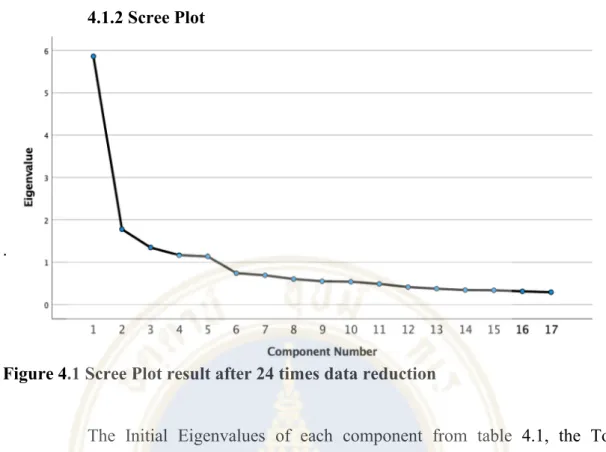
Figure 4.1 Scree Plot result after 24 times data reduction
The Initial Eigenvalues of each component from table 4.1, the Total Variance Explained result are plotted on this graph. There is a clear separation between the fifth component and the sixth component. After the fifth component, the graph becomes horizontal, which means the sixth to the seventeenth components cannot represent the fundamental factor. Therefore, the optimal components of this study are five components.
According to the Total Variance Explained and Scree Plot result, it can obviously see the fundamental factors from Total Variance Explained aligns with the Scree Plot. Hence, there are five vital factors influencing people to purchase a business format franchise in Thailand.
4.1.3 Rotated Component Matrix
Table 4.2 Rotated Component Matrix result after 24 times data reduction
Component
1 2 3 4 5
I think it is important to be eager to learn new things in my franchise business even if the franchise is processed.
.775
I think to survive in the business is to easily adjust to every environment.
.762
I want to expand the business to a different area if I have a chance.
.739
I prefer to have an easy accessible location.
.679
It is important to be flexible in every situation.
.670
I think it would be better to have a strong social capital before opening a new franchise.
.799
I prefer to have a good social capital before doing a business.
.796
Having connections is like an advertisement to my
franchise.
.754
Having connections helps me get new customers easily.
.730
Extraction Method: Principal Component Analysis.
Rotation Method: Varimax with Kaiser Normalization
Component
1 2 3 4 5
I think it is important to have a franchisor to help me do the business.
.741
If there is no franchisor support, my business will fail.
.728
It is important to follow the manual.
.705
I think that a franchisor’s support can reduce time consuming.
.668
Although being different is hard to engage in the mass market, I am willing to be different.
.796
I think to be creative can gain more customers than to be on the trend.
.754
I think a weak managerial capability in a franchisee cannot lead to success even if the franchise is perfect.
.875
Having good absorptive capacity leads to success.
.570
Extraction Method: Principal Component Analysis.
Rotation Method: Varimax with Kaiser Normalization
The result of the Rotated Component Matrix demonstrates five components with the factor loading > 0.4, no cross-loading, and no mismatched meaning. The first component is measured by five variables. The second component is measured by four variables. The third component is measured by four variables. The fourth component is
measured by two variables, and the fifth component is also measured by two variables.
Therefore, all the variables can be clarified as follows.
Component 1 is measured by,
- I think it is important to be eager to learn new things in my franchise business even if the franchise is processed.
- I think to survive in the business is to easily adjust to every environment.
- I want to expand the business to a different area if I have a chance.
- I prefer to have an easy accessible location.
- It is important to be flexible in every situation.
These variables can be categorized as “Transferability”.
Component 2 is measured by,
- I think it would be better to have a strong social capital before opening a new franchise.
- I prefer to have a good social capital before doing a business.
- Having connections is like an advertisement to my franchise.
- Having connections helps me get new customers easily.
These variables can be categorized as “Social Capital”.
Component 3 is measured by,
- I think it is important to have a franchisor to help me do the business.
- If there is no franchisor support, my business will fail.
- It is important to follow the manual.
- I think that a franchisor’s support can reduce time consuming.
These variables can be categorized as “Franchisor Support”.
Component 4 is measured by,
- Although being different is hard to engage in the mass market, I am willing to be different.
- I think to be creative can gain more customers than to be on the trend.
These variables can be categorized as “Brand Differentiation”.
Component 5 is measured by,
- I think a weak managerial capability in a franchisee cannot lead to success even if the franchise is perfect.
These variables can be categorized as “Capability Development”.
4.2 Multiple Regression
Multiple Regression is used for predicting the value of the intention to buy, which is a dependent variable by five independent variables including Transferability, Franchisor Support, Social Capital, Brand Differentiation, and Capability Development.
The selected outputs to predict the value in this study are Descriptive Statistics and ANOVA.
4.2.1 Descriptive Statistics
Table 4.3 Descriptive Statistics demonstration
Mean Std. Deviation N
If I found the matched business format franchise with my preference, I would purchase this franchise in 1 year.
1.55 .499 209
Transferability 4.4127 .51211 209
Social_Capital 4.2249 .64181 209
Franchisor_support 3.9522 .61049 209
Brand_differentiation 4.0478 .72065 209
Capability_development 4.2081 .65117 209
Referring to the Descriptive Statistics, the mean score is analyzed from 209 respondents. The highest mean score is Transferability, followed by Social Capital, Capability Development, Brand Differentiation, and Franchisor Support.
Thus, to rank all the constructs can state that the most impact is Transferability, and the least is Franchisor Support. The factors can be ranked as the following.
1. Transferability 2. Social Capital
3. Capability Development 4. Brand Differentiation 5. Franchisor Support
4.2.2 Model Summary
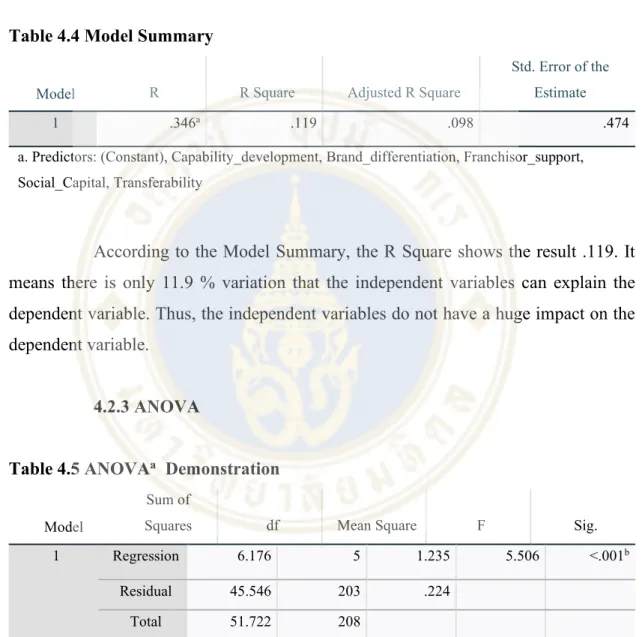
Table 4.4 Model Summary
Model R R Square Adjusted R Square
Std. Error of the Estimate
1 .346a .119 .098 .474
a. Predictors: (Constant), Capability_development, Brand_differentiation, Franchisor_support, Social_Capital, Transferability
According to the Model Summary, the R Square shows the result .119. It means there is only 11.9 % variation that the independent variables can explain the dependent variable. Thus, the independent variables do not have a huge impact on the dependent variable.
4.2.3 ANOVA
Table 4.5 ANOVAa Demonstration
Model
Sum of
Squares df Mean Square F Sig.
1 Regression 6.176 5 1.235 5.506 <.001b
Residual 45.546 203 .224
Total 51.722 208
a. Dependent Variable: If I found the matched business franchise format with my preference, I would purchase this franchise in 1 year.
b. Predictors: (Constant), Capability_development, Brand_differentiation, Franchisor_support, Social_Capital, Transferability
The Anova result shows that the independent variables can predict the intention to buy because the significance of the F-test is <.001 which is less than 0.05.
Social Capital, Capability Development, Brand Differentiation and Franchisor Support can predict the intention to buy.
4.2.4 Coefficients
Table 4.6 Coefficientsa
Model
Unstandardized Coefficients
Standardized
Coefficients t
Sig.
Correlations
B Std. Error Beta
Zero- order
1 (Constant) 2.688 .327 8.208 <.001
Transferability -.081 .083 -.083 -.984 .326 -.203
Social_Capital .009 .061 .012 .146 .884 -.122
Franchisor_support -.259 .062 -.318 -4.154 <.001 -.328 Brand_differentiation -.029 .050 -.041 -.569 .570 -.100
Capability_development .077 .056 .101 1.370 .172 -.043
From the result of Coefficients, Franchisor Support is the only one whose significance level is lower than the significance level of .005 which is <.001. So, it means that Franchisor Support is the only factor that predicts the intention to buy.
CHAPTER V
CONCLUSION AND RECOMMENDATIONS
5.1 Conclusion
This study was conducted by surveying 224 respondents via a google form questionnaire to find the factors influencing people to purchase a business format franchise in Thailand. There are only 209 responses that can be analyzed. There are ten factors mentioned from the previous studies, and these ten factors are categorized into two groups, including Franchisor's Performance and Franchisee's Performance. The researcher created four specific questions for each factor. Thus, there are 40 specific questions to ask the respondents giving the opinion from strongly agree to strongly disagree.
After processing the factor analysis, the fundamental factors which represent the factors influencing people to purchase a business format franchise in Thailand are only five factors ranking as the following.
1. Transferability 2. Social Capital
3. Capability Development 4. Brand Differentiation 5. Franchisor Support
Accordingly, the factors are from both Franchisor's Performance and Franchisee's Performance. Franchisor's Performance includes Transferability, Brand Differentiation, and Franchisor Support. Franchisee's Performance includes Social Capital and Capability Development. It means an entrepreneur who wants to establish or develop a business format franchise in Thailand can specifically focus on Transferability, Brand Differentiation, and Franchisor Support.
According to the study of Weerapong Smanutthanon (2015), the factors which affect the intention to buy a food business franchise can be ranked as Brand Reputation, Financial, Franchisor Support, Operation, and Brand Differentiation.
Compared to this research, two factors match with the study of Weerapong S. (2015), which can group these two factors in Franchisor's Performance. The matched factors are Franchisor Support and Brand Differentiation, but this research result ranks Brand Differentiation higher than Franchisor Support, which differs from Weerapong S.
(2015). The interesting point is that the first two rankings of Weerapong S. (2015), Brand Reputation and Financial, are not the significant factors in this research, even though these two factors were included in 10 attributes of this study. The reasons for the difference between these two studies might be about the trend in the different years of the studies, the different focused groups, or the different number of sample factors.
Another Franchisor's Performance which is the highest score in this study, is Transferability. This factor matches with the fourth-ranking out of five from Worawit Srisawasdi (2015)'s study that focuses on restaurant franchises in Thailand. However, even though the other four factors of Worawit S. (2015)'s study are also on the list of 10 attributes of this research, the results are not the same. The reasons for the difference might be similar to Weerapong S. (2015), the trend of the difference of time and the different focused groups. However, for the number of sample factors, the study of Worawit S. (2015) also used ten attributes to analyze the same as this research.
The selected factors of Franchisee's Performance group in this research, Absorptive Capacity, Social Capital, and Managerial Capability, are from Ehsan Asgharian Bourkheili's (2015) study. Social Capital is on the second rank of this research. For Absorptive Capacity and Managerial Capability, both factors were categorized as the same component after processing the factor analysis. Therefore, both can gather in the same component, so naming a new name as Capability Development factor is completely matched. Therefore, this factor is ranked as the third-ranking.
Although it is approximately five years different and Ehsan Asgharian Bourkheili (2015)'s were distributed in Iran and Sweden, the trend remains.
5.3 Recommendations
Referring to the Discussion, it is clear that Franchisor's Performance, including Transferability, Brand Differentiation, and Franchisor support, can change by time and different businesses. Meanwhile, Franchisee's support, including Social Capital and Capability Development, remains the same even though the time has changed and the samples were distributed in different countries. Therefore, entrepreneurs should focus on developing the Franchisor's Performance to influence franchisees to purchase a franchise business easily. For Franchisee's Performance factors, it is out of a franchisor or an entrepreneur control. Thus, the recommendations focus only on Transferability, Brand Differentiation, and Franchisor Support.
The recommended model is the 4Ps of Marketing. It is used for projecting the goods or services to be successful in the market. The 4Ps include Product, Price, Place, and Promotion. Since the customer is a franchisee, the product is a franchise. To attract the customer, the franchisor should be creative by differentiating the brand from the competitors or losing the customers. Another important thing in the product is adding the franchisor support as a general service. The transferability factor, it relates to place. The location or the channel should be easy to access or easily adjustable. Being flexible can reduce unexpected circumstances in the future, so it benefits in the long run.
For the price and promotion they may not be defined as the factor of this study, but the franchisor should maintain them reasonably.
5.4 Limitation
This study focuses on all franchise industries. It means the result of the factors influencing people to purchase a business format franchise in Thailand is in general. Thus, this study might be suitable for a franchise which sells products more than provides services because there might be some different essential impacts in each service industry. So, the factors for some service franchises might not be the same as this study. For example, the logistic service franchise, the most impact might be brand reputation because customers leave their belongings with the shop and expect safety and fast delivery from the service. If the brand has a good reputation in safety and fast, it will motivate customers to use the service easily. So, brand reputation might be one of
reputation is not a strong factor in this study. Hence people who want to know the factors influencing people to purchase a business format franchise in the service industry should do a deep study as individuals again.
5.5 Future Research
According to the discussion part, some factors are changed, but some remain when compared to the existing studies. It would be great to know what impacts the change of each factor. Then people will know what factors influence people to purchase a business format franchise in Thailand and also when or why the factors will change.
REFERENCES
Bourkheili, E. A. (2015). Performance in Franchise Systems: The Franchisee Perspective. Linköping University. http://liu.diva portal.org/smash/get/
diva2:868056/FULLTEXT01
D.B.D. (2021). DBD Annual Report 2020: Franchise Business Promotion (Page 46).
Department of Business Development. https://www.dbd.go.th/download/
publicdevelop_file/annualreport/annualreport_ThEng63.pdf
de Maeyer, P. (2021, March 23). CMMU Digital Archive: The potential success factors for SMEs social commerce in Thailand. CMMU.
https://archive.cm.mahidol.ac.th/handle/123456789/2664
Huang, Y.-A., Phau, I., & Chen, R. W. K. (2007). Conceptualizing the Franchise System Quality (FSQ) Matrix. Researchgate. https://www.researchgate.net/
publication/233058570_Conceptualizing_the_Franchise_System_Quality_
FSQ_Matrix
Lafontaine, F., & E. Slade, M. (1998). Incentive contracting and the franchise decision.
National Bureau of Academic Research. https://www.nber.org/system/
files/working_papers/w6544/w6544.pdf
Praditbatuga, P. (2005). Reaching the decision to purchase a franchise in Thailand.
Assumption University. https://aujm.au.edu/index.php/aujm/article/
download/71/56
Thamsatitdej, P. (2021a, March 23). CMMU Digital Archive: Factors influencing Thai entrepreneurs intention to buy Thai Franchised food business. CMMU.
https://archive.cm.mahidol.ac.th/handle/123456789/1374
Thamsatitdej, P. (2021b, March 23). CMMU Digital Archive: The key success factors for assessing the Franchisability of Franchise restaurant business in Thailand. CMMU. https://archive.cm.mahidol.ac.th/handle/123456789/
1364