IDENTIFY THE POTENTIAL KEY SUCCESS FACTORS FOR TRANSFERRING A TRADITIONAL BIKE AND MORTAR RESTAURANT ONLINE KRIP JARUPRAVIT 5549042. This article attempts to identify the key factors for transforming a traditional restaurant into an online business by identifying key success factors and potential online channels. This study also prioritizes the key success factors and the online channel that brick-and-mortar restaurant owners use in their online business.
I would like to know how to successfully present a traditional restaurant online. The purpose of this study is to identify the key success factors in using online tools for brick-and-mortar restaurants to bring products and services from a physical location to the web. With this, I expected the critical success of transferring a traditional restaurant to an online business.
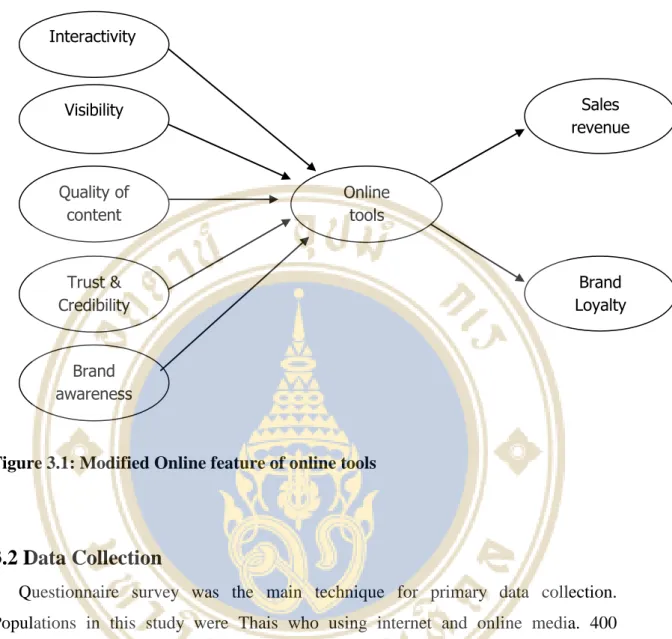
Online tools
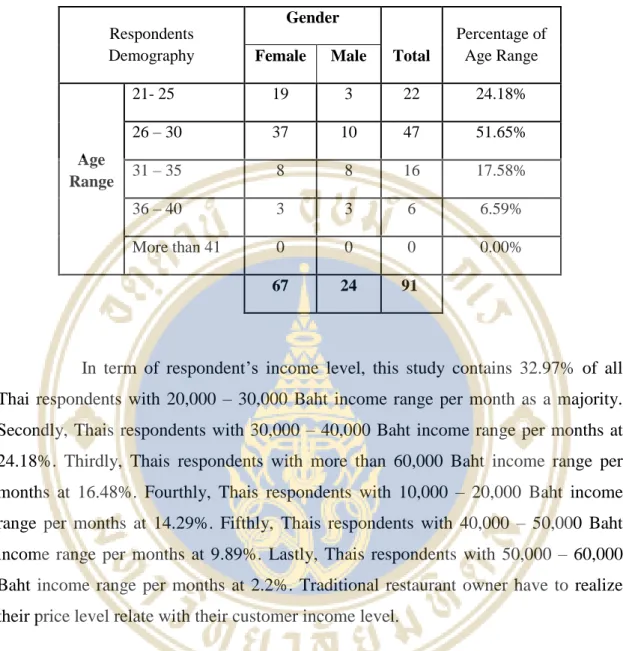
Thai consumer's behavior and competitiveness of the restaurant are factors that contribute to the restaurant business networks are still on the growing trend. During the year 2012 of Euromonitor International, Thai people spend their money at the food service provider that is not a business network, on average 7,481 baht / person, 3.3% down from the year 2007. While the spending of the food service provider with a network in average, 2,431 baht / person in 2007 is 28.7% higher than last year. With all the mentioned advantages, social network is one of the potential tools that can help support traditional restaurant to survive in the highly competitive market.
Pawoot Pongvitayapanu (2013), president of the Thai E-Commerce Association, confirmed that the figure of 10 percent of the 19 million Facebook users in Thailand.
Perceived benefit of social networks
Social networks and consumer-generated content give users the opportunity to interact in real time, as well as to create constant and large user bases (Kozinets, 2002; Harris and Rae, 2009). This is one of the successful approaches to popularize social networking in the internet world. Once the company provides proper and sufficient basic information to Internet users, more members can participate in the social networks.
That is why it is important for the companies to give proper information in social networks and listen to it. The leading social networks are concerned about this aspect because nowadays users pay more attention to privacy issues. Moreover, online competitions also give networkers the opportunity to show their skills, which can stimulate the interaction and increase the number of members in social networks (DiIworth, 2009).
It is a tool that allows customers to ask questions about products/services to the companies, including filing complaints, allowing members to express their opinions and become more familiar with the social networks. The companies that integrate social networks have the ability to attract users or members who visit and share regularly. Another expected benefit of social networks is that members should have greater brand awareness and loyalty after participating in the networks (Muniz and Schau, 2007; Rae and Harris, 2009; McLaughlin and Davenport, 2010).
Although the ultimate results from social networking strategies for business are increased sales and profits, according to the study, the main benefit of social networking is gaining clear customer insights. Social networks help companies truly understand customer needs and attitudes, and build brand loyalty among customers.
DATA COLLECTION
Research Methodology
Data Collection
RESEARCH FINDINGS
Data Analysis
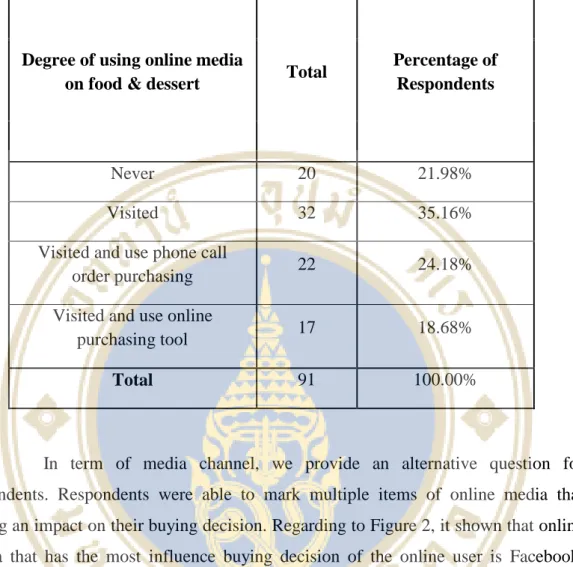
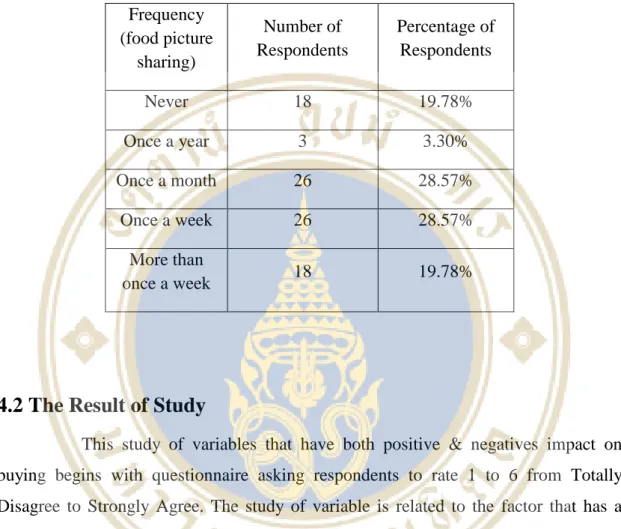
In terms of the extent to which online media are used for food and dessert content, this study shows that 78.02% of respondents ever visit a food and dessert website or media. 24.18% of respondents have ever visited food and dessert content online and made a purchase via a phone call. Moreover, 18.68% of respondents have ever visited and purchased food and dessert through an online purchasing tool, as shown in Table 4.4.
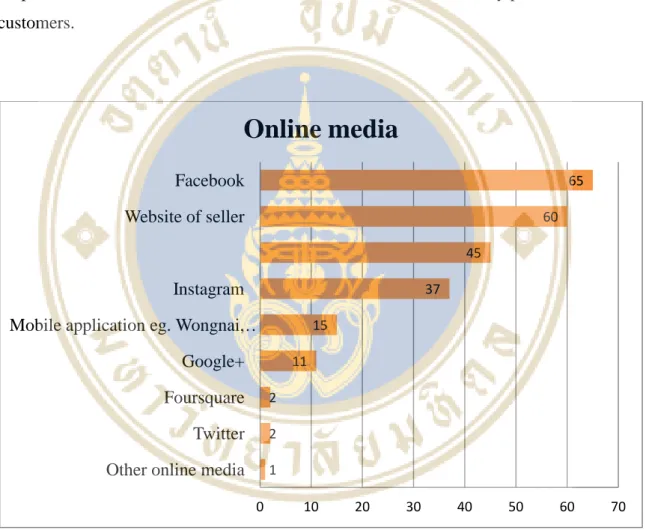
Respondents were able to mark several items from online media that have an impact on their purchase decision. Regarding Figure 2, it showed that online media that most influence the purchase decision of the online user is Facebook, which 65 respondents or 71.42% of all respondents think that it has an impact on their purchase decision. This may imply that most of the online users think that food and dessert ads on Facebook have the most impact on their purchase decision.
Second, the site for sellers, which is usually created and managed by all the content of the site owner, is also one of the most important online tools that the respondent. 60 respondents or 65.93% of all respondents believe that the seller's website has an influence on their decision to purchase food and dessert. 37 respondents or 40.65% of all respondents believe that this mobile application influences their food and dessert purchasing decision.
These media channels will optimize the visibility of their product and the business owner can focus on the channel that had the most views and visits from potential customers online. This may mean that they have already used the social network and already contribute to the content of the restaurant.
Online media
The Result of Study
- Interactivity toward Buying Decision
- Quality of Content toward Buying Decision
- Trust & Credibility toward Buying Decision
- Brand Awareness toward Buying Decision
- Visibility toward Buying Decision
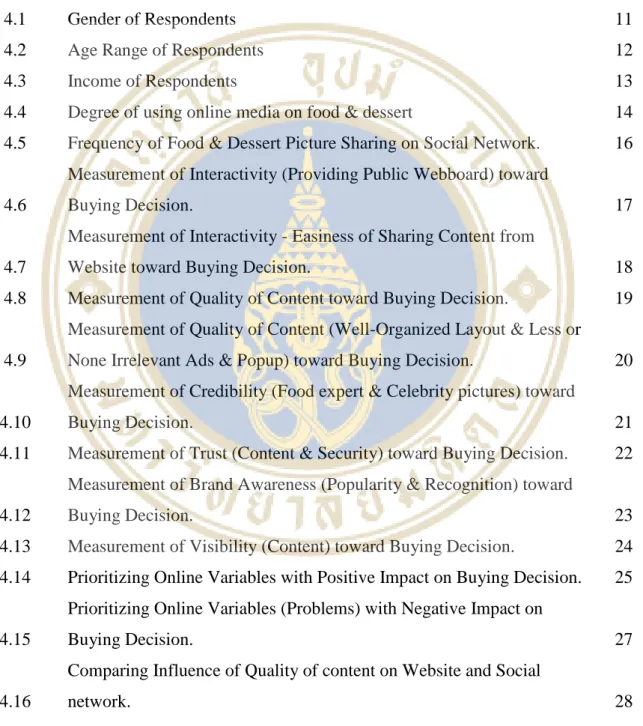
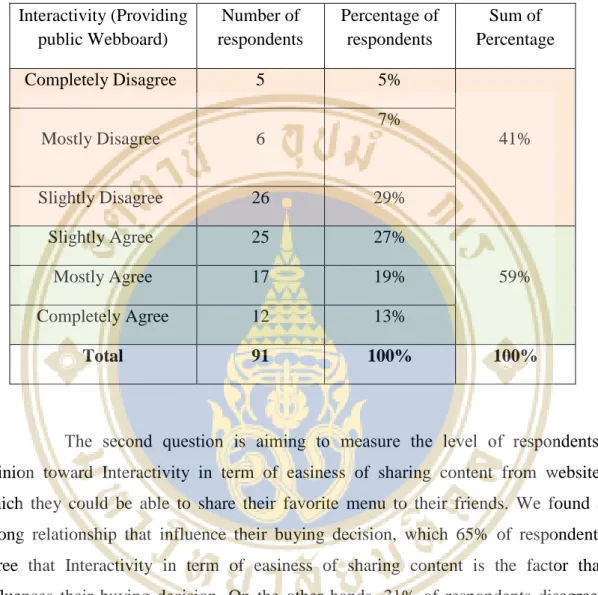
The study of variable is related to the factor that has a positive impact on their purchase decision of the respondents. The first question aims to measure the degree of the factor that has a positive impact on the respondents' purchase decision in terms of interactivity, in the form of websites that provide the public space or Webboard for them to ask a question and make sense of a restaurant. We found that 59% of respondents agree that interactivity is the factor that influences their purchase decision on websites, as shown in Table 4.6.
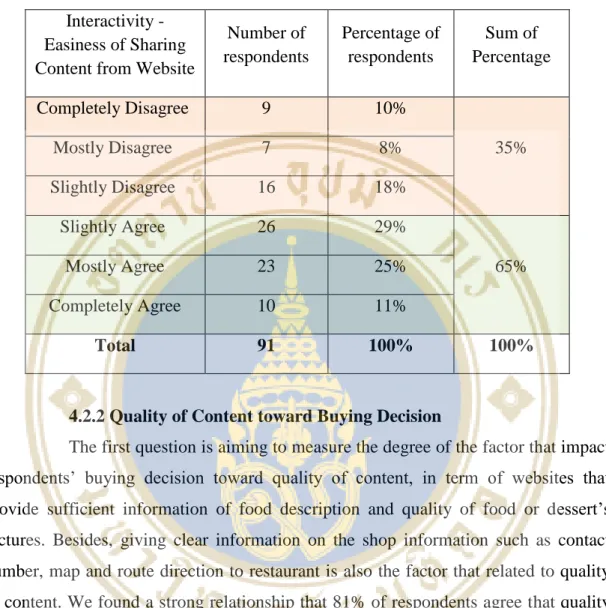
We found a strong relationship that influences their purchase decision, with 65% of respondents agreeing that interactivity in terms of ease of sharing content is the factor that influences their purchase decision. On the other hand, 31% of the respondents do not agree that this factor has a positive impact on their purchase decision as shown in Table 7. in terms of websites providing sufficient information of food description and quality of food or dessert's photos.
We found a strong relationship: 81% of respondents agree that the quality of content is the factor that influences their purchase decision on the website, as shown in Table 4.8. There is a strong correlation, with 69% of respondents agreeing that the quality of content, in terms of well-organized layout and construction, influences their purchasing decision, as shown in Table 4.9. We found that 50% of respondents agree that interactivity is the factor that influences their purchasing decision.
On the other hand, 50% of the respondents do not agree that the credibility factor using pictures of nutrition experts and celebrities posted on the website affects their purchase decision as shown in Table 4.10. We found the highest correlation with 89% of respondents agreeing that seller trust and credibility in terms of providing security in an online transaction are factors that influence their purchase decision in Table 11. There is a strong correlation with 85% of respondents agreeing. the brand recognition factor affects their purchase decision, as shown in table 4.12.
There is a strong relationship, with 86% of respondents agreeing that visibility influences their purchasing decision, as shown in Table 4.13.
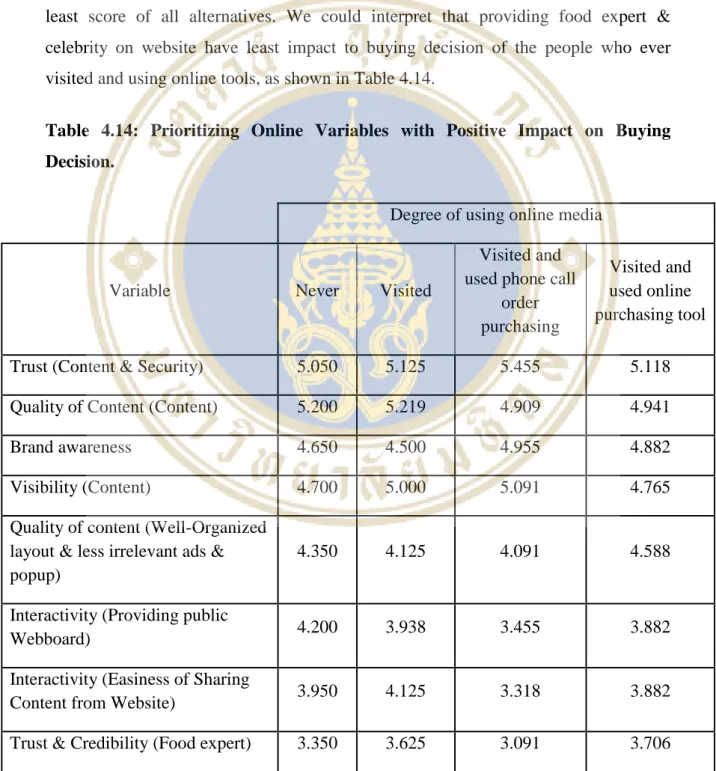
Prioritize Online Variables
Sixth, Interactivity, in terms of providing a public web board where the customer can ask the question and the ease of sharing content from the website to other online applications and other social media, we found that the average score is less than 4 .00, i.e. 3.882. We also provided the same variable by asking respondents about an issue related to the same online variable. This research aims to confirm the issues that negatively impact the purchasing decision of online respondents.
In this analysis, we would like to focus on respondents who have ever visited the website and have already used the online shopping tool. Third, the quality of content, in terms of the display of irrelevant banners and advertisements on websites, is thought to have a negative impact on the purchase decision of respondents with an average score of 4.47. First of all, brand awareness, in terms of low or no brand recognition, is considered to have a negative impact on the respondent's purchase decision with an average score of 4.24.
Finally, visibility in the sense of not being able to view updated content 24 hours or poor website domain reliability has a negative impact on the respondent's purchase decision with an average score of 4.00 out of 6. We found a smaller association between the negative impact on the purchase decision and interactivity factors, without providing public web boards and no social sharing tool, with a mean score of 3.53 and 3.47, respectively. In addition, we also found that there is less negative impact on the respondents' purchase decision in terms of trust and credibility without the review of food experts and the attached image of a celebrity, as shown in Table 4.15.
We had given a questionnaire regarding the quality of the content; in the form of social network provide sufficient information about food description and the quality of food or desserts images. However, the average score of the website's content quality is higher than the social network as shown in Table 4.16.
DISCUSSION & CONCLUSION
Recommendation
Finally, the delivery unit must deliver food below the quality accepted by the customer in terms of time and place confirmed by the call center or staff with the customers. Restaurants can build revenue and strengthen their brand online by building brand awareness among a targeted audience. From using the concept of brand positioning to creating a meaning-filled image and communication message, there are many ways restaurant owners can approach brand awareness.
Accelerating brand recognition by leveraging market positioning, developing a visual presence, creating an advertising and marketing plan, and establishing loyalty in both offline and online business could increase brand awareness. By doing this, we can gain more customer insights and opinions about online tools, which could give us more detailed and accurate data.
Conclusion