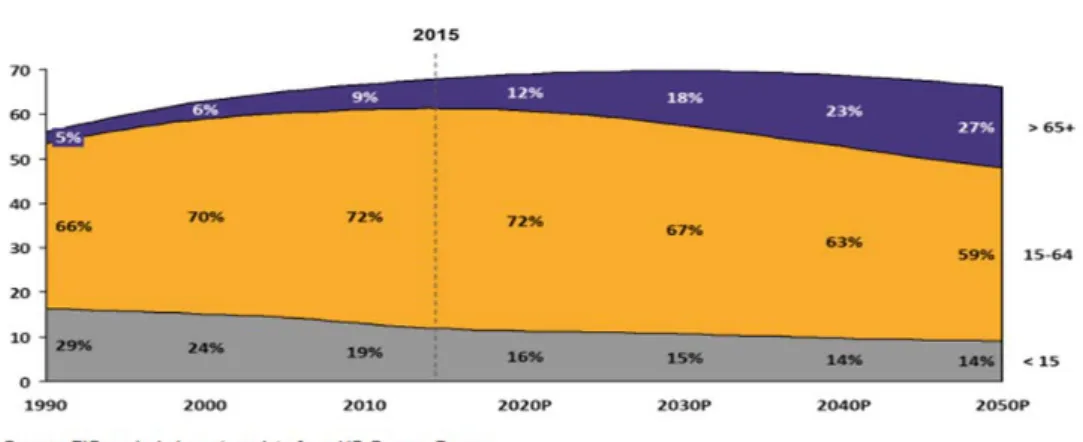
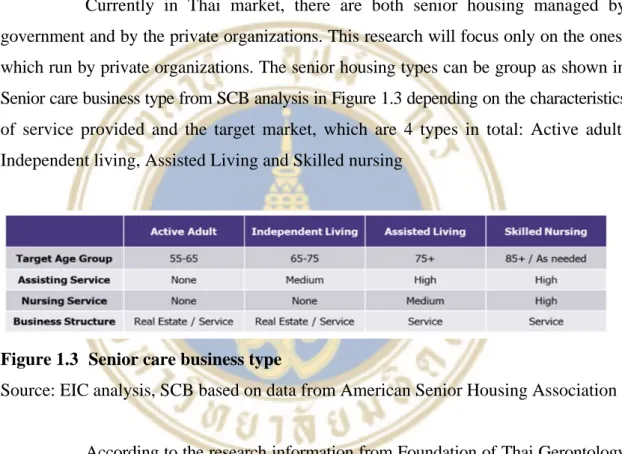
As Thailand approaches the age of the elderly, there is an increasing number of senior housing companies in the market to respond to the increasing demand. This paper will provide information on insights of Thai elderly about the senior housing business, their potential to stay in senior housing and also their expectations and perspective. Even though there are business opportunities in senior housing to respond to the needs of Thai elderly, there are challenges that business developers must consider as mentioned in the next section.
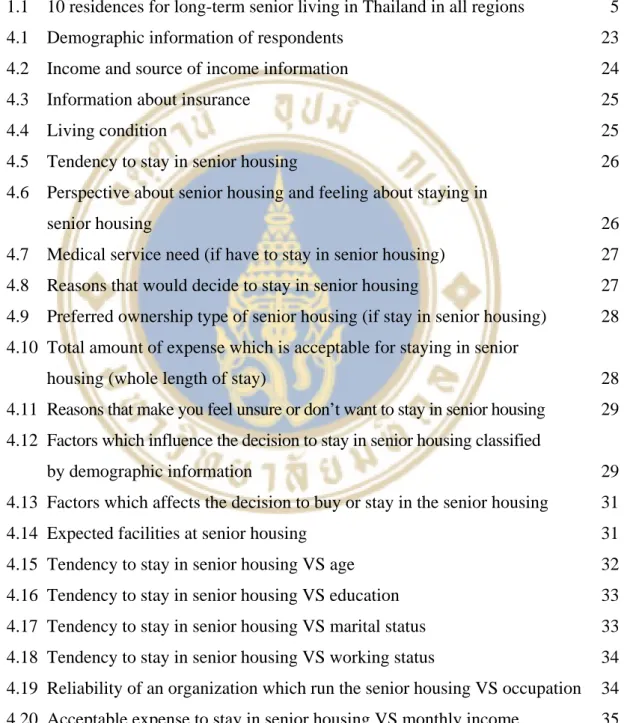
Senior Housing Market
Even though there are business opportunities in senior housing to respond to the needs of Thai elderly, there are challenges that business developers must consider as mentioned in the next section. senior housing has unique strengths that serve at different price ranges due to its location, decoration, facilities, activity and service provided as described below.

Challenges of Senior Housing Business
Problem Statement
Research Questions
Objective of This Study
Scope of the Study
Definition
LITERATURE REVIEW
- The Customer Buying Decision Process Theory
- Preferences of Thai Senior Housing
- Preference to stay in senior housing
- The preference towards senior housing
- Collectivism and Individualism
- Culture and Housing Norms in Thailand
- The Changing Economy
- Retirement Housing in Thailand
- The Demand of Senior Housing
- The Framework of Study
The steps in the purchasing decision process are influenced by consumer involvement and the personal, social and economic meaning of the purchase to the consumer. Extensive troubleshooting requires significant time at each stage of the consumer's purchasing decision process. In the US, there are many housing options available to meet the needs of the senior population.
RESEARCH METHODOLOGY
- Research Design
- Sample Selection
- Sample characteristics
- Population and Sample size
- Instrument & Measurement
- Research Questionnaire
- Measurement
- Data Collection
- Data Analysis
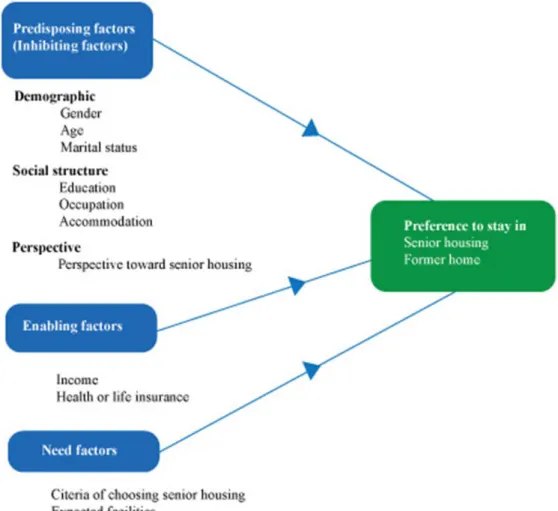
A quantitative approach allows the analysis of the relationship between potential variables and people's perspectives on senior housing. The researcher also added an open-ended question to explore in-depth data on Thai elderly people's preference and opinion towards senior housing. The data was collected using paper-based questionnaires. The questionnaire consisted of three parts, shown in Figure 1.4. The questionnaire was developed based on the behavioral model of health care service use (Andersen, R. & Newman J.F., 1973).
Part A: Predisposing (residential) factors, which include information on demographics (gender, age and marital status), social structure (education, employment status, occupation, people they live with, type of accommodation, type of accommodation ownership) and their perspective apartments for the elderly. Part A described the profiles of the respondents in terms of their predisposing factors (residence) which are demographics, age, education and study about their view and views on senior housing, how they see living in senior housing, see the possibility and aspiration, to stay in apartments for the elderly. Part B analyzed their driving factors, which are income and health/life insurance, to understand whether this affects the choice of senior housing or the decision to stay or not stay in senior housing.
Part C: Need factors include criteria for choosing senior housing (need for medical care, factors influencing the decision to stay in senior housing, preference for ownership type of senior housing, acceptable costs of senior housing, factors influencing the decision not to stay in senior housing, criteria when choosing senior housing), Expected facilities in senior housing. Part C: measure what are the most influential factors when deciding to stay in senior housing. And then calculate the total score and find the average means to reflect the reasons behind the rationale for choosing factors that influence their decision to stay in senior housing.
This research investigated the preference and perspective of Thai elderly when deciding to stay in senior housing.
DATA ANALYSIS AND RESULTS
Result of Data Analysis
- Respondents profile
- Financial information
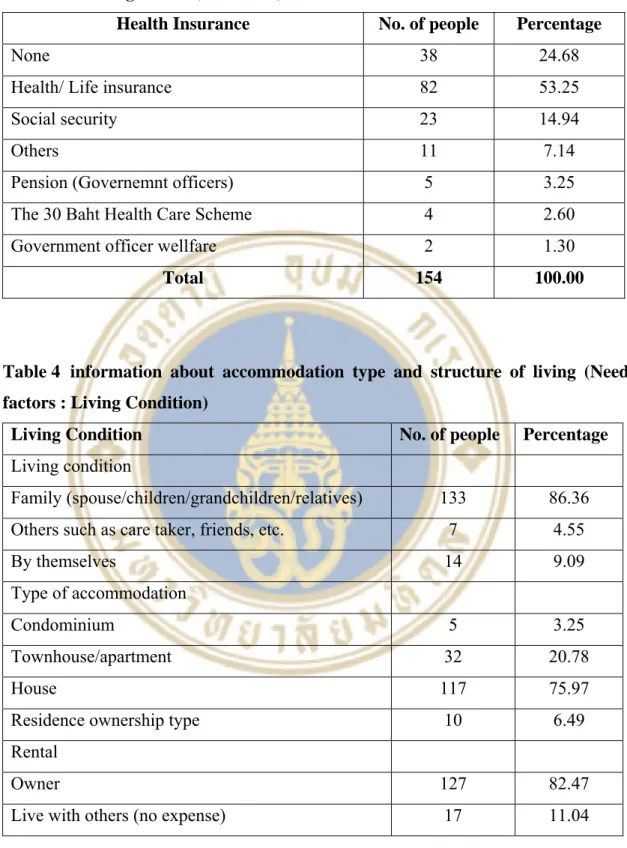
- Information about insurance
- Living condition
- Tendency to stay in senior housing
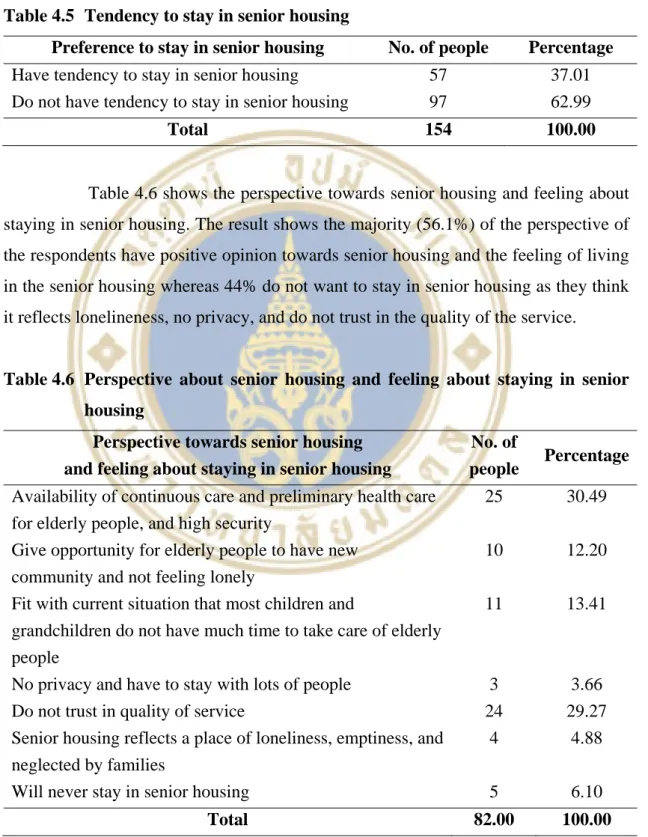
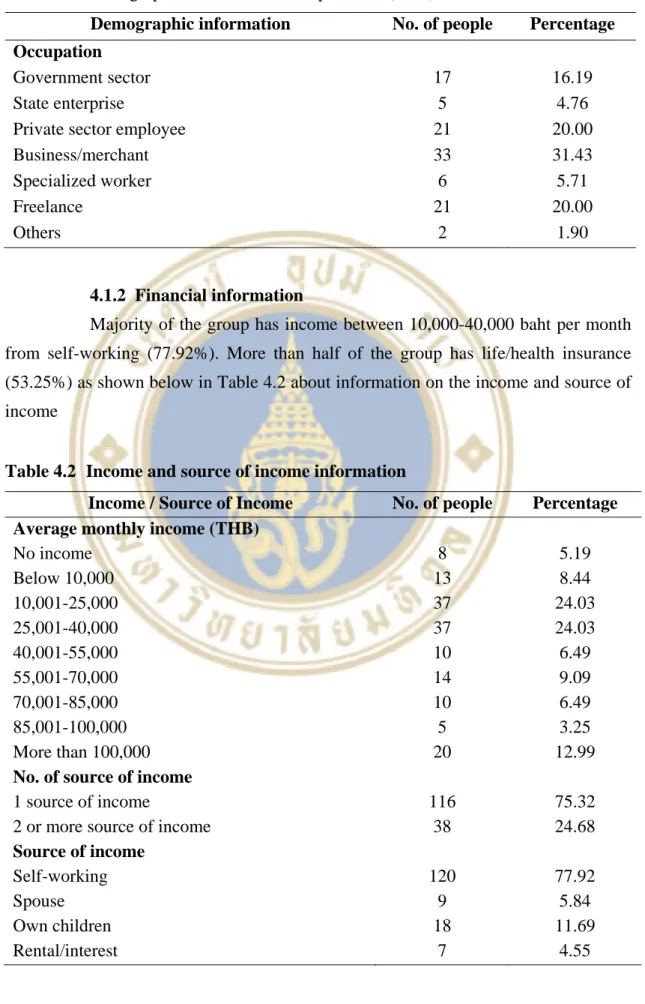
The majority of the group is not inclined to live in apartments for the elderly (62.99%) according to Table 4.5 on the tendency of the respondents to live in apartments for the elderly. As can be seen in Table 4.7 regarding the respondents' preference for health services in senior housing, almost all respondents need health services in senior housing (98%). According to Table 4.8, which explains the reasons people will choose to stay in senior housing, it is because 1.
According to the information in Table 4.10 on the total amount of expenditure that is acceptable for a stay in an apartment for the elderly (entire period of stay) Acceptable expenses for the entire period of stay are less than 1 million baht (74%), between 1-3. million baht (22.73%) as shown in Table 4.11. The main reasons why Thai seniors do not want to stay in senior housing are because they want to live with their family (64.94%), feeling that living in senior housing lacks privacy (47.4%), followed by other reasons, as shown in Table 4.11 below. The second most important factor for men is location, and for women the reliability of the organization that runs the senior housing.
According to Table 4.13, regarding the factors influencing the decision to buy or live in an apartment for the elderly, the most influential factor influencing the decision when choosing an apartment for the elderly is "price", which scored 3.54 points, and the second factor is "location" which scored 3.42 points, and the third factor is the reliability of the organization that manages the housing for the elderly, which scored 3.39 points. The factor that has the least impact on the sample group when making decisions is the availability of housing for the elderly with 1.69 points. According to Table 4.15 on the tendency to live in housing for the elderly compared to age.
People between the ages of 50 and 54 are most likely to live in senior housing.
Survey Result Analysis
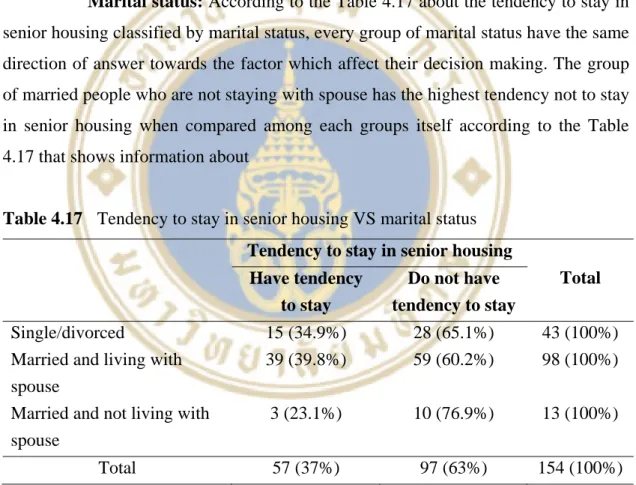
Marital status: According to Table 4.17 on the propensity to stay in senior housing by marital status, each marital status group has the same response direction regarding the factor that influences their decision-making. The group of married people who do not stay with their partner has the greatest tendency not to stay in senior housing, compared to either group itself, according to table 4.17 which provides information about. Work status: According to Table 4.18 on the propensity to stay in senior housing, classified by work status, the retired group attaches the highest weight to the reliability of an organization (40.82%), while the group of people who are still working approximately considers price as the most important factor (45.75%).
However, the majority of both groups do not tend to stay in senior housing. Have no inclination to stay. 100%) Occupation: According to Table 4.19 on the reliability of an organization managing senior housing by profession, an employee of a state-owned company gave the “reliability of an organization” as the highest weight when assessing senior housing compared to other professions according to Table 4.19 which compares responses regarding the reliability of an organization managing senior housing by occupancy factor. Monthly income: According to Table 4.20 on the acceptable costs for staying in senior housing, classified by monthly income, the sample group with a monthly income lower than 85,000 baht puts the highest weight on the price, especially the group who has no income, while the group who does not income has the highest weight on price. group with a monthly income of more than 85,000 baht places the greatest weight on the reliability of an organization.
All groups of the monthly income range do not have a significant difference regarding the decision to stay or not stay in an apartment for the elderly. The majority of all income levels consider the acceptable price (the maximum amount they are willing to pay) to live in senior housing to be under 1 million baht, but groups with a monthly income of more than 55,000 baht begin to see different price ranges selected according to Table 4.20 shows a comparison of acceptable costs for living in an apartment for the elderly compared to monthly income. The results of the survey on influencing factors based on demographic data reflect the differences in factors in the decision to buy or stay in housing for older people of different ages, genders, education levels and average incomes.
This information will be very useful for the senior housing management team to understand the needs and to be able to really meet the needs of the clients.
DISCUSSION AND RECOMMENDATION
- Demographic Profile Summary
- Discussions and Conclusion
- Recommendation and Practical Implementation
- Recommendation for Further Research
The result reflects the character of Asian people who are mostly collectivistic that collectivistic societies value family cohesion, cooperation, solidarity and conformity (Skillman, 2000). The results on the factors that most influence their decision to stay in an apartment for the elderly turn out to be primarily price, location and reliability of the organization that manages the apartment for the elderly. All sample groups in all income brackets choose price as the most important factor in deciding to live in a senior housing, except for people with a monthly income above 85,000 baht. The reason why people see price is the most important factor and they indicated that the acceptable total cost they are willing to pay is less than 1 million baht for the entire length of stay in the payment terms of renting or buying (74% of respondents' choice) , it can be because most of the respondents do not plan to live in an apartment for the elderly and also want to live with their family, so this could be seen as an additional cost and an unexpected cost.
From the result, the targeted customer for senior housing is the group who are between 50-54 years old with a bachelor's degree education level and are married and living with their spouse. The senior housing should provide medical service as it is the most needed facilities and a private space for their family visit as most of them are worried about staying with their family. The main reasons why people do not want to live in senior housing is mainly because they want to stay with their family and think that living in senior housing has no privacy.
Therefore, the senior housing developer should ensure that each unit has its own space, which is not congested, and also provide space for the residents' families to visit or stay for a short period of time, so that they do not feel lonely. Moreover, 30% of the people who responded do not have confidence in the quality of the service. Therefore, if the business owner has a strong partnership with an organization/brand with a high reputation, such as well-known hospitals, this would increase the reliability of his senior housing. and able to attract potential customers. Because most people prefer to buy senior housing rather than renting or partially owning it.
Therefore, an organization that wants to run a senior housing project should sell the homes and also have two types of senior housing, which are.
Most elderly residents plan to stay in their current home, Montgomery Country Department of Park & Planning, Research & Technology Center Suwanrada, W. The Situation of Thai Elderly 2011 and National Economic and Social Development Board, Population Projection in Thailand: 2010.
APPENDICES
Appendix A: QUESTIONNAIRE
Appendix B: SPSS Result
No privacy in senior housing 73 47.40 Not ready/can't afford more expenses 53 34.42 Social norms for senior housing (non-living) 53 34.42 Other reasons such as lack of confidence in quality,.