Zang Dance at Jingzhou Vocational and Technical College: Transformation from Original Dance to Academic Dance in China. TITLE Zang Dance at Jingzhou Vocational and Technical College: Transformation from Original Dance to Academic Dance in China. In addition, the transformation of original Zang dance into a new style of Zang dance at Jingzhou Vocational and Technical College had 3 steps.
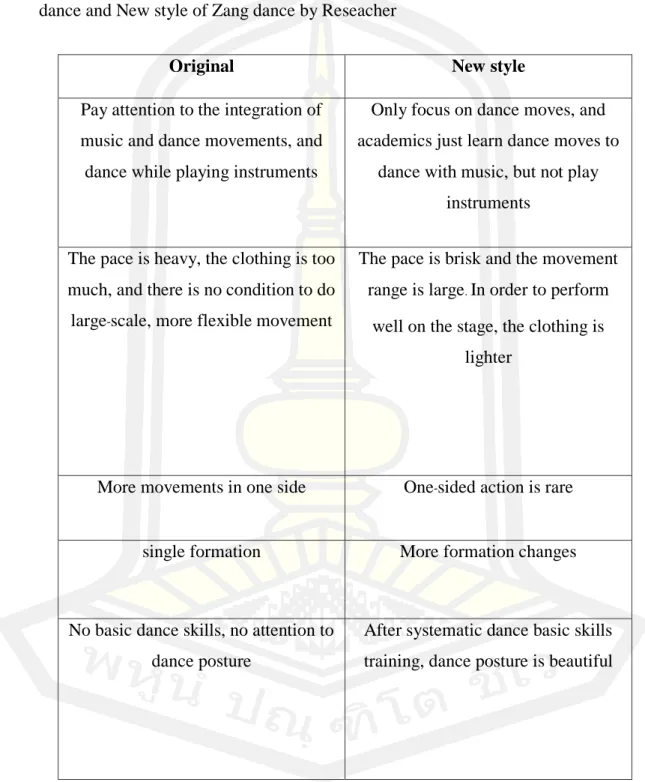
88 Table 2 The comparison of dance movements between the original style of Zang dance and New style of Zang dance by researcher. The inherent "absence" of academic folk dance has led to the irrelevance of academic Zang dance. As a kind of folk dance art, the Zang dance has also experienced a process from original ecological dance to academic school.
Analyze the transition from the original zang dance to system academies at Jingzhou Vocational and Technical College. In-depth analysis makes understanding the difference between primitive Zang dance and academic Zang dance.
Literature reviews
In the Yuan Dynasty, Zang was officially incorporated into the territory of the motherland, ending the long-term division within Zang, and the people gained a stable life. In modern times, the Zang people and the people of all ethnic groups in the country fought against the imperialist invasion and maintained the unity of the motherland. The formation of Zang costumes has a good relationship with the ecological environment of the Zang people and the production and way of life formed on this basis.
By the fifth and sixth centuries, the Zang community entered a slavery society with the development of production. Taking the formation process of Zang cultural history as a background also plays an important role in the study of the evolution of Zang dance culture. Compared with the dances of other nationalities, the nationality of Zang dance is one of the most important aesthetic characteristics.
The richness of the emotional expression content of the whole dance based on body coordination is also one of the unique aesthetic features of Zang dance. In the Song Dynasty, Zhao Xian, Emperor Shao of the Southern Song Dynasty, was sent to Zang. The development of social training and education in China is the inevitable result of the Chinese government and the public's reflection on the institutionalized education system and the "academic society".
The arrival of the two princesses also led to the development of Zang musical culture.
Research Methodology
It can be seen that the heirs' teaching methods are quite arbitrary, and there is no fixed teaching method, so they can learn whatever they want. The academic dance teaching method is designed in advance and must be taught according to the prescribed teaching procedures. The teacher tells you what the characteristics of the movement are, which are supplemented with several beats and combined with several movements.
However, if academic teachers do not have an in-depth understanding of ethnic culture, they may instill the students in the aspect of ethnic culture not as good as heirs. Case study focusing on three styles of Zang dance at Jingzhou Vocational and Technical College, including Zang Tita, Guozhuang, Xianzi. In the first phase, the researchers pretested 60 samples using questionnaires and interviews to conduct questionnaire analysis. The result is 60 valid questionnaires, which indicates that the questionnaire has high reliability and validity.
In the second phase, the researcher conducts field investigation through the survey interview sample, and the questionnaire is distributed as shown in the appendix. The respondents have enough time to answer the questionnaire and participate in the feedback of the questionnaire questions. We also observed Zang students and interviewed two dancers to learn more about Zang cultural history and the characteristics of original Zang dance.
Research Results
74 The characteristics of Singing Dance are that the lower limbs are mainly active and the lower limbs are centered on the vibration of the knee joint. Strict and precise hooking and opening is one of the important standards of the Singing-Dance aesthetic. Different Circle methods often depend on the type of dance, and the different types determine the difference in the rhythm of the Circle method.
Only by understanding these unique movement elements can we grasp the movement structure of the original Zang dance, and play a controlling role in the transformation of the original Zang dance into the academic Zang dance. Through the study in this unit, students can gain a preliminary understanding of the style and movement characteristics of Zang folk dance. 97 Teaching content: explain the basic cultural background of Zang dance, explain the characteristics of the characters in the dance, and perform the combination exercise of Zang dance rhythm.
Teaching content: explain the basic cultural background of the Zang dance, explain the characteristics of the characters of the dance, and train the combination of flexion and extension of the Zang dance. From the history of the origin and development of dance, dance is a product of human society. First of all, the new folk dance style is a concentrated and systematic arrangement of the original ecological folk dance.
Based on the organic combination of theory and practice, students' singing and dancing skills are strengthened. In the Song-dance system of Chinese academic school, most schools use teacher Pan Zhitao's "Chinese Folk Dance Teaching Materials and Teaching Methods". The place of performance of the original ecological dance is in front of the ridge in the field, a dance form of self-entertainment or collective meditation.
This photo was taken by the researcher while he was in college, and one of the movements in Zhang's dance work was taken by the researcher. Now it seems that in this picture, apart from Zang's body-worn dance costumes, there is no shadow of Zang's original dance in other movement features. In the process of transformation from the original Zang dance to the academic Zang dance, not only the way of movement, music and dress has changed, but also the way of teaching has changed.
The teaching of the original ecological dance is taught by folk artists and dance heirs. In the process of imitating and learning with the teacher, the students discovered the characteristics and laws of movements.
Conclusion Discussion and Suggestions
Conclusion
Through the case study of Zang culture, Zang dance culture, Chinese dance education and Zang dance teaching at Jingzhou Vocational and Technical College, this dissertation clarifies the historical development of Zang dance, finds the historical background of the development of academic dance, and states how the original Zang dance was transformed into an academic dance. According to research objective 1, it can be concluded that the teaching system and content of teacher Pan Zhitao are used in teaching Chinese academic Singing Dance at the current stage. People are more casual when dancing, don't pay attention to the dance posture and the.
If it is copied and performed on stage, the effect will not be good. Therefore, the first batch of dancers went to Tibet and collected the original Zang dance moves. Based on the original ecological movements, they created a new style of Zang dance and brought it to schools and classrooms.
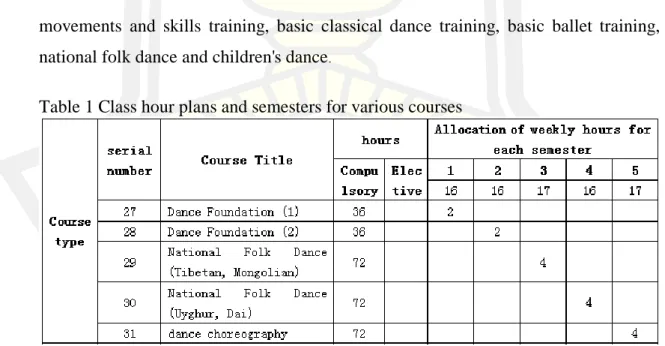
The teaching content adopted in the dance teaching of Jingzhou Vocational and Technical College is the teaching content of academic Singing Dance.
Discussion
Whatever method is used, the characteristics and styles of the original Zang dance cannot be lost, and the nation's traditions, customs and religious beliefs should be respected. The movements of the academic Zang dance cannot be separated from the culture of the Zang nationality. Only by inheriting the essence of Zang culture can we innovate in dance movements, enrich the vocabulary of Zang dance and allow more people to pass the stage.
The diversified Zang original ecological dance is a manifestation of the Zang people's self-entertainment and liberation nature, and it is also a kind of sociality and worship of the gods, with a strong religious color. This article has a deep understanding of Zang culture in all aspects, such as the origin, geographical features, historical culture and human environment of the Zang. Interpretation of the main points of academic Zang dance movements, compare and analyze the differences between original Zang dance movements and.
1. In the process of creating dance works, it is more about following the characters themselves and the environment where the characters live, which can be created by combining their essential inner structure. The performance of Zang dance movements is created by observing the dancing body movements of the original Zang people and adding to the understanding of the aesthetics of the human body. 2. Respect national traditions and humanistic customs. The presentation of academic dance movements is evidence-based and derived from the inherent movement characteristics of the original dance.
When showing dance, do not just blindly strengthen skills, but blindly pursue technical skills, no matter how you show it, do not lose the style and characteristics of the original Zang dance. 3. The local government should strengthen the protection and publicity of the original dance culture and encourage young people to inherit the traditional Zang culture. 4. In the daily teaching of Jingzhou Vocational and Technical College, a more comprehensive and richer Singing-Dance syllabus should be revised based on the current actual situation.
Let the students have a deeper understanding of the inner meaning of dance, no longer blindly follow one training of academic Zang dance movements, but ideologically recognize the beauty and cultural charm that dance brings. The design of the research subject should be comprehensive and targeted so that the research conclusion can be of greater value. The difference between original classroom teaching of ecological dance and academic classroom teaching: A case study of intangible cultural heritage on campus.
Interviews
Research Tools
To what extent has the legacy of Zang dance been influenced by Western culture?
Figure