Financial Crises:
Lessons from the Past,
Preparation for the Future
This book is based on the sixth annual financial markets and development conference held April 26–27, 2005, in Washington, D.C. The conference was cosponsored by the World Bank Group and Brookings Institution.
The previous volumes in this series are available from the Brookings Institution Press:
Financial Markets and Development: The Crisis in Emerging Markets (1999)
Managing Financial and Corporate Distress: Lessons from Asia (2000) Open Doors: Foreign Participation in Financial Systems in Developing
Countries (2001)
Financial Sector Governance: The Roles of the Public and Private Sectors (2002)
The Future of Domestic Capital Markets in Developing Countries (2003) The Future of State-Owned Financial Institutions (2004)
Financial Crises:
Lessons from the Past, Preparation for the Future
Washington, D.C.
.
.
Editors
ABOUT BROOKINGS
The Brookings Institution is a private nonprofit organization devoted to research, educa- tion, and publication on important issues of domestic and foreign policy. Its principal
purpose is to bring the highest quality independent research and analysis to bear on current and emerging policy problems. Interpretations or conclusions in Brookings publi-
cations should be understood to be solely those of the authors.
Copyright © 2005
THE BROOKINGS INSTITUTION
1775 Massachusetts Avenue, N.W., Washington, D.C. 20036 www.brookings.edu
All rights reserved. No part of this publication may be reproduced or transmitted in any form or by any means without permission in writing from the Brookings Institution Press.
Library of Congress Cataloging-in-Publication data
Financial crises : lessons from the past, preparation for the future / Gerard Caprio, James A. Hanson, Robert E. Litan, editors.
p. cm.
Summary: “Analyzes the efficacy of attempts to recover from past crises and their lessons for the future, assesses the current state of international financial markets and examines policy options for reducing systemic vulner- ability, and addresses pension system reform”—Provided by publisher.
Includes bibliographical references and index.
ISBN-13: 978-0-8157-1289-3 (pbk. : alk. paper) ISBN-10: 0-8157-1289-8 (pbk. : alk. paper)
1. Financial crises. International finance. 3. Monetary policy. 4. Economic policy. I. Caprio, Gerard. II. Hanson, James A. III. Litan, Robert E., 1950–
III. Title.
HB3722.F546 2005
332'.042—dc22 2005027077
9 8 7 6 5 4 3 2 1
The paper used in this publication meets minimum requirements of the American National Standard for Information Sciences—Permanence of Paper for
Printed Library Materials: ANSI Z39.48-1992.
Typeset in Adobe Garamond Composition by Circle Graphics
Columbia, Maryland Printed by Victor Graphics
Baltimore, Maryland
1 Introduction 1
Gerard Caprio, James Hanson, and Robert E. Litan 2 Postcrisis Challenges and Risks in East Asia
and Latin America: Where Do They Go from Here? 15 James A. Hanson
3 Banking System Crises and Recovery in the Transition
Economies of Europe and Central Asia: An Overview 63 Fernando Montes-Negret and Thomas Muller
4 Sovereign Debt in Developing Countries
with Market Access: Help or Hindrance? 87 Indermit Gill and Brian Pinto
5 The Next Emerging-Market Financial Crisis:
What Might It Look Like? 121
Morris Goldstein, with the assistance of Anna Wong
6 Financial Risks Ahead: Views from the Private Sector 211
Contents
7 Starting over Safely: Rebuilding Banking Systems 217 Gerard Caprio and Patrick Honohan
8 Old-Age Income Support in the Twenty-first Century:
Conceptual Framework and Select Issues
of Implementation 257
Robert Holzmann
Contributors 279
Index 281
Introduction
1
T
he calm before the storm? That question dominated the stage at the seventh annual conference on emerging markets finance, cosponsored by the World Bank and the Brookings Institution and held at Brookings in late April 2005.At the time of the conference, it had been a little less than eight years since the onset of the Asian financial crisis, an event that had depression-like effects throughout much of Asia and, for a time, seemed to threaten global economic stability. That this outcome never happened can be attributed to a combina- tion of aggressive monetary easing by the Federal Reserve Board in the United States, emergency lending to the countries in the region by the International Monetary Fund (IMF) and other international institutions, the concerted rollover of some of Korea’s private external debt, and a dose of good luck.
The Asian economies have since recovered from their financial crises to varying degrees, as have the other major emerging-market countries that suffered their own crises shortly afterward: Argentina, Brazil, Russia, and Turkey. What has been learned since these crises in key parts of the devel- oping world? How exposed are countries in different parts of the world to another, perhaps entirely different kind of financial and economic crisis?
These are among the questions that the conference papers address. This introduction provides a brief overview of their main findings. The subsequent chapters contain the papers as well as a summary of the panel discussion with
gerard caprio james hanson robert e. litan
private sector representatives of commercial banks and rating agencies and select portions of the discussion by the roughly 100 financial experts from around the world who attended the conference.
James Hanson led off the conference by examining the challenges and economic vulnerabilities in East Asia and Latin America. Countries in both regions suffered financial crises in the 1990s and the early part of this decade.
In chapter 2, Hanson discusses the common features of the crises in both regions and the very different paths that countries in each region have taken since their crises.
Almost all of the crises in the 1990s and post-2000 in both regions were not just external crises; they often began in the domestic banking sectors, and banking sector problems complicated policymaking in all cases. In the typical case, runs on banks quickly turned into runs on currencies, forcing central banks to abandon attempts to peg the exchange rate and deal with bank failures. In some, but not all, cases, excessive government borrowing contributed to the crises, unlike the 1980s-era Latin American crises, where excessive government borrowing was the dominant cause.
There also were common elements among the policy responses to the more recent financial crises. Governments typically bailed out bank deposi- tors. They incurred massive debts to the banking systems in the process, since governments also had to pick up the tab for losses on unpaid bank loans that typically were transferred to separate asset management companies. On the macroeconomic front, pressure from the market and the IMF, which pro- vided emergency finance to many of the countries in both regions, sooner or later forced the governments to tighten monetary and fiscal policy.
Hanson does not add to the well-known and vigorous debate over these policy responses; instead he focuses factually on what happened in the econ- omies as a result. One of the postcrisis macroeconomic outcomes, common to both regions, was a dramatic drop in inflation, an unusual experience for Latin America, where much higher inflation rates had been common. Lower inflation rates helped the working of the financial system after the crises in all the countries.
In terms of growth, the postcrisis experiences have differed between (and within) regions. The East Asian countries generally have rebounded from their crisis-induced downturns. Annual growth recently has been in the 4–6 percent range, good for developing countries, but below their growth rates in the first half of the 1990s. Korea recovered the most rapidly, using the unorthodox strategy of promoting consumption, but its growth then slowed as the approach reached its limits. Indonesia suffered the most from
, ,
its crisis, in part because of the political turmoil surrounding the end of the Suharto regime and realignment of the political economy as the country developed a democratic government. The Latin American countries that suffered crises in the 1990s recovered quickly. Nonetheless, despite their upswing in 2004, their average growth remained low.
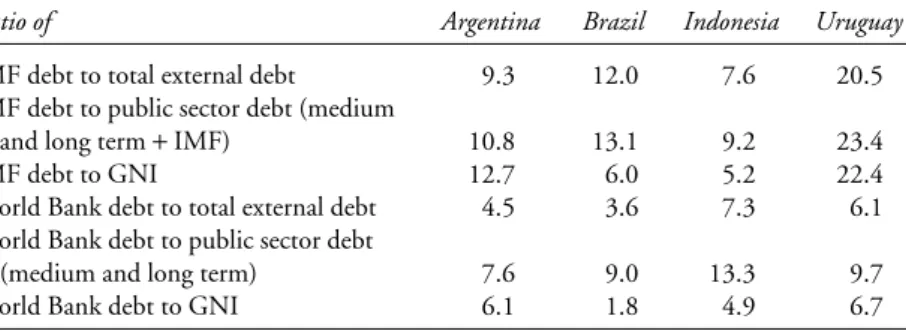
Another sharp contrast between the two regions relates to their external debt. Since the 1997–98 crises, the average ratio of external debt to GDP in East Asia has fallen. The opposite has occurred in Latin America, where the ratio of external debt to GDP in 2004 stood above the level of the mid- 1990s. Borrowing from the World Bank and the IMF by Latin American governments is one factor contributing to this difference in external debt patterns. Other factors include an apparent increase in the risk tolerance of investors, coupled with improving economic prospects in many Latin Amer- ican countries since 2000, which has enabled governments to sell their debt more easily. Indeed, by early 2005, the spread on interest rates on emerging- market bonds relative to those on U.S. treasury bonds stood at an eight-year low. The lower spread, coupled with the lower level of U.S. rates, has eased the debt service of all emerging-market borrowers. It remains to be seen whether, and to what extent, high-borrowing countries will be able to keep on servicing their debts if interest rates rise. In contrast to Latin America, the East Asian crisis economies generally have taken advantage of the benign external financial environment since their crises to run tight fiscal policy, reduce their debt, and substantially increase their foreign exchange reserves.
They should have an easier time avoiding future difficulties than their coun- terparts in Latin America.
Hanson points to a number of interesting structural developments in both regions during the past few years. While countries in both regions con- tinue to rely heavily on banks for intermediation, pension funds have grown increasingly important in Latin America (Peru and Chile, in particular).
Domestic currency government and private corporate bond markets have also developed in both regions, although trading in secondary markets remains low. Banks have recovered, but Latin American bank deposits remain low. In Latin America and Indonesia, banks’ holdings of government debt have increased relative to deposits, crowding out private credit. This represents a major challenge to growth and development since private credit is a major factor in growth.
Banks also face some risks. The government debt carries market risk and is not free from default risk. Private loans are riskier than they were, with the most creditworthy private sector borrowers financing themselves abroad
or in the domestic bond markets. Banks may lack the risk management capacity to deal with their expansion into consumer, small-scale, and mort- gage lending, a problem that hit Korea. Many borrowers in Latin America continue to borrow in dollars, exposing themselves to currency risk, which contributed to previous banking crises. Improvements are slowly occurring in banks’ risk management techniques and the information and legal frame- works on which sound lending depends.
State-owned banks, which were major factors in the previous crises, also continue to be important financial institutions in both regions and are even growing in some cases. In the current environment of tight fiscal and mone- tary policy, governments face political pressure to use public sector banks as economic policy instruments. The costs of this strategy are already becoming clear in some Asian countries. Meanwhile, the well-known international banks that once were thought to be a way to improve financial sector perfor- mance have become less interested in expanding into most developing coun- tries. Regional banks are expanding, but they offer fewer benefits than the well-known international banks.
Finally, governments in both regions have strengthened prudential reg- ulation of their banks, prodded and supported by the IMF–World Bank Financial Sector Assessment Program. Most countries also have indicated their intention gradually to adopt the about-to-be-implemented Basel II capital standards. It remains to be seen whether these measures will prove sufficient to prevent or minimize the damage from future financial crises, especially given the political constraints facing their application.
Central and Eastern Europe, too, were touched by financial crises of their own, but these were largely due to a wave of bank failures that arose as their economies were transformed from centrally planned to market- based economies, as discussed in chapter 3 of this volume by Fernando Montes-Negret and Thomas Muller, both of the World Bank.
The “banks” that existed prior to this transformation were banks in name only; in fact, these institutions were administrative agencies that sim- ply held credits from state-owned enterprises on their “books.” When the institutions were converted into “banks,” as part of the transformation to market-based economies, these bookkeeping credits proved largely worth- less. The banks thus found themselves with insufficient assets to back the deposits that individuals and firms held in them.
At the same time, household assets were relatively liquid because the shortage of goods in centrally planned economies left them with little alter- native other than to hold their meager income as bank deposits or buy for-
, ,
eign exchange. The new governments therefore faced a macroeconomic problem as well as a structural one: with a monetary “overhang,” the new freedoms could have unleashed a wave of spending unmatched by the pro- duction of goods, causing a major bout of inflation. Central banks attempted to reduce that overhang by tightening credit, forcing so-called hard-budget constraints on enterprises that were not used to them. The predictable result was a wave of bankruptcies, which only reinforced the structural problems in the “banks” that had once extended them credit.
The economies in the region took very different approaches to “clean- ing up” their banking sectors, particularly in terms of transparency. In all cases, however, some form of government infusion of funds was required to make good on the deposits and compensate for the inevitable write- downs of the banks’ previous credits. Most governments also attempted to introduce some semblance of sound bank supervision, consistent with international practice. But understandably, the countries did not have the expertise to carry out this program effectively, especially as long as the banks remained state owned and thus followed the directions of government lead- ers rather than market norms.
A number of countries in the region tried to offset the domination of their state-owned banks by allowing new entrants into commercial bank- ing. But, as Montes-Negret and Muller discuss, many of these entrants were too small to be efficient, lacked experience, and were undercapitalized and thus the source of additional banking problems.
Notwithstanding all of these difficulties, the costs of banking problems in Central and Eastern Europe, computed as a fraction of total output, turned out to be substantially below the costs suffered by the crisis-ridden countries in East Asia and Latin America and by Turkey and even Japan. The authors suggest that in the European countries, the financial sectors were relatively much smaller to begin with, so they suffered and caused less damage than in countries where banks played a more central role in the economy.
Although the economies in the region during the transition period have performed very differently, the authors suggest that certain common con- clusions can be drawn from their experiences. For example, after suffering initial downturns following the end of central planning, Central and East- ern European economies generally have enjoyed real growth, as have their financial sectors. At the same time, all countries in this part of the world could benefit from increased financial depth (measured by the ratio of financial assets to GDP) as well as stronger capital markets to supplement the dominant role being played by banks.
As for the country-level differences, the authors note that eight Eastern European countries that later joined the European Union (EU) in 2004 outperformed, along several dimensions, other formerly centrally planned economies that have transitioned toward some capitalism. They suggest that the prospect of EU accession encouraged reforms and foreign capital inflow that made this superior performance possible. Russia has benefited from favorable commodity prices and fiscal discipline since its 1998 crisis, but its banking and financial systems remain underdeveloped relative to those of other countries in the authors’ survey. Central Asian economies, in the authors’ words, seemed trapped in a “low-level equilibrium,” with underdeveloped financial institutions and regulatory oversight. In South- east Europe, financial sector development is very uneven, with Slovenia fur- thest ahead, having joined the European Union; finance in the countries that formerly made up Yugoslavia continues to be held back in the after- math of civil conflict in the 1990s; and the financial sector is perhaps most underdeveloped in Albania and Macedonia.
The well-known association between financial crises in the developing world and external debt raises the obvious questions of whether external debt is going to lead to a new crisis and, more fundamentally, whether sovereign borrowing is an aid or a hindrance to economic growth. Indermit Gill and Brian Pinto of the World Bank address these questions in chapter 4 of this volume.
What is the likelihood of a sovereign debt–induced financial crisis in the developing world in the near future? The authors suggest that, in light of the frequency of past episodes, future crises always remain possible. Public debt (external and internal) remains high in the major developing countries with market access. Nonetheless, the authors argue that risks have receded for several reasons.
Taking the East Asian crisis economies first, along with reasonably strong growth, many of them have improved government balance sheets and now have strong fiscal positions (except the Philippines). The buildup of inter- national reserves should provide protection against “sudden stops” in capital inflows.
The other four major crisis economies of recent years—Argentina, Brazil, Russia, and Turkey—have taken very different roads to recovery. All four got into trouble because of unsustainable exchange rate pegs, excessive sovereign borrowing, and, in the last three cases, weak financial systems. When the gov- ernments could not service foreign currency–denominated debt, they aban-
, ,
doned the currency pegs; Argentina went further and stopped payment on its debt and later restructured it (to the consternation of its creditors). Russia also restructured its debt, but through more of a negotiation than the unilateral actions taken by Argentina. Brazil and Turkey adopted much tighter fiscal policies. Since these actions, all of the economies have rebounded to varying degrees. Primary fiscal surpluses (budget accounts minus interest payments) now exist, in the cases of Brazil and Turkey at unprecedented rates. The coun- tries are building up hard currency reserves, and the adoption of more flexi- ble exchange rates also will help (by discouraging excessive foreign currency borrowing). However, debt ratios remain uncomfortably high, especially in Brazil and Turkey, and the sustainability of debt depends on continued high primary surpluses, low international interest rates, and market confidence that translates into continued low sovereign spreads.
Perhaps the best test of the success of measures taken so far is how the mar- ket, specifically bond investors, has perceived them. By this test, the verdict, at least at the time this paper was presented, looked good: for virtually all of the countries that experienced a crisis within the last decade, interest rates rel- ative to U.S. treasury bond rates have fallen significantly since the time they were in trouble.
Does sovereign debt help or hinder growth? Government borrowing (like private sector borrowing) can add to growth, provided borrowing occurs in moderation and the proceeds are used for investment rather than consumption. Crises, related to high debt, obviously slow growth. But even without a crisis high debt can slow growth as a result of direct crowding out of private investment, concerns about debt overhang, and reduced fiscal space for public investment and social spending.
The authors do not identify a specific debt-to-GDP threshold that should trigger concern, but they observe that the debt ratio seems high in a number of prominent market access countries. Countries are responding, to varying degrees, with fiscal discipline, changes in institutions to lock in fiscal disci- pline, and reforms to speed growth.
An important challenge for developing-country governments in the future is to manage foreign exchange risk and thus the risk of currency crises. One response, in some cases related to financial sector bailouts, has been to develop a domestic currency debt market and borrow more in domestic currency.
Innovations in debt instruments can help: one idea is to issue bonds with interest payments tied to GDP growth (to help avoid unsustainable interest rate burdens in years when the domestic economy may be performing poorly
for exogenous reasons, such as a slump in commodity prices). However, it appears that such instruments and markets will not play a major role in easing the burden of developing-country debt for some time.
Peering into the future is a lot more difficult than explaining the past, but Morris Goldstein of the Institute for International Economics takes up the challenge in chapter 5 of this volume, speculating on what the next emerging-market-economy financial crisis (banking, currency, or both) might look like. Admittedly, at the time of this exercise, the likelihood of such a crisis seemed lower than it had for some time: GDP growth in emerg- ing markets in 2004 was the best in twenty years, primary prices were high, and borrowing rates were low.
But Goldstein warns against complacency: very good times often precede bad times. And the healthy averages conceal wide variation in country per- formance: in 2004 more than fifty developing countries had current account deficits exceeding 5 percent of GDP. And then there is the looming presence of the “haircut” that Argentina forced its creditors to take on foreign currency debt earlier this decade. When the next crisis occurs, investors may rightly fear the same thing happening to them and thus bolt for the exits at the ear- liest sign of trouble.
Of all the myriad things that could go wrong in the near future, Goldstein singles out two for special attention: a bursting of the apparent “investment bubble” in China and a sudden run from the U.S. dollar on account of the large U.S. current account deficit. Moreover, the two events are not mutually exclusive; they could happen simultaneously and thus have potentially syn- ergistic negative effects on the world economy, emerging markets included.
China and the United States account for roughly 12 and 21 percent of the world’s output, respectively, based on purchasing power parity exchange rates. In 2003–04, the two economies together accounted for nearly half of the world’s expansion in output. Clearly, therefore, a slowdown in one or both economies could have potentially serious ripple effects on much of the rest of the world.
The main risk that could arise from China comes from the likely slow- down in its very high rate of investment, which as a share of GDP recently hit an all-time record of 46 percent of GDP. Although Chinese officials ini- tially denied that investment spending posed a problem, more recently, the government has attempted to tighten monetary policy (through adminis- trative controls and higher interest rates) in an effort to curb spending gen- erally, which had pushed GDP up almost 10 percent in 2004. Of course, another risk is the impact of a change in exchange rate policy. (After the
, ,
conference, this issue became more important when China announced a slight revaluation of its currency in July 2005.) Goldstein lays out the pros and cons of each of three possible future scenarios for the Chinese econ- omy: a soft landing, a hard landing, and a long (but gradual) landing. He sides with the long-landing view, implying that China’s GDP growth in 2006–07 could be 3–4 percentage points lower than in 2004.
Goldstein also outlines alternative “landing” scenarios for the U.S. cur- rent account deficit. As his Institute for International Economics colleague Michael Mussa (former chief economist of the International Monetary Fund) has argued, one way or another, the U.S. current account deficit will have to be reversed, and when that occurs, three interrelated things must happen: (1) the dollar must depreciate against a basket of foreign currencies, (2) domestic demand in the United States must grow more slowly than pro- duction to make room for the additional exports that a weaker dollar will stimulate, and (3) domestic demand elsewhere in the world will have to grow faster than output to reduce net exports from the rest of the world. Yet when and how fast these adjustments will take place is highly uncertain.
How will emerging markets fare if and when the Chinese and the U.S.
economies slow down or, worse, suffer sharp corrections? Clearly, the effects will be negative, but they will be manifested in several ways. One is through a decline in exports to a slumping China and the United States; through this channel, Hong Kong and Korea, the largest exporters to China, would suf- fer disproportionately, as would much of Latin America, which exports com- modities to the United States and recently to China. European emerging economies would be the least adversely affected.
A second channel through which emerging economies could suffer is through higher interest rates in the United States, which the Federal Reserve has been engineering and which is likely to slow capital flows to emerging economies as a by-product. A higher U.S. dollar interest rate could also be a by-product of a slowdown in China’s accumulation of U.S. government debt. In a worst case, the contraction of capital flows and higher domestic interest rates could precipitate another financial crisis, especially in countries with weak banking systems. The negative impact could also spread to other countries through “contagion” effects, similar to those displayed during the Asian financial crisis of the late 1990s. The countries that will suffer the most from high interest rates are those that still have high debt ratios, many of which are countries that still have not recovered fully from earlier crises.
Emerging-market economies may be somewhat defenseless against shifts in economic fortune because it is difficult for them, in a global environment,
to run independent and effective countercyclical macroeconomic policies.
Countries with relatively low levels of sovereign debt to begin with are likely to be best able to carry out effective countercyclical economic policy (because foreign investors will not necessarily flee from the country when its govern- ment attempts to offset a downturn with stimulus).
What do institutions with real money at risk believe about the outlook for emerging economies? A panel of three experts from major commercial banks and rating agencies offered their views at the time of the conference, which are summarized in chapter 6.
David Wyss from Standard and Poor’s was much more optimistic about the general outlook for emerging markets than Goldstein. While he acknowl- edged that credit ratings are not perfect, he found it nonetheless a signifi- cant sign of optimism that the ratings of emerging markets had improved markedly in recent years. Wyss also was much less alarmed than others at the conference about the U.S. federal budget deficit, which he noted was not out of line with the deficits of other industrial countries. He was more concerned, though, about the large and growing U.S. current account deficit and the danger that foreign central banks would suddenly be unwilling to continue buying large volumes of U.S. government debt, thereby removing the financ- ing of the large U.S. current account deficit and the associated large demand for U.S. assets.
Don Hanna of Citigroup noted that foreign central banks that are buying U.S. dollars are doing so out of their free will and presumably are making rational decisions in doing so. Indeed, in countries such as China where for- mal domestic interest rates are lower than in the United States, the central banks are making money in the short run through such purchases (although they are also assuming the risks of capital losses in the future if the dollar should decline in value).
On another subject, although better regulation supports higher credit rat- ings on Asian securities, Hanna questioned how much transparency in finan- cial reporting had really improved in the region since the 1997–98 crisis.
Furthermore, enforcing legal rights in some countries, such as China, can still be quite expensive.
Khalid Sheikh of ABN Amro was more nervous than the other two panel- ists, highlighting the possibility that some unforeseen event could trigger an economic downturn in emerging markets. In particular, since other Asian economies have become so dependent on the Chinese market, any slowdown of China’s economic growth could have significant negative effects in the rest of the region. Furthermore, some of the countries that have been buying dol-
, ,
lars have also had difficulty sterilizing the dollar inflows, which creates a dan- ger of inflation.
The financial sector, and the banking system in particular, has been at the heart of the financial crises discussed in this volume. To what extent have countries since introduced reforms to address the weaknesses that con- tributed to their difficulties in the first place? This is the topic of chapter 7, by Gerard Caprio and Patrick Honohan of the World Bank.
The authors observe that, in most cases, banks in crisis countries took speculative or unhedged foreign exchange positions that later contributed to their difficulties and to problems in the financial sectors generally, when gov- ernments were forced by events (and dwindling reserves) to float their cur- rencies. In a few cases, like the Dominican Republic and Venezuela, outright fraud played an important role in the banking crises.
The authors discuss several features of how the financial crises in these countries were resolved. Although there were many differences among coun- tries, the authors note that there also were common features. For example, with a few exceptions, banking difficulties in the crisis countries were con- fined to a minority of institutions and were not widespread throughout entire banking systems. In addition, problems arose at both public and privately owned banks. Governments rarely addressed banking problems quickly and all at once; instead they tended to recapitalize failed institutions in successive waves. Sharp currency depreciations typically affected the timing, nature, and scale of these recapitalizations.
The authors examine the postcrisis performance of thirty-eight countries that have suffered crises (a few more than once) since 1994. Again, despite the country variations, some interesting common features stand out. On average, GDP growth in the three years following the crisis was lower than in the three years preceding it; the same was true with inflation (suggesting that, with less pressure from domestic demand, prices were not pushed up as rapidly as in the precrisis period). Almost all countries increased their
“financial depth” postcrisis—that is, deposits flowed into the banking sys- tems, during and as they were repaired. The experience with bank credit postcrisis was much more varied; in some cases it grew, while in others it shrank (suggesting that government debt rose rather than loans to private borrowers, partly because of the postcrisis bank restructurings). At the same time, interest rate margins—the “spreads” between banks’ earnings from interest and the costs of funds—have fallen pretty uniformly since the cri- sis episodes. In addition, the crises have moved varying amounts of owner- ship of banks into private and, especially, foreign hands.
One silver lining to the black cloud of financial crises is that experience has produced a reasonable degree of consensus about how to resolve trou- bled financial institutions. Ideally, the process should be clear and trans- parent, and banks’ nonperforming assets should be removed as quickly as possible and sold to private investors. Parallel work should be done on strengthening the banks’ main clients, the corporate sector. Losses should not be fully socialized. Government aid should “fill the hole” in the balance sheets of failed banks created by the loan and other losses that contributed to the failures, but only as part of recapitalization plans that draw in new, private capital and management to run the bank thereafter. Although for- eign capital and expertise can often make a real difference, it is not always a panacea. If capital and management—domestic or foreign—cannot be attracted, then the institutions should be liquidated. The authors discuss specific additional principles for special situations, such as what to do with failed state-owned banks, how to realize value most efficiently and prof- itably for the banks’ nonperforming assets, and how and to what extent to protect depositors.
In reality, countries varied in how closely they conformed to these “best practices.” The authors suggest that many deficiencies in the implementation of “resolution policy” can be attributed to limited administrative capacity and limited independence from political elites who run the countries.
In addition to these lessons for authorities whose financial system has just emerged from a crisis, the authors conclude with a series of broader rec- ommendations for developing countries in building productive and stable financial sectors in the future, including the advisability of attracting for- eign banks and other financial institutions, reducing the reliance on banks, encouraging more intermediation through capital markets, and relying more heavily on markets than on regulators to discipline banks and prevent them from taking undue risks. They note that the lack of access to finan- cial services in many developing countries is a source of vulnerability for emerging markets, not least because it could prompt calls, already being heard, for the return of development banks and subsidized credit schemes, which the authors warn could, as in the past in many countries, undermine financial sector development.
Finally, looking ahead, one of the larger financial challenges confronting all emerging-market economies (and developed countries too) is the pension system. Populations are aging, but the traditional way of providing support for the elderly—the extended family—is being eroded by migration and urbanization. At the same time, the standard pay-as-you-go pension systems
, ,
for government and formal sector workers have become costly in many developing countries. Many countries have followed Chile and put in place some sort of fully funded system of individual pension accounts, but ques- tions have arisen about these systems. In chapter 8, the last paper in this vol- ume, Robert Holzmann of the World Bank examines these issues, drawing on a longer study by a World Bank team.
Holzmann argues that successful reform of pensions depends first of all on a careful consideration of whether the macroeconomic and fiscal environ- ment can support the reform. It also depends on a credible commitment aris- ing from the political economy of the country and a buy-in by the country’s leadership. Finally, it depends on creating appropriate regulatory and super- visory arrangements and building capacity and governance to deal with the complex, intertemporal problems of providing retirement income. In reform- ing pensions, careful attention to the secondary developmental benefits of pensions is also necessary. Pensions are, after all, a claim on future economic output and should therefore be designed to leverage positive impacts from saving and financial market development and to reduce potential negative impacts on labor markets and macroeconomic stability.
Holzmann suggests that pension reform is now becoming based on five subsystems or pillars. In addition to the three well-known pillars—a pub- lic system linked to earnings and usually with pay-as-you-go financing; a mandatory, fully funded, and privately managed system (essentially an indi- vidual savings account or variant of the Chilean model); and voluntary sav- ings for retirement—there is a basic, “zero” pillar to deal with poverty among the elderly and a nonfinancial pillar that involves intrafamily sup- port, access to health care, the housing status of the elderly, and so forth.
To be sure, this is an ideal system, and not every country has the resources to have all pillars—pension systems must be affordable and not create macroeconomic instability—but the full system is something to which all countries can aspire.
Holzmann concentrates the latter part of his chapter on three areas of the mandatory, fully funded, privately managed pillar that have drawn atten- tion: country readiness and regulatory and supervisory issues, containment of fees and costs, and annuities for retirees, an often overlooked issue when systems are set up. Generally, most countries are ready to implement some sort of fully funded, privately managed pillar. The exceptions are countries with chronic macroeconomic imbalances. A credible macroeconomic frame- work and a sound banking system are preconditions for a sound pension sys- tem. For countries with immature markets, tight regulation and supervision
of investments and close attention to provision of information for the con- tributors are desirable initially. As the system and capital market develop, the limitations on investments can be relaxed.
Fees have become an issue for contributors to private pension systems.
High fees not only reduce the returns to retirees but also reduce the system’s attractiveness to potential contributors outside the formal economy. The most successful approaches to containing fees seem to involve reducing costs by using a unified clearinghouse system for managing the accounts, limiting the incentives for marketing expenditures, and limiting the fees via competitive bidding or passive investment options.
The provision of annuities is becoming an issue as pension systems age and more contributors retire. Typically, the insurance sector is the most likely provider. However, information on insurance companies or specialized annu- ity providers is often opaque and needs improvement. A crucial issue, which has not yet been resolved, is to determine who will bear the risk of rising life expectancy and uncertain future investment income. So far, a combination of three approaches has been used: regulation of the insurance-annuity sec- tor, the creation of variable annuities, and minimum pension guarantees by the government.
Much has happened in emerging markets, mostly for the good, since the financial crises of the late 1990s and the early part of this decade. At the same time, however, some of the conditions that allowed those crises to come close to getting out of hand, such as poor transparency and inadequate regulation, remain. Furthermore, some countries have not taken sufficient advantage of the current, benign conditions to strengthen their debt positions and their financial markets to better withstand future crises. Finally, there are signifi- cant global imbalances in saving and investment that may not be sustainable.
It seems odd that the emerging markets are financing the leading economic power in the world. True, the United States may offer high returns, but so should many emerging markets themselves. At some point, the appetite for U.S. dollar investments may wane, and if it does so too rapidly, the economic fallout for the entire world will not be pleasant.
, ,
Postcrisis Challenges and Risks in East Asia and Latin America
Where Do They Go from Here?
2
B
eginning in the mid-1990s, Latin America and East Asia were rocked by a series of financial sector and currency crises. The Mexican crisis began in late 1994 and then spread quickly to Argentina, where damage was limited by sound policy and efforts to strengthen the financial system.1 Jamaica also suffered a severe crisis in the mid-1990s, following a poorly managed financial liberalization. In 1997 crises unexpectedly hit Asia. The“miracle” countries—Indonesia, Korea, Malaysia, and Thailand—were hit hardest, the Philippines was less affected. China, which continued to grow rapidly, is not considered a crisis country and is not treated extensively in this chapter; its substantial effects on world growth and finance are dis- cussed in Goldstein’s contribution to this volume (chapter 5). In 1998 Brazil was hit by a crisis, following the Russian crisis. Soon after, banking crises of varying severity began in Colombia, Ecuador, and Peru, among other Latin American countries, as international lending dried up and pre- miums on high-risk debt rose in industrial-country markets. Chile managed
james a. hanson
The author thanks Jerry Caprio and Patrick Honohan for comments and Ying Lin and Roman Didenko for their excellent assistance.
1. The dating of the crises in this paragraph refers to when each crisis became open. In some cases, this was very close to the end of the year. In most cases, GDP growth only declined after the year of the crisis.
2. In 1998, to reduce the risks of contagion from Asia and encourage capital inflows, Chile elimi- nated the special reserve requirements that had been used to deter short-term inflows (Edwards 1999).
3. Krugman (1979).
4. Kindleberger (2000); Minsky (1992).
5. Dooley (2000).
6. World Bank (2000, 2005a).
to avoid a crisis, but its growth slowed noticeably.2In late 2001 Argentina’s excessive domestic and international debt and high international rates finally turned into a full-fledged, old-fashioned debt crisis; Uruguay was hit immediately by contagion to its banking system. Beginning in late 2001, Brazil came under currency and debt rollover pressure but survived with- out a default. In 2003 a major financial crisis hit the Dominican Republic.
Various explanations have been offered for the crises, and different mix- tures of the explanations apply to each country. Krugman’s first-generation model of crises focuses on the current account and seems inappropriate for the most recent round of crises.3Another type of explanation relates to excess debt, “sudden stops” in capital inflows, and liquidity and insolvency prob- lems, in particular, in the case of Argentina but also for countries that had rel- atively high ratios of debt to GDP. The question remains why countries that were able to borrow so much in international markets were suddenly cut off.
Contagion and multiple equilibria are possible explanations. However, these theories neglect the financial sector element of the crisis. Some critics have argued that financial markets are prone to overshooting and bubbles, which must eventually lead to crashes.4A more recent perspective emphasizes the role of liability holders’ subjective estimates of net worth: when a gov- ernment’s contingent liabilities suddenly appear more likely to become actual liabilities, its subjective net worth falls sharply, and domestic and foreign asset holders respond by attempting to liquidate their holdings in the country quickly.5Finally, many of the crises reflected massive underlying problems in the banking systems related to the lending of public and private banks to
“well-connected parties” for activities that proved unproductive. These prob- lems eventually led to runs on the banks and the currency, because of politi- cal as well as economic factors.6
This chapter discusses the policies with which East Asian and Latin American governments dealt with their crises and how the crises may affect their financial systems into the twenty-first century, the different rates at which growth resumed in the countries after the crises and other macro- economic developments, developments in international debt and reserves
after the crises, and the current situation in the financial systems of East Asia and Latin America, including the risks and challenges they face. It also discusses particular risks, such as the resurgence of public sector banking in developing countries, the recent reduction in interest of well-known inter- national banks in expanding into developing countries, the issues related to cross-border expansion of regional banks, and the possibilities for reducing risk through regulation and supervision, market discipline, and improve- ments in the legal framework, issues discussed in more detail elsewhere in this volume, notably in chapter 7 by Gerard Caprio and Patrick Honohan.
The last section offers a brief summary.
Policy Response to the Crises and Financial Sector Overhang All the crises in East Asia and Latin America included currency crises; the new element was how many of these crises involved, if not originated in, banking and financial sector crises. This pattern contrasts with most of the crises of the early 1980s, which largely reflected the inability of govern- ments to roll over the external debt of the public sector.7In many of the recent cases, the banking and financial crises preceded the currency crises.8 In the crises of the 1990s, banks were hit by withdrawals of deposits and cuts in external credit lines. Initially, central banks typically responded with lender-of last-resort support for weak institutions; in some cases, monetary policy was loosened to deal with sectoral problems.9Although a standard policy response, lender-of-last-resort support was fraught with the well- known difficulties of distinguishing between illiquid and insolvent banks.
Another issue was the possibility that well-connected insiders attempted to loot their banks or take funds out in response to increasing political risks, and lender-of-last-resort support allowed them to do so. In some cases,
7. The Chilean crisis of 1982 is an exception.
8. Kaminsky and Reinhart (1999).
9. A significant literature exists on whether credit crunch existed in East Asia during the crisis; see the works cited in Coe and Kim (2002), for example. As discussed below, some evidence suggests that central banks were increasing their domestic credit fairly rapidly, interest rate policy was not particu- larly tight, and funds were flowing out of the countries rapidly. See World Bank (2000); Kenward (2002), and various papers in Coe and Kim (2002). Moreover, a lot of credit continued to exist; it just went bad. However, cutbacks in foreign credit and closure of banks and other intermediaries probably did reduce the availability of credit to some borrowers.
notably Indonesia and the Dominican Republic, lender-of-last-resort sup- port far exceeded the precrisis capital of banks.
The 1990s runs on the banks and the support for the financial sector typ- ically turned into runs on the currency and the loss of international reserves.
The runs on banks reflected depositor and creditor pressure to reduce their holdings and obtain foreign assets, not just switch banks.10East Asia was one obvious set of cases—massive amounts of new central bank domestic credit were roughly matched by losses of reserves, producing a complete change in the composition of central bank assets but not much change in the money base.11The lender-of-last-resort support tended to increase the supply of domestic assets, the demand for which was falling, and so trans- lated into additional pressure on the exchange rate. In addition, central bank support may have generated concerns about the state of the financial system and the government’s targets and policies (for example, Thailand’s fixed exchange rate), further increasing the demand for foreign assets. This process may explain why financial crises often precede currency crises.12In open economies facing bank runs and capital flight, the central bank must decide whether to maintain the exchange rate by selling reserves, allow depreciation, or tighten money generally to offset the liquidity support given to a few intermediaries, which puts pressure on borrowers indebted in local currency and their lenders. Typically, central banks in the 1990s did a bit of all three, allowing some depreciation, but limiting it by using reserves and by tightening money from time to time.
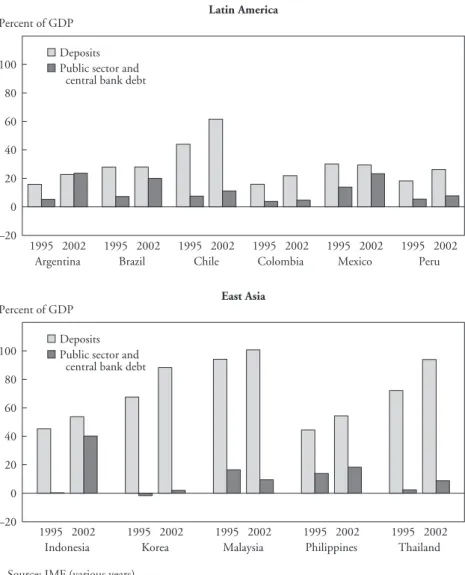
A second, more lasting, impact of the crises on the financial system was the massive increase in government debt in domestic banking systems. As shown in figure 2-1, government debt rose in almost all the banking systems that suffered crises, in most cases substantially.13Governments typically bailed out depositors in weak banks with deposit guarantees—few depositors lost much in local currency terms. The bailout process typically involved transferring bad loans from weak banks to an asset management or recovery company.
The asset management company, in turn, put new debt into the banks,
10. This outcome contrasts with the standard analysis of a lender-of-last-resort facility in a closed economy, where depositors shift their funds to other banks or currency. Public sector banks sometimes gained deposits in the crises; despite the well-known poor performance of their portfolios, depositors considered these banks to have the full backing of the government.
11. World Bank (2000).
12. Kaminsky and Reinhart (1999).
13. In Korea and Thailand, government debt in the banks did not rise substantially, but the gov- ernment took over the external debt of the banks and other intermediaries, shrinking their balance sheets.
–20 0 20 40 60 80
100 Deposits
Public sector and central bank debt
Source: IMF (various years).
a. With the exception of Argentina, for which the postcrisis date is 2002.
Percent of GDP
–20 0 20 40 60 80 100
Percent of GDP
1995 2002 1995 2002 1995 2002 1995 2002 1995 2002 1995 2002
Argentina Brazil Chile Colombia Mexico
1995 2002 1995 2002 1995 2002 1995 2002 1995 2002
Indonesia Korea Malaysia Philippines Thailand
Peru East Asia
Latin America
Deposits Public sector and central bank debt
Figure 2-1. Bank Deposits and Public Sector and Central Bank Debt as a Share of GDP in Major Latin American and East Asian Countries, 1995 and 2000a
implicitly or explicitly guaranteed by the government.14The resultant bank was either merged with another bank or banks (often in the public sector) or kept open—under old or new management or, in some cases, under the asset management company—and eventually sold. Whatever initial optimism existed regarding recovery of the bad loans proved false—typically the recov- ery was 20 percent or less of face value. The governments eventually had to put their debt into the banks to replace the debt of the asset management company. The implications of this process for banking systems postcrisis are discussed below.
The Macroeconomic Recovery: Low Inflation and the Return of Growth
Inflation remained surprisingly low despite the crises and, in some cases, fell even lower afterward. In East Asia, inflation traditionally had been low and remained in single digits in almost all cases during the crisis. The exception was Indonesia, where inflation jumped to more than 50 percent after the large devaluation. However, Indonesian inflation fell back to about 6 percent in 2003 and 2004. Latin America historically had high inflation, with infla- tionary spurts, and the associated inflation tax on depositors was often used to finance governments and clean up bank balance sheets. However, in a break with history, Latin American inflation dropped sharply in the 1990s. Most Latin American emerging-market borrowers, which often had experienced three- or even four-digit inflation at the beginning of the 1990s, dropped to single-digit inflation in 2000, despite their crises.15The crises in Argentina and Uruguay that began in 2001 were associated with large real devaluations and inflation that rose to the 20–30 percent range, but by 2004 their infla- tion returned to single digits. The crisis in the Dominican Republic that began in 2003 was associated with an even sharper rise in inflation, but after July 2004 inflation was largely halted by a sharp appreciation of the peso.
14. Banking data from the International Monetary Fund’s International Financial Statisticstypi- cally do not show the rise in government debt from the crisis until the government actually puts its debt into the system. In Mexico, for many years, some of the debt from the asset management company remained in the system with a government guarantee that was renewed annually by congress.
15. Mexico experienced a rise in inflation after the crisis at the end of 1994, but by 2001 its inflation was down to the 4–6 percent range. Jamaica reduced its inflation after the large outburst in 1992 and, with a sharp fall in 1997, began a run of single-digit inflation. Colombia also maintained single-digit, declining inflation after 1999. The exceptions are Ecuador and Venezuela, where inflation remained high.
The general prevalence of single-digit inflation has had some benefits.
Low inflation reduces the need for high nominal interest rates, the pressures for government intervention to favor particular borrowing groups, the mas- sive subsidies associated with interest rates that were kept well below infla- tion, the attention to financial engineering rather than efficient production, and the allocation of credit to activities that benefit from inflation. Low inflation has largely eliminated the issue of whether financial intermediaries charge reasonable real interest rates; the issue has become more one of ensuring loan repayment.
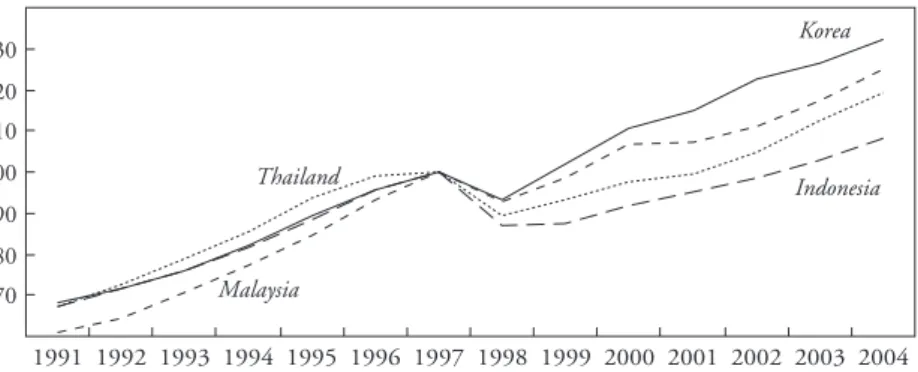
The recovery of growth after the East Asian crises has left the crisis coun- tries with average annual growth in the 4–6 percent range since 2000. This is relatively high by developing-country standards, but less than these coun- tries enjoyed in the first half of the 1990s. Except for Korea, all the crisis countries are well below their previous growth path (figure 2-2).16Invest- ment ratios have fallen from their high levels of the early 1990s, but pro- portionately not as much as growth has declined.
Among the East Asian countries, Korea recovered most rapidly and had roughly returned to its previous growth path by about 2002, but growth has since slowed to an average of less than 4 percent a year. Korea’s finan- cial crisis was, relative to GDP, the second smallest of the East Asian coun- tries, and it benefited from a large international support package and an agreement among major international creditors to roll over a substantial part of their outstanding loans. Korean imports fell dramatically initially, and the country began to accumulate international reserves; by 2001 it had prepaid its debt to the International Monetary Fund (IMF) and much of its crisis-related external debt. Korea is also generally considered the East Asian country that reformed the most. Some chaebols (conglomerates) were allowed to go bankrupt, others were forced into major restructurings, and a few banks were sold to foreign investors.
A major factor in Korea’s rapid recovery was a rise in household con- sumption. With a slowdown in traditional export markets and competitive pressures from China, the government elected to stimulate the economy by encouraging a rise in consumption, including a major expansion of credit cards. Although banks eventually suffered losses on consumer credit and one
16. Barro (2001) finds that output loss after the financial crisis in East Asia was larger than in a broad sample of crisis countries, the recovery was strong, and the previous growth path may not be resumed. Cerra and Saxena (2003) also find a quick recovery from the crisis, but some permanent loss of output.
of the largest non-bank credit card companies went bankrupt and had to be bailed out, principally by Korean Development Bank, the consumption-led growth strategy was initially successful in supporting a rapid return to Korea’s earlier growth path. When world growth increased, Korean exports and cap- ital account receipts also increased, and the buildup in international reserves increased massively. However, consumption is now lagging, household indebtedness is high, and, with high oil prices, GDP growth seems likely to be less than 5 percent in 2005, after 4.6 percent in 2004.
Thailand’s recovery was slow until, as in Korea, its consumption picked up in 2002, followed by sharp rises in exports in 2003 and 2004. The gov- ernment that took office in 2001 adopted a somewhat populist strategy, putting a moratorium on rural debts, offering new lending after write-offs of old loans by public sector banks, and providing funds for revolving credits in villages, low-cost medical care, and incentives for home buying. The govern- ment also resisted industrial restructuring or execution of collateral on past- due debts. However, the fiscal accounts actually tightened after 2001, and monetary policy was largely unchanged. Thailand has reduced its interna- tional debt by one-third since 2000 and paid off its IMF debt in 2003, two years early. The government is now promising a push on infrastructure, but high oil prices and the tsunami that devastated the country in December 2004 are limiting growth in 2005 to less than 5 percent.
In contrast to Korea, Indonesia has recorded average growth much slower than in the first half of the 1990s and hence has fallen well below its previ-
70 80 90 100 110 120 130
1991 1992 1993 1994 1995 1996 1997 1998 1999 2000 2001 2002 2003 2004 Indonesia
Korea
Malaysia Thailand Index of GDP 1997=100
Sources: IMF (various years); World Bank estimates.
Figure 2-2. Precrisis and Postcrisis Growth in Select East Asian Countries, 1991–2004
ous growth path. Indonesia suffered the worst crisis of the Asian countries.17 In 1998 democracy replaced the long-lived regime of President Suharto and his cronies, which meant a complete restructuring of Indonesia’s political economy and major adjustments in the economy. Recently, the country was unable to take advantage of the rise in petroleum prices and reduce its fiscal deficit or increase public investment or social spending, because of a large subsidy of domestic oil prices, a long history of underinvestment in petro- leum production, and a generally unfavorable climate for foreign direct investment, all of which had turned the country into a net importer of petro- leum. The election of a new president was associated with a rise in growth, and construction in Jakarta is picking up, but the tsunami may slow growth again, and foreign investors still cite many issues, including security. Malaysia and the Philippines have also remained below their precrisis growth path.
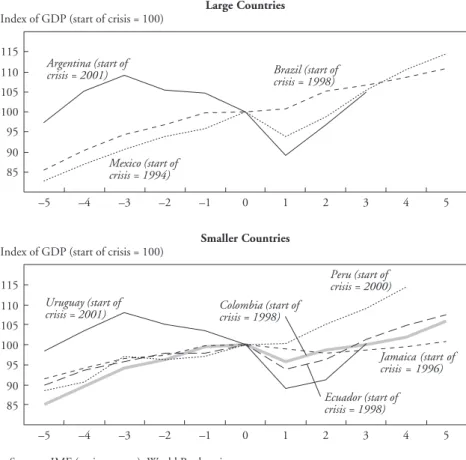
In the Latin American crisis countries, growth has resumed, but most countries remain below their relatively slow precrisis growth paths, despite 2004 bringing the highest growth in Latin America since the 1980s (fig- ure 2-3). In many of the Latin American countries the crises were smaller, relative to GDP, than in East Asia, and hence the recoveries did not have to be as large. In addition, the crises in some of the Latin American countries started after 1997, which meant that the recovery periods coincided with a pickup in the world economy and growing markets for primary products.
However, Latin American growth rates were much slower than in East Asia, and, until 2004, the Latin American economies seemed to have benefited less from the rise in world growth than the East Asian economies. Although the Latin American economies recently benefited from the increased world demand for primaries, many Latin American economies still face significant adjustment problems in their manufacturing sectors as a result of globaliza- tion. Investment rates in most Latin American countries are 20 percent of GDP or less, which is somewhat lower than investment rates in East Asia today and much lower than East Asian rates in the first half of the 1990s.
Regarding individual Latin American countries, Peru did better than most, increasing its growth rate and rising above the previous growth path.
Peru suffered a relatively small financial crisis that it managed well. Despite a major political upheaval in 2000, Peru maintained a strong fiscal stance and a market orientation, while continuing to limit government inter- vention in the economy. Mexico also seems to have risen above its growth
17. Some indicators suggest that postcrisis growth and exports may be underestimated, particularly in forestry and related industries, because of the growth in illegal logging after the end of the cronies’
control of logging concessions, which was related to their monopoly on plywood exports.
path prior to the 1994 crisis (not shown in figure 2-3, where the last date for Mexico is 1999). Jamaica also is above its former growth path, but its growth remains less than 3 percent a year.
Argentina and Uruguay rebounded quickly from the large losses in output after their crises; it remains to be seen whether they can sustain growth in coming years. Argentina suffered a recession before the 2001 crisis, especially after Brazil’s devaluation in 1999 (figure 2-3). Many observers attribute that recession to Argentina’s declining competitiveness because of the peso’s link to the dollar. Both Argentina and Uruguay suffered sharp declines in output
Large Countries
85 90 95 100 105 110 115
85 90 95 100 105 110 115
Argentina (start of
crisis = 2001) Brazil (start of
crisis = 1998)
Mexico (start of crisis = 1994)
Smaller Countries
–5 –4 –3 –2 –1 0 1 2 3 4 5
–5 –4 –3 –2 –1 0 1 2 3 4 5
Colombia (start of crisis = 1998)
Ecuador (start of crisis = 1998)
Jamaica (start of crisis = 1996) Peru (start of
crisis = 2000) Uruguay (start of
crisis = 2001)
Sources: IMF (various years); World Bank estimates.
Index of GDP (start of crisis = 100) Index of GDP (start of crisis = 100)
Figure 2-3. Precrisis and Postcrisis Growth in Select Latin American Countries, 1994–2001
following the Argentine debt-financial crisis that began in late 2001. Since then, Argentina has benefited, at least temporarily, from its default, and its exports have become much more competitive since it broke the link between the peso and the dollar. Uruguay has benefited from Argentina’s recovery.
And both countries, along with Brazil, have benefited from the rise in demand for major agricultural exports such as meat and soybeans. Brazil managed to avoid a debt default in 2002–03, and export-led growth has picked up. The other crisis countries, Colombia and Ecuador, have recovered but continue to suffer from country-specific problems that limit their growth.
International Debt and Reserves
Globalization of financial markets has given international debt and reserve issues an important role in both financial intermediation and crises. Inter- national borrowings played a major role in financing the private sector up to the mid-1990s in many of the larger developing countries.18Excessive exter- nal debt and “sudden stops” in inflows played an important role in the crises of the 1990s.
Since 1997, among the “emerging markets,”19the average ratio of exter- nal debt to gross national income (GNI) in East Asian countries has declined to roughly the 1995 level; in Latin America, the average ratio has risen since 1997 and exceeds the levels of the mid-1990s (figure 2-4). The fall in East Asia reflects sharp declines in the amount of external debt in Korea and Thailand—and a smaller decline in Indonesia—as well as real growth and real exchange rate movements. The rise in the average debt ratio in Latin America since 1997 reflects the sharp rise in the debt ratios of the crisis coun- tries of Argentina, Dominican Republic, and Uruguay, because of real exchange rate depreciations and declining output (compared to 1997). In the other emerging-market crisis countries of Latin America, the amount of debt in dollars was roughly constant, and the ratios of external debt to GNI tended to rise less sharply than in the other crisis countries and, in some cases, were roughly constant, reflecting changes in the real exchange rates
18. Hanson (2003).
19. The term “emerging markets” refers to countries that have issued international bonds; as used here, these are Indonesia, Korea, Malaysia, Philippines, and Thailand in East Asia and Argentina, Brazil, Chile, Colombia, Costa Rica, Dominican Republic, Ecuador, Jamaica, Mexico, Panama, Peru, Uruguay, and Venezuela in Latin America.