Page 1 of 109 ش
Semesters
1439 H – 2018 G
TECHNOLOGY DIPLOMA
Technical and Vocational Training Corporation Director General for Curricula
Curriculum for Department of
Design and Clothing Production Technology
Major
Sewing and Clothing Production
Training Plans For Technical Colleges
Page 2 of 109
Introduction
Praise be to Allah who taught (the use of) the pen, Taught man that which he knew not. Peace and blessings upon our Prophet, instructor and role model, Muhammad Ibn Abdullah, who is sent as a teacher and guide to people and caller to Allah to bring people out of the darkness of ignorance and misguidance to the light of knowledge and guidance.
The Technical and Vocational Training Corporation seeks to qualify trained national cadres who are able to fill technical, technical and vocational jobs available in the Saudi labor market. This interest comes as a result of the directions requested by the leaders of this country. All these jobs seek to obtain an integrated homeland that depends first on Allah's success, then on its resources and the strength of its youth, which has knowledge and faith. Everyone strives for the sake of continuing to reach developmental progress, so that, by the grace of Allah, the country becomes one of the highest industrialized countries.
The Director General for curricula has taken a positive step in line with advanced international experiences to build training programs, according to modern scientific methods that are compatible with the requirements of the labor market in all its specialties to meet these requirements. This step consisted of the National Professional Standards Preparation Project, then the National Professional Qualifications Project. Both projects are the main pillar in building training programs. Standards and qualifications depend on the formation of specialized committees representing the labor market and the General Organization for Technical and Vocational Training. The scientific vision must be compatible with the practical reality imposed by the requirements of the labor market, so that these committees ultimately come out with an integrated view of a training program more relevant to the labor market, and more realistic in achieving its basic requirements.
This training plan deals with the "Sewing and Clothing Production" in the Department of Design and Clothing Production Technology for trainees of technical colleges to describe the courses of this specialization. This plan needs to include vital topics that deal with how to acquire the necessary skills for this specialization so that their skills are to assist them in their practical life after graduating from this program.
The Director General for curricula hopes that this training plan will be a direct contribution to the study of necessary skills, in a simplified manner free of complication.
We hope that Allah will grant success to those who prepare the training plan and its beneficiaries, for what Allah wants and pleases.
Director General for curricula
Page 3 of 109 Table of Content
No Subject Page
1 an introduction 2
2 Index 3
3 Program description Program description 5
The overall goal of the program Detailed program objectives
4 Distributing the training plan to the training classes 7
5 Cover of a brief description of the specialized training courses 8
6 A brief description of the specialized training courses 9
7 Cover a detailed description of common courses in the Department of Clothing
Technology 12
8 Dressmaking techniques 13
9 Textiles 19
10 Fashion Design Basics 23
11 Draw patterns 32
12 Vocational safety 38
13 traditional clothes 42
14 Embroidery skills 48
15 Formation on mannequin 52
16 Outerwear 58
17 Fashion Marketing 63
18 Cover detailed description of the specialized courses for the sewing specialization in
garment production 71
19 Advanced Dressmaking Techniques 72
20 Children Clothes 77
21 Clothing Production Quality 82
22 Industrial Production of Apparel 86
23 Household Clothes 91
24 Cover of training plan appendices 97
25 Supplement of workshop, laboratory, laboratory, and human energy equipment 98
26 Statement of workshops and laboratories 98
27 Equipping the fashion drawing lab 98
28 Equipping the garment implementation factory 99
29 Equipping the sewing techniques laboratory 99
30 Equipping the automated embroidery lab 99
31 Equipping the industrial production plant 99
32 An appendix on the proposed evaluation tools 101
33 References 104
Page 4 of 109 Program Description
The Fashion Design Diploma in the Department of Clothing Design is designed in line with the needs of the local labor market for the specialization, and this specialization is trained in technical colleges, in five midterm training semesters, each training semester lasts eighteen training weeks, with a total of (1872) training hours, in addition To (490) practical training hours in the labor market, equivalent to (81) credit hours.
Training is provided in this program on specialized skills in the basics of fashion design, sewing techniques, drawing patterns, textiles, forming on mannequins, the art of fashion design, traditional clothes, artistic applications in clothes, outerwear, computer fashion design, fabric design, fashion shows Marketing fashion and products, in addition to general skills in Islamic culture, Arabic language, English language, mathematics, computer applications, and getting to know the business world or (courses of career guidance, excellence, job behavior and communication skills).
The graduate from this program is granted an intermediate university degree in Fashion Design from the Department of Clothing Technology and is expected to work in the fields of fashion houses, garment factories and workshops.
The overall objective of the program
This program aims to provide the trainee with the necessary skills and information to practice work in the field of fashion design and to obtain the fifth level in the National Qualifications Framework.
The detailed objectives of the program
By the end of this program, the trainee will be able and efficiently to:
Keep track of safety procedures.
She considers the client's desires
Models are designed manually.
Specifies requirements for the segment.
Follow up the implementation phases.
Add complements to the model.
Manufactured clothing items.
Deals with new developments in the field of fashion,
Quality is applied in clothing production
Calculates the cost of the piece and how to market it.
The Study Distributed on Semesters
1 st Semester
No Course
Code Course Name Prerequisites Equivalent
No of unites
CRH L P T CTH
1 ISLM 101 Islamic Studies ISL 101 ISL 101 2 2 0 0 2
2 ARAB 101 Technical Writing ARB 101 2 2 0 0 2
3 ENGL 111 English Language -1 ENG 8111 3 3 0 1 4
4 MATH 101 Mathematics MAT 8101 3 3 0 1 4
5 ICMT4101 Introduction to Computer
Applications CMT 101 2 0 4 0 4
6 DRES 113 Dressmaking techniques CDP 9107 5 2 6 0 8
7 DRES 131 Textiles CDP 110 2 2 0 1 3
8
VOCA 101 Vocational Guidance &
Excellence KAB 107 2 2 0 0 2
KABB 101 Know About Business (1) KAB 101 2 0 4 0 4
Total Number of Units 23 16 14 3 33
CRH: Credit Hours L: Lecture P: Practical T: Tutorial CTH: Contact Hours
Page 6 of 109 2 st Semester
No Course
Code Course Name Prerequisites Equivalent No of unites
CRH L P T CTH
1 LEAS 101 Learning Skills 2 2 0 0 2
2 ENGL 112 English Language -2 ENGL 111 ENG 8112 3 3 0 1 4
3 ICMT 102 Advanced Computer
Application ICMT 101 CMT 102 2 0 4 0 4
4 DRES 104 Fashion Design Basics CDP 124 4 2 4 0 6
5 DRES 111 Pattern Drawing Basics DRES 113 CDP 9121 3 1 4 0 5
6 DRES 101 Vocational safety CDP 103 2 2 0 0 2
7 DRES 105 Advanced Dressmaking
Techniques DRES 113 3 1 4 0 5
Total Number of Units 19 11 16 1 28
CRH: Credit Hours L: Lecture P: Practical T: Tutorial CTH: Contact Hours
3 st Semester
No Course
Code Course Name Prerequisites Equivalent No of unites
CRH L P T CTH
1 ENGL 113 English Language -3 ENGL 112 ENG 8113 3 3 0 1 4
2 DRES 215 Children Clothes DRES 111
DRES 113
CDP 9224
3 1 4 0 5
3 DRES 243 Traditional Clothes DRES 111 DRES 113
CDP 9161
3 1 4 0 5
4 DRES 222 Embroidery Skills CDP 9151 3 1 4 0 5
5 DRES 271 Industrial Production of Apparel
DRES 111
DRES 105 SEW 9224 4 2 4 0 6
6 DRES 281 Clothing Production Quality DRES 151 SEW 238 2 2 0 0 2
Total Number of Units 19 11 16 1 28
CRH: Credit Hours L: Lecture P: Practical T: Tutorial CTH: Contact Hours
4 st Semester
No Course
Code Course Name Prerequisites Equivalent No of unites
CRH L P T CTH
1 DRES 247 Outerwear DRES 111
DRES 113
SEW 9234
4 1 6 0 7
2 DRES 226 Formation on Mannequin DRES 104
DRES 113 CDP 4233 3 1 4 0 5
3 DRES 255 Fashion Shows DRES 241 SEW 9236 4 2 4 0 6
4 DRES 274 Fashion Marketing CDP 9241 2 2 0 0 2
5 ETHS 101 Professional Ethics & Comm.
Skills VOCA 101 ETH 101 2 2 0 0 2
6 KABB 102 Know About Business (2) KABB 101 KAB 102 2 0 4 0 4
Total Number of Units 16 7 18 0 25
CRH: Credit Hours L: Lecture P: Practical T: Tutorial CTH: Contact Hours
5 st
Semester
No Course Code Course Name Equivalent No of unites
CRH
1 DRES 299 Co-operative Training CDP 299 4
Total Number of Units 4
CRH: Credit Hours L: Lecture P: Practical Hours T: Tutorial CTH: Contact Hours
Total Number of Semesters Credit Unites CRH L P T CTH
81 45 64 5 114
Total of training Hours (16×105)= 1680 + Cooperative training Hours (490)
2314
Brief description of the major courses
Page 9 of 109 Course
Name Dressmaking techniques Course
Code DRES 113 CRH 5
Description
Implementation of sewing techniques (manual and automatic, cleaning, installation of envelopes, additional pieces of costs and ribbons, implementation of adhesives and ruffles, installation of pockets of all kinds on pieces of clothing (blouse - skirts - bags ...
etc.) by using appropriate industrial techniques and industrial machines to execute and remove pieces of clothing. As well as working on the maintenance of the machines and machines by optimizing the use of equipment and machines of various kinds (straight- over) and methods of preserving and maintaining them.
Course
Name Textiles Course
Code DRES 131 CRH 2
Description
It is concerned with textiles, their importance and benefits, how to obtain textile fibers from their various sources and infer the general qualities of textiles according to their nature, and how to manufacture textiles, starting from the formation of threads, spinning them and determining their tones, and then converting these threads into different types and shapes of fabrics, represented by: woven fabrics with their different textile compositions, Non-woven fabrics, woven fabrics with a single thread, in addition to appropriate care methods for different types of textiles to maintain them as long as possible in good condition by (removing stains, type of cleaning and detergents, drying, ironing, storage).
Course
Name Fashion Design Basics Course
Code DRES 104 CRH 4
Description
It includes knowledge, theoretical information and the necessary skills in the basics of fashion drawings and designs from mannequin drawing in the correct standard proportions, designing the various parts of the costume with the correct scientific methods, and linking it with fashion and its development throughout history to keep pace with the current era.
Course
Name Pattern Drawing Basics Course
Code DRES 111 CRH 3
Description
Through this course, the different types of patterns are studied: the flat pattern by the method of the workshops (the quarter) with personal sizes and the treatment of these sizes by scientific mathematical methods for drawing the different parts of the clothes (the upper and lower parts, sleeves, cups ...) and drawing models (bits, cloves, cuts, cuts and drape). Etc.) which is the basis for later downloading the various models and the commercial pattern, reading and extracting its parts, and the industrial pattern.
Page 10 of 109 Course
Name Vocational safety Course
Code DRES 131 CRH 2
Description
In this course, the trainee is provided with concepts related to security and safety and their objectives, and the correct methods for applying safety and security measures in the work environment to avoid potential risks, injuries and accidents that may occur as a result of breaching safety methods in the facility, and to ensure the application of safety measures for workers and the safety of equipment and tools in the work environment according to Occupational safety standards.
Course
Name Formation on Mannequin Course
Code DRES 151 CRH 3
Description
It includes the basic skills of forming on the mannequin through theoretical explanation and practical application, by implementing different patterns for various models, and sewing them manually (neck openings, corridors, sleeves, drapery, clutch, pleats, cuts) by forming on mannequins instead of flat patterns, and finishing them elaborately . Course
Name Traditional Clothes Course
Code DRES 243 CRH 3
Description
It is interested in studying the characteristics of traditional clothing in the Kingdom of Saudi Arabia and the extent to which they are affected by environmental and geographical factors according to regions, in addition to employing traditional clothes and their supplements in implementing modern models with a traditional character.
Course
Name Embroidery Skills Course
Code DRES 222 CRH 3
Description
The use of different methods of manual and automatic embroidery by dealing with modern tools and techniques in the field of embroidery. (Various raw materials, hand tools and equipment, industrial machines, computer embroidery machines) to work on the development of aesthetic taste and the art of innovation in order to produce pieces of utilitarian or aesthetic value.
Course
Name Outerwear Course
Code DRES 247 CRH 4
Description
Draw flat patterns for the lower part of the body (skirt - pants) and upper body (blouses - soft dresses - jacket ... etc.) and lower the various models, taking into account that he contains the necessary skills (cuts - pleats - klush - kalouni - pleats, Ruffles, attached or separate sleeves, attached or separate buckles (to be carried out by the industrial production mechanism in clothes.
Page 11 of 109 Course
Name Fashion Marketing Course
Code DRES 274 CRH 2
Description
This course includes the study of the concept of marketing, its management and the elements associated with it in general and in the field of fashion and fashion in particular by preparing a marketing campaign based on the existing data taking into account all the factors affecting marketing.
Course Name
Advanced Dressmaking Techniques
Course
Code DRES 105 CRH 3
Description
This includes theoretical knowledge and techniques for different fabrics by applying them to pieces of clothing using industrial techniques, maintenance of industrial machinery (buttons, buttonholes, and fabric) and methods of preserving them.
Course
Name Children's clothing Course
Code DRES 241 CRH 4
Description
Drawing the basic pattern of children's clothes and then implementing children's clothes using the commercial pattern in different models for the age stages from birth to school age, and these models are designed and executed using materials and fabrics suitable for children with industrial sewing techniques and correct finishes
Course Name
Industrial Production of Apparel
Course
Code DRES 271 CRH 4
Description
This course contains a new approach in sewing techniques by means of devices and tools that help in the process of preparation and operation in an industrial way as well as explaining the stages of production followed in the ready-made garments factory, namely: (design and preparation for production - production - processing) taking into account the speed, mastery and quality system in the production of clothes According to the energy specified in the production plan to work in the workshop or clothing factory.
Course
Name Home clothes Course
Code DRES 245 CRH 3
Description
Design and implementation of various home clothes with designs, materials and appropriate colors, and beautify them with costs and luxuries in a modern and innovative way by following industrial sewing techniques. The course also contains the conditions that must be taken into account when choosing home and interior clothes for women in terms of appropriate designs as well as the quality of fabrics and materials
Page 12 of 109
A detailed description of the common courses
in the Department of Clothing Technology
Page 13 of 109 Course
Name Dressmaking techniques Course
Code DRES 113 Prerequisite
Training semester 1 2 3 4 5
Credit hours 5
Collaborative training Contact hours
(Hour/ week)
Lecture 2
Practical 6 Training 0 Course Description
Implementation of sewing techniques (manual and automatic, cleaning, installation of envelopes, additional pieces of costs and ribbons, implementation of cuffs and ruffles, installation of pockets of all kinds ... using the appropriate techniques for the implementation and removal of various pieces of clothing, as well as working on the maintenance of machinery and machines with optimal use. For equipment and machinery of various types, methods of maintenance and maintenance.
The general objective of the course:
The course aims to provide the trainee with the basic skills of the necessary sewing techniques, using the optimal use of equipment and machines of various kinds, with their maintenance and execution, for the implementation and production of clothes in their final form.
The detailed objectives of the course:
By the end of this course, the trainee will be able to:
1. Determine the tools used for sewing.
2. Determine the tools used for sewing.
3. The trainee prepares the cloth correctly.
4. Implemented by hand sewing.
5. Multiple types of industrial sewing machines.
6. Follow the instructions for each device (the manual that comes with the machines).
7. You see the parts for a sewing machine.
8. Connect a sewing machine to the power supply after checking its fit.
9. The industrial sewing machine is operating properly.
10. Make sure that the needle is installed correctly.
11. The industrial sewing machine is attached properly.
12. The shuttle is filled regularly.
13. The trainee sews the piece of clothing with different types of seamstresses
Page 14 of 109 14. Sealants are installed correctly in the clothing items.
15. The added parts shall be installed on the wear parts using the appropriate techniques.
16. Multiple tools used in maintenance.
17. Carries out regular maintenance of the industrial sewing machine.
Units (theoretical and practical) Training hours Theoretical practical
Sewing tools and their maintenance methods 6 0
Hand seamstresses 2 6
Sewing machine (household - industrial) 2 6
Maintenance of various machines 2 12
Prepare the fabrics 2 6
Types of seamstresses 2 6
Cleanings 2 12
The most important faults of the sewing machine and methods of
treating it 2 6
Replacement of damaged parts 2 6
Closures 2 12
Added pieces 6 12
Applied tests 2 12
Total 32 96
128 Procedures of Safety Requirements:
1. Preparing the workplace (good lighting - ventilation - air conditioning).
2. Wearing appropriate clothes when working (petticoats - eye protection goggles).
3. Ensure the safety of electrical appliances before use.
4. Implementing the necessary safety measures to carry out maintenance.
5. Return the tools to their place after completion of the work.
Page 15 of 109
The detailed approach (theoretical and practical)
hours Content Assessment tools
6
Tools used for sewing and maintenance methods:
o Terms and definitions.
o The most important tools used in sewing.
o Ways to protect the tools.
o Methods for correct use of tools.
o Types of sewing machines.
o The importance of machine maintenance.
o Methods and steps for sewing machine maintenance.
o See the included manual for your sewing machine.
Oral exams Written exams
Subject references
1-Singer Encyclopedia of Sewing, Principles of Sewing, 1992, Academia Lebanon.
2-Al-Ablani, Elham Ahmed, Illustrated Guide to Using a Home Sewing Machine, 2006.
3-Secondary industrial institutes, training bag, maintenance and safety procedures for sewing.
8
Hand sewing:
o Saddlery o Fabrication o The plant.
Practical performance
Subject references
1-Singer Encyclopedia of Sewing, Principles of Sewing, 1992, Academia Lebanon.
2-Al-Zubaidi, Kholoud Manea, The Facilitated Encyclopedia of Sewing and Detailing, 1st Edition, 2006 AD, Amman - Dar Degla.
8
Household and industrial sewing machine:
o Machine parts.
o To combine the upper and lower machine.
o Machine operation
Oral exams Written exams Practical performance Subject
references
1-Al-Ablani, Elham Ahmed, Illustrated Guide to Using a Home Sewing Machine, 1st Edition, 2006.
2-Secondary industrial institutes, training bag, maintenance and safety procedures for sewing
14
Maintenance of various machines:
o The work of cleaning the shuttle house.
o Machine lubrication method.
o Do a cleaning of the house of the shuttle house, the method of oiling the machine.
o Machine socket repair.
o Machine belt installation.
Oral exams Written exams Practical performance
Page 16 of 109
The detailed approach (theoretical and practical)
hours Content Assessment tools
o Maintenance of the knitting machine.
o Maintenance of over-the-top machine.
o Maintenance of the buttonhole machine.
o Maintenance of the fabrication machine.
o Maintenance of the button machine and the installation of machetes needles in various machines
Subject references
1-Singer, Encyclopedia of Graphic Sewing, Edition 1, 2003 AD, Academia International.
2-Al-Ablani, Elham Ahmed, Illustrated Guide to Using a Home Sewing Machine, 1st Edition, 2006.
3-Secondary industrial institutes, training bag, maintenance and safety procedures for sewing
8
Preparing the fabrics:
o A fabric shows.
o Trends longitudinal fabrics cross-stitch.
o Bend the fabrics lengthwise, crosswise and interchangeable.
o Preparing fabrics to fix the patterns according to the required direction
Oral exams Written exams Practical performance
Subject references
1-Singer Encyclopedia of Sewing, Principles of Sewing, 1992, Academia Lebanon.
2-Al-Zubaidi, Kholoud Manea, The Facilitated Encyclopedia of Sewing and Detailing, 1st Edition, 2006 AD, Amman - Dar Degla.
8
Types of seamstresses:
o Straight sewing.
o Curved sewing.
o Sew corners
Oral exams Written exams Practical performance Subject
references
1-Singer Encyclopedia of Sewing, Principles of Sewing, 1992, Academia Lebanon.
2-Singer, Encyclopedia of Graphic Sewing, Edition 1, 2003 AD, Academia International.
14
Cleanings:
o Cleaning the internal seams (protruding - flat - flyer - the pier).
o Crease cleaning.
o Twine.
o Machine crease.
o Hand blast.
o Cleaning refrain.
o Sewage o curtain
Oral exams Written exams Practical performance
Page 17 of 109
The detailed approach (theoretical and practical)
hours Content Assessment tools
Subject references
1-Singer Encyclopedia of Sewing, Principles of Sewing, 1992, Academia Lebanon.
2-Singer, Encyclopedia of Graphic Sewing, Edition 1, 2003 AD, Academia International.
3-Al-Ablani, Elham Ahmed, Illustrated Guide to Using a Home Sewing Machine, 1st Edition, 2006
8
The most important faults of the sewing machine and methods of treating them:
o The machine is moving and not enabling.
o The needle breaks more than once during enablement.
o If the thread breaks at the needle.
o The stitches are uneven.
o Enabling stitches are improper on top.
o Enabling stitches are intact at the bottom.
o The machine does not spin
Oral exams Written exams Practical performance
Subject references
1-Singer Encyclopedia of Sewing, Principles of Sewing, 1992, Academia Lebanon.
2-Singer, Encyclopedia of Graphic Sewing, Edition 1, 2003 AD, Academia International.
3-Al-Ablani, Elham Ahmed, Illustrated Guide to Using a Home Sewing Machine, 1st Edition, 2006
8
Damaged parts change:
o Feeding comb.
o Industrial Overhead Scissors.
Oral exams Written exams Practical performance
Subject references
1-Singer Encyclopedia of Sewing, Principles of Sewing, 1992, Academia Lebanon.
2-Singer, Encyclopedia of Graphic Sewing, Edition 1, 2003 AD, Academia International.
3-Al-Ablani, Elham Ahmed, Illustrated Guide to Using a Home Sewing Machine, 1st Edition, 2006
8
Closures:
o Installation of manual and automatic buttons on the headers.
o Lug (manual and automatic).
o Visible concealer fasteners.
o Adhesive tape.
o Manual and automatic capson.
o Shankar
Oral exams Written exams Practical performance
Subject references
1-Singer Encyclopedia of Sewing, Principles of Sewing, 1992, Academia Lebanon.
2-Singer, Encyclopedia of Graphic Sewing, Edition 1, 2003 AD, Academia International.
3-Al-Ablani, Elham Ahmed, Illustrated Guide to Using a Home Sewing Machine, 1st Edition, 2006
Page 18 of 109
The detailed approach (theoretical and practical)
hours Content Assessment tools
18
Added pieces:
o Internal pockets.
o External pockets.
o Chloasma.
o Rubber.
o Ruffles.
o Connect fabrics
Oral exams Written exams Practical performance
Subject references
1-Singer Encyclopedia of Sewing, Principles of Sewing, 1992, Academia Lebanon.
2-Singer, Encyclopedia of Graphic Sewing, Edition 1, 2003 AD, Academia International.
3-Al-Zubaidi, Kholoud Manea, The Facilitated Encyclopedia of Sewing and Detailing, 1st Edition, 2006 AD, Amman - Dar Degla.
14
Applied Tests:
o A practical test on a mini-project in which the skills are applied from first to fifth in the middle of the semester.
o A practical test on a skills mini-project from the sixth to the ninth at the end of the training semester
Oral exams Written exams Practical performance Subject
references All references
References
1. Secondary industrial institutes, training bag, maintenance and safety procedures for sewing.
2. Dalia Abdeen, Dr. Zainab Al-Dabbagh, Studies in Textile and the Foundations of Executing Clothes, 1st Edition, 1424 A.H., Dar Al Masirah for Printing and Publishing.
3. Wadad Muhammad Al-Hajji, The Developed Approach in the Technique of Tailoring and Tailoring, 1st Edition, 1422 AH, The Gulf Women Charity Girl.
4. Al-Ablani, Elham Ahmed, Illustrated Guide to Using a Home Sewing Machine, 1st Edition, 2006.
5. Al-Zubaidi, Kholoud Manea, The Facilitated Encyclopedia of Sewing and Detailing, 1st Edition, 2006 AD, Amman - Dar Degla.
6. Ghaith, Kholoud Badr, Principles of Sewing, 1st Edition, 2004 AD, Arab Society Library.
7. Singer, Encyclopedia of Graphic Sewing, Edition 1, 2003 AD, Academia International.
8. Singer Encyclopedia of Sewing, Principles of Sewing, 1992, Academia Lebanon.
9. Garment Technology / Lebanese-French Technical Publications Company Euro Rient Publishing / 2014
10. Sewing Basics, Types of Machines and Equipment Author / Terza Giluska 2015 11. Tailoring Creation of Prototypes Author / Govarn Veld Andrew Richard 2008
Page 19 of 109 Course
Name Textiles Course
Code DRES 131 Prerequisite
Training semester 1 2 3 4 5
Credit hours 2
Collaborative training Contact hours
(Hour/ week)
Lecture 2
Practical 0 Training 1 Course Description
It is concerned with textiles, their importance and benefits, how to obtain textile fibers from their various sources and infer the general qualities of textiles according to their nature, and how to manufacture textiles, starting from the formation of threads, spinning them and determining their tones, and then converting these threads into different types and shapes of fabrics, represented by: woven fabrics with their different textile compositions, Non-woven fabrics, woven fabrics with a single thread, in addition to appropriate care methods for different types of textiles to maintain them as long as possible in good condition by (removing stains, type of cleaning and detergents, drying, ironing, storage).
The general objective of the course:
The course aims to provide the trainee with the most important science and knowledge that enables her to classify the different types of fabrics according to the type of fibers used in their manufacture and their structural fabric and to determine appropriate care methods for them.
The detailed objectives of the course:
By the end of this course, the trainee will be able to:
1. Textile fibers are classified according to their source.
2. Examine the shapes of the tissue fibers.
3. Differentiate the types of fabrics.
4. It shows specifications of different fabrics.
5. Perform different textile compositions for woven fabrics.
6. Decode the clothing guide.
7. It deduces the benefits of textile bleaching processes.
8. Multiplication of the most important equipment for textiles.
9. Realizes correct ways to care for clothes.
10. Various stains are removed in the correct ways 11. Various stains are removed in the correct ways
Page 20 of 109
Units (theoretical and practical) Training hours Theoretical practical
Textile fibers 6 0
Textile manufacturing and installation 15 0
Fabric processing and preparation 9 0
Care for textiles 9 0
Assessment of knowledge and science acquired 9 0
Total 48 0
48 Hours of exercise are added to theoretical hours
Procedures of Safety Requirements:
1. Good lighting and ventilation 2. Wearing appropriate work clothes
3. Take care when using chemicals and detergents.
4. Take care when using sharp tools (scissors, nails, needles).
5. Take care when using ironing tools
The detailed approach (theoretical and practical)
hours Content Assessment tools
9
o Textile fibers:
o Definition of textiles.
o Textile benefits and importance.
o The most important basic terms used in the textile industries are:
o Fibers.
o Raw Material.
o Spining.
o Twisting.
o Weaving.
o Warp.
o Weft
Oral exams
o Tricot.
o Dyeing.
o Printing.
o Finishing.
o Divide the fibers according to their source:
o Natural.
o Industrial.
o Transformational.
o General qualities of textile fibers:
Page 21 of 109 o Basic qualities:
o Bristle length.
o The durability of the bristles.
o Flexibility.
o Flexibility and elasticity.
o Creases or spinability.
o Capillary smoothness and precision.
o Secondary traits:
o Physical shape (practical by examining the longitudinal and cross section of the fibers):
o Density.
o the color.
o Gloss.
o The ability to absorb moisture.
o Filament elongation.
o Capillary maturation.
o Resistant to sunlight, heat and chemicals.
o Combustion.
Subject references
1-Nasr, Ensaf / Al-Zoghbi, Kawthar: Studies in Textile, Dar Al-Fikr Al- Arabi, Revised Edition 7, 2007
2-Zahir, Mustafa: Advanced Histological Structures, DAR ELFIKR ELARABI, 2nd Edition, 2003
3-Al-Naouri, Souad Asakria / Nishiwat, Leila Hijazin: Textiles, Al- Shorouk 2004
20
o Textile manufacturing and installation:
o Strings.
o Yarn.
o Twist strings.
o Types of threads according to their qualities.
o Thread leopard.
o Types of fabrics and their specifications:
o Types:
o Woven and its divisions (regular, lanugo, retina).
o Non-woven (interconnected).
o Epoca (single thread).
o Modern and smart fabrics.
o Its specifications:
o Features and disadvantages of fabrics of various types.
o Textile compositions for woven fabrics (practical):
o Types of looms.
o Simple Loom Parts.
o Simple loom preparation and processing.
o The sealing process (warping yarn preparation).
Oral exams Practical performance
Page 22 of 109 o Draw textures on square paper.
o Implementation of a product (shawl, hat, hair accessory, or the most important weaving
compositions of woven fabrics using color effects:
o Regular fabrics:
o Plain or simple fabric.
o Fabric chiller.
o Atlantic fabric.
o Lanugo fabrics
Subject references
1-Nasr, Ensaf / Al-Zoghbi, Kawthar: Studies in Textile, Dar Al-Fikr Al- Arabi, Revised Edition 7, 2007
2-Zahir, Mustafa: Advanced Histological Structures, DAR ELFIKR ELARABI, 2nd Edition, 2003
3-Al-Naouri, Souad Asakria / Nishiwat, Leila Hijazin: Textiles, Al- Shorouk 2004
6
Fabric treatment and preparation:
o Bleaching:
o Its benefits.
o Sections of bleaching materials.
o Textile dyeing:
o Sections of tints.
o Dyeing methods (filaments, threads, dyeing fabrics).
o Fittings:
o Anti-frizz processing.
o Mercerization process.
o Mite resistance.
o Stain resistance.
o Anti-static processing.
o Water absorption resistance.
o Preparation against combustion.
o Preparing to take form or fixed form.
Oral exams Practical performance
References
12. Nasr, Ensaf / Al-Zoghbi, Kawthar: Studies in Textile, Dar Al-Fikr Al-Arabi, 7th Edition, revised 2007
13. Kashgari, Khadija Rousey: Fabrics and Tiles in Health and Disease, Fold and Psychological Aspects in History, Psychology and Public Health, 2005
14. Al-Naouri, Souad Asakria / Nishiwat, Leila Hijazin: Textiles, Al-Shorouk 2004 15. Zahir, Mustafa: Advanced Histological Structures, DAR ELFIKR ELARABI, 2nd
Edition, 2003
16. Al-Zabin, Haila Abdulaziz: Textile Brief, 1st Edition 2000
17. Fashion Color Styles / Lebanese-French Technical Publications Company Euro Rient Publishing 2014
18. Tissue guide for a suitable test for a successful design. Author / Christcel Benion Publisher Eastern European Publishing Company 2015
Page 23 of 109 Course
Name Fashion Design Basics Course
Code DRES 104 Prerequisite
Training semester 1 2 3 4 5
Credit hours 4
Collaborative training Contact hours
(Hour/ week)
Lecture 2
Practical 4
Training 0
Course Description
It includes knowledge, theoretical information and the necessary skills in the basics of fashion drawings and designs, from drawing mannequins in the correct standard proportions, designing the various parts of the costume in the correct scientific methods, and linking it with fashion and its development throughout history to keep pace with the current era.
The general objective of the course:
This course aims to provide the trainee with the necessary knowledge, theoretical information and skills in the basics of fashion drawings and designs, linking them with fashion and its development throughout history, which enables her to draw mannequins in correct standard proportions and design different parts of uniforms by scientific methods.
The detailed objectives of the course:
By the end of this course, the trainee will be able to:
1. Remember a brief history of fashion design and fashion.
2. Defines fashion and fashion concepts.
3. Infer the factors affecting the development of fashion.
4. Describes different costumes in past civilizations.
5. It teaches the most important international schools of fashion in the modern era.
6. Differentiate the types of design.
7. Multiple elements of fashion design.
8. Differentiate the foundations of design.
9. The multitasking of a fashion designer.
10. The design lines are determined according to the nature of the body.
11. The clothes are classified according to the different occasions.
12. Determine the tools and materials used in the fashion design.
13. You practice drawing geometric shapes.
14. Draw basic lines of the mannequin according to the length of the head unit.
Page 24 of 109 15. Draw a mannequin by the geometric method.
16. Softened external mannequin lines.
17. Draw a bunch of hairstyles on the mannequin.
18. It delineates various neck openings around the neck of the mannequin.
19. Paint various colors in different ways.
20. Draw different shapes for the connected and split sleeves.
21. She draws cornices and bracts on the mannequin.
22. Draw knots and bows in different shapes.
23. Draw different costume accessories appropriate to the design.
Units (theoretical and practical) Training hours Theoretical practical
Introduction to design and fashion 4 0
Fashion, motifs and ornaments in ancient civilizations 4 0
Fashion in the pre-Islamic and Islamic era 2 0
Fashion in European times 6 0
Fashion schools in our modern era 3 0
Types of design 1 0
Design elements 2 0
Basics of design 4 0
Choose clothes 4 0
Tools and materials used in fashion design 2 0
Draw geometric shapes 0 6
Draw the mannequin by the geometric method 0 8
Draw hair 0 4
Draw the parts of the costume 0 24
Draw outfit supplements 0 22
Total 32 64
96 Procedures of Safety Requirements:
1. Create the appropriate work environment (lighting, ventilation, temperature).
2. Wear appropriate clothing to work.
3. Maintain cleanliness during work.
4. Return the tools and materials to their designated places after the end of their use
The detailed approach (theoretical and practical)
hours Content Assessment tools
4 Introduction to design and fashion:
o About design and fashion.
Oral exams Written exams
Page 25 of 109 o Concept outfit.
o Fashion concept.
o The design concept.
o Fashion design concept.
o The importance of fashion.
o Factors affecting fashion trends.
o The stages of fashion development.
o The tasks of a successful fashion designer.
Subject references
1-Soliman, Kifaya and Zaghloul, Samar, Foundations of Fashion Design for Women, 2007, Cairo, The World of Books.
2-Samman, Samia Ibrahim, Encyclopedia of Clothes, 1997
3-Nasr, Soraya Sayed: A History of People's Fashion, The World of Books 1998
4-."100 Dresses: The Costume Institute / The Metropolitan Koda , Harold .(2010)
4
Fashion, motifs and ornaments in ancient civilizations:
o Primitive costume.
o Ancient civilization of Egypt.
o Assyrian civilization.
o Persian civilization.
o Greek civilization.
o The Romanian Civilization.
o Byzantine civilization.
Oral exams Written exams
Subject references
1-Soliman, Kifaya and Zaghloul, Samar, Foundations of Fashion Design for Women, 2007, Cairo, The World of Books.
2-Samman, Samia Ibrahim, Encyclopedia of Clothes, 1997
3-Nasr, Soraya Sayed: A History of People's Fashion, The World of Books 1998
Subject references
1-Soliman, Kifaya and Zaghloul, Samar, Foundations of Fashion Design for Women, 2007, Cairo, The World of Books.
2-Samman, Samia Ibrahim, Encyclopedia of Clothes, 1997
3-Nasr, Soraya Sayed: A History of People's Fashion, The World of Books 1998
2
Fashion in the pre-Islamic and pre-Islamic era:
o Fashion in the pre-Islamic era.
o Fashion in the Islamic era:
o Interior.
o External.
o Clothes out
Oral exams Written exams
Subject references
1-Al-Bassam, Laila Saleh / Sidqi, Mona Mahmoud: The History of Women's Fashion Through the Ages, Dar Al-Zahra, 2002
2-Nasr, Soraya Sayed: A History of People's Fashion, The World of Books 1998
4 Fashion in European times: Oral exams
Page 26 of 109 o Middle Ages.
o European fashion from the tenth to the fifteenth centuries AD.
o Renaissance sixteenth century.
o The seventeenth century.
o Eighteenth century o Nineteenth century.
o Twentieth century
Written exams
Subject references
1-Soliman, Kifaya and Zaghloul, Samar, Foundations of Fashion Design for Women, 2007, Cairo, The World of Books.
2-Samman, Samia Ibrahim, Encyclopedia of Clothes, 1997
3-Nasr, Soraya Sayed: A History of People's Fashion, The World of Books 1998
4-Hart , Avril . North , Susan .(1998)."Historical Fashion in Detail: The 17th and 18th Centuries". by Rizzoli.
5- Fogg, Marnie.(2011)." Fashion Illustration 1930 to 1970" . by Batsford.
6- Century -. "Nineteeth, Helen .(2006)Johnston , Lucy . Kite, Marion.
Persson. " by Victoria & Albert MuseumFashion in Detail
3
Fashion schools in our modern era:
o Founder of high fashion houses.
o The history of the most important international fashion designers in the modern era.
o The most important international magazines specialized in fashion and fashion.
o The spread of fashion and its marketing in the modern era.
Oral exams Written exams
Subject references
1-Soliman, Kifaya and Zaghloul, Samar, Foundations of Fashion Design for Women, 2007, Cairo, The World of Books.
2-Samman, Samia Ibrahim, Encyclopedia of Clothes, 1997
3-Nasr, Soraya Sayed: A History of People's Fashion, The World of Books 1998
4-."Patterns of Fashion 3: The Cut and Construction of Clothes Arnold, by Costume & Fashion Press/Quite Specific Mediad Women"for Men an 5-".by Laurence King "100Years of Fashion Illustration Blackman, Cally.(2007).Publishing.
1
Design Types:
o Functional design.
o Architectural design.
o Decorative design
Oral exams Written exams Subject
references
1-Samman, Samia Ibrahim, Encyclopedia of Clothes, 1997
2-Issa, Yousry Moawad, Rules and Foundations of Fashion Design, 2nd Edition. 2011, Cairo.
2 Design elements: Oral exams
Page 27 of 109 o Line.
o The shape.
o The color.
o Texture
Written exams
Subject references
1-Samman, Samia Ibrahim, Encyclopedia of Clothes, 1997
2-Issa, Yousry Moawad, Rules and Foundations of Fashion Design, 2nd Edition. 2011, Cairo.
3-" . by Contemporary Fashion Illustration Techniques e, Naoki.(2009)."WatanabRockport Publishers.
4-.".by Prentice Hall" Fashion Illustration for DesignersHagen, 4
Basics of design:
o Unit.
o Equilibrium.
o The rhythm.
Oral exams Written exams o Sovereignty.
o Proportionality.
o the scale.
o Variance.
Subject references
1-Issa, Yousry Moawad, Rules and Foundations of Fashion Design, 2nd Edition. 2011, Cairo.
2-Samman, Samia Ibrahim, Encyclopedia of Clothes, 1997 3-" . by Contemporary Fashion Illustration Techniques e, Naoki.(2009)."WatanabRockport Publishers.
4-.".by Prentice Hall" Fashion Illustration for DesignersHagen,
4
Choose clothes:
o According to the nature of the body:
o Skinny short.
o Mega short.
o Tall, slender.
o Long mega.
o With narrow shoulders.
o Wide center.
o With a prominent belly.
o Depending on the occasion:
o Morning clothes o Evening wear.
o Evening wear o Home clothes
Oral exams Written exams
Subject references
1-Samman, Samia Ibrahim, Encyclopedia of Clothes, 1997
2-Issa, Yousry Moawad, Rules and Foundations of Fashion Design, 2nd Edition. 2011, Cairo.
2
Tools and materials used in fashion design:
o Design tools.
o Design materials
Oral exams Written exams
Page 28 of 109 Subject
references
1-Soliman, Kifaya and Zaghloul, Samar, Foundations of Fashion Design for Women, 2007, Cairo, The World of Books.
2-Samman, Samia Ibrahim, Encyclopedia of Clothes, 1997
3-Nasr, Soraya Sayed: A History of People's Fashion, The World of Books 1998
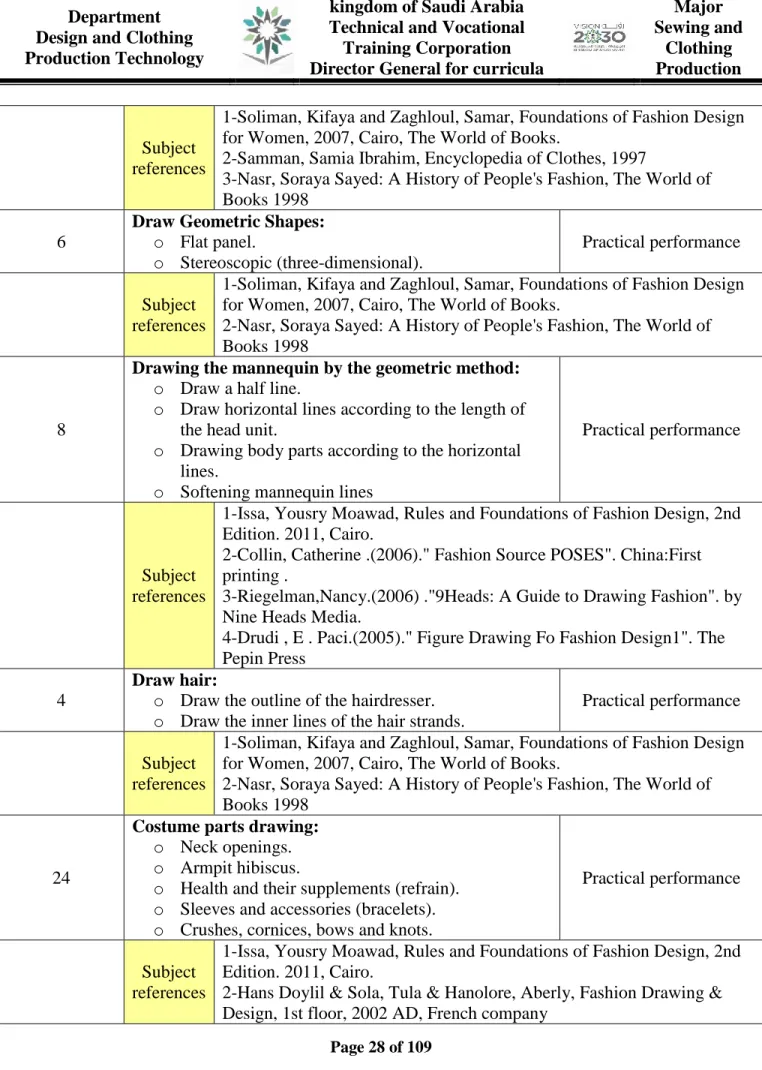
6
Draw Geometric Shapes:
o Flat panel.
o Stereoscopic (three-dimensional).
Practical performance Subject
references
1-Soliman, Kifaya and Zaghloul, Samar, Foundations of Fashion Design for Women, 2007, Cairo, The World of Books.
2-Nasr, Soraya Sayed: A History of People's Fashion, The World of Books 1998
8
Drawing the mannequin by the geometric method:
o Draw a half line.
o Draw horizontal lines according to the length of the head unit.
o Drawing body parts according to the horizontal lines.
o Softening mannequin lines
Practical performance
Subject references
1-Issa, Yousry Moawad, Rules and Foundations of Fashion Design, 2nd Edition. 2011, Cairo.
2-Collin, Catherine .(2006)." Fashion Source POSES". China:First printing .
3-Riegelman,Nancy.(2006) ."9Heads: A Guide to Drawing Fashion". by Nine Heads Media.
4-Drudi , E . Paci.(2005)." Figure Drawing Fo Fashion Design1". The Pepin Press
4
Draw hair:
o Draw the outline of the hairdresser.
o Draw the inner lines of the hair strands.
Practical performance Subject
references
1-Soliman, Kifaya and Zaghloul, Samar, Foundations of Fashion Design for Women, 2007, Cairo, The World of Books.
2-Nasr, Soraya Sayed: A History of People's Fashion, The World of Books 1998
24
Costume parts drawing:
o Neck openings.
o Armpit hibiscus.
o Health and their supplements (refrain).
o Sleeves and accessories (bracelets).
o Crushes, cornices, bows and knots.
Practical performance
Subject references
1-Issa, Yousry Moawad, Rules and Foundations of Fashion Design, 2nd Edition. 2011, Cairo.
2-Hans Doylil & Sola, Tula & Hanolore, Aberly, Fashion Drawing &
Design, 1st floor, 2002 AD, French company
Page 29 of 109
3-by David & ".."Fashion Illustration: Inspiration and TechniqueKiper,Anna.(2011) Charles Publishers
4-" . by Contemporary Fashion Illustration Techniques Naoki.(2009)."
WatanArnold,Janet.(1985)."Patterns of Fashion 3: The Cut and 5- Construction of Clothes for Men and Women". by Costume & Fashion Press/Quite Specific Media.abe, Rockport Publishers
16
Outfit Supplement Drawing:
o the shoes.
o Hats.
o Shawls.
o Belts.
o bags.
o Ornaments.
Practical performance
Subject references
1-Issa, Yousry Moawad, Rules and Foundations of Fashion Design, 2nd Edition. 2011, Cairo.
2-Hans Doylil & Sola, Tula & Hanolore, Aberly, Fashion Drawing &
Design, 1st floor, 2002 AD, French company
12
Citation from various sources:
o The concept of the quote.
o Citation sources.
o Adapted fashion drawing (for children, for women).
o Quote from historical source.
o Quote from popular source.
o Quote from natural source.
o Citation from architectural source.
o Citing sources according to events (gifts, the army, the clown, the masks ...).
Oral exams Practical performance.
Subject references
1- Al-Turki, Hoda and Al-Shafei, Wafaa, Fashion Design, Theories and Applications, 2000 AD, Riyadh.
2- Hussein, Greetings Kamel, Egyptian Fashion from the Pharaohs to the Era of Muhammad Ali, Dar Al Maarif.
3-"Fashion Artist: Drawing Techniques to Portfolio .( 2013).Sandra Burke,
4-Tatham , C . Seaman .(2003). ''Fashion design drawin. China''. Midas Printing International Ltd .
References
Easa, Yousry Moawad. (2011). Rules and foundations of fashion design
Translated by Jawhar, Siddiq Ahmed (2011 AD), History of Arab Fashion from the Dawn of Islam until the Modern Age Abu Dhabi: Kalima House and the Sheikh Zayed Grand Mosque Center.
Siraj, Areej Alawi. (2011), Fashion Design, Drawing and Painting, Grandfather:
Dar Sebawiya.
Abu Musa, Ihab Fadel (2008 CE). Fashion design and development. Riyadh: Dar Al Zahraa, Nasr, and Soraya Sayed (2008 CE) Encyclopedia of European Fashion
Page 30 of 109
History, Complements, Decorations and Embroidery Cairo: The World of Books.
Shawky, Ismail (2007), Art and Design, 4th Edition, The Arab Republic of Egypt:
The House of Arab Thought
Solomon, enough. Zaghloul, Samar (2007), Foundations of Fashion Design for Women, Cairo: The World of Books.
Civilization House (Department of Authorship and Translation) (2007 AD): Your clothes, how to choose them and take care of them.
Al-Bassam, Laila Saleh and Sidqi, Mona Mahmoud. (2002 AD) History of women's fashion through the ages. Riyadh: Dar Al-Zahraa.
Abdin, Alia (2002 AD), Innovation Theories in Fashion Design, Cairo: DAR ELFIKR ELARABI.
Hans, Doylil, Sula, Tula and Hanolore, Aberly. (2002 AD) Fashion drawing and design 1. Lebanon: The French Technical Publications Company.
Al-Turki, Hoda and Al-Shafei, Wafa. (2000 AD) Fashion Design, Theories and Applications, Riyadh: Al Majd Printing Press.
Nasr, Soraya Syed. (1998 AD), A History of People's Fashion, Cairo: A World of Books.
Suleiman, Kifaya and Shukri, Najwa (1993). Fashion design and modeling on mannequins, Cairo: DAR ELFIKR ELARABI.
Al-Samman, Samia Ibrahim (1997 AD), Encyclopedia of Clothes, Cairo:
Knowledge Establishment.
Giloska, Terza. (2015), Fashion Design, Part (1), cloth detailing, basic rules, Eastern European Publishing Company.
Giloska, Terza. (2015) Fashion Design Part (2) Template Design Rules Eastern European Publishing Company.
Giloska, Terza. (2015) Fashion Design Part (3) Template Design Rules Eastern European Publishing Company.
Giloska, Terza. (2015) Fashion Design Part (4) Sewing the final touches of fashion - Eastern European Publishing Company.
Giloska, Terza. (2015), Fashion Design, Part (6), Flat Cut for Large Sizes, Eastern European Publishing Company.
Giloska, Terza. (1520 AD) Fashion Design Part (7) Garment Fixes, Eastern European Publishing Company.
Math skill clothes. (2014). Publisher / Lebanese-French Technical Publications Company Euro Rient Publishing.
Math skill clothing / solutions. (2014). Publisher / Lebanese-French Technical Publications Company Euro Rient Publishing.
Fashion sketch and design. (2014), the Lebanese-French Technical Publications
Page 31 of 109 Company, Euro Rient Publishing.
Fernandez, Angel. (2008), Creative Drawings by Fashion Designers, Eastern European Publishing Company.
Hussein, greetings, full. Egyptian fashion from the pharaohs until the era of Muhammad Ali. Knowledge House
Takamura, Zeshu.( 2009).'' Fashion Design Techniques''. China: First printing.
''Fashion Source Technical Design'', First printing . (2007), China.
Ireland, Patrick John.(1987).'' Incyclopedia of fashion details' . London: First printing..
Hagen, Kathryn .(2004). '' Fashion Illustration for Designers '.
Tatham , C . Seaman .(2003). ''Fashion design drawin. China''. Midas Printing International Ltd .
Kindersley , Dorling .(2012) ."Fashion: The Definitive History of Costume and Style". Publisher DK Publishing .
Koda , Harold .(2010) ."100 Dresses: The Costume Institute / The Metropolitan Museum of Art". by Yale University Press.
Hart , Avril . North , Susan .(1998)."Historical Fashion in Detail: The 17th and 18th Centuries". by Rizzoli.
Century -. "Nineteeth006)Johnston , Lucy . Kite, Marion. Persson, Helen .(2. " by Victoria & Albert MuseumFashion in Detail
."Patterns of Fashion 3: The Cut and Construction of Arnold,Janet.(1985). by Costume & Fashion Press/Quite Specific Clothes for Men and Women"Media.
".by Laurence "100Years of Fashion Illustration Blackman, Cally.(2007).King Publishing.
by ".."Fashion Illustration: Inspiration and TechniqueKiper,Anna.(2011)David &
Charles Publishers.
" . Contemporary Fashion Illustration Techniques Watanabe, Naoki.(2009)."by Rockport Publishers.
".by Prentice " Fashion Illustration for DesignersHagen, Kathryn.(2004).Hall.
. by Nine "9Heads: A Guide to Drawing Fashion"Riegelman,Nancy.(2006) .Heads Media.
.rd" . by BatsfoFashion Illustration 1930 to 1970 Fogg, Marnie.(2011)."
." by Pepin " Figure Drawing for Fashion DesignDrudi, Elisabetta.(2002).Press.
""Fashion Artist: Drawing Techniques to Portfolio .( 2013).Sandra Burke,
Page 32 of 109 Course
Name Draw patterns Course
Code DRES 111
Prerequisite DRES 113 - Sewing techniques
Training semester 1 2 3 4 5
Credit hours 3
Collaborative training Contact hours
(Hour/ week)
Lecture 1
Practical 4
Training 0
Course Description
Through this course, the different types of patterns are studied: the flat pattern by the method of the workshop (quarter) with personal sizes and the treatment of these sizes by scientific mathematical methods to draw the different parts of the clothes (the upper and lower parts, sleeves, paulas ...) and draw models (bits, cauliflower, cuts, cuts and drape). Etc.) which is the basis for later downloading the various models and the commercial pattern, reading it and extracting its parts, and the industrial pattern.
The general objective of the course:
The course aims to provide the trainee with the skills of drawing the flat pattern by the method of the workshops, and to download the models by the correct scientific methods, and the extraction of models from the commercial pattern and drawing the industrial pattern.
The detailed objectives of the course:
By the end of this course, the trainee will be able to:
1. Multiple types of flat patterns.
2. Take body measurements correctly.
3. Calculates the basic divisions of standard sizes.
4. Draw the base pattern of the upper part according to standard sizes.
5. Actualize the basic chest bend in different places.
6. Draw the base pattern of the bottom part according to standard sizes 7. Patron paints kasrahs, kaluniyat, zam, and drape
8. The khats, kaluniyyah, zam, darabeh, and cuts are executed on a sample canvas.
9. Draw the different types of sleeves.
10. Paint the different types of cola.
11. Draw basic pattern in personal sizes.
12. Various designs are applied to the flat pattern.
13. Converting a regular flat pattern into a synthetic pattern.
14. Practice reading the instruction booklet and the commercial pattern face and back 15. The model shall be extracted from the required size from the commercial pattern.
Page 33 of 109
Units (theoretical and practical) Training hours Theoretical practical
Sizes - types of patterns 1 4
Patron drew the upper part 2 8
Drainage of the main chest 1 4
Patron draw the bottom part 1 4
Pattern drawing in personal sizes 2 8
Drawing of sleeves patterns 1 4
Draw a cola patron 1 4
Drawing kasra, kalooniyyah and zam 1 4
Drawing the mana and the longitudinal and transverse cuts 1 4 Applying different designs to the flat pattern and linking it to the
basic fashion design course. 2 8
Industrial Albatron 1 4
Extracting a model of the specified size from the commercial
pattern 2 8
Total 16 64
80 Procedures of Safety Requirements:
1. Wear appropriate clothing to work.
2. Take care when using cutting tools.
3. The tools are returned after finishing their use in the designated place.
The detailed approach (theoretical and practical)
hours Content Assessment tools
5
Sizes:
o Concepts and terminology.
o Global measurement tables.
o Flat Patterns Types.
o Tools used in drawing patterns.
o Mannequin / Human Body Measurement Method.
Oral exams Practical performance
Subject references
1- Al-Zaylaa, Khair Al-Din. (2005). Rules for tailoring tailoring for women, Dar Al Hayat Library
2- Mogy, overhead. (2001), Drawing the Pattern (1) (2), Cairo: The House of Arab Thought.
3- Hussein and others, Fawzia. (1993). Drawing the Pattern. Cairo: Al- Amiri Press
10
Patron drawing the upper part: (in standard sizes) o Make the necessary divisions for the upper part.
o Draw the width and length of the pattern.
Oral exams Written exams Practical performance
Page 34 of 109 o Draw the back neck monogram.
o Anterior neck ridge drawing.
o Draw shoulder lines.
o Draw a basic chest penny.
o Draw the anterior and posterior armpits.
o Draw the total length of the pattern.
o Draw a dividing center line.
o Draw a center penny front and back.
o Fee divided larger size.
o Writing data.
o Front and back coloring.
Subject references
1- Al-Zaylaa, Khair Al-Din. (2005). Rules for tailoring tailoring for women, Dar Al Hayat Library
2- Mogy, overhead. (2001), Drawing the Pattern (1) (2), Cairo: The House of Arab Thought.
3- Hussein and others, Fawzia. (1993). Drawing the Pattern. Cairo: Al- Amiri Press
5
Discharge of the main chest penny:
o Types of penny: functional penny; and decorative design penny.
o The difference between functional and decorative pennies.
o Drainage of the main chest peg in the six different main positions on the identical canvas.
Oral exams Written exams Practical performance
Subject references
1- Bukhari, Sanaa Maarouf. (2007 AD) Basic pattern and functional and decorative pennies design, Riyadh: Dar Al Zahraa.
2 - mogy, superstructure. (2001), Drawing the Pattern (1) (2), Cairo: The House of Arab Thought.
5
Bottom pattern (skirt / trousers): (standard sizes) o Make the necessary divisions for the bottom part.
o Draw the width and length of the pattern.
o Draw the dividing line.
o Draw the line of the buttocks (the largest size).
o Draw a center penny front and back.
o Draw a dividing center line.
o Fee divided into larger size.
o Soften lines to the middle.
o Add bows to the trouser pattern.
o Writing data.
o Front and back coloring
Oral exams Written exams Practical performance
Subject references
1 - mogy, superstructure. (2001), Drawing the Pattern (1) (2), Cairo: The House of Arab Thought.\
2-Hussein and others, Fawzia. (1993). Drawing the Pattern. Cairo: Al- Amiri Press
Page 35 of 109 5
Sleeve Patterns Draw:
o Types of sleeves.
o Draw a Quantum Patron.
o Draw short sleeve shapes.
o Draw long sleeve shapes.
o The laying on paper is the same as the canvas.
Oral exams Written exams Practical performance
Subject references
1 - mogy, superstructure. (2001), Drawing the Pattern (1) (2), Cairo: The House of Arab Thought.\
2-Hussein and others, Fawzia. (1993). Drawing the Pattern. Cairo: Al- Amiri Press
5
Sleeve Patterns Draw:
o Types of sleeves.
o Draw a Quantum Patron.
o Draw short sleeve shapes.
o Draw long sleeve shapes.
o The laying on paper is the same as the canvas.
Oral exams Written exams Practical performance
Subject references
1- Al-Zaylaa, Khair Al-Din. (2005 AD) Rules for tailoring tailoring for women, Dar Al Hayat Library.
2- Mogy, alia. (2001), Drawing the Pattern (1) (2), Cairo: The House of Arab Thought.
3- Hussein and others, Fawzia. (1993). Drawing the Pattern. Cairo: Al- Amiri Press.
5
Drawing of the Cola Patterns:
o Types of alakal o Draw a colaspor.
o Chinese kool drawing.
o Drawing of chemise cole.
o Collage drawing (optional model).
o The laying on paper is the same as the canvas.
Oral exams Written exams Practical performance
Subject references
1- Al-Zaylaa, Khair Al-Din. (2005 AD) Rules for tailoring tailoring for women, Dar Al Hayat Library.
2- Mogy, alia. (2001), Drawing the Pattern (1) (2), Cairo: The House of Arab Thought.
3- Hussein and others, Fawzia. (1993). Drawing the Pattern. Cairo: Al-Amiri Press.
10
Drawing patterns in personal sizes:
o Take body measurements.
o Make the necessary divisions.
o Patron drew the upper part.
o Patron draws the bottom part.
o Patron drew the sleeve in personal sizes (long or short).
Oral exams Written exams Practical performance
Subject references
1- Al-Zaylaa, Khair Al-Din. (2005 AD) Rules for tailoring tailoring for women, Dar Al Hayat Library.
2- Mogy, alia. (2001), Drawing the Pattern (1) (2), Cairo: The House of Arab