Tareq Zaal Suhail Muftah Al-Ali. TOWARDS THE MICRO FOUNDATIONS OF ENVIRONMENTAL SUSTAINABILITY: PROMOTING PRO-ENVIRONMENTAL BEHAVIOR. TOWARDS THE MICRO-BASES OF ENVIRONMENTAL SUSTAINABILITY: PROMOTING PRO-ENVIRONMENTAL BEHAVIOR AMONG EMPLOYEES TO ENHANCE CORPORATE ENVIRONMENTAL PERFORMANCE IN THE UNITED ARAB.
Introduction
- Background
- Statement of Research Problem
- Research Aim and Objectives
- Research Questions
Determine the main factors that persuade employees to exhibit pro-environmental behavior in the workplace. Addresses recent calls to bridge micro and macro studies in the field of environmental sustainability.
Literature Review
UAE Vision 2021 and Environment Vision 2030 Overviews
Sheikh Zayed bin Sultan Al Nahyan's actions initially inspired the environmental visions of the UAE. While the UAE's environmental goals are in UAE Vision 2021, Abu Dhabi has set its own goals in Environment Vision 2030.
Environmental Sustainability Initiatives Among UAE Organizations
Another environmental sustainability initiative common among UAE organizations is the adoption of climate-positive development programs. Meanwhile, Bitar (2012) supported the practice of introducing environmental projects, arguing that it is a better way for organizations to demonstrate their commitment to environmental sustainability to the public.
Research Predictors of Employees' Pro-environmental Behavior
- Pro-Environmental Behavior Among Employees
- Utilitarian Orientation
- Intrinsic Preference
- Social Influence
- Green Consumption and Environmental Behavior
- Environmental Knowledge
- Subjective Norms
They adopt pro-environmental actions because they need to ensure that the world is habitable for the next generation (Rezapouraghdam et al., 2018). It is imperative to point out that most organizations in the United Arab Emirates have designed numerous pro-environmental actions, but few have been implemented because they are optional.
Employees Participation in Decision-Making (PDM)
Genuine participation can be observed in the spontaneity and freedom of employees in their conversations with management. When employees participate in detailing these measures, they become part of the process and provide details about what they need to change their operations (Shaed et al., 2015).
Environmental Awareness Training (EAT)
Management mindfulness is critical because it leads to the maintenance of healthy and energetic employees to the company's overall productivity. Environmental awareness training is important in all companies as it encourages sustainable actions and makes pro-environmental thinking part of the company culture.
Environmental Transformational Leadership and Employee PB
These dimensions align with the primary need for leadership-influenced pro-environmental behaviors for all individuals at work (Wesselink et al., 2017). Pro-environmental behavior has flourished from the demand of employees to reasonably optimize resources responsibly, such as eliminating harmful elements and protecting the environment (Saeed et al., 2019).
Employees Participation in Environmental Initiatives (PEI)
It is rare to find employees who can express their values or question the way they work in the company (Loeser et al., 2017). They are given the opportunity to exercise their freedom by identifying ways to reduce energy and water consumption in the company (Taylor et al., 2018).
Attitude Towards Pro-Environmental Behavior (APB)
- Values
- Personality
- The HEXACO Personality Model
- Moral Anger
While studying the circular continuum model with 19 values, Sagiv et al. 2017) found that the social focus sector, as opposed to the personal focus sector, provides strong confirmation of the influence of values and attitudes on pro-environmental behavior. Studies on how organizations can guide employees' values and attitudes towards environmentally oriented behavior are limited.
Organizational Environmental Performance (OP)
- Age
- Gender
- Income
- Education and Knowledge
- Political Views and Worldviews
Education about nature will shape children's interest and inclination for nature, thus influencing environmentally friendly behavior (Martin et al., 2017). Wealthy individuals in society are among the individuals who pursue the highest level of environmentally friendly behavior (Han et al., 2018). They will inspire the rest of the population to engage in such practices as they have to save the environment (Singh et al., 2018).
Human Resource Management's Influence on Employees'
They pointed out that providing environmental training to employees is one of the most effective HRM strategies to cultivate pro-environmental behavior in employees. The issue of transparent and regular communication has also been a critical HRM strategy that cultivates pro-environmental behavior in employees (Epstein et al., 2018). By inference, trying to motivate employees also encourages them to engage in more pro-environmental behavior.
Environmental Performance's Impact on Organizational Growth
In their work, Paillé et al. 2014) found that staff motivation is one of the primary HRM strategies mediating environmental performance. Also regarding the internal benefits of environmental performance on growth, Saeidi et al. 2015) found that most environmentally conscious organizations reduced expenditure in areas that are not always environmentally conscious, e.g. energy, transportation, legal and compliance, and supply chain. Finally, the literature outlined previously suggests that organizations' high environmental performance translates directly into overall growth.
Research Gap and Emerging Research Questions
Therefore, organizations must view investments in environmental sustainability as profitable ones that can yield short-term or long-term financial gains. While Kolk (2016) noted that employee participation in organizations' environmentally sustainable projects is not mandatory because organizations are legal entities, it is also essential to consider that organizations need employees to operate. Therefore, it is strongly recommended that researchers begin to examine more closely how employees can independently influence their employers to achieve environmental performance goals.
Micro-foundations Concept and Environmental Sustainability for the
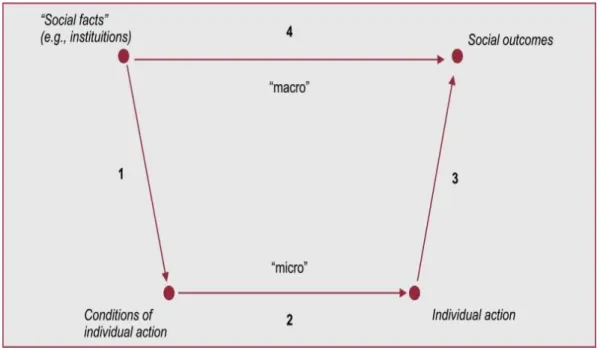
It is important to conduct in-depth research and analysis of micro-foundations of environmental sustainability due to the growing global population and economies, as illustrated in Figure 1. It is imperative to state that more emphasis should be placed on individual learning and impact on environmental sustainability and how individual initiatives can collectively lead to a mutual organizational influence (Bolognesi & Nahrath, 2020). This focus will bridge the currently available data on macro-foundations of environmental sustainability and micro-foundations.
Theoretical Framework
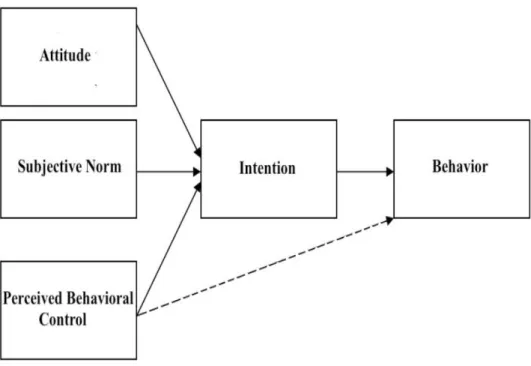
While trying to determine why individuals adopt energy-saving behaviors and other forms of PB, the social psychological theory of planned behavior (TPB) is applied in Figure 2. The theory of planned behavior in this paper will be used to evaluate various proposed environmentally oriented behaviors (Karami & Dehghan, 2021). As reflected in its name, the TPB links a person's beliefs to their behavior (Askew et al., 2014).
Research Hypotheses
H2: Employee participation in decision-making mediates the relationship between environmentally friendly behavior and the environmental performance of the organization. 2021) argued that adding value to environmentally friendly behavior through training will lead to a change in personal norms. There is a positive relationship between transformational leadership and employee attitudes towards environmentally friendly behavior. 2006) explained that environmental education and awareness programs are essential to changing the way organizations conduct their operations, especially if the training is aimed at changing environmental culture.

Methodology, Method, and Sample Design
- Research Paradigm
- Research Questionnaire
- Domain of Interest, Population, and Sample
- Survey Design
- Field Access
- Pilot Research
- Ethical Considerations
- Data Coding
- Chapter Conclusion
In this case, this paradigm will be effectively used in the research model because of the high score in transparency (Li et al., 2019). Efficiency in the research process will lead to the quality of the research and general success (Daryanto & Song, 2021). The research project focuses on a general topic regarding pro-environmental behavior in the workplace and does not require the collection of sensitive information.
Data Analysis and Results
Study Questionnaire
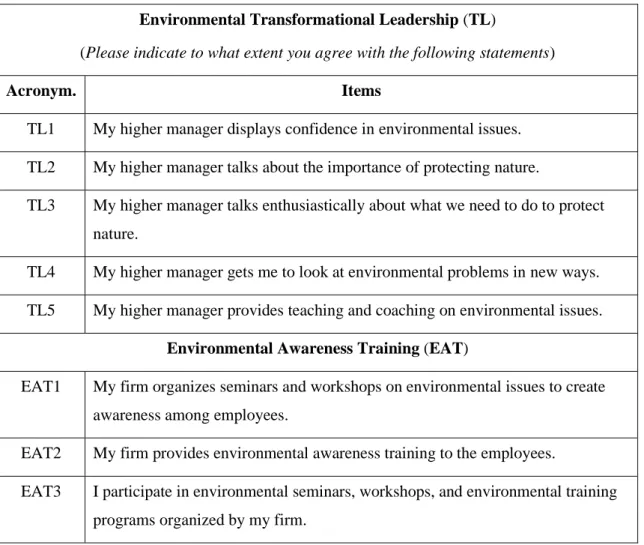
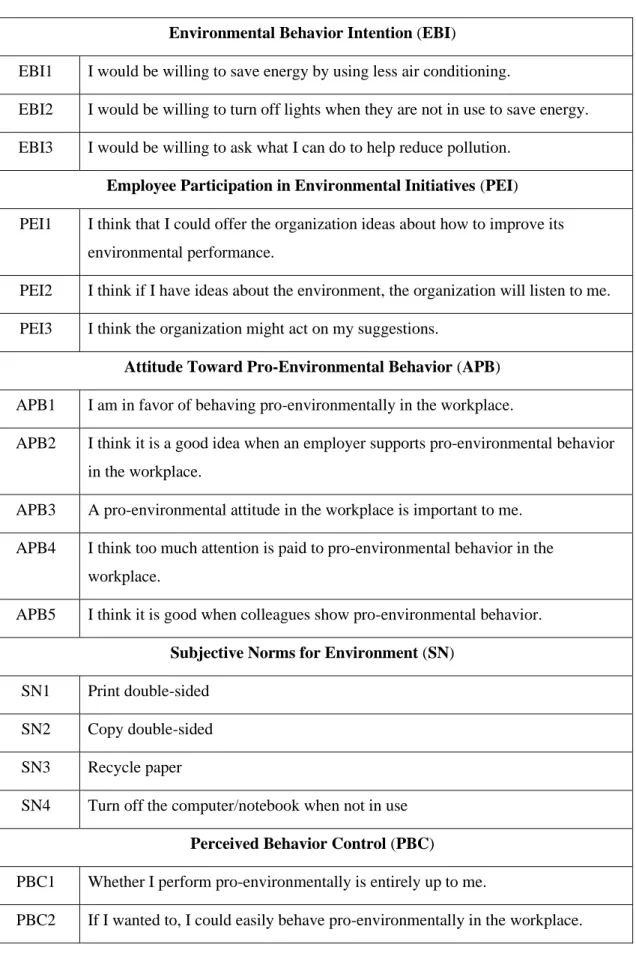
Attitude towards Pro-Environmental Behavior (EPB) APB1 I am in favor of engaging in pro-environmental behavior in the workplace. APB2 I think it is a good idea when an employer supports pro-environmental behavior in the workplace. PDM3 Employees are given opportunities to suggest improvements in the way things are done here.
Case Screening
- Unengaged Responses
- Outliners
- Variable Screening
Mahalanobis distance is a statistical measure of the extent to which cases are multivariate outliers, based on a chi-square distribution, evaluated using p < .001. Skewness and kurtosis: The skewness and kurtosis values of the nine latent variables were tested. The value for skewness is indicative of the symmetry of the distribution, while the value for kurtosis is indicative of the peak of the distribution (Pallant, 2020).
Exploratory Factor Analysis (EFA)
- Number of Factors
- Kaiser-Meyer-Olkin Measure of Sampling Adequacy (KMO)
It is also defined as the sum of the squared factor loadings for the variable. Reliability is a measure of internal consistency in a questionnaire, i.e., how coherent are the items of the same scale or how closely are they correlated (Sekaran . & Bougie, 2016). The correlation between latent variables is a bivariate measure of the strength of the association between two continuous variables.
Confirmatory Factor Analysis (CFA)
- Convergent and Divergent Validity
- Model fit
- Common Method Bias (CMB)
- Structural Equation Modelling
- Testing Moderation and Path Analysis and Hypothesis
- Analytics Software
The TLI and CFI depend on the average size of the correlations in the data. These cutoff criteria for model fit were used as previously defined (Hu & Bentler, 1999). e) Reliability: The reliability of the constructs was evaluated using composite reliability (CR). Consequently, to ensure the reliability of the results, the moderation analysis was repeated using the Process tool in SPSS v 26.
Results Generated
- Case Screening
- Descriptive Statistics
- Variable Screening: Exploratory Factor Analysis
- Validity and Reliability of The Latent Constructs
- Common Method Bias
- Inter-Directional Effects of Variables
- Indirect Effects Mediated between Variables
- Fit Measures for The Final Structural Model- Moderation Analysis
- Descriptive Statistics for Factor Scores
- Association between Dependent and Independent Variables
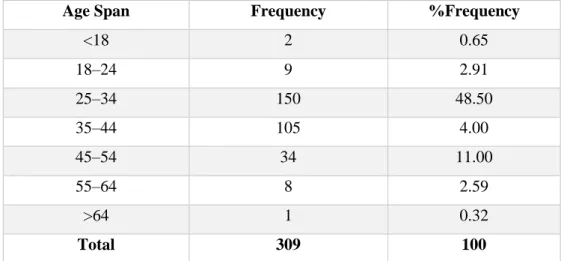
115 of the alternative hypothesis, and it can be concluded that EBI is positively associated with PB. The work sector was therefore significantly associated with nine of the included factors in the pro-environmental survey, as shown in Table 28. Employment status was therefore significantly associated with the scores for eight of the included factors in the pro-environmental survey, as shown in Table 29.
Chapter Summary and Conclusion
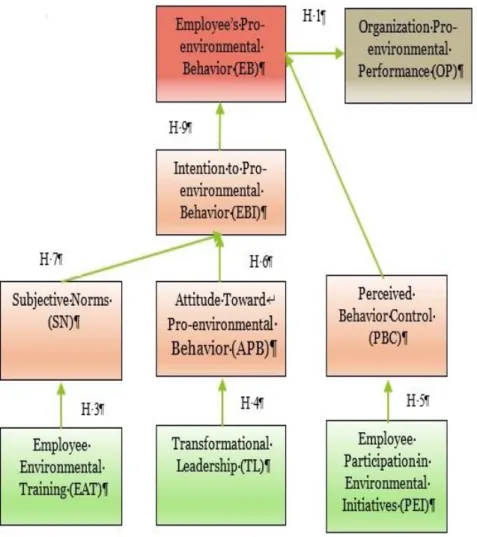
Results for the remaining factors were not associated with years of work with the organization and years of experience. As a result, all hypotheses were tested positively, except for hypothesis 8, where the result showed that there is no correlation between PBC and EPI. Additionally, eight hypotheses were tested along with mediation analysis and the final model was modified, as shown in Figure 16.
Discussion
Introduction
Revisiting Research Objectives and Hypotheses
- Concerning Research Objectives
- Concerning Research Hypotheses
In addition, the hypotheses section elaborates on how pro-environmental behavior affects employees' participation in their employers' environmental initiatives. As well as to investigate the relationship between the environmentally oriented behavior of employees at work and the environmental performance of the organization. Moderating relationships of employee participation in decision-making between pro-environmental behavior and organizational environmental performance.
Summary
137 deliver the benefits of pro-environmental behavior and the impact, with a view to long-term attitudinal changes among employees. For this reason, employees who adopt pro-environmental behavior at work influence people outside of work with their behavior. Consequently, the spillover effect of pro-environmental behavior at work to the community and private sector will benefit the sustainability of the environment in the country (Razak & Sabri, 2019).
Implications and Conclusions
Introduction
Therefore, starting from the micro level, this research showed the critical role of employee PB on the environmental performance of the organization. For example, they can encourage participation in videoconferencing to reduce travel costs, carpooling and recycling (Yuriev et al., 2018). Second, this research reveals micro factors such as environmental training, employees' TL, and PEI that promote employees' willingness to engage in environmentally friendly behavior.
Practical Implications
Thus, the implementation of pro-environmental behavior may conflict with the short-term goals of profit maximization. In addition, they can also promote green building practices, such as reducing waste and energy consumption, through training and implementing small incremental changes to motivate PB, which has a significant impact on employees and gains increasing support (Hodges, 2005). Second, organizations are expected to perform several tasks to successfully incorporate PB, such as motivating and rewarding employees for their environmental roles, offering environmental training, and creating space for employee environmental innovation.
Limitations of the Study and Future Research
141 questionnaires must be carefully designed and administered, from mixing the order of questions to using different types of scale to avoid social desirability bias and using the time lag method (Chang et al., 2010). Furthermore, regarding the generalizability of the findings, data were collected from the hospitality, government, and private sectors in the UAE, thus limiting the generalizability of this study to other countries and cultural contexts. Moreover, future studies can also investigate other factors, such as empathy, to replace employee participation in the decision-making factor as a moderator to improve the research result (Islam et al., 2019).
Conclusion
The role of environmental behavior preferences among urban middle-class households in Peru. How transformational leadership and employee motivation combine to predict environmentally friendly worker behavior in China. Green Human Resource Management Practices and Environmental Performance in Malaysian Green Hotels: The Role of Green Intellectual Capital and Eco-Friendly Behavior.
Consent Letter to Participate in the Research Study
Please note that a maximum of five staff members are required to participate in the questionnaire. If your prestigious firm is selected to participate in the questionnaire, the person concerned should send this email to one manager and four staff members requesting their participation.
Survey Questionnaire
Disagree Neither Strongly Agree Agree I think I can offer ideas about me. organization about how to improve its environmental performance. The firm's managers and employees have a sense of pride in the firm's environmental goals and missions. Managers and employees of the firm identify that the firm pays a lot of attention to environmental management and protection.
Survey Structure
I think it's a good idea for an employer to support environmentally friendly behavior in the workplace. Employees are given the opportunity to suggest improvements in the way business is done here.