1
BỘ GIÁO DỤC VÀ ĐÀO TẠO
TRƯỜNG ĐẠI HỌC DÂN LẬP HẢI PHÒNG ---
ISO 9001 : 2008
KHÓA LUẬN TỐT NGHIỆP
NGÀNH: NGOẠI NGỮ
HẢI PHÒNG - 2012
2
HAIPHONG PRIVATE UNIVESITY FOREIGN LANGUAGES DEPARTMENT
---
GRADUATION PAFER
A STUDY ON TECHNIQUES TO IMPROVE ENGLISH VOCABULARY FOR 3TH GRADERS AT QUANG TRUNG PRIMARY SCHOOL IN HAI PHONG
By:
ĐỖ THỊ TRANG
Class:
NA 1202 Supervisor:
NGUYỄN THỊ HUYỀN,MA
HAI PHONG - 2012
3
BỘ GIÁO DỤC VÀ ĐÀO TẠO
TRƯỜNG ĐẠI HỌC DÂN LẬP HẢI PHÒNG ---
Nhiệm vụ đề tài tốt nghiệp
4
Nhiệm vụ đề tài
1. Nội dung và các yêu cầu cần giải quyết trong nhiệm vụ đề tài tốt nghiệp
( về lý luận, thực tiễn, các số liệu cần tính toán và các bản vẽ).
………
…..
………
…..
………
Các số liệu cần thiết để thiết kế, tính toán.
………
…..
………
…..
2. Địa điểm thực tập tốt nghiệp.
………
…..
………
…..
5
CÁN BỘ HƯỚNG DẪN ĐỀ TÀI Người hướng dẫn thứ nhất:
Họ và tên:...
Học hàm, học vị:...
Cơ quan công tác:...
Nội dung hướng dẫn:...
Người hướng dẫn thứ hai:
Họ và tên:...
Học hàm, học vị:...
Cơ quan công tác:...
Nội dung hướng dẫn:...
Đề tài tốt nghiệp được giao ngày …. tháng …. năm 2012
Yêu cầu phải hoàn thành xong trước ngày … tháng …. năm 2012
Đã nhận nhiệm vụ ĐTTN Đã giao nhiệm vụ ĐTTN
Sinh viên Người hướng dẫn
Hải Phòng, ngày tháng năm 2012 HIỆU TRƯỞNG
GS.TS.NGƯT Trần Hữu Nghị
6
PHẦN NHẬN XÉT TÓM TẮT CỦA CÁN BỘ HƯỚNG DẪN
1. Tinh thần thái độ của sinh viên trong quá trình làm đề tài tốt nghiệp:
………
…..
………
…..
2. Đánh giá chất lượng của khóa luận (so với nội dung yêu cầu đã đề ra trong nhiệm vụ Đ.T. T.N trên các mặt lý luận, thực tiễn, tính toán số liệu…):
………
…..
………
…..
3. Cho điểm của cán bộ hướng dẫn (ghi bằng cả số và chữ):
………
…..
………
…..
………
Hải Phòng, ngày ….. tháng ..… năm 2012
Cán bộ hướng dẫn (họ tên và chữ ký)
7
NHẬN XÉT ĐÁNH GIÁ
CỦA NGƯỜI CHẤM PHẢN BIỆN ĐỀ TÀI TỐT NGHIỆP
1. Đánh giá chất lượng đề tài tốt nghiệp về các mặt thu thập và phân tích tài liệu, số liệu ban đầu, giá trị lí luận và thực tiễn của đề tài.
2. Cho điểm của người chấm phản biện : (Điểm ghi bằng số và chữ)
Ngày... tháng... năm 2012 Người chấm phản biện
8
PART I: INTRODUCTION 1.Rationale
It is can not to denied that English is the international medium of communication in the fields of science, technology, culture, education, economy and so on. It is also considered a means to promote mutual understanding and cooperation between Vietnam and other countries. It is widely seen as the key language toll in the integrating process in the world.
With the rapid development and expansion of informatics technologies, there needs to be a common language for people of all countries to exchange information with each other and it is English that is used as a means of international communication. Therefore, there has been an explosion in the need of teaching and learning English all over the world.
It has been, in fact said that language was a house, vocabulary would be as construction material to build up that house. Therefore when teaching a new language for learner, vocabulary must be the background to develop like building a house, if the foundation is strong the house will be firm.
Therefore, studying a language cannot be separated from studying vocabulary. Yet it is true that the vocabulary is the focus of language. It is in words that sound and meaning interlock to allow us to communicate with one another, and it is word that we arrange together to make sentences, conversation, and discourse of all kinds. Besides, vocabulary really plays an important role because it appears in every language skills: listening, speaking, reading, writing . Obviously, vocabulary is really important in any language learning.
However, it is not easy to study perfect English vocabulary. Almost students often face up with some problems in learning vocabulary at first,
9
especially primary students. In fact, it is difficult to memorize a new word with its meaning, spelling and pronunciation, many primary students are often confused with knowing how can apply grammar into sentences, sometimes, they can not understand when being opposed to video and audio. Moreover, techniques to teach English in primary schools is traditional teaching methods and similar activities days by days, which makes students become fed up with learning English. Therefore, interesting techniques to teach English are necessary to help 3th students learn English vocabulary better, they also attract students’ interest on English.
From the above reasons, I have the ambition of presenting some effective techniques to teach English vocabulary for students at Quang Trung primary school with hope that students will be interesting in learning English.
Due to my English knowledge limitation and the frame of the graduation paper, I would like to choose the research paper entitle: ―A study on techniques to improve English vocabulary for 3th graders at Quang Trung primary school in Hai Phong”
2. Aims of the study
Being a student of English department, I would like to contribute some idea as well as find out some techniques to improve teaching and learning English for 3th graders . To summarize the above, my study is aimed at:
To find out difficulties in teaching and learning English for English teachers as well as 3th graders at Quang Trung primary school.
Find out appropriate techniques for teaching vocabulary lesson which draw student attention in to the lesson. The student will feel interested, enjoyable and funny when they come into the lesson. Some effective techniques will be given out in order to make student study English better.
3. Scope of the study
10
In fact, there are lots of various techniques to teach English for primary students, especially 3th graders. It requires much of time and effort.
However, due to the limitation of time, resources and knowledge of mine, this study can only focus on difficulties that 3th graders encounter when they learn English vocabulary and study some effective techniques in teaching vocabulary (meaning, form, use) for 3th graders at Quang Trung primary school in Hai Phong city.
4. Methods of the study
To complete this graduation paper, the following methods has been adopted:
First, survey questionnaires are conducted on the teaching and learning English vocabulary for 3th graders at Quang Trung primary school in Hai Phong.
Besides, observation class is employed 5. Designs of the study
The study is divided into three main parts: Introduction, Development, and conclusion.
Part I: Introduction shows the reasons to choose the study, the aims, scope, methods and design of the study.
Part II: Development consists of three chapters:
Chapter 1: ―Theoretical background‖ focuses on the aims to answer the questions related to vocabulary, and techniques to teaching English vocabulary for pupils at primary school.
Chapter 2: ―The study on techniques to teach English vocabulary for 3th graders at Quang Trung primary school in Hai Phong‖ refers to the survey questionnaire and analyzed findings of questionnaire results.
11
Chapter 3: ―Some suggested techniques in teaching vocabulary for 3th graders at Quang Trung primary school in Hai Phong ‖ that contains some techniques to teach vocabulary and some more suggested activities to attract students.
Part III: Conclusion in which all the issued mentioned above are summarized.
To sum up, Part I has referred to rationale, aims, scope, methods and design of the graduation paper. In Part II, the study introduces the literature review, the study on techniques to teach English vocabulary for 3th graders at Quang Trung primary school in Hai Phong and some suggested techniques in teaching vocabulary them.
12
PART II: DEVELOPMENT
“If language structures make up the skeleton of language, then it is vocabulary that provides the vital organs and the flesh”, (Harmer 1993-153).
Ever since language teaching came into its own as a profession in the twentieth century, there have been persistent considerations of vocabulary in whatever approaches and methods are involved in classroom teaching ,despite the fact that so me approaches or methods do not attach saliency to the role which vocabulary plays. Recently, however, methodologists and linguists have increasingly turning their attention to vocabulary, stressing its importance in language teaching and reassessing some of the ways in which it is taught and learned.
CHAPTER I: THEORETICAL BACKGROUND I. Vocabulary
Firstly, to master the techniques of improving vocabulary, especially for 3th graders at Quang Trung Primary school in Hai Phong, it is impossible not to mention the concept of vocabulary.
I.1. Definition
In fact, there are many definitions of vocabulary which can be found in many various resources. Here are some main definitions of vocabulary:
According to Steven Stalh (2005), it has been said that ―Vocabulary knowledge is knowledge, the knowledge of a word not only implies a definition, but also implies how that word first into the world..‖ Vocabulary knowledge is not something that can ever be fully mastered, it is something that expands and deepens over the course of a lifetime.
13
Because instruction in vocabulary involves far more than looking up words in a dictionary and using the words in sentence. Moreover, vocabulary is acquired incidentally through indirect exposure to words and intentionally through explicit instruction in specific instruction in specific words and word-learning strategies.
From the book entitled ―A course in Language Teaching‖
written by Penny Ur (1990:60) vocabulary is defined ―Vocabulary can be defined, roughly, as the words we teach in the foreign language.
However, a new item of vocabulary may be more than a single word. For example “foot-path”, “railway station”, “forget-me-not”, which are made up of more than one word but express a single idea. There are also multi-word idioms such as ―once in a blue moon‖, where the meaning of the phrase cannot be deduced from an analysis of the component words. A useful convention is to cover all such cases by talking about vocabulary
―items‖ rather than ―words‖ .
According to Richard, Platt (1992), vocabulary is ―a set of lexemes, including single words, compound words and idioms.”(p. 40). Whereas, the Advanced Learner’s Dictionary (1995:1331) offered its own definition.
Vocabulary here is simply understood as ―the total number of words in a language.”
Nguyen Bang and Nguyen Ba Hoc (2002) considered their following definition of vocabulary as ―logical‖. According to them, when the term
―vocabulary‖ of a language was mentioned, it should be mentioned as consisting of all the words, compounds and idioms used to transmit information on both ―oral and written communication‖.
In conclusion, it is easy to see that there are many ways to define vocabulary. The way that linguists choose to define vocabulary depends on the way he assesses the importance of the components of each language. Of
14
all the above definitions, the one that Richard and Platt (1992) proposes in the Dictionary of language teaching and applied linguistics is perhaps one of the most widely-accepted definitions since it given us the whole scope of vocabulary.
I.2. Types of vocabulary
Vocabulary is knowledge of words and word meanings. However, vocabulary is more complex than this definition suggests. Words come in two forms: oral and print. Oral vocabulary includes those words that we recognize and use in listening and speaking. Print vocabulary includes those words that we recognize and use in reading and writing (Kamil & Hiebert, in press).
I.2.1. Reading vocabulary
Reading vocabulary is made up of the words in print that we recognize or can figure out.
A person's reading vocabulary is all the words he or she can recognize when reading. This is the largest type of vocabulary simply because it includes the other three.
The extent of students’ vocabulary knowledge relates strongly to their reading comprehension and overall academic success . This relationship seems logical to get meaning from what they read, students need both a great many words in their vocabularies and the ability to use various strategies to establish the meanings of new words when they encounter them.
I.2.2. Listening vocabulary
Listening vocabulary refers to the words we need to know to understand what we hear.
A person's listening vocabulary is all the words he or she can recognize when listening to speech. This vocabulary is aided in size by context and tone of voice.
15
I.2.3. Writing vocabulary
Writing vocabulary consists of the words we use in writing. A person's writing vocabulary is all the words he or she can employ in writing. Contrary to the previous two vocabulary types, the writing vocabulary is stimulated by its user.
I.2.4. Speaking vocabulary
Speaking vocabulary consists of the words we use in everyday speech.
A person's speaking vocabulary is all the words he or she can use in speech.
Due to the spontaneous nature of the speaking vocabulary, words are often misused. This misuse – though slight and unintentional – may be compensated by facial expressions, tone of voice, or hand gestures.
However according to John Friedlander – associate professor in English department at Southwest Tennessee community college, vocabulary is divided to two types: concrete vocabulary and abstract vocabulary.
I.2.5. Concrete vocabulary
Concrete vocabulary refer to objects or events that are available to the senses.
Examples of concrete vocabulary include spoon, table, velvet eye patch, nose ring, sinus mask, green, hot, walking. Because these terms refer to objects or events we can see or hear or feel or taste or smell, their meanings are pretty stable. If you ask me what I mean by the word spoon, I can pick up a spoon and show it to you.
I.2.6. Abstract vocabulary
Abstract vocabulary refer to ideas or concepts; they have no physical referents.
Examples of abstract vocabulary include love, success, freedom, good, moral, democracy, and any -ism (chauvinism, Communism, feminism, racism, sexism). These terms are fairly common and familiar, and because we
16
recognize them we may imagine that we understand them—but we really can't, because the meanings won't stay still.
Take love as an example. You've heard and used that word since you were three or four years old. Does it mean to you now what it meant to you when you were five? when you were ten? when you were fourteen (!)? I'm sure you'll share my certainty that the word changes meaning when we marry, when we divorce, when we have children, when we look back at lost parents or spouses or children. The word stays the same, but the meaning keeps changing.
I.3. The importance of vocabulary
It is impossible to assume the importance of vocabulary in English learning because of different reasons. Partly, it is the key to master English knowledge.
On a personal level, a good vocabulary is important in sharpening one’s perception. Thought and perception, to become fully conscious, must be formulated in words.
Thus the more words one has to make fine distinctions among one’s own observations or feelings and among things in the world, the more one can become a fully aware and perceptive human being. Not surprisingly, some psychological research studies have validated the hypothesis that vocabulary and mental acuity are interrelated.
A good vocabulary is important not only for more precision in thought but also in one’s daily affairs, the actions one must perform both on and off the job in ordinary living. Basically, people can relate to other people (love ones, friends, co-workers, society at large) and the rest of the external world (nature) in only two ways: physically and verbally.
17
Vocabulary plays an important role in combining 4 basic English skills such as listening, speaking, reading and writing. Naturally, when having multiform vocabulary, it is extremely advantageous to develop 4 above skills. For example, if we lack of necessary vocabulary, it will be difficult to express any ideas to others. Therefore, our speaking skill cannot make any progress. Moreover, sometimes it makes confusion among people and lead to many inconvenient situations. Additionally, if it is supposed that you have a poor vocabulary, how can you write a lively and excellent essay or normal paragraphs? Truly, it requires a great number of vocabulary.
We have to understand and remember what we have learned to use vocabulary in each situation effectively. Frequently reading comprehension, and thus retention are faulty because of a learner s less than adequate vocabulary. With the lack of vocabulary, it is difficult to communicate with other people confidently. Moreover, it is easy to have misunderstanding in the process of exchanging information. It is hard to express ideas and explain something necessary. Only when having a great number of vocabulary can we make a progress in developing 4 skills. In communication, it is a decisive factor to make us talk with others actively and understand each other quickly. With a poor vocabulary, the free flow of ideas and pen is blocked and dribbles out. With a good vocabulary, it will be helped to flow, unimpeded.
Consider the importance of vocabulary in learning foreign language.
The mastery of this element should be ensured and developed. Otherwise the vocabulary mastery of learners as children will be limited and consequence of it is that they will find difficulties in learning the skill of language.
18
I.4. What need to be studied
Learning foreign language requires you to spend a lot a time on studying vocabulary. Learning English vocabulary, too. When we learn a new word we have to focus on 3 mains: meaning, form, and grammar.
I.4.1. Meaning
The first thing to realize about vocabulary items is that they frequently have more than one meaning, so when you learn a new word you should decipher is meaning in the context in which is used. Another fact about meaning is that sometimes words have meaning in relation to other words. Thus, you need to know the meaning of animal word to describe anyone of a number of other thing, eg: elephant, peacock, penguin, etc. Animal has a general meaning while elephant is more specific. We understand the meaning of the word like good in the context of word like bad . Words have opposites (antonyms) and they also have other words in similar meaning (synonyms) eg: bad and evil . Even in that example, however, one thing is clear: words seldom have absolute synonyms although context may take them synonymous on particular occasions. As far as meaning goes, them, you need to know about the meaning in context and sense relation.
Word meaning is meant that having something particular in mind when saying a word.
The field of semantics is often understood as a branch of linguistics, but non-idealized meaning as a type of semantics is more accurately a branch of psychology and ethics. Meaning in so far is it is objectified by not considering particular situations and the real intentions of speakers and writers examines the ways in which words, phrases, and sentences can seem to have meaning. This type of semantics is contrasted with communication-focused semantics where
19
understanding the intent and assumptions of particular speakers and writers is primary as in the idea that people mean and not words, sentences or propositions. An underlying difference is that where causes are identified with relations or laws then it is normal to objectify meaning and consider it a branch of linguistics, while if causes are identified with particular agents, objects, or forces as if to cause means to influence as most historians and practical people assume, then real or non-objectified meaning is primary and we are dealing with intent or purpose as an aspect of human psychology, especially since human intent can be and often is independent of language and linguistics.
I.4.2. Form
I.4.2.1 Pronunciation
Pronunciation is extremely important in the process of learning English vocabulary as well as all other languages all over the world. Obviously, pronunciation plays an important role in making listeners understand what we are speaking about. In fact, it is not easy to pronounce an English vocabulary exactly without practicing many times day by day. In order to pronounce a word well, it is necessary to learn from dictionary- a reliable source.
Moreover, it is very effective for us to listen directly on television or through internet, radio especially from daily conversations among different people.
When pronouncing a certain English word, we should pay attention to the stress of that word and the intonation of whole sentences. Good pronunciation helps us have confidence in expressing our all ideas freely and comfortably. However, if we make too many mistakes in pronouncing English vocabulary, it may make listeners confused and lead to wrong information transmission.
A consideration of learner’s pronunciation errors and how these can inhibit successful communication is useful basis on which to assess why it is important to 12 deal with pronunciation in the classroom. When a learner
20
says, for example, soap in a situation such as restaurant where they should have said soup , the inaccurate production of a phoneme can lead to misunderstanding. This can be very frustrating for learner who may have a good command of grammar and lexis but have difficulty in understanding and being understood by a native speaker.
Learners who are out-going, confident, and willing to take risks probably have more opportunities to practice their pronunciation of the second language simply they are more often involved in interactions with native speakers. Conversely, who are introverted, inhibited, and unwilling to take risks lack opportunities for practice ESL teacher should strive to create a non-threatening atmosphere in their classrooms so that student participation is encouraged.
I.4.3. Spelling.
Spelling is defined that the writing of a word or words with the necessary letters and diacritics present in an accepted standard order. It is one of the elements of orthography and a prescriptive element of alphabetic languages . Most spellings attempt to approximate a transcribing of the sounds of the language into alphabetic letter. However, completely phonetic spellings are often the exception, due to drifts in pronunciations over time and irregular spellings adopted through common usage.
Spelling is very important when it comes to understanding English and communicating properly. Spelling words in English is challenging work. As a matter of fact, many native speakers of English have problems with spelling correctly. One of the main reasons for this is that many, many English words are not spelled as they are spoken. This difference between pronunciation and spelling causes a lot of confusion.
21
Therefore teaching English spelling for the beginner like children must be easy to understand, visible and interesting.
I.4.4.Grammar
The grammar of a new item will need to be studied if this is not obviously covered by general grammatical rules. An item may have an unpredictable change of form in certain grammatical contexts or may give some idiosyncratic ways of connecting with other words in sentences; it is important to provide learners with this information at the same as we study the base form. When studying a new verb, for example, we might give also its past form, if this is irregular (buy – bought), and we might note if it is transitive of intransitive. Similarly, when studying a noun, we may wish to present its plural form, if irregular (mouse – mice), or draw learners’
attention to the fact that is has no plural at all (happiness, information). We may present verb such as want and enjoy together with the verb form that follows them (want to, enjoy), or adjective or verbs together with their following prepositions (interesting in, accuse somebody of).
I.5. How to teach English vocabulary for pupils at primary schools.
Teaching techniques are the ways in which the information to be learned is presented. Teaching techniques vary in terms of the medium (text book, video, computer, etc,...) structure of the program, how the teacher operates, and how progress is monitored and tested. The teaching techniques that is best for the students is often not economically feasible, especially in terms of public schooling. Reducing class size is expensive, and many schools don t have the budget to maintain small classes. Similarly, the teaching resources best suited to the students, such as the latest technology, may not be available to the teacher, teachers must find the best techniques to teach the students using the resources available to them.
22
These are popular techniques for teaching English vocabulary for pupils at primary schools.
I.5.1.Teaching English by putting student-centered learning method into practice
There are many definitions of student-centred learning, according to Mr Canno ( 2000):
Student-centred learning describes ways of thinking about learning and teaching that emphasize student responsibility for such activities as planning learning, interacting with teachers and other students, researching, and assessing learning.
Student-centred learning has student responsibility and activity at its heart, in contrast to the stronger emphasis on teacher-control and the coverage of academic content found in much conventional, didactic teaching.
Student responsibility and independence help to develop characteristics of lifelong learners—motivation, self-evaluation, time management and the skills to access information. Research in student learning underscores the importance of concentrating on what learners do, and why they think they are doing it, rather than what the teacher. Problem-based learning is an outstanding example of student-centred learning in higher education.
According to the book which is used in second level education (post-primary), entitled ―A Guide to Student-Centred Learning‖, the main principles of student-centred learning as:
The learner has full responsibility for her/his learning Involvement and participation are necessary for learning
The relationship between learners is more equal, promoting growth, development
23
The teacher becomes a facilitator and resource person
The learner experiences confluence in his education (affective and cognitive domains flow together)
The learner sees himself differently as a result of the learning experience.
In developed countries, Teaching method ―put student-centered learning method into practice‖ was applied to school many years ago. With this teaching method, the student will explore the knowledge by themselves, the teacher only is the guide and provide information. The student have to solve difficulties as well as answer the questions arise in learning process by themselves, the teacher is only considered as ― referee‖ and ―adviser‖.
Teacher play role leading, evoking, inspire inspiration in the student. In order to become the referee and the adviser, the teacher must have deep and broad knowledge, and they always improve and confirm their knowledge by studying books, and documents.
With enthusiastic guidance and close supervision, students learn more positively and Self-consciously as well as search new knowledge. Each student has to find out the optimal learning method for themselves, and research the documents, do the exercises individually after getting the guidance from the teacher. So, students more and more promote their independence and creative.
I.5.2. Teaching English by putting students into groups
From the hard copy book Tools for Teaching by Barbara Gross Davis; Jossey- Bass Publishers: San Francisco, 1993.
Students learn best when they are actively involved in the process.
Researchers report that, regardless of the subject matter, students working in small groups tend to learn more of what is taught and retain it longer than
24
when the same content is presented in other instructional formats. Students who work in collaborative groups also appear more satisfied with their classes.
(Sources: Beckman, 1990; Chickering and Gamson, 1991; Collier, 1980;
Cooper and Associates, 1990; Goodsell, Maher, Tinto, and Associates, 1992;
Johnson and Johnson, 1989; Johnson, Johnson, and Smith, 1991; Kohn, 1986;
McKeachie, Pintrich, Lin, and Smith, 1986; Slavin, 1980, 1983; Whitman, 1988)
Various names have been given to this form of teaching, and there are some distinctions among these: cooperative learning, collaborative learning, collective learning, learning communities, peer teaching, peer learning, reciprocal learning, team learning, study circles, study groups, and work groups. But all in all, there are three general types of group work: informal learning groups, formal learning groups, and study teams (adapted from Johnson, Johnson, and Smith, 1991).
Informal learning groups : the teacher should cluster students within a single class session. Informal learning groups can be initiated, for example, by asking students to turn to a neighbor and spend two minutes discussing a question the teacher have posed. The teacher can also form groups of three to five to solve a problem or pose a question. The teacher can organize informal groups at any time in a class of any size to check on students' understanding of the material, to give students an opportunity to apply what they are learning, or to provide a change of pace.
Formal learning groups are teams established to complete a specific task, such as perform a lab experiment, write a report, carry out a project, or prepare a position paper. These groups may complete their work in a single class session or over several weeks. Typically, students work together until the task is finished, and their project is graded.
25
Study teams are long-term groups (usually existing over the course of a semester) with stable membership whose primary responsibility is to provide members with support, encouragement, and assistance in completing course requirements and assignments. Study teams also inform their members about lectures and assignments when someone has missed a session. The larger the class and the more complex the subject matter, the more valuable study teams can be.
Studying in a group with teacher’s guidance is a new learning method and effectiveness method. This method is applied in teaching and learning at many school in Vietnam. The students are divided in group 3 people or 5 people in order to discuss a small problem, or students can work in pair to exchange their idea the topic which they have. At the end of the discuss, the students will present their idea as well as their group’s idea in front all students in the class. And students in other groups have to give the comment, the comment can be true or false, or give supplementary ideas. When use this method in teaching, the teacher should put the student in many groups, with this way, a students have chance to work with many students, so the students are more active more intelligent.
In order to control and organize groups effectively, teachers should use following tips when put their students into groups:
Firstly, teacher plans for each stage of group work. When teacher is writing syllabus for the course, decide which topics, themes, or projects might lend themselves to formal group work. Think about how you will organize students into groups, help groups negotiate among themselves, provide feedback to the groups, and evaluate the products of group work.
Secondly, teacher carefully explains to her class how the groups will operate and how students will be graded. As teacher would when making any assignment, explain the objectives of the group task and define any relevant
26
concepts. In addition to a well-defined task, every group needs a way of getting started, a way of knowing when its task is done, and some guidance about the participation of members. Also explain how students will be graded.
Keep in mind that group work is more successful when students are graded against a set standard than when they are graded against each other (on a curve). See "Grading Practices." (Source: Smith, 1986).
Finally, teacher gives students the skills which they need to succeed in groups. Many students have never worked in collaborative learning groups and may need practice in such skills as active and tolerant listening, helping one another in mastering content, giving and receiving constructive criticism, and managing disagreements. Discuss these skills with your students and model and reinforce them during class. Some faculty use various exercises that help students gain skills in working in groups (Fiechtner and Davis, 1992). See "Leading a Discussion" for examples of guidelines for participating in small groups. (Sources: Cooper, 1990; Johnson, Johnson, and Smith, 1991).
I.5.3. Teaching English by helping students to be relax in the class
It is important for students to feel comfortable in the classroom. When people are under stress or feel anxious they get a mental block, which is as an affective filter. It prevents language from entering and being assimilated into students' minds. The more students are able to relax in the class, the easier it will be for them to understand what teacher is saying and thus begin the process of acquiring English. Aim for students to be in a state of alert relaxation.
If teacher notices that students are beginning to feel anxious, it is a signal for teacher to change the pace of the class in some way: have students get out of their seats and do an activity that requires them to mill around the room;
27
play some music and change the focus of your lesson; or tell a joke to help students lighten up.
The teacher can make the student love English lesson by using pictures, games, songs, using different teaching method:
Singing a Song:
Before class begins, the teacher should let the student listen to music.
Make sure to use a song that students understand and know very well. The songs will help the student’s brain focus on the English language in a relaxing manner. It's important to be relaxed when the student study English! Singing a song also helps activate the creative side of the student’s brain which can help the student come up with more examples as the student’s practice conversation or do some creative writing.
A Thousand Words ...
As the saying goes in English: A picture is worth a thousand words.
Help activate the creative side of the student’s brain by trying to describe a photo or other image. The student can combine use this also to activate the student’s vocabulary by choosing a picture that has something to do with the subject the student are going to study in English.
The total physical response
Teaching English vocabulary to children through the Total Physical Response method was very suitable for children because it was easier for them to give physical response than giving verbal response; in other words, when the learning process was emphasized on children’s physical response it was appropriate in terms of their level and their age range (most of them are 9 years old). As the classes progressed, the children demonstrated that they knew more about the language to respond and act out the commands given by the teacher. Also, we found that this method could facilitate the students
28
understanding of vocabulary by perceiving the meaning from a real context.
Consequently, children could memorize the vocabulary by remembering the action and they could also understand the meaning of the words even when the commands were not translated.
Besides, the total physical respond method stimulate and motivate students to new level. If they do not pay attention during the presentation of new language and make a mental effort to memorize it, they will not be able to act following the teacher requires as well as play the game well. They will let their team and themselves down, so they make more effort to join in and learn as much as possible.
Using Different Methods to Learn
Don't just use one way to teach English. Using a variety of methods which will help all the parts of the student’s brain (multiple intelligences) . when the teacher teaches new vocabulary, the teacher should create a word map, describe a picture.
I.6. The different steps of teaching vocabulary at primary school.
Teacher should teach students English vocabulary with two steps:
Presentation and practice I.6.1. Presentation
Presentation seems to be the most important stage in the process of teaching vocabulary. Because when we prepare to give a new word, we have to think twice. We sure that given new words may be easiest. Like this, pupils will feel attracted into our lecture. In addition, the teacher should use attached techniques in order to get the best result.
I.6.2. Practice
29
Practice is one of the most important ways in teaching vocabulary. The pupils will have opportunities to practice new words which they have learnt.
They will be able to use new words effectively. In general, the practice is often done throughout three stages: Controlled, guided, and free practice.
However, it depends on the length of lesson and perception process of pupil.
The teacher selects the suitable practice.
I.6.2.1 Controlled practice
In this way, the teacher gives some words which are put in the wrong place of a sentence; pupils’ task is to rearrange them into correct sentence.
Like this, the teacher can help their pupils practice not only vocabulary but also grammatical structures. However, as there are many ways to teach vocabulary, the teacher should not give complex structures. If the teacher uses difficult structures, pupils only pay attention to these structures without remembering vocabulary items. In addition, the teacher may give the pupils similar scrambled sentences which the pupils must write in order.
Example:
She/teacher/is/good/a She is a good teacher
The teacher can give pupil the word ―sport‖ : Do you play sports?
Which kind of sports do you like?
How often do you play sports?
Which sports have you ever take part in?
I.6.2.2 Guided practice
The aim of guided practice is to give pupils chance of using new words which is less controlled context
30
In this stage, pupils are required to translate new words. This way is to make them remember words directly. However, the teacher should limit in a specific context. At the same time, the teachers should ask their pupils to translate what they say from Vietnamese into English in both written and spoken forms. The teachers can also give real objects, pictures…..with some suggested question and then require pupils to describe it by speaking or writing. For me, I think that this is the good way to help pupils form the ability to remember and use new words in sentences.
I.6.2.3 Free practice
This is to help pupils use vocabulary to express their ideas in communication. They may talk, exchange, present with their partner even if they can discuss in pairs or groups. Many teachers said that this stage helps pupils develop fluency in speaking and it makes them become more self- confident.
To sum up, three stages play an important role in teaching vocabulary. Each stage has its own advantage. However, the teachers should select the most suitable practice with object and perception process of the pupil.
To sum up, Chapter I has provided us with the background knowledge of English vocabulary in general and teaching meaning, form and grammar in particular. In Chapter II, we will investigate how English vocabulary are studied and taught by teachers and students at Quang Trung Primary school in Hai Phong.
31
CHAPTER II: FINDINGS ON TEACHING AND LEARNING VOCABULARY AT QUANG TRUNG PRIMARY SCHOOL
The purpose of this chapter is showing the attitudes and expectations of students at Quang Trung primary school toward teaching English vocabulary.
In this chapter I will deal with two sections: the first is the reality at Quang Trung primary school, and the second reveals the results and analysis of the collected data from survey questionnaires.
II.1. Reality
In my opinion, teaching is interdependent relationship between the teacher, the aids that he/she uses and the students. In addition, learning and teaching conditions are also very important. All these are the factors that decide the success of the lecture.
II.1.1. English teaching staff
With 3 English teachers, Quang Trung primary school has young English teaching staff and advantageously, all of them graduated from university, college and have experience in teaching English. All of them are interested in teaching profession and they are very enthusiastic in teaching and helping students; they always prepare their lectures carefully and thoroughly. They wish to bring interesting lectures for their students and always set goal how to communicate knowledge in the best way to help students understand an acquire in almost effectiveness.
However, to catch up with the intention of time and developing country level, the English teaching staff should be taken more care by author and government to have the best teaching condition, enhance the teaching and learning quality by applying modern teaching methods.
II.1.2. The students
32
Quang trung primary school is a school in countryside. The school has more than 600 students divided into 20 classes, in which about 100 students enrolled in 3 classes are learning in 3th grade.
Most of them are very active and eager in English lesson. They are interested in learning English and study very hard all English skills because they are aware the importance of English language in their life and attracted by the new methods in textbook guided by the teacher.
They, however still do not have the effective learning method, especially in vocabulary lesson which require student memorize as much words as possible, well pronounce and exactly spell.
However, memorize the words seemed to be a big difficulty for them. Although students are very enthusiastic, the current teaching methods are not satisfied their expectation.
Therefore, a new and strange way for teaching English is so necessary.
Let students enjoy coming English periods with funny activities in order to help them memorize the given words and phrases easily.
II.1.3. The textbook
In the school, 3th graders have been working with the newest material textbook, its name is “let’s learn English book 1” consist of twelve units which are theme based and four self-check. Each units is being taught in four periods and each consolidation units being taught in from one to two periods. Each unit has following parts:
Look, listen and repeat: help students to observe, listen and get familiar with sounds and alphabets.
Look and say: help students understand the words meaning and speak the words.
Let’s talk: help students practice speaking .
33
Listen and check: help student listen and find out the correct answer.
Say it right: help student practice speaking and spelling.
Let’s write: help student practice writing and write truly the words.
Let’s play/sing : practice in English through games, extra-activities, songs.
Read and match: help students understand and use right words.
Summary : help student in learning grammar.
Four self-check units are presented in the test form. These are designed so that students can check their own knowledge after learning three units.
And help teachers designed the 45 minutes test.
II.1.4. English teaching and learning condition
In general, Quang Trung primary school is well-equipped with a lot of aids and spaces. All infrastructures are in good condition: class rooms are large installed with plans, lights, and windows to make the brightness enough for students. Chairs and table are designed according to national standard to help students prevent from diseases of the eyes and spine, that is why in English periods the class atmosphere is very pleasant and comfortable. In addition, teaching aids is always available when necessary such as cassette players, micros, pictures, and especially there is a projectors , always ready whenever they need to use. It is the reason why students have more chance to get approached to facilities and to improve their English better. Furthermore, teachers often organize English contests to encourage students to express their abilities.
To sum up, Quang Trung primary school is a good environment to practice English. It always leaves an unforgettable impression on people who visit it the first time. It is really the good choice for teachers and students to work in.
34
II.2. Survey questionnaires
II.2.1. The objective of the survey
The general goal of this study is to have a right look at current situation of teaching and learning English Vocabulary at Quang Trung primary school in Hai Phong in order to find out better teaching techniques.
This survey has following purposes:
To do research on teacher s and student s attitudes and expectations about teaching through some techniques.
To learn about the current situation of teaching and learning English vocabulary in Hai Phong Primary schools.
To get information about the effectiveness of techniques used in teaching English vocabulary for 3th graders students at Quang Trung Primary school in Hai Phong.
To work out the students problems when learning English vocabulary.
II.2.2. The design of the survey questionnaires
In this survey, I used questionnaires to get information.
Two sets of questionnaires are conducted in this survey ( one for teachers, one for students).
For teachers: there are 7 questions to find out:
Their attitude toward teaching English for primary students (importance, effectiveness..)
Which current techniques are used in teaching and its effectiveness.
Difficulties in teaching English vocabulary for 3th graders.
35
For students: there are 9 questions conducted in order to study:
Their general attitude toward English
Their general attitude toward English vocabulary lesson (frequency, importance, effectiveness..)
Their expected activities for studying.
II.3. Data analysis
II.3.1. Students’ interest in learning English.
Chart 1: Students’ interest in learning English.
This question to find how 3th graders students are interested in learning English the results indicate that most of students are fond of studying English. This is the first students get acquainted with learning English and they get use to English with simple words, simple sentences. So they said feel really excited and enjoyable when saying ―hello‖ or ―how are you?‖ to every ones, and especially they enjoy looking at the pictures, playing the games and singing English songs. However these students also have some difficulties in pronouncing and memorizing a word.
Only 1% of students do not like learning English . when being interviewed, they express that they find it easy to remember a new word, but
99%
1%
yes no
36
quickly to forget it, and they can not pronounce some syllables as ― /s/ , /z/ ‖.
So they are fed up with studying English.
From that point of view, teachers should have show students the importance of English and try to help students like this subject more by using useful and workable techniques. Because when students has the love, the indulgence to English , they can overcome many difficulties to have the success.
II.3.2. Teachers’ and students’ opinion toward the role of English vocabulary.
Table 1: Teachers’ and students’ opinion toward the role of English vocabulary.
Firstly is the students’ attitude to learning English vocabulary. The table shows us that most of teachers and students agree that learning vocabulary plays an important role in mastering English. Only 7% of student gave negative response to this question.
The students who say learning English vocabulary important told me that they felt this subject time at school was very interesting and comfortable, and they are very fond of this subject. This proved that they are not surely aware of how English important to them. Most students who gave negative response said that they do not like learning English vocabulary because they met many difficulties in reading and memorizing vocabulary, and they found other skills more important.
Important Not important
Students 93% 7%
Teachers 100% 0%
37
This data shows that students are still not aware of the importance of learning vocabulary. Teacher must explain to help them understand more about the importance of this subject and love this subject more.
The first and the most important step in learning and teaching English for beginners is vocabulary. Apparently, vocabulary has a great effectiveness on other skills: Listening, speaking, reading, writing. If students do not have enough words, they cannot show their thinking, share information and cannot successful in communication as well as reading, writing. In fact, it is so difficult to master speaking, writing, reading without vocabulary. Besides, the teachers should help students understand that it is very easy to learn English . students at 3th graders are so childish they often frighten and feel boring with difficult subject. Let’s put students in learning with pictures, games, songs, interesting activities. Students will realize that English is not difficult as they thought.According to the chart, we can remark the role of teaching English vocabulary in primary school.
II.3.3. Students’and teachers’ difficulties in learning and teaching vocabulary
Table 2: Students’and teachers’ difficulties in learning and teaching vocabulary.
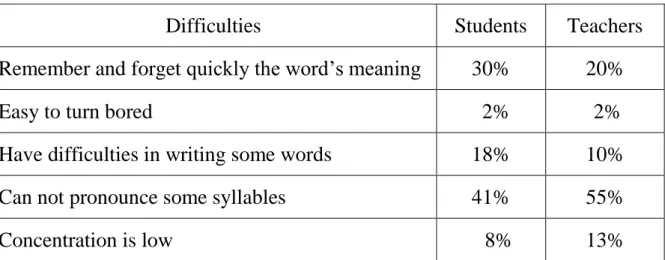
Difficulties Students Teachers
Remember and forget quickly the word’s meaning 30% 20%
Easy to turn bored 2% 2%
Have difficulties in writing some words 18% 10%
Can not pronounce some syllables 41% 55%
Concentration is low 8% 13%
38
The aim of this question is to study about the difficulties in teaching and learning English vocabulary. Basing on the result, teacher can focus more on it and have useful methods to help student learn better.
According to the table both students and teachers agree that students rarely get bored when they learn English. because it is the first time students learn English and this subject is very strange to them. So they are very curious and want to explore this fresh subject. Students always feel eager and elated in English periods, because they not only learn English but also play interesting games.
Therefore, teachers should apply interesting games, exciting activities to teaching English vocabulary. When children like English subject they will learn well as teacher hope.
Look at above table we can easily see that the most popular difficulty student encounter when learning vocabulary is word’s pronunciation ( 55% of teacher, 41% of student). they are confused it because of the interference of local language’s characteristic .Most students in 3th graders often pronounce a word without final syllable or make mistake with this difficult sounds such as ―th‖ ―sh‖ ―ʤ”.
Having a standard pronunciation help students own native English voice. In order to improve this big problem teachers should let students listen to the native sound through songs, radio.
However, in fact with the current traditional methods, teaching English, especially teaching vocabulary cannot get good results, students still face many difficulties in learning. Therefore, workable techniques are necessary.
The second difficult in learning vocabulary is memorizing meaning of words in a lesson. Because they are young children who are very enthusiastic, they easily remember but forget easily also, leading to children
39
who very enthusiastic, they easily remember but forget easily also, leading to the big difficulties for teachers and students in teaching and studying.
The English vocabulary is very large, to memorize words is difficult because of differences in the writing and pronunciation ways compare to Vietnamese.
Furthermore, they are not taught enough in the class, the period time is short, not enough for teacher to transfer information for students.Besides, some students have difficulty in writing some words. Sometimes, there are some long words with many letter as ― library‖, ― weather‖ that children feel difficult to memorize in writing.
Many teachers think that the reason is because their concentration is low. Children are kiddy and easily distracted by things around them, attracting their concentration is a decisive factor in a successful lesson. Teacher should be spent much more time on prepare the lessons, make it as interesting as possible. If we can give the answer for this question, students will learn English better.
II.3.4. Difficulties faced by teachers when teaching vocabulary for primary students
Chart 2: Difficulties faced by teachers when teaching vocabulary for students
40%
30%
10%
20% lack of workable teaching
tecniques
teaching condition
students' pronunciation
lack of students'
awareness, attention and eagerness
40
This question is raised to teachers to explore their opinion about the difficulties when teaching vocabulary for students of 3th graders. According to data of above pie chart, 2 main difficulties of teachers is lacking of workable teaching techniques and teaching condition. Pictures and audio- visual aids are often used to illustrate the information in most lessons, and they also apply funny games but not much. The workable games downloaded from internet which students can play immediately are limited because of without the assistance of high- tech equipments such as projector .If these are installed, they will be useful for teaching English in particular and other subjects in general. However, installing new teaching equipment must depend on financial capability of each school. It means that teaching condition is one of reason make the difficulty in teachers’ teaching. They say that they find out many interesting techniques, but they can apply them into the lesson because of poor condition.
Students are one of the most important factors in the success of each lesson. Their awareness, attention and eagerness will decide how successful a lecture is. At this age, students of 3th graders are eager to find and study new knowledge. However, they just focus on interesting and funny things which attract their curiosity while teacher use similar techniques in most their lectures, therefore they can easily memorize what are studied but they also forget them quickly. Looking at the pie chart, students’ awareness occupied 20% of teachers’ difficulties.
To sum up, these questions are raised to find out the problems coped with by students and teachers at Quang Trung primary school when English vocabulary are taught. When we know what our problem is, we surely find the way to overcome it. With the guidance of teachers and efforts of students, they will be more interested and involved in English lessons, and techniques to teach English vocabulary will be more and more effectives.
41
II.3.5. Students and teachers point of view on the current vocabulary teaching and learning techniques.
II.3.5.1 Current teaching techniques and its effectiveness.
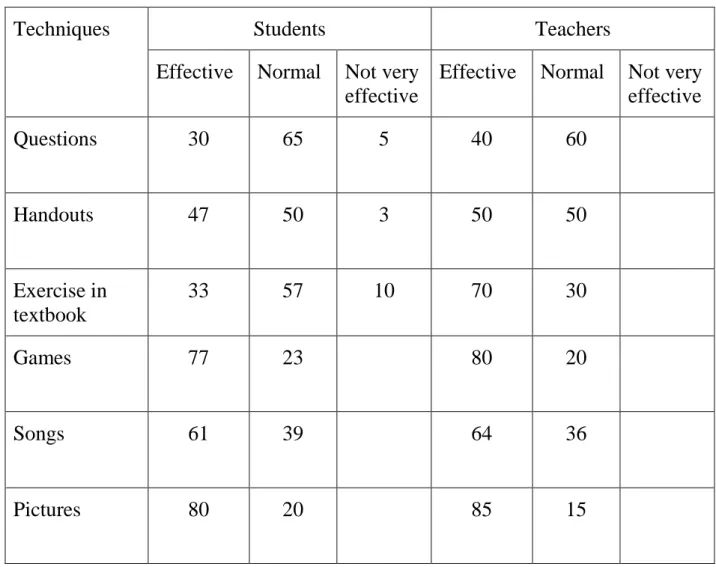
When I ask students this question about current teaching techniques of your teacher you like most I got the result below:
Techniques Students Teachers
Effective Normal Not very effective
Effective Normal Not very effective
Questions 30 65 5 40 60
Handouts 47 50 3 50 50
Exercise in textbook
33 57 10 70 30
Games 77 23 80 20
Songs 61 39 64 36
Pictures 80 20 85 15
Table 3: Current teaching techniques and its effectiveness.
This question is put to both students and teachers. It is to study how effective teachers’ techniques are and from that point of view teachers can have more effective methods to teach.
If we see the table carefully, we can realize a surprised finding in this question. While questions, handouts and exercise are the most popular
42
techniques by the teachers, they are less effective. In contrary, games, songs, pictures stated to be not frequently employed seem to be more effective.
The highest percentage of effectiveness level belongs to pictures, 80% while questions, handouts, exercises is found respectively 30%, 47%, and 33% We also find other differences from using songs, games these are techniques that is said to be with high percentage of effectiveness according to the idea of 61%, 77% of students. It is also a good new that the number of students who find all the techniques not very effective is rather low.
To the teacher side, they suppose quite equal level among those techniques. However, using exercises, games and pictures are highly appreciated according to the idea of teachers.
Actually, it is time we took these numbers into consideration. From the table above , because the tradition ways (questions, exercises..) are so often used, it has been claimed to be monotonous and boring in class.
The students sound to be cold with these techniques and find it normal level of effectiveness even some say not very effective. We should remember that 3th graders are very kiddy, enthusiastic and funny so the lesson of vocabulary need to be the same, to some extent.
When being interviewed, most of them said that beautiful pictures with lively images, funny games, wonderful songs make them more willing and excited to take part in than long and so boring explanation or difficult exercises from their teachers.
Besides, songs receive rather high percent of effective level, it is the reason why teachers need to adjust time to present this activity within a 45 minute period.
43
To conclude, this question has brought us a surprising and interesting finding that is the least frequently used techniques are the most effective ones for our students.
II.3.5.2 The frequency of adopted techniques on teaching vocabulary:
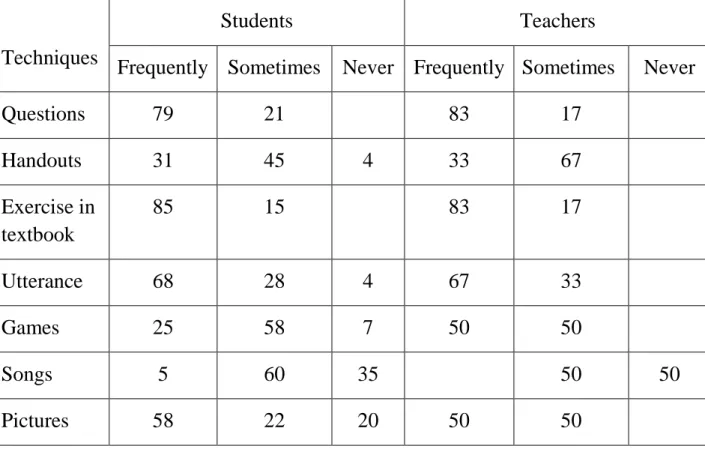
Table 4: The frequency of adopted techniques on teaching vocabulary This question is to find in what way the teachers often used and the level of frequency that techniques are applied. This question is raised to both teachers and students.
On students’ side, the most regular way of teachers to carry out lessons on classes doing exercises in the text book. It accounts for 85% of the students. Using question to ask takes the second rank (79%). And 68%
students noted that using utterance is frequently applied.
Techniques
Students Teachers
Frequently Sometimes Never Frequently Sometimes Never
Questions 79 21 83 17
Handouts 31 45 4 33 67
Exercise in textbook
85 15 83 17
Utterance 68 28 4 67 33
Games 25 58 7 50 50
Songs 5 60 35 50 50
Pictures 58 22 20 50 50
44
According to the table we can see the same percent of teachers’side, questions, exercises in the textbook and utterance are mostly used.
All facts and figures are easy to understand. First of all, doing exercises is time is time when teachers check how students get know about the lesson.
In addition, exercises are available on the textbook and other books and easy for teacher to find. Furthermore, this technique can get student s attention because it is quite clear and easy.
What about using this question? It is the simplest and quickest way to ask students directly at the class.
However, I also have some words about the way of using utterance. It is completely basing on the level of students. Some students revealed to me that when teachers summarizing lesson in English, they nearly cannot catch what they mean, really.
Also, it is surprising that games, songs, pictures and graphs are sometimes used. Using pictures (28%), songs (5%) and games (25%) are frequently used to the teachers side. A great percent of students claimed that these techniques are never applied: games, songs. There are some reasons for these could be considered as follow:
Using games depend on time and activeness of the teachers because games give students relaxing times and easy to understand the lesson. And maybe it requires students to use other language skills such as speaking, listening, and use much vocabulary which have been problem in any class room. Some teachers claimed that with only 45 minutes for each period, there is not enough time to carry out such activities. But they do not recognize that they can make it possible if they control the time appropriately.