~)
Southern Africa labour and Developnent Research Unit
Cape Town
. THE DESI~ OF RURAL IlE.VEIDPMENl' : ProPCBAlS FOR THE EITOU1l'ICN OF A
SOCIJIL CCN.l'RACl' SUITED TO CX'.NDITICNS
m
SOOl'HERN ArnICAPARI' II Nonnan Reynolds Saldru Working Paper No. 41
August 1981
ISBN 0 7992 435 8
{
I
PARI' I CHAPTER I Introduction
OUl'LlNE OF PROPOSALS 2
CHAPTER 2 THE ELEMENI'S OF DESIGN 6
P~erty 6
Land Hunger 8
Ccmrumal Land Systems 9
The Small Farm Sector 12
Basic Needs Approach 13
Basic Needs and Economic Planning 13
Footnotes to Chapter 2 16
CHAPTER 3 THE UNDERNRITING OF SECURITY A."ID THE FURl'HERANCE OF A SOCIAL CXNl'RACT IN THE CXXJNI'RYSIDE : THE ROLE
AND ParENTIAL OF JlN EMPLOYMENl' GUARANTEE SOIE}IE 18
Aim 18
Method 18
Implications of an .flnployment Guarantee Scheme 19
COntrol of the Assets 21
The COst of an EGS 21
Benefits of an El3S 22
Footnotes to Chapter 3 25
OlAPl'ER 4 THE CXM1UNITY LAND a:MPANY (CLC). 26 The COnstitution and Working of the Ccmrumity Land
Ccrnpany (CLC). Physical Definition of a CLC 27
Manbership 28
Shareholding 29
Grazing Land 29
Taxation 32
The Objective Governance of Livestock Management 33
CormIunaI Forestry 35
Irrigation 38
Arable Land 40
The Financing of the CLC 41
Footnotes to Chapter 4 44
0lAPl'ER 5 THE c:.u.MUNITY SERVICE CT.,lmISATICN (CSO) 45
, 0lAPl'ER 6 AGRICULTURAL LAND SEl'l'LEMENI' 52
Footnotes to Chapter 6 56
i i
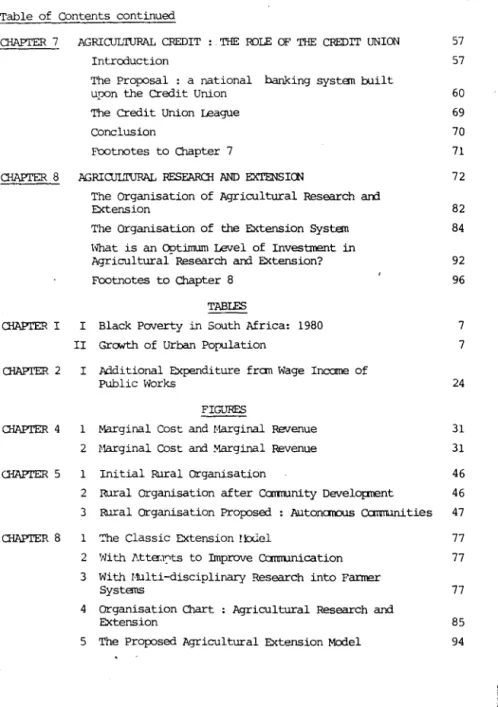
Table of Contents continued
01API'ER 7 AGRICULTURAL CREDIT THE ROLE OF THE CREDIT UNION 57 Introduction
The Proposal : a national banking system built upon the Credit Union
The Credit Union League Conclusion
FoOtnotes to Chapter 7
01API'ER 8 AGRIOJLTURAL RESEARCH AND EXTENSICN
The Organisation of Agricultural Research and EXtension
The Organisation of the Extension System
\'lhat is an Optimum Level of Invest:ment in Agricultural Research and Extension?
Footnotes to Chapter 8
TABLES
01API'ER I I Black Poverty in South Africa: 1980 II Growth of Urban population
01API'ER 2 I Additional Expenditure from Wage Income of Public Works
FIGURES
1 Marginal Cost and !·larginal Revenue 2 r-larginal Cost and ~ginal Revenue
57 60 69 70 71 72
82 84 92 96
7 7 24
31 31
CHAPI'ER 5 1 Initial Rural Organisation 46
2 Rural Organisation after Community Development 46 3 Rural Organisation Proposed : AUtonaoous Ccmnunities 47
01API'ER 8 1 ':'he Classic Extension rroel 77
2 'tlith 1\tte-.1':'ts to Improve Ccrmunication 77 3 \-Jith f.1ulti-disciplinary Research into Fanner
Systems 77
4 Organisation Chart : Agricultural Research and Extension
5 The Proposed Agricultural Extension Model
85 94
PARI' III
PARI' II
CHAPl'ER 9 THE urILITY OF A cx:MBINED PERIODIC SERIlICE AND RmJIATED MARKE.T SYSTEM IN THE DEVEIDF.-1ENl' OF ECCNCl1IC HINTERLI\Nl:6 : THE CASE OF ZIMBABWE'S
TRIBAL TRUST IANDS 99
The Proposal 99
The Regulated Market Society 120
Footnotes to Chapter 9 124
CHAPl'ER 10 cxroPERATIVE DAIRYING AND THE DEVEIDPMENr OF THE
SMALL MIXED FAR1 SECTOR 127
Footnotes to Chapter 10 142
0!APl'ER 11 AN APPR01\CH TO A CXl1MlJNITY LED, STATE SUPPORl'ED
srnOOL SYSTEM 144
The Voucher System 145
Objections to the Voucher System 146
A Cross-OVer Tax 146
The Financial Benefits of a Voucher Plus Tax System 147
Brief Notes on the System 147
lliucation and Rural Developnent 151
0!APl'ER 12 HEALTH: PREIlENTION IS STILL RE.VOWTIONARY 152
Footnotes to Chapter 12 157
CHAPl'ER 13 RURAL EIECTRIFICATION 158
Footnotes to Chapter 13 159
CH1\Pl'ER 14 RIGffi'S, PUBLIC INI'EREST lAW AND THE FURl.'HERFlNCE OF
DEMXRATIC INSTI'lUrIONS 160
Footnotes to Chapter 14 166
0!APl'ER 15 MANI'Cl'lER AND THE USE OF SOCIEl'Y'S RESOORCES 167
Staffing Rural Institutions 168
Short-tenn Consultancy 170
Opening the way to public and private sector financial, technical and managerial support for
developnent prograrmes 171
CH1\Pl'ER 16 IMPLEMENl'ATION.: THE ARt' OF GOIlERNMENl' SURI7IVAL 175
A Mixed. Planning Model 175
Administration 178
Implementation 179
Conclusion 181
Footnotes. to Chapter 16 182
iv
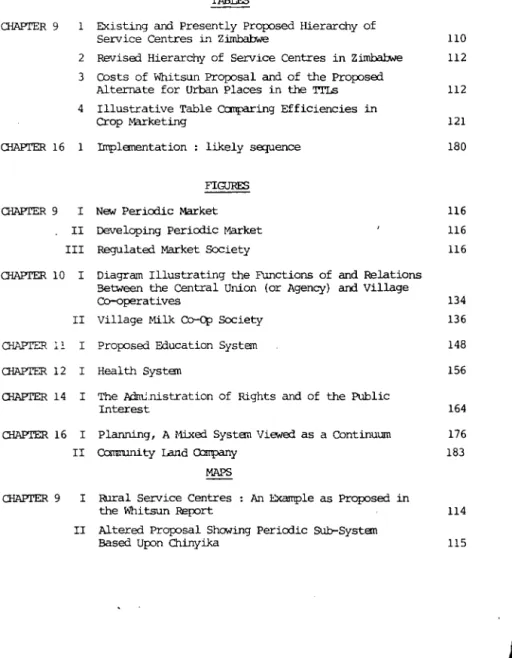
Table of contents continued
C11API'ER 9
TABLES
1 Existing and Presently proposed Hierarchy of
Service Centres in Zimbabwe 110
2 Revised Hierarchy of Service Centres in Zlitibabwe 112 3 Costs of Whitsun Proposal and of the Proposed
Alternate for Urban Places in the 'ITLs 112 4 Illustrative Table COmparing Efficiencies in
Crop M3.rketing 121
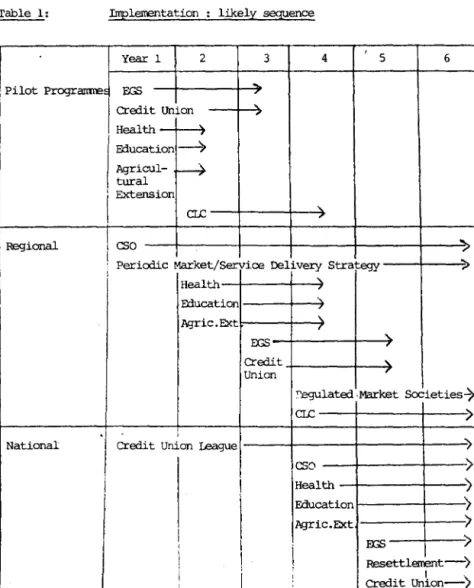
CHAPl'ER 16 1 Implementation likely sequence 180
FIGURES
- - -
C11API'ER 9 I New Periodic Market 116
116 116 I I Developing Periodic llJarket
III Regulated Market Society
CHAPl'ER 10 I Diagram Illustrating the Functions of and Relations Between the Central Union (or Agency) and Village
Co-operatives 134
II Village Milk Oo-Op Society 136
CHAPl'ER I I I Proposed Education System 148
CHAPl'ER 12 I Health System 156
C11API'ER 14 I The l\dm.;.nistration of Rights and of the Public
Interest 164
CHAPI'ER 16 I Planning, A ~·ti.xed System Viewed as a Continuum 176
CHAPI'ER 9
I I CcmrIunity Land COIrpany 183
MAPS
I Rural Service Centres : An Example as Proposed in the Whitsun Report
II Altered Proposal ShCMing Periodic SUb-System Based Upon Chinyika
114 115
ClfAPl'ER 9..-
THE urILITY OF A CCMBINED PERIODIC SERVICE AND REGUIATED MARKET SYSTEM IN THE DEVEWPMENI' OF FXXl'ICl1IC HINTERLI\NDS THE Cl\SE OF ZIMBABWE'S TRIBAL TRusr LANOO
Spatial planners have made their contribution to developrent planning within the econanic grCMth paradigm which held that grCMth w::luld rrost readily result from industrialisation and that rapid industrialisation w::luld IroSt naturally be acc:arrrra:iated in a f~ metropolitan centres fran where its benefits w::luld 'spread'. Planning for the objective of econanic grCMth via industrialisation and urbanisation was seen as a central
techru.cal function characterised by econanetric rrodelling allied to sophisticated administration.
Spatial planners added a concern for spatial equity and integration, pro- posing an ordering of praroted activities at urban, regional and national levels. Their principal contribution has been the notion of grCMth poles and grCMth centres. 1
In recent years the econanic grCMth paradigm has been questioned and ne.v approaches proposed. Olalitative judganents rather than quantitative techniques have gained the centre of the planning stage. Developrent is seen as based on social developrent with a prime focus on JJasic needs. 2 This chapter revi~ a recent proposal, along the lines of central place theory, to build Rural Service Centres (RSC) in Zimbabwe's Tribal Trust
I
Lands. It concludes that a less concrete, rrore organic approach w::lUld promise not only greater returns to physical invest:nent but w::lUld provide the outline to a rrore integrated approach to the prOVision of services, to local market development and regional specialisation, and to cammunity expression and functioning.
The Proposal
The Tribal Trust Lands of Zimbabwe represent poorly developed spatial con- figurations with weak links into the urban place hierarchy of the country.
They are typically served by small business centres rrost of which do not
100
reach the size used to define rural service centres.3
The Whitsun Foundation Rural Service Centres Development Study estimates that there are serne 2 500 such business centres. 4 The great majority of Z:ilnba!::Me IS numerous small business centres in the countryside exist at serne distance fran the relatively few developed urban centres. The ~Vhitsun report identified a serious lacuna in the structure of urban places which exists between the large number of small business centres and the 20 or so pro- posed small to.vns included in the Integrated Plan for Rural Developnent of 1978. The Whitsun report recarmends the creation of 300 Rural Service Centres (RSCS) serne 15 to 20 kilernetres apart, each one serving a population of between 5 000 and 15 000. None of the 300 proposed centres are in areas where the population density drops below 15 per square k,ilrnetre. It is believed that the 300 RSCS would cater to over 80% of the population living in the rrore densely settled half (56%) of the Tribal TrUst lands. Each RSC would cost 400 000 dollars and require the raising of local revenues to sustain annual recurrent costs of about 50 000 dollars. The proposal estimates that serne 40 to 45 jobs would be created at each RSC or a total of serne 13 000 in the country. 5
The study admits that it has adopted an abstract statistical rrethod.
The actual number of rural service centres required could vary fran 275 to 320. The study acknowledges that, by limiting RSCS to areas with IOC>re than 15 persons per square kilernetre it has ignored sane 46% of the Tribal Trust Lands with low density populations which hold approximately 20% of the population.
these areas.
It argues that a different approach is required for
The Whitsun study develops a static framework - Central Place Theory and spatial and numerical standards derived fran the existing situation - as the basis for changing the future. 6 Central Place Theory provides little insight into processes of spatial econanic developnent.7 The statiC, inflexible framework adopted may constrain rather than prarote developnent in the medium to long term. The study does not explore the relationship between the distribution of power and wealth in Zirobabwe and the lop- sided urban spatial structure. The maldistribution is reflected in the absence of medium and small size tov.'I1S; a factor which investIrent in to.vns by itself may not correct. This weakness is further revealed in a belief that the universal aspects of the urbanisation process are a
sufficient basis upon which to launch a successful RSC progranme. As a result the study relies on Christaller's abstract geometric sclution for the optimum location of central places as the basis for the spatial pattern of RSCs. The appropriateness of the assumptions underlying Christaller's Central Place Theory are not explored. The peculiar history of Zllnbabwe's develor:rnent does suggest that a IlOre particular view of the structural problans which exist in the urban hierarchy and of rural dependence is needed.
The result, flCMing fran the simple adoption of Christaller's theory, -is that three assumptions are included which may be at variance with the requiremmt of the situation in Zirobabwe. These are:
1. production costs (of services) are constant over a uniform plane, 2. consumers (demand) are evenly distributed,
3. each type of service has its o.m net of hexagons (market/service areas) with one production unit located in the -centre of each hexagon so as to IlOnopolise the largest number of consumers.
An alternate approach to that of market/service area would be to minimise costs. Such an approach would reverse assumptions (1) and (2) above.
It would not lead to an a priori pattern of centres.
The static framework raises several queries. The first is the Likelihood that many centres would not call forth the activity required to support them. The second question is the ability of the RSCs, as proposed, to adapt. For instance, increased ino:::tre and lIPbility in the hinterland of a RSC, hC1Never brought about, might invalidate the numerical and spatial standards adopted i f it led to people by-passing the locai RSC for another to.m.
Governm:mt will no doubt introduce investment of this type in a phased manner. The IIIDA-1 project dOC\lI'OO11t advises a cautionary learn1ng--by- doing approach. 8 The high capital requiremmts of RSCs and the risks inherent in the progranme as proposed suggests that caution will be exercised, at least in the sense that fewer. and lIPre obvious centres will be developed in the first phase. That phase itself nay turn out to be of a longer duration than fits with the desire to bring the Tribal
102
Trust Lands further into the national service and market system. A rrore flexible, less costly and less formal approach appears to be needed.
Ideally, such an approach would also serve the 46% of the Tribal Trust Lands excluded in the Whitsun proposal.
The Grain Marketing Board an::1 the Cotton Marketing Board have both pro- posed the opening of seasonal depots in the Tribal Trust Larrls at levels above the RSCs. At the same time it appears that the so-called 'approved buyer system' is likely to be expanded along with renewed co-operative effort. The Agricultural ~\arketing Authority intends to license rrore than one agent in every business centre so as to ensure carrpetition in the procurement of regulated crops. These rroves represent an extension of official marketing of regulated crops further dONn the scale of pro- duction. Government have also announced that they will reintroduce the idea of an equalisation of transport =sts so that prices paid at depots throughout the country will be equal or nearly equal.
Att~ts to equal or nearly equal farm gate prioes have been tried in the past in Rhodesia and elsewhere. Experience suggests that, as an isolated policy, it can lead to serious distortiOns in the spatial distribution of production and in resource use, an::1 to higher overall production =sts. 9 Equalisation measures are more acceptable if used as tactics within regional progranmes.
In Zimbabwe there is an immediate short-term need to stimulate activity in the tribal areas an::1 for Goverrurent to be seen to be redressing the old balance which operated in favour of white farrrers. Can short-tenn stimu- lation be achieved without leading to distortions in the longer run that may cancel the value of the initial impetus? For instanoe, the country is capable of producing more maize than is needed for the darestic market.
What priCing policies would attract maize production sufficient for the domestic and available export markets while also en=uraging a growing degree of regional speCialisation in the labour intensive, higher value cash crops, such as cotton and tobacco, that have stronger industrial and export market linkages? Schemes, such as the Transport Equalization FUnd. of old and the monopoly extraction of regulated crops fran the TI'Ls would appear to contain serious contradictions in terms of both national agricul tural production policy and of the role of local market growth in regional development.
The grONth of the co-operative llDvement in the 1960s and early 1970s did promise to bring small remote producers into closer contact with the national market and upon.llDre favourable terms. Producer involvement in decision making, group participation and a greater degree of self-determin- ation did and still can produce tangible results in the form of better understanding of market requirements, =re carefu~ ~ading and bagging, cheaper transport and handling, and greater autonany in member relations with the storekeepers-cum-agents. Regional and national federations of farmer co-operatives are capable of wielding strong negotiating cards in dealing with the central marketing bodies. In fact, they can offer to relieve agencies such as the Grain Marketing Board of functions it performs at high cost: local administration "of numerous trader/agents, the handling of payments to members, local storage and investment in local infrastructure.
The rejuvenation of the co.operative m:JVement will take SaTE time, certainly before it oovers the majority of fanners in the Tribal Trust Lands. The roan for oo-operative endeavour allCMed by the arrangements governing the R3C3 .mel. the official market structures may well be a vital factor in the grCMth and effectiveness of the oo-operative m:JVement. Strong oo-operatives can, in turn, playa crucial role in the developITent of regional special- isation in accord with spatial, agronomic and market cornitions.
A COunter Proposal : a Periodic System with Regulated Market Societies The development of an urban infrastructure in the TTLs has to be capable of meeting ~everal requirements, sctne of which conflict and all of which change over time. In essence, it has to be able to fill gaps in the proviSion of services whilst allCMing and being able to respond to local factors, initiatives and transformations. What follCMS is an adaptation of grCMth centre, periodic market and regulated market concepts~ It is designed to offer a least cost, flexible and locally responsive approach to the develOj:I!lent of \ltl)an centres in the Tribal Trust LandS.
Periodic market. systems have existed in Europe in earlier times and are still today a major feature of large parts of east and south Asia, of West Africa and of South America. Their utility is that they provide a regular focal point, usually within walking distance, for local marketing and service transactions within a system of hierarchic arrangements. A
104
series of weekly or biweekly markets, operating for a half or whole day, take place in 'a ring' around a central place. Invariably the timing of each market fits within a logical pattern of local activity and of linkages to the central place. The effect is to concentrate the economic and service requirements of remote, small and usually pcor cammunities so that economies of scale are achieved for households and for rrerchants, official agents, co-operatives and government services. As narkets grCM or decline, so the periodicity with which they operate increases or reduces.
A regulated market denotes the constitution of a local SOCiety which holds open auctions of agricultural produce. Regulated Harke,t SOCieties would normaily operate within a legal framework provided by governrrent and be fitted into a system of offiCial agricultural pricing. They are often created with IlDre than one aim in mind. Aims could be one or IlDre of the follCMing:
1. To encourage small producers to participate in the sale of surpluses by providing an open auction forum in which groups of fellCM producers can participate with a greater degree of confidence in the prices ruling at the time, than they can dealing with traders.
2. Allied to the first aim is a subsidiary proposition which is that producers in debt to traders nay be at a disadvantage when i t canes to selling surpluses through the same trader, particularly when sane or all of that produce is to pay interest charges or redeem part of the principal of a loan.
3. Conducting open auctions at local levels does bring farmers into contact with wider market trends and is therefore an educational process. Most research has found farmers to be generally well informed about prices prevailing in nearby areas, but that this is dependent in large part upon their physical access to markets.10 4. The channeUing of local agricultural surpluses through a local
institution provides for the development of local governance as well as a point in the lIOVement of goods at which a local levy can be easily and equitably applied.11 Regulated narket cammittees therefore potentially pCMerful bodies able to raise relatively local resources which can be utilised in the development of local
infrastructure and services. Where RegulatErl fmket Societies exist under law, their operation would be supervised and audited by a Registrar. That, as with other registrar~, is intended to add confidence to·the community in the operation of the auction as well as in the utilisation of the funds raised.
The design of spatial arrangerrents and service provision in the Tribal Trust Lands has to acccmrnodate a variety of subsistence and market orientated conditions. On the majority of tribal fanns the return to labour rather than to land is the measure of performance because they are pr€dorninantly subsistence operations.12 The bulk of farmers are small and with liroitErl resources. The size of the household may well be the prirre detenninant of the size of the holding worked. In that case production per unit of the land may be ~en as far as possible even if in contrast to spatial consid- erations. In sane areas, mainly because of the grCMing population pressure and perhaps because of more developed markets and services, the return to land rather than labour will be the key issue in fann management. The larger, better off and better serviced famers may reflect spatial relations more exactly. As iIcproved service and market arrangerrents are made, so the primary importance of the size of the household should begin to decline in favour of returns to land. As that happens spatial consider- ations ~ more prominent. HCM effective this transfonnation will be is dependent upon many factors, in particular the fonn and
thEi
flexibility of land tenure systans, the grCMth of local institutions and government, and settlement and trade patterns. MoSt agricultural intensification scherres in Africa have failed. Agricultural grCMth has tended to follCM fran the expansion of acreage, not yields. In Z:il\1baJ::Twe' s Tribal Trus t Lands there is little roan for the expansion of cultivation. Agricultural intensification has to succeed. It is in this light that proposals for the developnent of urban infrastructure in the Tribal Trust Lands mlSt be judged.Despite the caveats entered above, it is likely that in every region a scale of functional hierarchy can be observed. That hierarchy would explain and underline the settlement hierarchy. A series of major ,studies conducted in the 1960s and 1970s in Irrlia, which in many ways
reflects conditions in Africa, shCMed that for different services and levels of services people exhibit • space preferences' .13 This is of
106
=urse as it should be. HCMever, in India it was found that the lower order services involved little interaction beyond peoples' own village.
For nonubiquitous or complex services people will travel quite substan- tial distances. For instance, the studies revealed that p=r farmers travel frequently aver short distances using p=r methods of transport to achieve single purposes. In =ntrast, wealthier farmers travel less frequently but further using better means of transport to achieve a number of purposes. The p=r spend more time to service their fann operations and their personal and family needs than do the rich. In those parts of Irrlia where periodic markets exist it was noted that villagers tended to combine other interactions with that associated with the weekly market.
The picture that energes fran the Indian studies suggests that the recent tendency to locate all important rural institutions at the headquarters or central place needs to be examined. The frequency with which villagers visited the central place ranged from 0 to 5 times a year. Even the best of the farmers did not travel to the central place more than 4 or 5 times a year. The central place was visited in order to sell agricultural surpluses, to atterrl court cases or to arrange for agricultural loans or inputs. The more striking fact was that the great majority of villagers did not visit the central place in the =urse of the year. In =ntrast, villagers visited nearby weekly markets at an average of 52 times a year.
The Indian findings are not only dramatic, they suggest that efficiencies of scale are more likely to be realised at the village neighbourhood level rather than at the central place. They are surely of great interest to Zimbal:7.ve. They serve to raise the question whether it would not be advisable to try to create a network of rural institutions based on, arrongst other things, a pattern of distribution of weekly markets in a periodic system.
To raise the place and the role of periodic market systems in zimbaI:7.ve is to demand that the temporal element be added to the spatial component.
The forrrer is ignored in the Whitsun study. In the scheme prcposed, the temporal elem2nt would provide much of the initial dynamic to urban develO[:1l'ent.
The Irrlian and sorre of the West African material on rural services and markets suggests that a further canponent has to be included in the design of urban centres in the countryisde.14 That is the :in1portance of l=al leadership, ho.rever infornal. The success of l=al leader- ship adds an element of acceptability to the services and institutions at all centres which is as :in1portant as their spatial or accessibility factor. Informal leaders play the role of ccmnunicators through which others in their neighbourhood are brought to face and aocept change.
In other words there is a s=ial network in the countryside which is very strong and which is rarely absent in any village or across any space. While the leaders and their followers will vary from place to place, the pattern will have ccmnon therres.
Same may object that local leadership, if given its rein, may develop its eJq:lloitative character. While this is a difficult field on which to ccmnent in the abstract, it can be stated that l=al leadership can be IlOre or less valuable,in general dependent largely upon the nature of the institutions through which it wcrks. Elsewhere we have argued for strong democratic fourrlations and for more explicit eocnamic rights based upon camtunity Land Cmpanies, in l=al institutions such as Credit Unions and upon programnes which support the weaker irrlividuals while infusing capital into the ocuntryside, such as an Employrrent Guarantee Schere. Given that backdrop to the design of rural develO);XlEI1t, it shruld be possible to pr=eed with sorre ocnfidence in the design of institutions which wculd enhance the role play of informal l=al leadership at the level of weekly periodic markets. In theoretical terms it wculd acknowledge that a formalisation of spatial patterns of interaction is encouraged by the demarcation and use of political, institutional and administrative zones within which much interaction takes place. Also that there already exists a s=ial organisation that both birrls and separates grrups of people and which affects if not determines the nature of the relation- ships between them. In short the design of. urban centres in. the country- side has to fit within institutional and programne approaches, particularly
these determine the level at which decisions are made. I t is also 1l1n<"\rt·,.",r to recognise that the interaction between villages is as :in1por-
that be~een the village and its adjacent rretropolis.
108
The last point can be illustrated by ccmparing the recanmendations of the h'hitsun report for Z.i.rnbabwe with actual conditions in the tribal belt across central India. The Whitsun report recaw.ends the =eation of rural service centres serving a population of between 5 000 and 15 000.
This is in the rrore densely settled parts of the Tribal Trust LaIrls.
In central India sane 7 to 10 villages with approximately 7 000 people are served by a central place which itself has a population of between 1 500 to 2 500: the focal point with its sub-system of periodic rrarkets comprises sarewhere between 8 000 to 11 000 people. In other wards a sub-system on the lowest order of settlement in the hierarchy which oontains approximately half the number of people proposed to be served by rural service centres in Z.i.rnbabwe. Added to that is the fact that of the 7 to 10 villages in the 'ring', a majority of villages would have on one day a week a periodic market operating in that village which was well attended by people fran that village and surrounding villages. IS In
~lanning temlS, the =eation of larger socio-e=nanic and political spaces than that of the single village.16
The knONledge gained by recent research into the temporal arrangerrents of the oountryside in India suggests that rrost villagers can conduct the great majority of their transactions in a weekly market which takes place either
in or within close walking distance of their CMn village. The task which planners have nON embarked upon in India is to utilise that very local and intimate sub-system around the lONer order settle!rents to bring administrative and other services close to Villagers. Because the e=nanic base of an urban centre changes over ti.nE, it is a pear predictor of urban grCMth. Long-run urban grCMth, it has been argued, is more a function of the service sector than of basic activities. In particular, a campetitive service sector enables urban centres to replace stagnating basic activities with vigorous new ones. 17
We may nON pose the question, whether there is a natural progression in the determination of spatial and temporal relations in the countryside? Is it necessarily the only correct procedure to invest in rural service centres that by the present standard of many other parts of the world are higher order centres, or is it possible to embark upon a dual programre which develops both higher order centres and sub-systems which radiate out fran
~\
\
then in the fonn of a 'ring'? The question can. be answered in large part only in tenns of the nature of the institutions and programmes that govern- ment interns to prrnote in any one area. Nonetheless, experience elsewhere suggests that the mechanical develop!¥2nt of rural service centres· has to be questioned and that a richer complex of higher and lower order settlenents together with sub-systens of a periodic market systen pranises to be alto- gether IIOI'e effective.
I t is now possible to reorder the Whitsun proposal in certain directions.
Before doing so we must take note of the proposal contained in THE INTEX;RATED PLI\N FOR RURAL DEIlELOPMENl' prepared under the last government. 18 The plan listed twenty potential 'growth points' for the first ten year planning period. These 'growth points' are towns designed to fall within a so- called middle or lower level of the urban hierarchy with populations of between 2 500 and 25 000 people. The plan estimates that each town's infrastructural cost will total 600 000 dollars at 1977 costs. Each town is planned to consist of 1 000 residential
am
100 cc:mrercial units. The definition of a growth point includes the basic functions contained in the rural service centre together with more speCialised functions, especially those of manufacturing and processing. The proposed twenty 'grOwth points' are shown in Table 1. The table shows the hierarchy of service centres in Z:iJnbab..Ie according to the 1969 census figures. The Whitsun proposal is to add 300 IIOI'e service centres as the lowest level of settlement to the present hierarchy. Below that are the 2 000 odd business centres scattered through the Tribal Trust LaIrls.The failure of growth centre policies to generate significant spread effects to lagging hinterlands has been
~oted
by several authorities.19 Indeed, Benjamin Higgins has asked i f develOp!¥2flt poles exist, that is , cases where inves~t in manufacturing, perhaps with government subsi- dies, or in infrastructure or in both attracts propulsive industries to a particular urban centre, with these industries solving the problems of the retarded' region by generating spread effects'. 20 Higgins points\ out that there may be a conflict between the goal of accelerating national 'growth and the goal of inproving the urban structure. 21 certainly,
growth centre policies can introduce an infrastructure bias which shifts atbtion cmay from critical health, education, market and other services
I
110
Existing and Presently Prop?sed Hierarchy of Service Centres in Zirobab~
Grade
Present 8
7 6 5 4 3 2 1 Business Centres
Nlm1ber of Centres
1 1 4 3 6 8 24 108(100) 2400+
Mean Population
386,000 245,000 36,000 16,000 8,000 6,000 3,000 1,500
-
M=an ntm1ber of Central Functions
-
-
70 60 48 40 27 12
-
Mean ntm1ber of Functional
Units
-
-
504 254 121 100 53 27
;... 20
Mean Distance
be~
Centres kms
-
370 130 80 80 74 59 28
-
Service Proposed
Invest- Population
~
2-5 20 2,500-25,000-
<.50-
I
'Growth
\Points' RSC 300 1,000
-
<.20 15-20 5-15,000i
il.
I
I
,100 Grade 1 centres are in, though poorly distributed over, the Tribal TrUst Larrls.
Source: Figures from 1969 Census. Table derived from Whitsun report, Table 3, p.44
in their hinterlands. Hansen argues that the general failure has placed the burden of proof in the efficacy of growth centre policies upon its supporters. 22 Higgins prefers to see the emergence of central places as historical accidents, as the result of natural resource explOitation, agriculture, forestry or mining, which generates the grOtlth that, at first, is able to sustain an urban centre.23 Lefeber is more explicit. He deman:'ls that, in the case of retarded regiOns and pockets of unernploynent distant fran industrial centres, the first planned effort must ooncentrate on the upgrading of agriculture. 24
.
>,
;
.
,
\The revised proposal which appears belON excludes the twenty 'grONth points' proposed for Zimbabwe. Instead, it is proposed that policy and investment concentrate on lONer order centres and in more suitable institutional and political choices for the countryside. That should generate the = a l econany and the mechanisms needed to sustain grONth points of the size envisaged las a natural outgrONth of more active hinter lands .
Table 2 shows the revision of table 1 utilising the periodic market con- cept. Revision is in two directions. The twenty grONth points are replaced by an increase in the nlmber of grade 1 settlenents. This is so because I1X)st are in the Tribal Trust Land and therefore can act as central places to a periodic sub-system.
Each grade 1 centre could support ten to twenty periodic markets organised in two or I1X)re rings about the central place. Half the number of pro- posed = a l service centres, each together with a periodic sub-system or on average ten daily markets in two rings, would raise the total ntmiber of market-cum-service centres in the Tribal Trust Lands fran the 400 proposed
(grade 1 plus RSC), to 3080, 280 (grade 1 plus RSC) plus 2800 (periodic markets), alrrost a seveFJ.-fold increase in the ntmiber of centres. Since this pattern would suit both the high and the 1= density areas of the TTLs, it represents an order of increase in the high population density areas of about four times that proposed. In other words, a revision of the basic service area, that of the RSC as proposed, fran about 220 sq.kms • to 400 sq. kms., to a service area per periodic market of 16 sq. kms. to 25 sq. kms. A greater distance between RSCs would result, fran 15 to 20 kms. as proposed to about 20 to 30 kms. in the I1X)re densely settled half and fran 30 to 50 kms. in the less densely settled half of the TTLs.
Instead, all villagers WOlld be brought into I1X)re intimate contact with periodic markets. For many villagers a market, with services, would operate in or near their village at least once a week. Moreover, on a further' three to four days a week markets would operate in neighbouring villages within 5 kms. in the more densely settled half or within 8 kms.
in the less densely settled half of the Tribal Trust
Larrls~5
Contactwith markets and services should rise fran a few times a year in the case of RSCs to weekly or = e frequent contact in the case of a periodic sub- system.
1 '') J._
TABLE 2
Revised Hierarchy of Service Centres in ZinJbah.le Grades 8 - 2 as in Table 1
N1m1ber of Mean Mean number Mean dis tance Service
Grade Centres Population of between population
functional Centres kms.
Units
1 138 (130) 2 1 500 27 25
-
RSC 150 1 000 ,(,20 (20-30)3 7-20 000
(3.0-5oJ Periodic
Markets 2 800 40-120 t 20 54 1 700-3 200
(8) ,
l. The table takes no account of the 20 proposed 'grCMth centres'. It is being argued that investment of this nature be deferred.
2. 130 in the TTLs.
3. 20-30 kms in the more densely settled and 30-50 kms in the less densely settled halves of the TTLs.
14 . 5 kms apart in more densely settled and 8 kms apart in the less densely settled halves of the TTLs.
i
TABLE 3
- - -
Costs of WhitsunProposal and of the Proposed Alternate for Urban Places in the 'ITIs
a. Whi tsun Report 300 RSCs at $400,000 b. Alternate Proposed 30 Grade 1 at $800,000 150
RSCs
at $500,000 2 800 Periodid at $10,000Jobs Created:
Whitsun: full-time RSCs 40-45 per RSC total Alternate: full-time 30 Grade 1 at 70 jobs
=
150 RSCs at 50 jobs part-time: 2 800 periodic rrarkets
at 25-50
1
$120,000,000
$ 24,000,000
$ 75,000,000
$ 28,000,000
$127,000,000 13,000
2,100 7,500 9,600 112,000
1. Plus, cost of proposed twenty Gr~ Centres, $12,000,000. This investment in ~al develo~nt strategy to be deferred in favour of more direct invest- ment ln rural develo~nt - infrastructure, institutions, services and rrarkets.
:",
Maps I and II provide a visual. comparison between the RSC structure proposed in the Whitsun report and the alternate periodic sub-system proposed herein. In Map I four existing business centres are upgraded to RSCs, one new site becanes a I5C and the remaining sixteen business centres stay as they aref6 In Map II, only two existing business centres are upgraded to RSCs. Radiating out fran these and fran Gutu ta.m are several periodic market rings. The map illustrates the two rings emanating fran Chinyika RSC; in all thirteen market sites which operate fran half a day to two full days per week. A nU!lll::er of periodic markets arise outside of any existing business site.
In Map II a four tier system canprised of 39 sites is illustrated.
Figure 1 portrays the evolution of a periodic market site brought into being by the delivery of services for a particular period each week into an increasingly pennanent market site with a Regulated r,1arket Society reinvesting its incane fran rents, levies and profits ill the further develq:ment of the market and services.
Zi1nbaJ::Me is busy reinstating and extending the coverage of rural services built up before the disruption of the last few years. The concept of I5Cs will help to diSCipline the siting of services and the housing for service personnel into fewer urban sites with, therefore, greater growth and service potential. The tenporal aspect and the IlDre intimate physical character of a periodic sub-system should lead to other equally :impor~ant
efficiencies. For instance, in the few areas where the full physical health care plan is in place, clinics are still 11 kms. or so apart.
They serve a population of between 2 000 to 5 000. The clinics are fed by village health workers serving an area with an 8 kIn. radius and a population of between 200 - 500. That infrastructure can be incorporated into a periodic sub-system with the benefit that on at least one day a week higher level medical personnel would attend clinics in a nearby market place at which large numbers of people fran neighbouring villages congregated. Real savings in terms of travel and of accanplishnEnt per visit by personnel and patients can be effected.
The same would hold true for agricultural and veterinary extension, bank, postal, rrobile library, adult education and ccmnercial services. At
114
Rlral Service Centres : An Example as Proposed in the Whitsun Rep:>rt (p.G8).
/ ...
,
...,... '
...1/ ... ,
"'L __ --, ?
/ Go. \
/ ... 0.... /
'" , "
'" \ \ I
'" '¥---...
/ \ '
1 , , \
I " \
b
I
.-'---
... ..(,." \ "I / \ " \
I _ - - __ """ \ ) , \
f
--0
JgI ' \
+_-
I '" ,I
r
0 "I
a I '0---
/6
Io
¥
~~--::~
, II/
. - - ' ' - - 0 - ~~~
'&l- '" ~- ....
/
-_ ...
/ ----~--/ - -0' v
/
\
o
5I 10
I IS-Ie.
!
p...
I', /.-- ...
I 0 - _ / 0,
\
\
,
\
\
3[,1
yI
~: 0 ~ '&'uSit-\I:bS~
D~~S~~
-,nWN'l-1-
5 f2.vfALS~Gt:N~
I " f':~17"i:1l>Uf.I~~c,c~
Z
1-
ToT,l(LI. '
MAP II. Altered Proposal Shewing Periodic Sub-Systan Based
o
o
o
o
Upon Chinyika
\
\
\
o 5 10 I~ 201)< J
E i I 11 , "
\~y: 0 PEe/ODIC. i'1~A" 8)<15TlNCiBus/~~
,
.
'.'f{
0 NI:'vJ A:iZ1O{)1G ~ULA""rro ~ M6,~~T ~m' [J 1GueAt., ~aNTUALCeep pgo~Al- ~
!bWN. Y-1o
,
D····
2c~~~~ 10 eeaVLA"TE:il fiI~1 5cx:le;."TIiS"6
DO ~~DIC.M~
3~ TOTAL
1
fI1Z.
Tu Z.
~z.
liil
!!I. I
Tl\"l
"!II
fz..
1=1 SZ
~:
M=i'I'O'I.atv\
f1~~DAy t:1=~N.t>IVL
[~EW PE.K:.lOPIC MAR-tET () J
IN FOeMLI,L tv'A~1C-
t::T
5?0e:TY we
t,. De\t-.lI:::INC WA TE£.$eVICCS ON wi-lf-£L6
Ht;.t.lTH/.fl:"61
DfAcPlACj~Ul-11J~o
TeAD~
eN Fa?T(MDSiLYIA.OMJ;N) 116~uT~~~6~~) ~~~
DEVE LOPINC,
FICWE IIpB-eiOP Ie l'v\Ae~T
0+
iCa:;VL~ MAf,I:::.CT.$CClm PRIMIT\\AS- A\JCllCN.s1+f4) f.1f'o::.I::.
~t.ET
PlJlce
$1lIU..5 "",e. UNI M~-r S€-l.LINC, CL~At:)
Se~VICU oN WI-+~L.5 H~-m I Ft6T OA=U s;+ops E. S11:>Ee5
.,.. EAe..5~ I
TtrIt.ce
~~ MA~T J6 )
FIGURE IIIeu;uL.A""fBP
MA~~m Avc;110NFLCDe IN$OJ ~5 OIL.~i2-1
\.
present the ideal, though still a distant hope, is that agricultural demonstrators serve, by bicycle, an area not exceeding 10 kIlls. in radius, or a ~ population of fram 5 000 to 12 000, or one staff member for fram roughly 1 000 to 2,400 farmers. Congregating fanners at several 'periodic markets on different days of, ~e week within the area served by
one agricultural derronstrator means that he ,can contact through derrons- trations, lectures and films a large number of fanners each week (depending on the seasonal requirements of extension) and that this efficiency can warrant his regular support by specialists and the use of specially prepared media. RSCs, conversely, because they are higher yield order centres, are suitEd to occasional, region wide events such as agricultural shavs, meetings of the (sO Board and of Master Fanner ccmni ttees and the like.
Table 3 illustrates the costs of the altered hierarchy of service centres proposed. Nhile very rough, the table does suggest that it would be possible, on cost grounds, to achieve a fairly universal coverage in the Tribal Trust Lan:is for about what it would cost to implement the Whitsun proposal. The cost of a rural service centre has been increased 25% to include additional facilities and residences in order to cater to its hinterland of periodic markets. As we shall see, those periodic markets and. those rural service centres that institute and operate a RegUlated Market Society would be able to finance the developnent of their market and its relatEd infrastructure. In other words, much of the cost of developing the periodic markets could be financed by means of loans.
Table 3 also carrpares the jobs created urrler the two proposals. The significant difference is in the very large number of part-time ?ObS provided in the periodic markets. It means that many villagers will gain worker, artisan, manager or specialist status and experience - an invest- ment in the leading edge of developnent, htmlan capital.
The Working. of Periodic Markets
A periodic market can operate in a clearing, preferably urrler shade trees.
It would normally be situated near a village and adjacent to a cross roads
am a
bus stop. In Zi.mbabHe i t would almost certainly take place in anexisting business, mission or schcol or in a canbination of such sites.
118
The impetus for the institution of periodic markets would have to came from government working with local leaders and institutions. ~e following list of services that would operate in a developed periodic market illus- trates the combination of official, local institutional and commercial elements that would bring its periodicity to life.
lDCal Institutions - weekly, monthly or seasonal meetings of:
Ccmruni ty Land Crnpany eredi t Union
Regulated Market Society Agricultural Co-operative Church Ccmni ttees School Ccmnittees Health Ccmnittees
Official Agencies - mobile offices or weekly opening of:
Post Office
Primary Health Centre Agricultural Extension
Adult Education (perhaps under Employment Guarantee Scheme) Animal Husbandry; including the management of dip tanks and
livestock auctions (these oould be administered by the market or a co-operative SOCiety)
Mobile Library Camercial:
Existing store or stores
Butcher (often open only once or twioe a week in a Tribal Trust Land)
Baker (a rural bakery becomes profitable under periodic market systems. It can serve two or three nearby markets from one bakery, i.e. it can operate three to
four times a week)
Griming mill (can be mobile) Visiting traders
Open vegetable and fruit, seoond hand and locally fabricated goods market usually manned by petty traders operating in a circuit and by local villagers, mostly 1NCIllen
Hobile cinema, theatre, other entertainment, sane officially sponsored for educational purposes
Barber Tailor Shoe repairer Potter Herbalist.
It may help to illustrate the working of a periodic market system with an aocount of the way they operate in West Africa. Periodic markets take plaoe in a 'ring' among a group of villages. The markets are usually over 4 or 8 day periods with the market in one part of the area each day.
The distribution of markets is such that every market area, or ring, has four or eight market meeting places. In West Africa markets take place in easily accessible areas though they are usually away from any village.
This is probably the result of traditional rivalry among the people of the area so that they chose to meet and trade on llUltual grourrl. This fact may also explain the daninance of women in local trade, probably, at least
initially, because it avoided the possibility of arguments among men.
Each market is usually 11 kms. away from the other and there is usually a higher, level town or village at the centre of the market
area~7
A central village usually has a daily market which buys much of the surplus production fran the market area and also supplies local women with gocds imported into the area. Waren from the central village take the goods tQ the periodic market and sell them there, often in return for local produce which they then resell at the daily market. Local women often travel to I'OClre than one market during the four or eight day period. This is because they often cannot carry all their produce to market (m::>st travel is by foot) and many products are liable to perish if not used within a day or bro.The periodic markets are highly efficient with most of an .area's population partaking in the trade. Goods aimed at markets outside the local area are bulked by part-time local traders in touch with intermediaries. SUch
goods may by-pass the periodic market and go straight into the larger central town or village. In other words, the periaHc market, once every four or eight days, brings I'OClst of the adults of a locality into contact with intermediaries from the larger area. Local produce is traded and i f the price is lower than the expected price in other areas (indicating a surplus)
120
the produce is bought in bulk by the intermediaries and sold in other areas. Such 'export' trade provides revenue which can be used to purchase farm inputs and other goods brought into the local area, usually by the same or other intermediaries. The system is both labour intensive and efficient with the government's role kept to a minimum.
It is reccmrended that in ZirnbaJ:::Me each periodic market be managed by an elected carnmittee. The carnmittee could receive a small amount of initial support fran government in the form of a low interest loan to set out the market, including the prOVision of pit latrines and drinking water where necessary. The committee should enjoy the legal rights to charge a small fee fran those who use the facilities to trade. It shoUld be encouraged to take loans with which to erect covered spaces, storage, a rreeting hall and even shops; whatever will encourage the growth of the market and thereby the business turnover and the comfort and effectiveness of social and other services.
The Regulated Market Society
Market ccmnittees should be able to register, perhaps with a special registrar, as Regulated Market Societies. A 'regulated' market in this context means a physical market area in which agricultural prcduce is auctioned. The principle is to open up the selling and buying of agricultural produce, primarily with the major staples, cash crops and livestock within a locally controlled and understood market. Open market rrechanisms act to encourage peasant prcduction for the market for the m:chanism of sale is verbal and open to checks by neighbours, the elected Market Committee and auditors. It removes producer reliance on traders, including official agents, with whan prcducers may have other and deperrlent relations. For instance, a trader can play upon the prices he offers for produce in settlem=nt of debt or when he knows that the seller relies upon him for credit 'in emergencies.
A significant degree of efficiency is effected by the temporal discipline of auctions. Under the trader/agent scheme crop deliveries take place on any day and tend to be in the form of small exchanges for :i.IlIrediate consumption needs. In contrast, a Regulated Market SOCiety 'NOuld
a limited number of auctions after harvest tillie, as decided by the rrernbers.
. l
The greater volume of deliveries on anyone day allows for greater eff- iciencies in terms of handling, storage and transport. Consequently, as shown below, the Society should be able to translate official prices for produce delivered at depots. into a support price-offered by the Society, which includes transport on society account, that is appreciably above the price offered by traders/agents.
a1B De[lOt Price 100
Illustrative Table 9amparing Efficiencies in Crop Marketing
Trader/Agent1 deductions for:
handling 19.4%
transport 8.3%
net price 100 - 27.7 official price 72.3
Regulated flarket Societl deductions for:
levy 8%
transport 6%
net price 100 .;.. 14 suppOrt price 86 1. Figures are for 1960, drawn frcrn l-1. Yudelrnan, Africans on the
Larrl, Harvard University Press, 1964, p.18!.
2. Hypothetical figures, the levy, at 8%, is 2% above the maximum levy on wheat allowed in the Punjab, India. The transport, 6%, reflects expected efficiencies frcrn bulk haulage.
The translation of official depot prices into a support price.at auctions conducted by Regulated Market Societies has several benefits. It removes the manageroont of countless petty details frcrn the responsibility of the official agencies. It opens internal, and i f so provided,
export
trade to the private sector who can capture business by bidding above the support price set by each society. I t provides a strong econcrnic incen- tive to co-operative effort which can spread to other agricultural, service and local processing ventures ..Ope of Tanzania's roost successful develor:rnent scheres has been the ins- ti~tion of cyclical cattle auctions which operate throughout the country-
sid~.
called 'nmada' the auctionswere
introduced in the 19505 as an acceptable form of encouraging destocking. Cbvernment acts as a buyer122
of last resort, as in the regulated rrarket system proposed, announcing the prices i t is prepared to pay in advance. The auctions are especially praninent in the Masai region, notably ArUsha district, where they have l::ecane important rrarket events attracting large cro.-.ds. Party an:J.
administrative officials invariably travel to attend neighbouring auctions.2tl A Regulated Market Society system provides a source of local revenue
raising which is controlled, set an:J. the uses determined by members.
Covernrrent, if thought desirable, can encourage local efforts by offers to match furrls for particular purposes within laid do.m time limits. In similar fashion, banks an:J. potential business partners, including CLCs, will vest in Societies whose membership is seen to l::e taxing itself for a l::etter tarorrOW'. As with a tax on electriCity constnnption urrler a carmunity Electric canpany,29 a levy on crop sales controlled by members of a Society is attractive on equity, efficiency an:J. management grounds.
The operation of auctions need not preclude the retention of the trader/
agent system. Society auctions should largely replace the trader/agent simply l::ecause, for at least same crops, it is able to generate efficiencies an:J. group benefits fran co-operative endeavoors. Another benefit, though one to be llOre carefully husban:J.ed, is that it helps to move the local economy onto a fuller cash basis. If that movement is supported by the thrift and especially the loan philosophy of local Credit unions,30 then it can premise to help break onerous financial dependent ties. These ccrnbinations are l::eccrning increasingly important as the nexus of poverty, unetployment an:J. grOW'ing cash needs raises the price of llOney in the oountryside.
In line with the above, Society sponsored storage an:J. Credit Union loans to help farmers hold grains through periods of lOW' prices post-harvest can me en that ~armers do not have to lose oonsiderable rrargins through distress sales and later re-purchases. It would help to even out local rrarket fluctuations and to ensure that expected future local derrand is held in the area; not, as at present, in a central depot.
Within the system of regulated rrarket societies and periodic rrarkets local people are offered a greater variety of seasonal, part-tiIre an:J. specialist.
roles within a close ambit. The intimate scale of operation, concentrated
,
"\
both terrporarily and spatially, means that the smaller rneIl'bers of local society can exert influence and can participate at the botton end of a system that links local to regional and national markets. /<bst of the trade would be locally managed with little initial reliance on external goods and funds. It should be possible for a large variety of local people to utilise small savings as venture capital with which to embark upon new ccmnercial occupations. However petty in the beginning, new occupations can benefit fran the scale inherent in the tenporal and P'lysical mechanisms of the links between market and service hierarchies.
A properly integrated system of services, markets and local institutions should assist local traders to effect efficiencies of scale, including those attached to part-time or seasonal trade,31 and to move fairly rapidly fran a concern for the pursuit of wider social goals to more narrowly econemic ones. 32 Local trade and the specialisation of production and services are more premising carponents of any strategy of regional develop- rrent than is the present limited· system of official purchase and monopoly removal of the surplus production of regulated crops.
A ccmbination of the Regulated. Market Society and the periodic market system does suggest that it is ~ssible to nurture the growth of regional trade as a primary concern of development. To the degree that regional trade bea:ines a daninant reality, so it should represent a break in the dependency on the higher order urban areas that exists at present. With that should flow the beginnings of balanced development of the rural areas. At the same tirre the Regulated 11arket Societies and the periodic market system suggest a solution to the inflexibility in terms of both location and function of the rural service centres as proposed. Rather,·
it starts fran the premise that growth centres and developnent poles can arise over tirre based on the developnent of service and market functiOns in a region exploiting natural resources. In that sense Christaller's central place theory is relevant, though it focuses on manufacturing rather than, as here, the earlier. stages of services and markets. The proposal demands a change <May fram the conventional view that service and especially market functions are unsavoury activities which need to be carefully controlled , ~ administered fram the centre, .to one which recognises their generative,
\
:"'~productive, and skill and risk base within both a hierarchical and e<rop-
J . • 33
eratJ.ve settlllg. Furthermore, popular partiCipation and local determination are brought in as strong features at the initial stages of post-irrlependent development.
124
FOOI'NOI'ES TO CHAPrER 9
1. Antoni Kuklinski, ed., GrONth Poles and GrONth Centres in Regional Planning, Mouton, Paris, 1972.
2. See, for instance, Mike Faber and Dudley Seers, eels., The Crisis in Planning, 2 vols. Chatto and Windus, wndon, 1972 and chapter 2.
3. A rural service centre should provide all essential retail, agricultural, ccmnunity and government services to its hinterland - the hub of rural life. See Whitsun Foundation, Imral Service Centres Develq::ment Study, 1980, p.4.
4. Ibid.
5. Total cost $120 000 or $9 230 per job created.
6. This and the next paragraph are derived fran ccmments on the study in a menorandum for DEVAG written by David Cort of the Department of Urban and Regional Planning, University of cape Town, 25.8.80.
7. Niles Hansen, Systems Approaches to Human Settlements, Papers cif the Regional Science AsSOCiation, vol. 38, 1977, p.18.
8. Intensive Imral Developnent Area 1, project report, prepared by Agriculture and Imral Developnent AUthority, Salisbury, May 1980, pp.89-92 (M:i.neo).
9. Rhodesia has experience from the 1960s in the fonn of the Transport Equalization Fund which reimbursed trader agents their costs but charged farmers in the 'lTLs unifonnly for transport. The scheme benefitted farmers at a distance fran markets and worked to oenalise those well placed but who faced unifonn charges higher than the cost of delivery.
The latter, as is the case when it pays SOlle to 'break the ring', stood to gain from illegal arrangements, which, being suocessful, ruined the fin CIlCial structure of the equalization scheme. It is only when such a scheme is heavily subsidised that discipline can be maintained.
10. See, for instance, Urra Lele, The Design of Imral Developrent : Lessons fran East Africa. Johns Hopkins, 1975, pp.llO-1l4.
11. The members VoUlld detennine the levy rates so as to cover costs and to leave a profit for local investment. Government could set a max~,
a min~ or both, but should do so only as stages in the furtherance of member ~cation and SOCiety experience.
12. In most of Africa the size of the holding worked remains remarkably constant through periods of price and weather changes. The all-Africa figure is about one acre per person or two acres per labour unit.
The pre-occupation with food crops and the limitation :irrp:>sed by hous('>- hold size are the determinant factors. See, for instance, Carr, S,:
Imral Africana, Fall, 1971, and Boserup, E., The Conditions of, ' Agricultural GrONth, wndon, 1965.