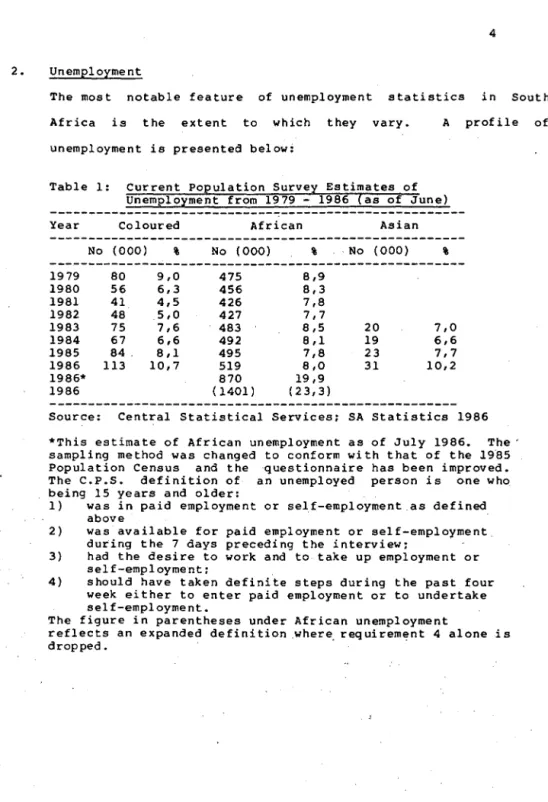
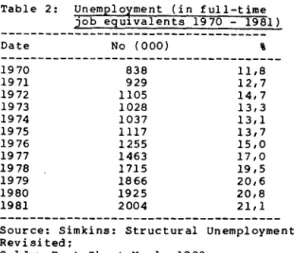
These biases are evident in official estimates of the education levels of the registered unemployed for blacks and Asians as well (Table 3, Appendix 1). The analysis of the previous section has different implications for different population groups in the country. Due to the mining tax formula, rising gold prices result in poorer quality ore being mined.
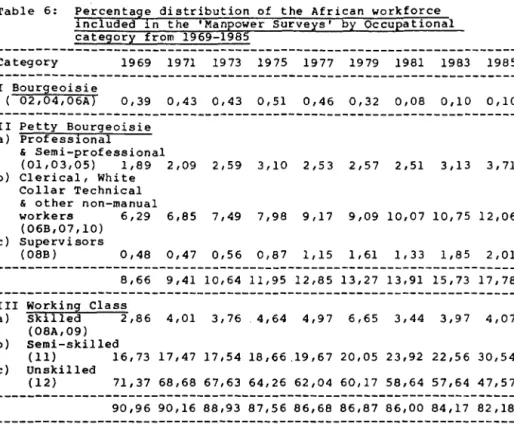
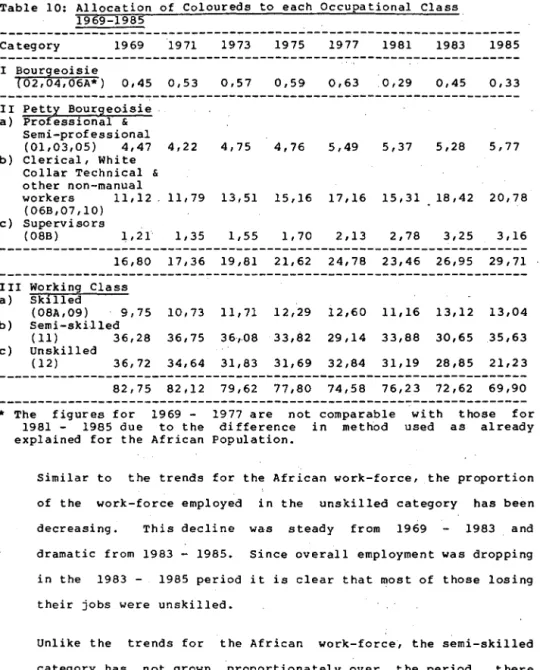
To determine the validity of these claims, we need to examine the changes in the occupational structure of the African workforce. Simkins and Hindson group these categories into three classes based on the ratio of those employed in the categories to the means of production (Simkins and Hindson, 1979 pS). This would explain the decline in the percentage of the black workforce allocated to the 'bourgeoisie'.
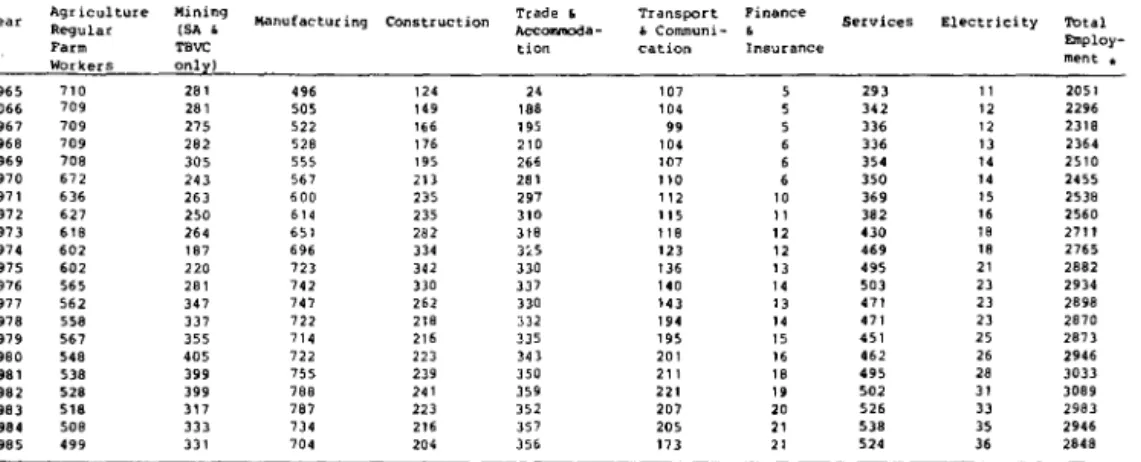
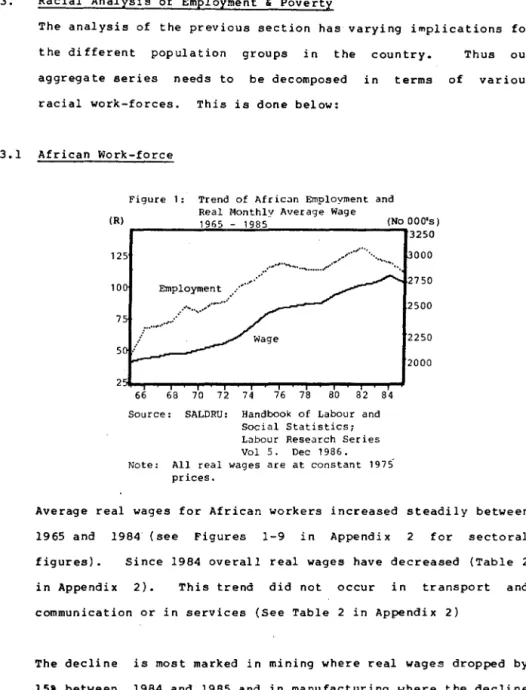
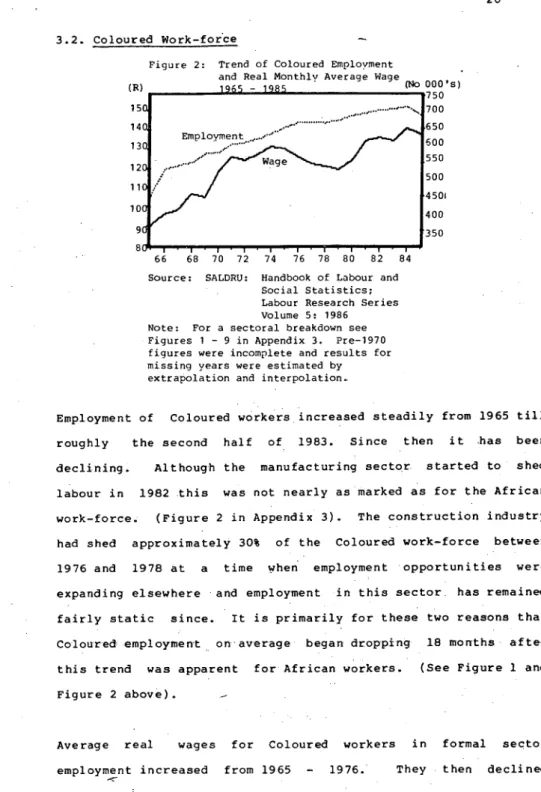
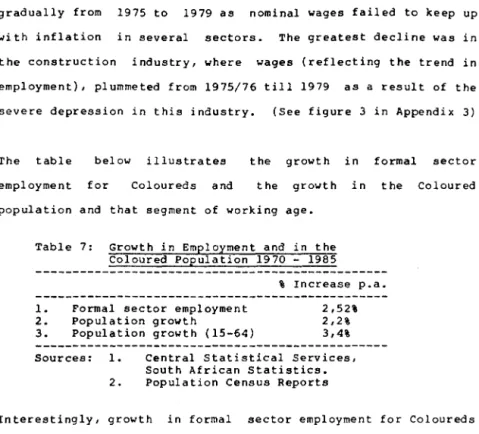
The biggest drop was in construction, where wages (reflecting the trend in employment) fell sharply from 1975/76 to l l 1979 as a result of a severe depression in that industry. The table below illustrates the growth in formal sector employment for people of color and the growth in the people of color and that part of the working age population. Similar to the African labor force, the share of the labor force employed in the unskilled category is decreasing.
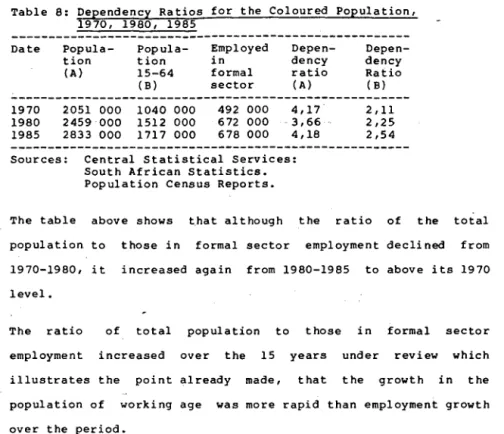
Most of the decline in employment appears to be in the unskilled manual labor category. The table below illustrates the growth of employment in the formal sector, in the population and in the working age population. By 1985, the majority of the workforce was employed in non-manual employment categories, most of whom were employed in the 'clerical, sales and representative' employment category.
Thus, there has been a significant amount of upward mobility in the Asian workforce. As the growth of formal sector employment has lagged the growth of the population in the 15-64 age group, either the number of unemployed has increased or the participation rate has decreased. Since employment in the formal sector has been faster than population growth, the upward mobility of the white labor force and the increase in real wages during most of the period are indicative of improved living standards for the white population.
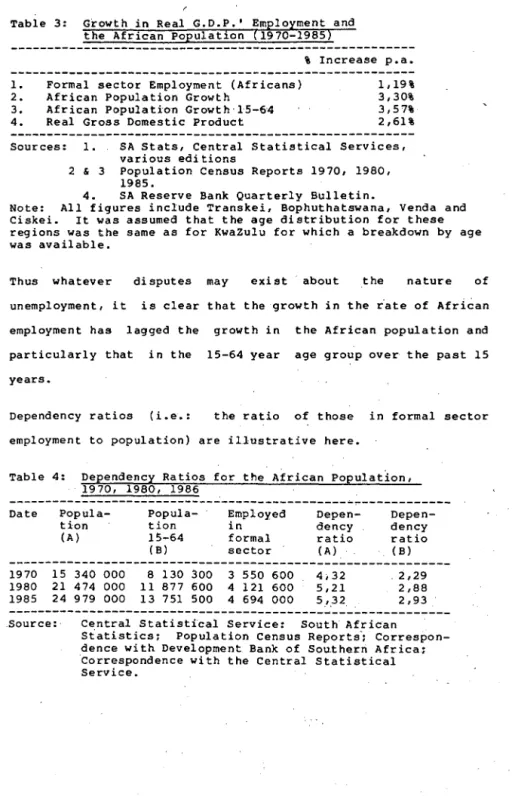
Employment growth in the formal sector has been significantly lower than overall population growth for Africans and especially for that portion of the population in the economically active age group. However, population growth in the economically active age group exceeds employment growth in the formal sector and it is therefore likely that unemployment will continue to rise. Rogerson and Beavon argue that it is generally a desperate response in the face of unemployment.
EAP is defined as the sum of those employed in the formal sector plus those seeking employment.
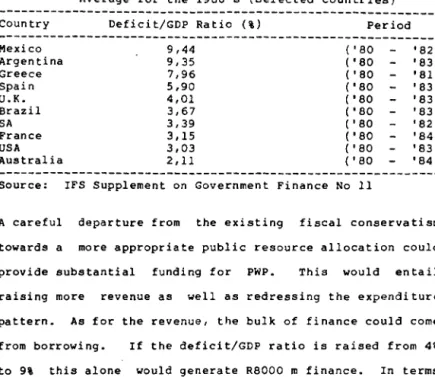
Although foreign sources of funding seem difficult to tap, they do exist, especially when the funds are earmarked for community-oriented projects that further the socioeconomic prosperity of communities of color. In addition to the primary sources of income, there is an important multiplier effect, which would also provide additional additional funding. That is, to the extent that initial spending through its multiplier generates growth and thus employment, it reduces the need for job creation through PWPs.
After studying trends of employment in the formal sector over two decades, it was determined that:. there was a definite trend for real wages to rise against all racial groups. This rise is largely due to the upward shift of the occupational structure, and caused] by, among other things, increasing capital intensification. Of the four population groups, Africans and Coloreds were the worst affected. the distribution of income within each of these two racial groups has become more skewed, causing impoverishment.
This is illustrated by an increase in dependency ratios from 4.32 to 5.32 for the African population during the period 1970-1985. in the face of the inability of the formal sector to provide sufficient employment opportunities, the informal sector has also shown little capacity to absorb unskilled unemployed workers. This is so despite the fact that some have made a comfortable living through informal business activities. there is a definite need for a conscious policy change to address the problem. On the one hand, policy makers must correct the overall macroeconomic/fiscal policy of the country in order to direct the economy to a growth path in accordance with its factor power.
On the other hand, it is high time to start a nationwide program of job creation through a PWP and thereby generate the much needed capital formation. We have argued that taking on debt in a developing economy such as South Africa's to aid capital formation is fully justified. In addition to financial requirements, perhaps there is a need for political importance. commitment to ensure the allocation of a large proportion of public resources for a long enough period to stop the process of impoverishment.
Urban Problems Research Unit) (1982): 'Urbanisation, unemployment and small commodity production and trade: comparative cases in Cape Town in Smith, DM, (ed): Living Under Apartheid: Aspects of Urbanization and Social Change in South Africa (London, Allen &. An appropriate strategy to meet the basic needs of the poor in Port Alfred's Black Township." (Institute for Planning Research, U.P.E.). Reproduction of Labor Power and the Soweto, {Carnegie Conference Paper No. Wellings, P~ and Sutcliffe, M Informal sector in South Africa:.
1 3599 EI1PLoYKEKl
Regular year Mining Manufacturing Construction Trade and Transportation Financial Services Eleetr iei ty Average real wages.