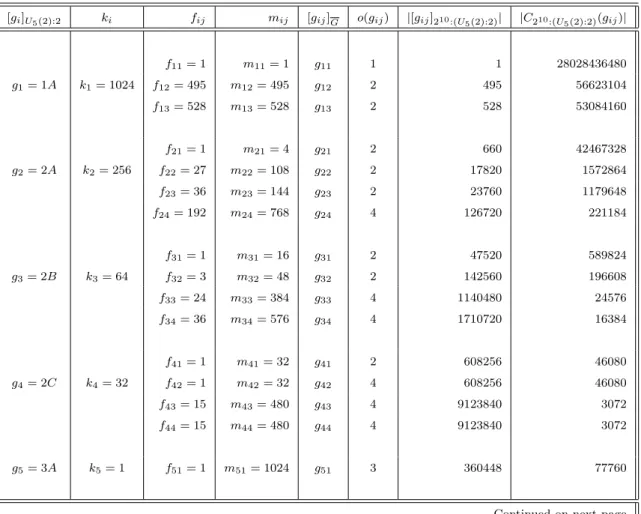
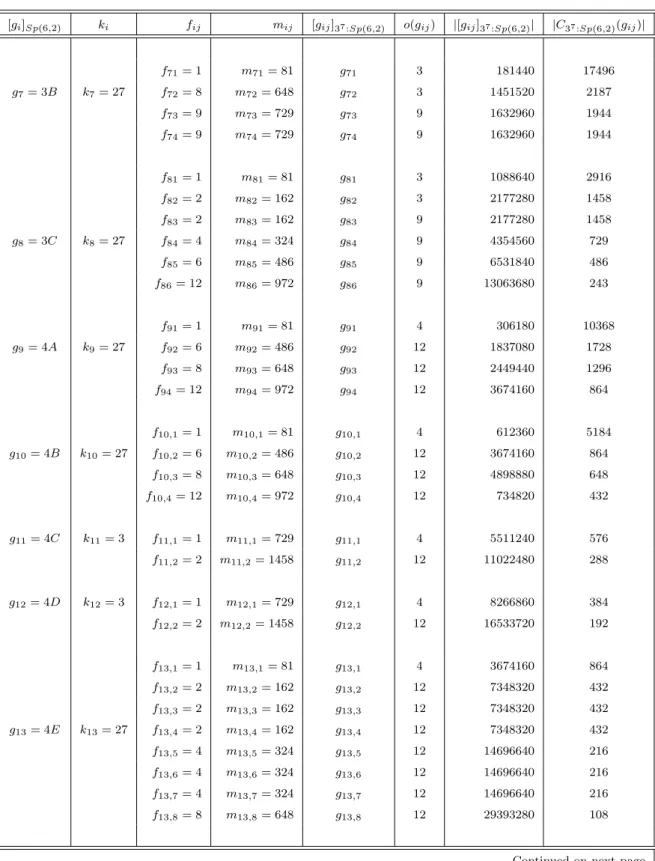
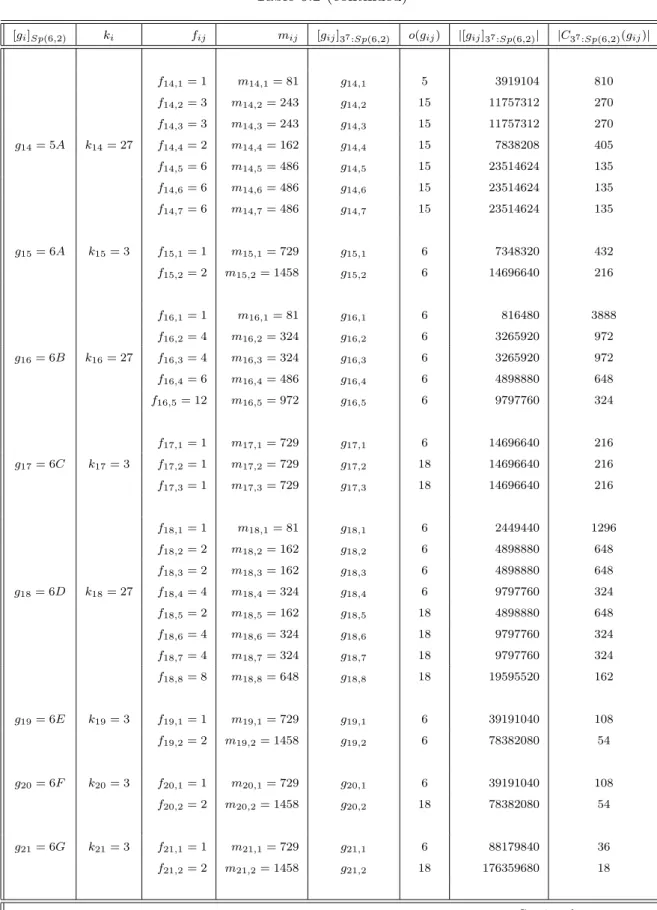
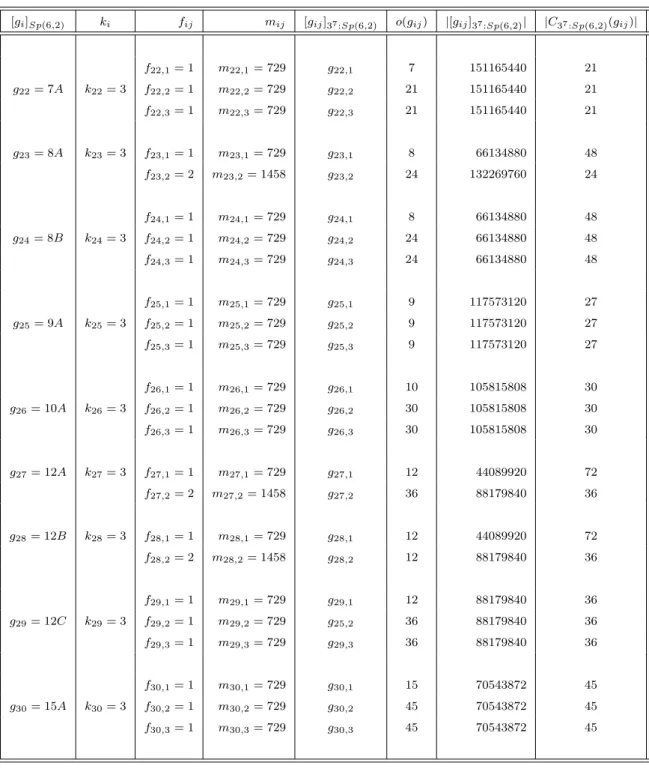
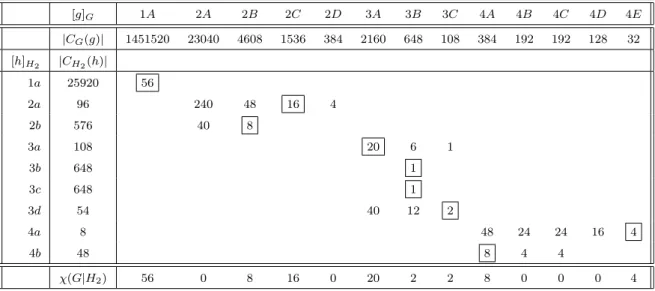
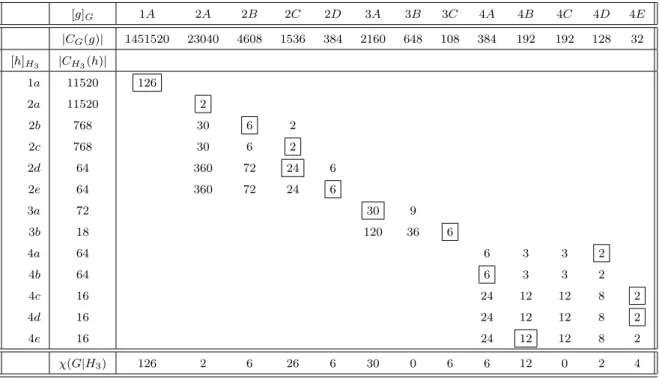
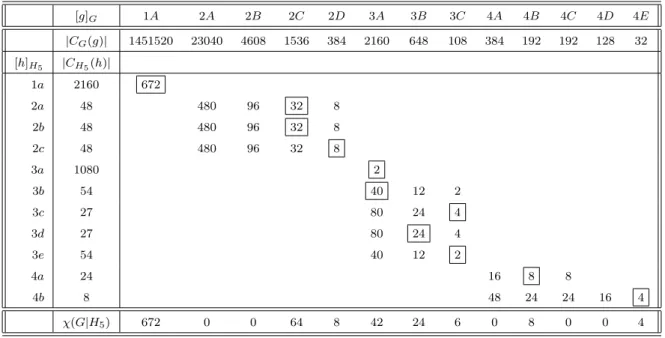
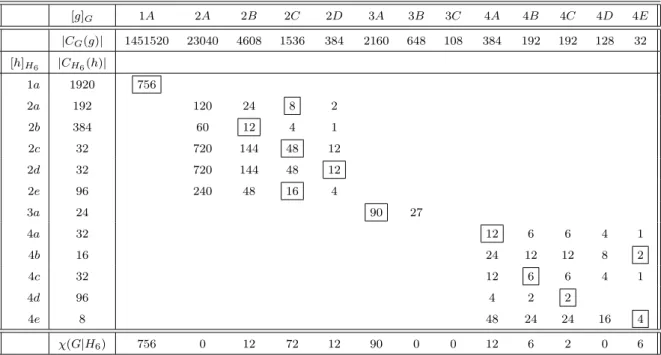
If G =N·G is an extension, the technique of composition analysis can be used to calculate the conjugation classes of G. In Section 9.3 we provide the generators of G= 28·Sp(8,2) as well as generators of the normal subgroup N = 28 in terms of permutations of a set of cardinality 512 (more precisely, these generators are elements of the alternating group A512).
Preliminaries
Also, a character χ of G is called irreducible if it is not a sum of other characters of G. The number of irreducible characters of G is equal to the number of conjugation classes of G.
Character Tables and Orthogonality Relations
We will use the notation Irr(G) to denote the set of all regular irreducible characters of G. Direct consequence of the fact that the irreducible characters, and therefore the sequences of the character-.
Tensor Product of Characters
Now we show that by knowing the character tables for two groups K and H, the tensor products can be used to obtain the character table for K×H. Note that if χ, ψ ∈Irr(G), then in generalχψ 6∈Irr(G). In the special case when deg(ψ) = 1, we have the following proposition.
Lifting of Characters
One of the advantages of the character table of G is that it supplies us with all normal subgroups of G. Therefore the character table can be used to decide whether the set is simple Gis or not.
Restriction and Induction of Characters
Restriction of Characters
Induction of Characters
With the above, the representation φ∗ is called the representation induced by the representation φ of H and is denoted by φ∗ =φ↑GH. We recall from the elementary theory of representations and characters of finite groups that if H≤Gand ψ is a class function in H, then.
Permutation Character
Therefore the commutative character of the action of G on Ω is the same as the commutative character of the action of G on the left cosets of Gω inG, which is 1↑GG. In this chapter we present the concept of projective representations and characters of a finite group G, which are of great importance in the continuation of this thesis.
Projective Representations
The projective representation P : G −→ GL(n,F) is irreducible if there are no non-trivial subspaces of the vector space V(n,F) that all transformations P(g) , g∈G send to themselves. A projective representation of P is irreducible if it is not linearly equivalent to a projective representation of a form.
Projective Characters
The group G has dual actions on the conjugation classes N and Irr(N). The next important result of Brauer relates the number of orbits on the two actions. Let G = N·G be an arbitrary extension such that gcd(|N|,|G|) = 1. Then every G-invariant character N is expandable to a character G.
The Fischer Matrices
5.6), we can see that the entries of the Fischer matrices essentially depend on the irreducible characters of the inertial groups Hk. Instead, we use the sign tables of the groups of inertia factors Hk along with the Fischer matrices to calculate the sign table G. The Fischer matrices have some interesting properties that aid in the calculations of their entries. A permutation of the columns of the Fischer matrices will result in a corresponding permutation of the columns of the G character table.
The Character Tables of Group Extensions
We conclude this section on Fischer matrices by noting that the Fischer matrices of any expansion Gare unique up to the ordering of the columns and rows, provided that the grade tables for Hk have been determined. One of the major challenges in the theory of Clifford-Fischer matrices is the determination of the type of the character table for Hk (projective or ordinary) to be used in the construction of the character table in G. 5.7) may also be useful for to prove that we must use projective characters of some of the inertia factors in a specific expansion.
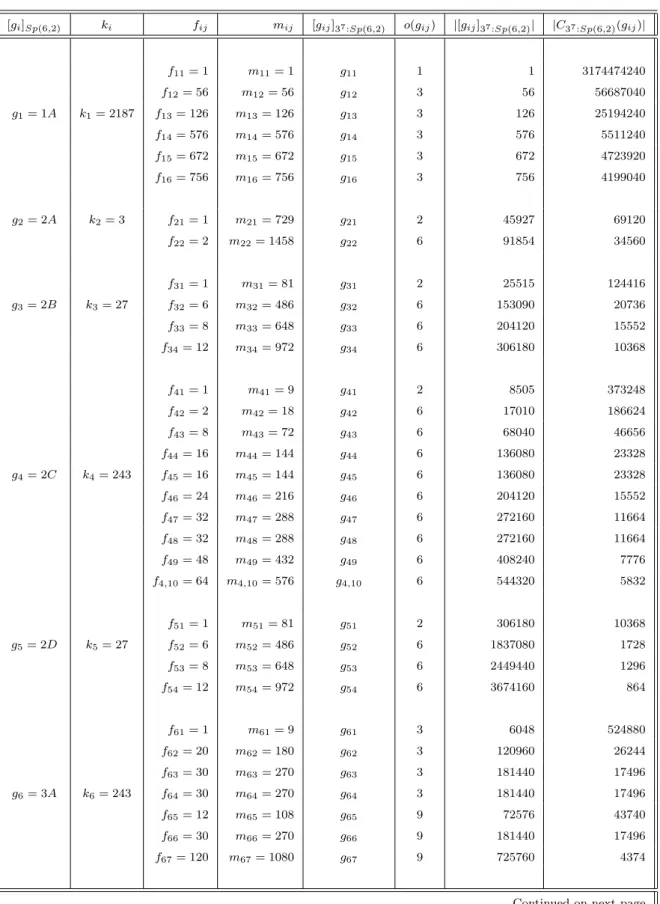
Recall that N is abelian, and therefore each path of the action of N on itself consists of singletons. These classes have sizes corresponding to the circuit lengths of GonN with respective representatives g11, g12, g13, g14, g15, and g16. The values of the f1j's are also the same as the lengths of the corresponding conjugation classes for all 1 ≤ j ≤ 6.
First, Second, Third and Fourth Inertia Factor Groups
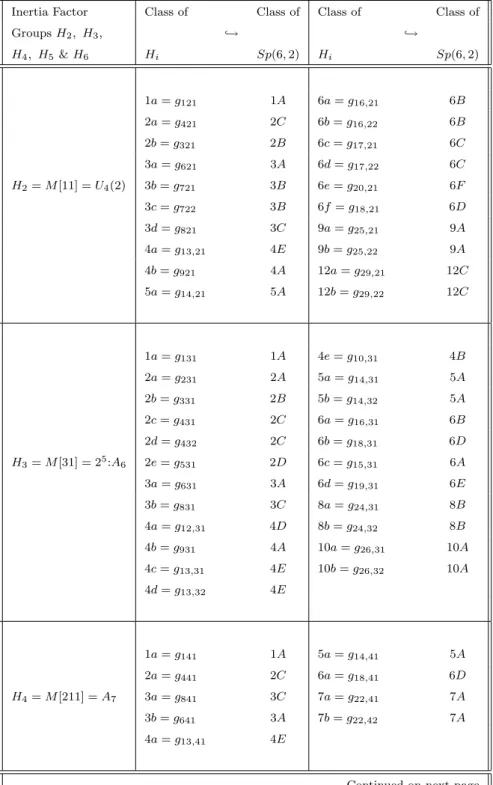
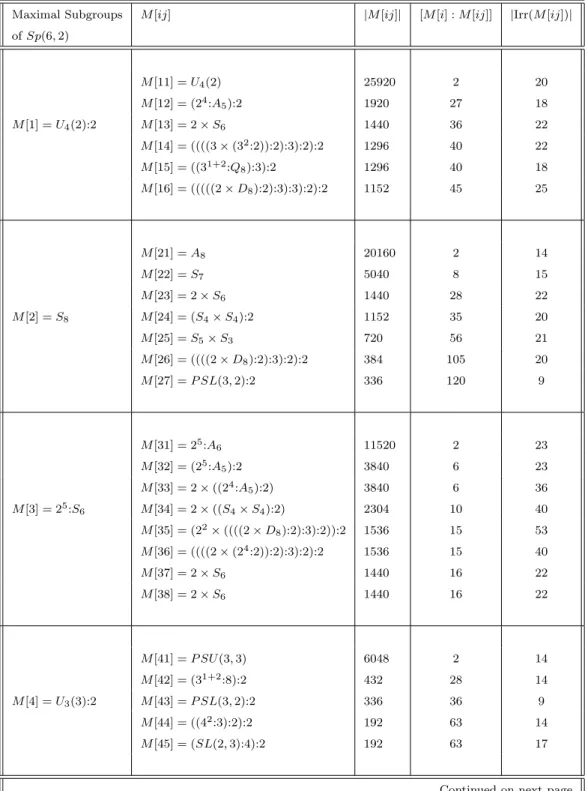
We used the following 6-dimensional matricesαe1 andαe2 overF2, which generate Sp(6,2) (see [71]) to present Sp(6,2) in GAP and then generate the maximal subgroups and the other required subgroups track. We mentioned that the first inertia factor group is H1 Sp(6,2), which has 30 irreducible characters. The third inertia factor group H3 has an index 2 in 25:S6. In Table 6.3 we provide information about the maximal subgroups of the maximal subgroups ofSp(6,2).
Fifth and Sixth Inertia Factor Groups
Thus, for the construction of the G sign table, it will not matter which A7 we choose. So if M[12] is the sixth inertia factor group, then we get a contradiction (the Fischer matrix F2 corresponding to g2 = 2A will be of size 3×2, which contradicts Proposition 5.2.2(i)). If θi is the orbit representing the action of Gon Irr(N), then Hi can be obtained by GAP as Gθi, the stabilizer of the set θi in G.
![Table 6.5: Some information on the maximal subgroups of M [31], M [32] and M[33]](https://thumb-ap.123doks.com/thumbv2/pubpdfnet/10640044.0/88.892.140.781.210.827/table-information-maximal-subgroups-m-31-m-32.webp)
Fusions of Inertia Factor Groups into Sp(6, 2)
Character Tables of the Inertia Factor Groups
Introduction
In the unique class of involutions 2A in the Thompson group Th there are 5 commuting involutions, e.g. n1, n2, n3, n4 and n5. Let x and y be in the 248-dimensional matrix group over F2 which are generators of Th given by the electronic ATLAS of Wilson. Using this 69-dimensional representation over F2, one can obtain the 5 generators n1, n2, n3, n4 and n5 of the normal subgroup N of G using Magma or GAP [30].
The following theorem characterizes the type of character table (ordinary or projective) of H2 that we will use to construct the character table of the DempwolffG group. From Remark 5.3.1 we see that H1 contributes 27 characters to the character table of G (these 27 characters are the usual irreducible characters of G= GL(5,2)). Thus, the design character table of H2 with factor setα−1, which we will use to construct the usual character table of G, must have 14 irreducible characters.
![Table 7.2: Projective characters of H 2 = 2 4 :GL(4, 2) with factor set α, α ∼ [2]](https://thumb-ap.123doks.com/thumbv2/pubpdfnet/10640044.0/117.892.146.775.784.1102/table-projective-characters-h-gl-factor-set-α.webp)
Fusion of Classes of H 2 into Classes of GL(5, 2)
We give an example of how to construct a character table for G, which is divided into 54 blocks corresponding to 27 cosets and two groups of inertia factors. However, in Table 11.9 we give a table of characters of G in the format of Clifford-Fischer theory (the characters are organized in blocks corresponding to the inertia factors and conjugation classes of G, where the conjugation classes are arranged in blocks corresponding to cosets 25gi, where gi is the preimage of the representative gi conjugation class G=GL(5,2)).
Introduction
In Table 7.5 we list the conjugation classes of G together with the fusions of its classes into the classes of Thompson group Th.
![Table 7.5: The conjugacy classes of 2 1+8 + · A 9 [g i ] A 9 m ij [g ij ]](https://thumb-ap.123doks.com/thumbv2/pubpdfnet/10640044.0/128.892.197.724.285.1051/table-7-5-conjugacy-classes-2-ij-ij.webp)
The Character Table of the Inertia Factor Group H 2
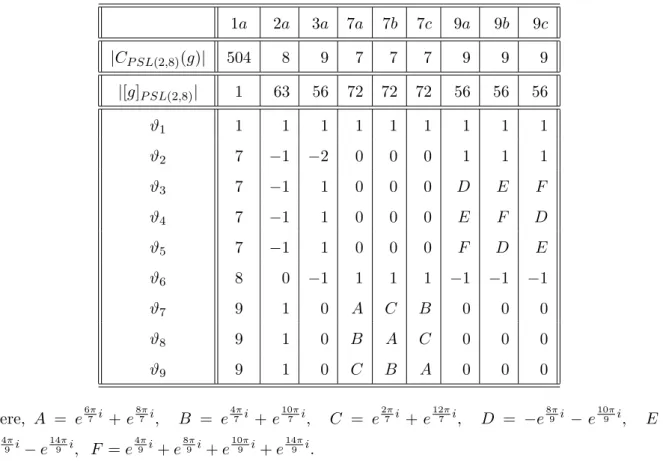
We apply the method of coset analysis to compute the conjugacy classes of the split extension H2=P SL(2,8):3. In Table 7.6 we give the character table of P SL(2,8), although at this stage we are only interested in its conjugation classes. The resulting orbits of M in M are the conjugacy classes of M =P SL(2,8). Thus k1 = 9 (recall that ki is the number of orbits obtained by the action of M on the coset M gi =M gi as described by the method of coset analysis). We know that the rows of Fb1 are the sums of the orbits of the irreducible characters of M in the conjugacy classes of H2 that are produced by M.
Fusion of the Inertia Factor Groups into A 9
Next, we determine some of the entries of F1. The first row and column of F1 are determined by properties of Fischer matrices given by Proposition 5.2.2. Note that from subsection 7.2.3 we get 52 irreducible characters of G, which is exactly the same number of the conjugation classes of G given in Table 7.5. For every α−regular Fischer matrix Fi, of size c(gi), the sum of the first c(gi)−1 rows is equal to the (componentwise) square of the last row.
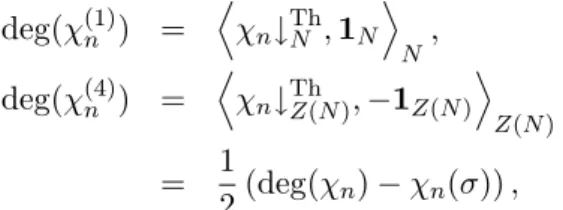
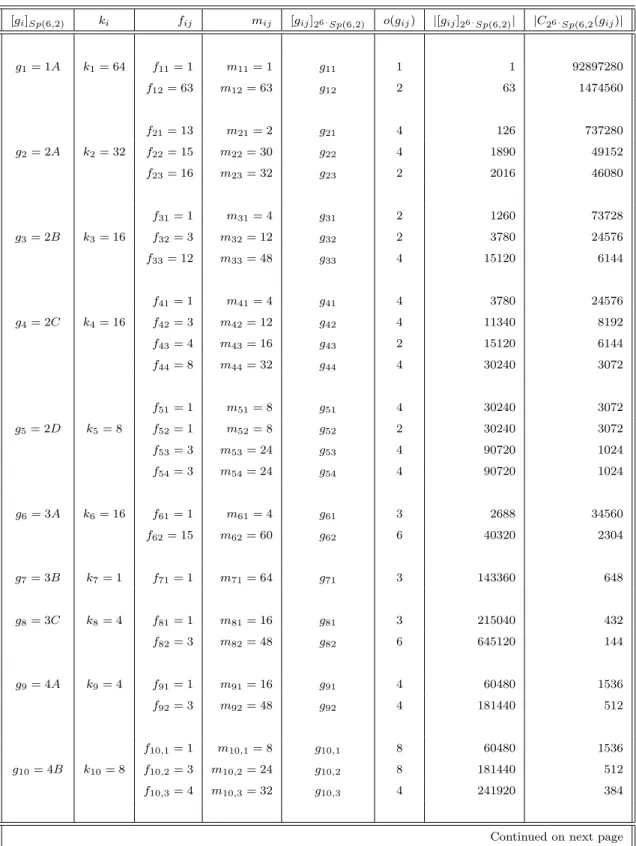
In this chapter, we construct the character table of the non-split expansion G = 26·Sp(6,2) using the Clifford-Fischer theory in combination with the coset analysis technique. In this chapter we are interested in calculating the character table of G3 = 26·Sp(6,2) :=G using the Clifford-Fischer theory. It will turn out that the character table of G is a 67×67 integral matrix and coincides with the character table of the split extension 26:Sp(6,2), constructed in Mpono [55] and which is also available in GAP.
This shows that the group G constructed using the generators g1 and g2 is indeed a nondisjoint extension of the elementary abelian group N = 26 from the symplectic group Sp(6,2). This confirms that the set G constructed using the generators g1 and g2 is different from the set T but it will be shown later that the character tables of the two sets will be the same.
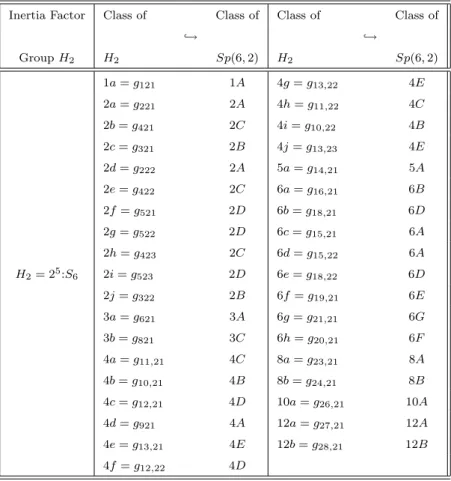
The character table of H1 =Sp(6,2) is available in the ATLAS, Wilson's electronic ATLAS [71] or can be obtained from Magma or GAP. The next set of Magma commands reveals H2's Schur multiplier as well as the regular character table of H2's entire parent group. This shows that we need to use the set Irr(25:S6) to construct the regular character table of G.
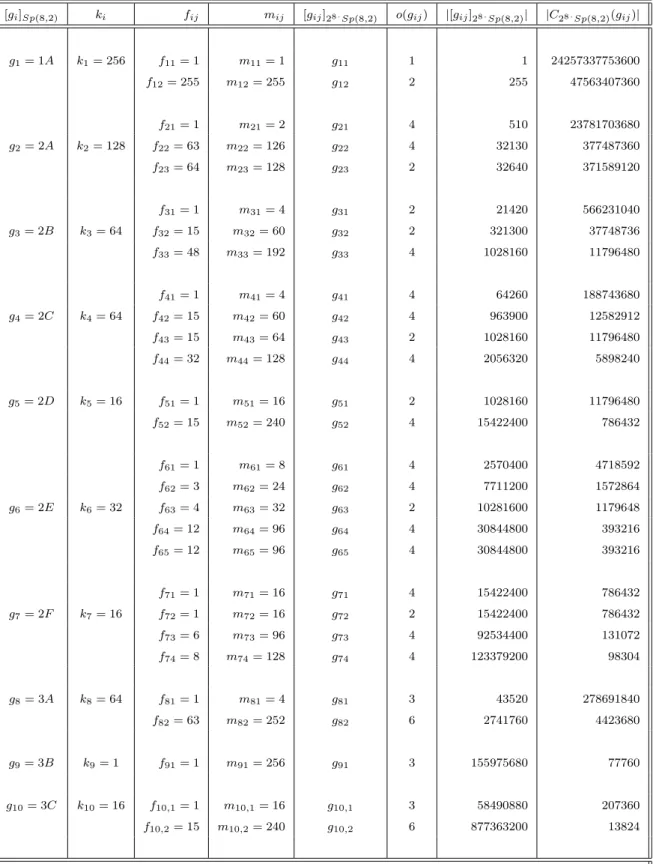
In Section 9.2 we provide a sequence of commands that generate Gn followed by some general results about the inertia factors of this expansion. In Section 9.3 we provide the generators of the group G= 28·Sp(8,2) as well as the generators of the normal subgroup N = 28 in the form of permutations of a set of cardinality 512. In Section 9.7 we describe how to obtain the full character table of 28·Sp(8,2), which appears in the appendix.
After this rearrangement of signs, it can be seen that there is a character of G5 (resp. G6) contained in K2 of degree 1023 (resp. 211:Sp(12,2)) which we will use to construct (via of Clifford-Fischer theory) the character table for G5 (resp. G6) contains a character of degree 1. Also note that we have used the information we have on the character table for G5 (resp. G6) and the identity Fischer matrix for G5 (respectively G6) to determine the type of sign table (projective or ordinal) of 29:Sp(10,2) (respectively
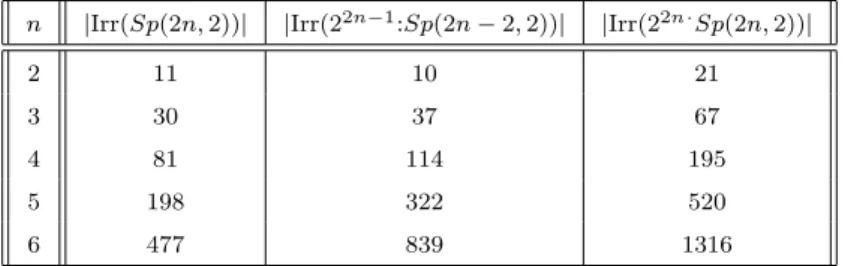
Conjecture: We speculate that for any n∈N≥2 we only need to use the ordinary sign table H2 = 22n−1:Sp(2n−2,2) to construct the sign table Gna and therefore the theory of projective representations is not involved in the construction of sign tables Mr. This is an equation. In fact, the only non-trivial proper normal subgroup contained in G is the group of order 256 and thus must be isomorphic to the elementary abelian group N = 28. The following 8 permutations n1, n2, · · · , n8 generate a normal subgroup N. We can also check that that the quotient group G/N ∼=Sp(8,2). This shows that the group G constructed by the generators g1 and g2 is indeed an unsplit extension of the elementary abelian group N = 28 by means of the Symplectic group Sp(8,2) .
In Magma or GAP one can easily check for the complements of any normal subgroup N of G. Note that from Table 9.2 the groupG= 28·Sp(8,2) contains 8 conjugation classes of involutions, while from the character table of the split expansion 28:Sp(8,2) (see GAP) there are 11 conjugation classes of involutions. This confirms that the group G constructed using the generators gl and g2 is different from the group 28:Sp(8,2), but it will be shown later that the character tables of the two groups are the same.
In section 10.3 we determine the inertia factor groups, the mergers of classes of these inertia factors into classes of G=U5(2):2 and provide the character tables of these groups. A significant part of Section 10.3 is devoted to the construction of the character table of H2 via Clifford-Fischer theory, where we will see that the Fischer matrices of this group satisfy some interesting properties (Lemmas 10.3.3 and 10.3.4 ). In section 10.4 we mention the 43 Fischer matrices of G. These matrices are integrally valued and the size of these matrices varies between 1 and 5.
The next two elements g1 and g2 generate the complement GofN inG. Note that Gi is a subgroup of Gisomorphic with the quotient G/N ∼=U5(2):2 and together with N creates the split expansion Gin consideration.