Celtis africana is one of the species that has a documented record in Lesotho of having been a well-adapted, resourceful tree in the past. More research and determined replanting programs are needed to improve the status of Celtis africana in Lesotho.
INTRODUCTION
EVOLUTION OF INDIGENOUS SPECIES
HUMAN INTERACTIONS WITH ECOSYSTEMS
As human impacts on natural systems extend to the farthest reaches of the planet, the challenge for the twenty-first century is to reconcile resource use with a just life for current and future generations of humans, while addressing the millions of other species with which we are alive to be sustained. share the planet (Kanashiro et al., 2002). This is the situation observed by Sharma (1992) in which the world today faces the challenge of achieving a balance between the development and maintenance of natural systems and thereby ensuring the integrity and stability of forest ecosystems.
LACK OF AWARENESS OF SOCIO -ECONOMIC IMPORTANCE OF THE INDIGENOUS VEGETATION
Conventional national accounts do not recognize the reduction of the forest resource base, and therefore the contribution of forest resources to both the local and national economy is largely unknown. The anomaly is further compounded by the insufficient data on the true values of forest resources (Temu, 1993).
BACKGROUND INFORMATION IN RELATION TO CELTIS AFRICANA INLESOTHO
Research on native species as a whole appears to be very limited (Hall and Green, 1989) and the assumption has always been that only fast growing exotics can meet the needs of the country. It is within the context of the above discourse that this thesis seeks to encourage and emphasize research on indigenous C.

AIM AND OBJECTIVES OF THE RESEARCH
INTRODUCTION
Ridley (1963) states that there are three genera of the elm family in southern Africa, which are Trema, Chaetachme and Celtis. One is found in the Transvaal and from Natal to the Uitenhage division of the Cape Province.
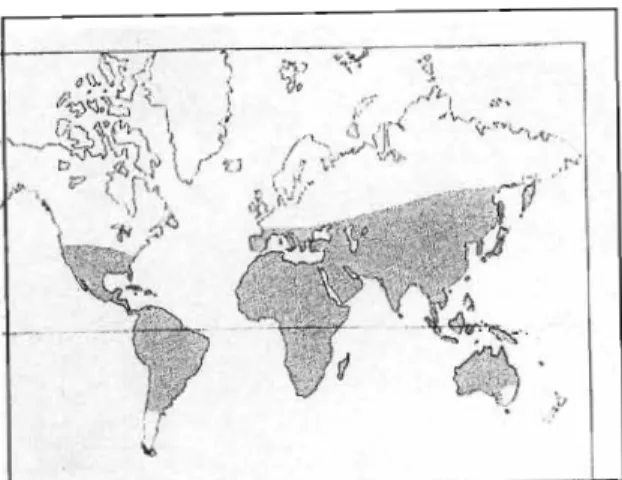
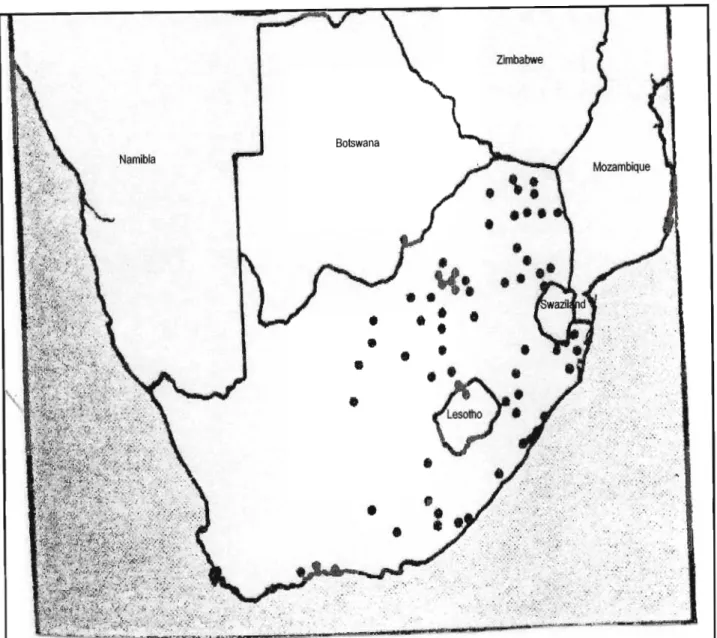
GENERAL DISTRIBUTION AND HABITAT OF CELTIS AFRICANA
- Flowers
- Wood
In the Southern Cape it is occasionally found in dry forest and scrub forests, usually near the coast (von Breitenbach, 1974). In the winter rainfall area of the South West Cape it is now rare for only a remnant in the forest above Kirsternbosch to be recognizable (Dyer, 1956).
PESTS AND DISEASES .1 Pests
The species is susceptible to attack by uncinula polychaeta DOIDGE resulting in downy mildew, Daedalea eatoni BERK, Fomes applanatus (P) WALLR, F. Attack severity may increase or decrease along a gradient of elevation or climatic conditions. In some cases, the species may be a second host.
THE SOCIO-ECONOMIC IMPORTANCE OF CELTIS AFRICANA
Many countries, such as the United States of America, Mexico, Australia and some Middle Eastern countries, have already begun large-scale research into the study of plant indicators of groundwater. Celtis africana is considered one of the excellent indicators of groundwater on Highveld.
CONCLUSIONS
It is believed that its wood, mixed with crocodile fat, can be a charm against lightning or evil spirits (Pooley, 1974; Thomas and Grant, 1998; Mbambezeleni and Notten, 2003). LESOTOAS COUNTRY DESCRIPTION OF THE MAIN STUDY AREAS AND NICHES OF CELTIS AFRICANA IN SOUTH AFRICA.
LOCATION OF LESOTHO AS THE MAIN COUNTRY OF STUDY
GEOLOGY
This stage of soil development is influenced by the interaction of five soil-forming factors, namely geological materials, climate (mainly temperature and precipitation), topography (steepness and slope), vegetation and time. Geological material provides starting material, climate influences the rate of weathering of the geological materials, topography determines the stability of the landform and the rate of erosion (process of removal) and deposition (process of addition), vegetation provides organic material for the soil and Time determines the continuity of the influence of all factors.
SOILS
The duplex soils form the most extensive soil series in the low-lying regions of Lesotho. There is usually a higher proportion of clay in the B horizon than in the A horizon due to downward movement of clay.
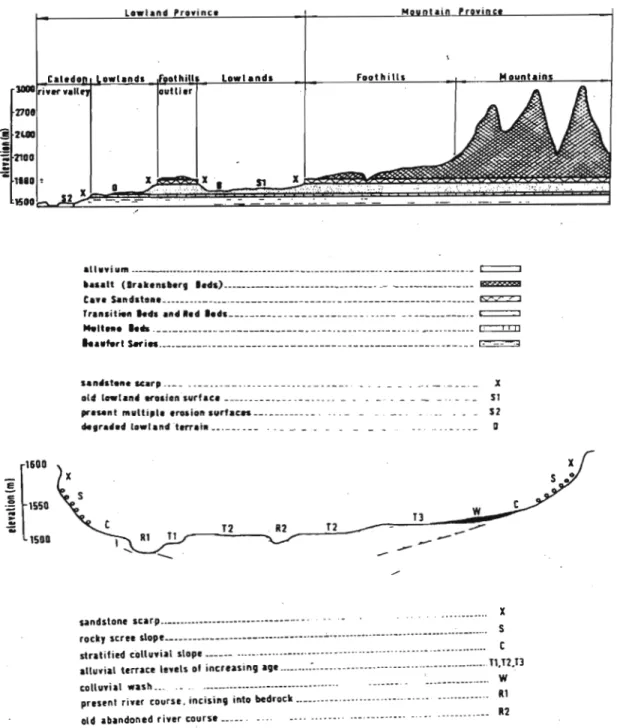
VEGETATION
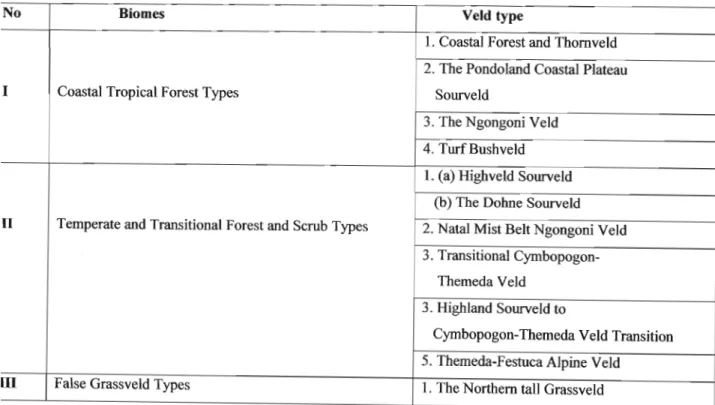
- Vegetation of Lesotho
The soil is usually shallow on steeper slopes, but in the valleys it can be deep. Dense shrubland, rich in species, with some components of the tree and shrub layer, covers many river valleys, especially in the central part of the river.

PHYSIOGRAPIDC LESOTHO
- Lowlands zone
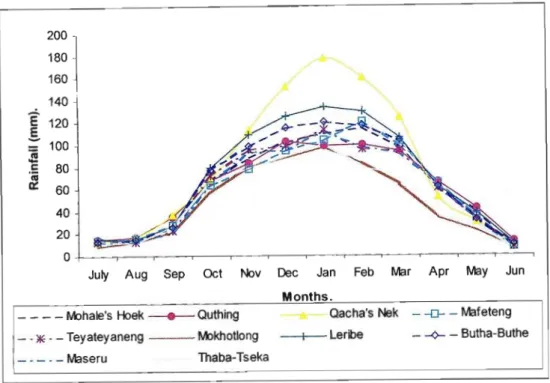
The general increase in rainfall is from west to east (Mc Xee and Bevan, 1975). The steepness of the slopes allows only poor profile development in the soils in this zone.

GENERAL CLIMATE OF LESOTHO
- Snow
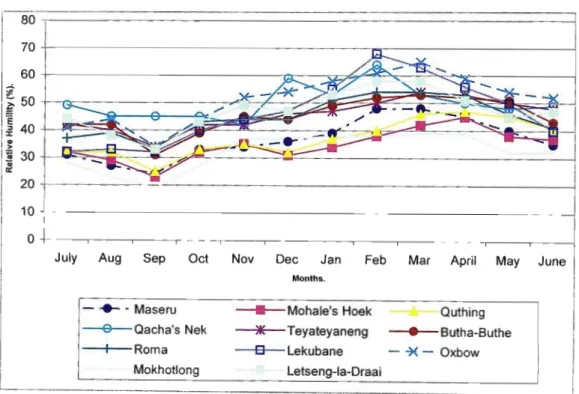
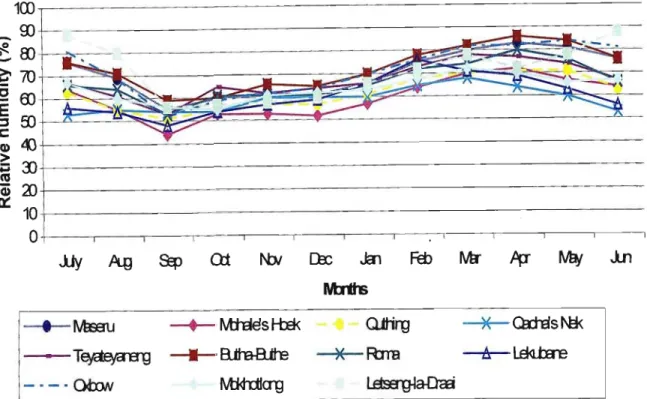
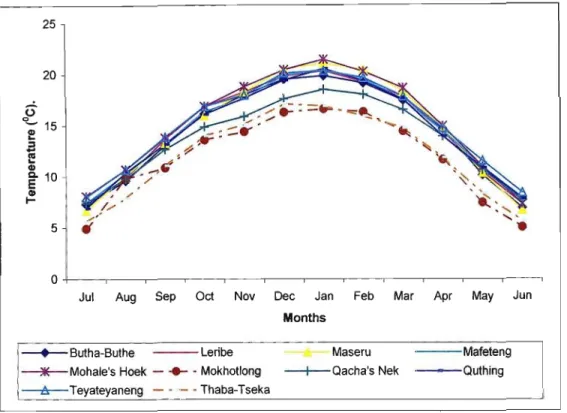
In the lowlands, the average annual relative humidity is around 60%, with the higher values tending to occur in the north. The diurnal variation of relative humidity is more or less the inverse of the temperature variation, maximum values occurring just before sunrise and minimum values in the early afternoon.
Jtirg )( R:rra
- CONCLUSIONS
- INTRODUCTION
- THE INDIGENOUS TREES AND RELATED LEGISLATION
- TREE PLANTING BY OWNERSHIP
- Trees and small-holdings (treelots) owned communally or individually
- CONCLUSIONS
- INTRODUCTION
- ASSESSMENT OF SEED MASS
- GERMINATION TESTS
- ESTABLISHMENT OF RELATIONSIDP BETWEEN DIAMETER AT BREAST HEIGHT AND HEIGHT
- LEAF-BLADE ASSESSMENT
- DETERMINATION OF WOOD DENSITIES
- STATISTICAL ANALYSIS
- DARGLE - STUDY AREA IN KWAZULU-NATAL IN SOUTH AFRICA
- FORT-HARTLEY- STUDY AREA IN LESOTHO
- MOKHALINYANE - STUDY AREA IN LESOTHO
- IDLTON - STUDY AREA IN LESOTHO
- CONCLUSIONS
- INTRODUCTION
- VARIABLES SHOWING STAND CHARACTERISTICS .1 Frequency distribution
- Importance of seed mass in forestry
- Germination tests and their significance in forestry
- STUDY PLOTS AS SOURCES OF FIELD DATA FOR THE VARIABLES
- DBH AND HEIGHT VARIABLES
- SEED COUNT
- LEAF MEASUREMENTS
- DETERMITION OF WOOD DENSITIES OF CELTIS AFRICANA .1 Wood densities for C ajricana at Dargle
- Wood densities for C. africana at Hilton
- GERMINATION TESTS .1 Germination tests for Dargle
Their management is decentralized compared to the regular ministries and rests with the powers of the heads. They were engaged in forestry/agroforestry and soil conservation activities, and most of them had included a forest research component in their programs. a) The Matelile Rural Development Project had the largest program of species introduction trials (on and off farm) with an emphasis on multi-functional trees and shrubs. At all four locations, the extrapolation of the scatterplots of the data points (X's, Y's) indicated the relationship shapes that were linear, and therefore fit a linear regression model E(Y)= a +pX, where the regression parameters a and p are unknown (or better yet, for forestry purposes the model is usually expressed as Y = bo+ bIX, where bo and b I are unknown regression parameters).
The data for dbh and height on the scatter plot, clustered in a narrow ellipse, but showed a linear relationship (Figure 47). Table 22 below summarizes the results by group number and seed net mass. Table 23 provides a summary of the results by group number and seed net mass.
L DGs Day Gp DGs I DGs N
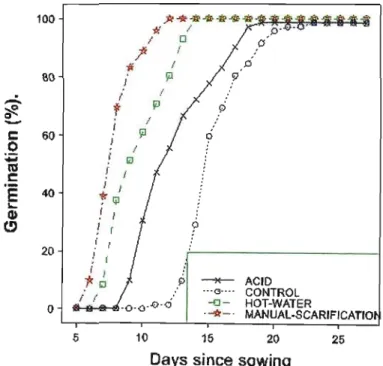
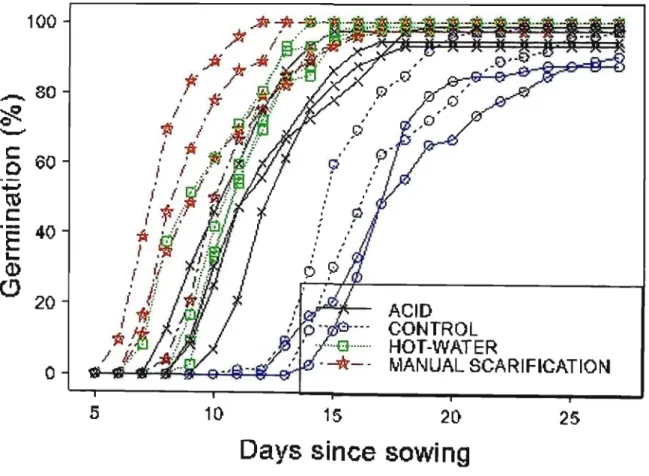
Complete germination after the first germination took 8 days. In total, it took 16 days for germination to be complete since sowing. Germination period for the four treatments took a total number of 28 days, i.e. from sowing to the completion of germination. Manual deformation was the first to complete germination from the day of sowing to the completion of germination in 14 days.
Manual scarification took the shortest time of 7 days to complete germination from the first day of germination.
Days since sowing
CONCLUSIONS
Species of the same genotype develop structures of different sizes depending on the environment they are subjected to. Consequently, careful opening of the seed coat by manual scraping significantly increases the rate of germination. The kiln-dried wood density results compare favorably with the results of De Winter et al.
However, the results could have been better if wood samples had been taken from the right positions and not from man-height branches.
INTRODUCTION
STEMS AND VOLUME OF C. AFRICANA PER LOCALITY PLOTIHECTARE The results showing number of stems and basal area per plot and volume per hectare are shown in
Fort-Hartley ranks second in the number of stems per field, with 21 (42 stems per hectare). Hilton was last in every respect except for the number of other tree species per plot, where it came in second with 11 (22 trunks per hectare).
DBH AND HEIGHT PARAMETERS OF CELTIS AFRICANA
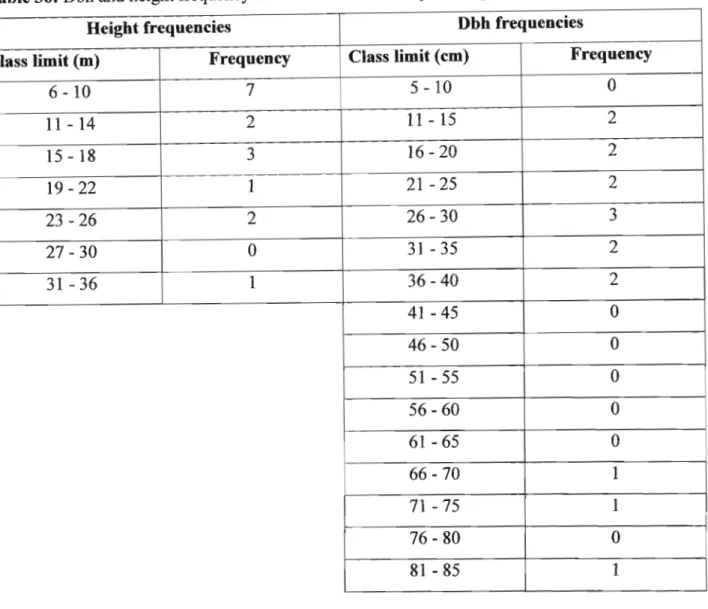
For height frequency 6 - 10, the class boundary appeared as the value of the most frequent occurrence (mode) with frequency 7. Frequency distributions by height classes and dbh for Fort-Hartley are shown in Table 37. Frequency distribution for heights and dbh are shown in Table 39 Table 39: Dbh and height frequency distributions for the Hilton site.
Fort-Hardey showed the highest ratio of diameter at breast height to height at 77%.
SEED MASS ASSESSMENT OF C. AFRICANA
GERMINATION
- Germination tests on C. africana
As a result, manual scarification had the greatest success in cumulative germination of Celtis africana at all sites. Dargle seed required the shortest time of 24 days to complete germination in all treatments (Appendix 12). On average, the warm water treatment had the most counts with higher values in gennification percentage than other treatments.
Analysis of variance indicated that the effect of different seed treatments, tested at 5%, had no significant effect on germination percentage (Table 42).
C. AFRICANA LEAF ASSESSMENT FOR COLOUR AND SIZES
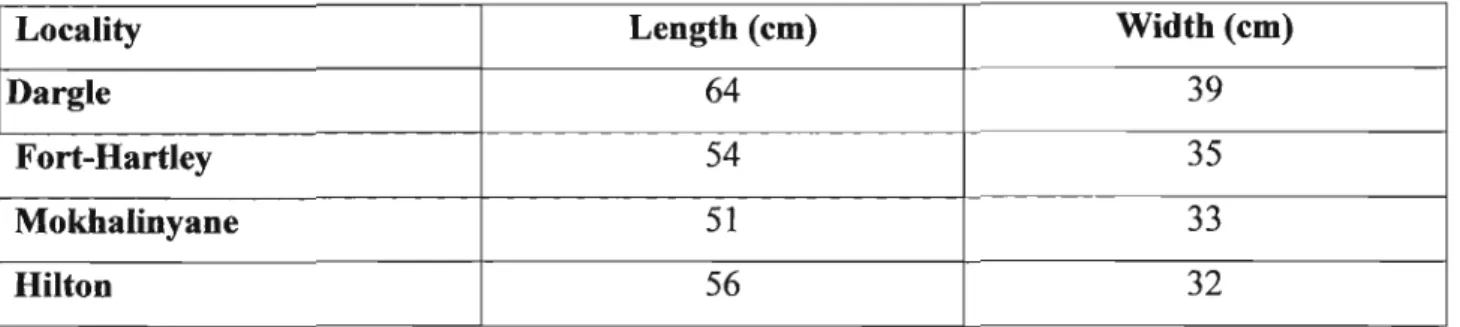
Dargle had the highest values for both mean lengths and widths at 64 cm and 39 cm respectively. Fort-Hartley was third in length measurement at 54 cm and Mokhalinyane was last at 51 cm. The results of the analysis for the lengths are shown in table 44 and for the widths in table 45.
Table 44: Summary statistics of the analysis of variance on variations of leaf lengths as affected by the location.
C. AFRICANA AS A MULTI-PURPOSE TREE
PESTS AND DISEASES
- Powdery mildew
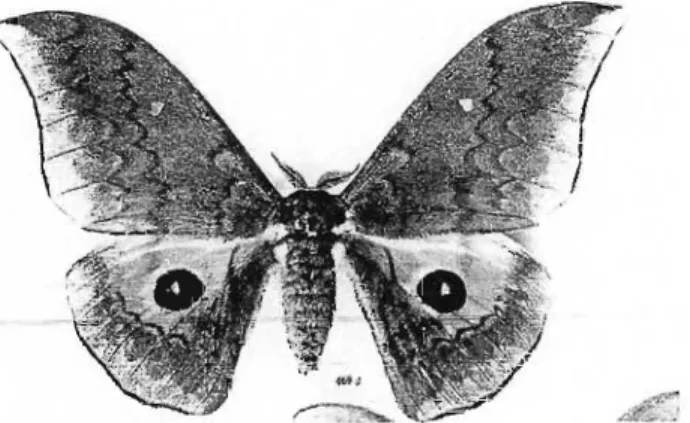
- Silver stripped hawk moth Pseudobunea tyrrhena
Ambrose (pers. comm, National University of Lesotho, Roma, Lesotho 2004) explains that when a goshawk burrows, it burrows into the ground and may also mimic a tree to avoid birds. It detects this by smell or sight, and confirms that it is a suitable species with receptors on the paws, antennae or the tip of the abdomen. Eventually, she lays her eggs on a part of the plant, giving the eggs and larvae the best chance of survival.
The larva of the silver-striped hawkmoth is green with yellow-green lines and silvery markings (Figure 61).
CONCLUSIONS
The consequence of this is that pollen migration does not encounter any barriers in the form of long distances or mountainous topography. It is clear that KwaZulu-Natal has more tree species per unit area than Lesotho (Table 35). This increased diversity of tree species can be attributed to more favorable growing conditions for a greater variety of other species and fewer human interruptions in the ecosystems.
Sargent and Bass (1992) support the claim by stating that natural forests are responsible for the low yield, which can be as little as 0.50 m3 per hectare, in contrast to industrial plantations, which can be in the order of 5-50 m3 per hectare. .
CONCLUSIONS
- Habitat and status of C. africana in Lesotho
- Forestry literature on indigenous trees
- Indigenous forests and plantation forestry
Poor results shown by Celtis africana in Lesotho, compared to those in KwaZulu-Natal, may indicate that the species has been exposed to genetic variation. Some of the genetic factors that seem to affect populations of Celtis africana in Lesotho are selection, mutations and inbreeding. Celtis africana in Lesotho has for a long time been exposed to cutting without regeneration in the form of replanting.
As a result, extra care should be taken when planting Celtis africana trees to avoid placing them too close to fences or infrastructure.
RECOMMENDATIONS
- Tenure
- Forestry literature and education
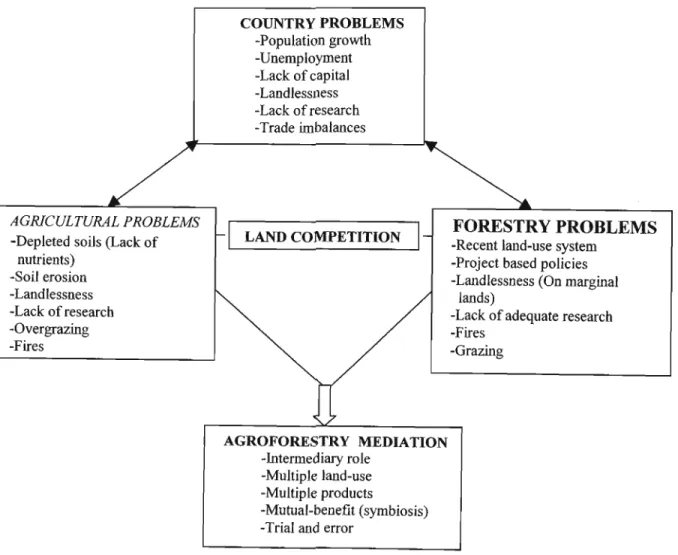
Intensive research efforts should be initiated to restore Celtis africanato to its original status as a valuable and important tree in the socio-economic structure of Lesotho. The lack of adequate research in both areas limits the possibilities for improvement and production in both areas, but the growing population (which is the government's problem) requires more food, wood, and building materials to meet their basic needs. AGRICULTURAL PROBLEMS -Depleted soil (lack of nutrients) -Soil erosion -Landlessness -Lack of research -Overgrazing -Fires.
Material needs to be developed and curricula designed to address the importance and future role of native trees in future land use plans.
Plot 1
Total number of days to full germination Days from sowing to first day Days to full germination from sowing.