i
THE CONSTRUCTION HEALTH AND SAFETY REGULATION 2014 IMPACT ON CONSTRUCTION
WORKERS WELL-BEING
BY
MOHLOMI TERAH RALIILE
Submitted in Fulfillment of Academic Requirements of Master of Science
in Construction Management Construction Studies
College of Agriculture, Engineering and Science University of Kwa-Zulu Natal
Howard College Durban South Africa
Supervisor: Prof Theo C. Haupt December 2019
ii PREFACE
This research has not been previously accepted for any degree and is not being currently considered for any other degree at any other university.
I, Mohlomi Terah Raliile, hereby declare that this Dissertation contains my own work except where specifically acknowledged
Student Name and Number
Signed………...
Date………...
As the candidate’s supervisor, I agree/disagree to the submission of this thesis
Signed………...
Supervisor………
Date……….
iii DECLARATION 1: PLAGIARISM
I, Mohlomi Terah Raliile, declare that:
i. the research reported in this dissertation, except where otherwise indicated or acknowledged, is my original work;
ii. this dissertation has not been submitted in full or in part for any degree or examination to any other university;
iii. this dissertation does not contain other persons’ data, pictures, graphs or other
information, unless specifically acknowledged as being sourced from other persons;
iv. this dissertation does not contain other persons’ writing, unless specifically
acknowledged as being sourced from other researchers. Where other written sources have been quoted, then:
a. their words have been re-written but the general information attributed to them has been referenced;
b. where their exact words have been used, their writing has been placed inside quotation marks, and referenced;
v. where I have used material for which publications followed, I have indicated in detail my role in the work;
vi. this dissertation is primarily a collection of material, prepared by myself, published as journal articles or presented as a poster and oral presentations at conferences. In some cases, additional material has been included;
vii. this dissertation does not contain text, graphics or tables copied and pasted from the Internet, unless specifically acknowledged, and the source being detailed in the dissertation and in the References sections.
______________________
Signed: Mohlomi Terah Raliile Date: 30 December 2019
iv DECLARATION 2: PUBLICATIONS
This section presents the details of contribution to publications that form part and/or include research presented in this thesis (include publications in preparation, submitted, in press and published and give details of the contributions of each author to the writing of each publication).
Publication 1
Raliile, MT*. and Haupt, T. (2019). Analysis of Recent Construction Regulation Changes and Their Impact On the Quality of Life of Construction Workers, 1st Association of Researchers in Construction Safety, Health and Wellbeing (ARCOSH) Conference at: Cape Town, South Africa, 3rd to 4th June 2019.
Publication 2
Raliile, MT*. and Haupt, T. (2019). Impacts of Recent Construction Health and Safety Legislation Changes On Construction Workers’ Health and Wellbeing, organised by Association of Schools of Construction in Southern Africa (ASOCSA) Conference at: Durban, South Africa from 2nd to 3rd September 2019 (In Press).
Publication 3
Raliile, MT*, Haupt, T., and Akinlolu, M. (2019). Analysis of Recent Construction Health and Safety Legislation Changes, Their Impact On Performance Improvement, hosted by The 8th International Conference on Construction Engineering and Project Management (ICCEPM) Dec. 8-10, 2019, Hong Kong SAR (In Press).
Signed………
Student……… Date……….
v ACKNOWLEDGEMENTS
I would like to acknowledge the following people for their involvement, assistance and support towards the completion of this dissertation:
Firstly, I would like to thank God for his guidance and protection through this journey and for giving me hope in my darkest moments.
I would like to thank Professor Theodore Haupt for his support, guidance, encouragement and believing in me. Thank you for the financial support, it wouldn’t have been possible. I could thank you all day.
I would like to acknowledge the National Research Fund (NRF) for funding my studies.
Special thanks to my family, my dad, mom, brothers; you have always been the light that shines at the end of the tunnel. May God grant you many more years.
Thank you to my best friend Lieketso, for encouraging and believing in me.
Thanks to my colleague, Mariam, for all the assistance.
Many thanks to UKZN for placing me in this program.
And many thanks to all the organisation who responded to the questionnaires and the construction workers who work tirelessly in the construction industry.
vi ABSTRACT
Globally, the construction industry is considered as one of the most dangerous industries. The industry is known to be a challenging regime in which to practice adequate health and safety as work activities take place in hazardous environments with exposures to heights; changing weather conditions and different locations. More so, construction workers are always expected to cope with the changing environments and different scopes of work. The construction industry is perceived to be fragmented, unfair and unpredictable regarding the adequate protection of construction site workers, often violating their fundamental human right. Recent construction H&S legislation in South Africa has been amended in an effort to achieve optimum health and safety throughout all construction project phases. However, it would appear that the primary purpose for compliance with health and safety legislation requirements among contractors is to avoid penalties and for profit maximisation. The purpose of this study was to analyse the recent construction H&S legislation changes (Construction Regulations 2014) and their impact of on construction workers’ quality of life, wellbeing and their sustainability within the South African construction industry. An extensive review of literature on the topic was conducted from online databases, books, articles, reports and other studies.
Furthermore, a quantitative study was employed and data were analysed using IBM Statistical Package for Social Sciences (SPSS) version 25. Descriptive statistics was adopted for the data analysis and further interpreted using inferential statistics. The total sample size for the study was 120 participants (80 managers and 40 construction workers) where a total of 80 construction companies in the Kwa-Zulu Natal province were conveniently sampled based on proximity and familiarity. The response rate for the study was 78.3%. A total of 64 managers (as representatives of the companies) and 30 construction workers completed close-ended questionnaires. Cronbach’s Alpha reliability test was used to determine the internal consistency of the constructs that had been used to analyse compliance and impact of legislative changes on construction workers wellbeing and the internal consistency of the various scales was deemed acceptable for interpretation. Independent t-test was done to determine the statistical significance of the means between management and construction workers’ responses. There was an overall statistical significance suggesting that both management and construction workers shared the same views on the impact of H&S legislation on construction workers wellbeing; onsite facilities; the level of compliance with the construction regulations 2014 onsite, and workers wellbeing. However, the respondents did not share the same views on whether there was management commitment; availability of H&S policies onsite; workers’
involvement in H&S inspections, and also if there was sufficient knowledge of the construction
vii H&S legislation. Furthermore, the means from both respondents suggested the need to improve in all constructs. A Spearman’s correlation was also conducted to determine any correlations and statistical significance between the constructs of the study. The findings indicated that the impact of the construction regulations 2014 on workers’ wellbeing has not yet been determined to date. However, a statistical significance between the level of compliance with the regulations suggested there was a positive impact on improving construction workers wellbeing. The findings further indicated that there is a need for more knowledge on H&S legislation among management and workers as this significantly improves workers’ wellbeing. However, a negative correlation between knowledge of H&S legislation and workers’ involvement suggested that it might not be in the best interest for the contractors to see workers gaining more knowledge. Also, management did not allow enough budget to improve workers wellbeing and did not see the need to improve onsite facilities, and this might have been influenced by the good and healthy state of workers. Furthermore, it could be that workers were not demanding better site facilities. However, it was agreed that management commitment to legislation contributed extensively towards improving workers’ quality of life and wellbeing as the main issue lies with the level of compliance which has a direct impact on implementation.
Based on the findings, the paper proposes measures for contractors to engender full compliance and apply all aspects of the construction regulations; improve working conditions, consider the health and wellbeing of workers and treat health and safety as a value and not just a priority.
Keywords: Health and Safety, Legislation, Workers Wellbeing, Sustainability, Performance improvement
viii TABLE OF CONTENTS
PREFACE ... ii
DECLARATION 1: PLAGIARISM ...iii
DECLARATION 2: PUBLICATIONS ... iv
ACKNOWLEDGEMENTS ... v
LIST OF TABLES ... x
LIST OF FIGURES ... xi
CHAPTER ONE ... 1
INTRODUCTION ... 1
1.1 BACKGROUND ... 1
1.2 PROBLEM STATEMENT ... 4
1.2.1 Hypothesis ... 5
1.3 OBJECTIVES ... 5
1.4 METHODOLOGY ... 5
1.5 LIMITATIONS ... 6
1.6 ASSUMPTIONS ... 6
1.7 ETHICAL CONSIDERATIONS ... 7
1.8 SIGNIFICANCE OF THE STUDY ... 7
1.9 DEFINITION OF KEY TERMS ... 7
1.10 STRUCTURE OF THE STUDY ... 8
1.11 CHAPTER SUMMARY ... 9
CHAPTER 2 ... 10
LITERATURE REVIEW ... 10
THE NATURE OF THE CONSTRUCTION INDUSTRY AND ITS IMPACT ON WORKERS WELLBEING ... 10
2.1 THE NATURE OF CONSTRUCTION INDUSTRY ... 10
2.3 COMPLIANCE WITH HEALTH & SAFETY IN THE CONSTRUCTION INDUSTRY ... 12
2.3.1 Performance of The Construction Industry Relative to Workers Wellbeing ... 13
2.3.2 Exploitation of The Workforce in Construction ... 14
2.3.3 Causes of Construction Accidents and their Impacts on Workers Wellbeing... 15
2.4 IMPROVING THE QUALITY OF LIFE OF CONSTRUCTION WORKERS ... 18
2.5 IMPROVING THE QUALITY OF LIFE OF WORKERS THROUGH CONSTRUCTION REGULATIONS .. 19
2.6 CHAPTER SUMMARY ... 20
CHAPTER 3 ... 21
LITERATURE REVIEW ... 21
SOUTH AFRICAN LEGISLATIVE AND REGULATORY FRAMEWORK ... 21
ix
3.1 LEGISLATION ... 21
3.2 REGULATORY FRAMEWORK ... 21
3.3 CONSTRUCTION HEALTH AND SAFETY LEGISLATIVE FRAMEWORK ... 22
3.3.1 SOUTH AFRICAN HEALTH AND SAFETY LEGISLATIVE FRAMEWORK ... 23
GENERAL LEGISLATION ... 24
PRIMARY LEGISLATION ... 25
3.4 THE CONSTRUCTION REGULATIONS ... 26
3.4.1 Impact of Construction Regulations Changes on Workers’ Wellbeing ... 28
3.4.2 Compliance with Recent Construction Regulations to Improve Workers Quality of Life .... 35
3.4.3 Contractors attitude and perception towards the Construction Regulations ... 37
3.5 IMPROVING THE WELLBEING AND SUSTAINABILITY ... 38
CHAPTER 4 ... 41
RESEARCH METHODOLOGY ... 41
4.1 INTRODUCTION ... 41
4.1.1 Research ... 41
4.1.2 Research Methodology ... 41
4.1.3 Research Design ... 42
4.2 RESEARCH PROCESS ... 42
4.3 RESEARCH APPROACH ... 43
4.3.1 Deductive Approach ... 43
4.3.2 Inductive Approach ... 44
4.3.3 Abductive Approach ... 44
4.4 RESEARCH DESIGN ... 45
4.4.1 Qualitative Research Design ... 45
4.4.2 Quantitative Research Design ... 46
4.5 RESEARCH STRATEGY ... 47
4.5.1 Survey ... 48
4.6 DATA COLLECTION METHODS ... 48
4.6.1 Secondary Data Collection ... 48
4.6.2 Primary Data Collection ... 48
4.7 SAMPLING ... 50
4.7.1 Probability Sampling ... 50
4.7.2 Non-Probability Sampling ... 51
4.7.3 Sample Selection Bias ... 52
4.8 DATA ANALYSIS ... 52
4.9 RELIABILITY AND VALIDITY ... 52
x
4.10 ETHICAL CONSIDERATIONS ... 53
4.11 CHAPTER SUMMARY ... 53
CHAPTER 5 ... 54
DATA ANALYSIS AND DISCUSSION OF FINDINGS ... 54
5.1 INTRODUCTION ... 54
5.2 RESPONSE RATE ... 54
5.3 CONTRACTOR PROFILE ... 54
5.3.1 Profile of the Managers ... 55
5.3.2 Profile of the Construction Workers ... 56
5.3.3 Data Interpretation: ... 57
5.4 RELIABILITY ... 57
5.4.1 Knowledge of Construction Health and Safety Legislation ... 58
5.4.2 Impact of Compliance with Construction Regulations on Worker Wellbeing ... 60
5.4.3 Compliance with Legislative Requirements During Tender Stage ... 61
5.4.4 Compliance and Impact of Construction Legislation Changes ... 61
5.4.5 Management Commitment ... 66
5.4.7 Workers Involvement/Engagement ... 71
5.4.8 Workers Wellbeing... 72
5.4.9 Onsite Facilities for Construction Workers ... 74
5.4.10 Analysis of composite means of various constructs ... 75
5.5 SPEARMAN’S CORRELATION TEST FOR INDEPENDENT VARIABLES ... 80
CHAPTER SUMMARY ... 87
REFERENCES ... 94
APPENDICES ... 105
LIST OF TABLES Table 1-1FEMs Stats 2018 ... 13
Table 2-1: FEMA, Most common causes of construction accidents in SA accounting to more than 80% ... 26
Table 3-1 Total accident reports from 2000 till Dec. 2018: FEMA ... 39
Table 4-1 Differences between research design and research methodology ... 53
Table 5-1: Response Rate ... 65
Table 5-7 Summary of Reliability Statistics ... 69
Table 5-8 Summary of Composite Mean Values ... 70
Table 5-9 Knowledge of H&S legislation ... 71
Table 5-10 Impact of compliance with H&S legislative framework on workers wellbeing ... 73
Table 5-11 Compliance with requirements of legislation when compiling a competitive bid ... 75
Table 5-12 Compliance and Impacts of the Construction Regulations ... 76
Table 5-13 Management Commitment ... 82
xi
Table 5-14 Health and Safety Policies ... 85
Table 5-15 Workers Involvement/Engagement ... 88
Table 5-16 Workers Wellbeing... 91
Table 5-17 Onsite Facilities for Construction Workers ... 94
Table 5-18 Strength of Association ... 95
Table 5-19 Spearman’s Correlations for The Constructs of the Study ... 96
LIST OF FIGURES Figure 1-1: Accident Statistics (2000-2018)……… …..4
Figure 1-2: Research Methodology……….6
Figure 2-1: Detrimental effects of construction activities on wellbeing and employees' work performance (Smallwood, 2000) ……….17
Figure 3-1: FEM Accident Statistics (2000- 2018) ……….29
Figure 3-2: Top Four Most Fatal Accidents in SA Construction (excluding motor vehicle accidents): FEMA……….30
Figure 3-3: Summary of Non-Compliance with H&S Regulations (Othman,2012) ……….36
Figure 3-4: Estimates by the Global Wellness Institute……….39
Figure 4-1: The research process (adapted from Bryman and Cramer, 2005)………..43
Figure 4-2: Deductive research process (Dudovsky, 2016)……….44
Figure 4-3: Inductive research process (Dudovsky, 2016)………44
1 CHAPTER ONE
INTRODUCTION 1.1 BACKGROUND
The construction industry is one of the largest global economies with an estimated $10 trillion spent on construction-related goods and services annually (McKinsey Global Institute, 2017).
The industry contributes significantly to the overall growth of any country`s economy.
According to the International Labour Organisation (ILO, 2015) the construction industry accounts for approximately 10% of the global Gross Domestic Product (GDP) and employs about 180 million people making up to 7% of global employment (ILO, 2015). In South Africa, the industry accounts for 3.9% of the country’s GDP and in addition, employs more than 1.4 million people (Statistics South Africa (Stats SA), 2018) on approximately 12,500 construction sites (Department of Labour Government Statement Release, 2017). The construction industry has potential in reducing poverty, improving the living standards and working conditions through the implementation of internationally recognised labour standards (Murie, 2007).
However, the International Labour Organisation estimates that globally the cost of accidents across all sectors is 4%, making workplace prevention an issue of concern (ILO, 2017). It has also been reported that a worker dies every 15 seconds resulting in about 6,300 fatalities per day as a result of accidents and occupational disease (ILO & DoL, 2017). Furthermore, a total of 313 million injuries are encountered or 860,000 injuries per day. The construction industry alone contributes approximately one sixth of fatal workplace accidents globally (ILO, Global Wellness Institute, 2017). In South Africa alone, the cost of claims for fatalities, injuries and occupational diseases exceeds R2 billion annually (DoL, 2017).
Construction workers are exposed to more risks such as, chemicals, noise, adverse weather conditions, biological and ergonomic hazards than workers in other industries (Aires, Rubio &
Gibb, 2016). According to International Labour Organisation (ILO), although construction industry employs only 7% of the global population, it accounts for 30-40% of the world’s fatal injuries. It is estimated to claim more than 100,000 lives every year (one person every 5 minutes) as a result of bad and illegal working practices. Additionally, 100,000 workers die every year due to diseases related to past exposures to asbestos (ibid). Furthermore, workers encounter carcinogens on a daily basis as a result of exposure to radon, crystalline silica, solar
2 radiation, wood dust, diesel exhaust and mineral fibres. Chronic ills are widespread such as silicosis, respiratory diseases, skin problems, deafness and long term physical pain from hard labour (ibid).
The South African construction industry is known for its poor health and safety practices and this remains a cause for concern (CIDB Report, 2009). The nature of the industry is such that it is fragmented and involves multiple stakeholders (Deacon, 2016). According to Deacon, the latter results in lack of proper implementation and understanding of the significance of health and safety requirements as design and construction phases continue to be divorced. The volume of accidents in the South African construction industry is more startling (Henry Shields Attorneys, 2017). DoL Government Statement Release (2017) reported that South African construction industry contributed 12% of the country’s GDP in 2016 however, 1.5 to 2.5 fatalities occurred per week.
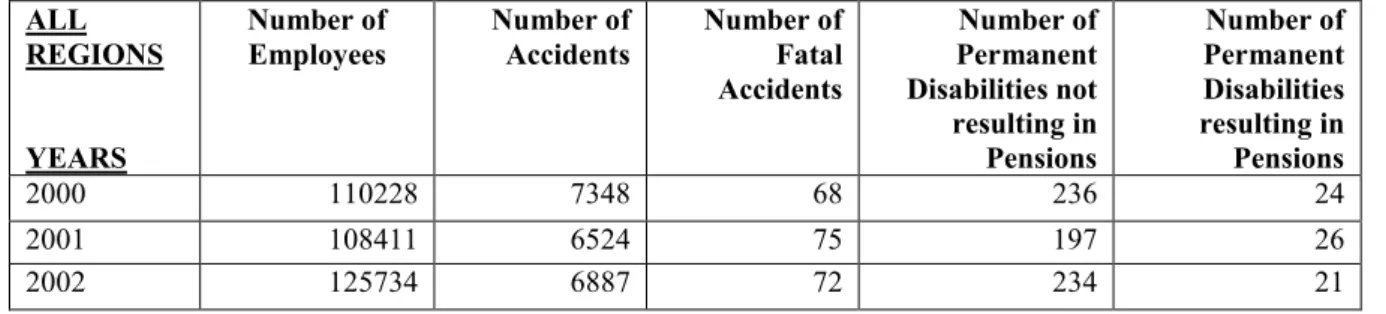
The cost of construction accidents is about 5% of the overall contract value in South Africa (Smallwood, 2004). Additionally, provision for health and safety at inception is approximately 0.5% to 3% of the contract sum. The latter indicates that accidents cost more than the provision for H&S (Malan & Smallwood, 2015; Hefer, 2016). Table 1 indicates statistics from Federal Employers Mutual Assurance (FEM, 2018): where 8,218 accidents resulted in 61 fatalities, 1349 permanent disabilities not resulting in pension and 47,708 lost days. FEM insures about 20% of South African Contractors and the average cost per accident was R37,859.00.
Table 1-1 FEMs Stats 2018
Cause %
Accid ents
Fatal Accid ents
Lost Days
No.
Of Accid ents
Permanent Disabilities Not
Resulting In Pension
Permanent Disabilities Resulting In Pension
Average Cost Per Accident
2018
Caught in, on, between
6.74% 1 3,971 554 141 0 R29,636
Contact with electric Current
0.58% 1 292 48 15 0 R125,507
Contact with temp Extremes
2.03% 2 1,388 167 55 1 R66,439
Fall on to different levels
11.37% 8 9,817 934 178 2 R68,570
Fall on to same level
3.94% 1 1,850 324 48 1 R34,862
Inhalation, absorption, ingestion
1.52% 0 62 125 6 0 R11,247
3 Motor vehicle
accident
11.04% 22 5,941 907 139 4 R88,482
Slip or over- exertion
14.33% 0 6,553 1,178 131 0 R20,095
Striking against 14.10% 3 4,480 1,159 205 0 R19,377
Struck by 32.67% 21 13,182 2,685 416 1 R26,885
Unclassified-not sufficient. Data
0.02% 0 0 2 1 0 R25,298
TOTAL FOR 2018 100% 61 47,708 8,218 1,349 9 R37,859
The Disabling Injury Incident Rate (DIIR) has been determined at 0.98/100 workers and fatality rate per 100,000 workers at 25.5 (CIDB, 2009).
Globally, research has indicated how industry stakeholders influence greatly to the improvement of health and safety (Smallwood & Haupt, 2005). Performance improvement in construction can be achieved through implementation of health and safety legislation to protect workers and communities (Adeyemo & Smallwood, 2017). Adeyemo & Smallwood (2017) further attest that prevention of construction accidents and injuries can be done through developing proper health and safety legislation. Construction regulations establish a general awareness on health and safety for all people involved in construction and also form a foundation for improving requirements for health and safety in the industry (Markram, 2005).
According to Philip Vervey “Construction Regulations to Improve Safety” (2014:1) “The purpose of the construction regulations is to clearly define the legal parameters within which construction companies are supposed to operate.”
The promulgation of the 2003 Construction Regulations (published July 2003) under the OH
& S Act 85:1993 assigned health and safety responsibility to stakeholders: clients, designers and quantity surveyors (Smallwood & Haupt, 2005). The regulations were seen to have had an impact by increasing awareness in the industry (CIDB, 2009). However, to achieve optimum health and safety in all project phases, the regulations needed to be amended (CIDB, 2009).
Integrating design and construction to achieve constructability has resulted in the promulgation of the latest construction regulations 2014 published on 7th February 2014. The latter placed more stringent health and safety obligations on all project stakeholders than the previous 2003 regulations (DoL, 2014).
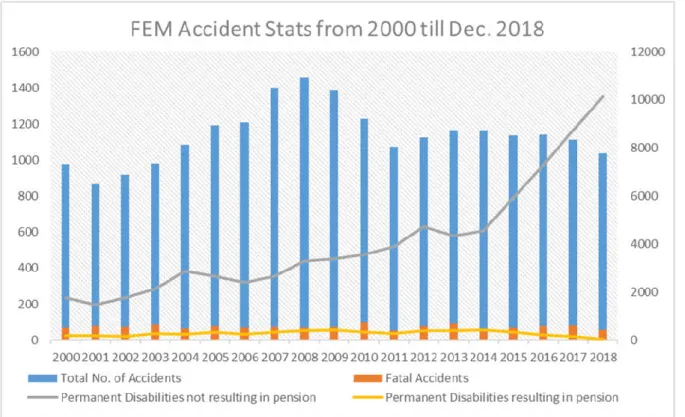
The standards of health and safety set out to protect workers are often overlooked by management (Murie, (2007). OHSA (1993:1) state that “A fundamental human right of every worker is to be able to return home at the end of each working day; alive and healthy in the same physical condition that he/she commenced that working day.” Figure 1 indicates the total
4 number of accidents, total fatalities, total accidents causing in permanent disabilities resulting in pension and those that result in pension. The period is from 2000 till 2018:
Figure 1-1: Accident Statistics (2000-2018)
1.2 PROBLEM STATEMENT
Recent legislation has been amended to achieve optimum H & S throughout all project phases (CIDB, 2009). However, workers’ health remains an issue for concern. Construction workers’
wellbeing and their quality of life is often overlooked. There is more emphasis on safety than health when dealing with construction health and safety matters. Workers are subjected to high risks due to the nature of the industry, are treated unfairly and regarded as disposable. Little to no coherence between compliance and impacts of legislation is seen, as contactors are not implementing all aspects of construction regulation to improve the quality of life and wellbeing of workers. Primarily, contractors comply with legislation to satisfy the requirements of the Department of Labour or Department of Public Works. Furthermore, contractors comply for profit maximisation and to avoid penalties or having their activities stopped. Compliance goes beyond checking boxes and PPE. This raises a question on sustainability of workers in an industry that is unsafe, unfair, unpredictable and does not protect its workers adequately as a result, violating the basic fundamental human right. The impact of recent legislation on workers` performance although formulated to challenge the status quo, has not yet been
5 determined to date. As a result, infringement of health and safety poses a threat to workers`
wellbeing and sustainability in the industry.
1.2.1 Hypothesis
The hypothesis to be tested are:
Management's commitment to legislation changes improves construction workers well- being.
The impacts of recent construction health and safety legislation changes on workers well- being have not been realised to date.
Contractors comply with health and safety legislation for profit maximisation and only because it is mandatory.
Contractors do not apply all aspects of the construction legislation to improve construction workers well-being.
1.3 AIM AND OBJECTIVES 1.3.1 Aim
The study seeks to analyse the impact of the Construction Regulations 2014 on construction workers wellbeing within construction companies in South Africa.
1.3.2 Objectives
To identify whether management’s commitment to construction health and safety legislation changes improves construction workers well-being.
To identify whether the impacts of recent construction health and safety legislation changes on improving construction workers well-being have been realised to date.
To identify whether contractors comply with health and safety legislation for profit maximisation and to avoid penalties.
To identify whether contractors apply all aspects of the construction legislation to improve construction workers well-being.
6 1.4 METHODOLOGY
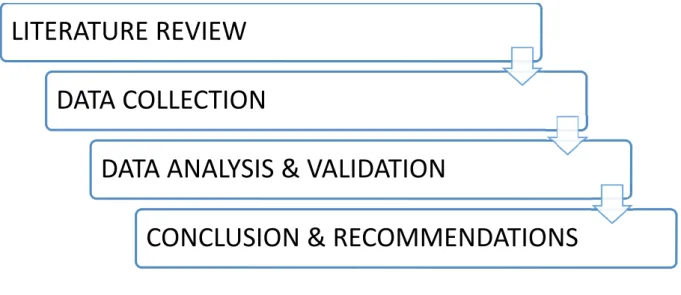
To achieve the objectives of the study, a quantitative research design was adopted and questionnaire surveys administered to gather data from contractors. The research will follow the sequence as follows:
Extensive review of literature from books, journals, articles, reports and web based publications to obtain existing findings will be conducted in conjunction with the objectives of the study.
Collection of data from construction companies through questionnaires, interviews and published case studies about the impacts of construction regulations on performance improvement in relation to workers wellbeing, their health and job sustainability on construction sites.
Analysis of collected data
Validation of findings from the analysed data to literature
Formulation of sustainable and effective recommendations
Figure 1-2 illustrates the logical sequence of the research methodology and structure
Figure 1-2: Research Methodology
1.5 LIMITATIONS
The study is to be conducted over a 12 Month period July 2018 to December 2019
The study is conducted in KwaZulu-Natal province only.
The study focuses on impacts of recent legislation changes on construction workers’ health, wellbeing, quality of life and sustainability in the work place.
LITERATURE REVIEW DATA COLLECTION
DATA ANALYSIS & VALIDATION
CONCLUSION & RECOMMENDATIONS
7 1.6 ASSUMPTIONS
It is assumed that data acquired from various people/organisations will be accurate and the participants have sufficient knowledge and experience to provide quality data.
It is further assumed that responses from participants will be reliable, honest and accurate to be considered for this study.
1.7 ETHICAL CONSIDERATIONS
To comply with internationally accepted ethical standards, no reference to actual names of individuals or companies will be recorded. In this way, no individual or company can be linked to a particular statement, thus assuring anonymity. No compensation will be paid to any respondent or participant in the study. Quality assurance will be done with respect to the following aspects, namely:
Quality of data capturing
Accuracy in calculations.
1.8 SIGNIFICANCE OF THE STUDY
Several studies have been conducted to identify the impacts of the Construction Regulations 2003. However, there no studies on the extent to which the Construction Regulations 2014 have had an impact or how they have improved construction workers wellbeing since their implementation. The findings of this study shall contribute to the overall body of knowledge within the construction industry about the impact of recent construction legislation changes and their impact on workers’ performance improvement in relation to their wellbeing and sustainability. Furthermore, this study shall inform the legislatures on the pros and cons of recent construction health and safety legislation changes and how they may be effectively implemented and revised in future in order to improve workers wellbeing, the quality of life and their sustainability in South Africa. Sustainability of construction workers in relation to improve quality of life will also inform the industry of the need to improve standards and strive for a zero accidents work place.
8 1.9 DEFINITION OF KEY TERMS
Accidents: ‘an accident arising out of and in the course of employee’s employment and resulting in a personal injury, illness or the death on the employee (OHS ACT, 1993:2004)’
‘An unplanned event that results in injury or ill health to people or damage or loss to property, plant, materials, or the environment, or a loss of business opportunity’ (Griffith and Howarth, 2000).
Incident: “any unplanned event that resulted in injury or ill health of people, or damage or loss to property, plant, materials or the environment or a loss of business opportunity” (HSE, 1999) Occupational Health: the promotion and maintenance of the highest degree of physical, mental and social well-being of workers in all occupations by preventing departures from health, controlling risks and the adaptation of work to people, and people to their jobs.
(ILO / WHO 1950)
Occupational Safety: legal right of a worker to work in a condition that is free from any known hazards (OHSA, 1993).
Quality of Life: according to the WHO, quality of life is “the individual's perception of their personal situation in their own life in the physical, social, mental and spiritual dimensions”
Wellbeing: according to the ILO, “Workplace Wellbeing relates to all aspects of working life, from the quality and safety of the physical environment, to how workers feel about their work, their working environment, the climate at work and work organization.”
1.10 STRUCTURE OF THE STUDY
Chapter One: Introduction – the chapter presents the background of the study by exploring the state of construction health and safety globally and its place in the economy of a country.
The chapter also presents the problem statement, hypothesis to be tested, aims and objectives, methodology, limitations and delimitations, assumptions, ethical considerations, significance of the study and the structure of the study.
Chapter Two & Three: Literature Review – the chapter explores various literature on the nature of the construction industry as well as health and safety legislative framework on African continent, the South African Constitution, Occupational Health & Safety Acts within
9 South Africa, Regulations and their significance, Standards (SANS), Basic codes of practice and Safe work procedures.
Chapter Four: Methodology – this chapter discusses data and tools used for gathering secondary and primary data and challenges encountered.
Chapter Five: Data Analysis – this chapter focuses on analysing data gathered from surveys and validating findings.
Chapter Six: Conclusion and Recommendations – the chapter establishes a link between data findings, problem statement, objectives and hypothesis of the subject under investigations and also focuses on testing the hypothesis.
1.11 CHAPTER SUMMARY
This chapter introduced the research topic, outlined research problems, proposed methodology, limitations of the study and the significance of the study. Health and Safety in construction has been an issue for decades with a staggering rate of accidents occurring within the South African construction industry. The promulgation of legislation has sort to improve workers’ health and safety with the introduction of more stringent and unambiguous regulations in an attempt to reduce accident. This was done to achieve optimum health, zero fatalities of workers, improved quality of life and job sustainability in an accident prone industry. However, the impacts of legislation if any, have not been realised. The next chapter contains relevant literature and previous studies relative to the research problem.
10 CHAPTER 2
LITERATURE REVIEW
THE NATURE OF THE CONSTRUCTION INDUSTRY AND ITS IMPACT ON WORKERS WELLBEING
2.1 THE NATURE OF CONSTRUCTION INDUSTRY
The construction industry is one of the major sources of employment globally and is considered the second largest employer after agriculture (ILO, 2001; WIEGO, 2014). The industry makes significant contributions to the global economy in many countries as it provides jobs to many of the world’s poorest and vulnerable (WIEGO, 2014). Construction projects are known for their complexity as they combine multi array of interdependent tasks all taking place at the same time. However, these processes are believed to be the most complex and risky undertakings of any industry (Gidado & Wood, 2008).
Construction is well known as a difficult and challenging industry with workers required to perform repetitive manual tasks involving heavy lifting, twisting, turning in awkward and cramped positions. Construction workers work in unpleasant conditions with noise, dust and sometimes with little light, low ventilation and are subjected to high rates of stuff turnover (Asanka & Ranasinghe, 2015). Moreover, Asanka & Ranasinghe (2015) note that the industry is still facing further challenges dealing with the increasing complexity in mega projects. In comparison to other industries, construction is believed to have the 3rd highest death rate (USA Bureau of Labour and Statistics, 2002).
Procurement procedures contribute significantly to the improvement of occupational health and safety on construction projects. However, the most common procedure for awarding public sector tenders in developing countries is through competitive tendering by the government (Wells & Hawkins, 2010). This method of procurement is normally evaluated on the basis of lowest price meaning that contractors must keep their prices low which affects labour as it forms part of the major cost items (ibid). In this regard, for contractors to secure lower prices they compromise on welfare facilities, protective equipment and safe working environment for its workforce (ibid). Murie (2007) adds that the low price culture in highly competitive tendering compromises health and safety requirements and encourages low wage payments of labourers, lack of safety equipment, lack of insurance coverage for accidents and promotes influx of informal workers for whom no tax or social security is paid.
11 The construction industry is characterised as one of the most accident prone businesses (Othman, 2012). Furthermore, labour rights issues are most striking in this sector as it relies heavily on manpower especially migrant labour and primarily unskilled workers, as a result earn low-wages (Nieuwenkamp, 2016). The industry is known to be a challenging regime in which to practice adequate health and safety as it takes place in hazardous environments with exposures to heights, changing weather conditions and different locations with construction workers always expected to cope with changing environments and different scopes of works (Bomel, 2001; Ishri, 2010). Ishri (2010) highlights the industry as fragmented due to multiple stakeholders involved from project inception and identifies the following as the results for fragmentation:
Increased costs
Low productivity
Poor communication
Increase and often unnecessary documentation
Ineffective and inefficient project management
Unnecessary delays
Unsatisfactory quality performance
Poor safety performance (Ishri, 2010:13)
Furthermore, Egan (1998) attests that the extensive use of subcontractors in construction attributes to increased contractual disputes and lack of productivity.
One of the attributes of construction is its low profit margins. This feature can be related to a number of factors such as late payments or no payments for work completed (SA Construction Industry Survey, 2016). In addition to low profit causes as highlighted in the Survey, Group Five identified some of the key factors as being inflation, lack of government spending on infrastructure development, consumption-driven activities which are supportive of real estate, retail and other consumer factors as well as highly competitive tendering which forces contractors to drop prices.
Egan (1998) further attests the industry has unrealistically low profit margins and most clients especially government, equate price with cost which has an impact on improvement in the industry. In South Africa, the rate of business failure is high as companies are experiencing profits as low as 1% (CIDB, 2004). The latter in relation to performance makes it hard for any improvements especially health and safety as most government tenders are awarded to large
12 contractors with the necessary skills (Wandapo & Cattell, 2011). Wandapo & Cattell (2011) further add that most companies registered with CIDB are small contractors, according to CIDB Report (2016), 85,7% of construction companies registered were Grade 1 Contractors.
These contractors find it hard to grow.
Construction is also identified as the second most corrupt sector globally and the same is true for South Africa (CIDB, 2016). According to South African Construction Industry Report (2016), the industry faces challenges where tenders are involved. The report indicates that most tenders are awarded without observing to the recommendations of the tender committee (ibid).
CIDB (2014) has indicated that approximately 12% of public sector tenders are awarded illegally without adhering to the recommendations of the tender committee.
2.3 COMPLIANCE WITH HEALTH & SAFETY IN THE CONSTRUCTION INDUSTRY
The construction industry has less than 50% rate of compliance with health and safety requirements with unacceptably high rates of incidents as a result of poor workmanship and lack of proper supervision on site (CIDB, 2016). Some accidents are attributed to senior managements’ lack of commitment, lack of communication and lack of training (Laney, 1982).
ILO (2011) reports that, despite government and trade union efforts, accidents will continue to happen on site due to lack of safety adherence by contractors. Lack of health and safety in construction is highest among Small Medium Micro Enterprises (SMME) who share a common misconception that they undertake less risky jobs (Okorie & Aikbavboa, 2016).
Okorie & Aikbavboa (2011) ILO (2011) further highlights the following as reasons for lack of compliance among SMME’s:
Insufficient financial and organisational resources;
Limited health and safety knowledge; and
Lack of effective health and safety skills to prevent occurrences.
Large construction projects are considered safer than small and limited scope projects (Asanka
& Ranasinghe, 2015). They refer to a study based on the Australian Construction Industry which indicated 79.5% of construction accidents attributed to small and medium projects while only 20.5% to larger projects. Globally, poor health and safety training of construction workers is common among small contractors and small contractors do not have a good record of
13 investing in health and safety training as compared to large contractors (Okorie & Aikbavboa, 2016; WHO, 2010).
2.3.1 Performance of The Construction Industry Relative to Workers Wellbeing
The construction industry is heavily reliant on manpower, more so because of their direct involvement with the actual construction activities and this proves workers’ health and safety must be given priority (Okoro et al., 2016). Furthermore, accidents can be reduced, employability of workers improved and performance improved. However, health and safety of construction workers has been a cause for concern for decades and justifiably so, since construction workers are considered invaluable to construction processes (ibid).
The total formal employment for construction is 8% in South Africa (SA) (Stats SA, 2018).
According to the CIDB Labour & Work Conditions in SA Construction Industry (2015), construction accounts for 8% formal employment and informal employment across all sectors in SA with the construction industry alone accounting for 460,000 informal workers of the 1.46 million total employed (CIDB, 2015). Furthermore, 70% of those employed in construction are semi-skilled and unskilled. Employment status have also changed in the industry due to economic pressures resulting from cyclical nature of the industry, more stringent labour regulations causing disposal of labour to keep only core supervisory staff, and increased subcontracting (CIDB, 2015). The latter also notes unskilled labour jobs are regarded as dirty, dangerous and hard and this has opened an opportunity for labour exploitation in many countries as this jobs are taken by migrants and marginalised individuals (ibid). The industry also accounts for 16% of the country’s total informal employment (ibid). Informal workers are subjected to illegal practices such as exploitation from contractors since their employment is not regulated by government (ILO, 2001: Mkenda & Aikaeli, 2015: Wells, 2007).
The ILO identified over 110 million informal construction workers globally in 2007. The construction industry is faced with employment challenges as contractors are finding it hard to get a steady flow of work due to a widespread system of contracting (ILO, 2013). This has increased the number of informal workers globally as friction exists between employers who tend to adjust with the current situation through labour outsourcing while workers demand job security (ibid). Workers are employed on a short term basis, per project duration. The practice of “fixed term employment contract” is seen as a solution to unstable employment practices in the construction industry. Under the conditions of the contract, employers can state which benefits are applicable and retrench employees at will without any severance payments (Henry
14 Shields, 2018). Furthermore, the author attests that employers practice this forms of contracts to circumvent Basic Conditions of Employment Act (75 of 1997) and Labour Relations Act (66 of 1995). Rolling over is defined as the practice of renewing a fixed term contact after it expires (SA Labour Guide, 2018). This practice is common among contractors in SA. However, it infringes the rights of workers under the Basic Conditions of Employment Act.
2.3.2 Exploitation of The Workforce in Construction
The construction industry is a sector that lends itself to exploitation as it involves complex supply chains for large companies with multiple subcontractors, labour agencies and takes place in different locations around the world (CIOB, 2016). Interrelationships in supply chain within the construction industry breeds corruption since there is lack of visibility and there is a lot of fragmentation. CIOB (2016) identified the following as the most common labour abuses in the construction industry:
Non-payment or late payment of wages. Employers not recognising all the hours worked.
Illegal deductions. Some employers will delay payment for months or even years, leaving the workers literally starving, yet too frightened to complain.
Inappropriate accommodation in cramped, unsanitary, crowded conditions and often far from site requiring long commutes.
Workers forced to work in unsafe conditions and very long shifts. Agents forcing them to work on multiple locations taking on more than one job.
Restriction of movement as workers have passports removed and are unable to leave the country or seek alternative work.
Accommodation is far from food outlets so that workers must pay for expensive canteen food. Deductions for food are made from wages, even though workers were promised that food and accommodation were inclusive.
Unfair contracts that are not in the labourers’ native language and labourers do not understand what they are signing. Despite this, the contract may be declared “legal” by employers and the courts.
Frequent threats of violence leave workers fearful and frightened to speak out.
Workers are unable to organise or form unions as they do not have a platform to raise issues with the client or main contractor. (CIOB, 2016:14)
15 Globally, there is an estimated 40,3 million people who are victims of modern day slavery (ILO, 2017). Furthermore, with 7% of global employment attributed to construction, the sector has the second highest number of forced labour at 18% (ibid). Employment conditions for these employees are extremely poor, demanding and dangerous resulting in high accidents. In addition, construction work has low social status, its problems have low visibility and the resolution for these problems have low priority. “Conditions are not recognized, if recognized are not diagnosed, if diagnosed are not attributed to work, and whether recognized or not are rarely compensated or effectively treated” (Murie, 2007:6).
2.3.3 Causes of Construction Accidents and their Impacts on Workers Wellbeing
Despite the high rate of accidents in the industry, accidents are foreseeable although not foreseen by those undertaking them (Bomel, 2001). ILO Construction OS&H (2008) indicated that construction accidents and preventative measures are well known. However, they are fuelled by failure to manage risk or by employers’ negligence. Samuel (2015) identified that root causes of accidents lie within the upper stream of management. Asanka & Ranasinghe, (2015) attest that most construction accidents can be prevented through involvement of project management systems. Furthermore, three root causes of accidents are attributed to failure to identify hazards prior to work, proceeding with work despite visible hazards and neglecting initial unsafe conditions and proceeding with work (Ibid).
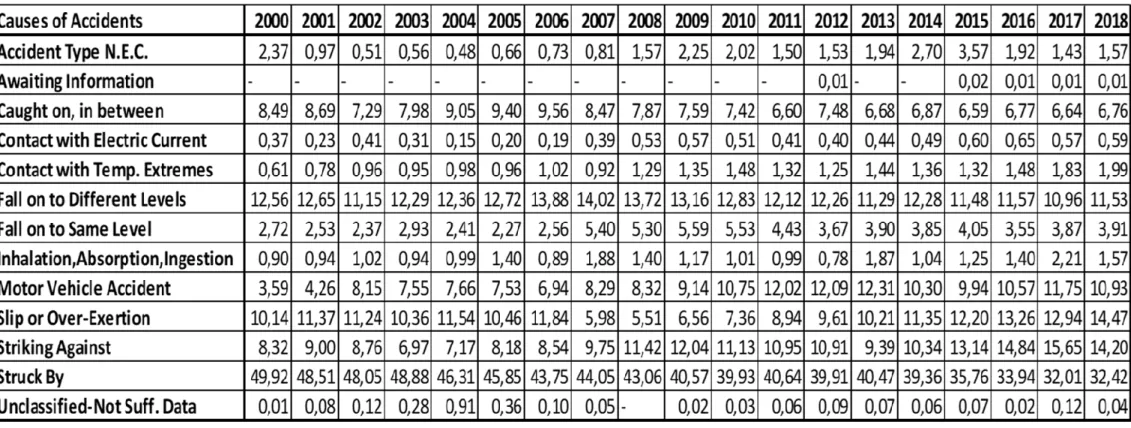
The top four causes of construction accidents have been identified as Falls, struck by Object, Electrocutions & Caught in/between (OHSA, 2015). Statistics for the fatal four were as follows; Falls – 364 out of 937 total construction worker deaths in 2015 (38.8%), Struck by Object – 90 (9.6%), Electrocutions – 81 (8.6%), Caught in/between – 67 (7.2%) (Jones, cited in OHSA 2015).
Table 2-1: FEMA, Most common causes of construction accidents in SA accounting to more than 80%
2017 2016
Description Percentage of
Accidents
Total Accidents Percentage of Accidents
Total Accidents
Struck By 31,81% 2615 33,86% 2883
Striking Against 15,67% 1288 14,86% 1265
Slip Or Over-Exertion 13,03% 1071 13,27% 1130
Motor Vehicle 11,80% 970 10,61% 903
Fall Onto Different Levels 10,99% 903 11,60% 988
16 Over and above, other causes of construction accidents are attributed to the following social factors:
Working long hours on site which leads to fatigue, lack of motivation and reduced mental acuity
Morale and attitude are also caused by social conditions where workers share sites and equipment with other trades, poor site conditions, over-inspections and absenteeism
High staff turnover and absenteeism
(CIDB Labour & Work Conditions in SA Construction Industry, Status &
Recommendations, 2015:1)
Construction workers’ health related interventions have been ignored and more focus has been on occupational safety in the past (Harinarain & Haupt, 2014). In order for the industry to perform, its workforce needs to be healthy however, there has been a decline in number of construction workers resulting from lack of responsiveness as a result of occupational diseases such as HIV/AIDS. Construction companies feel that the latter is not their problem. Harinarain
& Haupt (2014) highlight construction workers’ vulnerability to the pandemic is a result of its migratory labour force making them prone to visiting prostitutes or having multiple partners as they are separated from their partners for a long time.
The adaptation of construction health and safety as a value and not a priority must be realised as this is a prerequisite to addressing and optimising other constituents of health and safety culture (Haupt & Smallwood, 2004). James, (2011) further adds that people issues are integral to the company as the company is its people. Management within a company must be responsible for the wellbeing of workers and adequate Employment Assistant Programs in construction must be in place to support workers in a demanding work environment. “Failure by organisations to adopt employee assistance into their culture will inevitably lead to the escalation of sickness and the deterioration of organisational performance.” (Matlala, 1999:24).
The global construction workforce is ageing and this will impact South Africa (Eppenberger, 2009). The author adds that this is caused by changes in demography and loss of interest in a career in construction by youth. Haupt (2014) also adds the industry does not attract young people. Older workers as a result are a valuable resource in construction as they possess the necessary skills, experience, are loyal and produce work of high quality (Eppenberger, 2009:
Eaves et al., 2015). However, they are exposed to a number of hazards, are perceived to be
17 against personal protective equipment (PPE), other health and safety regulations initiatives and work at a slower pace (ibid). The negatives outweigh the positives in this regard as construction projects are carried out within short durations and rely on high levels of productivity (Eaves et al, 2015). It is imperative to improve the wellbeing of the older construction workforce to yield productivity within the industry.
Smallwood (2000) portrays the detrimental effects of construction activities on wellbeing of construction workers and their performance at work as follows:
Figure 2-1: Detrimental effects of construction activities on wellbeing and employees' work performance (Smallwood, 2000)
Over and above the social and human costs as a result of health problems and fatalities, escalating economic burdens are experienced as a result of unhealthy workforce and this has a
FAMILY &
RECREATIONAL TIME DEPRIVED
EMOTIONAL &
PSYCHOLOGICAL BREAKDOWN DECREASE IN FITNESS
LEVEL
POORER WORKERS PERFORMANCE
COMPANY ACTIVITIES: LONG TIME AWAY FROM HOME
18 detrimental impact on global economy due to low productivity and increased medical expenses (Buehler, Werna & Brown, 2017). Moreover, poor wellbeing of the workforce costs the global economy 10 to 15% (Ibid). It is imperative to enhance the wellness of the workforce as 50%
spend their time in the workplace and this is an opportunity to advocate awareness (Schwab, 2013).
2.4 IMPROVING THE WELLBEING OF CONSTRUCTION WORKERS
There are several interventions to improve construction workers’ wellbeing. Construction workers’ wellbeing may be improved through training, skills development and providing adequate supervision on site (Bester, 2016). Furthermore, Bester (2016) advises on the use of proper tools and equipment, provision of fall prevention equipment and regular screening of workforce for narcotics. Technological innovations with regards to health and safety may also be used to improve workers’ health and safety on site (Buehler et al. 2017). “Super-strength operators” may be used in the case of elderly workers to enhance their strength by wearing flexible and mobile exoskeleton. These technologies known as “wearable robotics” such as AWN-03; provide back support, they sense the workers body motion by sending signals to the motor to rotate gears enabling workers to lift and hold heavy items reducing lower back stress by at least 15kg (Lung & Man, 2018). Another wearable robotic known as FORTIS Exoskeleton enhances users’ durability by lifting heavy loads such as rebar and industrial tools and can adapt to different body types and heights (ibid).
Other technologies include Augmented and virtual reality which can be used to simulate site conditions and further identify unforeseen risks on site (Buehler et al. 2017). These technologies have been used to train construction professional in a simulated risk-free virtual construction site such as the Build Management Simulation Centre (Zhou, Whyte & Sacks 2011). Virtual Reality is defined as technology that uses software and hardware technologies to provide interactive 3D and real-time computer applications (Lung & Man, 2018).
Augmented Reality is defined as “an enhanced version of reality where live direct or indirect views of physical real-world environments are augmented with superimposed computer- generated images over a user’s view of the real-world enhancing users’ current perception of reality” (realitytechnologies.com, 2018).
Other human machine interfaces such as smart PPE, smart hard hats and wearable sensors may be used to detect exact moments when workers lose balance, trip or fall, allow site managers
19 to know where workers are working and the conditions on site, and give feedback through cloud based interfaces on workers physical and mental stress levels (Raymond, 2016; Lee, 2018). Furthermore, Lee (2018) attests that the wearing of this sensors by workers does not interfere with job activities as they provide “sensory/haptic feedback” (re-creation of a sense of touch through application of force, vibration or motion) which means advanced waveforms and vibrations convey information to workers and supervisors monitoring performance. This can range from safety alarms to positioning information alerting workers to focus on the task at hand. “All construction industries have the opportunity to advance the use of technology and, as a result, make workforce engagement safer” (Buehler et al., 2017:1).
2.5 IMPROVING THE WELLBEING OF WORKERS THROUGH CONSTRUCTION REGULATIONS
The key objective of health and safety legislation is to prevent accidents within the work place, improve the lot of construction workers, and this can be achieved through effective implementation of proper legislation (Ibid). Overall, construction regulations have had a positive impact and increased awareness among project participants (CIDB, 2009). The intended impacts of Construction Regulations have widely been spread. Furthermore, the increased awareness dominates followed by stakeholders’ awareness. This awareness has influenced greatly on the improvement of health and safety as well as increased financial provisions. This has further resulted in improved site conditions and fewer accidents (Smallwood & Haupt, 2005).
Regulations and legislation are key in directing and controlling activity, improving responsibility of business owners and health and safety (Rust & Koen, 2011). Technology is advancing at a rapid rate, shaping the future of workplace safety (Open access government, 2018). However, the Construction Regulations do not directly respond to the use of technology and does not prevent it either. The construction industry is renowned for its low levels of innovation and employers are more concerned about bottom-line and profit maximisation than investing in what will make work easier, safer and improve workers’ wellbeing (Rust & Koen, 2011).
Traditionally, fundamental project parameters were defined as time, cost and quality, and due to the nature of the activities, the industry is accident prone as work is carried outside under adverse weather conditions that do not favour health and safety (Smallwood & Haupt, 2005;
Othman, 2012; Agumba & Haupt, 2012). Increased health and safety awareness on project
20 performance has been realised and has spawned attention of different stakeholders (Smallwood
& Haupt, 2005). In construction, an ideal project is a one completed within budget, time, quality and zero accidents (Davies & Tomasin, 1990).
2.6 CHAPTER SUMMARY
This chapter discussed the nature of the construction industry. The construction industry is a complex and dangerous sector where accidents are most alarming. Compliance with health and safety requirements is of great concern as health and safety is not given attention by most stakeholders. Construction workers wellbeing and health are directly affected by poor health and safety practices. Workers are considered disposable and less valuable to the construction activities and as a result, sustainability of the workforce is becoming a challenge. Interventions through effective implementation of health and safety legislation needs to be realised to improve the overall quality of life, health, performance improvement and employability of workers as this has detrimental impacts on global economy.
21 CHAPTER 3
LITERATURE REVIEW
SOUTH AFRICAN LEGISLATIVE AND REGULATORY FRAMEWORK 3.1 LEGISLATION
Encyclopaedia Britannica (2008:1) defines Legislation as “the preparing and enacting of laws by local, state, or national legislatures” (law-making branch of a government).
“Legislation is a law that has been made and enacted by a legislature, such as a parliament”
(lawgovpol, 2014). The legislation is one of the most significant government tools for managing society and protecting citizens. It defines amongst others, the rights and responsibilities of people and authorities to whom the legislation applies. On the contrary, a law has little or no significance if there is neither discipline nor enforcement (De Jeger, 2000).
The legislation is important for some reasons, such as setting principles and controls to govern the actions of people and groups in both public and private spheres (https://www.reference.com/government-politics/importance-legislation-28cea6731f25cf).
3.2 REGULATORY FRAMEWORK
It is also imperative to define the meaning of “regulatory framework” as the term may draw confusion. A framework may be defined as “a particular set of rules, ideas, or beliefs which are used to deal with problems or to decide what to do” (Collins Dictionary, 2019:1). It is further defined as a basic underlying structure to a set of regulations (Rabeau, 1998)
Regulations, on the other hand, are defined as rules based on and meant to carry out a specific section of legislation (such as for the prevention of accidents on a construction site).
“Regulations are usually enforced by a regulatory agency formed or mandated to carry out the purpose or provisions of legislation also called regulatory requirement” (Business Dictionary, 2019:1). The Canadian Department of Justice defines regulations as follows:
"Regulations are a form of law, often referred to as delegated or subordinate legislation. They have the same binding effect as Acts and usually state rules that generally apply, rather than to specific persons or things. However, regulations are not made by parliament. Rather, they are made by persons or bodies to whom Parliament has delegated the authority to make them, such as the Governor in Council,
22 a minister or an administrative agency. Authority to make regulations must be
expressly delegated by Act." (A guide to making federal acts and regulations, 1995:16).
A regulatory framework can be defined as the basic steps that regulators must complete to implement regulations (Rabeau, 1998). Rabeau (1998:5) further defines a regulatory framework as the “high-level questions that a conscientious regulator would ask of themselves throughout the process of regulations development. Questions such as, ‘why do I need to regulate this behaviour’? ‘Who is harmed by the behaviour?’ ‘Is this harm serious enough to warrant government intervention?”
3.3 CONSTRUCTION HEALTH AND SAFETY LEGISLATIVE FRAMEWORK Globally as a result of poor health and safety performance, there have been several interventions to promote the wellbeing of construction workers through the introduction and revision of construction regulations (CIDB, 2009). Primarily the purpose of introducing health and safety legislation is to prevent accidents and their consequences, disablement and fatality as well as ill health in the workplace. To achieve its objective, good legislation should be supported by effective, sensible and accountable enforcement (Ibid).
In the USA, the impetus for passing Occupational Safety and Health Act of 1970 (OSH Act) by Congress was a result of workplace accidents claiming an average of 14,000 lives annually, causing 2.5 million disabilities and approximately 300,000 new cases of occupational diseases (Goetsch, 2013). This reports by the US Department of Labour would ensure a sound piece of legislation by Congress. The purpose as stated by Congress is “...to assure so far as possible every working man and woman in the nation safe and healthful working conditions and to preserve our human resources” (OSHA, 1970:3). Furthermore, indicating that no worker should have to choose between their life and their job. Under this act, standards for construction health and safety OSHA CONSTRUCTION STANDARDS were promulgated under section Code of Federal Regulations (CFR) Part 1926 subparts A – Z (Goetsch, 2013).
Since 1989, a series of European Directives in collaboration with the ILO's convention 167 and recommendations 175 changed the outlook on safe work procedures throughout SME's involved in all industries (HSE, 1999). Furthermore, the employer’s responsibilities increased, new worker’s obligations introduced as well as more involvement required from managers in the management of risks in health and safety (ibid). In 1992, in response to an unacceptably