Ecology of the South African giraffe (Giraffa camelopardalis giraffa) across a land-use gradient in
central KwaZulu-Natal, South Africa
Mmeli J.J. Nyathi
Submitted in fulfilment of the academic requirements for the degree of
Master of Science
in the Discipline of Ecological Sciences School of Life Sciences
College of Agriculture, Engineering and Science University of KwaZulu-Natal
Pietermaritzburg Campus 2020
ii ABSTRACT
Herbivore ecology is affected by various factors such as seasonality and land use. Conservation and management strategies are highly dependent on gaining an adequate understanding of such factors and their effects. Giraffe (Giraffa camelopardalis) are one of Africa’s iconic species but are listed on the IUCN Red List as vulnerable. The global giraffe population numbers saw a marked decline of approximately 30% between 1985 – 2015. This was because of several factors such as poaching, habitat destruction and disease.Core population numbers have shown an increase over recent years but the herbivores have become extinct in seven countries over the last century. This study investigated five key aspects of giraffe ecology in central KwaZulu-Natal: (i) the differences in home range sizes of South African giraffe (Giraffa c. giraffa) according to sex and seasonality across a land-use mosaic from 2019 – 2020 in the Zingela Conservation area, Kusa Kusa communal land and Emaweni Game Hunting Ranch.. This was done by fitting 12 giraffe with Ultra High Frequency (UHF) transmitters that sent out Global Positioning System (GPS) coordinates of the giraffe’ positions and movements. It was found that the giraffe did not show any significant differences in home range sizes seasonally or by sex. The home range sizes were controlled by food availability and quality which should be the main focus in conservation and management of these large herbivores. The availability and quality of browse in the dry seasons is vital to the size of giraffe home ranges as the animals will change their habits to adapt to a reduction the browse quantity and quality. The study also investigated (ii) seasonal changes in habitat use by the tagged giraffe. The study used the GPS co-ordinates obtained to map out how habitat use by the giraffe changed according to changes in seasons. In addition, the study investigated (iii) the seasonal changes in giraffe feeding habits in the Zingela Conservation area that has Thukela Bushveld vegetation. Field observations were conducted between 2019 – 2020. The giraffe had a
iii
higher dietary diversity in the dry seasons (H' = 2.039) than in the wet seasons (H' = 1.628), and there was a significant difference in feeding habits between the two seasons. There was an increase in tree species fed on in the dry seasons than in the wet seasons. The changes in diet were influenced by browse availability and quality. An adequate population of evergreen and semi- deciduous tree species is important in giraffe conservation and management as these will provide dry season browse. Furthermore, the study investigated (iv) the social behaviour of the giraffe in the Zingela Conservation area. Field observations were carried out between 2019 – 2020 to investigate changes in giraffe social behaviour seasonally between herds and sexes. Herd sizes were significantly larger in the dry seasons whilst more bulls were observed with the females in the wet seasons. This was influenced by food availability and quality as the animals aggregated at food sources with the best available browse. The food quality in the wet season allowed the bulls to move between herds and searching for females. Management efforts must focus on food sources as these have the most influence on the giraffe’ ecology. Vegetation investigations to quantify available browse in different seasons are important to calculate aspects such as carrying capacities.
vi
COLLEGE OF AGRICULTURE, ENGINEERING AND SCIENCE DECLARATION 2 - PUBLICATIONS
DETAILS OF CONTRIBUTION TO PUBLICATIONSthat form part and/or include research presented in this thesis.
Publication 1
MJJ Nyathi, P Calverley & CT Downs
Differences in South African giraffe (Giraffa camelopardalis giraffa) home range in a land-use mosaic in KwaZulu-Natal, South Africa
Author contributions:
MJJN conceived the paper with CTD and PC. CTD and PC sought funding. MJJN and PC collected data. MJJN analysed data and wrote the draft paper. CTD and PC contributed valuable comments to the manuscript.
Publication 2
MJJ Nyathi, P Calverley & CT Downs
Seasonal changes in habitat use by South African giraffe across a land-use mosaic in central KwaZulu-Natal, South Africa
Author contributions:
MJJN conceived the paper with CTD and PC. CTD and PC sought funding. MJJN and PC collected data. MJJN analysed data and wrote the draft paper. CTD and PC contributed valuable comments to the manuscript.
Publication 3
MJJ Nyathi, P Calverley & CT Downs
Seasonal changes in South African giraffe feeding behaviour in central KwaZulu-Natal, South Africa
Author contributions:
MJJN conceived the paper with CTD and PC. CTD and PC sought funding. MJJN collected data.
MJJN analysed data and wrote the draft paper. CTD and PC contributed valuable comments to the manuscript.
viii
ACKNOWLEDGEMENTS
Firstly, I would like to thank my supervisor Prof C. T. Downs. She has shown me support from the end of my Honours degree when she agreed to take me on as a Masters student. Prof Downs has funded my studies for the last two years and has given me the necessary academic feedback which I am eternally grateful. I would also like to express my gratitude to Dr P Calverley, my co- supervisor and mentor. The Calverley family took me in to do the research on their property and let me quarantine there during the COVID-19 lockdown, which allowed me to complete my data collection. I am extremely grateful for the opportunity that they gave me.
I would also like to thank Dr L. Iliskzo and his Ecotone Telemetry team for making the study possible by providing the transmitters that were fitted on the giraffe. The provision of the transmitters was the main driving force behind the whole project.
I am grateful for the help provided by my colleagues and friends at Prof Down’s Life Sciences Research Laboratory at UKZN. This help was in the form of assistance with data collection, analysis and proofreading of my manuscripts.
Last but not least, I would like to thank my family, who provided me with the necessary encouragement and support to finish this degree. A special thank you goes to Yandiswa “Popo”
Nyathi for religiously asking “What are you doing?” which always helped me get back to work.
ix CONTENTS
ABSTRACT ... ii
PREFACE ... iv
DECLARATION 1 - PLAGIARISM ... v
DECLARATION 2 - PUBLICATIONS ... vi
ACKNOWLEDGEMENTS ... viii
CONTENTS... ix
LIST OF FIGURES ... xii
LIST OF TABLES ... xiii
CHAPTER 1 ... 1
Introduction ... 1
1.1 Land use ... 1
1.2 Protected areas ... 2
1.3 Humans and wildlife outside protected areas ... 3
1.4 Trophy hunting ... 4
1.5 Study species: Giraffe ... 4
1.5.1 Morphology ... 5
1.5.2 Home ranges ... 7
1.5.3 Habitat use ... 8
1.5.4 Feeding behaviour ... 8
1.5.5 Social behaviour ... 9
1.5.6 Giraffe numbers decline: The reasons ... 10
1.5.7 Conservation action ... 11
1.6 Aim ... 13
1.7 Thesis structure ... 14
1.8 References ... 14
1.9 Supplementary Information ... 19
CHAPTER 2 ... 22
Differences in South African giraffe (Giraffa camelopardalis giraffa) home range in a land- use mosaic in KwaZulu-Natal, South Africa ... 22
2.1 Abstract ... 23
x
2.2 Introduction ... 24
2.3 Methods ... 25
2.4 Results ... 28
2.5 Discussion ... 30
2.6 Acknowledgements ... 32
2.7 References ... 32
2.8 Supplementary information ... 35
CHAPTER 3 ... 36
Seasonal changes in habitat use by South African giraffe across a land-use mosaic in central KwaZulu-Natal, South Africa ... 36
3.1 Abstract ... 37
3.2 Introduction ... 37
3.3 Methods ... 39
3.4 Results ... 41
3.5 Discussion ... 44
3.6 Acknowledgements ... 46
3.7 References ... 47
CHAPTER 4 ... 49
Seasonal changes in South African giraffe feeding behaviour in central KwaZulu-Natal, South Africa ... 49
4.1 Abstract ... 50
4.2 Introduction ... 50
4.3 Methods ... 52
4.4 Results ... 55
4.5 Discussion ... 57
4.6 Acknowledgements ... 59
4.7 References ... 59
CHAPTER 5 ... 61
Seasonal changes in South African giraffe social behaviour in central KwaZulu-Natal, South Africa ... 61
5.1 Abstract ... 62
5.2 Introduction ... 62
5.3 Methods ... 64
xi
5.4 Results ... 65
5.5 Discussion ... 67
5.6 Acknowledgements ... 70
5.7 References ... 70
CHAPTER 6 ... 72
Conclusions ... 72
6.1 Introduction ... 72
6.2 Research findings ... 73
6.3 Recommendations ... 76
6.4 References ... 77
xii
LIST OF FIGURES
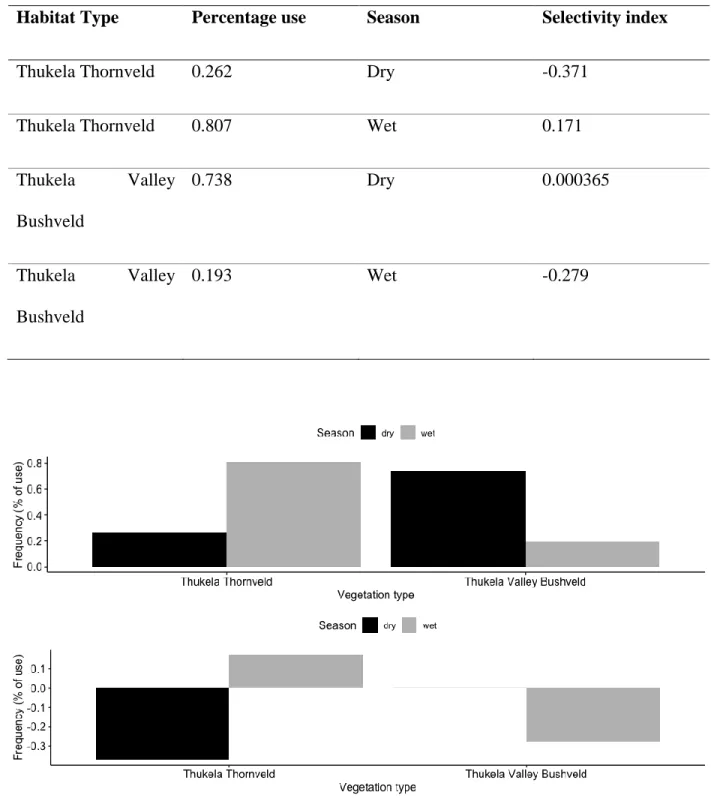
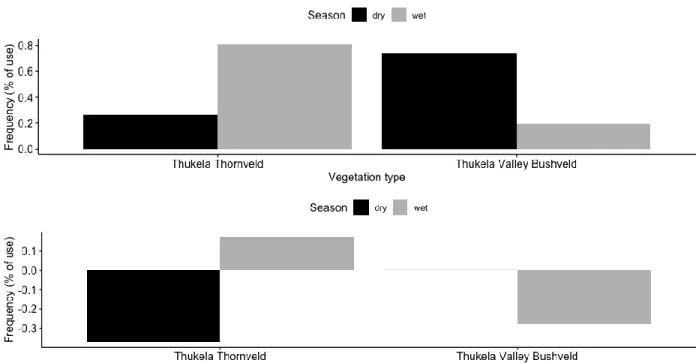
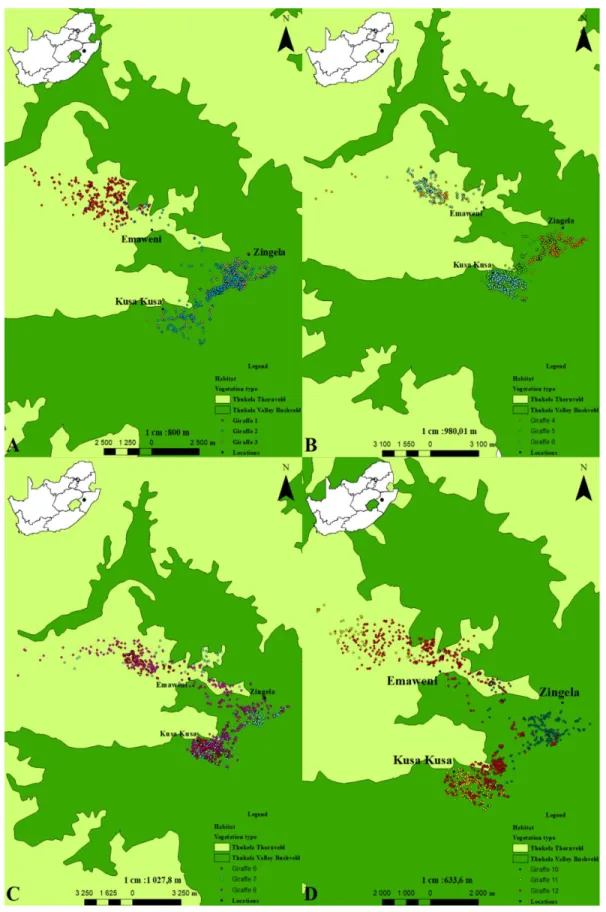
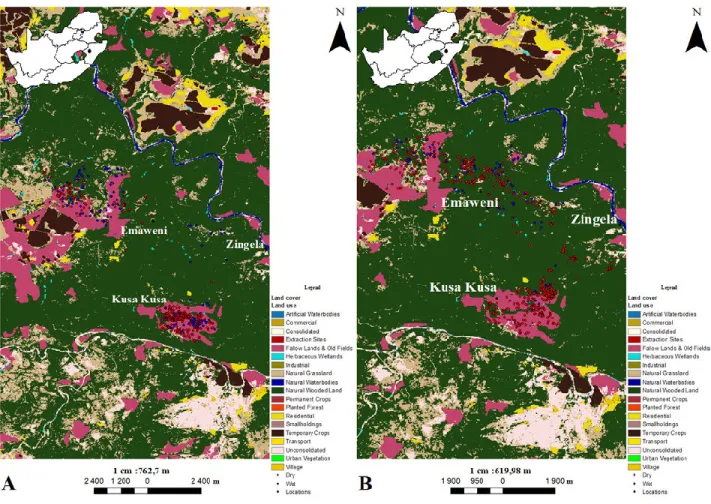
Figure 2.1: Differences in MCP home range sizes and KDE core area utilisation of male and female giraffe in the present study……….…..30 Figure 3.1: Habitat selection and avoidance by the giraffe in the present study as a consequence of seasonality. ……….………..42 Figure 3.2: Giraffe habitat use in areas of varying land-use and vegetation in the present study………..……….43 Figure 3.3: Giraffe habitat selection by land use during the different seasons in the present study……….……….44 Figure 4.1: Aerial view of the study area in a. the wet season and b. the dry season……….………53 Figure 4.2: Frequency of tree species use and bone ingestion by giraffe in the wet and dry seasons in the present study………57 Figure 5.1: Giraffe herd sizes in the wet and dry seasons in the present study………66 Figure 5.2: Number of giraffe males present in herds during the dry and wet seasons in the present study………...67
xiii
LIST OF TABLES
Table 1.1: Giraffe subspecies, their geographical home range and estimated numbers in Africa….6 Table 1.2: Summary of giraffe conservation laws in different parts of Africa (GCF 2020)……...12 Table 2.1: The mean (± SD) MCP home range sizes and mean (± SD) KDE core area utilisation by giraffe according to seasonal variation in the present study………30 Table 3.1: Giraffe habitat selectivity indices according to seasonality for the giraffe in the present study………..……….42 Table 4.1: List of plant species and other dietary items fed on by South African giraffe at Zingela conservancy, central KwaZulu-Natal, South Africa, in the present study and season of use. (Note:
arranged in alphabetical order by family). ………56
1 CHAPTER 1
Introduction 1.1 Land use
Rapid human growth has led to changes across the world in land use as there is a greater demand for agricultural produce to feed the population leading to mass deforestation (DeFries et al. 2010).
Urban growth and agricultural exports were observed to be positively linked to deforestation in 41 countries across Latin America, Africa and Asia (DeFries et al. 2010). Additionally urbanisation has been another contributing factor to changes in land-use as the expansion of urban areas has come at the expense of wetlands, forests and agricultural lands in countries such as India (Patra et al. 2018). These changes have brought about an increase in carbon emissions and extinctions of some flora and fauna, with the most recent being the sixth mass extinction (Houghton 1990;
Houghton 1994; Shivanna 2020). Global biodiversity is on the decline because of factors such as political corruption and weak national institutions that are not doing enough to combat wildlife habitat destruction (Gardner et al. 2007; Rydén et al. 2020).
With the increasing human population, there is an increasing demand for agricultural land and building sites (Symes et al. 2018). Human encroachment into different areas leaves wildlife at a disadvantage as rangelands and forests are removed (Symes et al. 2018). Bercovitch and Deacon (2015) noted that human encroachment also leads to an exploitation of wildlife resources in areas where wildlife and humans co-exist. For example, giraffe Giraffa camelopardalis numbers in East Africa have declined because of human-wildlife conflict (Bercovitch and Deacon 2015). Large scale land-use changes and poaching led to a reduction in giraffe numbers in areas where the wildlife was not protected by law (Bercovitch and Deacon 2015). Protected areas and reserves are currently widely viewed as a potential solution to this problem (Watson et al. 2014).
2 1.2 Protected areas
The IUCN (International Union for Conservation of Nature) defines a protected area as an area on land or sea that is set aside to protect and maintain biodiversity, natural and cultural resources and is managed by legal means (Dudley and Stolton 2008). Approximately 15% of the earth’s terrestrial surface and 3% of the global ocean have been set aside as protected areas following the IUCN’s definition (Muñoz Brenes et al. 2018). An example is the strategies followed in most parts of Africa such as Tanzania, Kenya and South Africa, where there are several game reserves, national parks and forest reserves (Stoner et al. 2007). These areas protect different levels of resources at varying levels of use with tourism, generally being the main source of funding for such areas (Biggs et al. 2014). National parks typically do not allow any killing of animals or cutting of trees whilst game reserves generally require permits for selective use of resources (e.g., trophy hunting permits and logging permits) (Stoner et al. 2007). The success of these methods of conservation can be monitored by observing changes in population densities of the protected species, with more recent studies showing a positive reaction (Thomas 1996; Barnes et al. 2016).
Barnes et al. (2016) found that wildlife populations in protected areas in Europe and Africa were stable or showed a mean annual increase of 0.5%.
Protected areas form a major part of biodiversity conservation globally, with the modus operandi being a reduction in habitat loss (Joppa and Pfaff 2011). Protected areas were highlighted as being very important in the fight to conserve wildlife, South African giraffe G. c. giraffa in this case (Deacon and Tutchings 2018). Although the strategy of protected areas is being implemented globally, there is still some resistance. This is mostly from communities in and around these protected areas (Holmes 2013).
3 1.3 Humans and wildlife outside protected areas
Many conservation efforts for different species are being conducted at varying scales globally, and one of the threats to these conservation efforts is from rural communities (Holmes 2013).
Population growth is changing the natural landscape as there is more cropland expansion to feed humans (Ehrlich and Harte 2015). Agriculture has always been the primary source of food and income in most African rural areas (Sibhatu and Qaim 2017). Agricultural practices such as crop cultivation have seen parts of rangelands being lost and has also led to human and animal conflict as the two are now sharing resources (Gemeda and Meles 2018). The main problems, in this case, become crop and livestock loss together with human safety as there is an overlap in resource demands (Hackel 1999; Seoraj-Pillai and Pillay 2016).
For example, in the past conservation efforts in northeastern Swaziland and Botswana’s Okavango Delta have been met by resistance in the past from rural residents as they see them as a means of taking away their land as well as prioritising wildlife over humans (Hackel 1993;
Mogomotsi et al. 2020). Increasing community rights have therefore led to changes in government policies which has seen the establishment of community-based conservancies (CBCs) to promote biodiversity and human development (Hackel 1999; Galvin et al. 2018). The CBCs have sought to help local people to benefit from wildlife resources by including them in management decision making and allowing them to own stakes in the resources (Galvin et al. 2018). There are several success stories from this strategy such as the Community Based Natural Resource Management (CBNRM) in Namibia and the Burunge Wildlife Management Area in Tanzania (Mupfume 2015;
Lee 2018). These management strategies have been introduced in South Africa with varying results. As is the case in most areas, conservation strategies are viewed as western ideologies, and
4
this brings about a negative stigma, in the case of Ndumo Game Reserve the distrust stems from apartheid (Teelucksingh 2007; Meer 2010). Conservancies have tried to build better relationships with communities by giving them some of the benefits, e.g., from culling (meat) done on the properties and donations from trophy hunting fees (Naidoo et al. 2016).
1.4 Trophy hunting
One of the most debated topics in conservation stakes is the issue of trophy hunting (Batavia et al.
2019). Trophy hunting has been defined as the act of hunting animals for meat and parts of their carcasses such as horns for use as trophies (Saayman et al. 2018; Sheikh and Bermejo 2019).
Hunters purchase permits from governments to hunt these animals and the money paid is used to run conservancies where the animals were shot and to also raise of awareness on the animals (IUCN briefing paper 2016). Several areas operate as hunting areas, and some are viewed as conservation areas (Di Minin et al. 2016). The argument against trophy hunting is based on how the hunting may negatively impact the welfare of the wildlife and how greed may drive certain unethical practices such as artificially selecting for rare qualities in the animals (Lindsey et al.
2007; Di Minin et al. 2016). There are some strong cases of trophy hunting being beneficial to conservation and surrounding local communities (Angula et al. 2018). For example, an analysis of the hunting industry in South Africa showed that trophy hunting supported over 17 000 jobs and contributed over ZAR5 billion to the economy (Saayman et al. 2018).
1.5 Study species: Giraffe
Giraffe (Giraffa camelopardalis) belong to the family Giraffidae (Geraads and Bobe 2017; Muller et al. 2018a,b). The IUCN lists nine classified subspecies of giraffe (Supplementary information
5
Table S1.1), but there has been scientific evidence stating that there are four species of giraffe (Fennessy et al. 2016; IUCN 2016; Winter et al. 2018). The GCF has listed as the Masai giraffe (G. tippelskirchi), Northern giraffe (G. camelopardalis), Reticulated giraffe (G. reticulata) and Southern giraffe (G. giraffa). The subspecies are the Angolan giraffe (G. c. angolensis) and South African giraffe (G. c. giraffa) which are subspecies of the Southern giraffe. The Nubian giraffe (G. c. camelopardalis), Kordofan giraffe (G. c. antiquorum) and West African giraffe (G.
c. peralta) are listed as the three subspecies of the Northern giraffe. The Rothschild’s giraffe is genetically identical to the Nubian giraffe. The difference in the numbers of species and subspecies is due to the differing in definitions of a species. In giraffe, coat patterns, mitochondrial analyses, gene flow analyses and cranial measurements are used to classify the different species and subspecies (Bercovitch and Deacon 2015; Winter et al. 2018). IUCN has listed the subspecies of G. camelopardalis as G. c. angolensis, G. c. antiquom, G. c. camelopardalis, G. c. giraffa, G. c.
peralta, G. c. reticulata, G. c. rothschildi, G. c. tippelsckirschi and G. c. thornicrofti (Muller et al.
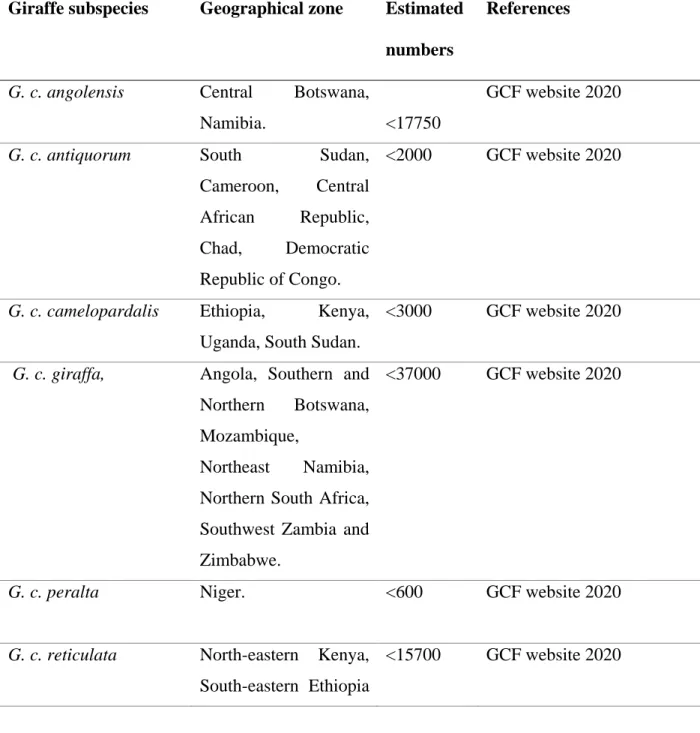
2018b, Table 1.1). The different subspecies also occupy different geographical areas in their native Africa as indicated by the table (Table 1.1.) The amount of research on the various giraffe taxa varies with country and focus (Supplementary information Table S1.2 and S1.3).
1.5.1 Morphology
Giraffe are large herbivores and can weigh between 550 - 1930 kg and reach heights between 4 - 5.5 m at adulthood (Jolly 2002). This differences in height and body mass are a consequence of the sexual dimorphism shown by the giraffe, with males being larger than females (Mramba et al.
2017). Adulthood is reached at three years of age, and the first mating for females is at four years of age whilst for males, it is at eight years of age. The gestation period for giraffe is 15 months,
6
with one calf being born, and the calving season is all year round (Furstenberg 2013). The calf stays with the mother for anywhere between 12 – 24 months with cows sometimes hiding their young when they leave to forage or leaving them in the care of a ‘babysitter’ (Bercovitch and Berry 2013).
Table 1.1: Giraffe subspecies, their geographical home range and estimated numbers in Africa.
Giraffe subspecies Geographical zone Estimated numbers
References
G. c. angolensis Central Botswana,
Namibia. <17750
GCF website 2020
G. c. antiquorum South Sudan,
Cameroon, Central African Republic, Chad, Democratic Republic of Congo.
<2000 GCF website 2020
G. c. camelopardalis Ethiopia, Kenya, Uganda, South Sudan.
<3000 GCF website 2020 G. c. giraffa, Angola, Southern and
Northern Botswana, Mozambique,
Northeast Namibia, Northern South Africa, Southwest Zambia and Zimbabwe.
<37000 GCF website 2020
G. c. peralta Niger. <600 GCF website 2020
G. c. reticulata North-eastern Kenya, South-eastern Ethiopia
<15700 GCF website 2020
7 and South-western Somalia.
G. c. tippelsckirchi North-eastern Zambia, Southern Kenya, Tanzania.
<35 000 GCF website 2020
1.5.2 Home ranges
Giraffe are non-territorial mammals which means that they do not defend a territory but rather have areas of frequent use which is termed as the home range (Dagg 2014). Home range size in giraffe differ because of several reasons such as food availability, proximity to humans, mean annual rainfall, availability of mates and predation (Knuesel et al. 2019). Adult home range sizes were observed as low as 17.6 km2 in the Lake Manyara National Park in Tanzania whilst a home range size of 1950 km2 was observed in the Namib Desert (Fennessy 2009). The difference in rainfall is a direct reason for these home range sizes as the giraffe in the more arid areas move for longer distances to find feeding patches and mates (Fennessy 2009; Knuesel et al. 2019). Proximity to human settlements is another factor that affects giraffe home. Large herbivores have larger home ranges in areas close to human settlements as they must move for longer distances to avoid human conflict (Knuesel et al. 2019).
Food and water availability are important factors in mammal habitat use as they govern the animal’s movements (Fennessy 2009). Giraffe are generally not water-dependent and can sustain themselves using the moisture content of their browse, especially in areas without visible surface water such as the arid Namib Desert (Fennessy 2009; Okello et al. 2015). Although they obtain moisture content from the leaves they browse on, the lack of an available surface water source influences the size of giraffe home ranges as they walk long distances to feed and drink (Knuesel et al. 2019). Food quality and availability are more dominant factors in habitat use as giraffe show
8
seasonal movement according to the availability of food, favouring areas with abundant Vachellia species. in the wet season and areas with evergreen species in the winter (Deacon and Smit 2017).
1.5.3 Habitat use
Giraffe show different habitat uses with the varying habitats that the different subspecies are found.
An animal’s habitat use is influenced by the spatial arrangement of resources it needs for survival (Lawson and Rodgers 1997). Giraffe show differences in habitat use according to seasons with rainfall being the largest factor in determining how the habitat is used (Fennessy 2009). The availability of high-quality browse in the wet season generally decreases the size of giraffe home ranges compared with the dry season where high quality is not as abundant. Giraffe typically prefer Vachellia species. for browsing, and these lose their leaves in the dry season so this leads to a shift in preference to evergreen species which have a lower protein content which in turn leads to a change in habitat use (Hall-Martin and Basson 1975; Deacon and Parker 2016). The availability of new, higher nutrition Vachellia species. shoots and surface water in the rainy season shortens the distances that giraffe must travel (Hall-Martin and Basson 1975). The water content of these shoots also reduces the need for the giraffe to frequent water points (Parker and Bernard 2005).
1.5.4 Feeding behaviour
Although minimal grazing has been observed in nutrient-poor habitats, giraffe are mainly browsers, and they feed mostly on Vachellia species. (Seeber 2012b; Mahenya et al. 2016).
Although these large herbivores show a preference for Vachellia species., their diet is not limited to these trees only (Berry and Bercovitch 2016). Berry and Bercovitch (2016) found that
9
Thornicroft’s giraffe G. c. thornicrofti in the Luangwa Valley of Zambia fed on a range of 93 plant species over a 40-year observation span.
Deciduous trees like the Vachellia species. shed their leaves in the dry seasons with evergreen trees making up most of the available browse (Tomlinson et al. 2013). In the Eastern Cape, South Africa, V. karroo sheds its leaves in the dry season, and that is when evergreens such as Sersia longispina become a prominent feature in giraffe diets (Parker and Bernard 2005). These feeding patterns influence giraffe movements seasonally as the animals seek optimal browse availability (Deacon and Smit 2017). The availability of high-quality food sources in the wet season has been shown to affect juvenile mortality (Lee et al. 2017). Calves conceived in the wet season and born in the dry season have higher chances of survival as cows typically have higher fitness at the time of mating (Lee et al. 2017).
1.5.5 Social behaviour
Giraffe occur in different sized herds with herd sizes influenced by factors such as predation risk and differences in habitats (Muller et al. 2018a). The composition of the herds varies as females bring their juveniles to herds hence increasing the herd size whilst some herds are not breeding herds (Muller et al. 2018a). Bulls move away from the breeding herds to form all-male herds (Bercovitch and Berry 2014). The function of these all-male herds is to establish ranks amongst bulls, to pass on information about the habitat to younger bulls and to help in protection against predators (Bercovitch and Berry 2015). Dominant bulls obtain mating rights, and dominance is usually established by body size and age with occasional fights observed. (Pratt and Henderson 1985; Seeber et al. 2012a). Pratt and Henderson (1985) also established that most of the herds did not have a set leader, with the task usually falling to the older cows with calves.
10 1.5.6 Giraffe numbers decline: The reasons
Although the subspecies G. c. giraffa has been recommended to remain listed as ‘Least concern’
because of their increasing numbers, the IUCN Red List has listed giraffe as a vulnerable species globally because of a decline in numbers in the last 30 years (Deacon and Tutchings 2018; Muller et al. 2018b). The general population has seen a decrease of numbers by at least 35% in the last 30 years (Muller et al. 2018b). Several reasons are cited for declining giraffe numbers, including diseases such as Rinderpest in southern Africa and skin lesions affecting Ethiopian populations (Furstenberg 2013; Abate and Abate 2017). Human population growth has also influenced declining numbers of giraffe because of habitat degradation, and an increase in areas changed for human housing and agriculture (Deacon and Parker 2016).
Habitat destruction is a significant reason for giraffe population decline in all the African regions with the giraffe’s favoured food source, Vachellia tree species, being removed and/or used to make charcoal in many countries, e.g. Ethiopia, Zambia and Tanzania (Abate and Abate 2017).
Ciofolo (1995) stated that some of the West African populations of giraffe would not have gone locally extinct without human interference, but the availability of automatic firearms was a major factor in giraffe deaths and declines. The giraffe had to compete with livestock and humans for resources, further endangering them (Ciofolo 1995). Some of the lesser investigated factors affecting giraffe populations are inbreeding depression and susceptibility to lion Panthera leo predation in some parts of Africa such as the Lake Nakuru National Park in Kenya (Brennemann et al. 2009).
11 1.5.7 Conservation action
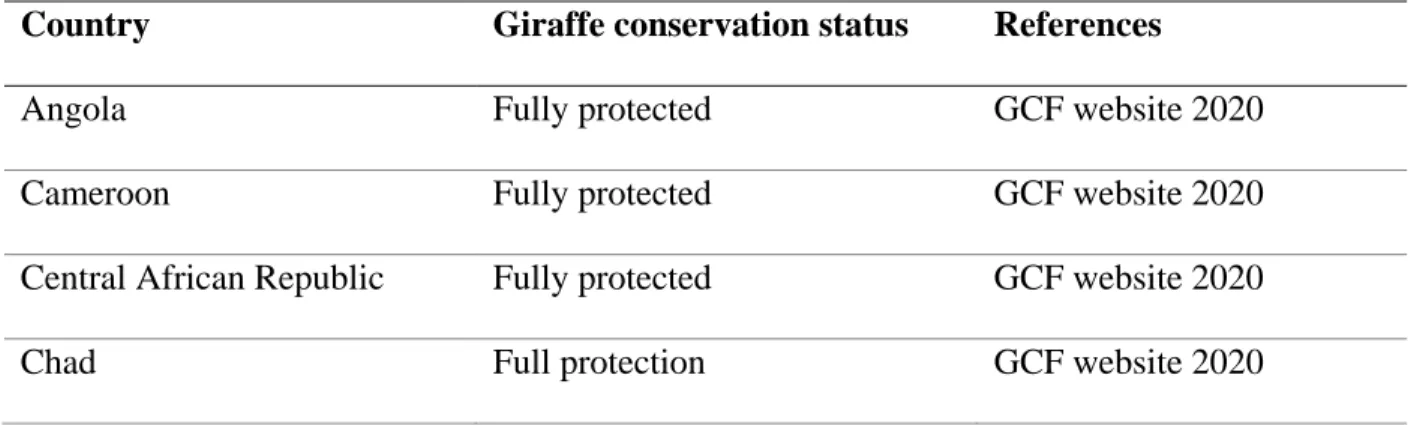
The conservation legislation and/or policies impacting giraffe in individual countries vary across Africa (GCF 2020; Table 1.2). The IUCN Species Survival Commission (SSC) Giraffe and Okapi Specialist Group (GOSG) is a volunteer group of experts that focuses mainly on providing technical advice on the conservation of giraffe and okapi (IUCN 2019). The herd is co-hosted by the Giraffe Conservation Foundation which focuses specifically on giraffe. GCF is an independent Non-Governmental Organisation working across 16 African counties, often with government, local and international partners to secure a long-term future for giraffe in the wild. With the noted decline in giraffe numbers across Africa, the Giraffe Conservation Foundation (GCF) is running giraffe conservation programmes for the different species of giraffe. These programmes are being run in Zimbabwe, Zambia, Malawi, Botswana, Chad, Democratic Republic of Congo, Kenya, Uganda, Ethiopia, Tanzania, Niger and Namibia (GCF 2020). The public is educated on these large herbivores and improve management efforts to stop the decline of giraffe numbers. The foundation also runs Twiga Tracker, an Africa-wide GPS staellite tagging programme that conducts genetic sampling, analysis programmes, surveys and development of national strategies.
National parks and protected areas are also part of the framework to reduce poaching of the animals (GCF 2020).
A variety of methods have been tabled to assist in giraffe conservation. Bolger et al. (2012) generated the WildID artificial intelligence software programme to help identify Masai giraffe G.
c. tippelskirchi individuals. The software uses pictures of giraffe coat patterns to identify individuals and was used to identify 600 individuals successfully. The images captured over three sampling points in a year helped estimate population size and survival rate (Bolger et al. 2012).
Such examples provide more information on giraffe genetics to help deal with problems such as
12
inbreeding which is prevalent in fenced-off protected areas (Austin et al. 2017). Faecal samples have also been used to investigate the genetics of giraffe populations to establish gene flow in these populations (Austin et al. 2017).
Translocation is a strategy that is being used across Africa to conserve threatened species such as giraffe (Muller et al. 2020b). This strategy either starts a new population in an area or introduces new genes into an already established gene pool (Muller et al. 2020b). Flanagan et al.
(2016) highlighted this method of conservation by looking at the establishment of giraffe in three Namibian regions and was the first post-translocation study. Of the six translocated giraffe, four established home ranges in their respective areas (Flanagan et al. 2016).
An important part of conservation is the general public, and there has been a rise in global citizen scientists participating in conservation projects (Dickinson et al. 2012). Citizen scientists provide useful information on wildlife and help in making conservation projects successful.
Another strategy that has been employed is the engaging of communities to teach them how to conserve specific species has been shown to bring success in conservation projects (Lee 2018).
There was an increase in giraffe survival and population growth rate in the Burunge area of Tanzania because of the community-based management strategy implemented in 2014 (Lee 2018).
Table 1.2: Summary of giraffe conservation laws in different parts of Africa (GCF 2020).
Country Giraffe conservation status References
Angola Fully protected GCF website 2020
Cameroon Fully protected GCF website 2020
Central African Republic Fully protected GCF website 2020
Chad Full protection GCF website 2020
13
DRC Full protection GCF website 2020
Ethiopia Hunting permit required GCF website 2020
Kenya Full Protection GCF website 2020
Malawi Not protected GCF website 2020
Mozambique Protected GCF website 2020
Namibia Hunting permit required GCF website 2020
Niger Fully protected GCF website 2020
Nigeria Fully protected GCF website 2020
Rwanda Fully protected GCF website 2020
Somalia Not protected GCF website 2020
South Sudan Fully protected GCF website 2020
Swaziland Hunting permit required GCF website 2020
Tanzania Fully protected GCF website 2020
Uganda Fully protected GCF website 2020
Zambia Not fully protected GCF website 2020
Zimbabwe Not protected; hunting permit
required
GCF website 2020
1.6 Aim
The study's main aim was to investigate the movement, habitat use, social and feeding behaviour of South African giraffe (G. c. giraffa) in central KwaZulu-Natal in a land-use mosaic.
14 1.7 Thesis structure
The thesis is presented as six chapters with the first a general introduction followed by four data chapters and then a concluding chapter. The four data chapters have been prepared as draft manuscripts for submission to international peer-reviewed journals; therefore, some repetition was unavoidable. Each chapter contains its respective hypotheses and/ predictions. The chapters are structured as follows covering the following topics:
Chapter 2: Home ranges.
Chapter 3: Habitat use.
Chapter 4: Feeding behaviour.
Chapter 5: Social behaviour.
1.8 References
Abate, D. and Abate, T. 2017. Factors affecting survival of giraffe in Ethiopia. Advances in Life Sciences and Technology 55, 8 – 12.
Angula, H. N., Stuart-Hill, G., Ward, D., Matongo, G., Diggle, R. W. and Naidoo, R. 2018. Local perceptions of trophy hunting on communal lands in Namibia. Biological Conservation 218. 26 – 31.
Austin, J. D., Moore, S., McCleery, R. A., Colton, J., Finberg, T. and Monadjem, A. 2017.
Conservation genetics of an isolated giraffe population in Swaziland. African Journal of Ecology 56, 140 – 145.
Barnes, M. D., Craigie, I. D., Harrison, L. B., Geldmann, J., Collen, B., Whitmee, S., Balmford, A., Burgess, N. D., Brooks, T., Hockings, M. and Woodley, S. 2016. Wildlife population trends in protected areas predicted by national socio-economic metrics and body size.
Nature Communications 7, 12747.
Batavia, C., Nelson, M. P., Darimont, C. T., Paquet P. C., Ripple, W. J. and Wallach, A. D. 2019.
The elephant (head) in the room: A critical look at trophy hunting. Conservation Letters 12, e12565
Bercovitch, F. B. and Berry, P. S. M. 2013. Age proximity influences herd composition in wild giraffe. Journal of Zoology 290, 281 – 286.
Bercovitch, F. B. and Berry, P. S. M. 2014. The composition and function of all-male herds of Thornicroft’s giraffe, Giraffa camelopardalis thornicrofti, in Zambia. African Journal of Ecology 53, 167 – 174.
15
Bercovitch, F. and Deacon, F. 2015. Gazing at a giraffe gyroscope: Where are we going? African Journal of Ecology 53, 135 – 146.
Berry, P. S. M. and Bercovitch, F. 2016. Seasonal and geographical influences on the feeding ecology of giraffe in the Luangwa Valley, Zambia: 1973–2014. African Journal of Ecology 55, 80 – 90.
Biggs, D., Swemmer, L., Phillips, G., Stevens, J., Freitag, S. and Grant, R. 2014. The development of a tourism research framework by South African National Parks to inform management.
Koedoe 56, 1 – 9.
Bolger, D. T., Morrison, T. A., Vance, B., Lee, D. and Farid, H. 2012. A computer assisted system for photographic mark-recapture analysis. Methods in Ecology and Evolution 3, 813 – 822.
Brenneman, R. A., Bagine, R. K., Brown, D. M., Ndetei, R. and Louis Jr, E. E. 2009. Implications of closed ecosystem conservation management: the decline of Rothschild’s giraffe (Giraffa camelopardalis rothschildi) in Lake Nakuru National Park, Kenya. African Journal of Ecology 47, 711 – 719.
Ciofolo, I. 1995. West Africa's last giraffe: The conflict between development and conservation.
Journal of Tropical Ecology 11, 577 – 588.
Dagg A I. 2014. Giraffe biology, behaviour and conservation. New York, NY: Cambridge University Press.
Deacon, F. and Tutchings, A. 2018. The South African giraffe, Giraffa camelopardalis giraffa: a conservation success story. Oryx, 1 – 4.
Deacon, F. and Smit, S. 2017. Spatial ecology and habitat use of giraffe (Giraffa camelopardalis) in South Africa. Basic and Applied Ecology 21, 55 – 65.
Deacon, F and Parker, D. 2016. A conservation assessment of Giraffa camelopardalis giraffa The Red List of Mammals of South Africa, Swaziland and Lesotho. South African National Biodiversity Institute and Endangered Wildlife Trust, South Africa.
DeFries, R. S., Rudel, T., Uriarte, M. and Hansen M. 2010. Deforestation driven by urban population growth and agricultural trade in the twenty-first century. Nature Geoscience 3, 178 – 181.
Dickinson, J. L., Shirk, J., Bonter, D., Bonney, R., Crain, R. L., Martin, J., Phillips, T. and Purcell, K. 2012. The current state of citizen science as a tool for ecological research and public engagement. Frontiers in Ecology and the Environment 10, 291 – 297.
Di Minin, E., Leader-Williams, N. and Bradshaw, C. J. A. 2007. Banning trophy hunting will exacerbate biodiversity loss. Trends in Ecology and Evolution 31, 99 – 102.
Dudley, N. and Stolton, S. 2008. Defining protected areas: an international conference in Almeria, Spain. Gland, Switzerland: IUCN. 220 pp.
Ehrlich, P. R. and Harte, J. 2015. Opinion: To feed the world in 2050 will require a global revolution. Proceedings of the National Academy of Sciences of the United States of America 112, 537 – 547.
Fennessy, J. 2009. Home range and seasonal movements of Giraffa camelopardalis angolensis in the Northern Namib Desert. African Journal of Ecology 47, 318 – 327.
Fennessy, J., Bidon, T., Reuss, F., Kumar, V., Elkan, P., Nilsson M. A., Vamberger, M., Fritz, U.
and Janke, A. 2016. Multi-locus analyses reveal four giraffe species instead of one. Current Biology 26, 2543 – 2549.
Flanagan, S. E., Brown, M. B., Fennessy, J. and Bogler, D. T. 2016. Use of home range behaviour to assess establishment in translocated giraffe. African Journal of Ecology 54, 365 – 374.
Furstenburg, D. 2013. Focus on the Giraffe (Giraffa camelopardalis). S.A. Hunter 06077, 24-26.
16
Galvin, K. A., Beeton, T. A, and Luizza, M. W. 2018. African community-based conservation: a systematic review of social and ecological outcomes. Ecology and Society 23, 39.
https://doi.org/10.5751/ES-10217-230339
Gemeda, D. O. and Meles, S. K. 2018. Impact of human-wildlife conflict in developing countries.
Journal of Applied Science and Environmental Management 22, 1233 – 1238.
Geraads, D., and Bobe, R. 2017. Ruminants (Giraffidae and Bovidae) from Kanapoi. Journal of Human Evolution 140, 1 - 9 DOI:10.1016/j.jhevol.2017.08.006.
Giraffe Conservation Foundation. 2020. www.giraffeconservation.org Giraffe Resource Centre. 2018. Library.girafferesourcecentre.org
Hackel, J. D. 1993. Rural change in nature conservation in Africa: a case study from Swaziland.
Human Ecology 21, 295 – 312.
Hackel, J. D. 1999. Community conservation and the future of Africa’s wildlife. Conservation Biology 13, 726 – 734.
Hall-Martin, A. J., and Basson, W. D. 1975. Seasonal chemical composition of the diet of Transvaal Lowveld giraffe. Journal of Southern Africa Wildlife Management Association 5, 19–21.
Holmes, G. 2013. Exploring the relationship between local support and the success of protected areas. Conservation and Society 11, 72 – 82.
Houghton, R., A. 1990. The global effects of tropical deforestation. Environmental Science and Technology 24, 414 – 422.
Houghton, R., A. 1994. The worldwide extent of land use change. Bioscience 44, 305 – 313.
International Union for Conservation of Nature briefing paper. 2016. Informing decisions on trophy hunting.
International Union for Conservation. 2019. https://www.iucn.org/commissions/ssc- herds/mammals/specialist-herds-f-z/giraffe-and-okapi
Jolly, L. 2002. Literature review of giraffe, Giraffa camelopardalis.
Joppa, L. N. and Pfaff, A. 2011. Global protected area impacts. Proceedings of the Royal Society B 278, 1633 – 1638.
Kie, J. G., Bowyer, R. T., Nicholson, M. C., Boroski, B. B. and Loft, E. R. 2002. Landscape heterogeneity at differing scales: Effects on spatial distribution of mule deer. Ecology 83, 530 – 554.
Kneusel, M. A., Lee, D. E., Konig, B. and Bond, M. L. 2019. Correlates of home range sizes of giraffe, Giraffa camelopardalis. Animal Behaviour 149, 143 – 151.
Lawson, E. J. G., and Rodgers, A. R. 1997. Differences in home-range size computed in commonly used software programmes. Wildlife Society Bulletin, 25, 721 – 729.
Lee, D. E., Bond, M. L. and Bolger, D. T. 2017. Season of birth affects juvenile survival of giraffe.
Population Ecology 59, 45 – 54.
Lee, D. E. 2018. Evaluating conservation effectiveness in a Tanzanian community wildlife management area. Journal of Wildlife Management 82, 1767 - 1774.
Lindsey, P. A., Roulet, P. A. and Romanach, S. S. 2007. Economic and conservation significance of the trophy hunting industry in Sub-Saharan Africa. Biological Conservation 134, 455 – 469.
Mahenya, O., Ndjamba, J. K., Mathisen, K. M. and Skarpe, C. 2016. Giraffe browsing in response to plant traits. Acta Oecologica 75, 54 – 64.
17
Meer, T. 2010. Finding the community in community base natural resource management: The case of Ndumo game reserve, South Africa. Submitted in partial fulfilment of the requirements for the degree of Master of Arts at Dalhousie University Halifax, Nova Scotia.
Mogomotsi, P. K., Mogomotsi, G. E. J., Dipogiso, K., Phonchi-Tshekiso, N. D., Stone, L. S. and Badimo, D. 2020. An analysis of communities’ attitudes toward wildlife and implications for wildlife sustainability. Tropical Conservation Science 13, 1 – 9.
Mramba, R. P., Mahenya, O., Siyaya, A., Mathisen, K. M., Andreassen, H. P. and Skarpe, C.
Sexual segregation in foraging giraffe. Acta Oecologica 79, 26 – 35.
Muller, Z., Cuthill, I. C. and Harris, S. 2018a. Giraffe herd sizes in Kenya: the influence of habitat, predation and the age and sex of individuals. African Zoology 306, 77 – 87.
Muller, Z., Bercovitch, F., Brand, R., Brown, D., Brown, M., Bolger, D., Carter, K., Deacon, F., Doherty, J.B., Fennessy, J., Fennessy, S., Hussein, A.A., Lee, D. E, Marais, A., Strauss, M., Tutchings, A. and Wube, T. 2018b. Giraffa camelopardalis, Giraffe. The International Union for Conservation of Nature Red List of Threatened Species.
Muller, Z., Lee, D. E., Scheijen, C. P. J., Strauss, M. K. L., Carter, K. D. and Deacon, F. 2020.
Giraffe translocations: A review and discussion of considerations. Ecology 58: 159-171 Muñoz Brenes, C. L., Jones, K. W., Schlesinger, P., Robalino, J. and Vierling, L. 2018. The impact
of protected area governance and management capacity on ecosystem function in Central America. PLoS ONE 13, 1 – 20.
Mufune, P. 2015. Community Based Natural Resource Management (CBNRM) and Sustainable Development in Namibia. Journal of Land and Rural Studies, 3, 121-138.
DOI:10.1177/2321024914534043.
Naidoo, R., Weaver, L. C., Diggle, R. W., Matongo, G., Stuart-Hill, G. and Thouless, C. 2016.
Complementary benefits of tourism and hunting to communal conservancies in Namibia.
Conservation Biology 30, 628 – 638.
Okello M, Kenana L, Maliti H, Kiringe J, Kanga E, Warinwa F, Bakari S, Ndambuki S, Kija H, Sitati N, Kimutai D, Gichohi N, Muteti D, Muruthi P, Mwita M. 2015. Population status and trend of the Maasai giraffe in the mid Kenya-Tanzania borderland. Natural Resources 6: 159-173. doi: 10.4236/nr.2015.63015.
Parker, D. M. and Bernard, R. T. S. 2005. The diet and ecological role of giraffe (Giraffa camelopardalis) introduced to the Eastern Cape, South Africa. Journal of Zoology 267, 203 – 210.
Patra, S., Sahoob, S., Mishra, P. and Mahapatra, S. C. 2018. Impacts of urbanization on land use /cover changes and its probable implications on local climate and groundwater level.
Journal of Urban Management 7, 70 – 84.
Pratt, D. M. and Anderson, V. H. 1985. Giraffe social behaviour. Journal of Natural History 19, 771 – 781.
Rydén, O., Zizka, A., Jagers, S. C., Lindberg, S. I. and Antonelli, A. 2020. Linking democracy and biodiversity conservation: Empirical evidence and research gaps. Ambio 49, 419–433.
https://doi.org/10.1007/s13280-019-01210-0
Saayman, M., van der Merwe, P. and Saayman, A. 2018. The economic impact of trophy hunting in the South African wildlife industry. Global Ecology and Conservation 16, 1 – 9.
Seeber, P. A., Ciofolo, I. and Ganswindt, A. 2012a. Behavioural inventory of the giraffe (Giraffa camelopardalis). BioMed Central Research Notes 5, 605.
Seeber, P. A., Ndlovu, H. T., Duncan, P. and Ganswindt, A. 2012b. Grazing behaviour of the giraffe in Hwange National Park, Zimbabwe. African Journal of Ecology 50, 247 – 250.
18
Seoraj-Pillai, N. and Pillay, N. 2016. A meta-analysis of human-wildlife conflict: South African and global perspectives. Sustainability 9, 34 doi.org/10.3390/su9010034
Sheikh, P. A. and Bermejo, L. F. 2019. International trophy hunting. Report for Congressional Research Service.
Shivanna, K. R. 2020. The sixth mass extinction crisis and its impact on Biodiversity and Human Welfare. Resonance 25, 93 – 109 doi.org/10.1007/s12045-019-0924-z
Sibhatu, K. T. and Qaim, M. 2017. Rural food security, subsistence agriculture, and seasonality.
PLoS ONE 12, 1 – 15.
Symes, W. S., Edwards, D. P., Miettinen, J., Rheindt, F. E. and Carrasco, L. R. 2018. Combined impacts of deforestation and wildlife trade on tropical biodiversity are severely underestimated. Nature Communications 9, 4052.
Teelucksingh, C. 2007. Environmental Racialization: Linking Racialization to the Environment in Canada. Local Environments 12, 645 - 661.
Thomas, L. 1996. Monitoring long term population change: why are there so many analysis methods? Ecology 77, 49 – 58.
Tomlinson, K. W., Poorter, L., Sterck, F. J., Borghetti, F., Ward, D., de Bie, S. and van Langevelde, F. 2013. Leaf adaptations of evergreen and deciduous trees of semi-arid and humid savannas on three continents. Ecology 101: 430-440.
Watson, J. E. M., Dudley, N., Segan, D. B. and Hockings, M. 2014. The performance and potential of protected areas. Nature 515, 67 – 73.
Winter, S., Fennessy, J. and Janke, A. 2018. Limited introgression supports division of giraffe into four species. Ecology and Evolution 8, 10156 – 10165.
19 1.9 Supplementary Information
Supplementary Table S1.1: Common names of the different giraffe subspecies (GCF website 2020)
Scientific name Species Common name
G. c. angolensis Southern giraffe Angolan giraffe G. c. antiquorum Northern giraffe Kordofan giraffe G. c. tippelskirchi Masai giraffe Masai giraffe G. c. camelopardalis Northern giraffe Nubian giraffe G. c. reticulata Reticulated giraffe Reticulated giraffe G. c. giraffa Southern giraffe South African giraffe G. c. peralta Northern giraffe West African giraffe
20
Supplementary Table S1.2: Summary of scientific papers on giraffe taxa accessible from the Giraffe Resource Centre (2018)
Topic Number of papers
Giraffe 437
Angolan giraffe 12
Kordofan giraffe 2
Masai giraffe 21
Northern giraffe 5
Nubian giraffe 0
Reticulated giraffe 33
Rothschild’s giraffe 23
South African giraffe 11
Southern giraffe 13
Thornicroft’s giraffe 12
West African giraffe 15
21
Supplementary Table S1.3: A summary of topics in scientific papers on aspects of giraffe ecology available from the Giraffe Resource Centre (2018)
Topic Number of papers
Speciation 293
Social Behaviour 80
Feeding Behaviour 27
Conservation 174
Habitat 177
Morphology 102
22 CHAPTER 2
Differences in South African giraffe (Giraffa camelopardalis giraffa) home range across a land-use mosaic in KwaZulu-Natal, South Africa
Mmeli J. J. Nyathi, Peter Calverley and Colleen T. Downs*
Centre for Functional Biodiversity, School of Life Sciences, University of KwaZulu-Natal, Private Bag X01, Scottsville, Pietermaritzburg, 3209, South Africa
Formatted for Behavioural Ecology
* Corresponding author: Colleen T. Downs
Email: [email protected]; ORCID: http://orcid.org/0000-0001-8334-1510 Other emails and ORCIDs:
M. Nyathi Email: [email protected]; ORCID: http://0000-0003-0791-0907 P. Calverley Email: [email protected];
Running header: Giraffe home ranges in a land-use mosaic
23 2.1 Abstract
Animal movements and home range assessments are an important component of animal behavioural studies. Home ranges are the area used by animals to obtain resources that they use for their survival. Giraffe (Giraffa camelopardalis) are large herbivores whose home ranges are variable because of many factors. We investigated changes in South African giraffe (G. c. giraffa) home range sizes according to sex and seasonality across a land-use mosaic. A total of 12 giraffe that use the Zingela Conservation Area, Kusa Kusa Communal Area and Emaweni Game Hunting Ranch in KwaZulu-Natal were fitted with Ecotone Ultra High Frequency (UHF) ear tags. These tags supplied Global Positioning System (GPS) co-ordinates during 2019 - 2020. Two home range methods [Minimum Convex Polygon (MCP) and Kernel Density Estimation (KDE)] were used to analyse home range and core utilisation data. The mean (± SD) home range size for the wet season was 45.76 ± 23.67 km2 and 55.06 ± 31.82 km2 for the dry season. We found that home range sizes were not significantly different between sexes and seasons. Giraffe home range sizes are typically controlled by food availability and quality.
Keywords: Ear tags, Kernel Density Estimate, home range, GPS tracking, South African giraffe.
24 2.2 Introduction
The distribution of resources has a direct effect on the movement of animals in their natural habitat, and animals use information about these spaces to survive daily (Spencer 2012). The space in which these resources are found is defined as the animal’s home range (Powell and Mitchell 2012).
The home range provides food, water and mating opportunities (Ruhmann et al. 2019). The availability of these resources is the main driving principle behind home range sizes (Zurell et al.
2018). Herbivores navigate through various trade-offs to establish the smallest home range possible, thereby minimising energy use (Bastille-Rousseau 2015). The dynamics of home range sizes are to minimise the negative effects on fitness and manage ecological constraints (Morellet et al. 2013).
Giraffe (Giraffa camelopardalis) are large mammalian browsers whose home range sizes are affected by food quality and water availability to a lesser extent (Owen-Smith 1988; Knusel et al. 2019). There are distinct wet and dry seasonal or degree of aridity variations in many parts of Africa where giraffe occur. In the Lake Manyara National Park, Tanzania, where rainfall and high- quality food were abundant, giraffe had a mean home range of 17.6 km2 whilst a giraffe bull in the dry Namib Desert had a mean home range of 1950 km2 (Fennessy 2009). Such differences in size are influenced by food quantity and quality as deciduous trees lose their leaves in the dry season (Fennessy 2009). Giraffe increase their diet breadth in the dry seasons to fulfil their bioenergy needs, and this increases their home ranges as there is a decrease in high-quality browse (Berry and Bercovitch 2016).
The availability of mating opportunities is another factor that affects animal home range sizes. Giraffe are non-territorial large herbivores that follow a fission-fusion social dynamic, with females showing stronger bonds between closely related individuals (Deacon and Bercovitch
25
2018). The herds show sexual segregation as males form all-male bachelor herds (Bercovitch and Berry 2014). Apart from these all-male herds, dominant adult bulls use a solitary roaming mating strategy (VanderWall et al. 2014). The bulls move between herds to find females that are in oestrus and are ready to mate (Van der Waal et al. 2014). Using this strategy, males move for considerably longer distances compared with the females (Fennessy 2009).
Improvement of Global Positioning System (GPS) tracking technology over the years has allowed for better investigation of animal movements (McQualter et al. 2015). Recent miniaturisation of devices and use of near real time global position has aided the acquisition of data on wildlife (Hart et al. 2020). The technology is helping provide more information on movements of these large herbivores, an area of study that has been relatively understudied in giraffe (Deacon and Smit 2017). We used this technology to investigate the differences in South African giraffe (G. c. giraffa, hereafter giraffe) home range sizes in a land-use mosaic in KwaZulu- Natal, South Africa, with distinct wet and dry seasons. We also investigated the differences in the effect that giraffe’ sex had on home ranges. We predicted that the giraffe would have larger home ranges in the dry seasons compared with the wet seasons. We also predicted that giraffe bulls would have larger home ranges compared with cows.
2.3 Methods 2.3.1 Study area
Zingela Safari and River Company (28⁰ 43.035 S 30⁰ 03.800 E) is a conservation area located 26 km from Weenen and 35 km from Colenso in the South African Midlands of KwaZulu-Natal. The property is approximately 1200 ha and is bordered by the Tugela River. Kusa Kusa Communal Area is approximately 1500 ha large and borders the conservation area. Kusa Kusa is bordered by
26
Zingela and Emaweni Game Hunting Ranch which is approximately 2000 ha large. This gives a relatively small, closed environment that is approximately 4700 ha in size.
Zingela is dominated by the Thukela Valley Bushveld vegetation type. This vegetation type is dominated by Vachellia tree species which are V. tortilis and V. robusta together with evergreen tree species such as shepherd’s tree (Boscia albitrunca) (Ezemvelo KZN Wildlife 2013). The area is dominated by Blepharis natalensis undergrowth which is a result of overgrazing in the past. The area also has high numbers of Aloe marlothii. Kusa Kusa comprises of Thukela Valley Bushveld and Thukela Thornveld vegetation. Emaweni Game Hunting Ranch is made up of the Thukela Thornveld vegetation type. This area is dominated by Vachellia tree species and turpentine grass (Cymbopogon caesius).
The study area receives approximately 500 mm of rain annually between October to March which is the wet season (Ezemvelo KZN Wildlife 2013). The area is a summer rainfall region. The dry season is between April to September, with winter temperature below 0 ⁰C having been recorded (Ezemvelo KZN Wildlife 2013).
2.3.2 Sampling techniques
The capture of the giraffe was carried out by a qualified veterinarian and a commercial game capture team over two days in July 2019. The giraffe were darted from a helicopter using a pneudart cartridge fire 389 projector gun that fired a type C, 2 cc 6.35 cm 13G needle dart. The dart administered 15 mg of Etorphine hydrochloride (M99 Reckitt) (Wildlife Pharmaceuticals, White River, South Africa). As soon as the animal was down a blindfold was put secured to protect its eyes. A team of three sat on the animal’s neck to prevent it from getting up. The veterinarian then administered 150 mg of Naltrexone (Wildlife Pharmaceuticals, White River, South Africa)
27
immediately to reverse the effects of the Etorphine. We fastened the transmitters onto the animal’s ear using plastic ear tags (Supplementary information Fig. S2.1). The process took approximately 15 min. per giraffe. Morphological measurements were not taken in order to minimise the time the giraffe were down. All the animals were selected from different herds. We avoided using heavily pregnant females and young calves for the study (Bennitt et al. 2019). We fitted seven male and five female giraffe with GPS Ultra High Frequency (UHF) ear tag transmitters weighing less than 25 g each (Ecotone Telemetry, Poland). The transmitters were programmed to send the giraffe’s GPS geographical location to the server every 4 h. The GPS UHF transmitters sent co-ordinates over a cellular network (GSM), and we read the *csv file through the Ecotone Telemetry online panel.
2.3.3 Data analyses Seasonality
We split the received data into two seasons, wet and dry according to when the GPS co-ordinates were received. We imported the GPS co-ordinates into ArcGIS 10.4 (ESRI, Redlands, CA, USA), and they were projected in UTM (WGS 1984 UTM Zone 35S and 36S). We used two home range estimation methods to calculate home range, the Maximum Convex Polygon (MCP) and the Kernel Density Estimation (KDE) (Streicher et al. 2020). The R package rhr (RStudio 2015) was used to estimate the 95% area utilisation from the MCP and 95% core area utilisation from the KDE (Streicher et al. 2020).
Sex
We split the giraffe by sex using the dry season data and used the two home range estimation methods as above. The R package rhr was used to estimate the core area utilisation values
28
(Streicher et al. 2020). The 50% KDE was used to determine the core home range used (Streicher et al. 2020). We then analysed the differences in home range sizes between sexes. We conducted a Mann Whitney U test on the statistical programme R to calculate the difference in home range sizes and core area used by the two sexes.
2.4 Results 2.4.1 Seasonality
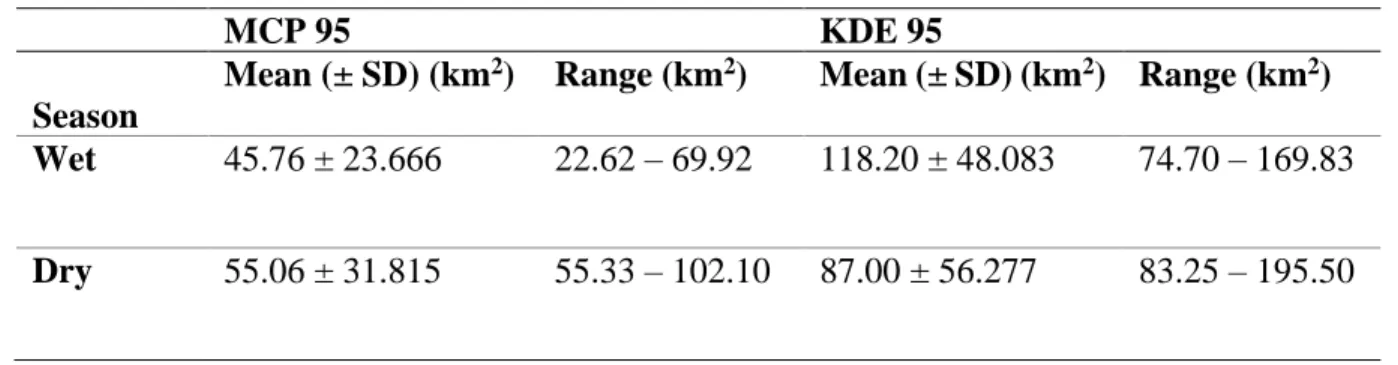
We found that the mean (± SD) MCP home range size for the wet season was 45.76 ± 23.67 km2 (n = 3) and 55.06 ± 31.82 km2 (n = 12) for the dry season (Table 2.1). The 95% KDE for the dry season was 87.00 ± 56.28 km2 and 118.20 ± 48.08 km2 for the wet season (Table 2.1). We found that there was no significant difference between MCP home range sizes in the different seasons (Mann Whitney, p = 2.012). We also found that there was no significant difference between KDE core utilisation in the two seasons (Mann Whitney, p = 1.217
Table 2.1: The mean (± SD) MCP home range sizes and mean (± SD) KDE core area utilisation by giraffe according to seasonal variation in the present study.
MCP 95 KDE 95
Season
Mean (± SD) (km2) Range (km2) Mean (± SD) (km2) Range (km2) Wet 45.76 ± 23.666 22.62 – 69.92 118.20 ± 48.083 74.70 – 169.83 Dry 55.06 ± 31.815 55.33 – 102.10 87.00 ± 56.277 83.25 – 195.50
29 2.4.2 Sex
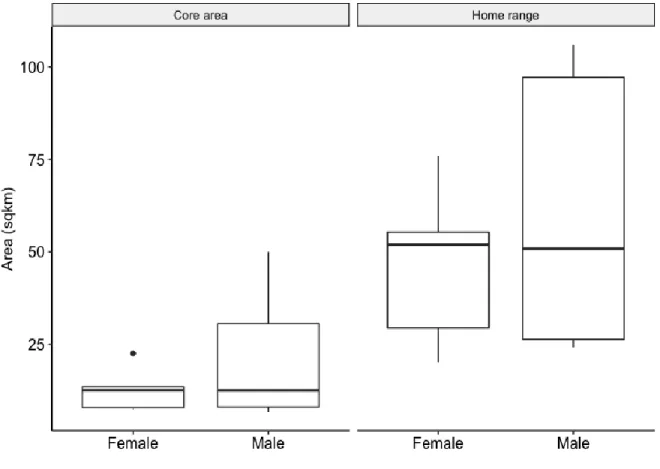
We found that the giraffe did not show a significant difference in MCP home range sizes between sexes in the dry season (Mann Whitney test; p = 0.755). We also found that the KDE core utilisation areas did not show a significant difference between the sexes in the dry season (Mann Whitney test, p = 0.8763; Fig. 2.1). The mean home range size (± SD) MCP for males was 61.14
± 37.749 km2 and 46.53 ± 22.152 km2 for females. The mean core area utilisation KDE for males was 20.91 ± 16.545 km2 and 12.80 ± 6.071 km2 for females.
Figure 2.1: Differences in MCP home range sizes and KDE core area utilisation of male and female giraffe in the present study.
30 2.5 Discussion
The vegetation in the study area had considerable populations of evergreen trees, mostly B.
albitrunca and Olea europaea subs. africana which are characteristic of Thukela vegetation (pers.
obs.). The giraffe settled in certain parts of the study area with high populations of the evergreen trees in the dry seasons (pers. obs.). During the wet seasons, the giraffe did not decrease their home ranges despite the availability of deciduous trees provided food, including their preferred Vachellia species (pers. obs.). Giraffe in the present study appeared to favour riparian areas along the Thukela River because of the availability of browse in both seasons (pers. obs.).
Giraffe are non-territorial herbivores whose home range sizes will fluctuate according to resource availability (Dagg 2014). Food availability is an essential resource that directly influences giraffe home range sizes, and this resource is affected by seasonality (Kneusel et al. 2019). In the dry seasons when food availability and quality are low, giraffe either congregate around a permanent food source or frequently move large distances to find food (McQualter et al. 2015). In the present study, the giraffe did not show significant differences in the respective mean MCP (95), and KDE (95) home range sizes between wet and dry seasons. The vegetation in the present study area has considerable populations of evergreen trees. We found that the giraffe used the habitat in certain parts of the study area with relatively high populations of evergreen trees in the dry seasons.
During the wet seasons, the giraffe did not decrease their home ranges despite the availability of deciduous trees which provided food, including their preferred Vachellia species.
Our study area was bordered by 8 km of Thukela River. Giraffe are not dependent on water, and they can go days without drinking water, using moisture from browse to sustain them (Okello et al. 2015). Despite this, the giraffe in the present study probably favoured riparian areas because the trees in the area obtained moisture from the river of the and could provide browse
31
during both seasons. This influenced the giraffe home ranges as the giraffe could drink at any time without having to travel long distances to feed or drink.
Giraffe follow a fission-fusion social system where herd size and composition are constantly changing, with closely related females forming the core of the herd (Deacon and Bercovitch 2018). Adult bulls follow a roaming mating strategy where they move around looking females that are ready to mate all year round (Van der Waal et al. 2014). Giraffe bull home ranges are larger than cows’ home ranges because of this strategy (Fennessy 2009). In the present study, the home ranges sizes did not show a significant difference between the sexes in the dry season.
The bulls did not move large distances which may have been a consequence of the number of bulls in the area. Only the dominant bulls mate with the cows and the tagged bulls were not dominant.
These males established home ranges and did not move large distances to find females. Another probable reason for the restricted movement could have been the study area being an enclosed environment.
Male giraffe create all-male herds where non-dominant bulls of different ages congregate (Bercovitch and Berry 2015). These all-male herds are used for information transfer to the younger animals and to protect them from the dominant bulls (Bercovitch and Berry 2015). The creation of all-male herds possibly also had an influence on home range sizes. In all-male herds the male giraffe did not roam as much as dominant bulls in other areas. The all-male herds followed the same pattern as the breeding herds, which was to find a suitable home range that provided food and water without having to move large distances to achieve that.
Contrary to our predictions, there were no differences in the giraffe home range sizes during the different seasons. The feeding behavioural plasticity shown by the giraffe during the different seasons were responsible for the home range sizes observed. The bulls also did not have
32
larger home ranges than the cows as predicted. This was likely because of herding strategies and dominance amongst individuals.
2.6 Acknowledgements
We are grateful to the University of KwaZulu-Natal (ZA), and the National Research Foundation (ZA) for funding. We want to thank Dr L. Iliszko and Ecotone for providing us with funding and donating the 12 transmitters. We also thank Wildlife Veterinary Solutions for carrying out the game capture. We thank the Ford Wildlife Foundation (ZA) for vehicle support. We are grateful to the Calverley family and all the staff at Zingela River and Safari Company for the help provided during the duration of the study. We thank Dr C. Hanzen and J. Streicher for helping with data analyses and Dr C. Price for editing suggestions.
2.7 References
Abraham JO, Hempson GP, Staver AC. 2019. Drought-response strategies of savanna herbivores.
Ecology and Evolution 9:7047-7056.
Bastille-Rousseau G, Potts JR, Schaefer JA, Lewis MA, Ellington EH, Rayl ND, Mahoney SP, Murray DL.2015. Unveiling trade-offs in resource selection of migratory caribou using a mechanistic movement model of availability. Ecography 38:1049-1059.
Bennitt E, Hubel TY, Bartlam-Brooks HLA, Wilson AM. 2019. Possible causes of divergent population trends in sympatric African herbivores. PLoS One 14:1-19.
Bercovitch FB, Berry PSM. 2015. The composition and function of all-male herds of Thornicroft’s giraffe, Giraffa camelopardalis thornicrofti, in Zambia. African Journal of Ecology 53:
167-174.
Berry PSM, Bercovitch FB. 2016. Seasonal and geographical influences on the feeding ecology of giraffe in the Luangwa Valley, Zambia: 1973 – 2014. African Journal of Ecology 55: 88- 90
Dagg A I. 2014. Giraffe biology, behaviour and conservation. New York, NY: Cambridge University Press.
Deacon F, Bercovitch FB. 2018. Movement patterns and herd dynamics among South African giraffe (Giraffa camelopardalis giraffa). African Journal of Ecology 56: 620-628.