LOCAL ECONOMIC DEVELOPMENT AS A POVERTY ALLEVIATION TOOL: A CASE STUDY ON THE URBAN RENEWAL PROGRAM IN
KWAMASHU DURBAN.
WALTER MUSAKWA
December 2008
A dissertation submitted in fulfillment of the Master of Science in Urban and Regional Planning; School of Architecture, Town Planning and Housing, University of Kwa-Zulu Natal
ABSTRACT
The study sought to establish the impact of LED strategies employed by the Inanda Ntuzuma KwaMashu Area Based Management program(INK ABM) in alleviating poverty in KwaMashu.The objectives of the study were: to identify aspects of poverty that has been reduced in KwaMashu;
assess the extent poverty alleviation is influenced by demographic characteristics namely age sex and income in KwaMashu; to compare levels of poverty before and after the INK ABM in KwaMashu; to identify the positive and negative impacts of the LED strategies within the INK ABM in KwaMashu; to establish the effectiveness of the structures put in place in the INK ABM project in KwaMashu in achieving the ultimate goal of poverty alleviation, and to use the results to recommend further initiatives. The methodology used in the study to asses‘ impact was Poverty Social and Impact Assessment.
The study revealed that LED strategies have had a significant impact in improving infrastructure and service delivery at KwaMashu town center and KwaMashu in general. LED strategies have had marginal impact in improving the income, assets indicators, human capabilities, market share and employment creation of SME‘s and residents in KwaMashu. Moreover the study revealed that there is a strong positive correlation between education levels and success of entrepreneurs.
Entrepreneurs who have better skills can leverage themselves to LED strategies than those with poor skills. LED has had a marginal impact on poverty alleviation due a myriad of factors which reinforce and interact with each other thereby trapping entrepreneurs and residents in poverty. A major finding is that LED strategies in KwaMashu do not target all the segments of the poor in a meaningful way. As such the study suggests a new LED agenda in KwaMashu which is: holistic, targets all the segments of the poor, fosters skills development and consists of various investment packages which would ensure that poverty in its multidimensionality is alleviated. The study contributes to knowledge by developing a model LED cycle and the concept of clinical LED which can assist in translating policy into meaningful practice so that LED has a high impact on alleviating poverty.
DECLARATION
I declare that this thesis is my own original work .Any work done by other persons has been properly acknowledged in the text. This dissertation has not been submitted for any other degree or examination at any other university.
Signature ……… Date………
WALTER MUSAKWA Durban, South Africa.
Supervisor: Dr Rosemary Awuor-Hayangah Signature……….
Date……….
ACKNOWLEDGEMENTS
I would like to give Glory to The Father The Son and The Holy Spirit for being my shield.
I would like to thank my supervisor Dr Rosemary Awuor-Hayangah whose guidance has been influential in writing the thesis. I would also like to thank my brother Fidelis, sisters Yeukai and Marcline, my mother and father for their moral support. I am also grateful to the LMRF team who financed the fieldwork for this research. I also thank the research assistants I worked with. My gratitude also goes to the INK office for their support.
TABLE OF CONTENTS
CHAPTER 1: THE RESEARCH PROBLEM 2
1.0 Background and Problem Statement 2
1.1 Objectives 3
1.2 Research Questions 4
1.3 Working Hypothesis 4
1.4 Research Log frame 4
1.5 Structure of Thesis 7
CHPATER 2: CONECPTUAL FRAMEWORK 9
2.0 Introduction 9
2.1 Local Economic Development 9
2.1.1 LED Planning Process 13
2.1.1.1 Organizing Effort 14
2.1.1.2 Competitive Assessment 15
2.1.1.3 Developing the LED Strategy 16
2.1.1.4 Implementing the Strategy 17
2.1.1.5 Evaluating LED 18
2.2 Local Economic Development Strategies 18
2.2.1 Community Economic Development 20
2.2.2 Enterprise Development 21
2.2.3 Locality Development 23
2.3 Dimensions of Poverty 25
2.3.1 Absolute Poverty 25
2.3.2 Relative Poverty 26
2.3.3 Human Poverty 27
2.4 Approaches to Poverty Alleviation 28
2.5 Indicators of Poverty 31
2.5.1 Poverty Line 31
2.5.2 Human Development Index 32
2.5.3 City Development Index 33
2.6 Pro-Poor Growth 34
2.7 Inequality 36
2.8 Theories 37
2.8.1 Theories of Economic Development 37
2.8.2 Development Theories 40
2.8.3 Debates on Poverty and Development 43
2.8.4 Theories of Poverty 44
2.8.5 Tools for Analyzing Poverty 46
2.9 Summary of Chapter 50
CHAPTER 3: INTERNATIONAL PERSPECTIVES ON LED AND POVERTY 51
3.0 Introduction 51
3.1 Why Local Economic Development 51
3.2 Economic Growth, Inequality and Poverty Alleviation 55
3.3 Poverty Reduction and Economic Growth 58
3.4 Poverty Alleviation at Municipal level Through LED 63
3.4.1 Regulatory Framework 64
3.4.2 Access to Municipal Services 65
3.4.3 Transport 66
3.4.4 Primary Health Care and Education 68
3.4.5 Employment Creation 69
3.5 LED and Globalization 70
3.5.1 Globalization, Poverty and Inequality 71
3.5.2 Thinking Local and Acting Global 73
3.6 International Practices in LED 74
3.6.1 Case Study: The Canal Corridor Initiative (CCI) New York 75 3.6.2 Knowledge Based Economic Development: The Massachusetts Biotech Cluster 76
3.6.3 Favela Bairro Project; Rio de Janeiro, Brazil 78
3.6.4 Towards Integrated Local Economic Development; Hamburg, Germany 79
3.7 Summary of Chapter 81
CHAPETR 4: LED IN SOUTH AFRICA 83
4.0 Introduction 83
4.1 Why Local Economic Development 83
4.2 LED in the Free State Province. 87
4.2.1 Lessons learnt from the Free State 88
4.3 LED in Limpopo province 90
4.3.1 Challenges in Limpopo 91
4.4 Local Economic Development in eThekwini 92
4.5 Cape Town 92
4.6 Ndlambe 93
4.7 Challenges Facing LED in South Africa. 94
4.8 Summary of Chapter 96
CHAPTER 5: METHODOLOGY 97
5.0 Introduction 97
5.1 Sampling 97
5.1.1 Sampling Procedure 98
5.2 Reconnaissance and Data Collection Tools 99
5.2.1 Questionnaires 99
5.2.2 Observation 99
5.2.3 Mapping 100
5.2.4 Key Informant Interviews 100
5.2.5. Use of Secondary Data 100
5.3 Data Analysis 101
5.4 Limitations of the Study 101
CHAPTER 5: PLANNING, DEVELOPMENT AND POVERTY IN KWAMASHU 102
6.1 Introduction 102
6.2 KwaMashu Spatial Context 102
6.3 KwaMashu a Planning Background 103
6.3.1 Planning Context in KwaMashu 106
6.3.2 Planning for LED in KwaMashu 108
6.4 KwaMashu Profile 108
6.4.1 Demographic profile 108
6.4.2 Education and Skills level 110
6.4.3 Employment and Income Levels. 111
6.4.4 Economic Profile 112
6.4.5 Service Delivery and /Infrastructure 113
6.4.6 Gross Domestic Product (GDP) 115
6.4.7 Environment 116
6.4.8 Profile Implications on Poverty and Development 116
6.5 Calculation of City Development Index for KwaMashu 119
6.6 Summary of Chapter 121
CHAPTER 7: LED STRATEGIES IN KWAMASHU 122
7.0 Introduction 122
7.1 Background to the URP and INK ABM 122
7.2 Durban‘s SME Policy 126
7.2.1 A Typology of SME‘S in KwaMashu and Durban. 127
7.2.2 Evolution of SME‘s 129
7.2.3 Challenges facing SME‘s 130
7.3 KwaMashu Town Center (KMTC) Redevelopment 132
7.4 Summary of Chapter 138
CHAPTER 8: THE IMPACT OF LED STRATEGIES, ON POVERTY IN, KWAMASHU 139
8.0 Introduction 139
8.1 LED‘s Impact of on Poverty and Inequality 139
8.2LED‘s Impact on the Business Environment. 142
8.3 LED‘s Impact on Income 142
8.4 LED‘s Impact on Skills, Training and Finance 148
8.5 LED Conceptualization and its impact on Implementation 150
8.6 Is the INK ABM Reaching Out? 152
8.7 LED‘s Impact on Markets 154
8.8 LED‘s Impact on Assets 155
8.9 LED‘s Impact on Infrastructure 156
8.10 Summary of Chapter 158
CHAPTER 9: CHAPTER 9: SUMMARY OF RESULTS, RECOMMENDATIONS AND CONCLUSION
9.0 Introduction 158
9.1 Changes in Infrastructure and Basic Needs 158
9.2 Changes in Assets, Income and Employment 159
9.3 Changes in Human Capabilities 160
9.4 Is LED Pro-Poor in KwaMashu? 161
9.5 Why a Slight Impact on Poverty Alleviation? 162
9.6 Re-engineering LED to Alleviate Poverty 164
9.6.1 Re-thinking Targeting of LED Programs. 164
9.6.2 Rethinking LED 165
9.6.3 Reengineering LED Strategies 170
9.6.4 Fostering Education and Training 173
9.6.5 Reengineering SME Ancillary Support 177
9.7 Conclusion 178
References 181
Appendix 1: List of SME‘s interviewed (categories) Appendix 2: Questionnaires
LIST OF TABLES
Table Number Title Page
Number
Table 1 Research log frame 6
Table 2 Classification of Local Economic Development Strategies 19
Table 3 Typology of Industrial Clusters 23
Table 4 Approaches to Poverty Alleviation 29
Table 5 Summary of Economic Development Theories 39
Table 6 Approaches to Development 42
Table 7 Differences between traditional development and LED 53
Table 8 SME‘s Interviewed at the Durban SME Fair 98
Table 9 Employment levels in KwaMashu 111
Table10 Obstacles to development in KwaMashu 116
Table 11 Poverty profile KwaMashu 117
Table 12 Poverty Profile INK 123
Table 13 Summary of URP/INK ABM PROGRAM 125
Table 14 Currently Running Initiatives in KwaMashu 127
Table 15 SME Typology EThekwini municipality 128
Table 15 KMTC Redevelopment 132
Table 17 Age of Business of SME‘s 146
LIST OF FIGURES
Figure Title Page
Number
Figure 1 LED Evaluation Continuum 5
Figure 2 Framework for Impact Assessment 5
Figure 3 Key Issues in LED 12
Figure 4 LED Strategic Planning Process 14
Figure 5 Poverty Alleviation from a Multidimensional Perspective 30
Figure 6 Development as Good Change 44
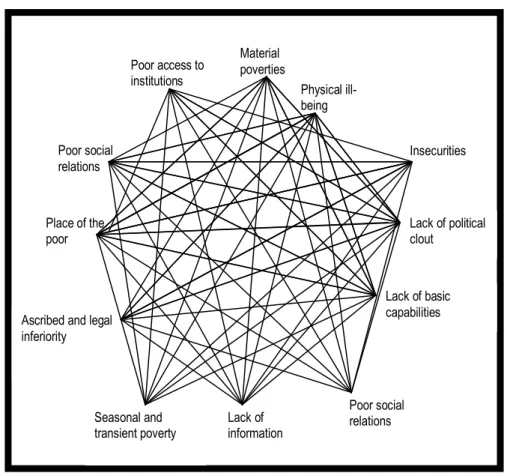
Figure 7 The Web of Poverty Disadvantages 45
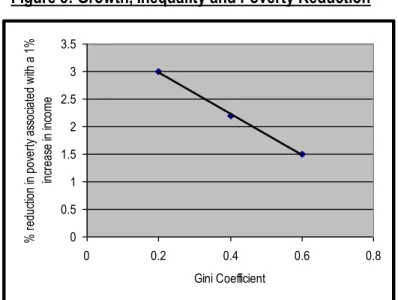
Figure 8 Growth, Inequality and Poverty Reduction 56
Figure 9 Impact of Investment on Returns 58
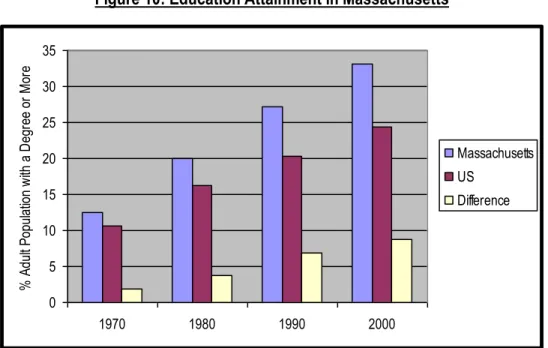
Figure 10 Education Attainment in Massachusetts 76
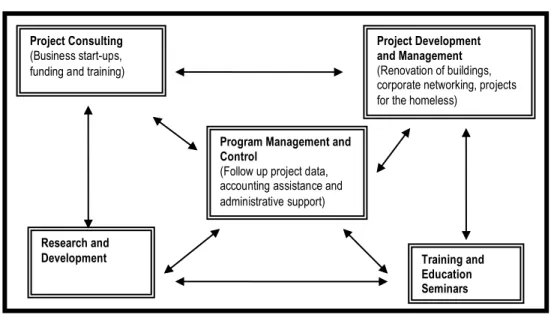
Figure 11 Activity Domains of the John Daniel Laweats Stiftung
Association 80
Figure 12 Population by Age Structure in KwaMashu 109
Figure 13 Education Attainment in KwaMashu 110
Figure 14 Household Income in INK (rand /month) 112
Figure 15 Serve Delivery in KwaMashu and INK 114
Figure 16 Comparison of Growth Rates 115
Figure 17 Evolution of SME‘s 129
Figure 18 Aerial Photograph of KwaMashu Town Center 133
Figure 19 Layout KwaMashu Town Center 134
Figure 20 Aerial view of Proposed Mahawini Business Hive 136
Figure 21 Existing Traders Stall 137
Figure 22 Proposed Traders Stall 137
Figure 23 Income levels per month of SME‘s at KMTC 143
Figure 24 Perceptions of Income growth since Start-up of SME‘s 144 Figure 25
Perceptions of Revenue and Output growth since Start-up of
SME‘s 145
Figure 26 State of SME‘s at KMTC 146
Figure 27 Forms of Assistance Required 148
Figure 28 Level of Assistance from INK ABM to SME‘s 152
Figure 29 Markets for SME‘s at KMTC 154
Figure 30 Level of Assets amongst SME‘s 156
Figure 31 Web of Factors Affecting LED Negatively 163
Figure 32 Model LED Cycle 167
Figure 33 Innovation Flow Chart 175
LIST OF MAPS
Map 1 KwaMashu and its Surroundings 103
Map 2 KwaMashu Precincts 105
Map 3 Spatial Framework INK Area 2005 106
Acronyms
ABM Area Based Management Program
ADB Asian Development Bank
CBD Central Business District
CBO Community Based Organization
CDI City Development Index
CED Community Economic Development
DPLG Department of Local Government
EDA Economic Development Agency
EU European Union
GDP Gross Domestic Product
HDI Human Development Index
IDB Inter American Development Bank
ILO International labor Organization
IMF International Monetary Organization
INK Inanda, Ntuzuma and KwaMashu
KMTC KwaMashu Town Center
LED Local Economic Development
LEDA Local Economic Development Agency
MDG Millennium Development Goals
NGO Non Governmental Program
PSIA Poverty Social Impact Assessment
RDP Reconstruction and Development Program
RSA Republic Of South Africa
SME Small Micro to Medium Enterprises
UN United Nations
UNCHS/UN HABITAT United Nations Center For Human Settlements
UNDP United Nations Development Program
URP Urban Renewal Program
USA United States Of America
CHAPTER 1: THE RESEARCH PROBLEM
1.0 BACKGROUND AND PROBLEM STATEMENT
Local economic development initiatives have been put forward as a panacea to poverty reduction and economic empowerment of communities in developing countries. Economic development has evolved from being purely measured in economic terms such as Gross Domestic Product, which did not necessarily measure distribution of income and wellbeing. Development theories have evolved to become theories with a ‗human face‘ (UNDP 2000) wherein development is not purely economic but aspects such as level of literacy, gender based development, quality of water and poverty levels are incorporated. Local Economic Development (LED) integrates the economic measures and humane aspects of development but goes on further to focus on development at a micro level. Local economic development is a conscious process wherein small communities assisted by better developed institutions work toward improving standards of social and economic life (Jeppe 1980). Thus in essence LED facilitates partnered development between the local government, community, private sector, NGO‘s and any other stakeholders.
The above partnered development has been explored elsewhere in eco-tourism projects in Siyakobvu Zimbabwe (Metcalfe 1993) and in rural Indonesia where the national government fostered clustered based industries. The results of such initiatives have been mixed (China Economic Review February 2007). In developing countries where LED has been going on for a number of years, it is difficult to identify stunning success stories; the collection of cases studies in (Aghón et al. 2001 cited by Meyer –Stamer 2003 ) gives little evidence of the outcome and impact of the initiatives described. Even in developed countries there are not that many LED success stories (Meyer –Stamer 2003). One cannot help but wonder: ―Is the popularity of LED perhaps more due to desperation than to a convincing track record?‖(Meyer –Stamer 2003 pg6). In South Africa, LED is a mandatory task of local government since it is viewed as a way of addressing imbalances brought about by the legacy of apartheid. Nevertheless it appears that, there is no clear concept and no consistent pattern of implementation of LED (Tomlinson 2003). In South Africa LED is encouraged by the national government through the Urban Renewal Program (URP) which seeks to kick-start development in previously disadvantaged areas such as KwaMashu.
Amongst its problems include: a youthful population with high unemployment, low levels of education, inadequate and poorly maintained infrastructure, high levels of poverty, crime, inadequate criminal justice capacity, poor transport systems environmental degradation and institutional capacity constrains (URP 2001). The city of Durban through its Economic Development has chosen to implement the urban renewal program by establishing the Inanda Ntuzuma and KwaMashu Area Based Management unit (INK ABM) which implements the program.
The INK ABM was established in 2001 by the Urban Renewal Program (URP) which targeted areas of greatest need .The URP aimed at conducting a sustained campaign against urban poverty (URP 2001). Though announced in early 2001, it is only recently that the URP in INK has gained real momentum. The eThekwini Municipality has chosen INK as one of its "learning areas" within the programme of Area Based Management and Development (ABMD) which was implemented in 2003 (Hindson 2003; eThekwini Municipality Report 2006. Currently the INK ABM is conceived as a system that complements rather than replaces line function departments, with a focus on mobilisation of actors, resources and co-ordination to secure integrated and sustainable development at the local level (Hindson 2003). The Area Based Management Programme is an institutional model for delivery and a means of bringing government to the people.
Despite Durban and other South African Cities engaging in LED initiatives for nearly a decade very few have assessed the impact of LED strategies on poverty alleviation (Nel and Rogerson 2005).
Only the financial and accounting systems of the LED initiatives have been rigorously appraised.
Meyer-Stammer (2003) argues that there is the fear that systematic impact assessments might paint a bleak picture, or is it a fact that LED makes little difference? It is therefore the aim of this research to establish how effective the LED strategies employed by the INK ABM in reducing poverty in KwaMashu.
1.1 OBJECTIVES
The overall objective of this thesis is to measure the level of poverty reduction attributable to the LED Strategies employed by the Inanda Ntuzuma KwaMashu Area Based Management Program (INK ABM) in KwaMashu. Specific objectives are listed below.
i. To identify aspects of poverty that has been reduced in KwaMashu.
ii. To asses the extent to which poverty alleviation is influenced by income and demographic characteristics namely age and sex in KwaMashu.
iii. To compare levels of poverty before and after the INK ABM in KwaMashu using indices such as Human Development Index(HDI) and City Development Index(CDI)
iv. To identify the positive and negative impacts of the LED strategies within the INK ABM in KwaMashu.
v. To establish the effectiveness of the structures put in place in the INK ABM project in KwaMashu in achieving the ultimate goal of poverty alleviation.
vi. To use the results to recommend further initiatives.
1.2 RESEARCH QUESTIONS
The overarching research question is: to what extent has LED led to poverty alleviation in KwaMashu .Specific research questions are listed below
i. What are the current LED strategies employed in KwaMashu?
ii. To what extent is the current LED strategy pro-poor?
iii. What were the levels of poverty before the INK ABM and after the INK ABM?
iv. What are the factors that affect LED as a poverty alleviation tool?
1.3 WORKING HYPOTHESIS
The implementation of LED strategies within the INK ABM has not led to a reduction of poverty in KwaMashu.
1.4 RESEARCH LOG FRAME
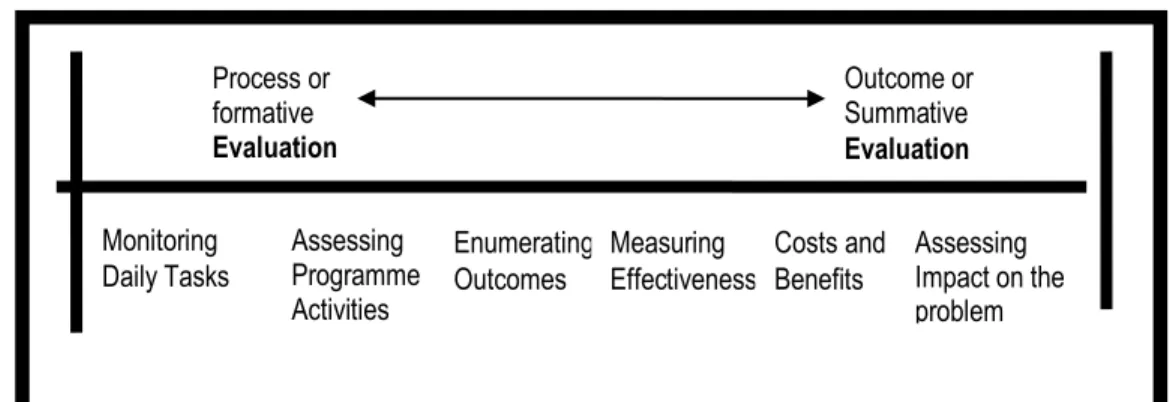
The research sought to, asses the impact of LED strategies on poverty alleviation in KwaMashu. It uses the PSIA as a method of evaluating the changes in wellbeing as a result of the INK ABM in KwaMashu. Evaluation is the ―systematic application of social research procedures in assessing the conceptualization and design, implementation, and utility of social intervention programs (Rossi and Freeman 1985: p. 19 cited by Bartik and Bingham 1997). Evaluation of LED takes place in a continuum from process to assessing impact of the problem; this is summarised in figure 1 below while the framework for analysis is summarised in figure 2 below .
Figure 1: LED Evaluation Continuum
Source; Bartik and Bingham (1997)
Figure 2: Framework for Impact Assessment
Source: Author‘s Construct
The research determined whether the initial problem of poverty has been reduced by the LED strategies being employed by the INK ABM in KwaMashu, by using the one group pre-test and post test approach. With this approach the status of SMES and households in KwaMashu is examined before the inception of the INK ABM and during the implementation of the program. This approach is summarized in the log frame shown on the next page.
Process or formative Evaluation
Outcome or Summative Evaluation
Monitoring Daily Tasks
Assessing Programme Activities
Enumerating Outcomes
Measuring Effectiveness‘
Costs and Benefits
Assessing Impact on the problem
INK ABM PROJECT
LED
STRATEGIES
a. Asset Indicators b. Basic needs(Water,
sanitation, electricity, refuse removal, telephone) c. Human
capabilities(education) d. Employment
e. Income
f. Awareness of residents of the INK ABM IMPACT ON
POVERTY INDICATORS
Table 1: Research log frame
Objectives Data Sources Tools and Techniques Indicators Data analysis
To identify aspects of poverty that
has been reduced in KwaMashu Households, SME‘s, line staff INK ABM ,LED professionals and Secondary data
Questionnaires, key informant interviews and
mapping Asset, basic needs Human
development indicators, City Development Index (CDI), employment and income indicators.
Data entered into excel worksheets, compare and analyze trends, profiling and grouping using the pivot table function in Microsoft excel l
To asses the extent poverty alleviation is influenced by demographic characteristics namely age sex and income in KwaMashu.
Households, SME‘s line staff INK ABM and eThekwini municipality, LED professionals census data, INK business plans and other secondary data
Questionnaires, key informant interviews and
secondary data Asset, basic needs
employment and income indicators, human development indicators.
To compare levels of poverty before and after the INK ABM in KwaMashu using indices such as Human Development Index(HDI) and City Development Index(CDI
Households, SME‘s, line staff INK ABM and eThekwini municipality,
professionals and census data
Questionnaires, key informant interviews , mapping
and secondary data Asset, basic needs Human
development indicators, City Development Index (CDI), employment and income indicators.
To identify the positive and negative impacts of the LED strategies within the INK ABM in KwaMashu.
Households, SME‘s, line staff INK ABM , eThekwini municipality and LED professionals
Questionnaires, key informant interviews, and
secondary data Asset, basic needs, Human
Development Indicators, City Development Index (CDI), employment and income indicators.
To establish the effectiveness of the structures put in place in the INK ABM project in KwaMashu in achieving the ultimate goal of poverty alleviation
Households, SME‘s, line staff INK
ABM ,and LED professionals Questionnaires and key informant interviews Awareness, milestones and targets set by the INK ABM
To use the results to recommend
current and future LED strategies Households, SME‘s, line staff INK ABM, Led professionals and secondary data
Questionnaires and key informant interviews , Asset, basic needs, Human Development indicators, City Development Index (CDI), employment and income indicators.
1.5 STRUCTURE OF THESIS
Chapter 1: The Research Problem-This chapter introduces the research study, aims, objectives, hypothesis and the justification of the research.
Chapter 2: Conceptual framework- The conceptual framework outlines a preferred approach to a system of analyzing phenomena (Carman 2004). It is a model of how one is to approach the issues of LED, poverty and poverty alleviation. In this framework key concepts are defined and the theories behind the particular definitions are discussed.
Chapter 3: International Perspectives on LED and Poverty.The chapter establishes the previous and current international debates with regards to the LED poverty alleviation nexus. Best practices with regard LED as a poverty alleviation tool are discussed
Chapter 4: LED in South Africa.-This chapter explores the current setup of LED in South Africa. It also discuses best practices of LED as poverty alleviation in South Africa.
Chapter 5 Research methodology- This section describes the tools and techniques used in this research. The methodology employed is mixed method research which employs both quantitative and qualitative methods of research.
Chapter 6: Planning, Development and Poverty in KwaMashu-This chapter provides a historical background The development and poverty a profile and the planning setup in KwaMashu is also discussed.
Chapter 7: LED Strategies in KwaMashu-The chapter gives the background of the Urban Renewal Program (URP) which brought about the establishment of the Inanda Ntuzuma KwaMashu Area Based Management Program (INK ABM).It discuses the LED strategies being employed by the INK ABM/URP in KwaMashu
Chapter 8: The Impact of LED Strategies on Poverty in KwaMashu- This chapter highlights the impact, both positive and negative of the LED strategies used in KwaMashu. It establishes the level, the depth, incidence of impact of the various strategies on poverty. The chapter also explains the reason behind the impact.
Chapter 9: Summary of Results, Recommendations and Conclusions. This chapter gives a summary of the findings of the research, whether LED is has had a major impact in alleviating poverty. Recommendations on improving LED as a poverty alleviation strategy are also made.
Lastly the chapter makes an overall conclusion on the study
CHAPTER TWO: CONCEPTUAL FRAMEWORK
"We have entered the urban millennium. At their best, cities are engines of growth and incubators of civilization. They are crossroads of ideas, places of great intellectual ferment and innovation...cities can also be places of exploitation, disease, violent crime, unemployment, and extreme poverty...we must do more to make our cities safe and liveable places for all." (Kofi Annan 2000). In this regard LED can be a useful tool if considerable time and care is taken in conceptualising LED
2.0 INTRODUCTION
This chapter defines and describes the key concepts and approaches used in this thesis. Local Economic Development (LED) and poverty are key concepts within which this study is conceptualized. LED is a concept used to achieve economic growth and poverty alleviation in developing countries. Poverty has various dimensions namely absolute, relative and human poverty within which this study is conceptualized. Poverty alleviation also has various approaches namely: income, basic needs social exclusion, human development and sustainable livelihoods.
These approaches assist in determining, the type, extent and dynamics of poverty. In these various approaches to poverty it is established that poverty is multidimensional. Thus poverty can be measured using simple income poverty lines and other complex measures such as Human Development Index (HDI) and City Development Index (CDI) which acknowledge the multi- dimensionality of poverty. These measures assist in determining whether LED is an effective tool in reducing poverty.
2.1 LOCAL ECONOMIC DEVELOPMENT
International experience suggests that LED is a slippery concept which is at times difficult to define (Syret 1995; D‘Arcy and Guissani 1996 cited by Meyer Stamer 2003). In South Africa LED has been interpreted in different ways resulting in policy confusion (Rogerson 1997). Nevertheless there is an emerging consensus that, among its core elements LED promotes growing local economies as well as addressing poverty alleviation (Rogerson 1999). Following this line of
communities assisted by better developed institutions work toward improving standards of social and economic life. Thus in essence LED facilitates partnered development between the local government, community, private sector, NGO‘s and any other stakeholders. The World Bank 2003 defines local economic development as ―local people working together to achieve sustainable economic growth that brings economic benefits and quality of life improvements for all the community.‖ A community; it is defined as an area, a city, town, metropolitan areas or sub national region (ibid). Local is defined as any urban area ranging from large cities to small towns and also implies the inclusion of rural areas linked to towns (World Bank 2003). LED can be described as a territorial planning tool employed by local authorities, using local resources to withstand national and global pressures (Pose 2001). LED thus can be defined as:
“A process in which partnerships between local government, the private sector and the community is established to manage local, and access external, resources that can be used to stimulate the economy of a well defined territory. In its earlier incarnations, the goal of LED was generally restricted to growing the economic and tax base of a location.
More recently, in the context of the Millennium Development Goals, a distinction has been made between economic growth as the “immediate goal” and poverty eradication as the
“overall goal” of LED” (Hindson and Meyer-Stammer 2007: pg 10)
In summary LED seeks to promote economic growth and poverty reduction. LED is endogenous, involves partnerships, should be sustainable and seek to improve the quality of life of citizens Given the nature of LED it is seen as an appropriate process for creating suitable conditions for sustainable employment, small and medium enterprise creation and growth; and for promoting human development, and decent work (Canzanelli 2001; ILO 2001). However there still remains a dilemma of how LED achieves the above. Canzanelli (2001) sets out the parameters which are deemed necessary to achieve poverty reduction and economic growth namely: participation, endogenous resources, and support to vulnerable groups and sustainability. These parameters are briefly described below.
o Participation- In order to realize sustainable development at local level, it is necessary that the stakeholders share a mutual vision of the future (Canzanelli 2001). This is
necessary, albeit not a sufficient condition and, is generally lacking in developing countries (ibid). Sharing a mutual strategic vision of development may be one of the most difficult things to achieve and the only way to meet this condition is to commence a long and tortuous dialogue among the local actors which may also be unsuccessful (ibid). The difficulties of succeeding in the elaboration of a mutual shared vision are related to the wideness of the territory concerned (ILO 2001). The territory must be big enough to ensure the presence of a critical mass of resources on which to base a LED intervention, but also small enough to allow a proper bottom-up participatory approach (Canzanelli and Dichter 2001). In essence LED should try to encourage participation even though difficulties may arise.
o Endogenous resources. A Local Economic Development approach should be based on the exploitation and development of the local endogenous resources (Canzanelli 2001, Bond 2003). The sustainability of the intervention strongly relies on the positive response to this condition (Canzanelli 2001). Therefore local economic development should be based on local resources. Foreign direct investment is not excluded in this milieu, but it should anyway be directed towards the use of local potentialities (Canzanelli 2001).
o Support to vulnerable groups. Local Economic Development practices should be carried out as means to favour social inclusion of the vulnerable groups (Canzanelli 2001).
Activities should be based on the broader concept of human development (UNDP 2006).
So issues such as the access to economic opportunities, the provision of decent work, the safeguarding of the environmental bio-diversity should be incorporated in a LED program (ILO 2001).
o Sustainability. LED should not detract from but rather enhance the economy to achieve the same goals in the future. It embodies the promise of societal evolution towards a more equitable and wealthy world in which the natural environment and our cultural achievements are preserved for generations to come (EDA 2007). LED should therefore seek sustainability financially, socially, institutionally and environmentally. Financial sustainability implies that an LED intervention should be able to cover its own expenses, possibly detaching itself as soon as possible from the funding of the donor agencies which
sustained the intervention at the beginning ( Canzanelli 2001) .Social sustainability implies that a shared vision of future development is reached among all the local actors (Canzanelli and Dichter 2001). Institutional sustainability implies that local administrations and authorities are fully committed to support the process and to channel to it all the public initiatives to be implemented in the area (ILO 2001).
From the above discussion it is clear that LED involves participation and social dialogue, it is territory based, entails mobilisation of local resources and competitive advantages, it is endogenous and should be sustainable. LED can therefore be broken down in three to come up with a better understanding as described bellow.
o Local: which entails endogenousness or a specific territory (Pose 2001) o Economic: which entails identifying investment opportunities and improving
competitiveness (EDA 2007;Meyer-Stamer 2005)
o Development: entails improvement in the living conditions or quality of life or a shift from ill-being to well being (Chambers 2006)
Using the above breakdown of LED Meyer Stamer develops a hexagon which identifies the key issues shown in figure 3 below. It consists of six different pies described below:
Figure 3: Key Issues in LED
Source: Meyer- Stamer (2005)
TARGET GROUP
LOCATIONAL FACTORS
SYNERGIES SUSTAINABILITY
GOVERNANCE
PROCESS MANAGEMENT
i. Target group- LED targets organisations or companies that are locally based external investors and business start-ups.
ii. Locational factors-these are factors which define attractiveness of a location; they may be tangible for example access to roads, and intangible factors, for example quality of life.
iii. Synergies-this refers to three interrelated and at times competing pies of LED namely:
economic promotion, employment creation/poverty alleviation/community development, and urban development .The challenge is to clearly define these otherwise conflicts may arise. Another challenge is to create synergies between the fields such that they are reconnected in a meaningful way (Meyer- Stamer 2005).
iv. Sustainable development- looks at sustainability in economic, social and ecological aspects of development.
v. Governance-this triangle postulate a governance of which is appropriate for LED, it must be based on administrative and regulatory streamlining in the public sector and organisational development in the private sector (Meyer –Stamer 2005).
vi. Process management-means that LED should be based on iterative planning implementation, monitoring and evaluation, benchmarking and reflecting which leads to adjusting and additional planning (Meyer-Stamer 2005).
From the above discussion it is clear that the six components are essential components when planning for an LED strategy.
2.1.1 LED Planning Process
LED is an endogenous process therefore the planning for a LED strategy should begin with the local people. The LED process always starts when local people, eventually together with national or even international institutions, join together in discussing how to establish common strategies for achieving determined aims and objectives, generally dealing with employment, fight against poverty and exclusion, improvement of the territorial quality and competitiveness (Canzanelli 2001). The LED planning process should form an integral part of the broader strategic planning process for a region, city, town or rural area (World Bank 2003). The LED planning process has five stages (see figure 4 below).
Figure 4; LED Strategic Planning Process
Source; Adapted from World Bank (2003)
From the above figure one can denote that the LED process is a cyclical and iterative process. The LED process is not prescriptive but should be flexible such that it adapts to a certain locality (World Bank 2003).The various stages of the planning process are discussed below.
2.1.1.1 Organising Effort
3
Organising effort involves identifying the people, public institutions, businesses, community organisations and other groups with interests in the local economy (World Bank 2003). Canzanelli (2001) defines this initial identification as the initial local forum. The initial local forum is usually headed but not always by the local government of the area. This can be through promoting an Economic Development Department in the local government department. Once the economic development unit has been set up, the various stakeholders have to be managed by identifying the key stakeholders, defining their interests and the best way to involve them (World Bank 2003).These stakeholders may include, the public sector, private sector and community sector.
Indeed stakeholders bring benefits which include specialist knowledge, resources, knowledge of the local area and they legitimise the process by being involved (World Bank 2003). Canzanelli
Evaluation
LED Planning Process
Develop the LED Strategy Conduct the competitive assessment
Implementing the LED Strategy
Organising effort
(2001) notes that these stakeholders have various interests and need to be managed tacitly. He goes on to explain that at this stage the stakeholders need to establish a common social ground or what he terms ‗social capital‘. Social capital is ―the ability of people in working together for a common objective and in an organised and voluntary manner, sharing rules and values and being able to subordinate individual interests to collective ones‖ (ibid). When this common vision is shared a competitive analysis for the area may be done.
2.1.1.2 Competitive Assessment
To develop a LED strategy, the community must be fully informed about their own town or city, their own region and their national economy (World Bank 2003). Information from a competitive assessment is crucial in that it identifies local attributes that hinder or promote LED. A local economy assessment involves collecting strategically important information and then analyzing it strategically (World Bank 2003. The information may include:
o Demographic information: information about the people in the community, what they need and what they are capable of.
o Economic information: This information will provide an understanding of the local economy.
o Investment climate information: This will inform on how the local government treats its business community.
o Hard Infrastructure information: This indicates the status of water, electricity, wastewater provision, transport infrastructure and other physical structures necessary for LED.
o Regional and National information: This involves gathering information on what is happening in other areas that may impact on the community.
When the data is collected a SWOT (strength, weaknesses, opportunities and threats analysis) analysis is undertaken. From the analysis, an area‘s competitiveness can be defined. This competitiveness in the current economic context does not depend on the antagonism of single companies, but relies on the environmental conditions that allow a certain territory to attract investment or selling its products or services, or facilitating advantageous agreements (Canzanelli
2001). Competitive analysis also takes place at various levels which are the meta, macro, meso and micro level.
At the meta level three issues are of concern; firstly, a social consensus on the guiding economic principle; secondly, a basic pattern of legal, political, economic, and overall social organization that bolsters national innovative, competitive and growth advantages; and thirdly, the willingness and ability to implement a medium- to long-term strategy of competition-oriented development (Esser et al 1996 cited by Canzanelli 2001). The main concern at the macro level is to create the framework for effective competition, a stable macroeconomic framework that ensures undistorted prices and favorable financing terms. The key issue at the micro level is an effective management of technical and organizational learning processes at the firm level (ibid). The meso level is concerned with shaping the specific environment in which firms operate. This is where the state and societal actors on the national, regional, and local level are creating locational advantages (Canzanelli 2001).
With a competitive assessment the local area is able to draw a community profile. This profile sets out possible pointers to developing a LED strategy and possible threats to a strategy (Canzanelli 2001; World Bank 2003). The City of Durban in 1996 undertook a competitive assessment where it identified its coast, beaches, natural environment as its competitive advantage and high poverty and unemployment as its major threats (Maharaj and Ramballi 1998). It is this assessment which is key in coming up with an LED strategy in developing countries.
2.1.1.3 Developing the LED Strategy
Strategy making involves coming up with a holistic approach to LED whilst taking into cognizance the competitive assessment of the local economy (World Bank 2003). Developing a LED strategy involves creating a vision, developing goals and objectives, developing programs and projects to achieve the objectives and documenting the strategy (World Bank 2003; Canzanelli 2001).
Creating a vision should involve all the stakeholders and it should focus on the stakeholder‘s preferred economic future. A strategic vision for the development of a certain territory is the first step the local actors pursue for fixing collective ideas and images, exchanging interests and values, identifying strengths and weaknesses of their territory, and all the necessary issues for the assessment of future coherent actions (Canzanelli 2001). The vision gives a sense of direction
even though it may not be achievable. Examples of LED visions include The City of Johannesburg whose vision is to become a ‗World Class African City‘, Buenos Aires: ‗The Environmental Quality of Life City‘, Seattle: ‗Gateway for high-tech to the Pacific Northeast‘ and Singapore: ‗The Most Globally Connected City‘ in the world. The vision helps in formulating goals and objectives.
Goals point more specifically to the outcomes the community seeks to achieve, whilst objectives are more specific, time bound and measurable (World Bank 2003). For example Singapore‘s vision is to become globally connected therefore it developed goals such as to invest in telecom infrastructure whose specific objective is to improve access to broadband internet. When the goals and objectives are set programs and projects to achieve them will be set in motion. It is also important to note that the LED strategy has to be documented for everyone to have access (ibid).
2.1.1.4 Implementing the Strategy
Implementation of LED strategies is driven by plans. When coming up with the plans various factors need to be taken into consideration. These factors include urgent priorities, resources, capacity and anticipated risks which pertain to a certain locality (World Bank 2003). The factors determine the type of LED to be implemented. Implementation of a LED strategy is usually through Private Public Partnerships (PPP‘s) that are strongly driven by the local authority (Mullin 2002, World Bank 2003). Canzanelli (2001) argues that the successful implementation of an LED strategy depends on formation of an implementing agency which he terms Local Economic Development Agency (LEDA). The creation of a functional structure, or ‗Local Economic Development Agency‘, is likely to contribute to success of LED processes. Such a structure will help establish an identity and visibility for the local development initiative, act as a vehicle for communication between partners, provide the technical skills for developing projects ,support entrepreneurs, facilitate coordination of efforts and initiatives and it can have long term objectives, since it is stable, self-sustainable and permanent (Canzanelli 2001). In USA an example of a LEDA is the Economic Development Agency (EDA). International organizations which act as LEDA‘s include European Union (EU), ILO, UNDP, and OECD. In South Africa LEDA‘s include The Department of Trade and Industry, and the Economic Development Department (eThekwni Municipality) which together with the EU manages the INK program. The LEDA is also a useful vehicle for monitoring and evaluating LED (World Bank 2003).
2.1.1.5 Evaluating LED
Evaluations can be divided into two categories—process or formative evaluations and outcome, impact, or summative evaluations (Bartik 1997). Process evaluations focus on how a program is delivered while impact evaluations focus on the program's results (ibid). Evaluation is critical in identifying whether the LED has met its objectives or whether it is achieving the desired outcomes (ibid) .This may point areas which needs further attention. Evaluation also depends on the type of LED strategies (ibid).
2.2. LOCAL ECONOMIC DEVELOPMENT STRATEGIES
Local economic development consist of three strategies namely, community economic development, locality development planning and enterprise development (Helmsing 2001).
Amongst these forms‘ LED assumes both supply and demand sides. Supply side policies are directed towards businesses through tax incentives and non tax incentives which are either discretionary or non discretionary (Eberts 2005).Demand side policies are aimed at providing an enabling environment for innovation, research and development, Small to Medium Enterprises(SME‘s) development and entrepreneurial activity. The supply and demand polices have existed and evolved in USA, Canada and Europe since the 1960‘s and they are classified into three waves (Clarke and Gaile 1998; Friedman and Ross 1990). Currently the world at large is in the fourth wave of LED initiatives (Clarke and Gaile 1998). The fourth wave differs significantly from the other three in that it focuses on integrating the local economy into the global market, developing human capital and increased use of telecommunications (Clarke and Gaile 1998) These waves are summarised in the ( table 2, see next page).
From table 2 it is clear LED has evolved from merely attracting investment to a local area to placing a local area onto a vantage point globally. These stages do not exist in isolation, and they overlap, with a mixture of strategies being employed at one time, depending on the type of pressures being faced by a local economy.
Table 2 Classification of Local Economic Development Strategies
Source; adapted from Clarke and Gaile (1998)
This pressure may be at local, national or international level (ibid). For example in South Africa despite a largely stable macro economic climate and large metropolitan cities, poverty still exists side by side with prosperity (May 2004). This is also echoed internationally with a great divide between the developed countries and developing countries (UNDP 2006). On one side are poor countries with relatively high birth rates and low life expectancies. On the other side are wealthy countries with birth rates so low that population decline and rapid aging are likely (UNDP 2006).
This divide involves a set of forces that affect the economic, social, and political circumstances in these countries. In this regard The United Nations at the UN millennium summit in 2000 embarked on the Millennium Development Goals program where one of the goals is poverty alleviation through various strategies including LED (UNDP 2005). Helmsing (2001) classifies LED strategies into three namely; community economic development (CED), enterprise development and locally planning which are described below.
Component First Wave
(1960’s-early 1980’s)
Second Wave (1980’s - mid 1990’s)
Third Wave (Late 1990s -2000)
Fourth Wave (2000 to Date) Goal Attract Outside Firms Retention and expansion
of firms
Enhance regional resources to promote industrial clusters
Enhance global competitiveness
Location of Assets
Discount them to attract outside business
Reduce taxes and provide incentives to business
Build regional collaboration
Globall, since there are no boundaries
Business Focus
Outside firms Assist all local firms Create context for better relations among firms
Being internationally friendly
Human Resources
Create jobs for locally unemployed people
Develop training programs Utilise workforce training to build businesses
Investment in human capital
Community base
Physical resources Social and physical resources
Leadership and development of quality environment
Build on international resources
2.2.1 Community Economic Development (CED).
Community economic development is development from the inside to the outside and its goal is development and empowerment of the individual and community (McLaughlin and Davidson 1994).
CED is the process by which local people build organizations and partnerships that interconnect profitable business with other interests and values: for example, skills and education, health, housing, and the environment (Helmsing 2001). In CED more local people get involved, describing how the community should change and organizations look for ways to make their actions and investments reinforce the wishes and intentions of the whole community (Perry 2003). With CED business becomes a means to accumulate wealth and to make the local way of life more creative, inclusive, and sustainable - now and the years to come (ibid). CED thus focuses on developing a community and involves various strategies such as women empowerment, training local businesses and harnessing human capital through training (Reich 1993 cited by Helmsing 2003).
Helmsing (2003) points out that CED aims at, stimulating a sense of belonging, to promote self help and empowerment, to contribute to the generation of (self) employment, to improve living and working conditions in settlements and to create public and community services. Helmsing has with taxonomised and classified CED strategies namely; creating local safety nets, housing improvements and settlement patterns, basic service delivery and stimulating the local economy.
These are described below.
i. Creating Local safety nets- Poverty shocks of any kind further deepens poverty, hence creating safety nets and reducing insecurity is essential for better LED conditions (Helmsing 2003). For example creating day care centres means women have more time to partake in economic activities (ibid). Credit groups and savings clubs may be formed to meet local emergencies. While physical security can be enhanced by formation of neighbourhood watch committees who patrol the community (ibid). However Helmsing notes that physical security is a serious economic problem which needs to be addressed.
ii. Housing improvement and settlement pattern- Settlements can be upgraded by improving infrastructure such as water, electricity and sewerage pipes. Houses may also be upgraded taking into consideration that a house is not only a place of
residence but economic activity as well (UN HABITAT 2000). In Zambia informal settlements have been upgraded by provision of services such as water (Helmsing 2001).
iii. Basic service delivery- Unbundling of basic service delivery through privatization and or on a non profit basis can stimulate a local economy. In Ghana Accra 51 Small to medium scale enterprises have been contracted to provide public latrines (Helmsing 2001). Waste collected has also been subcontracted to SME‘s (Aworti.2003).The 2010 soccer world cup has also meant a boom in the local South African Industry through subcontracting of building infrastructure.
iv. Stimulating Community Economy- A communities economy may be depressed because of an uneven playing field in terms of market entry (Helmsing 2003).
Individuals and households fare worse in a market led economy because they lack the resources to effectively produce and compete, and also there are barriers to entry.
However this may be ameliorated by removing barriers to entry and recognizing the importance of the informal sector. Programmes may also be carried out to stimulate development; these include credit programmes, training of SME‘s as contractors of basic services and technical assistance and marketing (ibid).Such initiatives may help train those that are deemed unemployable to become part of the workforce(ibid).
2.2.2 Enterprise Development.
Enterprise development refers to improving the economic base of an area (Schmitz 1998). The economic base refers to those firms which are export geared, the destination of these exports could be other parts of the country or beyond national borders (Helmsing 2001; Schmitz 1995:).
These exporting firms have a tendency to cluster since several benefits accrue to them (Schmitz 1998). These benefits include, firms supporting each other , reduced transaction costs as a result of close proximity to each other, being in a position to lobby for better training and education thus increasing the capacity to learn(ibid). The economic base is improved by attracting foreign direct investment, supporting invention, innovation and diffusion by local firms (Schumpeter1976). The economic base can also be enhanced by promotion of Small to Medium Enterprises which involves
having in place allied services such as finance, transport and freight and promoting industrial clusters (Helmisng 2001).
It is argued that Marshall (1919) cited by (Helmsing 2001) was the first to recognise the potential of industrial clusters. He defines industrial clusters as a concentration of small firms in the same industry which are indivisible from the local industry and local society. In essence they are one unit hence their usual reference in literature as agglomeration economies (Nadvi 1999). Becattin (1990 cited by Helmsing 2001) defines industrial clusters as a socio-territorial entity which is characterised by the active presence of both the community of people and firms. Onus and Malecki (1999) on the other define industrial clusters as an embodiment of interaction and dense network of linkages between firms that comprise of a local production system, usually around a single or highly related industry.
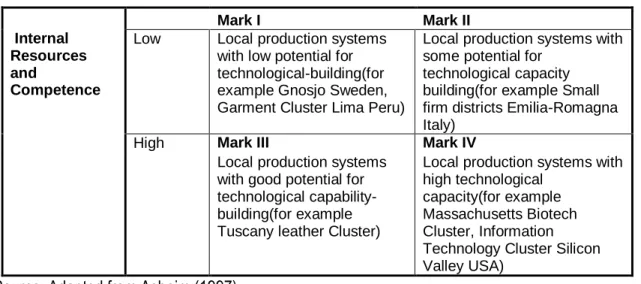
From the above definitions industrial clusters are characterised by specialisation, division of labour, they are indivisible from the local areas values and norms and they operate within close proximity of each other (Marshal 1919; Nadvi 1999; Sahel 1989; Storper and Scot 1989 cited by Helmsing 2001). Examples of clusters include the Massachusetts Biotech cluster USA, the leather cluster in Tuscany Italy, the fish processing cluster Lake Victoria, Kenya and the garment cluster in Lima, Peru. These clusters differ in the level of sophistication with the Massachusetts cluster being a hi- tech cluster and the garment cluster in Lima generating income for the community ( McCormick 1998 cited by Helmsing 2001). Asheim (1997) seeing the difference in sophistication goes on to classify industrial clusters according to the level of sophistication. This differentiation is also seen in SME‘s where they range form simple incipient SME‘s to mature SME (Nadvi 1999). According to Asheim industrial clusters as range from Mark I (low level of sophistication) to Mark IV (high level of sophistication). The typology is summarised in the table 3 below.
From table it is clear that industrial clusters (Mark I) are not sophisticated in terms of organisation whilst the Silicon Valley cluster, which is a Mark IV, is highly organised. Nadvi and Schmitz (1999) go further to taxonomies industrial clusters into incipient or survival clusters and mature clusters.
Incipient clusters are at an early stage of development and are usually located in poor areas, producing for local areas, with simple skills and technology.