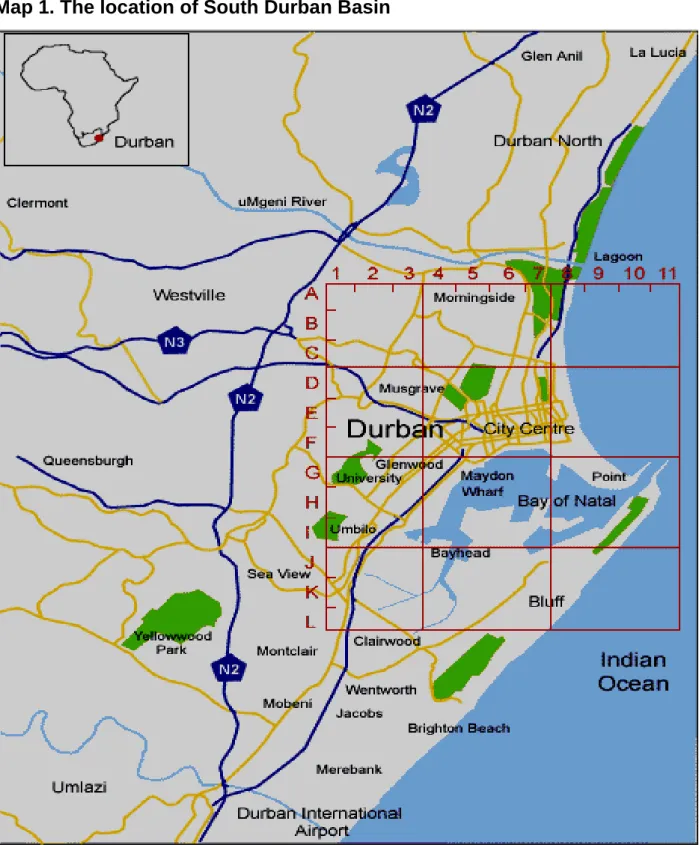
This study evaluates the extent to which the industries in South Durban Basin comply with environmental regulations. SARAH South African Railways and Ports SAPREF South African Petroleum Refineries SDB South Durban Basin.
Introduction
This study also recognizes ISO 14001, which was initiated in 1996 as an international standard for assessing and improving an organization's environmental management systems (Sheldon, 1997). The study also takes into account the National Environmental Management Act (NEMA), which took effect in 1996.
The location of South Durban Basin
Problem statement
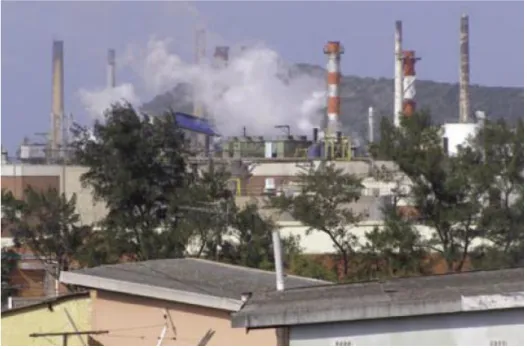
In the South Durban Basin, the most common type of pollution is air pollution (Scott et al, 1999). Additionally, the eThekwini Council has also acknowledged that the South Durban Basin (SDB) is environmentally degraded; experiences very high levels of air pollution and waste disposal problems, and that the problems are also compounded by the loss of vital natural resources (KMT Enterprises, 2004).
Objectives
- Research question
- Sub-questions
What are the factors that explain South Durban Industries' inability to comply with environmental regulations? What are the institutional challenges that have affected the enforcement of environmental regulations in the South Durban Basin?
International and local precedents in Environmental Regulations
- Inadequacy of environmental regulations controlling South Durban
- Comparative International literature on industrial pollution and
Much research has been carried out in the southern Durban Basin on industrial compliance with environmental regulations (Scott, 2002). In particular, Scott (2002) found that it is not true that air quality in South Durban is likely to be difficult to reduce or that enforcement of environmental regulations is poor or difficult to apply.
The study area
South Durban Basin is also home to a number of people from different racial groups, mainly poor Africans and Indians (Chetty, 2004). Chetty argues that the location of the working class on the access roads to industries in the South Durban Basin and surrounding areas was the result of inappropriate urban spatial planning during the apartheid government.
Conceptual and Theoretical Framework
- Definition of concepts
Environmental regulation is the body of legislation passed by Parliament or promulgated by the relevant ministers to ensure that the activities of all people are controlled so that they do not cause significant environmental degradation. As stated by Lazarus, in cases where there is non-compliance, it is the Environmental Management Inspector's duty to report the matter to the Minister or MEC as the case may be and the Minister or MEC can, acting in terms of subsection (2):. a) revoke or change the relevant permit, authorization or other instrument which is the subject of the compliance notice;.
Methodology
Targeted communities in Durban South were those close to industries, including local residents of Merebank, Wentworth, Mlazi and Isipingo. Targeted NGOs include the South Durban Community Based Organization (SDCBO) and the South Durban Community Environmental Alliance (SDCEA).
Dissertation Structure
MTRP2011 Page 13 The data sources for this research were local communities in the South Durban Basin, South Durban Industries, public environmental authorities and bodies, non-governmental organizations and the eThekwini Municipality. All these companies have a long history and are considered perpetrators of air, water, noise and soil pollution in southern Durban (Lazarus, 2007).
LITERATURE REVIEW AND THEORETICAL FRAMEWORK
- Introduction
- Approaches to Improving Environmental Enforcement and Compliance in
- Formal institutional and regulatory context in improving Environmental
- Compliance promotion and enforcement tools
- Community participation in regulating industrial environmental impacts
- Increasing public participation for the purpose of reducing industrial pollution in
- South Durban Community Environmental Alliance (SDCEA)
- The perception of environmental racism in South Durban Basin
- Contested urban politics of air pollution in south Durban (local precedents)
- Overview of industrial air pollution studies in South Africa
- The struggle of South Durban Basin with environmental degradation
- International precedents
- Multinational corporations and environment in developing countries
- Overview of Industrial air pollution studies in India
- Environmental Regulations in India and their relations in South Durban
- Environmental pollution leads to impoverishment and violence in Nigeria
- Summary
Public or community participation is an important part of the regulatory regime for the control of point sources of pollution. Advocacy and public engagement are some of the tools used in the south of the Durban Basin by the South Durban Community Environmental Alliance (SDCEA). Cox (1998) is one of many scholars using the South Durban Basin as a case study.
This law established rules for the management and protection of the environment, including water, air and land. India is one of the ten most industrialized countries in the world (Bell et al, 2003). The chimney is one of the big industries that emit gases that make breathing difficult.
One of the main areas of discussion at the dialogue was how the environmental review process is conducted by all government agencies in India and the US (Down to Earth Report, 2000). Small-scale industries (capable of high levels of pollution) are left out of the scope, further undermining the determinations in pollution control. This has led to the same situation as in the Durban basin of South Africa, which is poverty, conflict, human rights abuses, despair for most people and even caused local communities to have a lack of trust in the government of theirs.
Research Methodology
- Introduction
- What is methodology?
- Research type
- Control research
- Empirical research
- Sources of data
- Sampling procedure
- Interview Process
- Interview or data collection techniques
- The role of the researcher during the interview process
- Data analysis
- Introduction
- Geographical location
- Historical background
- Situational analysis
- Challenges faced by communities in South Durban Basin
- Development of Environmental Community Based Organizations in South
- Summary
These were selected because they are well-known non-governmental organizations with a long history in the South Durban Basin. The geographical location of South Durban Basin Industries and its historical background will be described. South Durban Basin is a combination of industrial and residential areas located close together.
The pressure from community-based organization leaders eventually led to the declaration of the so-called South Durban Basin Multi-point Plan (SDBMPP) in November 2000 by the former Minister of the Environment, Mr ValliMoosa (Chetty, 2005). Dodson (2002) argues that the progressive development of the South Durban Basin area has been accompanied by increasing environmental problems affecting the quality of life in nearby communities. These toxic incidents according to Musvoto (2007) have become "normal" for industrial operating conditions in the South Durban Basin Industries.
The South Durban Community Environmental Alliance (SDCEA) is a local community-based environmental justice organization in the South Durban Basin.
Results and Discussion
- Introduction
- Discussion and analysis
- Mechanisms for enforcement of environmental regulations
- Institutional framework
- Views from South Durban Basin local communities (households and
- Actions by local communities of South Durban Basin
- The role of South Durban Community Environmental Alliance
- The involvement by local government in combating environmental degradation
- The extent of compliance with environmental regulations
- Implementation, enforcement and compliance with environmental regulations
- Actions by industries in mitigating environmental pollution in South Durban
- Views on environmental pollution from South Durban Basin industries
- The strength and weaknesses of the South African government in the
- The impact of environmental regulations on the industrial sector (national
- The relationship between industries, local communities and government
Views from local communities in the South Durban Basin (households and community organizations). This was the moment when most local communities in the South Durban Basin finally lost confidence in the government. She puts the blame on the government and says the government should hand the matter over to the people to solve environmental pollution in the South Durban Basin area.
The role that local communities in the South Durban Basin can play in ensuring that industries comply with environmental regulations is vital. MTRP2011 Page 64 For several years, the communities in the South Durban Basin have been trying to find solutions to the environmental pollution issue. This argument shows that the Government has failed to take reasonable measures to evaluate and reduce air pollution in the South Durban Basin.
The local communities in the South Durban Basin have tried their best to find ways and approaches to solve the problem of pollution. In terms of upgrading, industries have negatively changed life in the South Durban Basin. Many serious disputes have arisen in the South Durban Basin area between local communities and industries.
Summary of Findings, Conclusions and Recommendations
- The way forward on environmental regulations in industries
According to Dasgupta et al (1999), one of the ways to ensure and improve environmental compliance in industries is to treat pollution control as an economic issue. As a result, industries as polluters are being unsettled by the pressure exerted by powerful political groups (Curmally, 2002), and this has resulted in gross violations of the law, with a large number of industries operating without proper countermeasures pollution. He argues that enforcement is important to ensure that industries comply with environmental regulations, but that this should result from the failure of what Morombo calls spontaneous compliance, namely voluntary compliance.
As mentioned in this paper, one of the implications for environmental regulatory policy is that regulatory authorities no longer need to see themselves as the only enforcers, and when community participation is introduced into the framework, complemented by a selective market-based instrument, then monitoring and enforcement of rules and standards are no longer confined solely to the regulator (Coase, 1996). However, according to Ahuja (2005), it can be argued that the use of social and economic incentives should go hand in hand with the valuation of natural resources, considering the costs development activities have on the environment and calculating the environmental sector's contribution to the gross national product. Other enforcement challenges include insufficient capacity of law enforcement agencies, both in terms of environmental legislation and management expertise and equipment and facilitation, underscoring the importance of ongoing training and capacity building, along with inconsistent policy positions and statements on the environment, especially during elections, that undermine environmental integrity .
This is important as the size of regulated industries can greatly affect a program's ability to effectively implement and enforce compliance regulations.
Bibliography
South Durban Basin Multi-point Plan: A Winning Strategy to Achieve Sustainable Air Quality, Weekly Mail Supplement. Introducing an air quality management plan – A case study of the multi-point plan for the South Durban Basin. Research methods and statistics in psychology (2nd edn The Economics of the Environment', Proceedings of the British Academy, Vol.
Wang, (2003), “Industrial Environmental Performance in China: The Impact of Inspections”, World Bank Development Research Group Working Paper no. An analysis of key institutional factors influencing air quality in South Durban using the DPSIR framework. 2002)'The Quest for a Common Agenda: Ecofeminism and Environmental Justice (ed) D McDonald, Environmental Justice in South Africa Cape Town: University of Cape Town Press. 2001) „Key Issues in Environmental Economics‟ in Van Ierland, E., Van der Straaten, J. 2001 Economic Growth and Environmental Valuation, Edward Elgar, Cheltenham. 2004), 'Corporate environmentalism, regulatory reform, and industry self-regulation: Toward true regulatory reinvention in the United States', Governance: An International Journal of Policy, Administration, and Institutions, Vol.
The role of community-based organizations (CBOs) in advancing the needs of the marginalized communities in contested urban areas.
APPENDIX: INTERRVIEW QUESTIONS
INTERVIEW QUESTIONS FOR GOVERNMENT ENVIRONMENTAL BODIES/
In your opinion, who deserves the blame for the situation (environmental problems) in the South Durban Basin. Who do you think may be the key players in the fight against environmental pollution in the South Durban Basin. Most industries are production and profit driven and very little attention is paid to protecting and managing the environment” what is your opinion on this statement.
Compliance of industries with environmental regulations is a solution to environmental pollution, but a setback in industrial production (national economy).
INTERVIEW QUESTIONS FOR SOUTH DURBAN BASIN (MANAGEMENT
What do you think are the strengths and weaknesses of the South African government in the area of environmental management.
INTERVIEW QUESTIONS FOR LOCAL COMMUNITIES OF SOUTH DURBAN