Or Annelie Barnard for her support and belief in the necessity and significance of the study and the project. Field trials were carried out with each of the three cereal crops in Vaalharts and Bethlehem in the 2003 and 2004 seasons. Local producers may not be aware of the potential use of PGRs as valuable anti-caking chemicals.
This study aims to investigate some of the issues related to the use of PGRs as a tool to prevent lodging in South African irrigated small grains.
Plant growth regulators (PG R's) in the cerea l industry
Deve lopment and mode of action
Much of this work led to the commercial use of ethephon to prevent lodging in wheat. With the introduction of intensive management practices, the use of ethephon became widely accepted in agronomy and was later identified as an ethylene-releasing compound (Brown & Earley, 1973). Following the success of using chlormequat and ethephon as valuable anti-lodging tools, development of products containing combinations of these agents began (Herbert, 1983).
Currently, there are many products on the market that contain chlormequat and ethephon as active ingredients.
Appl ications in the cereal industry
- Dosages and add itives
Ethephon is therefore a source of ethylene and has also been shown to stimulate further ethylene production in plants (Caldwell et al., 1988). However, there has been considerable controversy over the exact timing of application of these compounds (Woolley et al., 1991). After its discovery in the 1960s, chlormequat gained widespread use as a foliar spray applied during the stem elongation phase of wheat growth (Humphries et al., 1965).
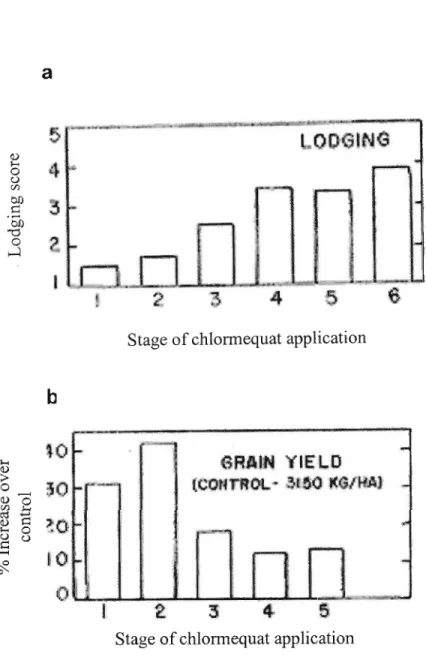
The influence of single foliar application (1-fifth leaf; 2-governing; 3-spike emergence; 4-starting; 5-heading; 6-control) of chlormequat on lodging (1-no soldering; 5-severe soldering) (a ) and yield (b) of wheat (from Myhre et al., 1973).
Effects of PGR's on vegetative growth
Tiller production and surv ival
Most reports on the effects of chlormequat on farm cultivation indicate that the product can be beneficial in increasing farm production and survival. The impact of chlormequat on farm production and farmer survival depends on the time of application of the compound. It has been suggested that reduced growth and elongation of the main stem after application of chlormequat (due to its anti-gibberellin properties) allows greater availability of assimilates for seed production and survival (Green, 1986).
Again, it is possible that the compound may act through a combination of these mechanisms, thereby enhancing tiller production and survival.
Biomass accumulation
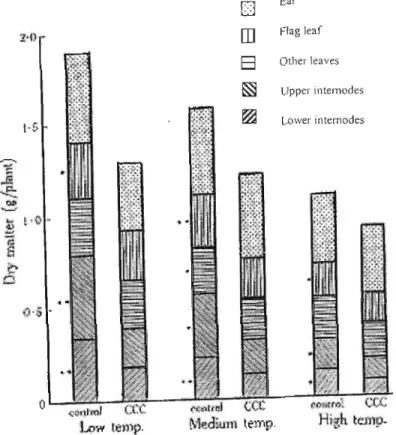
Rajala & Peltonen-Sainio (2001) applied ethephon to wheat during tillering and found significant reductions in the dry matter of 39 mg planr1 14 days after application. The consistent reduction in plant biomass with ethephon application may be due to the fact that in most studies, ethephon is normally applied at later stages of growth, after tillering has been completed. Consequently, there may be no improvement in the build-out (since it has already been completed) and therefore no contribution to the dry matter, while the.
The reduction in biomass production after PGR treatment does not necessarily mean that photosynthesis is reduced.
Root growth
Another possibility may be that chlormequat-induced reductions in shoot growth may allow the use of water, nutrients and photo-assimilates for improved root growth thereby improving root ratios. There have been no reports of chlormequat reducing root ratios and this suggests that in commercial agriculture, chlormequat applications are unlikely to have deleterious effects on the root system. It is the root.shoot ratio that matters when considering factors such as assimilate divisions, water use and shelter tolerance.
There is ample evidence that PGRs influence root-shoot ratio, but the nature of these effects is variable and requires further investigation before valid conclusions can be drawn.
Effects of PGR 's on agronomic characteristics
Yield and yield components
Meanwhile, some reports also indicated a decrease in grain yield attributed to decreases in all three yield components (Green, 1986). One possibility is the reduction in the rate of tiller development, thus allowing time for more tillers to develop and thus contributing to grain yield (Hutley-Bull & Schwabe, 1982). The majority of reports on the effects of ethephon on grain yield indicate that the compound reduces yield unless lodging is prevented.
However, when deposition did not occur, ethephon treatments tended to produce less grain yield, which could be attributed to reduced grain numbers and grain mass.
Plant height and lodging
1982) also reported significant reductions in plant height after ethephon application to both wheat and barley, but the responses were cultivar specific for both crops. One of the most influential factors affecting plant height and location is the time of application of the compounds. Work done by Myhre et al. 1973) suggested that the greatest reduction in plant height and establishment occurs when chlormequat is applied at about the fifth leaf stage of development.
The effects of chlormequat and ethephon on plant height and subsequent lodging are variable and dependent on application times.
The use of PGR 's in crop management
PGR 's and intens ive cereal management
PGR's and nitrogen fertilization
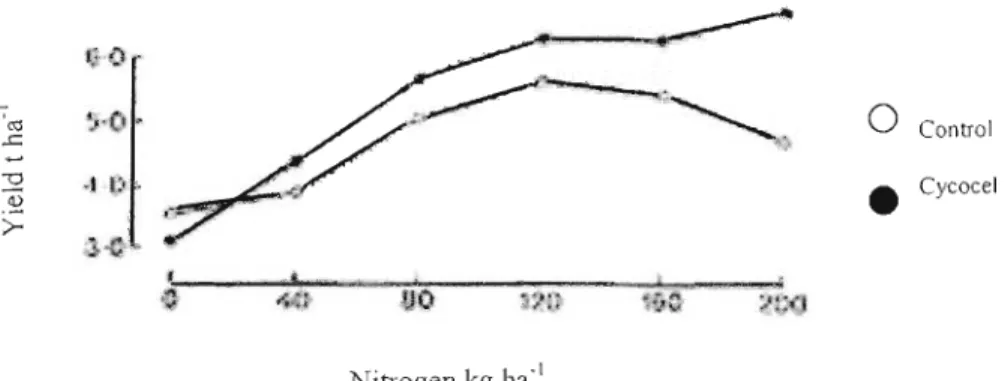
Webster & Jackson (1993), in an investigation of management practices to reduce lodging in wheat, suggested that the application of ethephon and an N top dressing should be considered in wheat production environments to improve grain and protein yield. . In contrast to these reports, Mohamed et al. 1990) reported no significant increase in grain yield or wheat protein content after ethephon application even at higher N rates. These results were supported by Foster & Taylor (1993), who suggested that ethephon was unlikely to increased wheat yield under conditions of intensive irrigation and higher N fertility.
The effect of PGRs on N fertilization and N use is dependent on cultivars (Van Sanford et al., 1989), as well as the time of application of the PGR.
Effects of PGR 's on small grain cereal quality
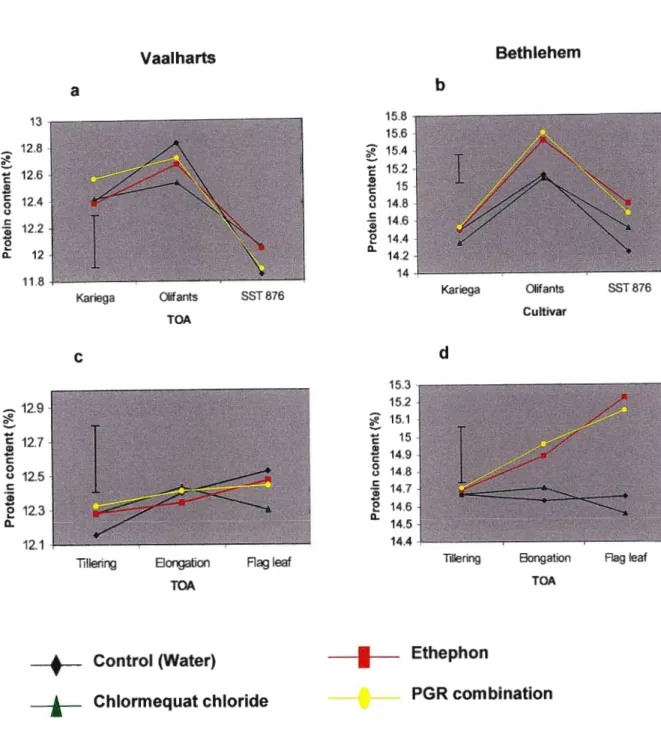
Protein content
Similar results were obtained by Mohamed et al. 1990) who concluded that the use of ethephon in an ICM system did not affect grain protein content. Grain protein content is related to nitrogen fertilization, with higher nitrogen rates leading to increased protein content (Knapp & Harms, 1988). Taking this into account, together with the potential for PGRs to enable a greater response to N fertilization, improvements in grain protein could be expected.
However, there are no convincing data indicating definitive improvements in grain protein content after application of PGR.
Hectolitre mass
One of the reasons for this may be the differences and interactions between environments, cultivars and application times, as shown by Knapp &. Consistent with this, Foster & Taylor (1993) reported small but significant increases in grain protein in ethephon-treated maize, but the effect was dependent on the rate and timing of ethephon application. One of the possible reasons for improvements in test weight after ethephon application could be the diversion of assimilate to the grain due to reduced stem growth.
Reductions in test weight after application of chlormequat can be attributed to the stimulatory effects of the product on ripening, when applied early.
Preharvest sprouting
In the same experiment, it was shown that chlormequat had no effect on test weight. 1995) found that chlormequat-induced yield increases could be attributed to increases in grain weight and could be related to possible improvements in test weight. Any reduction in test weight after ethephon treatment can be attributed to the release of ethylene (Lurssen, 1982) which can speed up aging and thus the grain filling process. One possibility is that the reduced growth rate after application of chlorine mequat may allow longer time for grain filling to improve test weight.
Any of the above scenarios are possible, but extensive testing on a range of local cutivars is needed to establish the correct mechanisms.
Summary
No previous work has been done to determine the effect of PGRs on pre-harvest germination under South African conditions. The inconsistencies associated with these products suggest the need to further investigate their potential under South African production conditions. To assess the effects of plant growth regulators on small grain grain growth and productivity, field trials were conducted on wheat, barley and oats.
For all three crops, field trials were conducted at two locations, namely at the Small Grain Institute Research Station in Bethlehem (28°30' S, 28°30' E, 1855 m) in the Free State Province and at the Vaalharts Agricultural Experiment Station in Vaalhartsu (28°00' S, 25°00' E, 1224 m), Northern Cape Province.
Wheat trials
Experimental layout
These doses were chosen according to current recommendations for product use in South Africa according to Vermeulen et al. Because resources did not permit complete sampling for growth analysis in all treatments, only selected treatments were sampled. Kariega and SST 876 were selected to investigate the effect of PGR on a lodging-susceptible cultivar.
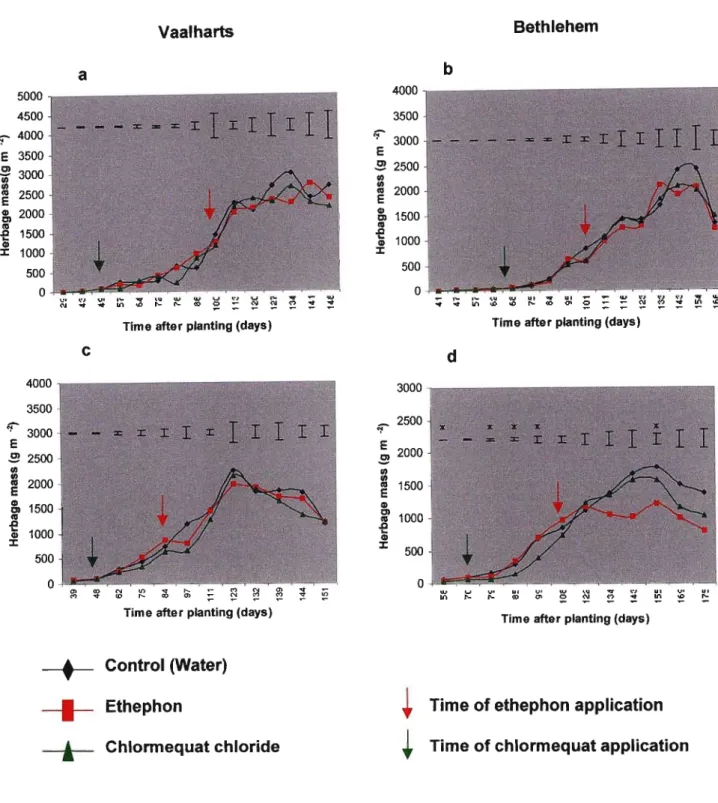
The data were used to produce growth curves of biomass accumulation during the season for each of the selected treatments.
Trial details
Plant height was measured in mm from the ground to the tips of the tallest branch per plant, excluding canopies. No artificial drying of the seed was necessary because the moisture in all tests was sufficiently low «13%). After determining the seed plot weight for yield, a subsample of the seed from each plot was passed through the machine to determine the hectoliter mass in kg hL-1 according to the manufacturer's specifications.
The protein content was then determined based on 12% moisture according to the manufacturer's specifications using the pre-calibrated instrument.
Statistical analyses
Barley trials
Variables investigated
Statistical analyses
Oat trials
Experimental layout
Trial details
Variables investigated
Stat istical analyses
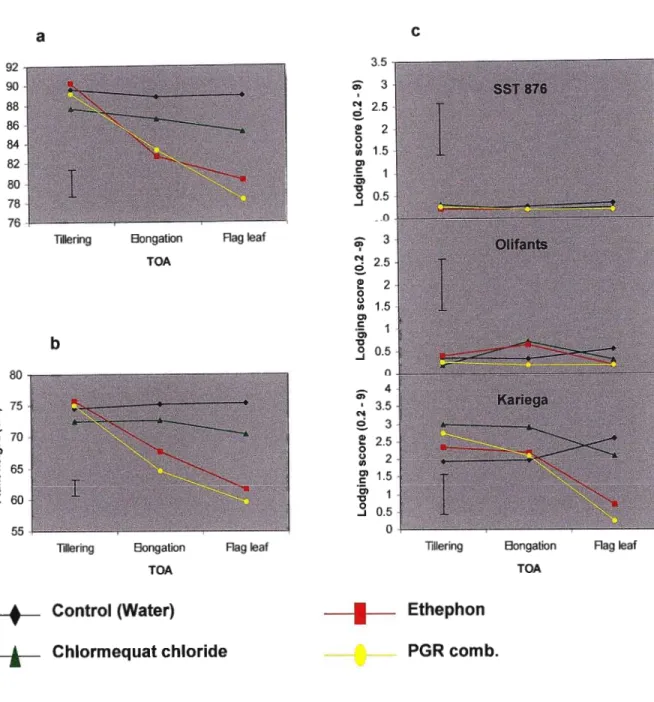
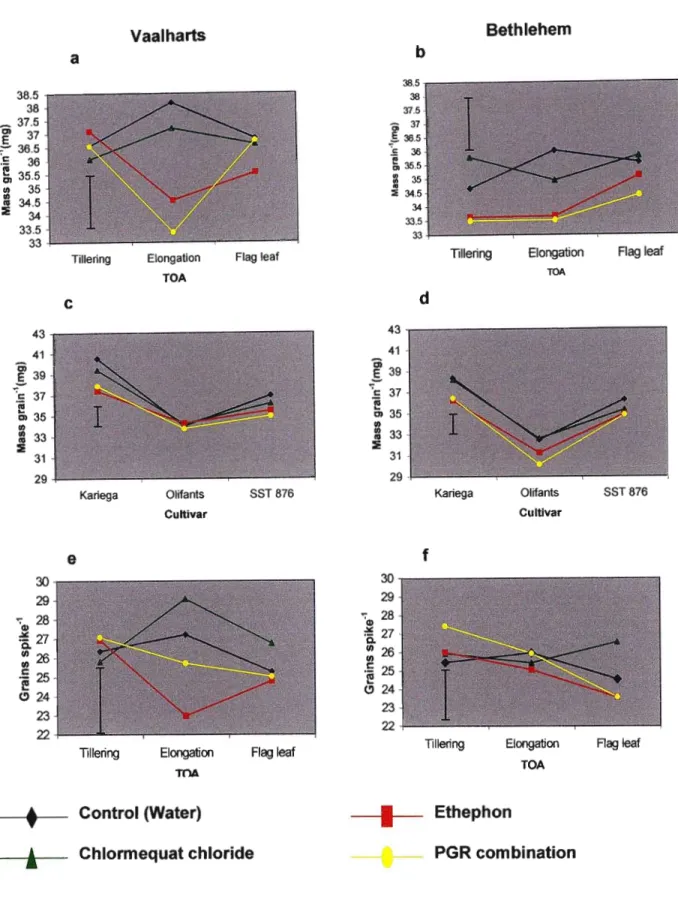
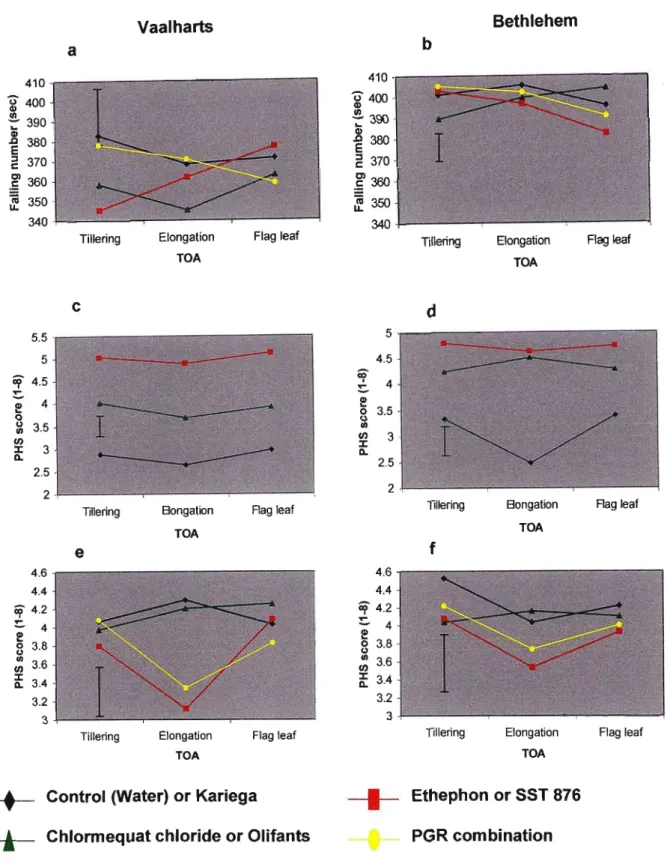
Approx. 85% of winter small grain production in South Africa is dominated by wheat (Anon, 2004), underscoring its importance over other small grain crops. The optimization of production practices in wheat has been taking place for decades with great success. In general, significant reductions in plant height were observed as the application of ethephon and the PGR combination continued towards the flag leaf stage at Vaalharts (Fig. 4a) and Bethlehem (Fig. 4b). Instead, the PGR combination treatment significantly reduced grain tip” at the flag leaf stage compared to the tiller applications.
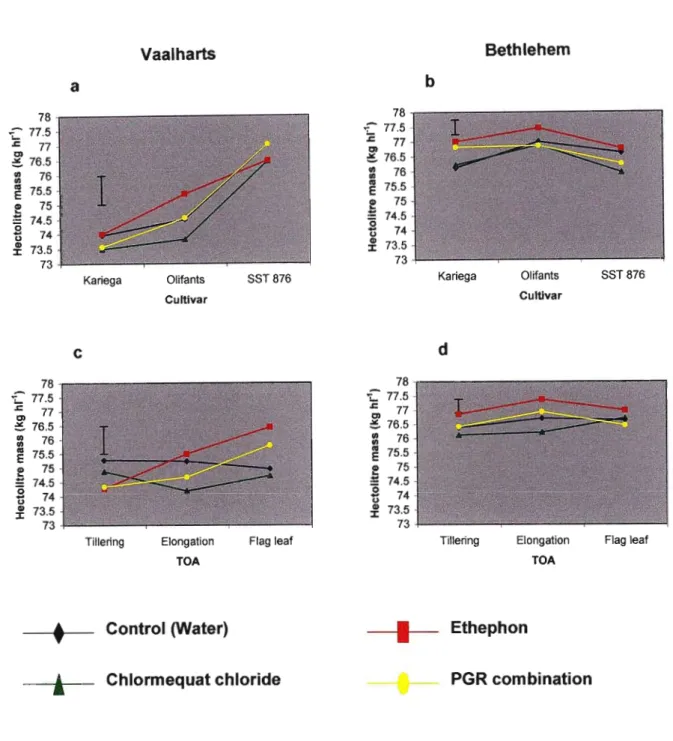
However, ethephon applications and PGR combinations on flag leaves significantly improved hectoliter weight compared to tillering applications. The improvement may be related to the effects of these PGRs on plant height (Fig. 4a) and lodging (Fig. 4c), which were significantly reduced after the application of ethephon and the combination of PGRs at the flagellar stage. Plant height was significantly reduced when ethephon and PGR combination applications were made at the flagellum stage rather than at the tillering stage (Fig. 4b).
The reduction in falling number with applications of ethephon and the PGR combination at the flag leaf stage may be related to the effect of the compound ethephon on development rate. Overall, the most consistent effect of ethephon and the PGR combination was the reduction in plant height and lodging. The residence of Puma was reduced due to ethephon or the PGR combination application at the flag leaf stage.
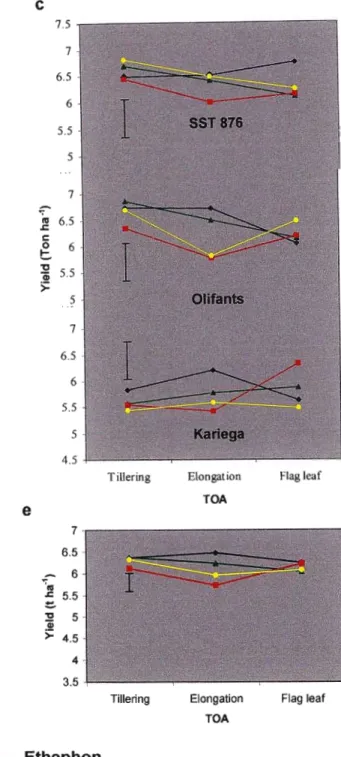
In addition, split application of ethephon significantly reduced yield compared to split application of the PGR combination. The decrease in dry weight after application of ethephon and PGR combination at the flag leaf stage can be attributed to most of the elongation growth occurring in the higher internodes (petioles). The marked changes in growth rate after application of ethephon and the PGR combination at the flag leaf stage can be attributed to the effective reduction of elongation growth.
Overberg, which produced a significantly lower yield than Sederberg at Vaalharts with any PGR (Figure 15c), produced a higher yield than Sederberg using ethephon and the combination of PGR at Bethlehem (Figure 15d). The improvement in the yield of the Overberg near Bethlehem in 2003 can therefore be attributed to the use of ethephon and the combination of PGR. In Bethlehem, ethephon and the PGR combination significantly reduced plant height by 8.9 and 6.5%, respectively, compared to the control (Table 9). Application of ethephon and a combination of PGR significantly reduced the height of the Overberg plant compared to the control in Bethlehem (Figure 18b).