i
UNIVERSITY OF KWAZULU-NATAL
EMPLOYEE ATTITUDES TOWARDS ENGAGEMENT: A CASE STUDY OF HULAMIN EMPLOYEES IN PIETERMARITZBURG
Siphiwe Michael Blose 8626799
A dissertation submitted in partial fulfillment of the requirements for the degree of Master of Commerce
College of Law and Management Studies School of Management, IT and Governance
Supervisor: Prof TI Nzimakwe
2018
ii
DECLARATION
I, Siphiwe Blose, declare that
(i) The research reported in this dissertation, except where otherwise indicated, is my original research.
(ii) This dissertation has not been submitted for any degree or examination at any other university.
(iii) This dissertation does not contain any other person’s data, pictures, graphs or other information, unless specifically acknowledged as being sourced from other persons.
(iv) This dissertation does not contain any other person’s writing, unless specifically acknowledged as being sourced from other researchers. Where other written sources have been quoted, then:
a) their words have been re-written but the general information attributed to them has been referenced;
b) where their exact words have been used, their writing has been placed inside quotation marks, and referenced.
(v) This dissertation does not contain text, graphics or tables copied and pasted from the Internet, unless specifically acknowledged, and the source being detailed in the dissertation and in the biography section.
Signature:
Date:
iii
ACKNOWLEDGEMENTS
Firstly, I wish to thank the Lord God Almighty for granting me the gift of life and the capacity to handle the work of this magnitude.
I wish to express sincere appreciation to the following individuals:
My late parents – Eunice Sibusisiwe (MaNyongwana) Blose and Andries Musawenkosi Blose. They nurtured the love of education in me and ensured that my educational needs were met.
My dear wife – Phumi (MaMthethwa) Blose. Throughout this journey, she remained a pillar of strength and source of inspiration.
iv
ABSTRACT
There has been an exceptional interest amongst researchers in wanting to understand the antecedents to motivated behaviour as much as engaged behaviour in organizations. Numerous studies reveal the grounds of employee attitudes and behaviour towards engagement which may result to spontaneous behaviour that can improve performance. Employee engagement is currently an apprehending concept within the Human Resource field. Both practitioners and the academia are struggling with understanding an unpacking this concept, however, there is little underpinning theoretical research evidence. There is convergence of opinions about the benefits that employee engagement can bring to any organisation. It is therefore the organisation that must work in developing and nurturing engagement, which requires a two-way relationship that is, between employer and employee.
The study was aimed at determining the attitudes of Hulamin employees towards employee engagement and identify factors that hinder employee engagement in order for recommendations to be made to assist employers to assess and enhance employee engagement in the workplace.
This study was qualitative in nature. The sample was made up of eighteen Hulamin employees at its Pietermaritzburg site spanning across various grades and levels of occupation. Interview guide was constructed and in-depth interviews were conducted with eighteen (18) participants. The study used a thematic analysis to analyse data to generate meaningful, trustworthy and insightful findings. The study discovered positive relationship between the participants (the employees) and Hulamin (the employer) and critical lessons on how levels of engagement can be enhanced. Based on the findings, the majority of fifteen (15) participants suggested that people seek more meaning in their day-to-day work than they do in their personal lives. This implies employers should be seeking to make work meaningful by finding out what matters to their employees, especially since evidence suggests that meaningfulness impacts not only on the individual, but also on the bottom line. The study recommended that measures of engagement be put in place with the diagnosis model to encourage employee engagement.
v
TABLE OF CONTENTS
Cover Page...
Title Page ……….i
Declaration ... ii
Acknowledgements………...iii
Abstract ... iv
Contents………...v
List of Tables ... ix
List of Figures ... x
List of Acronyms ... xi
CHAPTER ONE: INTRODUCTION ... 1
1.1 Introduction ... 1
1.2 Background to the Problem ... 2
1.3 Research Problem ... 4
1.4 Aim of the Study ... 4
1.5 Research Questions ... 4
1.6 Objectives of the Study ... 5
1.7 Research Methodology ... 5
1.8 Justification of the Study ... 6
1.9 Ethical Considerations ... 6
1.10 Limitations and Bias of the Study ... 7
1.11 Chapter Outline ... 8
1.12 Conclusion ... 9
CHAPTER TWO: LITERATURE REVIEW ... 10
2.1 Introduction………. ... 10
2.2 Origins of Employee Engagement and its Definition... ... 11
2.2.1 Khan’s Model... 12
2.2.2 Defining Employee Engagement ... 13
2.2.3 Employee Engagement in Relation to other Concepts ... 15
2.3 Employee Engagement Theories ... 16
2.3.1 Self-determination Theory ... 16
2.3.2 Burnout versus Engagement ... 18
2.3.3 Kahn’s Theory of Psychological Conditions ... 20
2.3.4 Expansion of Kahn’s Theory………..……….….……….22
vi
2.4Hellevig’s Perspective on Employee Engagement .………....23
2.4.1 Elements that are related to Employee Engagement ... 24
2.4.2 The Role of Corporate Culture ... 27
2.5 Employee Engagement and Trust ... 27
2.6 Employee Engagement and Innovation ... 28
2.7 Antecendents and Consequences of Engagement ... 29
2.8 Drivers of Employee Engagement ... 30
2.9 Engagement and Individual Differences ... 34
2.10 Rationality and Emotions ... 35
2.10.1 Personal Relations ... 36
2.11 Conclusion………..………...…37
CHAPTER THREE: RESEARCH METHODOLOGY ... 38
3.1 Introduction ... 38
3.2 Research Approaches ... 38
3.2.1 Quantitative Approach ... 39
3.2.2 Qualitative Approach ... 40
3.2.2.1 Advantages and Disadvantages of a Quantitative Approach ... 40
3.3 Research Process ... 41
3.4 Research Design………..………..42
3.5 Sampling Strategy ... 43
3.5.1 Probability Sampling ... 44
3.5.2 Non Probability Sampling ... 45
3.5.3 Sample and Sample Size ... 45
3.6 Target Population ... 46
3.7 Data Collection Methods ... 47
3.7.1 Research Instruments ... 48
3.7.2 Interview Question Construction... 48
3.7.3 Administration of a Interviews ... 49
3.8 Data Analysis ... 49
3.9 Pilot Study ... 51
3.10 Data Quality Control ... 52
3.11 Conclusion ... 53
CHAPTER FOUR: RESULTS, DISCUSSION AND INTERPRETATION AND FINDINGS ... 54
vii
4.1 Introduction ... 54
4.2 Data Analysis ... 54
4.3 Response Rate and Discussion ... 57
4.4 Findings and Data Presentation ... 58
4.4.1 Demographic Information ... 59
4.4.1.1 Age Distribution of Respondents ... 59
4.4.1.2 Gender Distribution of Respondents ... 60
4.4.1.3 Racial Groups ... 61
4.4.1.4 Educational Level of Respondents ... 61
4.4.2 Findings based on the Responses ... 62
4.4.2.1 Views on from respondents on the contextual factors that may hinder employee engagement ... 63
4.4.2.2 Establishing employees’beliefs and value systems that may enhance employees’attitudes ... 67
4.4.2.3 Examine if factors such as age, earnings and work experience as well as education may affect employees attitudes ... 69
4.4.2.4 To unearth those elements within the employees themselves that have impact on their engagement ... 72
4.3.2.5 To make recommendations and interventions that can be undertaken to heighten the level of employee willingness to commit to excelling in their duties..74
4.4 Conclusion...76
CHAPTER FIVE: CONCLUSIONS AND RECOMMENDATIONS ... 77
5.1 Introduction ... 77
5.2 Findings from the Study ... 78
5.2.1 Summary of Findings from the Literature Review... 78
5.2.2 Summary of Findings From the Primary Research ... 80
5.3 Conclusion of the Findings ...82
5.4 Recommendations of the Study. ... 83
5.4.1 Recommendations ... 83
5.5 Recommendations for Further Research ... 85
5.6 Conclusion………...…85
BIBLIOGRAPHY...86
viii Appendices
Annexure A: Letter –Gate Keeper ... 91
Annexure B: Consent Letter ... 92
Annexure C: Interview Guide ... 93
Annexure D: Ethical Clearance Letter ... 94
ix LIST OF TABLES
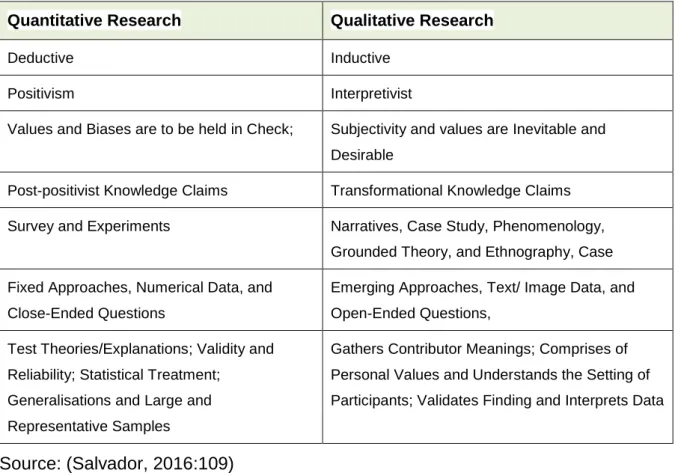
Table 2.1: Characteristics of Engaged Employed 26 Table 3.1: Differences between Qualitative and Quantitative Research 39 Table 3.2: Comparison of Probability and Non-probability Sampling 44
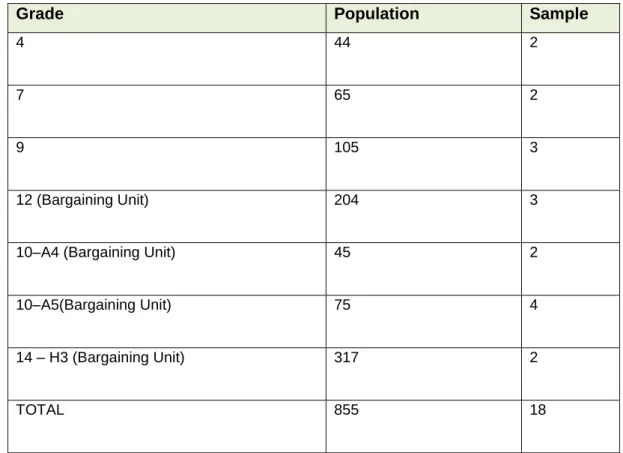
Table 3.3: Targeted Sample Size 46
Table 3.4: Stages of Thematic Analysis 51
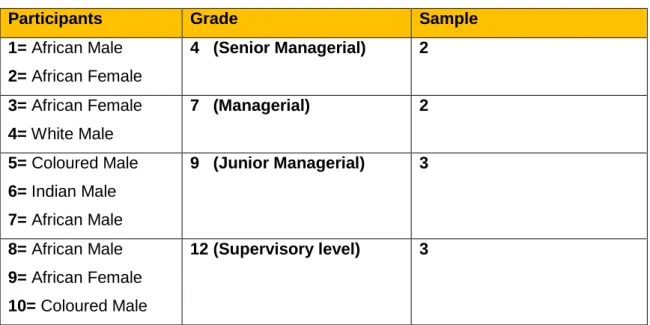
Table 4.1: Participants at Hulamin 57
Table 4.2: Age 60
Table 4.3: Gender 60
Table 4.4: Race 61
Table 4.5: Educational Qualification 61
Table 4.6: Do factors like training and development affect the
employees’ attitude towards engagement? 63 Table 4.7: Does trust in the company and its leadership affect the
employees’ attitude towards engagement? 64 Table 4.8: Does race affect employee’s attitude towards engagement? 65 Table 4.9: What are the contextual factors that have a bearing on
employees’ attitude towards engagement? 66 Table 4.10: What are the beliefs and values that impact employees’
attitudes towards engagement? 68
Table 4. 11: Responses 70
Table 4. 12: How do factors like work experience and educational qualifications affect the employees’ attitude towards
engagement? 71
4.13: Are you geared to engage in discretionary extra effort and
innovation for the good of the organisation? 73 Table 4.14: In what way (if at all) do you experience being valued by
Hulamin such that you would promote the company to the broader
community outside? 73
Table 4.15: Activities related to Employee Engagement 75
Table 5.1: HRM Practices and Interventions 84
x LIST OF FIGURES
Figure 2.1: Khan’s Model of employee Engagement 12
Figure 2.2: Model of Employee Engagement 15
Figure 2.2: Drivers of Employee Engagement 30
Figure 3.1: The Research Process 42
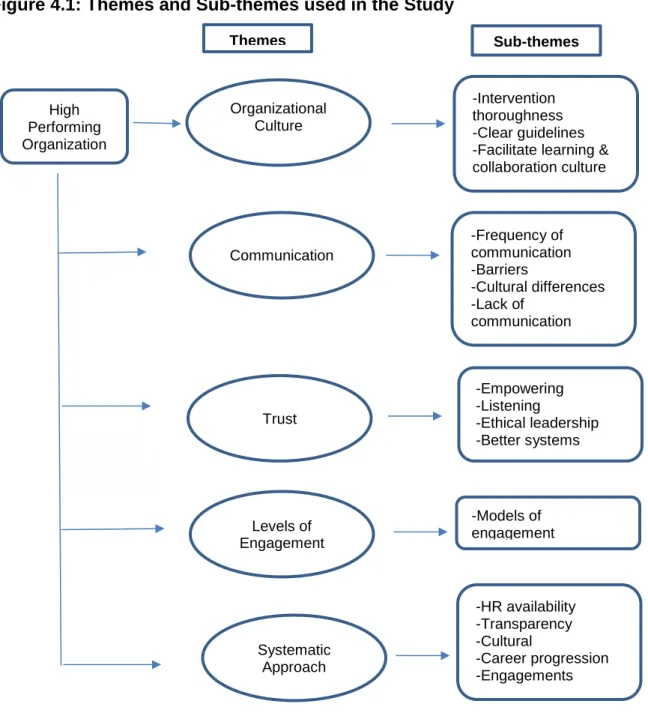
Figure 4.1: Themes and Sub-themes used in the Study 55
Figure 5.1: The Drivers of Employee Engagement: a diagnosis tool 79
xi LIST OF ACRONYMS
EE : Employee Engagement
HRM : Human Resources Management HR : Human Resources
OCB : Organisational Citizenship Behaviour
1
CHAPTER ONE
INTRODUCTION AND OVERVIEW OF THE STUDY
1.1 INTRODUCTION
Employee engagement has captured the attention of business practitioners, academic researchers and government departments. These organisations are interested in understanding the concept itself and what drives engagement as well as its root causes and effects (Yalabik, Popaitoon, Chowne and Rayton, 2013: 1). Organisations strive to recruit and train their employees, however, the balance between nurturing and enhancing employee engagement levels without compromising the business competitive position is still a challenge. The question still remain on how employee engagement can be influenced in the organisation hence this study was conducted.
Papay and Santille (2015:6) argue that employers are after business growth whereas employees are the main drivers. The researchers submitted that the core measures used in business such as quality, productivity profitability are higher at companies that have larger groups of employees who are engaged. Some reviews suggest that the employee engagement concept intersect with other well-established paradigms such as job involvement, job satisfaction and organisational commitment (Karatepe, 2011:3). Every business should therefore strive to ensure that employee engagement is high. Attempts should be made to survey and establish factors that may be contributing to employee engagement or lack thereof.
Employee engagement is considered a crucial driver of staff morale and performance within the Hulamin to reduce absenteeism, enhanced quality services and improved motivation. Engagement is an important human resource variable for the majority of organisations. It helps enable the organisation to deliver a superior performance and to gain a competitive advantage. Engaged employees make additional effort, learn more and faster, and be more creative. In addition, they are your organisation's ambassadors. Furthermore, engagement is a good predictor of customer satisfaction,
2
personnel retention, productivity and profitability (Smith, 2016:2). Further to this, Allameh, Shahriari and Mansoori (2012:7) cited Katz and Khan (1966) suggested that in order for the business to survive, employees need to display the following three types of behaviours:
Employees need to join and stay within the system.
Be dependable as individuals performed their role within the system.
Employees must demonstrate innovative and impulsive behaviour and perform above the optimum role requirements in order to achieve the organisational purposes.
In this case, employees of a successful business are required not only to meet the expectations but also to exceed those expectations. This paper presents key features of the relationship between the attitudes and behaviours of employees and factors hindering employee engagement. The establishment of employee value system that play a vital role in employee attitude towards engagement will be explored. Further, factors such as earnings, age, work experience and education will be determined.
However, this chapter will focus on outlining the introductory part of this dissertation which includes the background of the study, the research problem, and the aim of the study, the research objectives and questions, the justification of the study as well as the outline of the dissertation.
1.2 BACKGROUND OF THE STUDY
This study will be conducted amongst employees of Hulamin Operations LTD in the Pietermaritzburg area. This company manufactures and exports aluminium products.
It is the largest amongst similar manufacturers in the sub-Saharan region. Being a manufacturing type of business means Hulamin can be as successful as the type, quality and acceptance of, the products it manufactures. To the extent that employees determine the nature and standard of its products, individuals therefore greatly determine its success.
It has been observed within the company that some employees do not apply themselves to the utmost level that reflects commitment to quality, high productivity
3
and innovation. The number of disciplinary cases reflects the results of an attitude of a lack of discipline. This lack of discipline lands employees in hearings and huge amount of time is spent correcting practices and tasks that do not benefit the business.
The high level of grievances is also indicative of unhappiness that prevails. Critically, there have been incidents of safety related offences where workforce is frequently found to have transgressed the rules. Some of the safety incidents have either resulted in lost time injuries (Hulamin HR Report, 2017:14).
It has emerged in some disciplinary and grievance hearings that employees feel undervalued as individuals perceive that management and leadership should value them. The overall circumstance suggests that there is a possibility for improvement in so far as the level of commitment and motivation is concerned. Employee engagement can still be better than what it is currently at Hulamin. It is alluring to display the problem into the organisational processes, policies and procedures that do not make employees feel valued (Hulamin HR Report, 2017:15). There is thus need to examine what the contributing factors to this state of undertakings. This study is therefore intended at finding out the root cause of the low levels of engagement including what interventions could be undertaken to heighten the level of employee willingness to commit to excelling in their duties (Robertson-Smith and Markwick, 2009:12).
Human Resources (HR) are the most valuable and vital resources of the business as engagement of employees is now recognised as a critical factor by most firms to gain a competitive advantage. Employee engagement ensures high levels of passion, enthusiasm, commitment and involvement by the employees which transcends into numerous tangible and intangible benefits for the business. Linkage between employee engagement and various performance metrics such as productivity, retention, customer loyalty and profitability need to be established (Ahlowalia, Tiwary and Jha, 2014:309).
4 1.3 RESEARCH PROBLEM
Hulamin Operations cannot overlook some observations that reveal that some employees are either lowly engaged or totally disengaged. This study seeks to unearth the reasons behind these employees’ attitudes towards engagement. It is hoped that the answers from research questions will assist in strategies to infuse more positive and higher levels of engagement. If the study is not conducted, there is great risk that the low levels of engagement will harm the growth levels and the capacity to exceed the organisational goals Hulamin. There is sufficient evidence suggesting that highly engaged employees offer a great deal of worth towards any organisation’s sustainability and profitability. Further, employees are able to be involved in the decision making and to the extent to which individuals feel and voice their ideas and concerns which can be of value to both the business and the employee (Robinson, Perryman and Hayday, 2004:24).
1.4 AIM OF THE STUDY
The aim of this study was to explore the factors that have a bearing on employees’
engagement and establish the employees’ beliefs and value systems that play a vital role in employees’ attitude towards engagement. Further, the study will identify and explore factors that may affect the employees’ attitude towards engagement in the workplace.
1.5 RESEARCH QUESTIONS The research questions are as follows:
What are the contextual factors that have a bearing on employees’
(dis)engagement?
What are the beliefs and values that impact employees’ attitudes towards engagement?
What are the elements within employees themselves that have impact on their engagement?
5
Do factors like age, earnings, work experience and education affect the employees’ attitude towards engagement? and
What recommendations and interventions can be undertaken to heighten the level of employee willingness to commit to excelling in their duties?
1.6 OBJECTIVES OF THE STUDY The objectives of the study are as follows:
To unearth the contextual factors that have a bearing on employees’
engagement;
To establish those employees’ beliefs and value systems that play a role in employees’ attitude towards engagement;
To unearth those elements within the employees themselves that have impact on their engagement;
To examine whether factors like age, earnings, work experience education etc.
affect the employees’ attitude towards engagement; and
To make recommendations and interventions that can be undertaken to heighten the level of employee willingness to commit to excelling in their duties.
1.7 RESEARCH METHODOLOGY
The aim of this study was to explore factors that have an influence on employees’
engagement and establish employees’ beliefs and value system that play a role in employees’ attitude towards engagement. The study was descriptive in nature and data conducted was limited hence the study was qualitative. The research made use of interview guide and observations to gather data and utilised appropriate techniques to evaluate data to make conclusions and recommendations. The study was classified as phenomenological in nature. In relation with the research approaches, qualitative (inductive) approach was used in the interpretivist model to indicate the realism of the settings and environment that existed at Hulamin which led to this study being conducted. Further figure 3.1 below illustrate the research process that was used when conducting the study.
6 1.8 JUSTIFICATION OF THE STUDY
Through conducting this study, it is hoped that the questions asked will yield answers that will inform relevant interventions to improve the level of employee engagement.
According to Markos and Sridevi (2010) if all facets of human resources are not addressed in an adequate manner, employees will fail to fully engage themselves in their jobs in response to such mismanagement. The concept of employee engagement is built on the underpinning of earlier conceptions such as job satisfaction, employee commitment and organisational citizenship behaviour, hence the study is significant to be conducted.
Should the study not be conducted, there is a great risk that the type of low engagement and disengagement will continue and perhaps escalate to a level where the business objectives are difficult to achieve at Hulamin. Disengagement can be regarded as the combination of psychological self from the work role and involves individuals withdrawing and being defensive during role performances which may impact on performance (Knight, 2011). Therefore, problem of low and disengagement cannot be left alone to improve without conscious effort to address it.
The study will assist in adding value to the current state of knowledge by critically evaluating the existing literature on employee engagement and providing a reflective stance on existing debates and findings. As a result, concerns about the lack of agreement on what engagement is and how issues surrounding it can be addressed.
1.9 ETHICAL CONSIDERATIONS
Unethical activities are pervasive and include violating non-disclosure agreements, breaking respondent confidentiality, misrepresenting results, deceiving people, invoicing irregularities and avoiding legal liability (Bryam, 2012:338). The ethical responsibility of collecting data in an objective and accurate way carries forward to the phase of the research during which the researcher interpret the information he/she gathered and formulating conclusions (Anderson, 2011:87). Cognisance of the
7
following factors was taken into account to render the study ethically sound and were briefly explained to the participants prior to interviews being conducted. Ethical considerations used in the study are as follows:
Informed consent: The researcher comprehensively described the nature of the study to the participants before the interview was conducted. This ethical principle was part of the consent letter to respondents. The researcher addressed the required information to the participants on the days of the interviews (refer to Annexure B).
Permission to conduct the study: The research proposal was submitted for reviewing and approval by the research committee at UKZN and was approved.
In order to conduct this study Ethical clearance was obtained from UKZN’s Ethics Committee whereas the gatekeeper’s letter was obtained from the Registrar’s Office at UKZN. The researcher ensured that necessary permission was obtained from the participants during the participation process (refer to Annexure A).
Avoidance of harm or non-malfeasance: Participants were informed that the study that the respondents were partaking were conducted willingly. The participants had a right to withdraw from the study at any time. Information that was provided by the participants was treated sensitively and was not to be revealed to anybody to avoid harm to participants.
Ensuring confidentiality and anonymity: During the study, anonymity of the participants was maintained by addressing participants as 1 or 2 instead of their names as no names and addresses were mentioned throughout the study and report including in the questionnaire.
1.10 LIMITATIONS AND BIAS OF THE STUDY
As a result of time constraints, the study excluded other Hulamin premises. Other grades within the company were also excluded but care was taken that the sample reliably facilitates the credibility of the generated results. The use of gender, age groups, inadequate language and race was not utilised to avoid bias.
8 1.11 CHAPTER OUTLINE
Chapter 1: This section introduces the research study by giving an overview of employee engagement. The research problem statement including the objectives, questions and the justification for the study are outlined.
Chapter 2: This section reviews the literature on employee engagement, various theories will be explored including other constructs that are related to the concept.
Chapter 3: This section outlines the methodology that was used in the research study.
The selection of the sample, the sample size, research instrument used in data collection, the site of the study including the ethical considerations that were addressed in the study are all presented in this chapter.
Chapter 4: This chapter presents the data analysed that was gathered from research study. Data collected from the interviews were presented in table form and interpreted.
Chapter 5: This chapter presents findings from the literature review whilst also presenting empirical evidence gathered from the actual study. This section makes recommendations and interventions for Hulamin business in order to enhance its levels of employee engagement. Lastly, gaps will be exposed that require further research within the field of employee engagement.
1.12 CONCLUSION
This chapter briefly highlighted the essence of employee engagement. This chapter further presented the background of the study where a need for engaging in the study of employee engagement at Hulamin was indicated. The research problem was outlined. The research objectives and questions that formed the basis for the study were also defined. Lastly the justification for the study was provided with the significance rational for conducting the study and how the study will be of benefit to both the employees and the organisation.
9
The following chapter two (2) explores the literature review where the subject matter of employee engagement is presented from various theories and other constructs related to the concept will also be examined.
10
CHAPTER TWO LITERATURE REVIEW
2.1 INTRODUCTION
The conception of employee engagement has evolved into an intensely debated theory over the past few years. Truss et al. (2006:15) precisely argue that employee engagement has developed into a worldwide phenomenon which is thrusted by the focus on it by the academia as a positive psychology discourse. It is also propelled by the quest from the business to use the concept as a tool to extract more from engaged employees in order to achieve more of the organisational goals. Business stands to gain competitive advantage from an engaged workforce.
Bhattacherjee (2012:7) states that there are three purposes of literature review and they are as follows:
i) To establish knowledge that abounds in that field of study ii) To unearth articles, authors and theories in that field iii) To determine gaps that may be existing.
This chapter seeks to address the main purposes of literature review as indicated by Bhattacherjee above.
Managers indisputably support that this era demands more efficiency and productivity than any other eras in the past. Organisations are striving to increase their performance. Managers have been struggling with numerous challenges to succeed putting their businesses ahead of competitors. To aid managers manage, different researchers and professionals have been contributing their part displaying the best ways that can be useful and beneficial to managers. Firms have now comprehended that by focusing on employee engagement, supervisors can create more efficient and productive workforce. Any initiatives of improvement which are taken by management cannot be successful without wilful involvement and engagement of employees (Markos and Sridevi, 2010).
11
2.2 ORIGINS OF EMPLOYEE ENGAGEMENT AND ITS DEFINITION
Employee engagement is a multifaceted and dynamic process that reveals each individual's unique, personal relationship with work (Ahlowalia, Tiwary and Jha, 2014:3). Employee engagement was firstly defined by Kahn (1990) where the researcher developed a grounded theory of personal engagement and personal disengagement (Shuck and Wollard, 2009:8). It is notable that employee engagement was elevated to the current status about 27 years ago. Further, Macey and Schneider (2008) revealed that Kahn in 1990, published a paper on personal engagement in relation to work. In that piece of work, Kahn (1990) submitted that individuals make a choice to immerse themselves in their jobs based on their experience of the surrounding environment at work. Kahn developed his theory from upon what motivation theorists had submitted. Alderfer (1972) and Maslow (1954) had stated that individuals need self-employment and self-expression in their work. Kahn subsequently engaged in a study that qualitatively focused on a group of counsellors in a summer camp.
The major premise from which Kahn’s work operates is the one that states that there are three psychological conditions that need to obtain for engagement to manifest and these are: psychological safety, experienced availability and experienced meaningfulness of work. Since the publication of Kahn’s work to date, there has been enormous interest expressed by various writers on the subject of employee engagement. There has been a growing number of conceptualizations, measures, definitions and theories that seek to unpack and improve employee engagement.
Examining the developments around employee engagement from the time Khan popularized the concept, it is therefore correct to say it has become even more popular and useful. The concept continues to attract the attention of scholars and Human Resource practitioners (Smith, 2016:10).
12 2.2.1 Khan’s Model
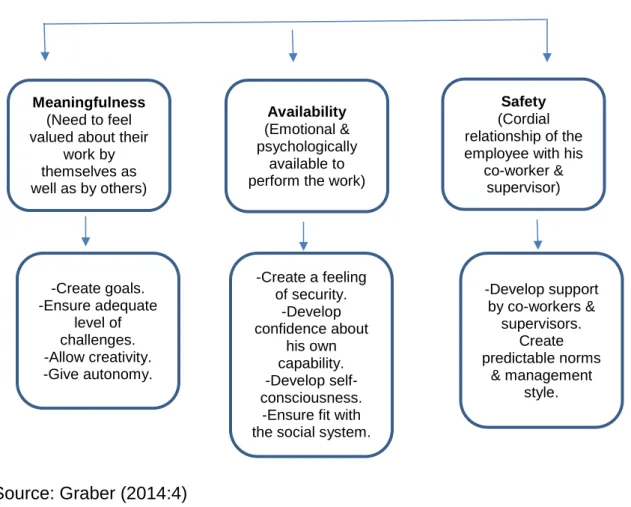
According to Padhi and Panda (2015:80), Khan’s model of employee engagement that was established in 1990 is considered to be the oldest model of employee engagement. The model emphasizes that there are three psychological conditions that are associated with personal engagement and disengagement of work:
meaningfulness, availability and safety illustrated in figure 2.1 below.
Figure 2.1: Khan’s Model on Employee Engagement
Source: Graber (2014:4)
Khan’s model depicts that if employees are engaged individuals are inspired to go above and beyond the call of duty to meet organizational requirements. Further, employees reinforce and support the organization’s culture and values. The importance of engagement as a corporate practice and the different parameters demonstrate that the notion would keep the employees engaged, motivated and inspired, reduce turnover and improve well-being of the employees (Imandin, Bisschoff and Botha, 2014:520). However, measuring engagement has remained highly crucial for the fact that it deals with the complex feelings, emotions and psychological state of mind of the employees (Padhi and Panda, 2015: 83).
Meaningfulness (Need to feel valued about their
work by themselves as well as by others)
Availability (Emotional &
psychologically available to perform the work)
Safety (Cordial relationship of the employee with his
co-worker &
supervisor)
-Create goals.
-Ensure adequate level of challenges.
-Allow creativity.
-Give autonomy.
-Develop support by co-workers &
supervisors.
Create predictable norms
& management style.
-Create a feeling of security.
-Develop confidence about
his own capability.
-Develop self- consciousness.
-Ensure fit with the social system.
13 2.2.2 Defining Employee Engagement
Ahlowalia, Tiwary and Jha (2014:3) cited Kahn (1990) defined employee engagement as “the harnessing of organization members’ selves to their work roles; in engagement, people employ and express themselves physically, cognitively, and emotionally during role performances”. It is rather difficult to establish common and universally agreed definition of employee engagement. Kahn (1990:694) states that employee engagement manifests in members of an organization harnessing themselves to their respective roles at work. In this regard, members express themselves cognitively, emotionally and physically as they perform their roles.
Cognitive aspect of employee engagement will manifest in the beliefs that employees have regarding their organization, its working conditions including their leaders. The physical aspect of engagement will manifest in the physical energies exhibited by each employee as they go about performing their tasks. The emotional aspect of engagement has to do with the feelings that employees have regarding the organization including the negative or positive attitudes toward the leaders themselves and the organization. Therefore, Kahn (1990) submits that engagement has to do with being physically and psychologically present when performing and occupying a role in the organization. The following is a list of researchers’ views on employee engagement:
Richman (2006), Shaw (2005) and Baumruk (2004) have described employee engagement as intellectual and emotional commitment to an organization.
Frank et al. (2004) define it as the discretionary effort that is exhibited by employees in their respective job functions.
Truss et al. (2006) see employee engagement as an expression of passion for work and as a psychological state which encompasses the three engagement dimensions originally outlined by Kahn (1990).
Hellevig (2012) submits that employee engagement centers on the achievement of organizational goals through the creation of conditions that enable human capital to thrive. As a result of such conditions, each employee is highly switched on in the execution of their jobs and put best efforts for the greatest good of the business.
14
What is apparent from the above is that employee engagement is often studied using different protocols. Common amongst the abovementioned attempts at defining employee engagement is the centrality of the state of one’s mind and the resultant activity following the attainment of the state of engagement. It is apparent that engagement moves an individual to a particular performance that is often associated with positivity.
Ferguson (2007:17) argues that these various protocols in handling the issue of employee engagement make it difficult to arrive at a universal measurement and definition. In other words, there often emerge differences when defining employee engagement. This poses further risk in improving this concept. It is challenging to improve what you do not fully comprehend. According to Ahlowalia, Tiwary and Jha (2014:3) cited Hewitt Associates (2004) employee engagement is defined as “the state in which the individuals are emotionally and intellectually committed to the organization or the group”. Based on the model in figure 2.2 below, work engagement in dependent on a number of factors such as people, work, compensation, procedures, quality of work life and opportunities provided by the business. This concept of employee engagement emphases on the three observable behaviours as follows:
Say: the employee’s support for the organization to co-workers, and refers it to potential employees and customers.
Stay: the employee has a desire to be part of the business despite opportunities that other firms may provide, and
Strive: where an employee put an extra effort to support the firm’s goals and contributes to the success of the business.
The model of employee engagement in figure 2.2 further depict that there is a correlation between engaging employees in the business activities with procedures of the firm such as policies as well as work or life balance. The result of engaging the employees may enhance performance of the business.
15 Figure 2.2: Model of Employee Engagement
Source: Hewitt Associates (2004:22)
2.2.3 Employee Engagement in Relation to other Concepts
Saks (2006) states that there is evidence that whilst engagement is distinct in itself, it appears related to certain concepts in organizational behavior. Robinson et al. (2004) submit that it contains elements of Organizational Citizenship Behaviour (OCB) and commitment but is certainly not a perfect match for the two construct. According to organizational and industrial psychology, OCB is an individual’s voluntary commitment manifesting in a company or organization that is not necessarily forming part of a person’s contractual duty. Employee engagement differs in that it is an expression of improved commitment they go on to say with engagement, there has to exist a particular degree of business awareness.
Saks (2006) argues further that organizational commitment is about attachment and an attitude that an individual will possess towards an organization whereas engagement transcends that. In effect, engagement is about the extent to which an employee will immerse themselves into their work and be as absorbed as they go
Engagement
Quality of Life -Physical Work Environment
-Work/Life Balance
Work -Intrinsic motivation -Work tasks -Resources
Procedures -Policies
-HR
Compensation -Pay -Benefits
Opportunities -Recognition
-Career opportunities
People -Co-workers
-Manager -Senior Leadership
16
about performing their roles. Further, whereas OCB is about informal and voluntary behaviours done in conjunction with co-workers towards the organization, engagement has to do with formal roles that each employee is expected to do.
Notwithstanding the various definitions, what cannot be overlooked is the similarity that employee engagement has with other familiar constructs that deal with the employees’ behavior within the workplace. May et al. (2004) state that engagement can justifiably be associated with the notion of job involvement. According to Kanungo (1982), job involvement is a belief state manifesting psychologically. What sets this construct apart from engagement is the involvement of emotions and behaviours only evident in engagement. Job involvement is about cognitions only.
Csikszentmihalyi (1990) submits that “flow” is another construct that can justifiably be associated with engagement. Flow is defined as a sensation that individuals will experience when involvement in their action total. When individuals are in a state of flow there is no need for motivation or reward. According to Kahn (1990) and Holbeche and Springett (2003), as with job involvement, the notion of flow has to do with cognitive faculties and can manifest intermittently, engagement, manifest in a longer term involvement with tasks at work.
2.3 EMPLOYEE ENGAGEMENT THEORIES 2.3.1 Self-determination Theory
Macey and Stacey (2008:10) use various theories to define what entails engagement.
The theorists induced similarities and differences in comparison with other similar constructs within the sphere of organizational behaviour. As a result, a better understanding of some of the components of engagement is attained. Notwithstanding that, Meyer and Gagne (2008:3) argued that there is still lack of a prominent merging theory that is to assist in research and practice. The researchers further submitted that the theory, however does exist and it presents itself as self-determination theory.
Deci and Ryan (1985) revealed that there are two forms of motivation that is, intrinsic and extrinsic. Intrinsic has to do with engaging in an activity out of sheer interest and pure enjoyment whereas extrinsic motivation has to do with engaging in an activity for
17
instrumental reasons. Meyer and Gagne (2008:11) stated that self-determination theory has been in existence for more than 30 years and has been well researched and tested. For that reason, researchers believe it can be used in bringing various concepts around engagement and give guidance in future research exercises.
Self-determination theory can be utilized in contributing in the field of underlying psychological mechanisms. According to this theory, the satisfaction of psychological needs such as autonomy and competence lead to autonomous regulation by an individual. According to Ryan and Deci (2000:13), there is sufficient evidence that these needs are universal and that where there is no satisfaction, there is poor performance and the psychological and physical wellbeing are reduced. The self- determination theory can thus assist in the development of intervention strategies.
Macey and Schneider (2008: 3) note that there is difficulty in confirming whether the opposite of engagement is disengagement or lack of engagement. The theorists then submit that self-determination theory makes a crucial distinction between engagement and withdrawal. According to Gagne and Deci (2005:6) both engagement and withdrawal are measurable individually. Meyer and Gagne (2008:4) submitted that there is a concept related to motivational state known as reactive autonomy. According to Koestner and Losier (2014:5), loss of autonomy may give rise to the source of control. To that end, the self-determination theory assists in explaining the behavioral reactions and motivational states that can be attributable to the absence of engagement.
According to Ryan and Deci (2000:3) self-determination theory research reveals that engaged people tend to experience greater psychological and physical well-being when compared to those that are motivated. In its own right, the wellbeing of employees is bound to have benefits to be seen in organizations recording low absence rates as indicated by Kahn (1990).
It is important to note that the self-determination theory cannot be used to directly measure engagement. Meyer and Gagne (2008:7) submit that the self-determination theory has served as a guide to measure only the variables that are associated with engagement such as behavioral outcomes, need satisfaction and motivational states in different contexts. It can thus be applicable in developing measurement for facets of engagement such as state and behavior. Consequently, it is applicable to domains
18
such as sports and education. Meyer and Gagne (2008) acknowledge that engagement is to be distinguished from other organizational behavior concepts such as job involvement, commitment and job satisfaction. There are two areas of limits that are identified by Meyer and Gagne (2008) and these are:
i) The encouragement of engagement to such an extent that physical health suffers and family time gets negatively impacted.
ii) In pushing for engagement, employees may be asked to stretch themselves beyond their level of competence and this may interfere with how they relate with others.
Macey and Schneider (2008:20) conclude that the self-determination theory can greatly assist in future research and development of the notion of engagement.
2.3.2 Burnout versus Engagement
Another model of engagement is to be derived from the literature on the notion of burnout. Maslach et al. (2010:7) note that burnout is a positive antithesis engagement.
The researchers further identified six areas within work-life that may lead to engagement or burnout and these are: perceived fairness and values, rewards and recognition, control, community and social support, workload, rewards and recognition.
According to Schaufeli and Bakker (2004:72) burnout and engagement are related constructs which are on the opposites by their nature. The theorists viewed burnout to be the negative counterpart whereas engagement is the positive counterpart. Burnout is essentially about a work-related state which manifests in cynicism, exhaustion and professional efficacy that is significantly reduced. To the extent that Schaufeli and Bakker (2004:70) believed engagement is the positive counterpart between the two constructs, it can be concluded that it has to do with a positive state of mind that is marked by fulfillment. The mind is healthy when compared to the ill-being that characterizes burnout. This depiction of the two constructs makes it easy to appreciate one definition of employee engagement which states that employee engagement is the degree to which employees feel motivated and thus contribute to the success of that particular organization. Such engaged employees further apply, out of their
19
discretion, efforts that will enhance the attainment of the broader goals of that organization or business.
The above definition of employee engagement suggests that there are three essential dimensions that can be observed and these are vigor, dedication and absorption. The three are outlined below:
Vigour
Schaufeli and Bakker (2004) submitted that vigor is about mental resilience and high energy levels exhibited at work, including the desire to invest great effort in work activities. The researchers further state that vigor can be observed in employees’
persistence during difficult work endeavors. Employees exhibiting vigor are usually not easily fatigued. This view shows how close the notion of vigor is to that of motivation.
According to Schaueli and Salanova (2008) this talks to intrinsic motivation that ensures goal oriented behavior and persistence in attaining objectives along with levels of activation and feeling enthusiastic and identifying with and being proud of one’s job. Moshoeu (2015:12) argues that employees’ drive, perseverance and interest in work depend on the extent to which the organization provides with the resources individuals need to perform their work roles”.
Dedication
Schaufelli and Bakker (2004) stated that dedication manifests in pride, enthusiasm, challenge and inspiration towards one’s work. This manifestation therefore brings to the fore the notion of commitment or involvement in one’s job. How an employee relates psychologically to the job being performed can reveal a degree of commitment to the job or task being performed at that particular time.
Absorption
Schaufelli et al. (2002); Schaufelli and Bakker (2004) argue that an employee is absorbed when they feel so focused on their work such that they find it difficult to detach themselves from their work activities. The academia are so immersed in their work and nothing else appears to matter and are in a very pleasant state which Csikzentmihalyi (1990) suggests brings about a flow. The researcher further describes
20
a flow as a phenomenon where a person possess control over what employees may be doing leading to efficacy and competency in the ability to execute their work.
Bakker, Denerouti and Euwema (2007) use the notion of flow to work activity and define it as a peak experience (albeit short) which is characterized by intrinsic motivation, work enjoyment and absorption.
2.3.3 Kahn’s Theory of Psychological Conditions.
Following a study that Kahn conducted, personal engagement was described as each member harnessing themselves to their role at work wherein individuals express themselves cognitively, emotionally and physically as people perform their respective roles (Kahn 1990). Holding a similar view to Kahn and Simpson (2009) argues that personal engagement includes emotionally, cognitively and physically articulating oneself in the performance of one’s work role.
Kahn (1990) states that engagement is a multi-dimensional construct because the cognitive, physical and emotional aspects are all involved. The more engaged an employee is in one of the three aspects, the higher the overall engagement will be in the performance of their work. Kahn’s notion of engagement centers around three psychological conditions which are safety, availability and meaningfulness. Kahn (1990) states that these represent experiential conditions which are drivers for personal engagement. The absence of these conditions is an indicator of personal disengagement. Shuck et al. (2011) state that the fulfillment of these conditions determine the existence of engagement. In other words, if these conditions are not exhibited a person is thus disengaged. The three conditions are briefly discussed below:
Psychological meaningfulness
Psychological meaningfulness is regarded as a critical psychological state of working. This is so because it is one of the fundamental reasons behind people seeking employment. Rothmann and Welsh (2010) revealed that through employment, a person is provided with a sense of meaning, for the mere reason that they spend more hours at work than at home. People spend a lot of time travelling to and from work to fulfill individual growth and also as some form of
21
calling. Employees thus prefer to engage with work that bears meaning to them and that which is linked to their dreams and personalities. Psychological meaningfulness has to do with feelings of usefulness and adding value. It is safe to conclude that non-existence of meaningfulness in one’s work activities denotes disengagement.
Psychological availability
According to Jeung (2011); Rothmann and Welsh, (2013), Psychological availability is a sense of possessing the emotional, physical and psychological resources which are required to engage one at work. It can be defined as competency which is inherent in one’s readiness to engage. According to Hakanen, Schaufelli and Ahola (2008), job related resources are great determinants in the manifestation of psychological availability. Therefore when resources are available, the employee’s confidence in engaging in their work increases. Bakker and Demerouti (2007) argue that resources are essential to deal with work demands so that employees’ engagement levels increase whilst, at the same time promoting psychological availability.
Psychological safety
Psychological safety is defined as a feeling of the ability to safely engage self with no apprehension of negative consequences to one’s individual image, career and status at work. According to Moshoeu (2015), people generally feel safer in instances where individuals are sure people will not be harmed for expressing themselves at work. She further submits that trustworthy and supportive management is most likely to induce psychological safety within a working environment. May et al. (2004) depict that in situations that are unpredictable, threatening and ambiguous are likely to bring about feelings of being unsafe to employees. Kahn (1990) states that situations that promote trust are clear, non-threatening, consistent and predictable. Kahn (1990) further states that under these situations, people fully understand what is allowed or disallowed, including the implications of their behaviour. At the core of Kahn‘s theory is the degree to which each employee is psychologically present when conducting their work.
Similarly to what Rich et al. (2010:619) concluded that engagement is about the
22
allocation of personal resources to the performance of job assignments including the persistence and the intensity in the application of the resources.
2.3.4 Expansion of Kahn’s Theory
Building on Kahn’s core conceptualization of the notion of engagement, May et al.
(2004) developed some measurement of engagement in the form of a three dimension theory which consists of the emotional, cognitive and physical dimensions. When these researchers progressed their work, they experienced some problems in presenting these three as distinct entities. Need was thus seen for a more robust measurement. A group of researchers from the Kingston Employee Engagement Consortium see engagement as being positively present when work is performed through the contribution of intellectual effort whilst experiencing meaningful connection and positive emotions with others (Alfes et al., 2010:5). Engagement is then deemed to have the following three facets:
Propensity to think deeply regarding work tasks – Intellectual engagement There are obvious benefits to employees thinking deeply about the tasks that they are involved with. In effect, this shows the presence of mind and the attendant consciousness about the tasks at hand. Factors like quality of are likely to be uppermost in the mind of an employee that is intellectually engaged. Another factor that could result from this is deep problem solving. An employee that is intellectually engaged can be assumed to be worried about doing the best in their tasks with the result that they will incline towards dealing with problems as though they were mere challenges to be tackled (May et al., 2004).
Enthusiasm and positive emotions – Affective engagement
This form of engagement is essentially about vigor and determination. Tackling tasks with enthusiasm and positive emotions is effective way of embracing the task at hand and giving it one’s best measure.
23
Discussion on work related improvements – Social engagement.
This aspect suggests a particular degree of excitement about the task being performed. However, it does not stop at the level of absolute excitement, work related improvements get discussed and indeed implemented. Each individual brings a particular dimension or challenge which gets discussed and possible solutions explored. As solutions are sought, this activity brings to the fore the concept of innovation. The Kingston team raised concerns about the physical component of engagement. The team submitted that physical engagement should not suggest that employees overwork themselves to a point where their family life gets disrupted by homework. Overworking that results in taking work home should not happen. Gatenby et al., (2009); Rees et al. (2009); and Alfes et al. (2010) all point out that the manifestation of engagement needs to be at the realm of the workplace, around work and, expressly, relating to work.
2.4 Hellevig’s perspective on Employee engagement
Hellevig (2012) states that employee engagement has to do with the achievement of organizational strategic goals through the creation of conditions that enable human capital to thrive. He further submits that when these conditions obtain, every employee, from the lowest to the senior most rank, is so switched on such that they individually give their best in the interest of the broader business. The attainment of this state, Helleving succumbs, rests with management playing their active role as drivers (2012). Based on this view, it is clear that employee engagement manifests in a mutual way. In other words, senior management has to actively design and foster appropriate conditions to enhance employee engagement. It can thus be safely assumed that once the conditions are there, individual employees will correspondingly exhibit engagement.
24
2.4.1 Elements that are related to Employee Engagement
Hellvig (2012) revealed that it is easy to mistake employee engagement for other similar constructs that bear similarity to it. The theorist further discuss the employee empowerment, employee commitment and job satisfaction as constructs that engagement can be confused with. Below is a discussion of these concepts which are namely employee empowerment, employee commitment and job satisfaction.
Employee empowerment
This notion suggests that employees are endowed with some level of authority towards decision making within the business. Such empowerment may not however be sufficient to generate visible engagement. It is true that those who are already engaged may greatly benefit from empowerment. In other words employee empowerment may induce greater levels of engagement but, an employee ought to have been engaged already. Engagement thus appears to be central and a fundamental condition for empowerment to add any value (Hellvig, 2012).
Employee commitment
This notion bears resemblance to engagement but differs in some respects. According to Hellvig (2012) has to do with a compulsion of some sorts. In other words, an employee somewhat feels compelled to perform work. Employee engagement, on the other end, has to do with discretionary effort that an employee puts into their work towards the attainment of organizational goals. It is also clear that with employee engagement, a conscious choice is made by an employee to give off their best for greater organizational good.
Job satisfaction
According to Hellvig (2012) the job satisfaction theory places the burden of creating a comfortable and happy workplace on the employer. He further argues that most employers labour under the notion that a workforce that is happy will necessarily be more productive. Lots of studies indicate that this may not always be true. Employee engagement on the other end, is about a reciprocal activity when compared to the one way traffic that job satisfaction is. Hellvig (2012) submits that attaining job satisfaction may not translate into higher levels of engagement. In other words, it is possible to
25
witness an employee who is only satisfied about their job conditions but is not applying additional discretionary effort towards the attainment of the company goals.
Hellvig (2000) submits that this notion often manifests in the level of motivation that often abounds in engaged employees. Such employees are intrinsically motivated. In such an environment, all that the business needs to do is to focus its strategic objectives whilst its engaged employees put in extra ordinary effort. The results are bound to reflect higher profits and bigger return on investments for the shareholders.
One outstanding feature of engaged employees is that they put in their best. For them it is not only about a better pay but, importantly better results for the company.
Whereas the pay may come, theirs is, first and foremost, putting in extra ordinary effort.
This clearly suggests that there is time commitment that manifests. Putting in extra effort may require that more time resources be utilized. Should time bring about some burden or disruption to family and social life, engaged employees are likely to be innovative in how they execute their job assignments. Therefore, innovation becomes one common characteristic that manifests in the work lives of engaged employees (Markos and Sridevi, 2010).
Engaged employees are naturally concerned about issues like safety, quality, customer service and costs. It must be noted that they do this not because they must but, because they are inwardly driven to do that. Hellvig (2000) submits that employers are compelled to correspondingly create a business environment that encourages engagement. The culture that should prevail within the business should be the one that enhances rather than diminish employee engagement. Corporate culture therefore is central (Knight, 2011).
26
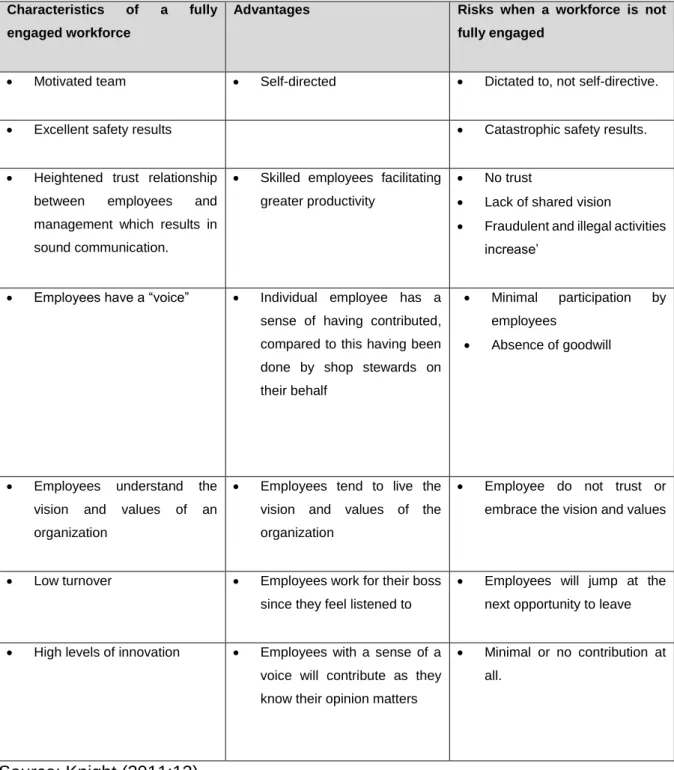
Table 2.1: Characteristics of Engaged Employees
Characteristics of a fully engaged workforce
Advantages Risks when a workforce is not fully engaged
Motivated team Self-directed Dictated to, not self-directive.
Excellent safety results Catastrophic safety results.
Heightened trust relationship between employees and management which results in sound communication.
Skilled employees facilitating greater productivity
No trust
Lack of shared vision
Fraudulent and illegal activities increase’
Employees have a “voice” Individual employee has a sense of having contributed, compared to this having been done by shop stewards on their behalf
Minimal participation by employees
Absence of goodwill
Employees understand the vision and values of an organization
Employees tend to live the vision and values of the organization
Employee do not trust or embrace the vision and values
Low turnover Employees work for their boss since they feel listened to
Employees will jump at the next opportunity to leave
High levels of innovation Employees with a sense of a voice will contribute as they know their opinion matters
Minimal or no contribution at all.
Source: Knight (2011:13)
27 2.4.2 The Role of Corporate Culture
Hellvig (2012:7) correctly notes that employee engagement cannot manifest in a vacuum. Further, engagement needs to be anchored in proper corporate culture that assists in sustaining and stimulating it. Hellvig (2012:8) briefly defines corporate culture as the sum total of the practices within a business, the behaviors, and decisions of its leadership and the employees at large. In a nutshell, corporate culture is simply the way business is conducted in an organization. The importance of corporate culture cannot be overemphasized. It can enhance employee engagement through promoting self-motivation, self-discipline and self-organization. Corporate culture that has minimal meddling and interference from management results in employee self- management. Minimal bureaucracy and hierarchy are pillars that can create progressive corporate culture that sustains engagement. It is therefore obvious that business leaders need to consciously create particular circumstances to enable engagement. Numerous studies confirm that teamwork also assists in the realization of commonly shared goals.
2.5 EMPLOYEE ENGAGEMENT AND TRUST
The notion of trust is one that is difficult to define since it is approached from various angles. One definition that is offered by Rousseau et al. (1998) suggests that it is a psychological state characterized by willingness to accept vulnerability on the basis of expectations of the behaviour or intentions of another.
Another definition is offered by Mayer et al. (1995). They state that it is about one party being willing to make themselves vulnerable to the actions of another. This is done with the hope by the trustor that the one trusted will neither harm them nor take advantage of their vulnerability. This suggests that there is an element of taking a risk here. Within the work environment, trust will often manifest in a belief by one employee that the other will act in a manner that does not harm them. This points to a belief or a mental attitude and can thus appropriately be characterized as a particular psychological state.
28
Noteboom (2002) simplifies the elements of trust as consisting of the four aspects namely:
(i) A person trusting (ii) A person being trusted
(iii) Trusting in some aspects of behaviour (iv) Trusting in particular circumstances
It is now clear that within the workplace, an employee will naturally trust their supervisor or management, including the organization itself.
2.6 EMPLOYEE ENGAGEMENT AND INNOVATION
Rao (2016) submits that owing to the global economic challenges, organizations are more open to innovation and creativity. Kruger (2007) notes in a Gallup study that there is correlation between engagement and innovation. A finding from this study was that 60% of engaged employees stated that their jobs functions brought out a flow of creative ideas. Only a mere three percent of employees that were not actively engaged could attain that state of creativity. This finding was again reflected in a research project undertaken in 2007 by the Chartered Management institute. This research established association between innovation and employee engagement. The findings revealed that from 1500 managers in the United Kingdom, there was an overwhelming 92% indication of engagement particularly in organizations where innovation was a dominant leadership feature. This provides evidence of the correlation between engagement and innovation.
Truss et al. (2006) note that the notion of employee engagement has received a lot of attention global and that this has largely to do with the focus on the notion of positive psychology amongst the academic community. In the UK, the Institute of Personnel and Development (CIPD) acknowledged the importance of the phenomenon of employee engagement such that it commissioned studies on it. Engagement is now regarded as so vital such that CIPD recommended that it be included in the top ten professional areas that HR practitioners need to focus on. A study commissioned in by MacLeod and Clarke (2009) emphasized that if the notion of employee engagement including its underlying principles were to be widely understood and practiced, great potential could be unleashed from the workforce. Further it emphasized that there