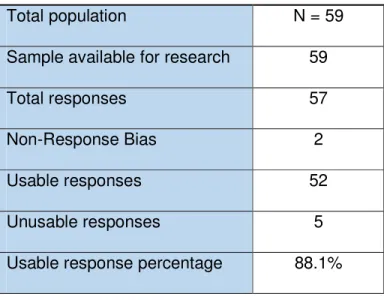
This thesis/dissertation does not contain text, graphics or tables copied and pasted from the Internet unless expressly acknowledged and the source is detailed in the thesis/dissertation and in the reference sections. A quantitative research approach was chosen and a sample of a total of 59 black employees, consisting of managers and technically skilled employees, was invited to participate in the study.
CHAPTER 1
- INTRODUCTION
- DEFINITION OF TERMS
- Black (People)
- Black Skills
- Economically Active Population
- Job Satisfaction
- Motivation
- Organisational Commitment
- Turnover
- Talent Management
- RESEARCH OBJECTIVES
- RESEARCH QUESTIONS
- SCOPE OF THE STUDY
- RELEVANCE OF THE STUDY
- LIMITATIONS OF THE STUDY
- Age of Respondents
- Qualifications of Respondents
- SUMMARY OF THE CHAPTERS
- CONCLUSION
Motivation is described as "the process that accounts for an individual's intensity, direction and persistence in efforts to achieve a goal" (Robbins, et al., 2009). The results of this study are intended to provide input for targeted talent management strategies, specifically targeting black executives and technically skilled black employees in the company, and could further be used as a guideline for similar companies within the industry.
CHAPTER 2 – LITERATURE REVIEW
- INTRODUCTION
- SKILLS SHORTAGE
- BBEEE AND EMPLOYMENT EQUITY
- MOTIVATIONAL THEORY
- Maslow’s Heirachy of Needs
- Aldefer’s ERG Theory
- McClelland’s Theory of Needs
- Herzberg’s Motivation-Hygiene Theory
- Vrooms Expectancy Theory
- Equity Theory
- EMPLOYEE RETENTION / TURNOVER
- Job Satisfaction
- Organisational Commitment
- Veldman’s Employee Commitment Model
- Mobility
- Review of Retention Factors
- Summary of Retention Factors
- CONCLUSION
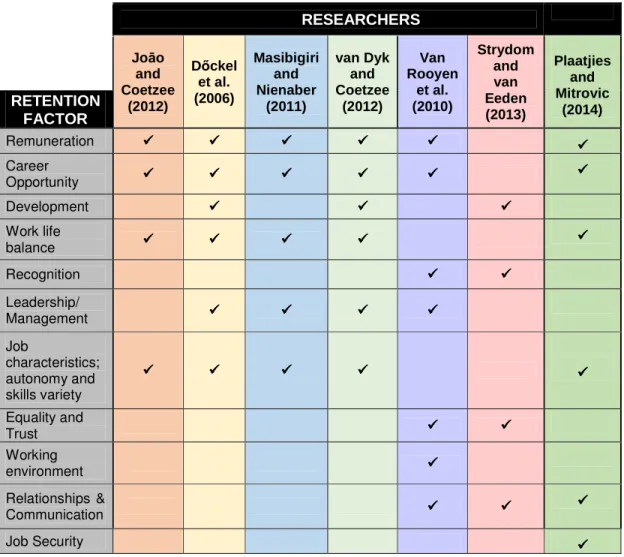
Maslow's Heirachy of Needs is one of the most popular and popular theories on motivation (Robbins, et al., 2009). Kerr-Phillips and Thomas, (2009) in their study titled Macro and Micro Challenges to Talent Retention in South Africa concluded that factors such as leadership and organizational culture are important factors in talent retention, while Balakrishnan and Vijayalakshmi, (2014) and Van Staden and du Toit, (2012) findings are consistent with some of the critical factors of listed retention. This was identified as one of the most significant factors related to employee retention.
Mabuza and Proches (2014) found that recognition was one of the key factors influencing staff retention.
CHAPTER 3 – RESEARCH METHODOLOGY
- INTRODUCTION
- TYPES OF RESEARCH
- RESEARCH DESIGN
- RESEARCH APPROACH
- POPULATION AND SAMPLE
- RESEARCH INSTRUMENT
- DEVELOPMENT OF QUESTIONNAIRE
- Questionnaire Testing
- DATA COLLECTION
- Problems Encountered
- ETHICAL CONSIDERATIONS
- RELIABILITY
- VALIDITY
- DATA ANALYSIS
- CONCLUSION
The nature of the research conducted is descriptive in nature as its main objective was to identify relevant factors for the retention of skilled black employees in a particular electronics company in KwaZulu-Natal. The nature of the research strategy adopted for this study is survey research as it uses a survey mechanism to collect information. The questionnaire was then pilot tested among eight (8) friends and colleagues who were not part of the sample identified for the study.
The supervisor played the key role of advising on the content and form of the questionnaire throughout the process. To encourage a high response rate, groups of approx. 10 participants were briefed at a time and informed about the study. This included the purpose and objectives of the study and informed participants of confidentiality.
It was further emphasized that participants had the right to withdraw from the survey at any stage. This was overcome by explaining that the anonymity of the questionnaire responses was strictly controlled. Fortunately, this was a small percentage of the sample and had a minimal impact on the outcome of the study.
CHAPTER 4 – DATA ANALYSIS AND PRESENTATION
INTRODUCTION
RESEARCH INSTRUMENT
- Response Rate
- Reliability
- Normality Testing
The reliability of each section, specific to a research question, was tested using Cronbach's Alpha test. According to De Vaus (2002), the Cronbach's Alpha reliability coefficient of 0.7 is normally considered indicative of a reliable set of items (Table 4.2). Although Shapiro-Wilk tests are more appropriate for small samples (n < 50), both Kolmogorov-Smirnov and Shapiro-Wilk tests were used for normality checking.
According to Appendix E, both Kolmogorov-Smirnov and Shapiro-Wilk were found to be significant, implying that the data were not normally distributed and parametric tests such as ANOVA and T-tests were not suitable for analysis. According to Cooper and Schlindler, (2014) the Kruskal-Wallis test is suitable for ordinal scaled data or for interval data that for any reason are unsuitable for a parametric test. Non-parametric measures of association were obtained using Spearman's Rho Rank Correlations, which is an adapted form of Pearson's product moment correlation and is suitable for ordinal scaled data (Cooper and Schlindler, 2014). .
During Chi Squared testing, where the expected scores were violated, Fisher's Exact tests were used.
DESCRIPTIVE ANALYSIS
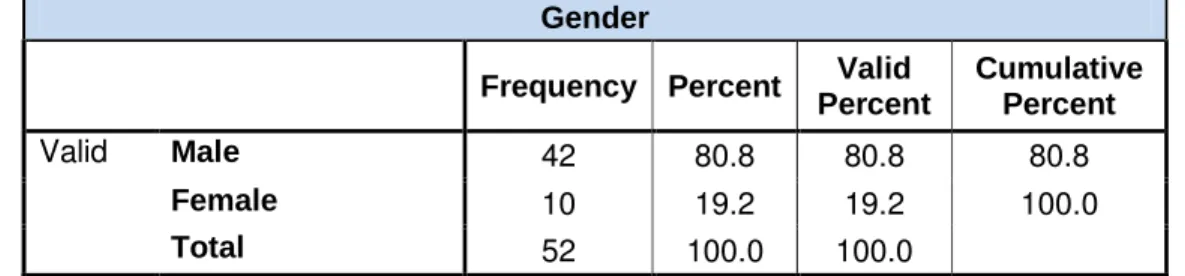
- Gender
- Age
- Race
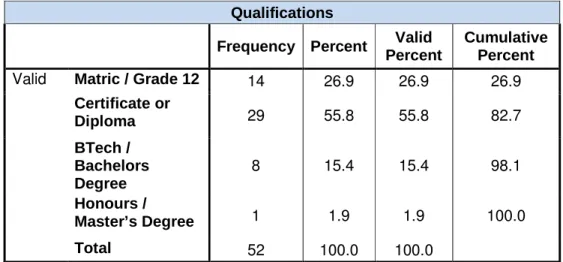
- Qualifications
- Monthly Remuneration
- Job Position
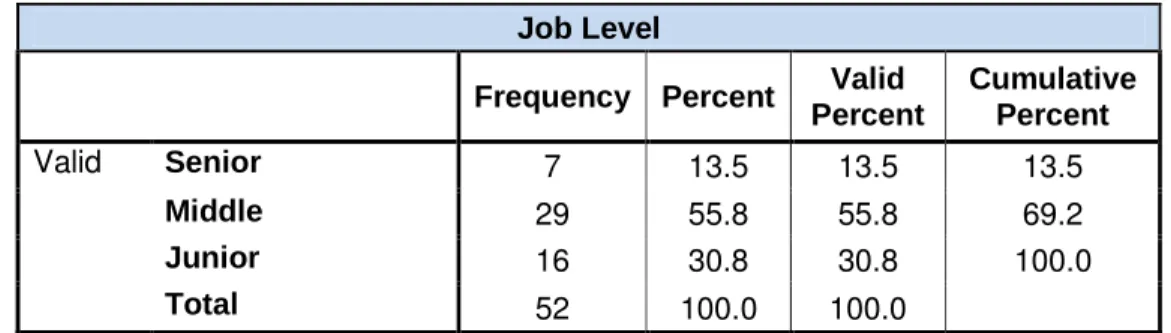
- Job Level
- Research Objectives 1 and 2
- Remuneration
- Career Opportunity
- Job Satisfaction
- Work-Life Balance
- Working Environment
- Relationships and Communication
- Leadership and Management
- Research Objective 3
- Better External Career Opportunities
- Willingness to Relocate
- Searching for Career Opportunities
- External Remuneration Perception
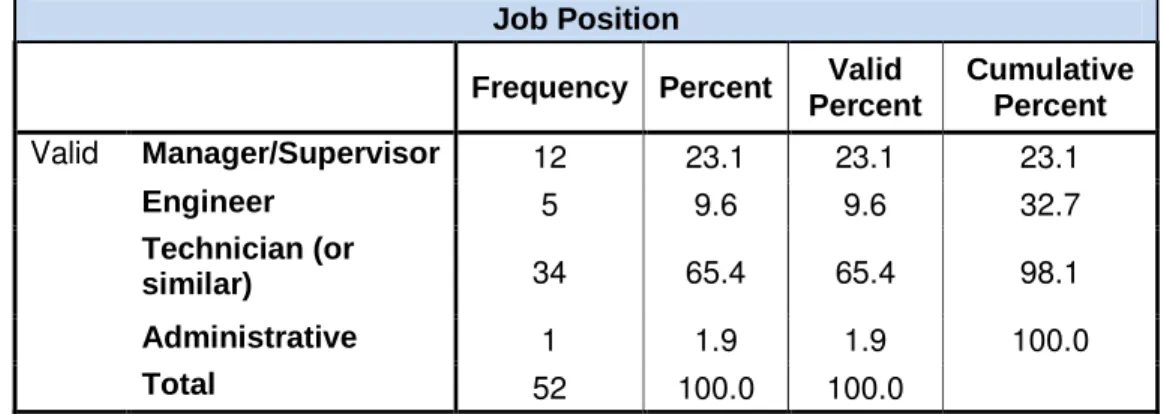
Engineers comprised 9.6 percent (n=5) of the sample, and technical administrators comprised only 1.9 percent (n=1) of the sample (Table 4.9). Key retention factors were identified in the literature review, and respondents were asked in the questionnaire to rank their perception of the importance of these factors on a scale from 1 to 7; 1 is most important and 7 is least important. 75 percent of the respondents indicated that their job was not satisfactory, and 80.8 percent of the respondents felt that they did not find their work interesting and challenging (Figure 4.4 and Figure 4.5).
In addition, 44.2 percent of respondents felt they could not talk freely with managers and supervisors about certain work-related issues (Figure 4.12). The research shows that the central tendency is to remain neutral. However, positive Kurtosis means that there is skew to the left, and therefore most values are concentrated to the right of the mean. According to the Kruskal-Wallis tests, there is also a significant difference in job level and willingness to move for a better job opportunity (H p = 0.003).
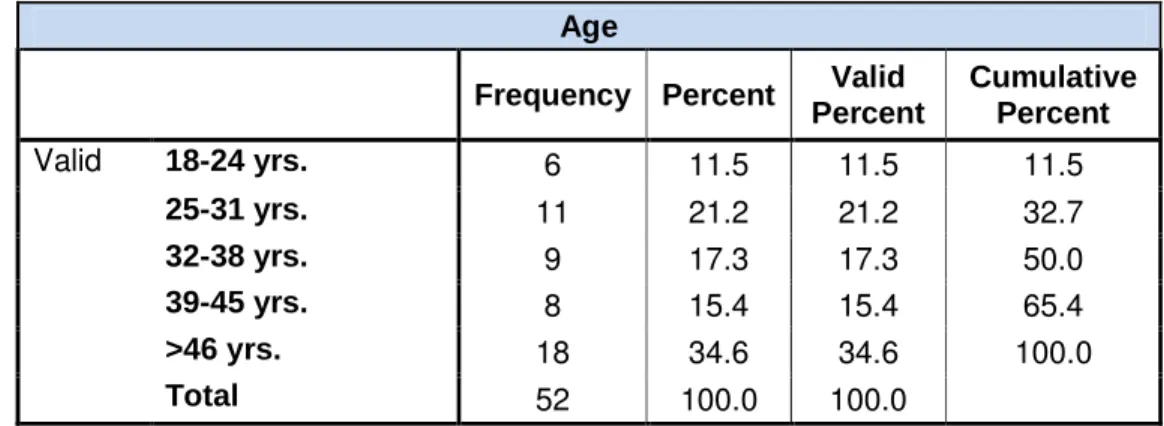
It is indicative that only 9.6 percent of the respondents believe that the remuneration in other companies is better. Negative kurtosis means that there is a skew to the right, so most of the values are concentrated to the left of the mean. There is a significant, moderate, negative correlation between age and the probability that someone would leave the company in the next 5 years (r N = 52, p = 0.003), indicating that the probability of leaving the organization decreases with age. the respondent increases.
In addition, there is a significant difference in the level of employment and the probability of leaving the company in the next 5 years (H p = 0.005), as determined by Kruskal-Wallis testing. There is a significant, moderate, positive correlation between the probability of leaving the company in the next 5 years and the willingness to relocate (r = 0.466, N = 52, p = 0.001), which means that as the probability of leaving the company.
CONCLUSION
There is a significant, moderate, positive correlation between the probability of leaving the company within the next 5 years and looking for better job opportunities (r = 0.489, N = 52, p = 0.000), which means that as the search for better job opportunities increases, the probability of leaving the organization increases, and vice versa.
CHAPTER 5 – CONCLUSION AND RECOMMENDATIONS
INTRODUCTION
STATEMENT OF RESEARCH PROBLEM
- RESEARCH OBJECTIVES 1 AND 2
- Findings: Research Objectives 1
- Findings: Research Objectives 2
- RESEARCH OBJECTIVE 3
- Findings: Research Objectives 3
More than half of respondents placed this in the top three most important retention factors. More than half of respondents ranked career growth opportunities among the top three most important retention factors, but 63.5 percent of respondents in this survey believed there were no prospects for growth and advancement within the company. In this survey, 48.1 percent of respondents placed work-life balance among the top three important factors.
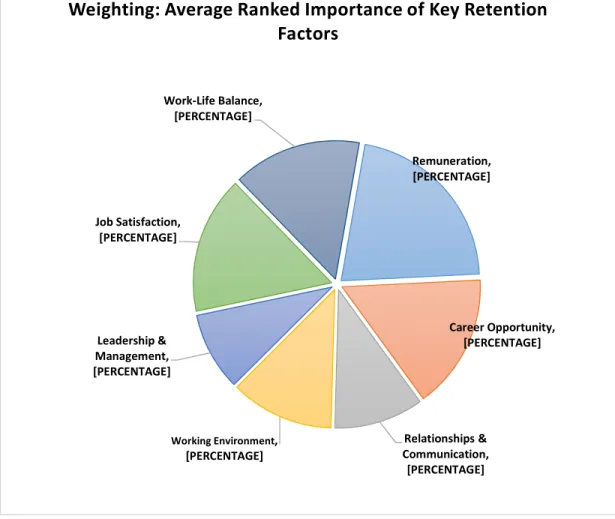
The work environment is perceived, by respondents, to have an overall effect of 12 percent on retention, compared to the seven main retention factors identified. However, according to the calculated average weight of the ranked importance of the main retention factors (refer to Figure 4.1: Weighting: Average ranked importance of the main retention factors), Relationships and Communication are perceived, by the respondents, to have an overall effect of 11 percent on retention, compared to the seven main retention factors identified. However, from the perspective of employee retention, according to the calculated weighted average of the ranked importance of the main retention factors (refer to Figure 4.1: Weighting: Average ranked importance of the main retention factors), Leadership and Management is perceived, by the respondents, have an overall effect of 9 percent on retention compared to the seven main retention factors identified and can be seen as a small negative impact on employee retention.
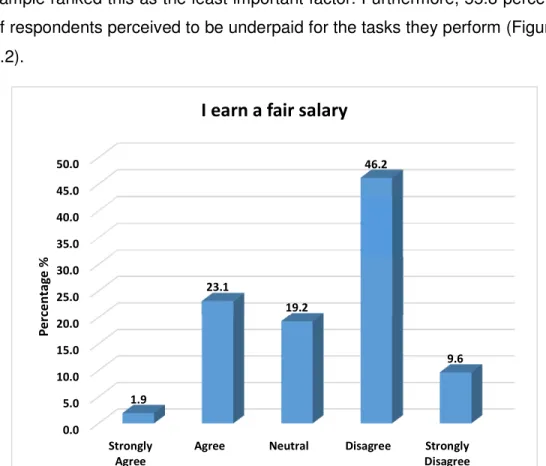
In this study, pay was rated as the most important factor, with more than 78 percent of respondents ranking it as one of the top three factors. Only a small percentage of respondents (3.8 percent), most of whom were in management positions, believed that there were better external career opportunities. In addition, only 9.6 percent of respondents perceived that pay, which was identified as the most influential factor in retention, was better at other companies.
LIMITATIONS OF THE STUDY
- Age of Respondents
- Qualifications of Respondents
SUMMARY OF THE STUDY
Work-life balance was identified as the third most important retention factor that negatively impacted employee retention. The work environment was identified as the fourth most important retention factor that negatively affected employee retention. In general, older respondents were more satisfied with the work environment compared to younger employees.
Relationships and Communication was identified as the fifth most important retention factor that had a negative impact on employee retention. Leadership and Management was identified as the least important retention factor that had a negative impact on employee retention. Finally, employees' perceptions of external career opportunities lend positively to the organization's intention of employee retention.
It also found that respondents in higher-level positions were more actively looking for better opportunities and more willing to move, compared to their younger colleagues. However, data analysis highlighted that employees in intermediate positions were the highest risk group when it came to the company's exit intentions.
RECOMMENDATIONS
The focus of this study was on the retention and benefits of black managers and technically skilled employees. However, it is important to know that retaining employees can also have a negative impact on the organization. Studies have shown that in some organizations, underperforming employees, lack of knowledge transfer and sharing may not be beneficial to the organization (Larkin and Burgess, 2013).
In conclusion, it is recommended that the company closely examine the results of the data analysis in Chapter 4 and address the shortcomings. While certain remedies can be applied globally, strategic efforts to retain talent require a targeted approach as different groups of employees within the organization have emphasized different areas of focus.
SUGGESTIONS FOR FUTURE RESEARCH
CONCLUSION
Through your participation, I hope to understand employee perceptions of the company and the external environment through analysis and identify positive and negative issues that have an impact on staff turnover. The results of the focus group are intended to contribute to the improvement of employer-employee relations at the company and the findings of the study will assist similar companies within the industry. Please note that a copy of your consent document has been requested by the company.
6 I earn a fair salary for the tasks I perform 7 I have prospects for job growth and promotion 8 I know what the company expects from me. 9 My contribution to the company is not important 10 I can use my skills and knowledge at work I. 15 Working conditions in the company are good 16 Sometimes I look for better job opportunities 17 I am not able to speak freely about a certain work-.
24 I am prepared to work overtime from time to time for the company to achieve its objectives. 30 I get feedback and recognition for the work I do 31 The company keeps me informed about news and. I am prepared to work overtime from time to time for the company to achieve its objectives.