Landau found that “in the rapidly industrializing economy of South Africa, approximately 60 percent of the population lives in urban areas. This is also one of the reasons that motivated the researcher to commit to understanding the behaviors of young people who are perceived by this study as being contrary to the behavior accepted by society in general.
Problem statement
Research question
Motivation for this study
Research objective
Delimitation of the study area
It has also been difficult to travel to parts of some rural areas to understand the youth crime dynamics that occur in these remote areas. The focus was more on urban areas, although it was expected that rural offenders could be met in the correctional facility and asked to share their accounts of juvenile involvement in crime and their motivations.
Crime phenomenon in urban areas
As mentioned above, it was also not possible that this study could afford to go to all parts of KwaZulu-Natal to obtain statements from the youth involved in criminal activities as to why they engaged in crimes. This is why this study took the initiative to focus on the Westville Correctional Facility (WCF) with a view to obtaining rich data on the motives that drive certain youth to criminal activities.
Economic inequalities and crime
This study therefore set out to investigate why some youth engage in criminal activities to achieve their goals in life: A study of male offenders incarcerated in the Westville Correctional Facility. The concern that this study also highlights is that the numbers of incarcerated youths are increasing year after year.
Youth crime as a global problem
This was one of the attempts to observe possible causes of criminal activities from different aspects of life. In many households, tension fueled by social exclusion and financial difficulties has affected the most vulnerable members of the family, such as women and children.
The social factors associated with crime in Africa
Most African countries are categorized as developing countries, characterized by poorly resourced criminal justice systems. Some individuals may dispute that the above social dynamics alone would not necessarily cause crime.
Youth crime as a South African problem
Ecology is defined as "the study of the relationship of the organism to its environment". For criminology, this involves studying the spatial distribution of crime and delinquency (Brown, Esbensen & Geis, 2001:307).
Merton’s social structure and anomie
This study also finds that Sampson and Groves (1989), Hill and Paynich (2014) and EDC (2012) all agree in their concern about the lack of community involvement and other networks they see as a major cause of neighborhood crime and disorder. They mentioned that with the social disorganization of the inhabitants there is distrust among themselves. This lack of trust in one another would continue despite the fact that members of this community are quite aware of the prevailing crime problems.
Differential association theory
From the perspective of this study, social factors seem to have a huge effect on members of society, not only because they are disadvantaged, but also because they criminally victimize each other due to their lack of interconnectedness. This reality revealed by this theory was confirmed by the participants of this study during data collection. This study therefore describes the answer to this question in the research findings section of Chapter 6.
A General Theory of Crime (Gottfredson & Hirschi, 1990)
From this study's point of view, to successfully instill self-control, parents must be concerned about their children's well-being, including concern about their whereabouts. This was discovered and thought about after the researcher determined that the youth who participated in this study grew up in disengaged family structures. The information about affiliation with gang members should also be part of a finding that helped provide this study with the motivations for some youth engaging in criminal activities to achieve life outcomes.
Ecology of Crime
This was one of the influences that motivated them to engage in criminal activities to achieve success in life, and they considered this as the best choice for material achievement. In view of what was mentioned by Nirmala (2009) above, the fact is that correctional facilities tended to be learning environments that instilled criminality in the youth who participated in this study as well as their fellow inmates. The confinement and restraint to which they were subjected seemed to appear opposite because they seemed to be free in the correctional institution as opposed to being in their respective homes or environments where they were born.
Summary
This study believes that young people can start criminal careers if they are subjected to environmental factors as mentioned by the criminological theories used by this study above. Therefore, it is important to clearly outline the methodology used in conducting this study and subsequent data collection, as well as its findings. The qualitative methodology used was considered by this study to be suitable and suitable for this research topic as follows in the next chapter.
Introduction
Research approach
Hennik et al (2011:9) further mentioned that, “One of the main distinguishing features of qualitative research is that this approach enables you to uncover valuable information from the participants' frame of reference and to understand their shared meanings and interpretations with the researcher about their behavior". When the phenomenon is vague or unknown, so that one's understanding of the nature of an issue or problem is limited or lacking, then a qualitative research approach should be used in a research project as a prelude to a statistical inquiry, especially if the subject needs to be understood or defined more clearly. Such a topic is likely to generate emotional and often painful responses, and the researcher must adjust the questions so that they respond to the individual's particular circumstances.
Research design
The researcher and participants were given a small but open room used by correctional services guards. The door was kept open so that correctional facility guards could observe the behavior of the offenders but could not hear the conversations between the researcher and the participants. It was still the duty of the guards to keep an eye on the participants as they were still considered trespassers and for the safety of the researcher.
Research Population
The researcher had to emphasize that the participants should not use their real names that could identify them. The fact of being set free to use the name of their choice, not their real names, helped create more rapport with the participants and the researcher could observe how they took ownership of the discussion. The correctional service assisted the researcher in the selection of young offenders incarcerated for theft, robbery, burglary and hijacking, although other offenses emerged during the interviews.
Sampling
After officially gaining access to the potential participants, the researcher used purposive sampling to select the participants who met characteristics related to the research topic of this study. The researcher must decide who or what is representative of the phenomenon being studied. Twenty (20) research participants were chosen for this study with the assistance of Department of Correctional Services (DCS) officials.
Anonymity and confidentiality
The first group of ten participants was interviewed separately during the first interview day. The reason for not interviewing twenty participants simultaneously was based on the researcher's manageability of information, and it was important that the researcher dealt with manageable information, small enough not to overwhelm him.
Validity, Reliability and Rigour
Hammersely (1992) and Lindlof and Taylor (2002) also agreed with this idea when they stated that "reliability is related to the degree of consistency in observing or categorizing the patterns under investigation". This idea was based on the perception of Shenton (2004:63), who mentioned that “when dealing with credibility, researchers try to prove that a true picture of the phenomenon under scrutiny is being presented. This study therefore outlined all the methods used from the sample and ensured the reliability of the data collected and how the study arrived at the generalization of the research findings.
Limitations of the study
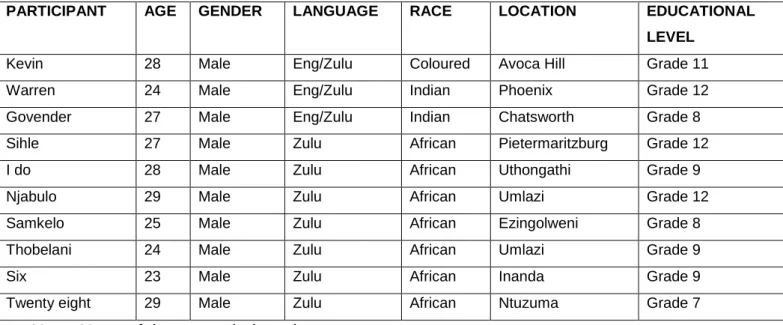
To enable transferability, they provide sufficient detail about the context of the fieldwork so that a reader can decide whether the prevailing environment is similar to another situation with which he or she is familiar and whether the findings can be legitimately applied to another setting. . Only the majority black community, two Indian and one colored participant were eligible for this study. The researcher suggested the rules to be followed to the groups of participants so that each participant had enough time to share their experiences and be respected.
Summary
Participants were not ashamed or embarrassed to share their criminal behavior with the researcher. This was due to the fact that the relationship between the participants and the researcher was established early on and the researcher had to make it clear that the study was for academic purposes. The researcher therefore decided to write down the pseudonyms as they were pronounced by the participants, as their true identity was not revealed during the interview and documentation.
PROFILE OF THE FIRST GROUP OF PARTICIPANTS
The majority of participants were raised by either a single parent (mother only) or grandparents. Below are the research questions of the researcher during the interview and the corresponding answers of the participants. Such crime reality, as explained by the participants above, was also mentioned by Bezuidenhout who argued that "The belief that certain ethnic groups are targeted by criminals more than other groups is rooted either in misinformation regarding criminal behavior patterns or in a desperate attempt to make sense. sense of crime.
PROFILE OF THE SECOND GROUP OF PARTICIPANTS
The second group was not aware that the first group had already been interviewed and they did not know each other, and this could be due to the high number of juvenile offenders in the Youth Prison. The second group of participants also seemed to own the conversation in the interview, and their research questions were presented slightly differently than the first participants, although they still had similar elements. Besides the reality of being confined in the correctional facility (incarceration), the participants' views seemed to benefit some of them as they used the opportunity of confinement as a learning moment for them to gravitate to other levels of criminal skills.
Conclusion
The discussion is designed to simplify what happened during the interview and reveal the underlying factors of the shared views and experiences of the research participants. This study therefore developed five themes that summarize participants' motives for engaging in criminal activities. Participants' views on the common attitudes and behavior of a young person who subsequently behaves criminally.

Discussion of the research themes
When discussing this topic, it became clear that the initiators are not strangers to the participants, but are close to their everyday life and can be easily reached. It seems that their homes were the first place that made it easier for the participants to turn to criminal activities in order to achieve success in life. On the other hand, there were experienced criminals who were mentioned by the participants as inspiring because the participants were willing to reach their level of criminality.
Participants’ views on how to identify a youth offender
South Africans live in a materialistic society where possessions and physical comfort are valued far above spiritual values. In a society where status comes from wealth and possessions, the very poor and marginalized are treated as a nuisance. Financial independence and the materialistic spirit of South African society places a huge burden on anyone unable to compete at this level.
Participants’ suggestions on how to prevent crime
The absence of parental figures in their daily lives created a situation that left participants feeling alienated from their sense of belonging to their family, unlike other young people who lived in healthy family cohesion with both parents living together. This study also found that participants had developed anger and envy towards those who lived in close-knit families, in such a way that they saw those who lived in healthy families as targets to be deprived of their possessions. Parental attachment was considered most important for the emotional bond between parent and child, and would help the child internalize norms.
RECOMMENDATIONS AND CONCLUSIONS 7.1 Recommendations
Conclusion
Burton (Eds.), Someone stole my smile: Exploring the causes of youth violence in South Africa (pp. 1–18). The opportunity costs of maintaining the criminal justice system in South Africa from 1980 to 2006. Youth crime and unemployment in the Cato Manor Police Area, KwaZulu-Natal, South Africa.
APPENDIX A: ETHICAL CLEARANCE
APPENDIX B: CORRECTIONAL SERVICES APPROVAL
APPENDIX C: INFORMED CONSENT
Some of the information you shared will be documented in the research report and your name or personal information will not be revealed anywhere. I understand that the information I will share will be used for research purposes only and that my identity will not be disclosed anywhere in any research report or publication. I am also aware of the fact that I can withdraw at any time during my studies without penalty.