By
WARREN F. MOORGAS
(Student Number: 202522806)
Submitted in partial fulfilment of the requirements for the degree of Masters in Business Administration
University of Natal (Durban)
Graduate School of Business, Faculty of Management
Supervisor: Professor Elza Thomson
September 2003
DECLARATION STATEMENTl
CONFIDENTIALITY CLAUSE
Due to the strategic importance ofthis research it would be appreciated if the contents :~;:d~.~mainconfidential and notbecirculated for a period offiveyears.
Date
\~ I Q.: J.~~ ..
STATEMENT 2
This work has not been previously accepted for any degree and is not being currently submitted in candidature for any degree.
Signed~
....Date
J.?/~.~j~J
096605
STATEMENT 3
This dissertation is being submitted in partial fulfilment ofthe requirements for the degree of asters in Business Administration.
Date '.
~fo.'1/~}
STATEMENT 4
The dissertation is the result of my own independent work / investigation, except where otherwise stated.
Other sources are acknowledged by giving explicit references. A bibliography is appended.
Signed~
...Isjo~ lo?
Date
f-' .
ii
ACKNOWLGEMENTS
To my Darling wife, Claudene. You are a true friend and supporter. Itake pride in being your husband and I hope we continue to be each other's best friend in the future. I would like to express my gratitude and thanks for your support and the many sacrifices made during my term of study and research. I want you to remember that I could not have come this far without you. You are my source of inspiration and strength.
To my parents, Anand and Savy Moorgas, for the freedom, support and love you have showered me with throughout these years, in good times and difficult times. I love you both very much and am grateful for everything you have done for me and our family. You have given me the courage to mount greater heights and pursue my dreams, whatever they may be.
I wish to express my gratitude to the following individuals who enabled this document to be successfully and timeously completed:
Professor Elza Thomson Brian Allers
Charuna Naidoo
ABSTRACT
This dissertation assesses the external environment of the Telecommunications market in South Africa. It accomplishes this goal by explaining the political economy, market structure, key driving forces and conducting an Industry analysis. The study considers the literature on regulation and liberalisation, convergence and the various techniques of industry and competitive analysis. A case study on the historic and current Telecommunications environment is presented.
The analytical framework developed for this study adopted from Naidoo (2002), consists of five components: the external environment, remote environment, industry environment, operating environment, key driving forces and an industry and competitive analysis. It also includes a background overview and recommendations.
Data for the study was largely collected using publications and journals, which have been published in electronic format on various Internet hosted databases including:
verbatim submissions to the White Paper on telecoms policy (Government Gazette no.
16995 Notice No 291 of 13 March 1996), submissions on the licensing of the Second Network Operator, participant-observation, government documents, statistical databases, published literature and unpublished papers.
The perspective of the study is to learn and apply the knowledge elsewhere. The main purpose of this study is to describe the industry for the various Telecommunications operators (fixed, cellular and VANS) in the South African market and to conduct a strategic analysis. Another objective is to provide the researcher with further knowledge of this particular industry and to ascertain from a business environment viewpoint whether to invest in the telecommunication sector in South Africa.
iv
TABLE OF CONTENTS
Page No:
lritle Jla~e••••••••••••••••••••••••••••••••••••••••••••••••••••••••••••••••••••••••••••••••••••••
Declaration..••..•.••.••...•..•.•...•...••.••.•.•..•...••.••.••....•..•.•.••.. ···•·•·•••··•·•.
Acknowledgements•.•..••••....•••••.•..•.••••.•....•.••.•....••.••••.•••...•••.•....•..
AlJstract..•••••••.•..•..•..•..•••.•.•••.••.•....•.••••.•....•..•....•.••...•••.••.•...••••.•••..
Table of Contents•...•..••.•••...•...••.•.•..••...•..•..••...•.•••..•••.•••...•...•.
List of Figu.res..•.••••••.•.•...•••.••••...••••••••••...•..•.••••.••..•••...•••.•••...
List of Tables.•..•..•••...••••.•...•..•...•..•...•..•..•...•..••...•.••••.•.•
ListofAppendices.•..•...••.•.•••.•••...•..••••••..••••••..•.•...•.•.•..•..•••.•.•.
11
ll1
iv v
Vlll
IX
X
Chapter I - Introduction .
1.1 Irltr<>Clllcti<>Il••••••••••••••••••••••••••••••••••••••••••••••••••••••••.••••.•••.
1.2 1.3 1.4 1.5 1.6 1.7 1.8 1.9
IJacJc~<>lU1Cl•••••••••••••••••••••••••••••••••...•...••..•.••••••••
M<>tivati<>Ilfor the StuCly•.•••.••.•••••••.••••••.•••.••..•...••.•••••••
Value of theStuCly•••••••••••••••.•....•...••••••.•...•
Objectives•••••••••••••••••••••.•.•..••.•••••••••••••••••..•••.••••••••••••••••
ResearchMethodology..••.•••••.•••••••••••••.••••.•••••••••••••...••••••••
~iDnjtati<>lls•••••••••••..••....•••••••••••••••....•••••••••••...•••••••••....
~tl1Jctllre.•••••••••..•...•••••••••.•...••.••••••...••••••••...
~UUIUn1~••••••••••••••••••••••••••••••••••••••••••••••••••••••••••••••••••••••
1 1 1 2 3 3 3 4 5 6
Chapter II - Literature Review... .... 8 2.1 Irltr<><lllCtiOIl... 8
~xteI11al ~Ilvirorullellti\I1a1)'sis.•...•.••...•...••...•.•
2.2
2.2.1 2.2.2
Compollellts of the ~xteI11ali\I1al)'sis•.•....•..•.•.•..•••...••
Rennote ~nvir<>IUn1ent•••••.•..••••••..•••••••••••••.••..•••••...•••
8 10 11
2.2.2.1 P~ST~i\I1al)'sis 13
2..2.. 3 Industry Environment... 16
2..2.. 3.. 1Porters Five forces... 17
2.2.4 The Operating Environment. 22 2.3 The Methods ofIndustry and Competitive Analysis... 22
2..4 Key Driving Forces... 27
2.. 5 The Telecom.m:un.ications Market... 28
2.5.1 Network Infrastructure... 30
2.5.2 Customer Premises Equipment (CPE) 31 2..5..3 Local Access... 31
2..5..4 Fixed Line... 33
2.5.5 Wireless (Cellular/Mobile) Networks... 33
2.5.6 Long Distance (National and International) 34 2.5.7 Provision of Services
CV
ANS) 34 2..5.. 8 Interconnects... 362.6 Regulation and Liberalisation of Telecommunications... 37
2.6.1 Normative Theory of Regulation... 37
2.6.2 Positive Theories for Regulation... 38
2.6.3 Different Types of Regulation.. 39
2.6.3.1 Regulation Under Perfect Information... 39
2.6.3.2 Regulation Under Asymmetric Information... 39
2.. 7 Convergence... .... 40
2..8 SummaTy'... 41
Chapter III -CaseStudy... 43
Telecommunications in South Mrica 3.. 1.. Introduction... 43
3.2. International and Regional Policy Structures Affecting South Africa's Telecommunications Market. 45 3..3.. Infra.structure. .. ... .. ... ... ... .... .. 46
3..4.. Human. Capacity... 49
3.5. Government Policy, Law and Regulation... 50
3..6.. CllITent Market Structure... 57
VI
3.6.1 Fixed Line... 57
3.6.2 Wireless (Mobile/Cellular)... 58
3.6.3 VANS... 59
3.6.4 Other Markets... 59
3.7. 3.8. Investment Situation.•...•...•••..••..••...•. SUUIUn1~••••••••••••••••••••••••••••••••••••••••••••••••••••••••••••••••••••••• 61 62 Chapter IV - Evaluation... 64
IrltrodlllCtiOIl•••••••••••••••••••••••••••••••••••••••••••••••••••••••••••••••••••• Fternote~1l~rOfU01eIlt••••••••••••••••••••••••••••••••••••••••••••••••••••••••• Irl<lus~ ~n"iroIUn1eIlt . SWOT Analysis of the Telecommunications Environment in SA... 64 64 70 71 74 74 PESTAnalysis•••.•...••.•.•..•..•....•.•....•.•..•...•.•.••••.•.•..• Porters Fi"e Forces . 4.4.1 4.3.1 4.4 4.1 4.2 4.3 4.4.1.1 Fixed Line... 74
4.4.1.2 Mobile... 78
4.5 4.6 4.7 The Operating~n\'ironment . KeyDriving Forces...••.••...•...•...•..•...•...••...•... SlUIUn1~•••••••••••••••••••••••••••••••••••••••••••••••••••••••••••••••••••••• 81 81 81 Chapter V - Recommendation and Conclusion... 83
5.1 Introduction... 83
5.2 5.3 Discussion and Recommendations•...•..•...•...•...•....•....•.••.. ~onclusion . 84 90 Bibliography.. .•.•••...•...••...•.•...•...••.•.••.•...•••...••• 92
Appendix I:Abbreviations... 98
Figure 1.1 Figure 2.1 Figure 2.2 Figure 2.3 Figure 2.4 Figure 3.1
LIST OF FIGURES
Dissertation Framework
The Firm's External Environment Forces Driving Industry Competition
Forces Driving Reform of the Telecommunications Sector A Simplistic Telecommunications Network
South Africa's Telecommunications Structure
viii
Page
7 9 21
29
32 56
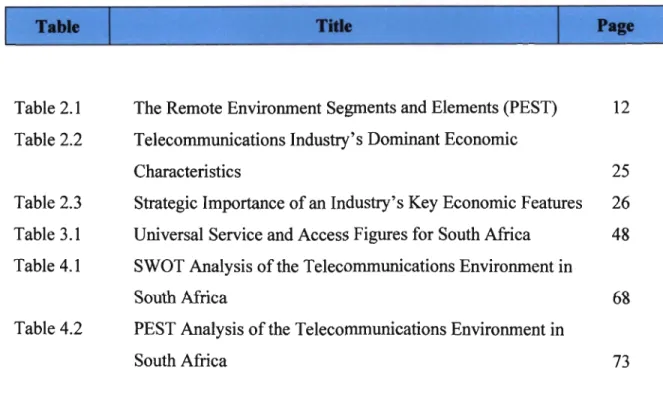
Table
LIST OF TABLES
p. .
Table 2.1 The Remote Environment Segments and Elements (PEST) 12 Table 2.2 Telecommunications Industry's Dominant Economic
Characteristics 25
Table 2.3 Strategic Importance of an Industry's Key Economic Features 26 Table 3.1 Universal Service and Access Figures for South Africa 48 Table 4.1 SWOT Analysis of the Telecommunications Environment in
South Africa 68
Table 4.2 PEST Analysis of the Telecommunications Environment in
South Africa 73
LIST OF APPENDICES
I
AppeadIsI_ _ ~_~_----,- __
Appendix I List of abbreviations
x
98
Chapter 1
INTRODUCTION
1.1 Introduction
Telecommunications plays a pivotal role in a country's economy and is a major enabler of economic growth. This is now more evident than ever with the emergence of the global economy and the struggle of developing countries to make inroads into the economic world of the developed or first world economies. The advancement of Telecommunications in South Africa has additional benefits in that it can also allow people previously denied access to the mainstream economy and so unlocking the potential of the country and its people.
Telecommunications includes a broad range of technologies incorporating telephone and cable networks, data communications, wireless communications systems, satellite, optical fibre, and Internet technologies. The cellular industry, wireless communication systems, electronic commerce, and the Internet have served as a catalyst for the worldwide demand for Telecommunications products and services, which is currently valued at more than $1 trillion per year (Institute of Telecommunications; 2000).
The Telecommunications industry incorporates the provision of two-way, one-to-one communications of voice, data and video. It is distinct from the broadcasting market, which is typically a one-way, one-to-many communication service. However, convergence means that infrastructure developed for either market can be adapted to provide the other service. The scope of this study will be the fixed line and cellular/mobile industries. However the value added network services (VANS) industry is an important one and cannot be completely ignored. Sufficient comment will be made on the VAN's. However, no distinction will be made to the different types of transmission, that is, voice, data or image.
1.2 Background
The South African Telecommunications sector has recently been the subject of renewed interest as it commences its second phase of liberalisation and opens up its fixed line
market to competition. With democracy in place in 1994, the challeng,e of economic and social development created by the ravages of apartheid, required detailed government policy in every sector. Telecommunications was no exception (Cohen; 2002). In 2001, the government began to articulate its plan for the future of Telecommunications policy, and with it the end of an era. Its vision continues to assume a positive association between Telecommunications infrastructure and economic growth and suggests that policy is tailored to achieve that end (Egglestonet al; 2002). It also continues to draw on ideas of distributive justice but has publicly begun to shift from universal service objectives to stressing the importance of foreign investment and of maximizing revenue from the restructuring of state assets.
1.3 Motivation for study
According to Cohen (2002), the South African Telecommunications sector is a lucrative market at the ascent of its potential. Telecommunications (services and equipment) account for 4 per cent of total GDP (which itself has grown almost 50 per cent since 1994), which translates into South Africa spending more on Telecommunications than most developed European nations.
The South African Telecommunications sector is about to embark on a highly challenging period as it begins to open its fixed line market to competition. With the current downturn in the global Telecommunications market, it faces many challenges.
The country's social and economic development agenda is as pressing as ever, necessitating creative solutions for service delivery - and requiring foreign investor interest and capital. Whether its current vision to affect this is sufficient will depend on many factors, but foreign and domestic investment is unlikely to flow if regulatory design matters are left un-addressed.
This dissertation is completed on the understanding that it will add to the body of knowledge of organisations and potential Telecommunications companies that would require industry information to consider entry into South Africa. Furthermore, research of this nature could be used to influence regulators in terms of policy decisions for the
Telecommunications industry as each country needs policies that will help prevent the gap of the "digital divide" between those who have and do not have access to basic Telecommunications services.
1.4 Value of Study
The perspective of the study is to learn and apply the knowledge elsewhere. The study is not mainly focused on applying the results on the studied matter but rather focused on migrating the results and applying the knowledge to another market. As stated previously, the South African Telecommunications market is very lucrative especially with the second round of liberalisation on the horizon. This study will allude to whether it is feasible, from a business environment viewpoint to invest in the Telecommunications sector in South Africa. The perceived shortcomings in the current government policy are also highlighted.
1.5 Objectives
The mam purpose of this study is to describe the industry for the vanous Telecommunications operators (fixed, cellular and VANS) in the South African market and to conduct a strategic analysis. Another objective is to provide the researcher with further knowledge of this particular industry. Due to the fact that the Telecommunications industry is very dynamic, and the usefulness of previous studies can be dated, it therefore became necessary to conduct a detailed overview study of this environment. This study is intended to have a useful time scale of approximately 24 to 30 months after completion.
1.6 Research Methodology
There have been many studies conducted by Academic Institutions, Business Organisations, Aid Organisations and other interested parties. Unfortunately these studies require large financial and human resources, and numerous other logistical obstacles are encountered. In keeping with the methodology used by Naidoo (2001), a decision was then taken to use these sources of data and not conduct a primary research study. This dissertation then utilises the many research papers conducted by others as a source of
secondary data. The generally accepted shortcomings of the use of secondary research have been noted, however it was evaluated and found to have very little negative impact on this particular study. The framework for the literature review (Naidoo; 2001) was conducted, using the theory of authors that have been accepted by students and academics as being accurate. The data for this research was largely collected using publications and journals, which have been published in an electronic format on various Internet hosted
databases.
1.7 Limitations
Telecommunications includes a broad range of technologies incorporating telephone and cable networks, data communications, wireless communications systems, satellite, optical fibre, broadcasting and Internet technologies. The scope of this study is confined to the fixed line, wireless (cellular/mobile) industries and a brief comment on the VANS. Itwas decided that the research would become too broad and hence loose its depth if all aspects of the Telecommunications environment were to be incorporated. It is noted that convergence means that there is a strong overlap between all industries in the Telecommunications environment. However this overlap is the most prevalent in the above three industries.
The study is limited to a strategic analysis. From a company investment viewpoint it is assumed that the firm's corporate strategic decision is to expand into new markets. Other considerations for investment, which are not covered by this dissertation, are the financial and economic aspects like return on investment and similar issues. The risk of the investment is also not discussed. It is based on the generally accepted principle that the first precondition for an investment in the Telecommunications industry in South Africa is that the business environment must first be conducive for market entry, thereafter when this condition is satisfied, the aspect of financial feasibility must be considered. The last, but also equally important, issue of risk needs to be then evaluated. This dissertation does not however, analyse the environment exclusively in isolation. However, it has recognised that there are certain overlaps between the financial feasibility, risk and business environment factors. Where these have been identified it was discussed
appropriately. It was once again decided that the research would become too broad and hence loose its depth if all aspects of the external investment environment were to be studied. Market research pertaining to the consumer's spending power and potential size and value of the Telecommunications market has been specifically excluded from this study.
The study completes a single aspect of the entire strategy decision process namely the external environment. A strategy could therefore be formulated using the study of the external environment in conjunction with the other various aspects of strategy formulation. This study provides only a partial process of the entire strategy development of an organisation, that is, it is restricted to analyse only certain aspects of the external environment and not the company's own internal situation.
1.8 Structure
The structure for this dissertation is based on the dissertation framework figure 1.1 proposed by Naidoo (2001) in his analysis of the East African region, that is, it takes the structure of the external analysis model. The purpose of situation analysis is to determine the features in a company's internal and external environment that will most directly affect its strategic options and opportunities, (Strickland& Thompson; 2003). The effort concentrates on generating solid answers to a well-defmed set of strategic questions, then using these answers first to form an understandable picture of the company's strategic situation, and second to identify what its realistic strategic options are.
In studying the methods of strategic situation analysis, it is customary to begin with single-business companies. In single-business strategic analysis, the two biggest situational considerations are (1) industry and competitive conditions ("external environment") and (2) the company's own internal situation and competitive position.
Industry and competitive analysis is the terms used to refer to external situation analysis of a company. Company situation analysis examines the internal narrower field of its microenvironment. This dissertation is restricted to analyse only the external environment and not the company's own internal situation.
1.9 Summary
With the emergence of the global economy the role of Telecommunications in a country's economy as a major enabler of economic growth is now more important than ever before.
The South African Telecommunications sector has recently been the subject of renewed interest as it commences its second phase of liberalisation and opens up its fixed line market to competition. With the current downturn in the global Telecommunications market, it faces many challenges. The country's social and economic development agenda is as pressing as ever, necessitating creative solutions for service delivery - and requiring foreign investor interest and capital. Whether its current articulated vision to affect this is sufficient will depend on many factors, but foreign and domestic investment is unlikely to flow if regulatory design matters are left un-addressed. The main purpose of this study is to describe the industry for the various Telecommunications operators (fixed, cellular and VANS) in the South African market and to conduct a strategic analysis. This dissertation utilises the many research papers as well as Internet resources conducted by others as a source of secondary data. The scope of this study is confined to the external environment of the fixed line and wireless (cellular/mobile) markets. Itwas decided that the research would become too broad and hence loose its depth if all aspects of the Telecommunications environment and the entire strategic process were to be studied.
Figure 1.1
DISSERTATION FRAMEWORK
- · .
•
Te1ecomms
inSouth BackpoundAfrica
•
Bxtemal
.
•. - PIrtBItvJronmentaIoldieOverall
~8tnIte&Y
n.-d Process
DitT«entiate . +
I
". ." ."
Remote
Bnviromnent IndustryBnviromnent Operating EnvironmeDtI I --r
".
Key
Drivina Forces
I
". ". w ~
0- .. -.
. Technologieal
CbaDge S . . -- , Iaterat GovermneDtInterestI I -r I
".
- . - -
..
.... Emb._w.....
Diseussion
•
•
RecommeadIaioD IDd
- . .
Chapter 2
LITERATURE REVIEW
2.1 Introduction
Johnson and Scholes (1999) define strategic analysis as being concerned with understanding the relationship between the different forces affecting the organisation and its choice of strategies. It may be that the environment exercises severe constraints, or yields potential opportunities and this needs to be understood. One of the objectives of this study is to determine whether it is feasible, from a business environment viewpoint, to invest in the Telecommunications service sector in South Africa. It is the opinion of this author that the various analysis techniques outlined below will higWight the various threats and opportunities in the Telecommunications industry. Itmay be that a particular firm has certain competences on which it can build, or that it needs to develop. Itmay be that the expectations and objectives of stakeholders who influence the organisation or the culture of the organisation play an important role in determining that company's strategy.
Most firms face external environments that are growing more turbulent, and complex and experience global conditions that make interpretation increasingly difficult. To cope with what are often ambiguous and incomplete environmental data and to increase their understanding of the general environment, firms engage in a process called external environmental analysis (Hanson, Dowling and Hitt; 2001).
2.2 External Environment Analysis
A host of external factors influence a firm's choice of direction, its action and ultimately, its organisational structure and internal processes. According to Pearce and Robinson (2000) these factors, which constitute the external environment, can be divided into three interrelated subcategories: factors in the remote environment, factors in the industry environment, and finally factors in the operating environment. This section describes the complex necessities involved in formulating strategies that optimise a firms market opportunities. Figure 2.1 suggests the interrelationship between the firm and its remote, its industry and its operating environments. In combination, these factors form the basis of the opportunities and threats that a firm faces in its competitive environment.
Figure 2.1
THE FIRM'S EXTERNAL ENVIRONMENT
.
)• •
OpII-"'JEmriraalDl'JDt(GJobalaad DctlWlIIItic)
• c.pedton
• •
• •
Source: Pearce and Robinson (2000)
An important objective of studying the external environment is identifying opportunities and threats. An opportunity is conditions in the general environment that may help a company achieve strategic competitiveness. A threat is a condition in the external environment that may hinder a company's efforts to achieve strategic competitiveness (pearce and Robinson; 2000).
2.2.1 Components of the External Analysis
As mentioned previously many firms engage in External Analysis. This process, which should be conducted on a continuous basis includes the following activities (Hanson, Dowling and Hitt; 2001):
• Scanning:
Entails the study of all segments in the external environment.Through scanning, firms identify early signals of potential changes in the general environment and detect changes that are already under way. When scanning, the firm often deals with ambiguous, incomplete or unconnected data and information. Environmental scanning is critically important for firms competing in highly volatile environments. In addition, scanning activities must be aligned with the organisational context. A scanning system designed for a volatile environment is inappropriate for a firm in a stable.
• Monitoring:
When monitoring, analysts observe environmental changes to see if an important trend is emerging from among those spotted by scanning. Critical to successful monitoring is the ability to detect meaning in different environmental events.• Forecasting:
Scanning and monitoring are concerned with events in the general environment at a point in time. When forecasting, analysts develop feasible projections of what might happen, and how quickly, as a result of the changes and trends detected through scanning and monitoring.• Assessing:
The objective of assessing is to determine the timing and significance of the effects of environmental changes and trends on the strategic management of a firm. Through scanning, monitoring and forecasting, analysts are able to understand the external environment. Going a step further, the intent of assessment is to specify the implications of that understanding for the2.2.2
organisation. Without assessment, the firm is left with data that is interesting, but of unknown competitive relevance.
Remote Environment
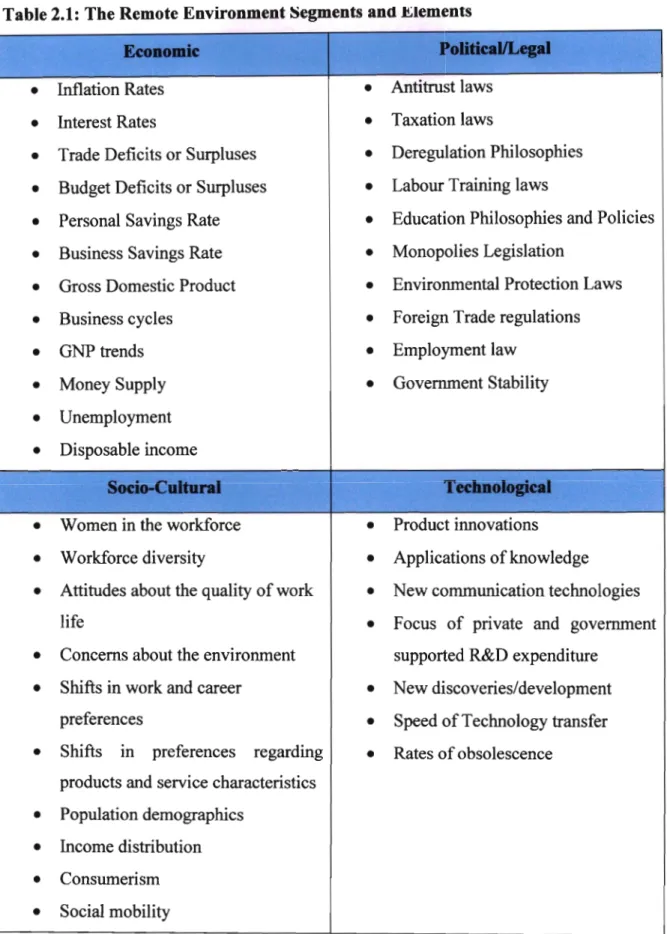
The remote environment comprises of factors that originate beyond and usually irrespective of any single firm's operating situation. The remote environment presents firms with opportunities, threats and constraints, but rarely does a single firm exert any meaningful reciprocal influence (Pearce and Robinson; 2000). The remote environment is composed of segments (and their individual elements) that are external to the firm (see Table 2.1). Although the degree of impact varies, these environmental segments affect each industry and the firms within it. The challenge is to scan, monitor, forecast and assess those elements in each segment that are of the greatest importance. In addition, the results of an external environmental analysis should recognize environmental changes, trends, opportunities and threats. Opportunities are then matched with a firm's core competencies. Through proper matches, the firm achieves strategic competitiveness and earns above-average returns (Hanson, Dowling and Hitt; 2001).
Itis useful to consider what environmental influences have been particularly important in the past, and the extent to which there are changes occurring which make these more or less significant in the future for the organisation and its competitors (Hanson, Dowling and Hitt; 200 I). Table 2.1 is designed to help by providing a summary of some of the questions to ask about key forces at work in the remote environment. This is commonly known as a PEST analysis, which involves identifying the political, economic, social and technological influences on an organisation. The political is very heavily weighted due to the regulatory framework controlled by the government. The influence of this control is analysed further to determine its effect on market entry and competitive rivalry.
Table 2.1: The Remote Environment Segments and Elements
- -
• Inflation Rates
• Interest Rates
• Trade Deficits or Surpluses
• Budget Deficits or Surpluses
• Personal Savings Rate
• Business Savings Rate
• Gross Domestic Product
• Business cycles
• GNP trends
• Money Supply
• Unemployment
• Disposable income
CII. ..l. - - -
-
• Women in the workforce
• Workforce diversity
• Attitudes about the quality of work life
• Concerns about the environment
• Shifts in work and career preferences
• Shifts ill preferences regarding products and service characteristics
• Population demographics
• Income distribution
• Consumerism
• Social mobility
--.-. -
•
Antitrust laws•
Taxation laws•
Deregulation Philosophies•
Labour Training laws•
Education Philosophies and Policies•
Monopolies Legislation•
Environmental Protection Laws•
Foreign Trade regulations•
Employment law•
Government Stability-r,- - - -
• Product innovations
• Applications of knowledge
• New communication technologies
• Focus of private and government supported R&D expenditure
• New discoveries/development
• Speed of Technology transfer
• Rates of obsolescence
Source: Adapted from (Hanson, Dowling and Hitt; 2001) and (Johnson and Scholes;
1999)
2.2.2.1 PEST Analysis
• Economic: The health of a nation's economy affects the performance of individual firms and industries. Because of this, companies study the economic environment to identify changes, trends and their strategic implications. The economic environment refers to the nature and direction of the economy in which a firm competes or may compete. Due to the connection among nations, which is resulting from the global economy, firms must scan, monitor, forecast and assess the health of economies outside their host nation. According to Hanson, Dowling and Hitt (1999), in light of the increasing interdependencies among the world's economies, it is in the best interests of all nations to create truly global markets. It has been argued, that doing this can create a future in which the common goals of creating wealth and fostering economic stability are achievable. Members of the World Trade Organisation (WTO) stated that 'A broad range of empirical studies concludes that open trade policies are conducive to growth. The conclusion appears to hold regardless of the level of development of the countries concerned, challenging the notion that a certain level of development is required before the benefits from trade can be fully realized. (Hanson, Dowling and Hitt; 2001).
Until recently the economic trends have largely been discounted. However more recently international powerbrokers like the European Economic Community (EEC) and the Organisation of the Petroleum Exporting Countries (OPEC) have changed the focus of economic environmental forecasting. Multilateral trade agreements between economic union groups have had a profound effect on most multinationals in almost all industries, the Telecommunications sector is not excluded. Developing economies have recently assumed a greater role in international commerce as a source of both threats and opportunities. These countries have found it economically advantageous to confront the developed countries (Pearce and Robinson; 2000). These factors must be taken into consideration when evaluating the economic trends in South Africa as this is classified as an emerging or developing economy. These international forces can affect positively or negatively the economic well being of the
Telecommunications business community in the Southern African regIOn.
Therefore the impact of these major forces, must be forecasted as accurately as possible for both the domestic as well as the international arena.
• Social: The socio-cultural segment is concerned with a society's attitudes and cultural values. Because attitudes and values form the cornerstone of a society, they often drive demographic, economic, politicaVlegal and technological conditions and changes. Socio-cultural segments differ across countries. For example, in the United States, 14 per cent of the nation's GDP is spent on health care (Hanson, Dowling and Hitt; 2001). This is the highest percentage of any Organisation for Economic Cooperation and Development (OECD) country.
Germany allocates 10.4 per cent of GDP to health care, while Switzerland allocates 10.2 per cent, Australia 8.4 per cent and New Zealand 7.6 per cent.
Countries' citizens have different attitudes about retirement savings as well. In Italy, just 9 per cent of the citizenry say that they are saving primarily for retirement, while the figures are 18 per cent in Germany and 48 per cent in the United States (Hanson, Dowling and Hitt; 2001). Attitudes regarding one's savings for retirement affect a nation's economic and politicaVlegal segments.
Differences in attitudes about work seem to exist between France and some other nations, including the United States. In Australia and the United States, boundaries between work and home are becoming blurred, as employees' workweeks continue to be stretched, whereas working long hours has become a crime in France.
Companies must understand the implications of a society's attitudes and its cultural values before they can expect to offer goods and services that will meet consumers' needs and interests. A significant trend in many countries is increased diversity of the workforce. The number of female workers is an important indicator of increasing workforce diversity, and women are a valuable source of highly productive employees. Changes in organisational structure and management practices often are required to eliminate subtle barriers that may
exist. Learning to manage diversity in the domestic workforce can increase a firm's effectiveness in managing a globally diverse workforce as the firm acquires more international operations. These commitments to promote and manage diversity enhance the firm's performance. Another manifestation of changing attitudes towards work is the continuing growth of contingency workers (part- time, temporary and contract employees) throughout the global economy. Parts of the world in which this trend is significant include Australia, Canada, Japan, Latin America, Western Europe and the United States. The fastest-growing segment of contingency workers is in the technical and professional area (Hanson, Dowling and Hitt; 2001).
• Political: The politicaVlegal segment is the arena in which organisations and interest groups compete for attention, resources and a voice in overseeing the body of laws and regulations guiding the interactions among nations. Essentially, this segment represents how organisations try to influence government and how governments influence them. Constantly changing, the segment influences the nature of competition (see Table 2.1). Due to this, firms must carefully analyse a new administration's business-related policies and philosophies. Antitrust laws, taxation laws, industries chosen for deregulation, labour training laws and the degree of commitment to educational institutions are areas in which an administration's policies can affect the operations and profitability of industries and individual firms. Often, how the firm intends to interact with the political/legal segment is captured through the development and use of a political strategy (Hanson, Dowling and Hitt; 2001). The effects of a host of global governmental policies on the firm's competitive position increase the importance of forming an effective political strategy. Inthese early years of the21st century, business firms across the globe confront an interesting array of political/legal questions and issues.
• Technological: Pervasive and diversified in scope, technological changes affect many parts of societies. Their effects occur primarily through new products,
processes and materials. The technological segment includes the institutions and activities involved with creating new knowledge and translating that knowledge into new outputs, products, processes and materials. The knowledge and capabilities that are created by developing or using new technologies sometimes transform or revitalise an entire industry. To ensure sustainability a firm must be aware of the technological changes that could influence the environment. A technological breakthrough can have a dramatic impact on a firm - this could be either a positive or negative one, (pearce and Robinson; 2000). The opportunities and threats are evaluated to determine how this influences the firms directly and indirectly.
2.2.3
Industry EnvironmentAn industry is a group of firms producing products that are close substitutes. In the course of competition, these firms influence one another. Typically, industries include a rich mix of competitive strategies that companies use in pursuing strategic competitiveness and above-average returns. In part, these strategies are chosen because of the influence of the effects of an industry's characteristics. Compared to the remote environment, the industry environment has a more direct effect on strategic competitiveness and above-average returns. The intensity of industty competition and an industry's profit potential (as measured by the long-run return on invested capital) are a function of five competitive forces: the threats posed by new entrants, suppliers, buyers, product substitutes, and the intensity of rivalry among competitors (Hanson, Dowling and Hitt; 2001). The five forces model of competition expands the arena for competitive analysis. Historically, when studying the competitive environment, firms concentrated on companies with which they competed directly. However, today competition is viewed as a grouping of alternative ways for customers to obtain the value they desire, rather than as a battle among direct competitors. This is particularly important, because in recent years industry boundaries have become blurred. For example, in the electrical utilities industry, co-generators - firms that also produce power - are competing with regional utility companies. Moreover, Telecommunications companies now compete with broadcasters, software manufacturers also provide personal financial services, and
airlines sell mutual funds, and automobile manufacturers sell insurance and provide financing. In addition, in order to focus on customers rather than specific industry boundaries to define markets, geographic boundaries should be considered. The reason for this is that research evidence suggests that different geographic markets for the same product can have considerably different competitive conditions. The five forces model recognizes that suppliers could become a firm's competitor (by integrating fOIWard), as could buyers (by integrating backward) (Hanson, Dowling and Hitt; 200 I).
2.2.3.1 Porters Five Forces
This section will detail how the above forces operate. Harvard Professor Michael E.
Porter's five forces model has been used internationally and is well renown. The five forces model has been adapted by many academics over the years. The literature review for this dissertation will be based on the adaptation by Charles Boyd (2003). A different perspective by Pearce and Robinson (2000) is however offered in figure 2.2 to add a different perspective on the model.
Force 1: Rivalry Among Existing Firms - is intensified by many factors:
Balance Among Firms: No matter how many firms are in the industry, if they are about the same size, rivalry is likely to be more intense as they try to gain an advantage over one another. This intense rivalry is easiest to see at the local level, such as the competition among supermarkets or fast-food outlets III one city.
You usually see the least intense rivalry in an industry in which one or a few large firms dominate.
Slow-Growth Markets: These make for intense rivalry because the only way to grow is to take market share away from competitors.
High Fixed Costs: High fixed costs may result in price-cutting to get the turnover to cover these costs.
Extra Capacity: When a firm adds extra capacity, it may create short-term overcapacity that results in intense price competition to build the volume needed to use the new capacity.
A Commodity Market: Exists when none of the competing firms have any sort of differentiation advantage. In these situations there is little to keep customers from switching to a competitor, so competition to hold customers can become brutal. We see this condition in the personal computer hardware market, where brand identity is hard to establish and competition is mostly based on price.
High Exit Barriers: Create chronic overcapacity and the intense rivalry that accompanies that condition. Exit barriers can be high for three key reasons:
• High investment in fixed assets that have no other practical use. This makes it hard for competitors to leave the steel industry:
• The cost of layoffs. When the auto industry lays off workers, they must pay 95 percent of wages for some time, according to the union contracts.
• Continuing to produce a product that loses money but which may be necessary to sell another product. Gillette must produce razors to sell blades. But the money is in the repeat sale of blades. Gillette must sell enough blades to justify producing the razors, some of which they may give away.
Force 2: New Competitors (Barriers to entry) - can be repelled by several means:
Brand Loyalty: Is established by continually advertising the brand and company name, patent protection, high product quality, after-sales service, and other means. Strong brand loyalty makes it hard for customers to change to a new, competing product.
Absolute Cost Advantages: Itis hard to compete against a firm with lower costs if their product is of appropriate quality. That is one major reason we see U.S. jobs going to Mexico. But remember that labour is only one cost, and it is becoming a less important cost for many products. Low-cost advantage can be achieved in any of a company's operations: better management, lower transportation costs, better purchasing-you name it.
Economies of Scale: Is the market big enough for the company in question to serve it profitably? Small businesses thrive by serving market niches that are too small for larger firms to serve profitably.
The Capital Requirement For Entry: Can you imagine the start-up of another South African automaker? The capital requirements to compete in today's world market would
be enormous. Smaller businesses, however, have no such protection against new competitors. Their protection must come from special service, high quality, or a focus on serving a market segment extremely well.
Legislation Or Other Government Action: This can lower entry barriers quickly and significantly. Deregulation of airlines, trucking, and long-distance telephone service are good examples during the past two decades.
Differentiation: This is the ultimate barrier to entry. Like lower costs discussed above, differentiation can be achieved in virtually any phase of a company's operations.
Expected Retaliation: You must consider how a competitor will react to any competitive action you take. This means that you musttryto understand the motivations of your key competitors, although that is hard. These motivations can change over time. The more you know about possible competitor reactions, the more able you are to choose a strategy that will not result in an unexpected or unwanted reaction.
Force 3: Threat of Substitutes
Both direct and indirect substitutes need to be considered. Some products are direct substitutes for one another: for example, calculators for slide rules or sugar substitutes for sugar. It is harder to see indirect substitutes for a product. For example, TV sets, VCRs, DVD players, and other consumer electronic products compete with furniture and home furnishings.
The direct and indirect substitutes for products or services offered by a firm need to be identified. Is there a way that a firm can lessen these threats, perhaps by some form of differentiation or by lowering costs? Is there a way that the firm can find new markets by making its products or services a substitute for those of a competitor?
Close substitutes are a very potent competitive threat. Newly created substitutes can even cancel advantages a firm may have gained by speeding down the learning curve. But the absence of close substitutes may give a firm the chance to raise prices and profit margins.
The firm fmd some way to take advantage of a lack of close substitutes, but must always be on the lookout for ways competitors may gain such advantages, and plan their countermoves.
Force 4: Supplier Power - is likely to be high when:
• There is a concentration of suppliers rather than a fragmented source of supply.
• The switching costs of changing from one supplier to another are high. For example, the cost and long learning curve associated with a corporation changing from one software application to another.
• Itis possible for a supplier to integrate forward if they do not obtain the prices and margins they want in their present business.
• The supplier's customers are not very important to the supplier. Such a supplier may not be willing to offer very favourable terms and service to customers. Many small businesses face this problem as they buy from their suppliers.
Force 5: Buyer Power
The buyer is the next person downstream in the channel of distribution. Thus, the buyer for the subject firm may be a manufacturer, wholesaler, or the final consumer. The question then is "Who is the buyer in the case or situation the firm is analysing?" The factors that increase a buyer's power are the mirror image of those that mcrease a supplier's power. Thus buyers have enhanced power:
• When they are concentrated and buy in volume. These conditions give buyers power over small, fragmented suppliers.
• When there are alternative sources of supply and it costs little to switch among them. This lets buyers play suppliers among each other to get the lowest price or best service.
• If the component or material cost is a high percentage of total cost. Under these conditions, buyers will shop for the best price and squeeze suppliers.
• When the buyer can integrate backward if suppliers cannot offer satisfactory prices.
Figure 2.2
FORCES DRIVING INDUSTRY COMPETITION
JWQtg,P8TO ENTRY Ab8olutecaet. . . . Proprictaty curve Access . . . .
GoverDlllCllltpolicy EconomicsofiClle Capital recpdraDcnts BI8IIdidcadly SwitcbiD8 COIlS Accessto~OD
ExpectedJtliIIiIdeB ProprieIary prodecIs
RIVALRY
IJUYDI'OWD.
BarpiDins . . . . Buyer-'- BuyeriulHiiIiIdoA 8IIIIdicIclJIdt)f Price- f i t ) '
~:of!!~::.e:~:_:lIII
SubIIitutoaYIIIIiIbIe
Buyers'ioccnIhes
TIIll&AT OFSVBSTI'I'lJTI:
SwitdliDa COIlS
BuyerpropeIISitytoIIIbIdtute ReIItiveprbperfilrmanc:cof su"'dIute
Source: Pearce and Robinson (2000)
2.2.4 Operating Environment
The operating environment is seen as the closest arena immediately outside ofthe finn. It is sometimes referred to as the near environment. The finn does have some control of this through its corporate strategy, which it decides to adopt. The environment comprises of factors in the competitive situation that affect a finns success in acquiring much needed resources or factors that affect the marketing of the Telecommunications service profitability. Pearce& Robinson (2000)iden~ifiesthe most important of these factors as:-
•
Competitors•
Creditors•
Customers•
Labour•
SuppliersThe customers, competitors and labour are key to the Telecommunications sector. The suppliers once the network infrastructure is built are less important to the direct profitability of the finn. One should not discount this supplier influence completely, because a huge capital expenditure, which is above market related rates could impact negatively in the long tenn, relative to other competitors.
2.3 The Methods of Industry and Competitive Analysis
Industry and competitive analysis uses various concepts and techniques to get a clear fix on key industry traits, the intensity of competition, the drivers of industry change, the market positions and strategies of rival companies, the keys to competitive success and the Industry's profit outlook. Thompson and Strickland (2003), propose a framework consisting of seven probing questions to conduct a competitor and industry analysis:
• What are the industry's dominant economic features?
• What is competition like and how strong are each of the competitive forces?
• What is causing the industry's competitive structure and business environment to change?
• Which companies are in the strongest/weakest positions?
• What strategic moves are rivals likely to make next?
• What are the key factors for competitive success?
• Is the industry attractive and what are the prospects for above-average profitability?
The collective answers to these questions build understanding of a finn's surrounding environment and fonn the basis for matching strategy to changing industry conditions and to competitive forces. This is an alternative view of environment analysis, which could be easily applied due to its question and answer nature. The main disadvantage to this method is that different individuals will attach various levels of significance to each answer without a solid theoretical foundation. The impact of each factor could then be misrepresented in the analysis.
Because industries differ significantly in their basic character and structure, industry and competitive analysis begins with an overview of the industry's dominant economic traits.
As a working definition, the word industry is used to mean a group of finns, whose products have so many of the same attributes that they compete for the same buyer. The definition of the Telecommunications industry, used to be abundantly clears in the past.
However with the convergence of the Internet, Telecommunications, multimedia and entertainment, the Telecommunications industry becomes much more difficult to identify.
The factors to consider in profiling an industry's economic features are fairly standard (Pearce & Robinson; 2000):
• Market size
• Scope of competitive rivalry (local, regional, national or global).
• Market growth rate and where the industry is in the growth cycle (early development, rapid growth and takeoff, early maturity, late maturity and saturation, stagnant and ageing, decline and decay).
• Number of rivals and their relative sizes - is the industry fragmented with many small companies or concentrated and dominated by a few large companies?
• The number of buyers and their relative sizes.
• The prevalence of backward and forward integration.
• Ease of entry and exit.
• The pace of technological changes in both production processes and new product introductions.
• Whether the servIces of rival firms are highly differentiated, weakly differentiated, or essentially identical.
• Whether there are economies of scale in manufacturing, transportation, or mass marketing.
• Whether the industry has a strong learning and experience curve such that average unit cost declines as cumulative output (and thus the experience of "learning by doing") builds up.
• Capital requirements.
• Whether industry profitability is abovelbelow par.
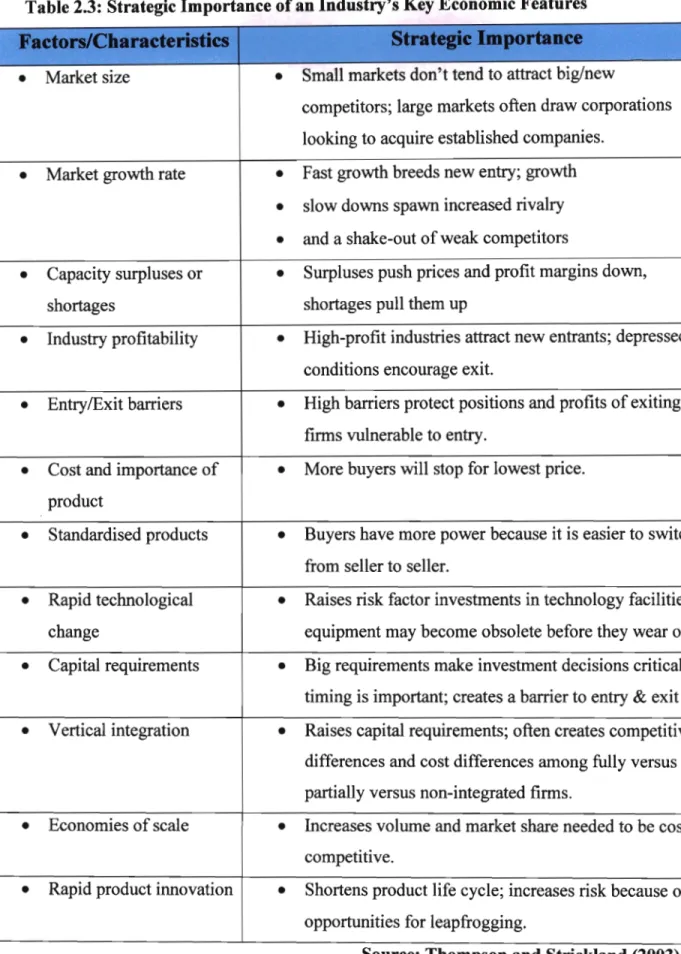
Table 2.2. (Naidoo 2002) illustrates a profile of the Telecommunications industry chief economic characteristics. According to Thompson and Strickland (2003) an industry's economic characteristics are important because of the implications they have for strategy - Table 2.3.
Table U TeIeee"l1lllicaa_lad_ry' .D. .
_ltl:e.l8IIIlie° CllaraderlltiaMarket Size:Value of revenue in each country Scope ofCompetitive Rivalry: Limited
Market Growth Rate: Inexcess of 300 percent per annum for the East African Region Stage ofLife Cycle:Infancy
Number ofCompanies in Industry: average of three in each country Customers: mainly early adopters of technology for cellular subscribers Degree of Vertical Integration: None
Ease of EntrylExit: High entry barriers exist in the form of capital requirements and licence approvals.
Technology/lnnovation:Cellular GSM technology standardised Fixed line - none
Product Characteristics: Highly standardised, the brands of different network operators are essentially identical (buyers perceive little real difference between operators).
Scale Economies: Does exist to an extent very high fixed cost and small percentage variable costs growthinsubscribers does translate into savings on scale economies.
Experience Curve Effects: A major factor in this industry, easy access to foreign expertise for operations and technical know how to overcome curve effects.
Capacity Utilisation: Network traffic difficult to predict due to lack of historical data, therefore design capacity based on projected values.
Industry Profitability: well above par profits, the utility nature of the service results in high usage of the service by subscribers and high profitability due to limited market entrants.
Source: Naidoo (2002)
Table 2.3: Strategic Importance of an Industry's Key Economic Features
FaetonlCharaeteristies
~IIDporta.a
•
Market size•
Small markets don't tend to attract big/newcompetitors; large markets often draw corporations looking to acquire established companies.
•
Market growth rate•
Fast growth breeds new entry; growth•
slow downs spawn increased rivalry•
and a shake-out of weak competitors•
Capacity surpluses or•
Surpluses push prices and profit margins down,shortages shortages pull them up
•
Industry profitability•
High-profit industries attract new entrants; depressed conditions encourage exit.•
Entry/Exit barriers•
High barriers protect positions and profits of exiting firms vulnerable to entry.•
Cost and importance of•
More buyers will stop for lowest price.product
•
Standardised products•
Buyers have more power because it is easier to switch from seller to seller.•
Rapid technological•
Raises risk factor investments in technology facilities/change equipment may become obsolete before they wear out.
•
Capital requirements•
Big requirements make investment decisions critical;timing is important; creates a barrier to entry& exit
•
Vertical integration•
Raises capital requirements; often creates competitive differences and cost differences among fully versus partially versus non-integrated firms.•
Economies of scale•
Increases volume and market share needed to be cost competitive.•
Rapid product innovation•
Shortens product life cycle; increases risk because of opportunities for leapfrogging.Source: Thompson and Strickland (2003)
2.4 Key Driving Forces in the Telecommunications Industry
According to Thompson and Strickland (2003) the most dominant forces in an industry are called the driving forces because they have the biggest influence on what kind of changes will take place in the industry's structure and competitive environment.
Historically, most countries had direct public control of the Telecommunications sector.
In this model, a state-owned monopoly provider had to meet targets, such as teledensity or affordability, which had been set by its government. This model worked well in developed countries in that it delivered significant penetration and network quality.
However, increasing pressure from both internal and external forces has altered the status quo. See Figure 2.3. The most important influence's according to Beardsley et al (2001) are:
• Ever accelerating technological change. State-owned companies often react too slowly to keep up. They also struggle to master the uncertainty created by change.
• Growing political consensus around the world on the benefits of open markets and reduced government control. This has been promoted mainly by international organisations such as the World Trade Organisation (WTO) and the European Union (EU).
• Stakeholders pushing for change. These include retail consumers looking for better service, businesses that require data connections to compete both locally and globally, and domestic and foreign investors who want to participate in a growing market.
• Increasing fiscal pressure on government and budgets, which means that resources have to be reallocated. It often results in privatisation and liberalisation, including the sale of Telecommunications to new operators, both to generate budget fmancing and to decrease state investment in the sector.
Anadded impetus for change in emerging and developing countries is the lack of capital.
Inthese countries, sector reform is the only way to bring in the funding needed to expand their Telecommunications infrastructure, and ensure the provision of communication services to their citizens. For this reason, many of those countries have been moving
Telecommunications sector is still a viable option for some countries. Countries that follow this path are basically reproducing the route taken by developed countries prior to sector reform. China, for example, decided to assign priority to building out its Telecommunications infrastructure, as the government undoubtedly recognized that this was key to making the country economically powerful. The country has been adding more fixed lines than the rest of the world in recent years, and creating incentives for equipment providers to manufacture in the country. State control has increasingly been coupled with sector reform and partial privatisation (Beardsley et al; 200 I). This option can work if a government has resources to divert towards infrastructure build-out and if it is willing to subsidize the provision of access with profits earned in other segments, such as long-distance. In addition, a government must be able to manage possible pressure to deliver open access and/or competitive entry. A market-based reform generally allows market forces to set prices, quantities, and quality, as well as to determine the services to be provided. Governments can start reform in three ways: through privatisation, liberalisation, or by a combination of both (full sector reform). A more detailed description of each option is included in Figure 2.3. Full sector reform is rarely done in one leap. Countries usually start with either privatisation or liberalisation before combining both approaches.
2.5 The Telecommunications Market
Telecommunications includes a broad range of technologies incorporating telephone and cable networks, data communications, wireless communications systems, satellite, optical fibre, and Internet technologies. The Telecommunications industry concerns the provision of two-way, one-to-one communications of voice, data and video. It is distinct from the broadcasting market, which is typically a one-way, one-to-many communication service.
However, convergence means that infrastructure developed for either market can be adapted to provide the other service. The scope of this study will be the fixed line and cellular/mobile industries. No distinction will be made between the different types of transmission, that is, voice, data or image.
Figure 2.3
FORCES DRIVING REFORM OF THE TELECOMMUNICATIONS SECTOR
TECHNOLOGICAL CHANGE
STAKEHOLDERS INTERE
• Operators(ineumbeDta,
DeWontIldtI)
• CIIIkImen(Busiaess, reeicfentiaI)
• BquipmeDtProviders (Domestic.Panip)
• Society (Unicmsetc.)
• Goalofpnaatiug proceedsfiom pri¥atisation
• Desiretowithdraw tiomroleinthe
sector
GOVERNMENT'S INTEREST
Source: Beardsley et al2001
Telecommunications production can roughly be divided into the provision of network infrastructure and the provision of services on that infrastructure. Typically a public monopoly is vertically integrated and so provides all parts of the production chain and all horizontal markets (Hodge and Theopold; 2001).
2.5.1 Network Infrastructure
Network providers operate the infrastructure on which vanous Telecommunications services are run. Networks are made up of switches and transmission. The switches provide the routing of voice, data, and video signals through the network. The transmission medium can be separated into fixed line (twisted pair of copper wires, fibre optic, coaxial cable) or wireless (satellite, cellular radio, microwave). The big technological changes in network provision have been (Hodge and Theopold; 2001):
• The rapidly decreasing costs of switches and transmission equipment
• The increasing capacity and speed of transmission mediums - both III the transmission material (e.g. fibre optic) and the improved compression of signals (e.g. ADSL or asymmetric digital subscriber lines which increase speeds on copper paired wire)
• The increasing intelligence of the networks enabling them to improve their efficiency and begin to offer a wide variety of services beyond mere telephony
• The convergence of different industries due to the common use of digital format.
The industries relate to the original purpose for which the networks were built - Telecommunications (voice), broadcasting (video) and computing (data).
Hodge and Theopold (2001) propose three different components to the network that can be seen as three different stages of production. These are local access, long-distance and international. Figure 2.4 demonstrates how these three components interconnect to form a complete international Telecommunications network. It looks at a mixed fixed line/mobile example. The local access network connects the customer premises to the local switch through the local loop. From the local switch there is an interoffice transmission facility to either other local switches or long-distance (national or international) points-of-presence (PoP). The long-distance networks then transmit the
signal to another long-distance PoP where it is distributed to a local switch and onto the other customer premises. What follows is a more detailed discussion of each component of the supply chain and the various technological platforms used.
2.5.2 Customer premises equipment (CPE)
The focus here is the retail supply of customer premises equipment and not the manufacture of the items. CPE's include fixed line telephones, mobile handsets, and PABX's (private exchange equipment for business use). Each of these can be considered a separate market. Inthe heyday of public monopoly, the customer premises equipment had to be supplied by the incumbent public switched telephone network (PSTN). This monopoly position, on what is essentially a service with no natural monopoly features, represented an opportunity for abnormal profits to be made. Almost without fail the first step in any deregulation process is to liberalise this part of the supply chain.
2.5.3 Local Access
Local access can now be provided by a number of different technologies, each with different cost structure and therefore different degrees of substitutability with the traditional PSTN. Although local access is being handled as one stage of production, it should be noted that this stage could be broken down further. Inparticular:
• Connection of premises to local loop
• Localloop
• Local exchange (switch)
Customer Premises
Figure 2.4
A Simplistic Telecommunications Network
Fixed Line
Customer Premises
Local Switch
Local Switch
Mobile
Source: Hodge and Theopold (2001)
2.5.4 Fixed Line
Within the group of network providers that use fixed line infrastructure, networks were historically built to focus on one of three different types of transmission - voice, data or image. However, increasingly networks are offering all three. This is feasible because almost all networks now use a digital format. In voice, the traditional PSTN consists mainly of copper or coaxial cable transmission equipment at the local access level and switching equipment that allows two-way transmission between two individual points on the network by establishing a dedicated line between two points for the duration of a call.
The transmission mediums have low capacity or network speed (measured in bits per second) making them inadequate for video transmission and a slow but adequate medium for data transmission. However, recent technological developments in data compression have substantially increased the speeds available on these wires (in particular the asymmetrical digital subscriber line systems - ADSL - and other DSL technologies).
Upgrading the networks to provide greater speed does require additional investments in the local access infrastructure (Hodge and Theopold; 2001). An alternative is the use of fibre optic, which has a far greater network capacity. Due to the higher cost of fibre optic, it is only cost effective with large businesses and not residential homes in the local access component of the network. It is used extensively in the long-distance and international networks. Either way, it is increasingly possible for PSTN networks to be upgraded to offer video services too. In fact, growing use of capacity for data transmission (that is, the Internet and intra-corporate transfers) makes the investments in fibre optic or ADSL increasingly worthwhile, offering the springboard to broadcasting.
2.5.5 Wireless (Mobile) Networks
According to Hodge and Theopold (2001) wireless networks differ from fixed line in their use of the radio frequency spectrum for transmission. The