I
UNIVERSITY OF KWAZULU-NATAL
Factors that Affect the Growth of Manufacturing Businesses within eThekwini Municipality
By
Manqoba Biyase
209510010
A dissertation submitted in partial fulfillment of the requirements for the degree of Master of Business Administration
Graduate School of Business Faculty of Management Studies
Supervisor: Mr Steven Msomi 2011
II
SUPERVORS’ PERMISSION TO SUBMIT FOR EXAMINATION
Date : 29 November 2011
Student Name : Manqoba Biyase
Student no. : 209510010
Dissertation Title : Factors that Affect the Growth of Manufacturing Businesses within eThekwini Municipality
As the candidate’s supervisor, I AGREE to the submission of this dissertation for examination. The above student has satisfied the requirements of English Language competency.
Name of Supervisor: Mr Steven Msomi
Signature: ___________________________ Date: ______________
III
DECLARATION
I, Manqoba Michael Biyase declare that:
a) The research reported in this dissertation, except where otherwise indicated is my original research.
b) This dissertation has not been submitted for any degree or examination at any other university.
c) This dissertation does not contain other persons’ data, pictures, graphs or other information, unless specifically acknowledged as being sourced from other persons.
d) This dissertation does not contain other persons’ writing, unless specifically acknowledged as being sourced from other researchers. Where other written sources have been quoted, then:
i) Their words have been re-written but the general information attributed to them has been referenced:
ii) Where their exact words have been used, their writing has been placed inside quotation marks, and referenced.
e) This dissertation does not contain text, graphics or tables copied and pasted from the Internet, unless specifically acknowledged, and the source being detailed in the dissertation/thesis and in the References sections.
Signature:
29 November 2011
IV
ACKNOWLEDGEMENTS
I wish to express my sincere appreciation and gratitude to the following individuals, without whose assistance, this study would not have been possible:
• My supervisor, Mr Steven Msomi, thank you for your guidance and encouragement throughout this dissertation, your knowledge and persistence is recommendable.
• I would like to express the greatest appreciation to my parents who raised me under trying circumstances, who taught me good values and more so that you never quit till you get what you set to achieve.
• As special tribute to my wife – Zola for her support and ensuring that the family is taken care of whilst I focused on my studies.
• To my children Phumeza and Awande, I apologise for not being there to provide support for the past two years of your life, I hope that one day, you will appreciate what I have to go through to complete my studies.
• To my colleagues and friends, you understood the pressure I was under and you provided support and guidance where possible.
• The MBA Class of 2009, especially Lenny Naidoo, Sachin Suknunan Jake John and Shireen Subramonian. Your leadership and encouragement has been the Lord’s blessing on this journey.
• A special thank to all of my respondents, this dissertation would have been meaningless without your contribution especially your insights to business.
V
ABSTRACT
The manufacturing industry of eThekwini municipality has been the most important aspect of economic development and job creation. This sector currently contributes 22% of gross domestic product to the local economy, with finance and transport being the other major sectors. The growth in manufacturing has averaged about 1% per annum over the past 10 years which has contributed to jobless growth of eThekwini.
Whilst policy makers have realized the importance of the manufacturing industry, the important sub-sectors within the manufacturing industry are proving to be uncompetitive in a more open economy as they are faced with numerous growth challenges. The rationale of this study was to investigate the factors that affect the growth of manufacturing businesses that operates within the eThekwini municipality. Despite the contributions of the manufacturing businesses to the local economy, this sector has never been given due attention as past studies of business performance had been biased towards larger businesses.
For the purposes of this study, the questionnaire used was aimed at respondents who own manufacturing businesses within the area. Questions were distributed electronically via QuestionPro to 100 respondents and 76 respondents accessed the questionnaire with 44 respondents who completed the survey which gave the completion rate of 44%.
The results from the respondents indicated that access to finance or credit, business skills, technology and globalisation were the factors that negatively affects the growth of the manufacturing businesses. The results also indicate that the unpredictable business environment, the regulatory environment and other economic factors such as inflation also affect the growth of the manufacturing businesses. The quantitative results supported by the literature review confirm that these factors affect development and growth of businesses especially small manufacturing businesses. Recommendations is also made on the actions to be undertaken to address factors affecting manufacturing businesses.
VI
TABLE OF CONTENTS
TITLE PAGE ... I SUPERVORS’ PERMISSION TO SUBMIT FOR EXAMINATION ... II DECLARATION ... III ACKNOWLEDGEMENTS ... IV ABSTRACT ... V LIST OF FIGURES ... XIII LIST OF ABBREVIATIONS ... XV
CHAPTER ONE ... 1
Introduction ... 1
1.1 Background and Context ... 1
1.2 Motivation for the Study ... 2
1.3 Focus of the Study ... 4
1.4 Problem Statement of the Study ... 4
1.5 Overview of the Study ... 5
1.6 Objectives ... 6
1.7 Hypotheses/Research Questions ... 7
1.8 Limitations of the Study ... 8
1.9 Chapter Summary ... 8
CHAPTER TWO... 11
Literature Review ... 11
VII
2.1 Introduction ... 11
2.2 The Economic Climate of eThekwini Municipality ... 12
2.3 The State of Entrepreneurship within eThekwini Municipality ... 14
2.4 Characteristics of a successful entrepreneur ... 18
2.5 The Business Environment ... 19
2.5.1 The Internal Environment ... 21
2.5.2 The External Environment ... 22
2.6 Globalisation ... 22
2.7 Management Skills ... 24
2.8 Access to Capital ... 28
2.9 The Regulatory Framework ... 30
2.10 Technological and Infrastructural support ... 33
2.11 Chapter Summary ... 34
CHAPTER THREE ... 35
Research Methodology ... 35
3.1 Introduction ... 35
3.2. Aim and Objectives of the Study ... 36
3.3. Participants and Location of the Study ... 36
3.4 Data Collection Strategies ... 37
3.5 Research Design and Methods ... 38
3.5.1 Description and Purpose ... 39
VIII
3.5.1.1 Construction of the Instrument ... 39
3.5.1.2 Recruitment of Study Participants ... 40
3.5.2 Pretesting and Validation ... 40
3.5.3 Administration of the Questionnaire ... 41
3.6 Analysis of the Data... 41
3.7 Chapter Summary ... 42
CHAPTER FOUR ... 43
Presentation and Discussion of Results ... 43
4.1 Introduction ... 43
4.2 Demographic data ... 44
4.2.1 Gender of Respondents... 44
4.2.2 Racial Profile ... 45
4.2.3 Level of education ... 46
4.2.4 Nature or Legal Status of Business ... 47
4.2.5 Type of Industry ... 48
4.2.6 Period of Business in Operation ... 49
4.2.7 Company’s Annual Turnover ... 50
4.2.8 Motivating Factors for Starting Business ... 51
4.2.9 Work or Management Experience. ... 51
4.2.10 Level of Academic Qualification of the Management Team ... 52
4.2.11 Level of Experience of the Highest Decision Maker ... 53
IX
4.2.12 Years of Practical Experience of the Most Qualified Management Team .. 54
4.3 Challenges Facing Manufacturing Business ... 55
4.3.1 Important Factors that Affect Manufacturing Businesses ... 56
4.3.2 Factors Affecting Manufacturing Businesses during the First Three Years ... 58
4.3.3 Business or Managerial Skills ... 59
4.3.4 External Support ... 61
4.3.5 Business Finance ... 62
4.3.6 Financial Control or Management ... 63
4.3.7 Financial Challenges Impacting Businesses ... 64
4.3.8 External Factors Affecting Businesses ... 66
4.3.9 Challenges Facing Manufacturing Businesses ... 68
4.3.10 The Regulatory Environment ... 70
4.3 Chapter Summary ... 71
CHAPTER FIVE ... 72
Discussion of Results ... 72
5.1 Introduction ... 72
5.2 Racial Profile ... 73
5.3 Level of education ... 73
5.4 Nature or Legal Status of Business ... 74
5.5 Type of Industry ... 75
5.6 Period of Business in Operation ... 75
X
5.7 Company’s Annual Turnover ... 76
5.8 Motivating Factors for Starting Business ... 76
5.9 Work or Management Experience. ... 77
5.10 Level of Academic Qualification of the Management Team ... 77
5.11 Level of Experience of the Highest Decision Maker ... 78
5.12 Years of Practical Experience of the Most Qualified Management Team ... 78
5.13 Challenges Facing Manufacturing Business ... 79
5.13.1 Important Factors that Affect Manufacturing Businesses ... 79
5.13.1.1 Skills ... 79
5.13.1.2 Access to Finance ... 80
5.13.1.3 Environmental Factors ... 80
5.13.1.4 Technology ... 81
5.13.1.5 Globalisation... 82
5.13.2 Factors Affecting Manufacturing Businesses during the First Three Years ... 82
5.13.3 Business or Managerial Skills ... 83
5.13.3.1 Change ... 83
5.13.3.2 Failure ... 84
5.13.3.3 Planning and Decision Making ... 84
5.13.3.4 Control ... 85
5.13.4 External Support ... 85
5.13.5 Business Finance ... 86
XI
5.13.6 Financial Control or Management ... 86
5.13.7 Financial Challenges Impacting Businesses ... 87
5.13.7.1 Access to Credit Finance ... 87
5.13.7.2 Access to Credit Facilities ... 88
5.13.7.3 Over Investment ... 88
5.13.7.4 Financial Knowledge ... 89
5.13.7.5 Inflation ... 89
5.13.8 External Factors Affecting Businesses ... 90
5.13.8.1 The Strength of the Rand ... 90
5.13.8.2 Globalisation... 91
5.13.8.3 Technological Advancement ... 91
5.13.8.4 Tax Incentives ... 92
5.13.9 Challenges Facing Manufacturing Businesses ... 92
5.13.9.1 The impact of Competition on the Growth of Businesses ... 92
5.13.9.2 The Impact of Globalisation on the Growth of Businesses ... 93
5.13.9.3 The impact government bureaucracy on the Growth of Businesses ... 94
5.13.9.4 The impact of Access to Financial resources ... 94
5.13.10. The Regulatory Environment ... 95
5.13.10.1 SA Labour Laws ... 95
5.13.10.2 Tariffs & Quotas ... 96
5.13.10.3 Government Incentives ... 96
XII
5.13.10.4 Broad Based Black Economic Empowerment ... 97
5.14 Chapter Summary... 97
CHAPTER SIX ... 99
Conclusions and Recommendations ... 99
6.1 Introduction ... 99
6.2 The Research problem ... 100
6.3 Recommendations to solve the research problem ... 102
6.5 Recommendations for Future Studies ... 106
REFERENCES ... 108
APPENDIX 1: Questionnaire ... 115
APPENDIX 2: Ethical Clearance ... 123
XIII
LIST OF FIGURES
Number Description Page
Figure 2.1 Sector contribution: Gross Domestic Product 2008...28
Figure 4. 1 Gender Profile of Respondents...56
Figure 4. 2 Respondents’ Racial Profile...57
Figure 4. 3 Educational Level of Respondents...58
Figure 4. 4 Nature or Legal Status of Business...59
Figure 4. 5 Type of Industry...60
Figure 4. 6 Period of Business Operation...61
Figure 4. 7 Annual Turnover....62
Figure 4. 8 Motivating Factors for Starting Business. ...63
Figure 4. 9 Work or Managerial Experience...64
Figure 4. 10 Academic Qualification of Management Team. ...65
Figure 4. 11 Level of Experience of Management Team...66
Figure 4. 12 Experience Level of the Management Team...67
Figure 4. 13 Factors Affecting Manufacturing Businesses....68
Figure 4. 14 Factors Affecting Business during the First Three Years....71
Figure 4. 15 Management Skills....72
Figure 4. 16 External Support...74
XIV
Figure 4. 17 Financing Options...75
Figure 4. 18 Financial management or control ...76
Figure 4. 19 Financial Factors...77
Figure 4. 20 External Factors...79
Figure 4. 21 Factors affecting growth of manufacturing businesses ...81
Figure 4. 22 Regulatory Environment...82
XV
LIST OF ABBREVIATIONS
BEE Black Economic Empowerment
BBBEE Broad Based Black Economic Empowerment GDP Gross Domestic Product
GEM Global Entrepreneurship Report
SA South Africa
MERSETA Manufacturing, Engineering and Related Services SETA SETA Skills Education and Training Agency
SMME Small and Medium Enterprise
1
CHAPTER ONE Introduction
1.1 Background and Context
Entrepreneurship is a critical aspect in the development of any country, in particular for any emerging economy like South Africa (SA). According to Haasje (2006), since 1994, the South African government has shown dedication towards the development of entrepreneurship by strategically positioning a sizeable amount of capital resources, financial assistance and has developed policies which are all geared to support the development of businesses. The role of entrepreneurship especially small businesses has now become a popular topic amongst the politicians and policy makers. The Minister of Finance, Mr Pravin Gordhan also highlighted the role of small business especially the manufacturing industry in addressing unemployment issues and in finding solution for the economic development problems of South Africa (Gordhan, 2011).
According to Gordhan (2011), entrepreneurs have a crucial part to play in the economic growth and development of the country and policy makers have noted repeatedly that the South African economy has become highly dependent on businesses.
The South African business market has highly diversified manufacturing industry that is considered to be the most important provider of the country’s economy. The manufacturing sector is the highest contributor based on foreign direct investment, employment creation and a superior balance of trade for South Africa. With the increased effects of globalisation, the SA manufacturing industry is now under tremendous pressure due to the competitive nature of this industry. As indicated by Robertson (2005), statistics indicate that as of March 2007, SA had 107,724 businesses in the manufacturing industry in and 42% of those businesses were reflected as economically dormant. Of these, 53% were manufacturing businesses. The
2
manufacturing industry contributes 22% to the country’s gross domestic product and more than 20% of exports were manufactured exports. The projections indicated that one of four economically active people exists in the manufacturing sector in South Africa (Gumede, 2004). The manufacturing sector’s contribution to the South African economy is expected to contribute substantially to employment growth, however there’s little attention being paid to the challenges facing this industry. The focus of this study therefore would be on factors that affect the manufacturing businesses operating within eThekwini municipality.
1.2 Motivation for the Study
The manufacturing industry plays a significant part in the South African economic development. The economic survey report (2006), indicates that the small business industry contributed over 50% of new jobs created in the year 2005. The policy makers have realised that small businesses have an important contribution to make to South Africa’s economic development and growth. Despite the significance of entrepreneurs and small businesses to the economy, previous information indicated that a third of the newly established businesses fail within the first few months of operation. According to Amyx (2005) one of the most significant challenges facing small businesses is the negative perception towards them. Prospective customers perceive small businesses as lacking the capability to offer quality services and are often seen as not capable to satisfy more than one critical project simultaneously.
Longenecker (2006) is of the view that when starting, the business owner must explore the possibility of success as well as failure. Due to the nature and complexity of the manufacturing industry, a simple error by management can lead to the closure of the business therefore entrepreneurs have no opportunity to experiment or learn from their past mistakes. As pointed out by Longenecker (2006) the principal reasons for the failure of businesses include the poor planning, lack of financial management expertise
3
and poor management skills. According to King and McGrath (2002), education or management skills are considered to be the other factor that has an effect on business growth. One of the most severe constraints confronting businesses and hindering their development is the availability of credit facilities. Businesses who are better equipped to acclimatise to continuously changing business environments are those businesses with skilled personnel. As can be expected with many developing countries, there is limited research study on the factors that negatively affect the growth of manufacturing businesses within the eThekwini municipality.
First National Bank’s 2010 business study in partnership with the Gordon Institute of Business Science provided a dialogue of the state of entrepreneurship in South Africa and highlighted that a consideration of the dynamics of small businesses is essential not only for the development of support programmes but also for the growth of the economy as a whole. Given the importance of manufacturing businesses to the South African economy and the exposure to risks owing to their failure, there is a need to conduct an investigation on the challenges facing manufacturing businesses face and to get an understanding on how they manage with those challenges.
The eThekwini business market has broadly been ignored by the local and global entrepreneurship researchers hence a motivation for a comprehensive study of the factors that the manufacturing businesses operating within eThekwini municipality would make a significant contribution to entrepreneurship literature. This study seeks to unpack the challenges faced by manufacturing businesses specifically within eThekwini municipality. This would be of benefit to entrepreneurs, the municipality as well as stakeholders who operates within this area of study. Identifying these factors enables stakeholders to develop appropriate actions and strategies to address these challenges as and when they occur which will enable to the success of the manufacturing industry as a whole.
4 1.3 Focus of the Study
The manufacturing industry is one division of the country accountable for producing a broad variety of products ranging from food and beverages to chemicals, clothing and different metal products. As indicated by Gono (2005), the manufacturing industry provides approximately 20% of formal employment within eThekwini municipality. A greater fraction of the manufacturing activities in the eThekwini area extends into food production, textiles, clothing and footwear, plastics and metal products. All these sub- industries of the manufacturing industry would be incorporated into the study since the essentials of the sample would be chosen using a random sampling method. The study focused on the factors and challenges affecting the growth of manufacturing businesses within the eThekwini municipality. The prominence of the study would be on the factors that have an impact on development and growth of the manufacturing businesses. The analysis is on the factors that may possibly have a negative effect on the growth and profitability of the manufacturing sector and to recommend possible remedial actions for businesses and stakeholders within this sector.
1.4 Problem Statement of the Study
South Africa is presently faced with the economic challenges which are characterised by economic uncertainty due to challenges that emanates from the global recession Manufacturing, Engineering and Related Services SETA (Merseta) (2007). The current economic hardships make the lending of money expensive, which often results in low appetite for investment opportunities. Due to the volatility of the currency, the importation of resources or raw materials needed for manufacturing becomes more difficult and expensive. The ability to access financial resources becomes a major hindrance for small businesses due to these prevailing economic circumstances. Many talented people have left the country and this has caused an undesired effect on the growth of small businesses as they now lack the much needed management skills to
5
effectively manage businesses. Based on these economic conditions, this research seeks to investigate whether economic factors, management skills, access to finance, globalisation and technological factors affect the establishment and growth of manufacturing businesses within the eThekwini municipality.
Major stakeholders including potential investors are withdrawing or disinvesting due to uncertainty in the market as well as the lack of favourable trading conditions which makes investment expensive. These stakeholders include multinational companies and private investors. The SA unemployment rate is high, this can be partially attributed to the lack initiatives which are needed efforts to create employment opportunities as well as the present situation of the economy. The reduction of unemployment the alleviation of poverty is the two important factors facing the SA government today. According to Gono (2005), the encouragement and support of manufacturing businesses within eThekwini is therefore important in the light of the many economic challenges which the country is currently experiencing. As the South African economy is characterised by a high rate of unemployment, the economic environment which is in a declining state and the unfavourable living standards, policy makers have seen the importance to promote the development of businesses as an important vehicle for the creation of employment and to stimulate economic growth of this country. An environment favourable for the development of small businesses is necessary and this has stimulated an investigation into the factors disturbing or affecting the performance of small businesses in the manufacturing sector of eThekwini municipality.
1.5 Overview of the Study
The study was undertaken is an approach that enabled for a clear understanding of the problem being examined, a review of the literature, a description of the methodology used, presentation of the data, discussion of the data and concluding recommendations and comments.
6
The structure of the study is presented in six chapters as follows:
• Chapter 1 introduces the research problem, explains the background of the study, outlines the research methodology that was used, outlines the research questions to be answered and informs on the limitations of the study.
• Chapter 2 will focus on the literature review. In this chapter an overview of the factors that affect growth and development of businesses are outlined. This chapter also outlines the characteristics of the successful business as well as the business environment of the eThekwini municipality.
• Chapter 3 describes the research methodology and data collection techniques used in the study.
• Chapter 4 focuses on the presentation and discussion of results from the questionnaire administered electronically using QuestionPro software.
• Chapter 5 presents the analysis and discussion of results that were obtained from respondents that participated in the study.
• Chapter 6 offers concluding remarks and recommendations to solve the research problem as well as recommendations for future studies.
1.6 Objectives
The following objectives were identified for the purposes of this study:
• To examine what are the factors that affect the growth of manufacturing businesses within eThekwini Municipality.
• To establish what opportunities exists for manufacturing entrepreneurs to grow their businesses within eThekwini Municipality.
• To examine what are the critical factors that will bring the success of manufacturing businesses within eThekwini Municipality.
7
• To investigate whether there is a link between the perceived problems and the level of business skills business owners poses.
• To investigate how entrepreneurs experience and deal with dilemmas associated with running business.
1.7 Hypotheses/Research Questions
For the purposes of the study, the target population would be the manufacturing businesses operating within the eThekwini municipality who are also members of the Durban Chamber of Commerce. The respondents would be entrepreneurs who apply the hands on approach to the day to day operation of their manufacturing companies.
The data gathered would be analysed and presented using descriptive statistics. The researcher used a descriptive research design methodology as a sampling technique.
The researcher also used a stratified random sampling in selecting respondents.
In this study, a quantitative research methodology would be used for the collection of data in order to ensure a complete understanding of the negative factors and challenges that affect the growth of manufacturing businesses within eThekwini municipality. A quantitative approach was deemed to be the most suitable research process to be used as the quantitative approach is seen as the ideal tool to analyse people's attitudes, perceptions and opinions. For the purposes of this study, the researcher will make use of controlled questionnaires. The research would look at targeting 100 manufacturing businesses operating within eThekwini municipality area. The manufacturing sector remains the highest growth or highest contributing industry to the economic activity of the eThekwini municipality (IHS Global Insight Report, 2010).
8 1.8 Limitations of the Study
The researcher will be conducting the research work on manufacturing businesses as registered by the Durban Chamber of Commerce. There is a possibility that this situation could have an effect during on the analysis of results because some businesses that are affiliated to the Durban Chamber might be operating outside of the eThekwini municipality boundaries and their responses would be a general view than practical experience of those factors affecting businesses. The researcher would therefore make an assumption that the businesses as listed by the Durban Chamber face similar challenges irrespective of their demographic spread. Some respondents might not be willing to share information via e-mail due to confidentiality and the time to complete the survey might also be a factor. There is a possibility that not all respondents have internet access which might limit the desired response rate and some people are not receptive to completing questionnaires online. Sekaran and Bougie (2010), indicated that the respondents that are likely to respond to online questionnaire invitations are generally biased towards younger people. Lack of personal touch and limited time for respondents might also affect respondents.
1.9 Chapter Summary
This research study is intended to examine the challenges and factors that negatively affect growth and profitability of manufacturing businesses that operates within the eThekwini municipality. The manufacturing sector is an important sector in the economic development of eThekwini municipality as the manufacturing sector contributes extensively to the economic development through the reduction of unemployment. The creation of employment results in more people with disposable income which stimulates economic activity as a result in an increase in the demand for goods and services. The important part played by manufacturing businesses in job
9
creation, revenue creation and the alleviation of poverty is recognised worldwide by the decision or policy makers.
Manufacturing businesses are caught up in non-essential activities in emerging economies especially in African countries provide work for more or less 17% to 27% of the workforce. Small manufacturing businesses or enterprises provide work for about 67% of the entire working community of the nation with manufacturing businesses.
Besides satisfying the creation of employment, manufacturing businesses are prone to present a superior foundation for business linkages and establishment of other businesses other than the manufacturing sector. Business linkages can also be formed amongst the domestic principal activities and manufacturing sub-industries because they make use of a large percentage of local based raw materials. Through subcontracting, this indicates that manufacturing businesses has the ability to offer services to big businesses.
Manufacturing businesses are a fundamental element of every country’s economy and their accomplishment is a significant characteristic for development. Business innovation can mainly be attained by manufacturing businesses consequently it is immensely meaningful to recognise and be aware of the challenges faced by manufacturing business within eThekwini municipality. This is supported by the fact that small businesses in general are the foundation for the South Africa’s economic development as well as a lot of developing countries around the world. Nurturing and supporting small manufacturing businesses ensure their continued existence, development and growth and they ought to be defended against any possible failure.
This research study would benefit entrepreneurs within the manufacturing sector of eThekwini municipality as recommendations are made to support the manufacturing businesses with their long term growth and development strategy. The study will also disclose the challenges faced by the manufacturing industry of eThekwini and can
10
further assist with the crafting of policies to address specific challenges of manufacturing businesses within eThekwini municipality. Although the eThekwini municipality, through its business support unit has dedicated an enormous quantity of capital (financial, labour) towards the support of small businesses, the rate of failure is still exceptionally high, consequently the need for the study. Since manufacturing businesses are an important factor in economic growth, an understanding of challenges facing entrepreneurs in this sector would enable policy makers within eThekwini municipality to establish strategy (ies) to decrease the rate of failure of the overall businesses which will enable the eThekwini municipality to achieve their objectives especially employment creation. Chapter two discussed literature related to the challenges faced by manufacturing businesses.
11
CHAPTER TWO Literature Review
2.1 Introduction
Manufacturing businesses are poised to play an important part in the stimulation of growth and development of both industrial and non-industrialised country’s economy.
Business owners build new business markets through creativity, which contribute to creation of employment. Businesses that empower people are necessary for any developing country in order to effectively integrate into the global economy. Since the South African administration has acknowledged the importance of businesses, the objective is now to establish South Africa as a commercial state that recognises and rewards businesses. According to Statistics South Africa (2009), since 1994, South Africa had been confronted with the challenges of re-integration into global economy, whilst trying to position itself as a force to be reckoned with in order to comprehend the high expectations of its population concerning a successful shift towards a more democratic order.
The growth and development of manufacturing businesses has been recognised by the majority of the interest groups and policymakers as being of critical importance to South Africa’s ability to tackle the serious problems of unemployment. In his 2011 state of the nation address, the president of South Africa, Jacob Zuma points out that entrepreneurship equates to small and medium businesses which account for 40 – 60
% of the South African Gross Domestic Product (GDP) and this equates to employment, re-allocation of wealth, more companies and healthy economic growth. At present, manufacturing businesses are the highest rising economic sector in South Africa and the biggest contributor of employment internationally.
12
The key industries within eThekwini municipality comprises of most prominent sectors being the manufacturing industry, retail trade, financial and community services. As noted by Valodia and Velia (2006), the manufacturing industry represents a foundation of the eThekwini municipality’s market, however manufacturing receives inadequate consideration from the key stakeholders like the lenders and the government. Across the country, the community and administration seems to have missed an important fact and a straightforward reality that you cannot generate employment if you do not have well-built businesses. The eThekwini’s manufacturing sector has remained very robust, contributing close to 22% of Gross Domestic Product (GDP) to the region. This sector is developed for export, with almost a third of South Africa's manufactured exports being manufactured and shipped via eThekwini’s harbour. The small business manufactures within the eThekwini municipality continues to be a very important employer especially the clothing and textile industry. When assessing the manufacturing sector of eThekwini municipality which is regarded as the mainstream economic support for the region, this sector has not proved to be a rapid generator of jobs due to challenges facing this sector.
With the increased globalisation and the challenges in the market, a declining manufacturing trend on manufacturing businesses operating within the municipality is noted (Global Insight Report, 2004). As commented on the Economic Survey Report (2006), nearly 80% of South Africa’s SMME’s fail or cease to exist during the first year of existence. The reasons thereof vary from lack of management skills, finance, and mentoring, coaching, marketing and business development.
2.2 The Economic Climate of eThekwini Municipality
The growth of manufacturing industries within the eThekwini municipality centred on the port and that has been the most important aspect of the Durban economy since the 1920s, and the manufacturing industry now accounts for about 30% of the local
13
economy (eThekwini Municipality SMME Strategy Report, 2007). The tourism sector concentrated along the coast and contributes approximately 24% to the local economy, with finance and transport being the other major sectors. The Durban economy accounts for approximately 60% of the provincial Gross Geographic Product (GDP), however, growth in manufacturing has averaged only about 1% per annum over the past ten years. Much of this has been jobless growth characterised by capital intensive improvements. While eThekwini municipality has a much diversified manufacturing base producing many different goods, few of these are considered sufficiently well developed to compete in global markets. Many of the important sub sectors within manufacturing such as textiles, clothing and printing are proving to be uncompetitive in a more open economy. The sectors that are regarded as attractive and competitive are industrial sectors such as chemicals, paper and paper products which are more capital intensive and will not necessarily create jobs (Monitor Group et al, 2000).
The eThekwini economy has been declining in recent years, in fact it has shifted from being South Africa’s fastest growing metropolitan area to its slowest growing (Casale, 1999). Unemployment is estimated to be between 30 to 40% and is increasing. Job creation in the formal sector is estimated at only 0.7% over the past decade in the context of much faster population growth (Small Business Monitor, 2010). Formal job losses in the manufacturing sector is estimated at 10,000 per annum over the past 4 years against a proposed future optimal job creation target of 15,000 new jobs per year for the next 10 years (Small Business Monitor, 2010). Informal sector employment is growing rapidly but small enterprises struggle to build a sustainable presence above subsistence levels.
Significant employers in the formal economy such as the clothing, food and textiles sectors are losing jobs the fastest (Small Business Monitor, 2010). All three of these sectors had large numbers of women in the workforce and the loss of these formal jobs has been particularly hard-hitting for a large number of households. Noting that at the
14
level of national statistics, the number of people involved in the clothing and textile industry has not declined markedly, Skinner and Valodia (2001) reveal that many of these workers have continued to do the same work in the informal economy but without the same level of legislative protection in working conditions and minimum wages.
2.3 The State of Entrepreneurship within eThekwini Municipality
As indicated by the South African Department of Trade and Industry (2009), there are more than 800, 000 SMME businesses absorbing about a quarter of the workforce of 15 million people. The 2008, Department of Trade and Industry Report, indicates that the small businesses in South African small businesses contributes about 60% towards employment and about 40% towards GDP. Whilst the SA government is promising to focus on job creation through small businesses or entrepreneurship, there are still hundreds of thousands of people without jobs and a means of putting food on the table.
Many of these unemployed individuals are starting up new businesses through necessity with the hope that these businesses would in turn grow sufficiently to support not only the founders, but generate enough profit to have a roll-over effect which creates further job opportunities. According to the Global Entrepreneurship Monitor (GEM) (2010), only 16.7% of South Africans had entrepreneurial intentions and 29%
have a fear of failure which is regarded as a major contributing factor to their failure to launch of entrepreneurship. The GEM study (2010), reports that the state of entrepreneurship in South Africa is affected by a number of factors which are causing a barrier to entry into the entrepreneurial arena.
The government is concerned about the lack of economic growth and have been confronted with the increase in unemployment especially in the manufacturing and retail industry, as well as the inability to create decent jobs, the slow economic growth. Due the globalisation of the world market, policy makers believe that entrepreneurship is the
15
way out to these concerns. Storey (2000) illustrated that politicians around the world have, over the past decade, re-iterated the significance of small businesses as a mechanisms for job creation, innovation, and the long-term growth and development of economies. It is usually acknowledged that manufacturing businesses face exceptional challenges, which affect their development and profitability and this diminishes their capability to contribute successfully to sustainable development.
In her research studies on small business challenges with access to finance, Dr Chetty (2008), points out that small business are regarded and the cornerstone to the development and growth of any country. Besides the topical economic turmoil coupled with the recession that is swelled quickly across the world, the development and the support of businesses has received adequate attention as efforts are now focused on small businesses. Although there is a large quantity of businesses (both public and private) who offer support to small business within the eThekwini Municipality the overall impact of these initiatives on the growth and development of manufacturing businesses is minimal and there is a shortage of studies that significantly scrutinise support services for small businesses provided by the private as well as the public sector. As indicated on the Entrepreneurship Management Report (2010), the eThekwini Municipality has the biggest harbour and city on the east coast of Africa therefore the bulk of goods are being imported through this port instead of being manufactured locally. The eThekwini municipality has a population of over three million people with a growth rate of 2.3% and is South Africa's second largest city. Statistics indicates that that KZN’s economic performance as from 1996 to 2009 showed growth of 3.8% and contributed 16.4%
towards the national economy (IHS global Insights Report, 2010). It is therefore regarded as the second largest with regards to contribution towards the national economy, however the manufacturing industry contributes 22% of the eThekwini’s economy.
16
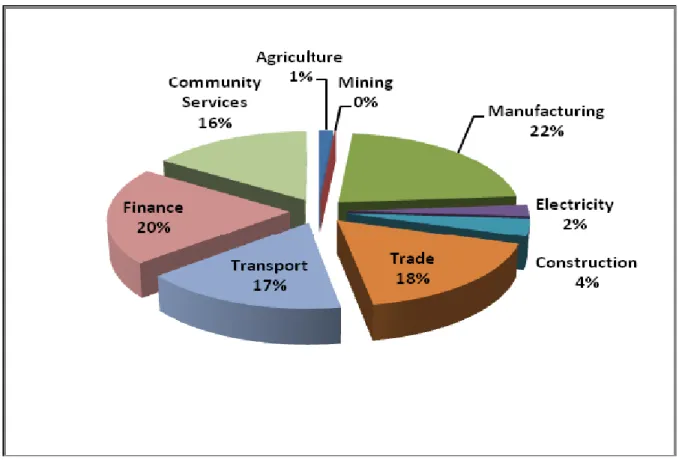
When deconstructing the manufacturing sector, this sector’s accomplishment can be attributed mainly to the chemical, automotive, pulp and paper, wood and wood products and food and beverages components. The municipality’s economic strategy acknowledge the significance of these sectors and their potential for growth, job creation as well as global competitiveness and has aligned suitable medium to long term strategy to promote improvement of this industry. The policy makers have re- emphasised the development of the country’s manufacturing sector as the cornerstone of the economy and have also committed to contribute to the growth of this sector. The manufacturing industry of eThekwini is the biggest contributor to the GDP growth, followed by finance, trade and then transport as indicated by figure 2.1.
Figure 2.1: Sector contribution: Gross Domestic Product 2008, Source: Global Insight
17
The figure above indicated that the manufacturing sector (22%) as well as finance (20%), trade (18%), transport (17%) and community services (16%) are the key industries in terms of GDP contribution of the eThekwini municipality.
The eThekwini municipality is predicted to grow its GDP at 3.5%, higher than the national average in 2010 and in line with the 2011 national average growth as well as contribution as predicted on the Global Insights Report (2010). The highest growth and contribution is expected in the transport, finance and community services industries with the lower growth expected in the mining, electricity, agriculture and construction industries. The economic empowerment and growth has become a main concern not only for South Africa but for the eThekwini Municipality and policy makers have realised the importance of manufacturing businesses as a main contributing factor to the growth of the economy. The manufacturing sector represents a sustainable, important vehicle to address the challenges of job creation, economic growth and equity within the eThekwini Municipality.
Despite the existence of different initiatives that are in existence to support small businesses within the eThekwini, the manufacturing sector still faces a number of challenges and there is a need to understand the factors that negatively affect the establishment and growth of small business within the city. In her research studies on small and medium business (2010), Dr Chetty argues that there is a need to have an understanding of the factors that hinders the accomplishment of SMME businesses and revolutionalise the support formation within eThekwini municipality which encompasses exploring different methods and new ways that would assist to enhance the international competitiveness of small businesses, in so doing making an important contribution to the economy. Therefore it is essential to first of all analyse the challenges or factors that the manufacturing industry faces within eThekwini municipality and to investigate the most suitable and valuable means of revolutionising this sector within the eThekwini municipality as referred to as the significant contributors to the economy in terms of both job creation and economic growth.
18
2.4 Characteristics of a successful entrepreneur
According to Boyett and Boyett, (2002), 70% of successful entrepreneurs show their success secrets through many aspects by identifying good business practices to raising capital, attracting and maintaining clientele as well as retaining them. Determining success or collapse of a business is fairly an intricate and challenging subject.
According to Lussier and Pfiefer (2001), the success of a small business can be defined as its ability to survive. The success of manufacturing businesses is dependent on owner’s previous knowledge, financial or capital access and personal skills which are the critical ingredients for the success of any business. This echoed by Pratt (2001) who noted that the business owner’s hard work, interpersonal skills and customer service orientation are also significant drivers of the performance of any business within the manufacturing industry. Psychological factors such as risk aversion, innovation and the ability to plan have an important effect on performance of the business. Hussain and Windsperger (2010) dispute that the understanding and the familiarity of the local marketplace play a key function for the achievement of any business, predominantly if the business operates within the retailing industry. The management abilities of entrepreneurs and the environmental factors are most important consideration for the success of small businesses. Benzing (2009) have categorised the important variables contributing to the success within the manufacturing sector into three groups’ i.e.
psychological, personal, management skills, training and external environment.
As pointed out by Benzing (2009), unpredictable political and socio-economic environment, intricate taxation, dishonesty, and cumbersome regulatory framework are frequent struggles confronted by entrepreneurs in growing economies. The South African manufacturing industry has to face a number of similar problems owing to the bureaucratic approach of public system and unbalanced administrative policies. Chu et
19
al. (2007) reported that African entrepreneurs face long waiting times for approval of licenses and registrations. Usually, the increased costs of doing business are a direct result of these bureaucratic hurdles and delays. According to Cook (2001), past business research studies are in agreement that the shortage of financial capital is one of the most important problems confronting entrepreneurs in the developing countries.
The factors related to the shortage or access to capital resources or funds are more evident in the case of women entrepreneurs. According to Kuratko and Hodgetts (1995) the most common characteristics of successful entrepreneurs includes technical competence, mental ability, integrity, dependability, acceptance of failure, internal locus of control, people management skills, the drive to high achieve results drive and creativeness, however he cautions that these are not all-inclusive.
2.5 The Business Environment
Manufacturing businesses are similar to the majority of businesses, they manoeuvre in a very competitive environment. Rwigema and Venter (2004) state that, “the entrepreneur must consider the business as a whole and be fully aware of its place within the market it operates in.” They are of the opinion that looking at the business as a whole will provide the entrepreneur with a lasting point of view for potential growth opportunities and continuity. Past studies showed that the relationship between SMME businesses and the business environment becomes a crucial focal area for the continual survival of businesses in the open market. Lee and Peterson (2000), is of the opinion that as business opportunities and capital is dependent on its surroundings therefore entrepreneurs must build up a closer relationship with the environment in which they operate in. This point is echoed by Coetzee (1993) who pointed out that the manufacturing companies may be regarded as an open system and is thus influenced by its surroundings. If the business is not capable to change to these forces from its environment and they are only dependant on the strength and nature of these forces,
20
they would be faced with either complications or opportunities which could potentially demolish the business or present businesses with opportunities to grow other avenues.
The circumstances in which entrepreneurs analyse the internal environment, external environment which encompasses the task and macro environments, imitate the character of the entrepreneur. It is noted that the internal environment is at the control of the entrepreneur whilst the external environment is beyond his or her control. It is the relationship between the entrepreneurs has with its environment that will determine the failure or success of the business. The most important factors impacting the failure of manufacturing businesses will be derived from the owners of businesses and the inside and outside environments factors.
According to Rigwena, et, al (2004), most entrepreneurs are at the leniency of economic environment that they have no control of. This is specifically relevant to areas which are highly dependent on big companies for employment. When such big companies settle on retrenching hundreds of the workforce, it negatively affects numerous small sized businesses that were developed dependent on employers. The current developments such as globalisation and economic meltdown have all impacted businesses drastically, especially those producing goods that are currently being imported at very low cost (Small Business Monitor, 2010). Entrepreneurs within the manufacturing industry are in general laggards for technology acceptance. The principal motive for the perceived higher expenses is staying in tune with the most modern technological innovations specific to their particular industry. Over the past decade, the rapid growth of technological advancement has been exceptional. The manufacturing business operating with outdated technology is at risk as the competition will leapfrog over quickly by reducing it to oblivion Rigwena, et, al (2004). It is noted that new technology typically brings the guarantee of reduced costs and or an increase in revenue. Generally businesses are not technically confidence enough to utilise the network efficiently. Small
21
business cannot also afford to employ specialist or web designers to plan or develop a superior online strategy.
2.5.1 The Internal Environment
Hunger and Wheelen (2003) argues that internal environment comprises of the manageable essentials of the business surroundings and stress that the entrepreneurs should focus on the administration aspects such as marketing, finance, research and development, operations and human resources management which are within the control of the enterprise. A thorough knowledge and understanding of the internal environmental factors will provide the entrepreneur with the essential administrative skills to enhance the management of the business and to eliminate the potential of business failure.
Deficiencies within the surroundings are the important causes of failure of the manufacturing industry. According to Ligthelm & Cant (2002), noted key internal issues affecting businesses as skills related to management and financial knowledge, the lack of expertise in key operational areas which includes marketing and the management of personnel. A number of the problems emanating from these factors include management aspects such as a poor or the lack of management skills as well as a limitations related to the lack of business culture in South Africa. The other causes for failure of manufacturing businesses as identified by Ligthelm, et, al (2002) include the entrepreneur incapability to act, control the growth of the business growth and too much focus on financial results. The actions of management as well as the behaviour reluctance to seek advice, lack of management commitment and unwillingness to adapt to change are the main causes for failure to put strategic goals, future plans.
22 2.5.2 The External Environment
Hunger and Wheelen (2003) describes the external environment as the societal environment which comprise a number of forces including political and legal forces, policies and regulations, economic factors which control the trade of resources, financial resources, energy and information, socio-cultural services which control the principles, habits of the public as well as technological forces that produce problem solving inventions. These macro environmental forces usually influence the long term decisions of any business. The owners of manufacturing businesses have no control or authority over the forces of the external environment and this can be accredited to the inadequate capital resources within this sector. The shifts of all the forces within the external environment affect all businesses irrespective of the size of the business. When there is a change in the external environment, bigger businesses are well placed to absorb these shifts compared to their smaller counterparts because they have adequate capital. There is a need for the owner manager to be attuned to the external environment in order to minimise any negative shocks emanating from this environment.
The owners of business should be able to adapt swiftly to environmental changes in order to capitalise on the shifts as and when they present themselves as opportunities.
2.6 Globalisation
Globalisation is defined as the elemental shift in world market where countries are stirring their economic system towards a mutually dependent worldwide economic system. As pointed out by Hill (2009), globalisation has resulted in markets in which formerly or traditionally discriminated markets have become one massive worldwide marketplace as a consequence of elimination of trade barriers and advances in information and transportation technologies. Due to globalisation, all countries can now partake in worldwide trade. The other facet of globalisation is the globalisation of means of production. Businesses can establish their production facilities in countries where
23
manual labour and other means of production are cheaper. The ending effect is that globalisation presents new fear for manufacturing companies especially in Africa as a result of increased competition from overseas market entrants. The locally produced goods and services are currently competing with goods of cheaper quality as well as merchandise from emerging economies, such as China, India, and Brazil. These low- priced imported goods are quickly replacing locally manufactured goods and closing down small manufacturing businesses.
Globalisation and modern technology is developing a fresh market with fresh traditions of doing business, production of goods and services as well recognising profits. Mass production has been replaced by a new move towards competition which is dependent on knowledge and skills. The purpose of any businesses is no longer about the maximisation of, but is now dependent on the management of production, innovation and advertising, the utilisation of all the available linkages as well as services presented by the network of manufacturing businesses. In globalised world businesses have the ability to produce an even better scale of returns, as well as efficiency and effectiveness that are far beyond the previously achieved profits. Manufacturing businesses are faced by free market as trade and import barriers have diminished. The bigger volumes of cross boundary trade and the current technology, in particular knowledge base transfer, computerised business environment and the communication technology has revolutionalised the world (Unido, 2000).
Globalisation has changed the world’s market and created a new business environment as factories have been established through technology and current technology driven knowledge is applied in the manufacturing process. Businesses can now take advantage of better system of government and utilize new linkages within a value system (Unido, 2000). The location of the manufacturing of goods does not matter causing a new spatial organisation as all kinds of knowledge, information, goods and services can be out sourced and traded anywhere in the world (Unido, 2000).
24
Manufacturing businesses need to understand that in a globalised environment, the new productivity economic benefits are the heart of the international data economy.Without a growing and prosperous regional consumer market, the manufacturing businesses within eThekwini municipality cannot rely on low wages but they need a strategy for global re-engagement as suppliers and buyers are easily accessible as the use of networks increases.
2.7 Management Skills
The shortage of management skills and the technical know-how is a most important restraint affecting the advancement of the small business especially in the manufacturing sector where skills are a key. According to Nyoni (2002), Business owners within the manufacturing industry places low precedence to training and are normally averse to participate in programs which necessitate them to finance even a small percentage of total training costs. The acknowledged areas of concerns differ from the supervision of money, strategic promotion and financial administration.
Business have are falling short of technical skills which includes the innovation needed for the production of quality products and services. The shortage of skills by entrepreneurs also affects the implementation of growth strategies for their enterprises.
Nyoni (2002) is of the view that addressing the skills shortage requires training and skills development which can be acquired at the ground level, administration or supervisory level as well as the entrepreneurial level. As indicated by Heraty (2005), management skills are crucial for the advancement of any businesses which also be associated with the national pool of management expertise which is critical for the economic growth and development of the country. Poor management skills within the manufacturing industry are recognised as an acute problem worldwide. Heraty (2005), also points out that managerial weakness is one of the most important reason for the failure of SMME businesses worldwide.
25 Management Expertise and Abilities
The success of any business is frequently attributed to the management’s expertise or performance, therefore the skills of the business owners are an important factor for any business to succeed. Entrepreneurs internationally need to attain the much needed management knowledge to make certain their business’ future survival and advancement. Business owners as well as managers who have insufficient management knowledge and the necessary skills will have a challenge to control their businesses efficiently and effectively to produce better results. According to Dzansi (2004), manufacturing businesses are crucial for economic growth and development and he is of the opinion that proper management of the business is essential to ensure or guarantee complete development of the manufacturing industry in a globalised word market. The accomplishment of businesses would result in better standards of living which will further enhance the alleviation and the reduction of poverty especially for underdeveloped communities. Dzansi (2004) also acknowledged that this division of the world economy may not be able to accomplish its role if it cannot grow quickly to be able to compete in a globalised world market.
Amongst other factors, the speedy growth of small businesses and their ability to participate worldwide would necessitate that the skills management of those individuals who established and managed these businesses to be enhanced from the current depressing condition to a more efficient level (Makatiani, 2006). Entrepreneurial capability is accessible to a lot of individuals, however managerial competencies that are fundamental for the continuation and sustainability of the SMME is inadequate. A successful business is extremely reliant on its management abilities and their resourcefulness. If the intended results of an enterprise are to be achieved in any business, certain responsibilities need to be carried out by owners and or managers, however the extent to which entrepreneurs carry out these tasks is rather different in contrast to big businesses because of a shortage of technical and managerial skills.
Research findings by Sawas & Feng (2005), pointed out that “a lack of managerial
26
competence result in the failure of small businesses worldwide.” Cronje (2003) pointed out that poor management is one of the primary reasons for the failure for a number of small enterprises. Longenecker et al. (2006) echoes the above sentiment and argued that small businesses are more vulnerable to the weaknesses of management which is a result of a lack of qualified personnel due to financial constraints.
The administrative inadequacies of manufacturing businesses can be accredited to the inadequate levels of proper schooling amongst the majority of entrepreneurs and or managers. The most important issue confronting the manufacturing business industry worldwide is therefore the improvement of the managerial skills of the owners or managers in this sector to ensure their long term success (Cronje, 2003). In developing countries, manufacturing businesses are key players in economic advancement in terms of employment creation and economic growth and development hence the success of small businesses becomes significant and there is a need to ensure their proper management. In order to provide the necessary management skills, entrepreneurs require a clear understanding of the needed skills which are necessary for the smooth and profitable running of small businesses. Furthermore, there is a undeniable necessity to develop what management skills presently exist specifically within the manufacturing sector and which ones are not there in order to ensure that manufacturing businesses are well managed.
Management Talent
Some of the manufacturing processes require very specific talents which are difficult to get or are very costly. If particular talents to the business are imperative, assessments should be conducted to establish whether they are accessible to commencing the business. According to Stats SA (2010), entrepreneur equates to small or medium business which represent about 40 to 60 % of the South Africa’s GDP which results to employment, re-distribution of wealth as well as more businesses and healthy economic
27
development. The shortage of administration skills is regarded as the second biggest cause of failure of small business. According to Hill (2007), many business owners lack managerial training and expertise. Entrepreneurs establish their own approach to management through a process of experiment and mistake which is due to their management style that is more or less to be more instinctive than systematic. Their system is more worried about day to day management than long term view and more opportunistic than strategic in its concept. Hill (2007) also acknowledges that even though this approach is the main strength at the developmental stage of the business, it enables the creativity necessary but it may present problems when compounded decisions have to be undertaken.
The end result of the unfortunate managerial ability is that the owners especially in the manufacturing industry are not well equipped to tackle changes in the business environment and to prepare suitable changes in technology. As pointed out by King and McGrath (2002), the majority of business owners who run manufacturing operations are ordinary people whose educational background is lacking hence they may not well equipped to carry out managerial routines for their business enterprises. Education and skills are needed to run micro and small enterprises. As highlighted by King and McGrath (2002), in their study of entrepreneurial challenges, the majority of entrepreneurs that carry out small and large businesses are not fairly capable in terms of education and skills and went on further to suggest that those with more teachings and training are more expected to be successful. Therefore for small businesses to do well, business owners require to be well knowledgeable in terms of skills and management.
According to Dockel and Ligthelm (2002), the struggles experienced by entrepreneurs in running a triumphant business includes economy related factors that are related to the national economic factors which are associated to the state of the economy, industry based problems that is associated with the industry in which the enterprise operates as