HERITAGE IN CONTEMPORARY GRADE 10 SOUTH AFRICAN HISTORY TEXTBOOKS: A CASE STUDY
BY
NKWENTI RAYMOND FRU
Submitted in fulfillment of the requirements for the Degree of Masters in Education (History Education)
At the
University of KwaZulu-Natal
2012
i
DECLARATION
I declare that this dissertation is my own work. It has not been submitted before, in whole or in part, for the award of any degree at any other university. Where use has been made of the scholarship of other authors, they have been duly acknowledged accordingly.
...
Nkwenti Raymond Fru
As the candidate's supervisor and co-supervisor we hereby approve the submission of the thesis for examination.
...
Professor Johan Wassermann May 2012
...
Mr Marshall Maposa May 2012
ii
ACKNOWLEDGEMENTS
Above all, I would like to thank the Lord God Almighty, for giving me the strength, courage, good health and sustenance which proved indispensable for the completion of this project in the midst of countless challenges. He is a God that never fails and I can simply never do enough to thank Him. I hereby acknowledge my heart-felt gratitude and appreciation to the following people for their unwavering contribution towards the completion of this thesis:
My supervisor, Prof. Johan Wassermann, for his trust, invaluable guidance and encouragement throughout this study but also on all aspects regarding my development as a person and an academic. Thank you for bestowing confidence in me Prof. You are more than a supervisor to me. I pray God to grant us the same strength to accomplish even greater things.
My co-supervisor and brother, Mr. Marshall Maposa.
My sister, Nchang Nkwenti, for giving me the rare opportunity to further my studies. At a time when all hopes seemed lost, you single handily took the initiative on my life through which I am able to see some light at the end of the tunnel. I will forever be indebted to you ‘grande sœur’.
My dearest and beloved wife, Immaculate Forlum Fru for your love, support and patience all these years. Your ability to withstand years of loneliness gave me an added impetus to succeed. You have been a tower of strength without which this thesis as well as a great deal of my personal happiness would not have been possible.
My father, Mr Nkwenti Keka and the rest of my family, especially Nche Nkwenti, Che Nkwenti and Kah Moma for standing by me throughout this most torturous, tiring, yet greatest learning experience I have ever had.
My mentors, colleagues, and peers in the School of Social Science Education;
the School of Education Studies and Professional Development; the Edminson library and the Edgewood counselling and disability unit. The spirit of camaraderie that prevailed is much acknowledged.
Mrs Angela Brian for taking time off her busy schedule to proof read this dissertation. Your professional input was invaluable
iii
DEDICATION
I dedicate this Masters in Education thesis to my late mother: Mrs Ngum Justine Nkwenti (1957-1992).
As long as your memory is in my heart, mom you are
never truly gone from my life.
iv
ABSTRACT
Drawing on two research questions, this study presents an understanding of the nature of heritage in selected contemporary Grade 10 South African history textbooks, and elucidates factors responsible for the depiction of heritage in a particular way. The context that informed this study was that of South Africa as a post-conflict society.
Using the interpretivist paradigm and approached from a qualitative perspective, this case study produced data on three purposively selected contemporary (post-1994) South African history textbooks with regards to their representation of heritage.
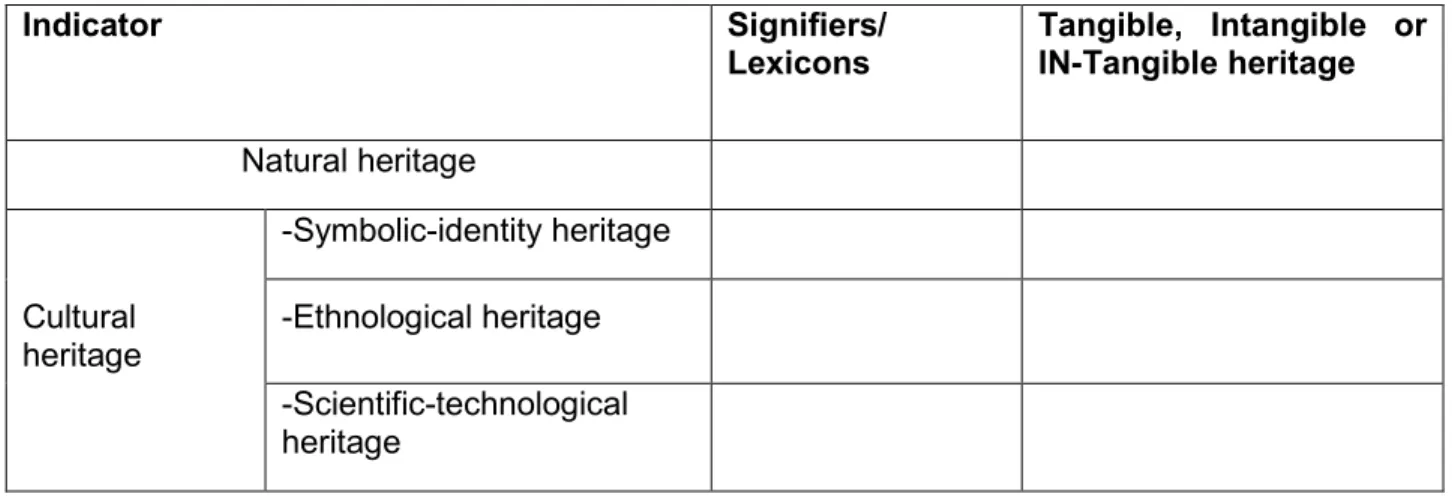
Lexicalisation, a form of the Critical Discourse Analysis (CDA) was used as method to analyse the pre generated data from the selected textbooks following Fairclough’s (2003) three dimensions of describing, interpreting, and explaining the text. The study adopted a holistic approach to heritage as a conceptual framework whilst following social constructionism as the lens through which heritage was explored in the selected textbooks.
My findings from this study concluded that although educational policy in the form of the NCS-History clearly stipulates the expectations to be achieved from the teaching and learning of heritage at Grade 10 level, there are inconsistencies and contradictions at the level of implementation of the heritage outcome in the history textbooks. Key among the finding are the absence of representation of natural heritage, lack of clear conceptualisation of heritage, many diverse pedagogic approaches towards heritage depiction, a gender and race representation of heritage that suggests an inclination towards patriarchy and a desire to retain apartheid and colonial dogma respectively, and finally a confirmation of the tension in the heritage/history relationship. The study discovered that factors such as the commercial and political nature of textbooks, the lack of understanding of the debates around the heritage/history partnership, and the difficulties involved in post-conflict reconstruction are responsible for this type of heritage depiction in the textbooks.
v
TABLE OF CONTENTS
TITLE PAGE
SECTION A
DECLARATION i
ACKNOWLEDGEMENTS ii
DEDICATION iii
ABSTRACT iv
TABLE OF CONTENTS v-vii
LIST OF TABLES AND FIGURES viii
LIST OF ACRONYMS ix
SECTION B
1 Chapter One: The overview of the study
1-131.1 The study in context 1-6
1.1.1 Pre – 1994 context 1-3
1.1.2 Post – 1994 context 3-6
1.2 Statement of purpose and focus 7
1.3 Critical questions 7
1.4 Rationale and motivation for the study 8-9
1.5 Research methodology 9-11
1.6 The layout of the study 10-12
1.7 Conclusion 13
2 Chapter Two: Literature review
14-442.1 Introduction 14-15
2.2 Heritage 15-35
2.2.1 Evolution and clarification of the concept of heritage 15-22
2.2.2 Heritage and history 22-25
2.2.3 Heritage education 25-28
2.2.4 Towards a conceptual framework of heritage 28-35
2.3 History textbooks 35-43
2.3.1 Reviewing the pedagogic role of history textbooks 35-37
vi
2.3.2 The political and ideological aspects of history textbooks 37-43
2.4 Conclusion 43-44
3 Chapter Three: Research design and methodology
45-673.1 Introduction 45-46
3.2 The research design 47-58
3.2.1 Qualitative research 47-48
3.2.2 Interpretive paradigm 48-50
3.2.3 Ontology and epistemology 51
3.2.4 The case study 52-53
3.2.5 Ethical issues 53
3.2.6 The sample 54-58
3.3 The research methodology 58-66
3.3.1 Methods 63-66
3.4 Conclusion 66-67
4 Chapter Four: Data analysis
68-1224.1 Introduction 68-69
4.2 Analysis of heritage – In search of history. Grade 10. Learner’s book 69-88 4.2.1 Description of heritage in the conceptualisation 70-71 4.2.2 Interpretation of heritage in the conceptualisation 71-75
4.2.3 Description of heritage in case study 1 75-76
4.2.4 Interpretation of heritage in case study 1 77-81
4.2.5 Description of heritage in case study 2 81-83
4.2.6 Interpretation of heritage in case study 2 83-87
4.2.7 Conclusion 87-88
4.3 Analysis of heritage – Shuters history. Grade 10. Learner’s book 88-98 4.3.1 Description of heritage in conceptualisation 89-90 4.3.2 Interpretation of heritage in conceptualisation 90-91
4.3.3 Description of heritage in case studies 91-93
4.3.4 Interpretation of heritage in case studies 93-97
4.3.5 Conclusion 97-98
4.4 Analysis of heritage – Making history. Grade 10. Learners’ book 98-115
vii
4.4.1 Description of heritage in case study 1 100-102
4.4.2 Interpretation of heritage in case study 1 102-107
4.4.3 Description of heritage in case study 2 107-108
4.4.4 Interpretation of heritage in case study 2 108-111
4.4.5 Description of heritage in case study 3 111
4.4.6 Interpretation of heritage in case study 3 111-114
4.4.7 Conclusion 114-115
4.5 Explanation of heritage in all three history textbooks 115-121
4.6 Conclusion 122
5 Chapter Five: Discussion of findings
123-1465.1 Introduction 123
5.2 The conceptualisation of heritage 123-126
5.3 The nature of heritage 127-132
5.4 The choice of language in the selected text books 132-135 5.5 The pedagogical design of presentation of heritage in the selected
text books
135-138
5.6 The heritage/history partnership 138-140
5.7 Gender and race 140-142
5.8 Heritage education in history in the context of South Africa as a post – conflict society
142-144
5.9 Conclusion 144-146
6 Chapter Six: Conclusion
147-1606.1 Introduction 147-148
6.2 Summary of chapters 148-151
6.3 Summary of key findings 151-156
6.4 Limitations of the study 157-158
6.5 Recommendations for further research 159
6.6 Conclusion 159-160
References
161-171Appendix: Ethical clearance certificate
172viii
LIST OF TABLES AND FIGURES
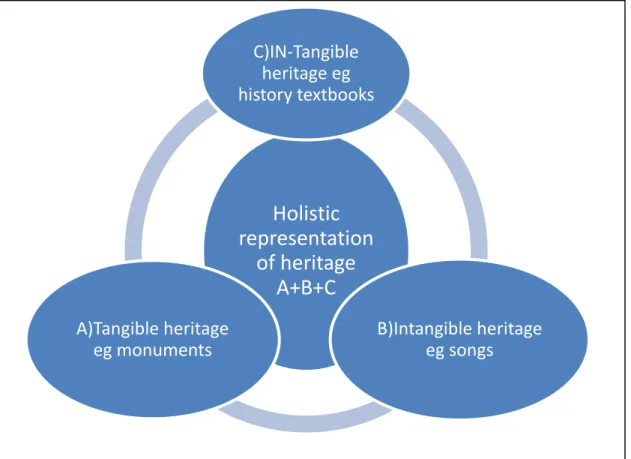
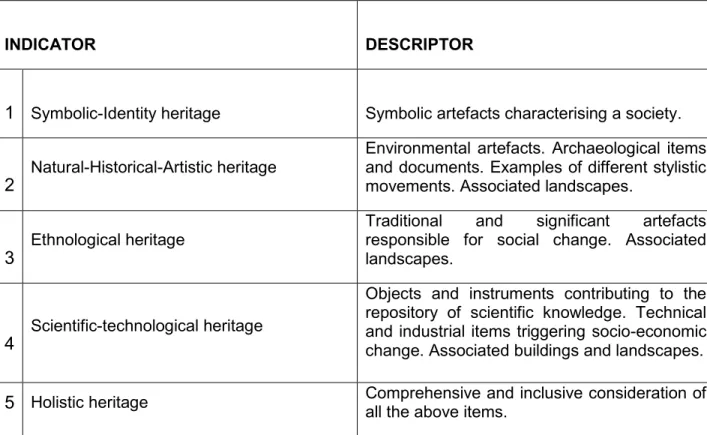
Table 2.1 Table illustrating the semantic evolution of heritage 16 Figure 2.1 Figure illustrating the manifestation of IN-Tangible heritage 33 Table 2.2 Table illustrating the conceptualisation of holistic heritage 34
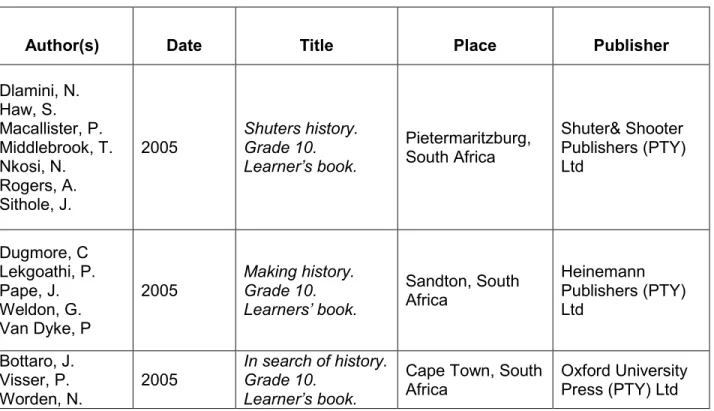
Table 3.1 The research sample 56
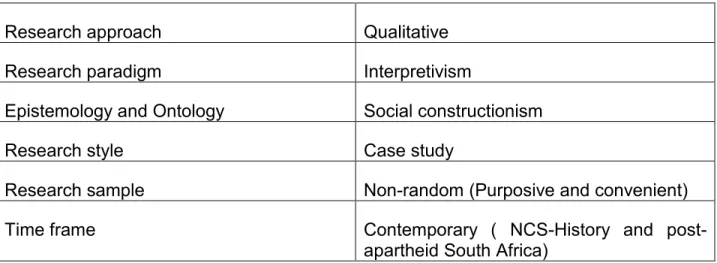
Table 3.2 Summary of the research design 58
Figure 3.1
Figure illustrating three dimensional configuration of discourse and discourse analysis as applied to this study 64 Table 3.3 Example of instrument for analysis for step 2 (interpretation) 65 Figure 4.1
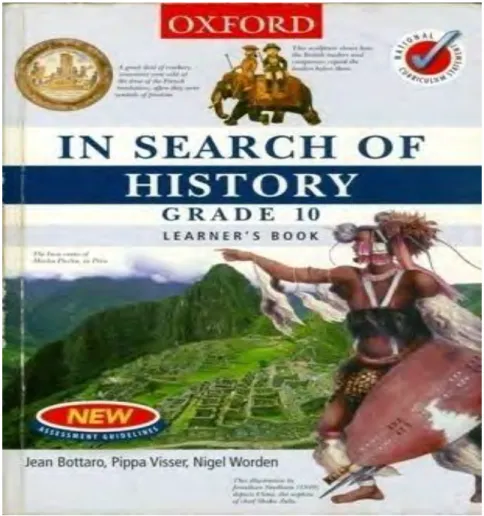
Cover page of In search of history. Grade 10. Learner’s
book 69
Table 4.1
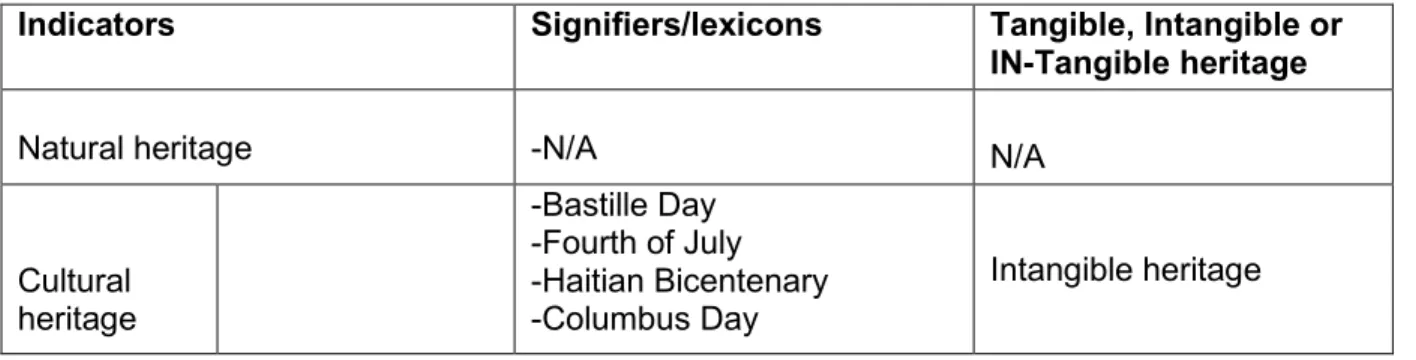
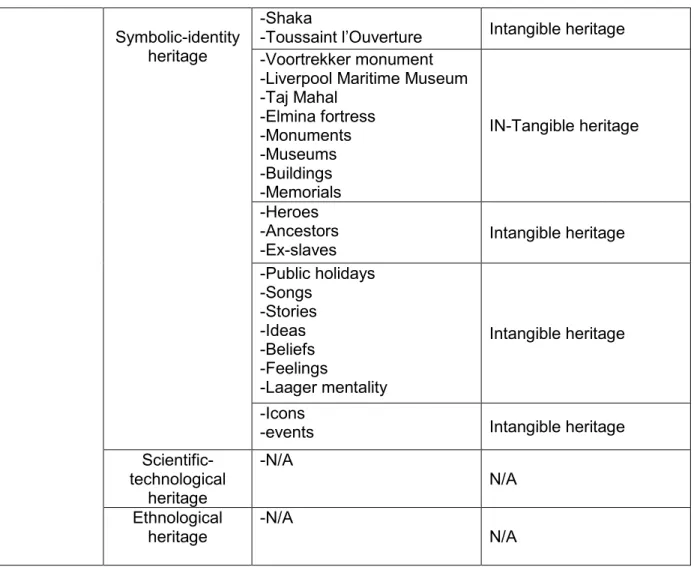
Interpretation of heritage in conceptualisation – In search of
history. Grade 10. Learner’s book 71-72
Table 4.2
Interpretation of heritage in case study 1 – In search of
history. Grade 10. Learner’s book 77
Table 4.3
Interpretation of heritage in case study 2 – In search of
history. Grade 10. Learner’s book 83-84
Figure 4.2 Cover page of Shuters history. Grade 10. Learner’s book 89
Table 4.4
Interpretation of heritage in conceptualisation – Shuters
history. Grade 10. Learner’s book 90
Table 4.5
Interpretation of heritage in case studies – Shuters history.
Grade 10. Learner’s book 93-94
Figure 4.3 Cover page of Making history. Grade 10. Learners’ book 99
Table 4.6
Interpretation of heritage in case study 1 – Making history.
Grade 10. Learner’s book 102-104
Table 4.7
Interpretation of heritage in case study 2 – Making history.
Grade 10. Learner’s book 108-109
Table 4.8
Interpretation of heritage in case study 3 – Making history.
Grade 10. Learner’s book 112
ix
LIST OF ACRONYMS
ANC African National Congress
AU African Union
CDA Critical Discourse Analysis
DA Discourse Analysis
CDS Critical Discourse Studies
DoE Department of Education
FET Further Education and Training
GDR German Democratic Republic
ICOMOS International Council on Monuments and Sites
IFP Inkatha Freedom Party
IKS Indigenous Knowledge Systems
MMR Mixed Method Research
NCS National Curriculum Statement OAU Organisation of African Unity
OBE Outcomes Based Education
SCHP Schools Council History Project SFL Systematic Functional Linguistics UDI Unilateral Declaration of Independence
UK United Kingdom
UN United Nations
UNESCO United Nations Educational, Scientific and Cultural Organisation UNISA University of South Africa
WHYH World Heritage in Young Hands
ZANU Zimbabwe National Union
ZAPU Zimbabwe African People’s Union
1
CHAPTER ONE
AN OVERVIEW OF THE STUDY 1.1 The study in context
This study was carried out in the context of contemporary South Africa as representative of a post-conflict society. The time frames provided to better comprehend this context were the pre-1994 and the post-1994 South African society. The former period represents the era of conflict that was characterised by the implementation of apartheid policies that divided social, economic and political space as well as officially defined ethnic divisions at personal, local and national levels (Lemon, 1990). The consequences were inequalities, discrimination and exclusion and the rise of social upheaval and outright conflict between perpetrators and victims of the system.
However, the demise of apartheid in 1994 and the introduction of a democratic constitution brought hope of a conflict free society, one that is united, non-racist, non- sexist and based on the respect of human rights. Education was identified as a major player in this endeavour and the role of heritage education in particular in promoting social cohesion was envisaged. Therefore, heritage was included as one of the outcomes of the National Curriculum Statement (NCS-History)1 so as to address this challenge. Consequently, history textbooks became an important medium through which these new ideals could be passed on to both learners and teachers. As a result, this study analysed three of these purposively selected history textbooks at Grade 10 level to determine the extent to which these books comply with the ambitions of the builders of this post-conflict South Africa through the manner in which they represent heritage. A deeper context of this study is provided with the two time frames under consideration clearly stated.
1.1.1 Pre-1994 context
There have been significant developments in education in South Africa since the demise of apartheid in 1994. The ultimate goal of these changes has been to redress
1The NCS was replaced in 2011 with the Curriculum Assessment Policy Statement (CAPS) as part of the process of curriculum transformation in South Africa (DoE, 2011). At about the same time, the National Department of Education (DoE) was split into two: Department of Basic Education (DBE) and the Department of Higher Education and Training (DHET).
2
the injustices of the apartheid curriculum. Msila (2007) submits that education is not a neutral act; it is always political. Education in the apartheid era was used as a weapon to divide society as it constructed different identities amongst learners. This is evidenced in the statement made by Dr. HF Verwoerd, the then Minister of Native Affairs in 1955, “when I have control over native education, I will reform it so that natives will be taught from childhood that equality with Europeans is not for them” (Christie, 1985, p. 12. Cited in Naiker, 1998, p. 9).
With the implementation of the apartheid policy, Verwoerd’s dream became reality.
Legislation such as the Bantu, Coloured and Indian Education Acts that were passed in 1953, 1963, and 1965 respectively strongly indicated the desire of the National Party to segregate schooling and to create a certain heritage (Molteno, 1991). The education that was offered to the different groups was well crafted with the purpose of making its recipients forever inferior to the whites in all aspects of socio-economic and political life.
This resulted in a scenario of all heritages being dominated by white heritage.
Therefore, during this period education in general and history education in particular was largely portrayed from the white man’s point of view. Both whites and people of colour2 were required to study the history of white pioneers and heroes. Other race groups of this country did not appear to have a history but were rather portrayed as hindrances in the efforts of the white heroes to survive. According to Kallaway (2002, p.
3) this system of education “... has been recognized as one of the most dramatic cases of institutional educational injustice in the history of the twentieth century”. This argument vividly indicates the extent to which education in apartheid South Africa was racist, sexist, and discriminatory. The national policy on South African living heritage (2009) of the Department of Arts and Culture explains this situation further by revealing that the history of apartheid ensured that heritage aspects such as the practice and promotion of languages, the performing arts, rituals, social practices and indigenous knowledge of various social groups were not balanced and in they were strongly and systematically discouraged. Summarily, it is evident that the apartheid authorities ensured that the heritage of the people of colour in South Africa was never appreciated or promoted. An example of this was the false impression that was created that
2 Term used to refer to the Black, Indian, and the coloured race groups of South Africa.
3
traditional dress code and traditional dances of certain groups were backward and clashed with colonial adopted practices such as Christianity (Department of Arts and Culture, 2009).
However, it should be noted that the quest for Afrikaner nationalism and the ideology driving this kind of heritage, resulted in a systematic subjugation and alienation of the heritage and history of people of colour, and consequently heritage was never an intended outcome of the study of history under apartheid. Even though it could be argued that the nature of the curriculum and the textbooks that accompanied it was enough indication of the kind of heritage that was promoted among learners, in terms of the intended curriculum heritage was never an issue. It was only after 1994 that issues of heritage studies started to be part of the public debate in education and other circles.
Now it is one of the outcomes of the NCS-History. The obvious question should be, why the sudden interest in heritage education in post-1994 South Africa?
1.1.2 Post-1994 context
The end of apartheid symbolised an end to different kinds of discrimination. The emphasis was now on the kind of education that Brittan and Maynard (1984) proclaimed as a leveller in its promotion of equalities and disregard of social differences. In other word the focus was now on education that strived to achieve nation building based on human rights and equality. For these values to be achieved there had to be a complete overhaul of the old apartheid curriculum and what it stood for. This transformation process could not have started in a better place than in the new Constitution of the Republic.
The constitution of a democratic country is the supreme law of the land which defines very clearly, the rights and obligations of citizens as well as the vision and mission of the nation. The dawn of democracy in South Africa necessitated the establishment of such a constitution to carry the aspirations of the ‘new’ rainbow nation into the future.
The adoption of the Constitution of South Africa, Act, No. 108 of 1996, was therefore an outcome of these considerations. This constitution recognises in its preamble the injustices of the past and honours those who suffered for justice and freedom in this land. It pays respect to those who have worked to build and develop this country and
4
emphasises that South Africa belongs to all who live in it. Evidently, the aims of the constitution as stated in its preamble were to “heal the divisions of the past and establish a society based on democratic values, social justice and fundamental human rights” (Republic of South Africa – constitutional law, 1996, p. 1243). Equally, the language, culture, religion and education clauses of the bill of rights catered for the appreciation and promotion of the heritage of all South Africa. By implication, the emphasis after 1994 was to build an inclusive and democratic society that is united in its diversity, is non-racial and non-sexist, which promotes the dignity of humans and strives to advance equality, human rights and freedom. The expectation was a prototype citizenship and a prototype styled heritage was a prerequisite for it. The enthusiasm of the new society was equally demonstrated through slogans and songs such as
‘Simunye’ and ‘Batho Pele’ – slogans that stand for ‘we are one’ and ‘people first’
respectively. As stated earlier, a very effective way to achieve these desired intentions was through education and this involved reviewing the curriculum policy and the textbooks to carry the message of change. The curriculum transformation was therefore driven and underpinned by the constitution and its inspiration was informed by the objectives outlined in its preamble (DoE, 2003, p. 1).
In line with the above developments, heritage was included as one of the outcomes of the NCS-History. The NCS-History states that in addition to enquiry skills, historical conceptual understanding and knowledge construction and communication, learners of history will be introduced to “issues and debates around heritage and public representations, and they are expected to work progressively towards engaging with them. Links are drawn between different knowledge systems and the various ways in which the past is memorialised” (DoE, 2003, p. 14). The implication here is that learners are expected to engage with different customs, cultures, traditions and in other words, different heritages. They are exposed to debates around sites of historical value, monuments, museums, oral histories and traditions, street names, buildings, and public holiday as they relate to the heritage outcome prescribed by the NCS-History.
Furthermore, in the context of this study it is necessary to understand that the curriculum is articulated by means of textbooks. As the most commonly used teaching resource and the vehicle through which the curriculum is made public, the history
5
textbook has the potential to play a significant part in the implementation of heritage education. According to Engelbrecht (2006, p.1) textbooks by their nature, “tend to control knowledge as well as transmit it, and reinforce selected cultural values in learners”. It is one of the means used by any government to present official history.
Therefore, the state requires learners to understand heritage in the curriculum as presented in the textbooks, and specific to this study, Grade 10 textbooks.
It is necessary to note that the presence of heritage in the curriculum and the textbooks has not eliminated some of the controversies and the contestations surrounding heritage. The reality on the ground is not always in line with the lofty aims of the constitution and the aspiration of the post-1994 South African government. A major concern here is about shared heritage, if indeed this notion exists .Recently the South African national and some local government structures have embarked on a project to change place names and street names. Though this can be understood in the context of reconstruction of a post-conflict society, such actions, however, provoke questions such as: whose heritage is being promoted? Is national heritage actually the heritage of the nation or inhabitants? It equally increases the debate on the place of history as well as the heritage/history dichotomy. What should be retained and preserved? What should be discarded and why? On the one hand there is the will to acknowledge the past and create inclusiveness in society as proclaimed in the constitution and the curriculum, but on the other hand there is the difficulty of its practicability as illustrated with the example below.
The recent controversy in eThekwini (Durban) over the elephant sculpture project by Andries Botha further testifies to this contestation. The project, commissioned by the eThekwini municipality was brought to an abrupt end because the elephants were declared symbols of the Inkatha Freedom Party (IFP) and were deemed unacceptable in an African National Congress (ANC) controlled city. This happened despite the fact that the majority of the inhabitants of the region are Zulus whose history is steeped in elephant reverence. For example, King Shaka was known as Great Elephant and the royal homestead is Mgungundlovu which refers to the secret place of the great elephant (van Wyk & Pillay, 2010). Moreover, as the biggest land based mammal the elephant is also known as one of Africa’s most iconic animal and is a quintessential African symbol.
6
This renders the elephant an important aspect of Zulu and African heritage and such controversy over its public representation leaves many questions about the nature and position of heritage and the heritage industry at large. As a result this study sought to elucidate the extent of such contestations with specific emphasis on the selected Grade 10 history textbooks.
However, the situation in South Africa is only part of increasing international concern regarding heritage. A study conducted by van Wijk (no date) reveals that cultural heritage is a key element in history curricula and history textbooks throughout Europe.
The roots of this recent worldwide interest in heritage studies can be traced to the aftermath of World War II. The urgent need to rebuild a war torn Europe led to propaganda on identity and citizenship as prerequisites for nation building and prevention of future wars. It was necessary for people to identify a common heritage, globally or locally, before they could come together to build their own nations and a better world. It was in this regard that heritage became a very important aspect of schooling especially in Europe. This did not occur in South Africa because the apartheid government strongly opposed these ideals. For this reason, South Africa had to wait till the end of apartheid before joining the existing international interest in heritage.
Consequently, it is imperative to note that the relationship between heritage and history is one of tension, contestation and contradiction. A synopsis of this situation is fore grounded here but elaborated more under section 2.2.2. Attempts to establish a demarcation between the two concepts have been carried out by researchers such as Lowenthal, Novick and Nora as cited in Phillips (2006). According to them, the primary concern of heritage is the domestication of the past and not a systematic study of the events of the past – the latter being the interest of historians. Therefore history acknowledges the concepts of historical time and distance in the interpretation of events while heritage on the other hand only clarifies the past so as to infuse them with present day purposes (Phillips, 2006). A detailed literature review on the conceptualisation of heritage and its relationship with history is provided under the appropriate section in chapter two.
7
1.2 Statement of Purpose and Focus
The purpose of this study was to attain an understanding of the curriculum translation of heritage into the selected Grade 10 history textbooks and to understand the different discourses around the curriculum and the textbooks with regards to history and specifically heritage within the context of a post-conflict South African society. It was important to do this because contemporary South Africa is a post-conflict and diverse society with a certain history which is fast becoming a distant memory to today’s learners who never experienced it. An understanding of the nature of heritage as portrayed in textbooks might help to identify the kind of citizenship that the post-conflict South African state is promoting through the NCS-History. The purpose of this study was also to see if such textbook representation of heritage met the goals of the curriculum and to a larger extend the Constitution of the Republic it is meant to reflect.
The focus of this study therefore was on the heritage outcome of the NCS-History and the way this outcome is manifested in contemporary Grade 10 South African history textbooks through the choice of language, known as lexicalisation. In this study, I attempted to understand the nature of the representation of heritage, including the reasons for its representation in any particular way through an examination of the content of three selected history textbooks by means of Critical Discourse Analysis (CDA).
1.3 Critical Questions
Research always commences with one or more questions. De Vos (1998) stated that a good research question is one that can be answered by collecting data and whose answers cannot be foreseen prior to the collection of data. With regards to the representation of heritage in selected Grade 10 South African history textbooks, this research study was based on the following research questions:
How is heritage represented in selected contemporary South African Grade 10 history textbooks?
Why is heritage represented as it is in selected contemporary South African Grade 10 history textbooks?
8
1.4 Rationale and Motivation for the Study
Heritage education is not a priority in many societies. My experience as a history teacher in Cameroon revealed to me that even though the country is as blessed as South Africa in terms of cultural and natural heritage resources, heritage is not given the same value in the history syllabus as is the case with the NCS-History. Not only is it absent as an expected learning outcome, textbooks are also ineffective on the topic. A critical study on heritage in history textbooks will therefore equip me personally, professionally, and conceptually with an in-depth understanding of the intricacies surrounding the neglect of the rich Cameroon heritage as a stipulated outcome in the history syllabus and evidently in history textbooks.
Furthermore, the South African experience aroused my interest resulting in my reading and researching widely on the subject. This realisation, that the role heritage education can play in amongst other things, identity formation and in conserving and protecting both tangible and intangible heritage resources so that these can be bequeathed to generations to come (Fru, 2010). But this cannot be realised without the textbook. This is supported by a UNESCO (2006) report which emphasises that even though textbooks are not the ultimate solution to a country’s educational problems, they are a major component underpinning many curricula and education systems. They provide a solid basis for learners learning and teachers teaching and a means for gaining information and knowledge. This clear link between textbooks and instruction is an indication that the textbook is the ultimate place to start unpacking my curiosity regarding heritage.
A review of a sample of literature on heritage studies in South African education revealed that heritage was never a component of the pre-1994 curriculum. Its sudden appearance in the post-1994 content and its inclusion as an outcome in the NCS-History left me with some questions – Why now?; What is it all about?; What is the purpose of it?; How does language contribute? Whose heritage and what kind of heritage? This is an indication that there are a lot of contestations and controversies about the nature of heritage and it is my intention to add my voice to the debates around heritage education in history education in South Africa.
9
Furthermore, the fact that heritage education is, in the South African context ‘new knowledge’ but packed in a familiar package, the history textbook means that teachers will lean heavily on it for teaching about heritage. This makes the history textbook a critical element in this discourse because its depiction of heritage greatly affects the views of both learners and teachers. This partly informs the motivation for this study which is to examine selected history textbooks in order to appraise the kind of heritage that is portrayed in them.
Moreover, as discussed in the introduction above, the concept of heritage is a very debatable one and is understood differently by different people at different times and in different contexts. The questions of which form of heritage or even who’s heritage easily come to mind when the topic arises. This means that heritage as a concept is contested. When can heritage be called national? Will national heritage be the heritage of the nation or of the people? If it is for the people, will everybody identify themselves with it? This conceptual debate of the term, together with the other factors explained above, served as motivation for this study. In short, it is important to understand the way heritage is presented in the history textbook to know what or whose heritage is represented, how and for what motive it is represented in a particular way as well as the implications thereof on post-conflict South Africa. Finally, even though this rationale has drawn a distinction between Cameroon and South Africa, it must be emphasised that this study is conducted in the context of South Africa. This investigation was grounded in a particular methodology as discussed below.
1.5 Research Methodology
The purpose of this section was to briefly describe the research design, the methodology, and the methods employed to address the research questions listed. As this is an introductory chapter to the study, a more detailed explanation including a link between the methods used and research findings is provided in chapters three and four respectively.
This research project was approached from a qualitative perspective. The study thus generated and interpreted qualitative data, using interpretivism as a guiding paradigm.
The qualitative design was centred on in-depth understanding of a phenomenon
10
(Henning, 2004). This made it suitable and effective for this study because it gave me a deep understanding of the heritage phenomena as it is represented in the selected South African Grade 10 history textbooks, and also as an understanding of the factors responsible for such a representation.
This study also adopted a case study approach as its design. Creswell (2008) highlights the different interpretations researchers have given to case studies. The case used in this research refers to specific phenomena and a specific object of study which are;
heritage and the selected Grade 10 history textbooks respectively. In a similar explanation, Maree (2007) submits that the case study method is used either to describe a unit of analysis or to describe a research method. She further discloses that this method of research has been used across a variety of disciplines for many years to answer the “how” and “why” questions. In line with the above, my justification for the case study method lies in the fact that it is directly linked to the critical research questions of this study through the why and the how questions. Equally the study is a qualitative study rooted in interpretivism and social constructionism which are typical characteristics of the case study research method.
The methodology adopted for this study was the Critical Discourse Analysis – CDA. The CDA as research methodology entails a form of detailed textual analysis which specifically includes a combination of interdiscursive analysis of texts and linguistic and other forms of semiotic analysis. This implies that the main focus of CDA is on the language of the text and social and theoretical issues underpinning such a text. CDA was appropriate for this study since it accommodates such theories as language, power and ideology that are vital in understanding post-conflict societies. This methodology was also adopted because it allowed me as the researcher to engage with the textual component of the textbooks to ensure that the phenomena under investigation are thoroughly analysed and understood. The CDA instrument used for analysis was the grammatical resource of lexicalisation. The analysis entailed describing, interpreting and explaining the lexical aspects of the textual data. This linked to my conceptual framework of heritage in that the indicators in my framework served as signifiers in my analysis instrument such that during analysis, the nature of representation of heritage in the selected history textbooks was informed by my conceptual understanding of
11
heritage. This together with the sampling of this study is discussed in greater detail under the methodology section in chapter three.
1.6 The Layout of the Study
The structure of this research project comprised six chapters as follows:
Chapter One
This chapter provided a preamble to the study. It presented the background to the research problem and set the tone of the research by examining the following sub- headings: The study in context; statement of purpose and focus; critical questions, rationale and motivation; research methodology including the layout of the study. To sum up, this chapter introduced the research problem and the procedure for addressing it.
Chapter Two
In this chapter, I provided an outline of the broad international and local research conducted in areas that shaped this study. I reviewed the literature pertaining to the conceptualisation and evolution of heritage, heritage education, textbooks in general but particular emphasis on history textbooks, as well as heritage studies in history textbooks. The dominant themes and discourses surrounding the two main concerns of this study: heritage and history textbooks were explored in this chapter. It also covered a reflection on the implications of the literature review for the purposes of this study. The niches that do exist in the literature reviewed as part of the intellectual conversation on heritage and textbooks were explored in this chapter.
Moreover, this chapter also provided the conceptual framework for understanding heritage in this study, based on an analysis of different theories that have been proposed to explain heritage.
Chapter Three
In this chapter, I discussed the research design, methodology and appropriate methods that were employed in order to generate and interpret the data relevant to answer the research questions of this study. Qualitative research, interpretivism, and case study research are vigorously analysed in this chapter as the design approaches chosen.
12
CDA was equally employed and discussed as the methodology to address the critical questions in this study. Lexicalisation was used as the specific method together with Fairclough’s three dimensions of description, interpretation and explanation of data. A detailed discussion of the design, methodology and methods used to conduct this research will be provided.
Chapter Four
Chapter four is the first level of data analysis. I utilised the research instruments at this level in order to answer the research questions. Therefore this chapter was aimed at my inserting myself into the data to allow it to speak. Details of the specific findings were provided with the intention of addressing the first critical question in particular, namely:
How is heritage represented in selected contemporary South African Grade 10 history textbooks? The explanation and the conclusion drawn at the end of the chapter compared and contrasted the findings gleaned from the analysis of the selected textbooks and pulled the argument together to answer the first research question.
Chapter Five
The findings, at the second level of analysis were discussed in this chapter. These findings from the previous chapter were discussed in relation to both research and theoretical and conceptual literature in terms of their convergence and divergence. The findings were also discussed within the framework of characteristics of a post-conflict society such as South Africa. The chapter concluded with reasons why heritage is represented in a particular way in the selected textbooks, which is the second critical question for this study.
Chapter Six
The final chapter served as conclusion to the research project. Some implications of the findings of the study are discussed with suggestions and recommendations based on the implications. The limitations of the research were explained with the aim of exposing possibilities for further research on the topic.
13
1.7 Conclusion
In this chapter, I fore grounded the context under which this study is undertaken. It also outlined the purpose, scope, rationale and methodology of the research study. It concluded with an overview of the research study by providing a preview of the chapters to follow. In the next chapter, a detailed review of literature on heritage education and history textbooks was embarked on and as a result, this subsequent chapter serves as a route map to my study.
14
CHAPTER TWO LITERATURE REVIEW 2.1 Introduction
In the previous chapter, which served as a route map to the main study, I identified why I undertook this study and what I hoped to achieve. In this chapter, the literature related to this study was reviewed in terms of its implication for this particular research project.
Using a thematic approach, this chapter reviewed research conducted in South Africa and beyond, focusing on heritage; heritage education and on textbooks more specifically, history textbooks. The aim was to demonstrate the type of topics or themes that are important to this research as well as the niche that exists. As Kaniki (2006) points out, thematic reviews are structured around different themes or perspectives in the literature, and often focus on debates between different schools of thought. This is important as it helped me resist the urge to merely summarise the literature but rather engage with it critically. Common themes and issues that emerged from the literature were therefore critiqued in terms of their applicability to this study. The review did not claim to be exhaustive but assessed what others have researched as it relates to my research topic. Consequently, this chapter was divided into the two sections critical to this study namely: heritage and history textbooks. It is, however, imperative to begin with some clarification on the purpose of a literature review in research.
It is important for a researcher to know who has already studied the research problem in question. The contention is that a research project does not exist in isolation but must build upon what has been done previously (Kaniki, 2006). According to Neuman (2006) the necessity of a literature review in a research project is based on the assumption that knowledge accumulates and that people learn from and contribute to previous research.
And thus any specific research project is but a fraction of the overall process of creating knowledge. As a result, reviewing the literature becomes an important step in the research process because there is a need for the study to build on existing knowledge and not merely add to the accumulation of findings on a particular topic (Creswell, 2009).
15
Kaniki (2006) clarifies this further by identifying other more specific purposes of a literature review which are: the identification of gaps in knowledge and the development of a research problem; the identification of a theoretical framework; identification of issues and variables related to the research topic; identifying conceptual and operational definitions; and lastly the possibility of the literature review revealing a number of similar or different methodologies that have been employed by others to study similar problems – “obviously, the more a method has been tested and adjusted for use in studying a specific problem, the more reliable it will be” (Kaniki, 2006, p. 22).
In this study, the review of literature on heritage and on history textbooks including the relationship between the two has put this study in context by showing how it fits into the broader fields of textbook research, but with particular emphasis on history textbooks and heritage studies.
2.2 Heritage
This section is the first of two reviewed in this chapter. It sought to review literature on the heritage/history relationship as well as on heritage education. Most importantly it clarified the heritage concept and produced a conceptual framework that was used as a benchmark for heritage analysis in this study.
2.2.1 Evolution and clarification of the concept of heritage
Many scholars have indicated that heritage as a concept is a malleable one. It is largely ambiguous, very difficult and debatable, and full of paradoxes (Copeland, 2004; Edson, 2004; Kros, 2003; Marschall, 2010; Morrow, 2002; van Wijk, no date & Vecco, 2010). It is therefore worth reflecting on this, beginning with the origin of the concept. In a keynote speech titled Heritage and education: A European perspective, Tim Copeland suggested a clue to the origin of the concept. He remarked that the word heritage appears to come from a Greek root that meant “to adhere to” or “to hang on to”
(Copeland, 2004, p. 19). His contention is that to hang on to something predicts choice about what is kept and what to discard or let go of, therefore the process of heritage is about choice and power. He further suggests that the term “inheritance”, which in his opinion is synonymous with heritage, also comes from the same Greek root. This enhances the idea of heritage as choice, in that we do not usually inherit everything; we inherit specific things and often that which someone has chosen to give us to ‘hang on
16
to’ but at the same time we have the choice to reject. One important issue that stems from this view of heritage as something chosen could mean that each generation has the opportunity of defining or choosing what its heritage should comprise at all levels and this choice is influenced by a range of political, social, and economic factors. As a result, it is this choice of heritage that is promoted and represented in different forms including curricula and history textbooks, the latter as an extension of the former. Whilst this seems like an inalienable right, I feel that current and future generations must be able to make that choice with informed knowledge of what the people of the present value from their past.
In a similar attempt although with a different perspective, Vecco (2010) opines that the concept of heritage has been characterised by expansion and semantic transfer ever since the last decade of the twentieth century. This has resulted in a generalisation of the use of the term with some aspects such as monuments and cultural property frequently used in the place of one another. Since all these terms cannot obviously cover the same semantic field, four different phases in the semantic evolution and history of the concept heritage can be distinguished: 1790-1791; 1930-1945; 1968- 1969; and 1978-1980 (Vecco, 2010). The table below provides an illustration of this evolution.
Table 2.1: Table illustrating the semantic evolution of heritage – An adaptation of the work of Vecco (2010)
Period Origin and semantic evolution of the term/concept heritage 1790-1791
The first use of the term is on 4/10/1790 in a petition aimed at the French Constitutional Assembly by Francois Puthod de Maisonrouge. He was trying to convince emigrants of the need to transform their heritage from family to national.
1930-1945 The concept takes a cultural dimension as artistic heritage is used for the first time by Euripide Foundoukidis at the Athens conference (1931). This will subsequently be used in the documents of international organisations.
1968-1969
Intensification in the use of cultural heritage in political and administrative circles.
In some cases it was used with a meaning that limited it to national property or to artistic property encompassing everything that traditionally belonged to the fine arts. These limitations in the use of the term continued until the end of the 1970s.
1978-1980
During this period, the concept was largely expanded upon. There was a gradual separation process from the idea of history monument to a more universal meaning of heritage as applies to date being an acknowledgement of both tangible and intangible heritage in natural and cultural forms.
17
Consequently, the meaning of heritage, like any other concept, changes over time. It evolves based on the temporal historical context. Table 2.1 is a rudimentary illustration of this evolution. The Table highlights a perspective on heritage that suggests the term was first coined in France in 1790 and has since evolved semantically through time and space up to the present where its meaning is still a source of contestation.
There is a clear disparity in the views of Copeland (2004) and Vecco (2010) with regards to the origin of the concept of heritage. While the former traces such origin from a Greek word, the latter as indicated in Table 2.1 suggests that the concept was first coined in France. However, despite this disparity both scholars concur that the meaning of heritage has greatly evolved over the centuries from its original meaning.
Ahmad (2006) suggests that international guidelines in the form of charters, resolutions, recommendations, declarations or statements drafted and promulgated mainly by international organisations have been significant in defining the scope of heritage and its broader definitions. As early as 1931, the Athens Charter had already taken into consideration, during its deliberations, the conservation of artistic and archaeological heritage as well as of historic monuments and works of arts. This charter however failed to conceptualise heritage in detail (Vecco, 2010). The first and most significant text that clearly defined the nature of heritage was the International Charter for the Conservation and Restoration of Monuments and Sites otherwise known as the Charter of Venice of 1964 (Ahmad, 2006; Vecco, 2010). This Charter helped to broaden the concept of historic building or monuments as a common heritage to be preserved for future generations, the main focus of heritage at the time. Since its adoption in 1964, the Charter of Venice has been used as a reference point by other organisations and for the development of a number of other documents pertaining to heritage. Some of these organisations that have since produced documents building on the Charter of Venice to define heritage, include: the United Nations Educational Scientific and Cultural Organisation (UNESCO) and the International Council on Monuments and Sites (ICOMOS). While ICOMOS in 1965 reinterpreted the term historic monument used in the Charter of Venice to mean monument and site, UNESCO on the other hand in 1968 interpreted it as cultural property to include both the movable and the immovable. It was, however, not until the World Heritage Convention also known as the UNESCO
18
Convention Concerning the Protection of the World Cultural and Natural Heritage held in 1972 that the difference in terminology between UNESCO and ICOMOS was reconciled (Ahmad, 2006).
Presently the concept heritage is still viewed and interpreted from many different perspectives by the different stake holders, with each interpretation having its own specific focus. The reason for these divergent views seems to be linked to the different local or regional, political, economic and educational agendas or interests of stake holders in the heritage enterprise. Ultimately, since the Charter of Venice, the scope of heritage has broadened from a concern of physical heritage such as historic monuments and buildings to non-physical heritage including environment, social factors and lately intangible values. My argument is that the tension over the origin of the concept and its semantic evolution, including its divergent usage in international and national organisations, accounts for the many perspectives and contested nature of heritage in present day societies, including the manner in which it is represented in school history textbooks. Some of these contemporary views on heritage are reviewed below.
Deacon (2004, p. 117) in her work on Heritage in African History explained heritage as
“… what is left behind after the historic event has taken place.” According to her, heritage is simply the outcome of historic events. It is enough to be celebrated as heritage for the mere fact that it happened and left residue. Even though one can appreciate this view due to the focus it placed on the historicity of the event, yet to limit the understanding of heritage to this statement is inadequate. It will be an acknowledgement that the present generation has no voice in deciding what its heritage should encompass since the process would be a natural one based on natural occurrences of events in the past. Obviously, this is a contradiction of Copeland’s (2004) notion of heritage being something that was chosen. Heritage according to the latter has more to do with the present generation’s need to retain the past and not simply a natural result of inherited past events.
Saunders (2007, p. 183) adds to the debate by arguing that heritage is more than simple historic events. His opinion is that, heritage must include “what is created in the present to remember the past by …” This point of view is an insinuation that heritage
19
cannot just be about the past itself but must entail what is recreated in the present to remember the past. In other words, it is the right and perhaps the responsibility of any given generation to decide or chose those aspects of the past that can be recreated to form their own heritage. This can be done at different levels including personal, family, community, nation or state. Such recreation of the past can then take the form of the giving of names to places, the erection of monuments and memorials, songs and slogans, the way objects are displayed in a museum, or as in this study, the representation of all these in school history textbooks, with the view that the textbooks themselves are heritage resources.
However, it should be noted that the process of such recreation is a very complex one.
To a large extend it is informed by the political atmosphere, economic realities, socio- cultural values as well as the ideological inclination of the government of the time. This partly explains why heritage is said to be a very malleable concept. For example in the South African context, the discourse of heritage changed after the first democratic elections on 27 April 1994 that formally ended apartheid. Marschall (2010) contends that this period has seen heritage associated with emotions and notions of benefits at different levels for the various stake holders and communities. In her view, heritage in South Africa is now presumed to signal empowerment for the previously marginalised black community: “The valorisation and preservation of their cultural beliefs and values;
the honouring of their heroes and contributions … [including] the official acknowledgement of their suffering and sacrifices” (Marschall, 2010, p. 1). On the other hand she notes that the white minority “motivated by anxieties over disempowerment and alienation tend to demonstrate a strong emotional attachment to contested facets of their embattled heritage, even if they no longer identify with the specific symbolic values each of these represent.” In the midst of this, the state on its part is using heritage as an opportunity to promote nation building, reconciliation and unity (Marschall, 2010, p. 1).
This is where the tension lies with regards to heritage because each stake holder uses heritage based on its own agenda of what heritage should be fore grounded for. The textbook ends up being a vital resource to serve these different agendas. However, the states’ role seems to be more powerful because it is that which in the South African context permeates the history textbooks.
20
The present emotions around heritage are different from the pre-1994 scenario where, as has been discussed in chapter one, heritage only served the need of the apartheid regime and the white minority and there seemed to be no concept of heritage for people of colour, in official history terms at least. The ideological preference of both eras explains the manner in which both generations interpreted, recreated and represented their heritages.
Recreating the past in the present will also mean linking heritage to the discourse of memory. Usually not all aspects of the past are quickly forgotten. Those left behind after historic events that remain in the memories of the people could be considered heritage.
According to Nora cited in Phillips (2004, p. 90), memory like heritage is always a
“phenomenon of the present, a bond tying us to the eternal present”. For such memories to be celebrated there must be a place for the domesticated past that Nora (1989) calls lieux de memoire or sites of memory. Institutions such as museums, monuments, schools, archives, commemorations, and history textbooks are all heritage resources and are all equally important institutions for the preservation sites of memory.
These institutions are a recreation of the past in the present and a way of seeing the past that denies distance and time. It is important to note that language is a vital factor in recreating the past in post-conflict societies, hence the focus of this study on the choice of lexicalisation in selected Grade 10 history textbooks. It should also be noted that this memory also resides at different levels such as the familial, religious, community, local and regional (Seixas, 2006). Therefore it is not uncommon when debates about heritage arise to entertain questions such as whose heritage? In this particular study, I attempted to respond to this question utilising a case study of selected South African Grade 10 history textbooks.
Memorialisation, representation, and recreation are not smooth processes in post- conflict societies. Bonner (2004, pp. 140-141) cites a number of examples of countries that have struggled with how to represent their past. These include: Japan that is to this day failing to acknowledge atrocities committed in China, Korea, and elsewhere in Asia prior to and during World War II; In Israel, the experience of holocaust survivors was publicly silenced for three decades due to post-war Israeli Zionist sense of shame at the apparent passivity of the victims “which some critics registered almost as complicity”; In
21
Germany itself, the holocaust represents an episode of national shame with which the nation has struggled to come to terms; In India and Pakistan, personal experiences of the communal violence that accompanied partition in 1947 were largely ignored or suppressed until the fiftieth anniversary of the event. In Bonner’s view, even those posts-conflict societies which attempt to represent painful engagements and painful pasts are sometimes lacking in detail or even evasive in their treatment of some of the issues. The South African situation confronts one additional dilemma to the above mentioned examples in that members and descendants of the communities that both executed or suffered from apartheid policy continue to co-exist in the same space. This makes it difficult to simultaneously engage their motives and experiences without perpetuating polarisation and re-igniting hatred. Sometimes questions arise whether in a post-conflict society such as South Africa, the more difficult and disturbing parts of their history should not be best left alone as in so many other countries until some point well into the future? It is against this background of controversy regarding representation of the history and heritage of post-conflict societies that this study examined the case of heritage representation in three selected South African history textbooks.
A different dimension of heritage comes from McMorran (2008, p. 336). He submits that heritage is a multi-disciplinary concept. He nonetheless stresses that there exists a division amongst heritage scholars between heritage as a highly contested political or ideological tool on the one hand and heritage as an ever evolving economic tool on the other. Whilst the foundation of scholarship is wrapped in discourses of representation, interpretation, and power, the focus of the latter group is on the protection and the development of heritage resources for purposes of commoditisation. Tourism heritage is an example of this multi-disciplinary heritage family. Henderson (2007) and McKercher and Ho (2006) confirm the link between heritage and tourism by affirming that heritage asserts are ideally suited to become tourist attractions. They reveal that most heritage manifestations and resources are tourist attractions or simply resources for tourism.
Consequently, there is a possibility that this commercial aspect of heritage, just like political and ideological aspects, have an influence on the nature of its depiction and representation in history textbooks. This notion of heritage might be initiated by the stakeholders to attract and promote tourism for all the economic benefits that
22
accompany that but might also be highly contested political or ideological tools or even both.
Resulting from the above, reviewed literature one can see that heritage is a very divisive and contested concept whose meaning and purpose is different over time and in space.
2.2.2 Heritage and History
What then is the relationship between heritage and history? The aim of this section was to review the literature on the relationship between heritage and history. It should be remembered that this study of heritage is entrenched in the discipline of history and it was therefore imperative to illuminate the intricacies that surround this relationship.
The first aspects that emerge in this relationship are historical time or historical distance. In the view of historians such as Lowenthal, Novick, and Nora as cited in Phillips (2006) heritage could be seen as a way of seeing the past that denies distance.
He explains that heritage clarifies the past so as to infuse them with present day purposes. This means that the primary concern of the heritage enterprise is with the representation or domestication of the past and not a systematic study of the events of the past. Why and how it happened are not relevant questions for the heritage practitioners. The interest, rather, is to recreate the events of the past so that they can permanently be implanted in the long term memories of people. As Nora (1989) puts it, heritage is always a phenomenon of the present like a bond that ties us to the eternal present.
On the other hand, history like heritage deals with events of the past but in contrast to heritage, history focuses on the historicity of such events that happened then not now.
In other words, history explores and explains the past as it grows opaque over time (Phillips, 2006). The importance of the time and distance factor in the heritage/history discourse is also made evident in the words of Gabrielle Spiegel:
To the extent that memory ‘reincarnates,’ ‘resurrects,’ ‘re-cycles,’ and makes the past ‘reappear’ and live again in the present, it cannot perform historically, since it refuses to keep the past in the past, to draw the line, as it were, that is constitutive of the modern enterprise of historiography (Cited in Seixas, 2006, p. 7).
23
Memory as used in the quotation above can be interpreted to mean heritage considering the link between heritage and memory as discussed earlier in this chapter.
Ultimately therefore history, unlike heritage, acknowledges historical distance.
A position raised by Lowenthal (1996) and Slekar (2001) is that historians base their claims on a quest for the truth on evidence in the form of documents, artefacts, eye witness accounts as opposed to heritage that is not a testable account of some past but simply a declaration of faith in the past. Lowenthal reiterates the argument by stating that “history in opposition to heritage aims to reduce bias, demands reinterpretation, conforms to evidence accessible to all trying to tell the truth but being aware that truth is chameleon and its chroniclers fallible beings” (Lowenthal, 1996, p. 121). The insinuation here is that heritage creates faith in mythologies while history is very critical of the past and seeks to inquire endlessly in a scholarly manner so as to destroy myths. This position suggests that heritage is concerned with stabilising the past while history by its methods is destabilising the past. A strong supporter of this school of thought is Jane Carruthers, an environmental historian with the University of South Africa (UNISA). In a briefing paper entitled Heritage and History, she describes history as a “high level of activity that includes systematic research and the convention of peer review”. In comparison to heritage, she believes that heritage is simply a sub-genre of history that is produced by non-academics and innately subordinate to academic history (Baines, 2007, p. 170)
An example of heritage as an emotive or non-academic discipline is evident in a research conducted by Kros (2003) with her heritage students. It revealed that students who visited museums that portrayed aspects of segregation and apartheid most often reacted with humiliation and anger at what they saw and declared that they did not want to see anything about the past at all, that it is best forgotten and are therefore not willing to engage in it academically. These visitors were exposed to a degree of communion with the past that we consider as history, but are actually heritage. They were not challenged to view the facts objectively and consequently reached over- simplistic conclusions. History on the other hand will be more critical and will certainly consider other issues linked to historical literacy and historical understanding such as empathy, historical time, causation and significance, contextualisation, sourcing and moral
24
judgments to explain and understand events of the past (Maposa and Wassermann, 2009).
Yet even as Saunders (2007) warns that in spite of the growing tension in this inter- relationship between heritage and history, the two are different and they must neither be confused nor must they remain opposed to each other. Fundamentally they build on one another and as a result the two can greatly benefit from this symbiosis. For example, writing on the situation of school history in post-1994 South Africa, Siebörger (no date) states that in recent years history as a discipline has suffered neglect in a world that is witnessing economic and social transformation and where the concerns of the past have been taken over by the needs of the market, competition and the world of work.
Seemingly, the heritage sector has not witnessed the same fate and some professional historians have welcomed the boom that has characterised the post-1994 South African heritage enterprise as a “life line for history departments experiencing declining enrolments” (Baines, 2007, p. 170). With this decline in the study of history, some historians found refuge in the heritage sector which was only made possible because of the common features of both that makes it possible to swop roles and blur the theoretical and conceptual boundaries in the process.
Summarily, despite first impressions heritage and history have much to learn from each another and share much in common as they are related fields dealing with issues of the past. Kros (2003) suggests that if the tensions that seem to characterise the heritage/history partnership persist, the discipline of history might become impatient with the easy gratification afforded heritage and heritage would be indifferent to what history has to say. This will not be doing justice to the past. The question therefore ought not to be on a shift from one to the other or even on which is the custodian of the past. Rather, more emphasis should be placed on protecting, preserving and memorialising the past so that it can be bequeathed to future genera