UNIVERSITY OF KWAZULU-NATAL
The Impact of the Decisions of Pension Fund Trustees on Socio- Economic Welfare of Beneficiaries
By
Mmokeng Rodney Makina
Student No: 214584818
A dissertation submitted in partial fulfilment of the requirements for the degree of Master of Commerce (Leadership Studies)
Graduate School of Business & Leadership
College of Law and Management Studies
Supervisor: Mr S. Msomi
2017
i
DECLARATION
I, MMOKENG RODNEY MAKINA, hereby declare that the dissertation, with the exception of where otherwise indicated is my original research work and I further declare that it has not been submitted for any degree or examination at any other university.
This dissertation/thesis does not contain other persons’ data, pictures, graphs or other information, unless specifically acknowledged as being sourced from other persons.
This dissertation does not contain other people’s writing, except where specifically acknowledged as being sourced from other researchers. In cases where other written sources have been quoted, their words have been rewritten but the general information attributed to them has been referenced. Where their exact words have been used, their writing has been placed inside quotation marks, and referenced accordingly.
This dissertation does not contain text, graphics or tables copied from the internet, unless specifically acknowledged, and the source being detailed in the dissertation and in the references section.
Mmokeng Rodney Makina (Student Number: 214584818)
Date
ii
ACKNOWLEDGEMENTS
I hereby wish to express my sincere appreciation and gratitude to the following individuals, whom without their assistance, this study would not have been achieved:
Mr Steven Msomi, my study supervisor, whose expert advice, support and guidance has assisted me tremendously with the research during my studies. He was marvellous to work with. You made studying an easy task. Thank you.
My sister, Sannie Makina, for taking care of my daughter, Kwena Makina since she was 1 year and 6 months old. My late wife, Mongwathi Julia Makina, for encouraging me to embark on this study whilst still alive in 2011. The successful completion of this work is posthumously dedicated to you. May your soul rest in peace.
My colleague, Mr CC Mokobane for the critical reading of my work.
All the participants in the study are highly appreciated, without your assistance the study would not have been achieved.
Lastly, I want to thank the University of KwaZulu-Natal for giving me the opportunity to study at this university and the financial remission that was granted to me.
iii
ABSTRACT
The aim of this study was to find out the reasons why most of the time the decisions taken by the trustees are challenged by beneficiaries at the Office of the Pension Funds Adjudicator. Secondly, to engage with the sitting trustees in order to understand what they go through when discharging their duties and their thinking about the impact of their decisions on the socio-economic welfare of the beneficiaries. The focus of this study was confined to the nature of interaction between beneficiaries of pension funds living in the Greater Tubatse municipal area and trustees, services available to former members of the retirement funds found in the Greater Tubatse municipal area. Qualitative research methods in the form of interviewer-administered questionnaires were used for data collection. The sample size consisted of five widows, four retired members, a focus group consisting of four sitting pension fund trustees from Greater Tubatse municipal area, and one official from the Office of the Pension Funds Adjudicator. Only persons who reflected the appropriate characteristics of the sample members were chosen. Non-probability sampling was utilised to select the sample members.
The study revealed a poor service being rendered by trustees to beneficiaries, disgruntled retired members of pension funds, as well as the difficulties and challenges under which trustees operate. Lastly, the most common matters referred to the Office of the Pension Funds Adjudicator for intervention, and what is considered to be the weakness of trustees. Among others it can be recommended as follows: that the Office of the Pension Funds Adjudicator be decentralised to be accessible to rural communities, regulation of support given to trustees to ensure uniformity, professionalisation of trusteeship, there should be consequences for trustees who ignore their duties, and educating members whilst still employed and the beneficiaries about the process of claiming death benefits.
iv
TABLE OF CONTENTS
Contents
DECLARATION ... i
ACKNOWLEDGEMENTS... ii
ABSTRACT ... iii
TABLE OF CONTENTS ... iv
LIST OF ACCRONYMS ... vii
LIST OF TABLES ... viii
CHAPTER 1 ... 1
OVERVIEW OF THE STUDY ... 1
1.1 Introduction ... 1
1.2 Motivation for the Study ... 1
1.4 Study Focus... 9
1.5 Problem Statement ... 10
1.6 Study Objectives ... 10
CHAPTER 2 ... 14
PENSION FUND IN THE LITERATURE ... 14
2.1 Introduction ... 14
2.2 Definition of key concepts ... 14
2.3 Historical background of pension ... 15
2.4 Retirement fund stakeholders ... 15
2.4.1. Members or former members as stakeholders ... 16
2.4.2. Dependents of former members as stakeholders ... 16
2.4.3. Trustees as stakeholders ... 18
2.4.4. Trade Unions as stakeholders ... 19
2.4.5. Government as stakeholder ... 19
2.4.6. Financial Services Board as stakeholder ... 20
2.4.7. Pension Funds Adjudicator as stakeholder ... 20
2.5. Retirement Fund Regulation ... 22 2.6.Minimum requirements to qualify as Pension Fund Trustee: South African Context 22
2.7.Minimum requirements to qualify as Pension Fund Trustee: International Practice 23
v
2.8. Trade Union involvement challenges ... 24
2.9. Latest Development ... 26
2.10. Appointment of Pension Fund Trustees ... 26
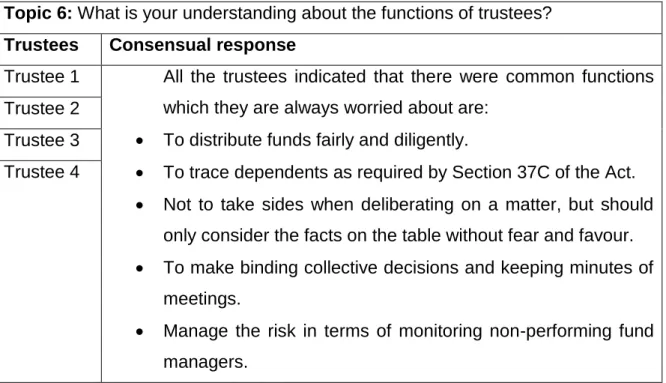
2.11. Trustees Duties ... 28
2.11.1 The duty of care ... 28
2.11.2 The duty of loyalty ... 28
2.11.3 Giving beneficiaries a voice ... 28
2.11.4 Duty to inform and educate beneficiaries ... 29
2.11.5 Duty to consult with beneficiaries ... 29
2.11.6 Duty to trace dependents ... 29
2.12. Point of interaction between dependents and trustees ... 32
2.13. Trustees obligations in terms of Section 37C ... 33
2.14. Roles and Responsibilities of Trustees ... 36
2.15. Trustees’ duty to invest funds ... 38
2.16. Summary ... 43
CHAPTER THREE ... 45
RESEARCH METHODOLOGY ... 45
3.1 Introduction ... 45
3.2 Objectives ... 45
3.3 Research methodology ... 46
3.4 Population ... 48
3.5 Sampling ... 49
3.6 Sample size ... 52
3.7 Data Collection in Descriptive study ... 52
3.8 Questionnaires as a Research Instrument ... 55
3.9 Questionnaire Pre-testing ... 56
3.10 Trustworthiness of the questionnaire... 56
3.11 Research validity and reliability ... 57
3.12 Ethical considerations ... 58
3.13 Administration of Questionnaire ... 59
3.14 Data Analysis and Interpretation ... 59
3.15 Data Reduction ... 60
3.16 Summary ... 60
CHAPTER FOUR ... 61
vi
PRESENTATION OF FINDINGS AND ANALYSIS ... 61
4.1 Introduction ... 61
4.2 Phase 1: Case study review ... 61
4.2.1 Relevance of Pension Funds Act No. 24 of 1956 to this study ... 61
4.2.2 Case 1: TC Khadi Versus Univen Provident Fund & Sanlam Insurance Fund 63 4.2.3 Case 2: GJ Radebe of Thokoza versus Metal Industries Provident Fund.64 4.3. Phase 2: Interviews with widows ... 65
4.3.1 Responses to questions by widows ... 66
4.4 Phase 3: interviews with ex-members of funds... 80
4.4.1 Responses by former members of pension funds ... 80
4.5 Phase 4: Focus group discussion with funds trustees ... 91
4.5.1 Consensual responses to topics by trustees ... 91
4.6 Phase 5: Interview with official (Office of the Pension Funds Adjudicator) ... 114
4.6.1 Responses from the official: OPFA ... 114
4.7 Summary ... 123
CHAPTER FIVE ... 126
CONCLUSION AND RECOMMENDATIONS ... 126
5.1 Introduction ... 126
5.2 Summary of study objectives ... 126
5.3 Conclusions drawn ... 126
5.4 Recommended solutions ... 131
5.5 Limitations to the study ... 133
5.6 Recommendations for further research ... 134
5.7 Summary ... 135
BIBLIOGRAPHY ... 136
Appendices... 144
1. Ethical Clearance ... 144
vii
LIST OF ACCRONYMS
COSATU: Congress of South African Trade Unions.
CCPPWAWU: Chemical, Energy, Paper, Printing, Wood and Allied Workers Union.
CWIU: Chemical Workers Industrial Union.
FEDUSA: Federation of Unions of South Africa.
FSB: Financial Services Board.
GEPF: Government Employees Pension Fund.
MWASA: Media Workers Association of South Africa.
NUM: National Union of South Africa.
NUMSA: National Union of Metal Workers of South Africa.
OPFA: Office of the Pension Funds Adjudicator.
PFA: Pension Funds Adjudicator.
RDP: Reconstruction and Development Programme.
SAMANCOR: South African Manganese Corporation.
SAPA: South African Press Association.
SAQA: South African Qualifications Authority.
UNIVEN: University of Venda
viii
LIST OF TABLES
Number Description Page
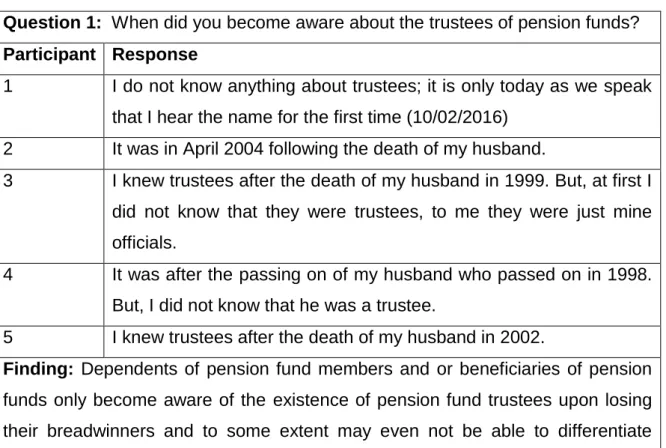
Table 4.1 Responses of widows to question 1 67 Table 4.2 Responses of widows to question 2 68
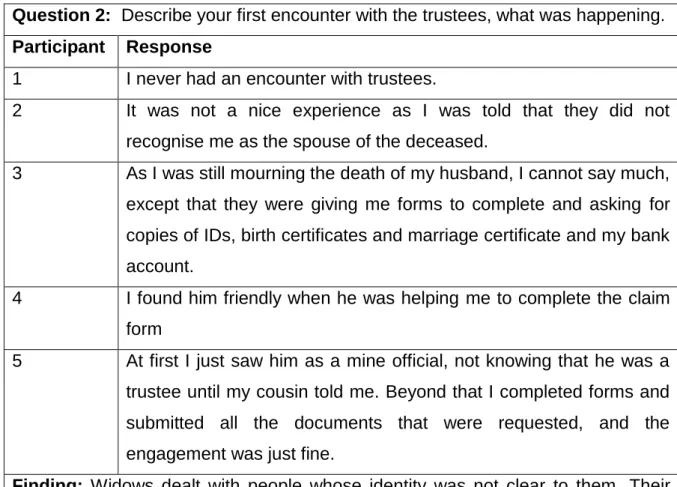
Table 4.3 Responses of widows to question 3 69
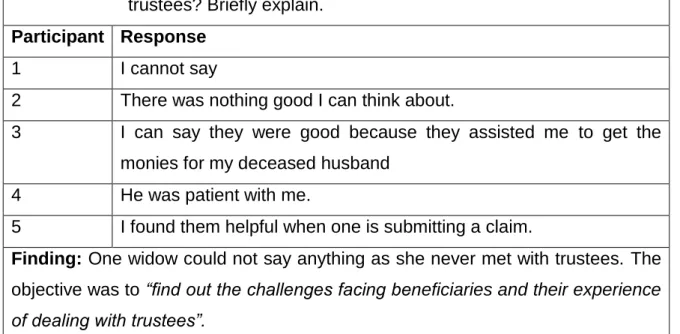
Table 4.4 Responses of widows to question 4 71
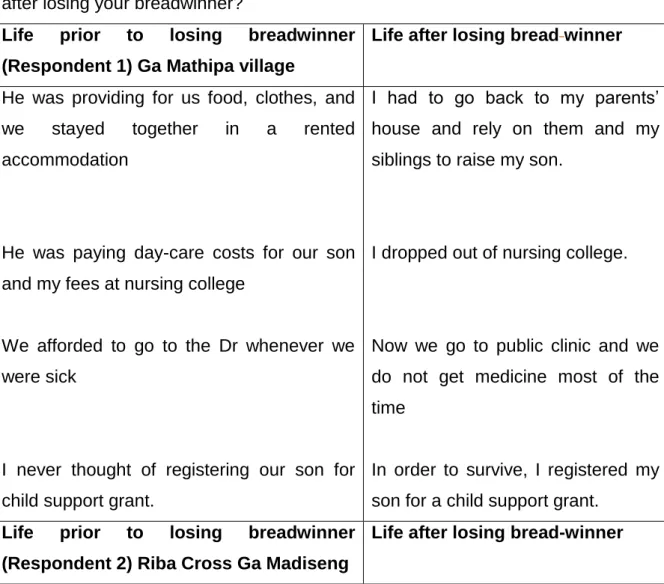
Table 4.5 Responses of widows to question 5 73
Table 4.6 Responses of widows to question 6 74
Table 4.7 Responses of widows to question 7 78 Table 4.8 Responses of widows to question 8 80
Table 4.9 Responses of widows to question 9 81
Table 4.10 Responses of retired members to question 1 82 Table 4.11 Responses of retired members to question 2 83
Table 4.12 Responses of retired members to question 3 84
Table 4.13 Responses of retired members to question 4 85
Table 4.14 Responses of retired members to question 5 86 Table 4.15 Responses of retired members to question 6 88
Table 4.16 Responses of retired members to question 7 89
ix
Table 4.17 Responses of retired members to question 8 90
Table 4.18 Responses of pension funds trustees to question 1 92 Table 4.19 Responses of pension funds trustees to question 2 93
Table 4.20 Responses of pension funds trustees to question 3 95 Table 4.21 Responses of pension funds trustees to question 4 95
Table 4.22 Responses of pension funds trustees to question 5 97
Table 4.23 Responses of pension funds trustees to question 6 98
Table 4.24 Responses of pension funds trustees to question 7 99 Table 4.25 Responses of pension funds trustees to question 8 100
Table 4.26 Responses of pension funds trustees to question 9 102
Table 4.27 Responses of pension funds trustees to question 10 103
Table 4.28 Responses of pension funds trustees to question 11 104
Table 4.29 Responses of pension funds trustees to question 12 105
Table 4.30 Responses of pension funds trustees to question 13 107
Table 4.31 Responses of pension funds trustees to question 14 110 Table 4.32 Responses of pension funds trustees to question 15 111
Table 4.33 Responses of pension funds trustees to question 16 112
x
Table 4.34 Responses of pension funds trustees to question 17 113
Table 4.35 Response of pension funds adjudicator to question1 116 Table 4.36 Response of pension funds adjudicator to question 2 117 Table 4.37 Response of pension funds adjudicator to question 3 118
Table 4.38 Response of pension funds adjudicator to question 4 119 Table 4.39 Response of pension funds adjudicator to question 5 120
Table 4.40 Response of pension funds adjudicator to question 6 121
Table 4.41 Response of pension funds adjudicator to question 7 122 Table 4.42 Response of pension funds adjudicator to question 8 123
Table 4.43 Summary of findings versus objective 125
1
CHAPTER 1
OVERVIEW OF THE STUDY
1.1 Introduction
Historically in South Africa, pension was for the sole benefit of the white employees. With slow political reforms black employees also became beneficiaries of pension funds. It was not until the early 80s that with the involvement of trade unions in South Africa that represented mainly black workers in the administration of pension funds, that the retirement industry became a contested business with numerous stakeholders. The retirement industry is regulated by Pension Funds Act No. 24 of 1956 and by oversight institutions like the Office of the Pension Funds Adjudicator (OPFA) and Financial Services Board (FSB).
Literature and research on the nature of contestation of the pensions, in particular the decisions of the trustees, has been on-going as has identifying the sources of the contestation and making recommendations for resolving the contestation.
However, much has not been done to find out the impact of the decisions of the pension fund trustees on the socio-economic welfare of beneficiaries in South Africa, especially when distributing death benefits as prescribed by Section 37C of the Pension Funds Act 24 of 1956, and the investment decisions or choices of trustees which has the potential to shape the socio-economic welfare of beneficiaries. This study was aimed at determining the impact of the decisions of the pension funds trustees on the socio-economic welfare of beneficiaries.
1.2 Motivation for the Study
The need for this research arose from the fact that there are disputes most of the time after the trustees of pension funds have discharged or are in the process of discharging their duty of distributing the pension benefits or death benefits to beneficiaries. Furthermore, it appears that the disputes are informed by the concerns of the beneficiaries, whose socio-economic welfare could be changing for good or bad going forward with life without their breadwinners.
2
Literature and newspaper articles point to poor decision making by trustees when tracing and identifying dependents in line with the requirements set by section 37C of the Act, examples being Maphanga Mampoto Emily vs. Anglo Platinum Group Provident Fund, Case number PFA/MP/1425/2004 and Komana Napogadi Mirriam vs. Samancor Group Provident Fund, Case number PFA/MP/4828/2005/LM/th.
Both matters emanated from poor decision making by trustees, when executing section 37C responsibilities. Literature also pointed to lost pension money that emanated from poor investment decision making by trustees on behalf one beneficiaries. Examples are the Mine Workers Provident Fund’s investment with Fidentia Asset Management (Pty) Ltd in association with Living Hands Umbrella Trust (FSB Bulletin 2008:14). In addition, Hunter (2013: 9) stated that a fund must have an investment policy statement, which must be reviewed at least annually.
Evidence exists that indicates cases whereby some members challenged the decisions of the fund administrators through the OPFA, and won the case and received their benefits. For instance, in the complaint of Maphanga Mampoto Emily vs. Anglo Platinum Group Provident Fund, Case number PFA/MP/1425/2004 the contested issue was the distribution of the death benefit.
At the time the fund member joined the Provident fund, he was single, and as such nominated two children of his sisters as the beneficiaries and their mothers. They were still learners then and not yet working.
In the complaint of Komana Napogadi Mirriam vs. Samancor Group Provident Fund, Case number PFA/MP/4828/2005/LM/th: the trustees refused to recognise the complainant as the second wife and dependant of the deceased. In addition, the trustees did not allocate any financial benefit to the children the deceased had with the complainant
During a presentation to Pension Funds Lawyers at Misty Hills, Johannesburg on 05 March 2013, Nevondwe indicated that trustees are confronted with many difficult decisions on a regular basis and are required to have knowledge and understanding of the legal framework in which they operate as well as the rights of the members under that particular legal framework. This was one the reasons the
3
researcher needed find out more about the impact of such difficult decisions on the socio-economic welfare of beneficiaries.
It further appeared that some of the legitimate beneficiaries were not or may not be benefiting due to, among other things, the failure of the board of trustees to execute their mandatory duties for some reasons known to the trustees. The Sowetan article titled” Widow in pension dispute with nyatsi” by Thuli Zungu dated 26 January 2015, p17 reported on a widow who was in a pension dispute with a nyatsi (concubine, Northern Sotho).
The girlfriend was contesting to be the sole beneficiary of death benefits. It further emerged that prior to the death of the fund member, the “nyatsi” had fraudulently nominated herself as the sole beneficiary to receive all death benefits in the event of the fund member’s death. The “nyatsi” was dismissive of the claims that she fraudulently nominated herself as the sole beneficiary, arguing that she followed the deceased member’s instructions when completing the form nominating herself as the sole beneficiary.
Research has indicated that in recent years there has been a marked increase in the number of cases referred to the PFA for determination, which have emanated from the application of section 37C, which regulates the distribution of death benefits to the identified dependants or nominees of a deceased pension fund member (David, 2012:5). The findings of this study may be used for policy and processes review by various pension funds trustees and other statutory bodies entrusted with overseeing the administration of pension funds for the benefit of fund members and their beneficiaries.
1.3 Context of the study
As an indication that decisions of trustees have the potential of having a negative impact on the socio-economic welfare of pension funds beneficiaries, a study was conducted in Accra, Ghana. Kutsoai and Morck (2012) when there was a need understand the living conditions of surviving widows and orphans prior to and after the death of their husbands or breadwinners. In order to clearly understand the
4
impact of the decisions of trustees on the socio-economic welfare of beneficiaries, there is need to conduct the research on the impact of the decisions of the pension funds trustees on the socio-economic welfare of beneficiaries. The likelihood is that a similar situation may exist at the Greater Tubatse Municipal area given that there were two complaints that were referred to the OPFA for adjudication (Maphanga Mampoto Emily versus Anglo Group Provident Fund and Komana Napogadi Mirriam versus Samancor Group Provident Fund).
Pensions are said to be positively linked to elderly pensioners’ health. Lloyd- Sherlock and Agrawal (2014:1571) state that by meeting older people’s economic needs, pensions are an effective means which seek to enhance other aspects of their well-being, including their health status. Lloyd-Sherlock and Agrawal (2014:1572) further stated that a number of studies have been conducted in South Africa in the Langeberg Health District in the Western Cape, and they indicate that pensions can have a significant effect on older people’s health status, suggesting that wrong investment decisions are likely to cause health problems to the elderly.
Whilst acknowledging the rights of beneficiaries, Chowdhury (2014:389) indicated that trustees are under no obligation to give reasons to the beneficiaries or explain to them why they have taken a particular decision. It is probably against this background that trustees in South Africa, may be of the view that they do not owe any explanation to the beneficiaries on how a certain decision had been arrived at regarding payment or non-payment of death benefits due for distribution. However, the trustees at the end find themselves having to explain their decisions to the beneficiaries through the OPFA.
Waitzer & Sarro (2013:32) acknowledged that in a fiduciary relationship, ultimate decision-making authority must rest with the fiduciary alone, Waitzer & Sarro (2013:32) further stated that this does not mean that a fiduciary cannot consult with beneficiaries as part of its decision-making process, and therefore, called for a statutory “duty to consult” plan of members before trustees take actions that affect members’ interests.
5
However, Chowdhury (2015:387) indicated that section 1 of the Trustee Act 1925 restricts trustees’ powers of investment to safe investments. However, the Trustee Investment Act of 1961 extended the trustees’ power of investment in shares, but still the investment power was restricted, in order to protect the beneficiaries from the trustee losing the trust fund in risky investment. In the South African context, one such example of investments that nearly went wrong was the partial collapse of African Bank, in which the Public Investment Corporation, which is the investment wing of the Government Employees Pension Fund (GEPF), invested the monies of government employees.
Nevondwe & Odeku (2014:773) concluded as follows: “Section 37C expects the board to exercise its discretion in a manner which would result in an equitable distribution of the death benefit notwithstanding that it does not provide any guidelines as to how this is to be achieved”. Therefore, it is probably because of this absence of guidelines that certain decisions of trustees are vulnerable to challenges by aggrieved beneficiaries through the OPFA. The nature of many complaints lodged showed an increasing tendency amongst many South Africans living under cohabitation situations and the so-called “vat and sit” relationship.
According to Marumoagae (2012:5) section 7D(c) of the Pension Funds Act, 24 of 1956, indicated that the duties of a board is to provide sufficient and reliable information to members of the fund informing them about their rights, benefits and duties in terms of the rules of the fund. Through this research, it will be clear whether road shows and awareness campaigns are being conducted by the boards.
Nevondwe further states that member rights have been explicitly outlined in the various sections of the Pension Funds Act, 24 of 1956, whereby the Act places a duty on the trustees to inform members of their rights, benefits and duties in terms of the rules of the fund, and that the core of the members’ rights lies with the governance of the fund. While the trustee may have legal title to the trust fund, real entitlements rest with the beneficiaries, and that trustees have a duty to act even- handedly towards the different classes of beneficiary. It is the duty of the trustees
6
to provide information to the beneficiary, and it is also the right of the beneficiary to see the trust document.
As much as Chowdhury (2015:389) states that trustees are under no obligation to explain themselves to the beneficiaries regarding what informed the decisions they have taken. To some extent, it is for the same reason that boards of trustees find their decisions being challenged by beneficiaries through intervention by the OPFA or the FSB; hence, the need to embark on this research to explore and understand the implications of the decisions of the trustees on the socio-economic welfare of beneficiaries. The number of complaints against the decisions of trustees may be an indication that decisions of trustees bring undesirable consequences to the beneficiaries.
Mhango (2014:105) stated that the OPFA has created a forum allowing unrepresented litigants to challenge decisions of the pension fund organisations and employers who participate in them, which they otherwise could not pursue in ordinary courts due to the high cost of legal services in South Africa. In the United States of America, the oversight structure that monitors the performance of pension funds or retirement funds trustees is called The Employee Retirement Income Security Act (Diaz, 2014:2).
According to Nevondwe & Odeku (2013:818) the OPFA is a specialist tribunal that aspires to be a respected institution which makes binding and final determinations in pension fund complaints submitted to it in terms of the Act. It is further stated that OPFA resolves complaints in terms of the Act in order to uphold the integrity of the pension fund industry and to protect the interests of the pension fund members (Nevondwe & Odeku: 2013:818). The OPFA Annual Report (2013/14:6) indicates that the office received 5405 new complaints, which represents an increase of 4.7% on the previous period, and 6643 complaints were finalised, representing a decrease of 22.3% on the previous period.
The Sowetan article titled “Laziness at pension’s agency blamed for payment delays” by Thuli Zungu dated 04 March 2015, p19 reported a situation in which a retired Limpopo advocate accused the Government Pension Administration
7
Agency of failing to process her pension pay-out since she had left the public service in March 2014. The same Sowetan also reported on p19 about a Giyani based widow and her two children who had been living in abject poverty for the past 14 years, yet they had almost R500 000.00 sitting in government coffers in the GEPF.
This research seeks to find out how situations like this impact on the socio- economic welfare of the beneficiaries concerned.
The OPFA Annual Report (2013/2014:12) points to another contested allocation of death benefits by the board of trustees, whereby at the end of considering all the facts presented by the complainant and the respondent, the PFA ordered the allocation of the death benefit by the board of the first respondent to be set aside.
Again, the OPFA ruled that death benefit allocations be set aside in two separate matters that came before it and ordered that thorough investigations be carried out into the circumstances of all potential beneficiaries (OPFA Annual Report 2013/2014:17)
When the member’s personal circumstances changed, he did not update his nomination form of beneficiaries. Later his sisters got jobs and had working husbands who supported them and their children. Following the fund member’s death, the trustees allocated financial benefits to the children of his sisters.
The complainant, wife of the deceased challenged this decision as she felt that the trustees had failed to investigate that the personal circumstances of the sisters of the deceased had changed, and as a result their children were no longer dependent on her late husband, and that such a decision was disadvantaging her children financially compared to the children of the deceased’s sisters who have both parents working and providing for them, compared to her children who lost their breadwinner. Also that she was not employed compared to the sisters of the deceased who had jobs. The complainant further argued that the children of the deceased’ s sisters stood a chance to benefit three times more than her children, as they would also benefit from the pension funds of their biological parents.
8
The PFA ruled in favour of the complainant on the basis that the trustees had failed to investigate and could not prove that the children of the deceased’s sisters were no longer dependent on the deceased prior to his death. The allocations to the sisters’ children were redistributed to the children of the deceased.
The fund member had a wife with whom he was married in civil marriage, and was also married to the complainant through customary marriage. Documentary proof from the local traditional authority and from both families existed to acknowledge the marital relations between the deceased and the complainant.
When allocating the benefits, the trustees failed to investigate and trace all the legitimate beneficiaries. Further, the trustees refused to acknowledge the deceased’s customary marriage and his children with the complainant. The complainant argued that the trustees did not have the jurisdiction to question and adjudicate on the status of her marriage, as this is the competence of the Department of Home Affairs. In addition, she argued that in refusing to acknowledge her and her children as the beneficiaries of the deceased, the trustees were violating a statutory prescript that governs the distribution of pension death benefits. In addition to that the deceased at the time of his death was staying in the same household with the complainant and her children.
The above complaints as referred to the OPFA suggest the existence of either flaws, lack of rationality in decision making or negligence by trustees when discharging their duties. Furthermore, these complaints may suggest that beneficiaries of death benefits as defined by the Pension Funds Act, Section 37c, are not benefiting from their breadwinners’ pension benefits, which are meant for distribution by Boards of Trustees.
In another complaint as indicated on the OPFA Annual Report (2013/2014:25), one pension board was slammed by the PFA for ignoring registered rules when computing a withdrawal benefit. The board of the Municipal Employees Pension Fund used an amended rule yet to be approved, instead of abiding by an existing approved rule. Furthermore, it appeared that the OPFA was the saviour of many
9
beneficiaries, because it offers free service to the beneficiaries, which enables the beneficiaries to test some of the decisions of trustees.
Although evidence exists as seen in New Age (Free State) article by Tshimologo Leeuw titled “PFA concludes ‘successful’ road show”, 19 February 2015, p3 indicated that the OPFA conducted a successful road show in Bloemfontein, it is yet to be known what the geographical coverage of such “Road Shows” and the extent to which beneficiaries were aware of the existence and the kind of assistance that can be sourced from the OPFA.
Nevondwe (2013:7) stated that boards of trustees have an obligation of making sure that relevant and sufficient information is being communicated to the members of the fund informing them about their rights, benefits and duties in terms of the rules of the fund. Another obligation the trustees have is to ensure that employers are paying contributions to funds on time.
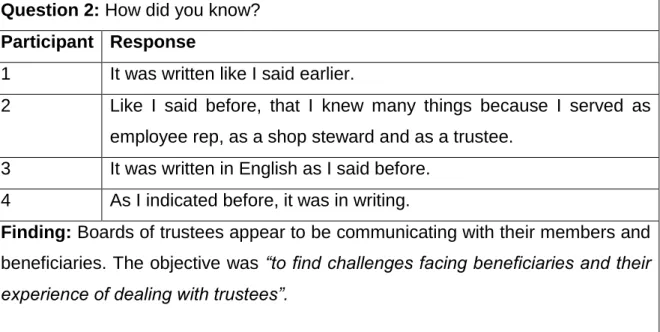
However, according to Lamola (2014:1), 60% of the complaints coming to the OPFA come from private security companies, which is an indication that trustees in the Private Security Regulatory Authority are failing to discharge the duty of taking all the necessary steps to ensure that employers in the Private Security Industry pay contributions on time without failure to the fund in favour of their employees. Lamola (2014) further indicates that members of security companies discover on their own that they are not properly covered. This is another indication that trustees in the private security industry are not communicating with their members.
1.4 Study Focus
The study focused on the challenges and experiences of pension fund beneficiaries, in particular widows and former members living within the Greater Tubatse municipal area emanating from their interaction with trustees of pension funds operating in the Greater Tubatse municipal area. Secondly, to hear the side of the pension fund trustees about their experiences and challenges when interacting with beneficiaries, and the nature of the environment in which they
10
operate. Thirdly, to find out from the OPFA how accessible the office is to people living in Greater Tubatse Municipal area, and which is considered to be the weakness of trustees when executing duties related to section 37C of the Act.
Finally, the study focused on the most the most common complaints reported at the OPFA.
1.5 Problem Statement
The number of complaints, past and present referred to the OPFA , as reflected in the OPFA’s Annual Report 2013/14 by beneficiaries for intervention against the decisions of the trustees, and other complaints alluded to in the print media (newspapers), point to the existence of decision-making problems by trustees when discharging their duties to the disadvantage of beneficiaries.
Furthermore, it appeared that some of the beneficiaries only became aware of the existence of trustees after the passing of their breadwinner, which is an indication of the likelihood that these beneficiaries may as well not be aware of the role and responsibilities of trustees.In the end, it is these same trustees who determine the financial benefits of the beneficiaries due to loss of a breadwinner, and invest monies on behalf on beneficiaries.
1.6 Study Objectives
For the purpose of addressing the research question the following study objectives have been set:
To determine the impact of the decision-making by trustees on the socio- economic welfare of beneficiaries who have to rely on pension pay-outs or death benefits.
To find out the challenges facing beneficiaries and their experience of dealing with trustees: in other words, surviving spouses and retired members.
To find out the nature of changes in lifestyle of widows before versus after losing their breadwinners.
11
To find out the most common complaints received by the OPFA and how the OPFA interacts with society at large.
The formulation of the research question and objectives was informed by the nature of complaints referred to the OPFA by beneficiaries and possible beneficiaries to the OPFA for review, and the continuous review and monitoring of the investment activities of retirement funds in South Africa by the FSB.
1.7 Research questions
What is the impact of the trustees’ decisions on the socio-economic welfare of pension funds’ beneficiaries in the Greater Tubatse Municipal area?
How aware are beneficiaries of pension funds of the duties of trustees?
Where do the beneficiaries of funds seek help in the event of a dispute with trustees?
What are the challenges facing beneficiaries of pension funds?
1.8 Study Limitations
The main limitation to this study was the time frame in which the study was conducted. The researcher had eighteen months to conclude the study. The cut- off time to complete this project was eighteen months. The limitations were as follows:
The target population of the focus group was supposed to be fully conversant in matters related to the distribution of pension death benefits and the investment affairs in retirement funds. To mitigate this challenge the researcher removed topics related to trustees’ duty to invest funds on behalf of beneficiaries. However, the researcher did ask the focus group for an opinion on some of the failed pension fund investments. There was a consensual response which was recorded in topic 17.
The literature review needed to be enriched with information contained in the FSB report on an investment flop of retirement funds by COSATU’s investment arm, Kopano Ke Maatla. The researcher made a formal request
12
to access the report from the FSB without success. The intention was to do a comparable study with the failed Mine Workers’ Provident Fund to draw similarities and differences that would have assisted the researcher to determine the weaknesses of trustees if any. To mitigate the risk the researcher did not speculate on what could have gone wrong on the side of trustees.
These constraints did not have any adverse impact on the conclusion of this study.
1.9 Structure of the Study
The study was planned in such a way that it provides a logical flow to the research process undertaken. The study is structured in five chapters mentioned below:
Chapter One: Provides the introduction to the research problem, the study motivation, the study focus and the research question and sub-questions which prompted the study. Study objectives and constraints are also highlighted.
Chapter Two: Focuses on the emerging issues from the literature review, derived mainly from South African and international literature on pension fund matters affecting fund beneficiaries. The main literature focused on the history of pension in South Africa, pension fund stakeholders, definition of fund dependents, retirement funds’ regulations, appointment and qualifying criteria for trustees, trade unions’ involvement challenges and the fiduciary duties of the trustees. The implications were discussed in the South African context.
Chapter Three: Addresses the various research methods utilised in this study together with the logic behind why those methods have been chosen.
Chapter Four: Deals with the presentation of the research findings, their interpretation and discussion. The chapter has been divided into five phases.
Phase one covers the brief overview of Section 37C of the Pension Funds Act, 24 of 1956 and two case studies pertaining to contested decisions of trustees with regard to the allocation of death benefits. Phase two provides responses to
13
questions by surviving spouses. Phase three provides responses to questions by retired members. Phase four provides consensual responses to topics by trustees, and phase five responses to questions by officials of the OPFA. The findings of this study were discussed with specific reference to the relevant emerging issues from the literature review and the applicable study objectives.
Chapter Five: The final chapter of this study deals with the conclusions and recommendations drawn from the findings in Chapter Four. The chapter provides suggestions for further research on the problem facing beneficiaries and its impact on their socio-economic welfare.
1.10 Summary
This chapter introduced the research on challenges facing pension fund beneficiaries or dependents when trustees are discharging their Section 37C responsibility of the Pension Funds Act, 24 of 1956, and how investment decisions of funds trustees affect the future financial income of minor dependents by focusing on relevant case studies. The chapter also outlined the nature of the research together with the direction that was followed in this research. The problem statement was formulated together with the sub-problems, the study objectives, as well as the research questions and constraints to this study. The next chapter covers issues emerging from the literature review.
14
CHAPTER 2
PENSION FUND IN THE LITERATURE
2.1 Introduction
The composition and administration of retirement funds in South Africa and abroad resulted in the formation of a contested relationship between employers and organised labour on how best to manage and administer these retirement funds for the benefit of workers after retirement, and their beneficiaries in the event of the worker’s death. In South Africa this relationship is regulated by Pension Funds Act, 24 of 1956 and FSB directives and regulations. Whereas, the OPFA plays an oversight role in situations whereby beneficiaries are not satisfied with the manner in which the board of trustees has distributed the death benefits to dependents, whether legal or factual dependents. The duties of trustees are not limited to distribution of death benefits; one critical task is to seek investment opportunities for the fund. The two duties of trustees are the core to this study, because the aim of the study was to find out the impact of the decisions of pension fund trustees on socio-economic welfare of beneficiaries.
2.2 Definition of key concepts
2.2.1 Beneficiary can be defined as a person receives money or property from someone else who has died (Mayor et al, 2009 142).
2.2.2 Pension fund can be defined as any association of persons established with the objective of providing annuities or lump sum payments for members or former members of such associations upon reaching their retirement dates or for the dependents of such members or former members upon the death of such members or former members (George and Joubert 2007:309).
2.2.3 Trade union can be defined as any organisation whose membership consists of employees, seeks to organise and represent their interests in the
15
workplace and seeks to regulate the employment relationship through the direct process of collective bargaining with management (Daud and Tumin: 2013:125).
2.2.4 According to FSB document titled “Role of Trustees” p7 trustee can be defined as a member of at least four individuals which holds or manages and invests assets for the benefit of retirement fund members.
2.3 Historical background of pension
The earliest record of pension provision in South Africa dates back to 1837 when pensions were paid by the British government of the time to some of their military staff (George & Joubert, 2007:309). It is further stated that pension funds perform an important role within the economy, in the sense that they enable their members to make provision for old age and provide large sums of money for investment in various asset classes (George & Joubert, 2007:307).
George and Joubert (2007:308) identify the three pillars of a retirement funding system: the first being public benefit programme funded from the general government revenue and aimed at redistribution; second is mandatory savings, like company sponsored retirement funds, with voluntary savings as the third.
However, for the purpose of this study the focus shall be limited to the second pillar, being the mandatory savings or company sponsored retirement funds.
2.4 Retirement fund stakeholders
George and Joubert (2007:307) identify the following as stakeholders in the pension fund industry:
Existing members or former members;
Dependents of former members;
Trustees;
Trade unions;
Government;
Financial Services Board; and
Pension Funds Adjudicator.
16
For the purposes of this study the focus was on existing members, former members, trustees and Pension Funds Adjudicator. According to Elias, Cavana and Jackson (2000:175) a stakeholder is an individual who can affect or is affected by the achievement of the organisational goals. The interests of these identified stakeholders are described below.
2.4.1. Members or former members as stakeholders
In the context of this study, members of a pension fund are those contributing financially to the fund, by virtue of being employees of a particular employer who is also subscribing to the retirement fund in favour of his or her employees, whereas former members are those who exited the retirement fund through retirement or death. It is common sense that most employees are working and affiliated to retirement funds for the purpose of saving money, which act will sustain their socio-economic welfare and that of their dependents when they cannot work anymore.
This expectation in turn informs what their expectations will be in terms of their association with their retirement fund. The expectations of these members are also supported by the Pension Funds Act, 24 0f 1956, which places a duty on the trustees to keep members of a fund informed all the time (Nevondwe, 2013:3).
2.4.2. Dependents of former members as stakeholders
Mhango (2010:186) stated that a dependent relative to fund members refers to:
(a) a person in respect of whom the member is legally liable for maintenance.
(b) a person in respect of whom a member is not legally liable for maintenance, if such person:
o “was, in the opinion of the Board, upon the death of the member in fact dependent on the member for maintenance;
o is the spouse of the member;
17
o is a child of the member, including a posthumous child, an adopted child and an illegitimate child;
o a person in respect of whom the member would have become legally liable for maintenance, had the member not died”.
Mhango (2008) 20 SA Merc LJ 126-135 indicated that the governing legislation of pension schemes created three categories of dependents: with legal dependents as the first, factual dependents as the second and a future dependent as the third.
Legal dependents refer to a person whom the member of the retirement fund is legally liable to maintain due to legal obligation. These dependents may be inclusive of spouse and children who rely on the member for maintenance;
however, according to Nevondwe (2010:40) the onus rests on the person to produce evidence that the deceased had a legal obligation to maintain him / her.
Nevondwe (2010:41) stated that factual dependents refer to any person who was not legally dependent on the deceased for maintenance. But, such a person may still be a dependent if the deceased in some way contributed to the maintenance of that person. Section 1 (b) (ii) addresses the issue of the spouses in respect of whom there exists no statutory law in terms of which the marriage or union is recognised (Nevondwe, 2010:41). An example of such spouses refers to those married in customary marriages.
Future dependents refer to those individuals whom the deceased member of a fund had no legal obligation to maintain at the time of his / her death, but such a person can prove that the deceased would have become liable to maintain had he not died. Therefore, such a person may qualify as a dependent (Nevondwe, 2010:41).
Lastly, this category also includes spouses in a cohabitation situation; Nevondwe (2010:41) cohabitation is found in situations whereby two persons who are not married stay together as spouses.
18 2.4.3. Trustees as stakeholders
According to Marumoagae (2012:556) the board of trustees refers to the body that manages and controls the fund, which operates independently of the employer, members and all other stakeholders. Furthermore, the board should carry out its duties as required by the rules of the fund and the Act (Marumoagae, 2012:556).
As pointed out by Makhubela (2015:1) management and governance of funds rely mainly on the system of trustees.
It is further stated by Marumoagae (2012:556) that the board should not be established to rubber stamp the wishes of either the employer contributing to the fund or the members of the fund, but, the board should be in a position to manage the affairs of the fund in a manner that advances the interests of the fund. This can be said to be true in the sense that in some instances, the wishes of members of the fund are contrary to requirements set by the Act, in particular Section 37C, which relates to the distribution of death benefits in the event of a death of the member of the fund.
Whilst acknowledging the rights of the beneficiaries; Chowdhury (2014:389) supported the notion of trustees being under no obligation to give reasons to the beneficiaries for having taken a certain decision. It is probably against this background that trustees in South Africa, may be of the view that they do not owe any explanation to the beneficiaries on how a certain decision had been arrived at regarding payment or non-payment of death benefits due for distribution. However, the trustees in the end find themselves having to explain their decisions to the beneficiaries through the Office of the Pension Funds Adjudicator.
Whilst acknowledging that in a fiduciary relationship, the ultimate decision-making authority should rest with the trustees alone, Waiter and Sarro (2013:32) stated that it does not mean that a fiduciary cannot consult with beneficiaries as part of its decision-making process, and for that reason, makes an appeal to legislate “duty to consult” fund members before trustees take actions that affect members’
interests.
19 2.4.4. Trade Unions as stakeholders
Webster indicated during a presentation on slide 4, topic: “Trade Unions and Retirement Funds” under the theme “Pension Power” on day 1 of the 20th Annual Pension Lawyers Conference in Johannesburg on 02 March 2015 that the interest of trade unions in retirement funds in South Africa can be traced back to 1983 when MAWU (forerunner of National Union of Metal Workers of South Africa, NUMSA) won the right to sit on the Pension Fund, and in 1987 Chemical Workers Industrial Union (CWIU) won the right to co-manage the Chemical Industries Pension Fund. Webster mentioned at the Pension Lawyers Conference, which was held in Johannesburg on 02 March 2015 that the idea grew that union trustees should influence funds to invest in socially responsible ways, like housing for their members.
This approach by unions for retirement funds to invest in housing development indicates that the welfare of members after retirement and the welfare of their beneficiaries are very important because housing is a basic social need; hence even the South African government is providing free housing in the form of what is today known as RDP houses (Reconstruction and Development).
2.4.5. Government as stakeholder
According to National Treasury discussion paper “Retirement Fund Reform”
(2004:4) government seeks the following:
To ensure that retirement funding arrangements are cost-effective, prudently managed, transparent and fair
Improve standards of fund governance, including trustee knowledge and conduct, protection of member’s interest, accountability, and disclosure of material information to members and contributors
Encourage individuals to provide adequately for their own retirement and the needs of their dependents.
Encourage employers and employees to provide for retirement funding as part of the remuneration contract.
20
The ultimate goal is to ensure that other role players in the retirement industry do not behave as they please and ignore the interests of those that they are meant to serve. The government is quite aware that should something go wrong in the pension fund industry, the burden to provide social grants will increase on its part.
2.4.6. Financial Services Board as stakeholder
The Financial Services Board’s mandate is to promote and maintain a sound financial investment environment in South Africa (FSB Annual Report, 2013:7). It is further stated that the task of the FSB is to ensure that regulated entities demonstrate delivery of clearly articulated fairness outcomes to financial services customers through its Treating Customers Fairly (TCF) regulatory and supervisory framework. In addition, the FSB promotes financial education and literacy programmes which are aimed at consumers (FSB Annual Report, 2013:7)
These programmes work with financial services institutions to inform and educate users about different financial products as well as their rights and responsibilities.
It is against this background that the FSB uses among others, periodical Circulars to communicate regarding retirement funds and other role players in the pension funds industry, like Circular PF 130, as supplemented by Annexure B to Circular PF 130 and Circular PF 98. The former gives guidance on good governance guidelines to an investment policy statement.
2.4.7. Pension Funds Adjudicator as stakeholder
Section 30B of the Pension Funds Act, 24 of 1956 confirmed the establishment of the OPFA. Section 30D indicated that the adjudicator’s main object shall be to dispose of complaints lodged in terms of section 30A of this Act in a procedural fair, economical and expeditious manner.
According to Nevondwe and Odeku (2013:818) PFA is “as a specialist tribunal that aspires to be a respected institution, that makes binding and final determinations in pension fund complaints submitted in terms of the Pension Funds Act, and resolves complaints in terms of the Act to uphold the integrity of the pension fund
21
industry and to protect the interests of pension fund members”. The role of the Pension Fund Adjudicator is most visible during the contested matter between the beneficiaries of pension funds and the trustees of pension funds.
The Pension Fund Act, 24 of 1956 states that the principal objective of the PFA “ shall be the disposal of complaints lodged in terms of section 30D of the Act in a procedurally fair, economical and expeditious manner. It further states that the PFA is appointed in terms of Section 37C of the Act. OPFA Annual Report (2013/14:6) makes it clear that the Act prefers that complainants approach their funds with a complaint before approaching the PFA. However, it is deemed undesirable for the PFA to insist on compliance with the section as it would have resulted in unnecessary delays in resolving complaints, thereby, resulting in prejudice to complainants.
Regarding the disposal of complaints, Section 30E of the Pension Funds Act, the Adjudicator shall investigate any complaint and may make the order which any court of law may make. OPFA Annual Report (2013/14:6) further indicated fractious relationships between employers and members of pension funds upon termination of service, with complainants often citing verbal responses received from uncooperative funds and administrators; and consideration for the financial circumstances of most of the complainants that approach the PFA who are often unemployed. Section 30E of the Act further stated that:
“Any complaint dealt with in terms of subsection (1) (b) shall be recorded by the Adjudicator and shall, for purposes of section 30H (3), be deemed to be a receipt of a complaint.
If the complaint, dealt with in terms of subsection (1) (b), is not resolved, the complainant may again lodge the complaint with the Adjudicator, who shall deal with it in terms of subsection (1) (a).
In the event the Adjudicator intends to conduct an investigation into a complaint he or she shall afford the fund or person against whom the allegations are made the opportunity to respond to the allegations. .
22 2.5. Retirement Fund Regulation
In South Africa pension funds are regulated by an Act of Parliament, Pension Funds Act, 24 of 1956. It is through this Act that the Minister of Finance has the executive authority to appoint, the chairperson of the Financial Services Board, which is responsible for overseeing the retirement industry (FSB Annual Report, 2013:7).
The challenges experienced in the retirement fund industry are not unique to South Africa, in the United States of America the Employee Retirement Income Security Act was enacted in 1974 by Congress for the purpose of protecting the interests of fund participants in employees benefit funds and their beneficiaries by providing for appropriate remedies, sanctions, ready access to the Federal Courts and providing state and federal venue for claim adjudication (Diaz, 2014:5).
2.6. Minimum requirements to qualify as Pension Fund Trustee: South African Context
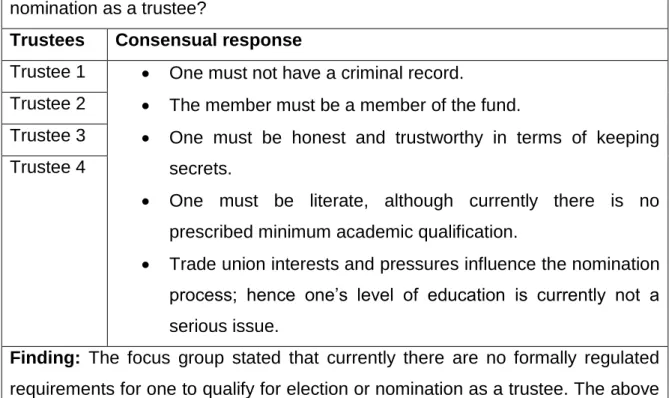
Currently it appears that the pension fund trustees do not have a specific prescribed academic qualification which serves as a minimum requirement for one to be a trustee. Evidence to this is the extract from the National Budget Speech of 2013, by the then Finance Minister, Mr Pravin Gordhan, which says “Governance reforms of retirement funds will also be implemented, with measures in place to ensure trustees of retirement funds are trained once they have been appointed. I intend to call up a conference of all trustees this year to take this process forward”
(National Budget Speech, 2013:19).
It was during the 20th Annual Pension Lawyers Association Conference in Johannesburg on 02 March 2015, where the topic of the day of the day was
“Trade Union and Retirement Funds” when Webster shed some light into how representation in retirement began with the following developments:
23
In 1983, MAWU, forerunner of NUMSA, won the right to sit on the Pension Fund;
1987, CWIU won the right to co-manage the Chemical Industries Pension Fund;
The idea grew that union trustees could influence funds to invest in a socially responsible way; and
Unions also played an important role in putting the idea of “social investment” and corporate citizenship on the retirement fund agenda.
In what appeared to be a challenge , Webster quoted the comment of the then Education Officer of the Federation of South African Trade Unions (FEDUSA), 1981, Alec Erwin as saying “Workers have virtually no information on how much they have contributed, how the money is invested and how interest is calculated”.
It is against this background that trade unions in South Africa are seen to be the front-runners when it comes to the interests and the socio-economic welfare of their members during their working time and post-employment.
In line with Erwin’s view in 1981, Webster further highlighted the following challenges faced by the trustees representing their respective trade unions in the retirement funds:
Trustee training by unions not developed, since training must empower trustees to deal with all challenges - core issues, such as governance, risk and return, which are (NUMSA Resolutions);
Trustees tended to be passive, relying on service providers for expert advice; and
Trustees often see appointment as a perk and are intimidated by asset managers.
2.7. Minimum requirements to qualify as Pension Fund Trustee:
International Practice
Steward and Yermo (2008: 17) indicated that some countries like Australia, Finland, Germany and Poland had prescribed certain specific qualifications and professional expertise that pension fund trustees should possess in order to
24
perform their duties more effectively. Steward and Yermo (2008: 17) further stated that other European countries have introduced general suitability requirements that trustees must satisfy beyond the basic disqualifying conditions, like criminal records or insolvency) that exists in most countries..
Stewart and Yermo (2008: 17) further indicate that the United States of America has introduced disqualifying criteria for certain individuals from serving on the boards of trustees. The disqualifying criteria differ across the countries.
It is against this background that one can indicate that there is a need to have minimum academic requirements for one to qualify as a trustee in South Africa.
There is also a need to have a disqualifying criterion for the trustees. The need for academic qualifications for trustees was emphasised by Hunter during the Pension Lawyers Association Seminar in Sandton on 09 October 2014. Hunter indicated at the conference that the FSB has to this end submitted a proposal to the South African Qualifications Authority (SAQA) for National Trustees Qualifications for possible approval.
Lastly, it appears that the reason for non-existence of a set minimum requirements for trustees in South Africa is the fact that trade unions appears to have more influence on the management of the affairs of retirement funds due to the long history of trade unions not trusting employers with the financial interests of their members.
2.8. Trade Union involvement challenges
Webster stated on slide 7 of his presentation during the Pension Lawyers Association Conference in Johannesburg, 02 March 2015 that around 2007 some unions broke ranks as alternative strategy of union investment companies emerged, like the Mine Workers Investment Company and Hosken Consolidated Investments. This development further indicates how serious pensions are in the lives of employees after retirement.
25
Webster’s argument is further confirmed by the FSB 2nd Quarter Bulletin (2008:15) whereby it is confirmed that the resolution in question by CCPPWAWU sought to impose obligations on trustees elected or appointed by trade unions or its members to manage benefit funds established by the union, and if those trustees did not follow the union mandate, they would be in breach of their duties to the union and would face expulsion from the union and removal from the board of trustees.
However, it is stated that a court found that a trustee has obligation to exercise an independent judgment, regardless of the views of the trade union or employer which appointed him. Therefore, it can be said that a trustees is expected to exercise an independent judgment as to what constitutes the best interest of the fund, its members and beneficiaries. Thus, declaring the CCPPWAWU resolution unlawful (FSB 2nd Quarter Bulletin, 2008:15).
Had the resolution be allowed to stay it was likely to have undesirable results to the dependents of the members, since the dependents are in most cases not members of the trade unions in question, nor employees of the organisations that are participating in the retirement funds which are co-managed by the trade unions.
Webster further indicates that trustees are caught between being elected on the basis of their popularity and their ethical standing, and that NUMSA wants the Act amended to allow union representation on the funds, including union recall and accountability. This NUMSA demand is similar to the resolution of CCPPWAWU, which was nullified by a court of law.
As a cause for concern Webster indicated on slide 10 of her presentation at the Annual Pension Lawyers Conference on 02 March 2015 in Johannesburg that there is R20 billion in unclaimed benefits, many beneficiaries are not adequately informed by employers, unions and fund administrators that their dependents- including children are entitled to death benefits, and lastly, members are not told that even if they are dismissed they are entitled by law to a prescribed minimum benefit.
26
This could be attributed to the fact that to this end there is no specific training intervention which is aimed at equipping trustees with the relevant and necessary skills and knowledge required to function effectively as trustees, and perhaps rationality is lacking in the manner in which trustees deliberate on the issue of unclaimed benefits. Rationally it is supposed to be obvious to trustees that it is their duty to trace and find beneficiaries and dependents, and that someone out there is in need of those unclaimed funds to improve his / her socio-economic welfare.
2.9. Latest Development
To this end, the Financial Services Board shows that there is a proposed SAQA accredited National Trustee Qualification which is aimed at all trustees of pension funds in South Africa (Hunter, 2014: slide 6). This approach is in line with the government’s governance reforms which calls for the training of trustees once they have been appointed within six months from the date of appointment (Hunter, 2014: slide 2).
Hunter (2014: slide 6) states that the need for an academic qualification for trustees is informed by the onerous nature of the duties and responsibilities of trustees.
2.10. Appointment of Pension Fund Trustees
Draft Information Circular of 2015 (p1) reference 12/12/25 provides for the appointment of board members in terms of section 7A of the Pension Funds Act as amended by the Financial Services Laws General Amendment Act, 45 of 2013 which says:
” (1) notwithstanding the rules of a fund, every fund shall have a board consisting of at least four board members, at least 50% of whom the members of the board shall have the right to elect.
(1A) The composition of the board shall at all times comply with the rules of the fund and any vacancy on such board shall be filled within such period as
27
prescribed, which is ninety days from the date on which the position became vacant.”
It is further noted that the registrar of pension funds recognises that sound governance of a fund requires that the members of the board of the fund together must have the appropriate knowledge and skills in regard to matters such as:
That the retirement funding and, if applicable, provides risk cover needs of the members of the fund, taking into account the profiles of its membership as a group and the nature and needs of other stakeholders in the fund by ensuring the following aspects:
o Sound governance and compliance with applicable laws;
o Fair treatment of its members and other stakeholders;
o The appropriate and effective management of its risks;
o Appropriate and effective communication with members and other stakeholders; and
o Policies and strategies that would be appropriate for the fund to adopt in relation to the investment of its assets, and the manner in which those strategies may be implemented effectively.
It is further noted that in order to ensure that a board is not over-dependent on the knowledge and skills of only one or few board members when making decisions in regard to a specific matter, each board member should have not less than the minimum levels of knowledge and skills so that he / she may properly engage in discussions on the matter before the board makes its decisions with regard to all matters of substantial importance to the fund and its members (FSB Draft Information Circular, 2015:3).
FSB Draft Information Circular (2015:4) indicates a significant progress towards the establishment of a new set of knowledge and skills measurement standards by the registrar of pension funds after consulting with representatives in the retirement funds industry.
It should also be noted that in order to assist board members to acquire the appropriate knowledge of the principles of sound fund governance and