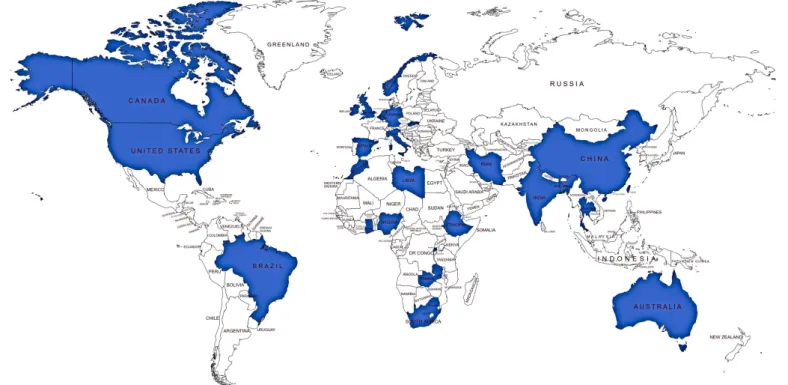
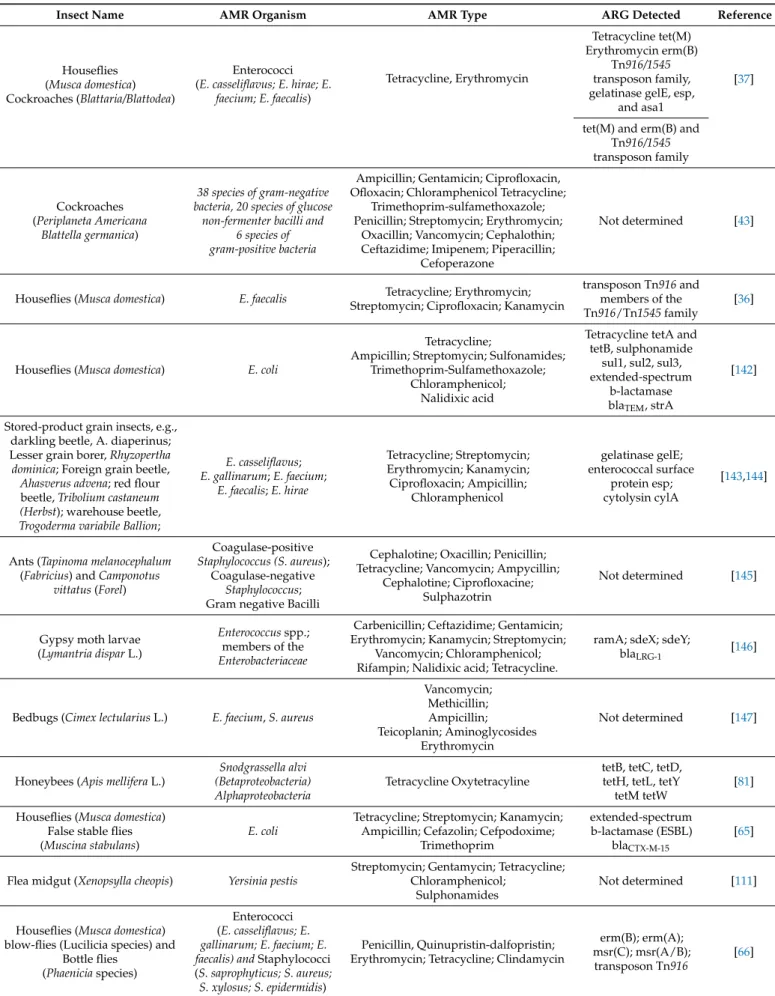
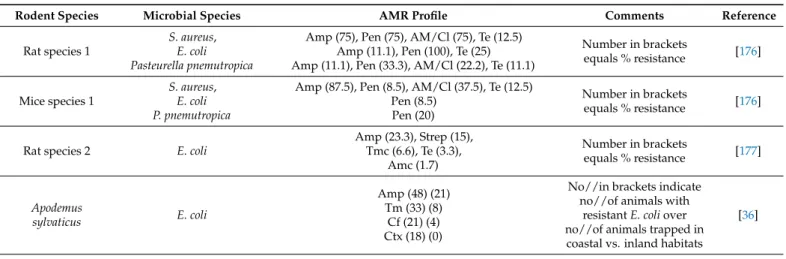
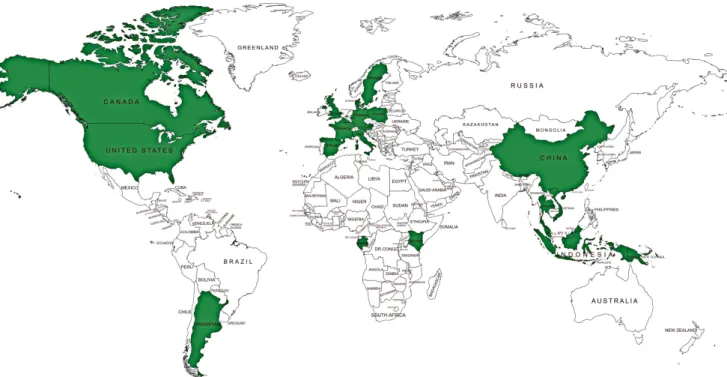
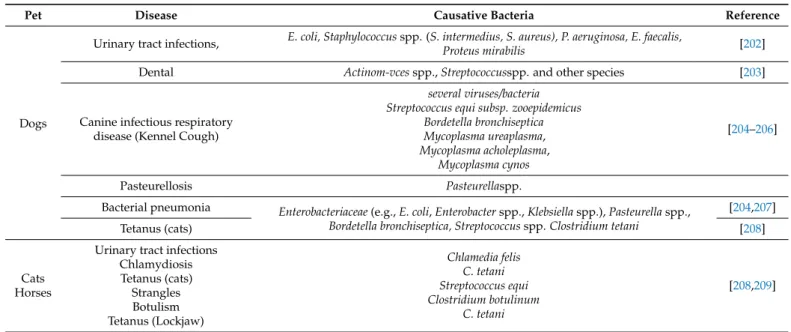
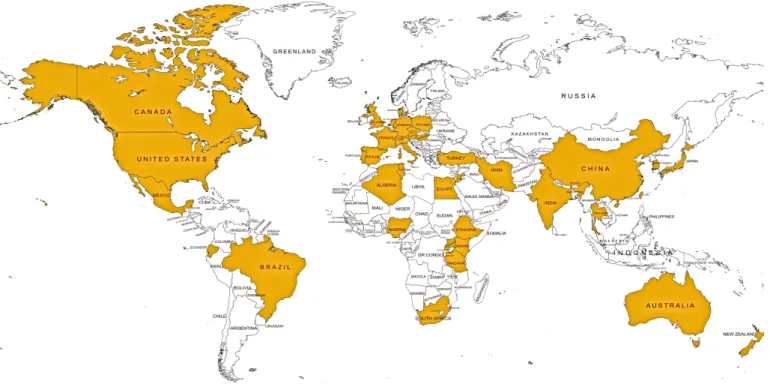
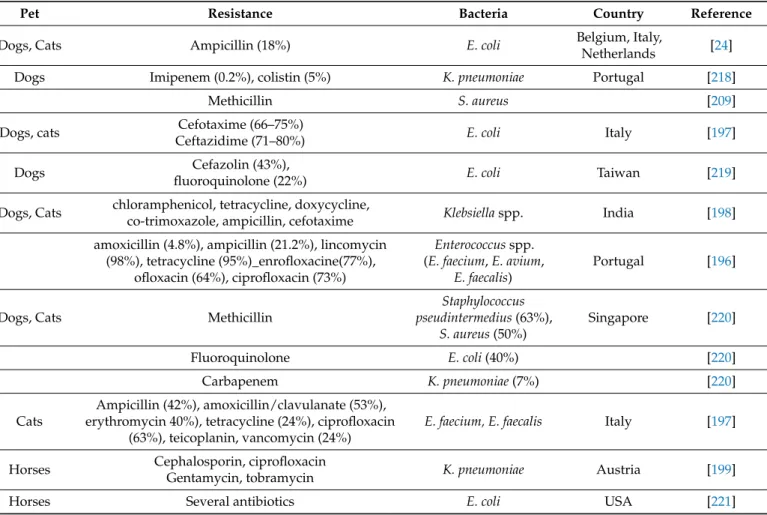
The emergence of AMR in domestic insects, rodents and companion/domestic animals is a major concern for human health. Furthermore, the occurrence of AMR in domestic animals, rodents and insects makes them ideal sentinels for AMR surveillance. Furthermore, the occurrence of AMR in domestic animals, rodents and insects makes them ideal sentinels for AMR surveillance.
A well-known example is the historical use of tetracycline in honeybees, which contributed to the development of AMR in the bees' gut microbiome [83]. Houseflies are suggested as good candidates for use as sentinels in monitoring the prevalence and spatial distribution of AMR in microbiota, such as bacteria in humans. The role of parasites in the transmission of AMR from rodents and pets to humans and vice versa has further demonstrated the complexity of AMR.
Nevertheless, this aspect is relatively less studied compared to the direct role of rodents and pets in the persistence and transmission of antimicrobial resistance. Due to their proximity and direct contact with humans, there is a high risk of transfer of antimicrobial resistance from pets to humans (and vice versa).
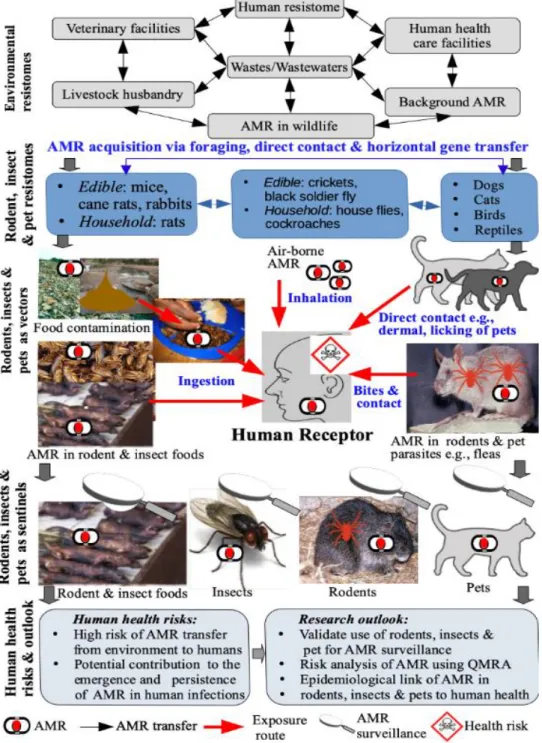
Human Exposure and Health Risks 1. Human Exposure Pathways
However, there is limited direct evidence linking AMR in pets to subsequent human exposure and health risks. Despite the lack of strong evidence, the emergence and spread of AMR poses potential human health risks. Previous studies assumed human health risks based on exposure to risk factors such as poor hygiene [45,232].
The occurrence of AMR in rodents and insects, including edible insects, and pets raised concerns for human health. Therefore, these regions may represent ideal sites for understanding the potential human exposure and health risks associated with the consumption of edible rodents and insects with AMR. The lack of convincing evidence for the human exposure and health risks associated with AMR in rodents, insects and pets may reflect the methodological limitations of existing studies that focus predominantly on the incidence and characterization of AMR.
In these studies, the mere occurrence of AMR posing a threat to human health is often interpreted as a human exposure and health hazard. Quantitative microbial risk assessment (QMRA) provides an ideal tool to overcome the methodological limitations of current studies while enabling a quantitative assessment of human exposure and health risks from AMR in rodents, insects and pets. QMRA is a systematic approach for identifying, evaluating and estimating the human exposure pathways and potential health risks of AMR, based on the source-exposure pathway.
QMRA uses quantitative dose-response relationships or models to estimate pathways of human exposure and associated health risks. In the case of antimicrobial resistance in rodents, insects and pets, QMRA requires data on the following—(1) the occurrence, nature and concentration of various antimicrobial resistances in rodents, insects and pets and their associated environmental media; (2) transmission of antimicrobial resistance from sources such as rodents, insects, pets, and associated environmental media to the receptor (human) through multiple routes of exposure (contact, ingestion, inhalation); (3) the behavior and fate of antimicrobial resistance from source to receptor, including possible degradation and potential mutations; Thus, assessing human exposure and health risks associated with antimicrobial resistance in rodents, insects, and pets, and developing and validating predictive methods for risk assessment is a key area for further research.
Information from such research is critical in developing strategies for mitigating the potential risks to human health from AMR.
Human Health Risk Assessment and Mitigation 1. Health Risk Assessment
Quantitative health risk assessment studies should also cover the identification of routes of AMR transmission from pets to owners, as this is crucial for developing management strategies and guidelines. However, this is a particularly challenging task that must be linked to studies addressing the frequency of AMR in animals and humans. It is also further complicated by the fact that there can be bilateral transmission of AMR between animal and owner, making assessment of the initial source of these transmissions even more challenging.
One should also note that transmission events can occur not only during the use of antimicrobial agents in animals, but also after the microorganisms with AMR colonize the pet, following their excretion and contamination of households [220]. Since it is virtually impossible to conduct experimental studies that directly address the transmission of AMR from real pets to their owners, some more definitive conclusions can be drawn from prospective studies. Such research should assess the baseline level of AMR in owners and companion animals and follow them sequentially, along with tracing the history of antimicrobial use in both compartments.
The application of a comparable assessment of the risks to human health associated with rodents and insects that are not intentionally kept in domestic environments but occur temporarily is more challenging. The results indicate that rodents and insects may be sentinels or bioindicators of AMR transmission in the environment [36]. The potential routes of transmission of AMR to humans by insects and rodents and the assessment of their frequency can be partially addressed through the experimental approach and the use of laboratory animals.
At this stage, such risk assessments require more data on the frequency of AMR microorganisms in these animals, the establishment of transmission routes and assessment of relationship with AMR observed in humans. Mitigation measures include (1) national and international guidance and monitoring on the use of antibiotics to limit the use of CIAs and non-essential use; (2) non-clinical interventions for animal health such as good feed, pet hygiene, regular examinations, vaccination and pest control to improve animal health while reducing the use of antibiotics; (3) training veterinarians on the selection of appropriate therapy to reduce antimicrobial resistance; (4) educating owners about good hygiene practices (eg, not allowing a pet to lick owner's face, frequent hand washing); (5) raising awareness among owners to strictly adhere to recommendations on the use of antimicrobial use (timing, dose, etc.); and (6) antimicrobial susceptibility testing for empirical guidance on antibiotic selection. In the case of pets, which are mainly but not exclusively represented by cats and dogs, the use of antimicrobial agents must rely on guidelines issued to veterinary specialists and recommendations issued by veterinary clinics to pet owners.
The use of preventive measures to prevent insects from entering the household environment (for example, screens on windows, mosquito nets); And.
Future Perspectives 1. Future Research Directions
In the present case, QMRA will estimate the probability of occurrence of adverse human health outcomes due to exposure to AMR in insects, rodents and pets. Such research will also provide critical epidemiological evidence linking AMR in insects, rodents and pets to specific human health outcomes. The contribution of insects, rodents and pets to the global human AMR burden There are currently no estimates of the contribution of AMR in insects, rodents and pets to the global AMR burden and the associated health risks.
Therefore, the development and validation of frameworks and metrics for assessing the global contribution of AMR to different environmental compartments or resistances, including insects, rodents, and domestic animals, requires further investigation. However, little is known about the contribution of the human factor to the transmission of AMR at the environment-animal-human interface. Some recent advances in analytical tools such as computational or in-silico techniques, genomics, network analysis, and big data analytics received only a cursory application in research on AMR in insects, rodents, and domestic animals.
Generic applications of new and emerging analytical tools in AMR research are discussed in a previous paper focusing on AMR in the funeral industry [13]. Here, potential applications of new and novel tools in the context of AMR at the environment-animal-human interface are highlighted. Compared to cultural methods, genomics has a number of important advantages for the investigation of AMR in insects, rodents and domestic animals and their health risks.
First, genomics can be used to study the occurrence and proliferation of AMR in non-culturable organisms in insects, rodents, domestic animals and humans. The occurrence, distribution and fate of AMR in the different compartments form a complex network that is often difficult to disentangle with conventional instruments. One question that arises is: “Does AMR in humans, insects, rodents and pets come from the same environment or is it resistant?”.
Thus, a combination of network analysis and genomics can be used to unravel such complex interactions and reveal the degree of similarity of AMR in the different compartments or resistomes.
Conclusions and Outlook
Microbial community composition and antimicrobial resistance in agricultural soils fertilized with livestock manure from conventional agriculture in northern Italy. Sci. Role of wastewater treatment plants on environmental abundance of antimicrobial resistance genes in Chilean rivers. The effect and mechanism of urban fine particulate matter (PM2.5) on horizontal transfer of plasmid-mediated antimicrobial resistance genes.Sci.
Frequency and antimicrobial resistance patterns of bacterial species isolated from the body surface of the housefly (Musca domestica) in Akure, Ondo State, Nigeria.J. Overview of antimicrobial resistance in the environment and its relevance to environmental regulators. Front. Comparison of microbiota, antimicrobial resistance genes and mobile genetic elements in flies and the faeces of sympatric animals.
Antimicrobial resistance in gonococci isolated from patients and from commercial sex workers in Harare, Zimbabwe. International Response to comment on "The role of wildlife (wild birds) in the global transfer of antimicrobial resistance genes".Zool. Molecular detection and antimicrobial resistance of Klebsiella pneumoniae from houseflies (Musca domestica) in kitchens, farms, hospitals and slaughterhouses.J.
Highly variable patterns of antimicrobial resistance in commensal Escherichia coli isolates from pigs, sympatric rodents and flies. Microbe. Antimicrobial resistance in generic Escherichia coli isolates from wild small mammals living in pig farms, housing, landfills, and natural environments in southern Ontario, Canada.Appl. Antimicrobial resistance in Escherichia coli isolates from pigs and wild small mammals near pig farms and in natural environments in Ontario, Canada.
New York City house mice (Mus musculus) as potential reservoirs of pathogenic bacteria and antimicrobial resistance determinants. Antimicrobial resistance in bacteria from livestock and companion animals; ASM Press: Washington, DC, USA, 2018; pp. World Health Organization. Antimicrobial Resistance: Global Report on Surveillance; World Health Organization: Geneva, Switzerland, 2014.