Despite these incremental measures, research shows that parents have different views on the role of education and schooling in their children's lives. The purpose of this research was to explore parents' understanding of the role of education in their children's lives. In order to answer this question, six parents' understanding of the role of education in their children's lives was explored through a qualitative narrative inquiry situated within a critical paradigm.
- Introduction
- Focus and purpose of the study
- Rationale and motivation of the study
- Background
- Contextualising the notion of class
- Research questions
- Methodological approach
- The theoretical framework of the study
- Structure of the dissertation
- Conclusion
In reviewing this literature, I noted that limited research focuses on the value of parents' understanding of the role of education in the lives of their children. In this study, parents shared their personal knowledge and experiences, providing insight into their understanding of the role of education in the lives of their children. What are parents' own experiences of education and how has this influenced their understanding of the role of education.
- Introduction
- Policy constructions of the role of parent in education
- Reflections on the state of education in South Africa
- Factors that influence how parents understand education
- Parent’s experiences of education
- Parents’ aspirations and expectations of education
- Social class and education
- Social class and parents’ investment in education
- Single parenting, education and work
- When school and home culture meet
- Parents, support and education
- International and local perspective on the issues presented in the literature
- Conclusion
- Theoretical Framework
- Bourdieu’s theory of practice
- Bourdieu’s notion of habitus
- Bourdieu’s notion of capital
- Conclusion
- Introduction
- Research paradigm
- Methodological approach
- Narrative inquiry
- Research design
- Context of the study
- Sampling
- Methods of data collection
- Data analysis
- Trustworthiness of the study
- Design limitations
- Ethical considerations
- Conclusion
My epistemological, in this study, assumed that in order to generate knowledge I had to create a special kind of relationship with the participants and the school their children attended. In this study, the participants were considered as powerful individuals who could find affirming experiences that enable them to support the education their children receive. The study's focus, purpose, rationale and significance are also discussed in this chapter.
- Introduction
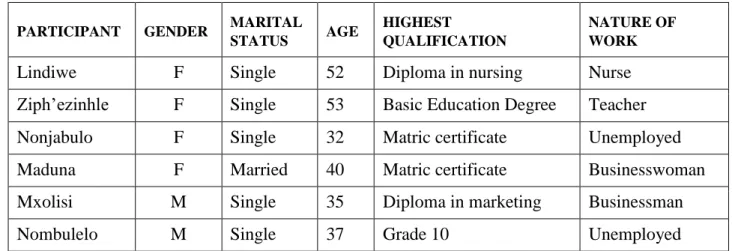
- Introducing the participants
- Influence of past experiences on current understandings of education
- Growing up in poverty: “It was the norm…we knew we won’t get it”
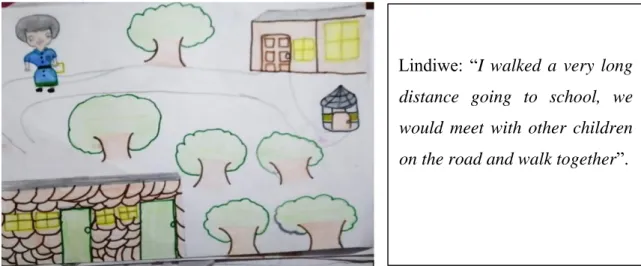
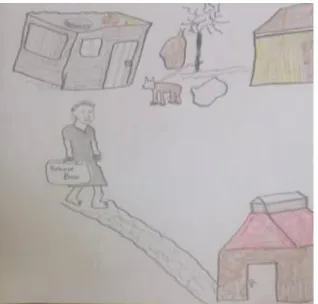
- The long road to school: Everyone was in their classrooms”
- Gender and education: “I left school to get married”
- Influence of social class on parents’ understandings of the role of education
- Education as social and civic duty: “For me education is life”
- Schooling as independence: “They no longer depend on me”
- Parents’ aspirations for their children: “I don’t want them to be like me”
- Single parenthood: “I have always been on my own”
- Parents supporting their children’s education
- Parents promoting reading: “I bring lots of books home”
- Learning the rules of the game: “I do try to do what is good”
- Home-school relationships: “They both have the responsibility”
- Summary
The understanding of how reality and knowledge are understood within the critical paradigm was considered important for this study (Zondi, 2018). The chapter also discusses the background, an overview of the theoretical framework and provides a snapshot of the methodological and design approach used in the study.
Introduction
In the previous chapter I presented the analysis of the data relating to parents' understanding of the role of education in the lives of their children. Furthermore, findings reveal the complex ways in which socioeconomic positioning influences the way in which participants understand the role of education in the lives of their children. In this final chapter, I summarize the key issues that emerged in the study.
First, I reflect on the theoretical, design and methodological considerations that guided the development of the study. I then present the main findings of the study and how they answer the main research questions of the study. This is followed by a presentation of the implications of the findings and recommendations for future research.
What parents from different socio-economic backgrounds understand about the role education plays in their children's lives. What are the experiences of parents from education and how has this been influenced by their socio-economic positioning. How socio-economic positioning affects their understanding of the role of education for their children.
How does this understanding of the role of education affect the way parents support and promote education.
Purpose and significance of the study
Third, this study contributed to the understanding of the various challenges parents face and their resilience and action to push the boundaries of poverty. This study found that while inequality may be endemic in South Africa, parents are still driven by the understanding that they do not want their children to be like them in trying to support their children in their pursuit of academic success.
Theoretical framework, methodological and design issues
For example, as a researcher, I could place the participants as the center of the study, a situation in which meanings were created by the participants themselves. Narrative research allowed me to gain insight into the participants' experiences by allowing them to tell their stories (Clandinin & Connelly, 2000). This had the advantage of moderating power relations and allowing participants to claim and take a more active role in generating data about their own experiences and understandings.
Additionally, this helped put my voice in the background while foregrounding the voices of the participants. The qualitative approach was useful as it allowed the study to generate rich accounts of the participants' experiences and understandings of education and its role in their children's lives. Denzin and Lincoln (2011) argue that in qualitative research special attention is paid to people's experiences (Denzin & Lincoln, 2011).
In addition to the above, the qualitative research approach allowed participants' experiences and understandings to be studied in their natural context. To this end, using the qualitative approach was useful as it enabled me to work closely with and understand the experiences of the participants. As such, the data generation process took longer than expected, resulting in changes throughout the project plan in relation to time frames. Furthermore, after translating and transcribing the interviews, I found that there were some gaps that required me to conduct follow-up interviews with the participants.
To comply with protocols for containing the spread of COVID-19, follow-up interviews had to be conducted by telephone.
Summary of key findings
This brought out their understanding of the role of education in the lives of their children. The second broad theme investigated the way in which social class had an impact on the participants' understanding of education and the role of education in the lives of their children. However, the intention of the study was to understand the role of education from the perspectives of parents.
For the purposes of this study, the results provide a contextualized and rich explanation of parents' understanding of the role of education in their educational lives. This study only explored parents' understanding and experiences of the role of education in their children's lives in a peri-urban area. This would allow for a comprehensive understanding of parents' understanding of the role of education in their children's lives.
This study focused on parents' understanding of the role of education in their children's lives. I conduct research into parents' understanding of the role of education in their children's lives. The aim of the research is to get parents talking about their experiences with education in their children's lives.
The purpose of the study is for you (parents) to talk about your educational experiences in the lives of your children. My research topic is "Investigating parents' understanding of the role of education in their children's lives". The purpose of the study is to investigate parents from different socio-economic backgrounds on how they understand the role of education in their children's lives with special emphasis on their positioning in the classroom.
Implications of the study
Limitation of the study
One of the limitations was that the study focused only on parents' experiences and, thus, only represented parents. Other members of the school community, such as students and teachers, can also provide their understanding of the role of education. While these methods allowed me to interact with participants and engage in in-depth discussions and provided rich detailed data, the difficulty was to keep asking all the questions and probe further during the interviews.
I was so overwhelmed that I missed so many questions, which led to me having to go back for follow-up interviews with the participants. Conducting follow-up interviews with the participants extended the time for data collection, which had an impact on the study's time frames. I was faced with the decision to only conduct the final interview once the university had given the go-ahead.
This attracted financial implications that I had not considered when planning the research project. In addition, when analyzing the data from the semi-structured interviews and the mapping exercise, I had to constantly telephone the participants to clear gaps in the research. Because this study involved a small number of participants, the findings cannot be generalized to a larger population.
Therefore, the purpose of this study was not to generalize the findings to other contexts and populations.
Recommendations for future research
This caused delays and prevented me from proceeding as I had planned. Only six parents from one suburban school in KwaZulu-Natal participated in this study. However, in qualitative research, findings are context-bound and do not provide conclusions that can be generalized to a larger population (Cohen et al., 2000).
Support for parents is critical if we are to instill the value and importance of education. Parents should therefore be supported on how to teach their children about the value and importance of education. It is therefore recommended that appropriate training programs for parents be investigated in this regard to strengthen their roles in supporting their children's education.
Conclusion
ICT-Enhanced teaching and learning in the College of Human Sciences, University of South Africa. Family-school relationships in immigrant children's well-being: the intersection of demographics and school culture in the experiences of black African immigrants in the United States. Distinctive features of schools in multiple disadvantaged communities in South Africa: Implications for policy and leadership.
Lack of parental involvement as a barrier in selected public primary schools in South Africa: Voices of educators. I want them to be better than me': Parents from different socioeconomic backgrounds reflect on their children's schooling and education in Mexico City. Starting behind and staying behind in South Africa: The case of insurmountable learning deficits in mathematics.
Please tell me about your children, how many children you have and how many are at school. How do you support your children to learn and why do you support them in the way you do. What are some of the other ways you have invested in your children's education.
Research question 2: How does socio-economic positioning affect their understanding of the role of education for their children. What differences do you notice in relation to how schools treat parents from different socio-economic backgrounds. How to overcome barriers that prevent you from participating in your child's education and school activities.