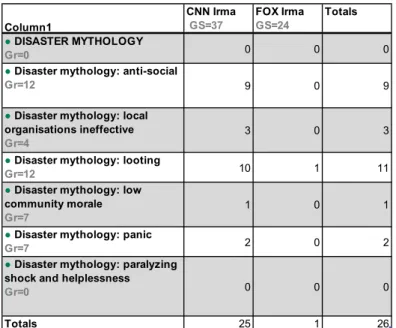
When disaster myths were used, these were mostly myths of panic and low community morale. Yet CNN often used myths of looting disasters and antisocial behavior when reporting on events outside the US.
Introduction
Research Focus and Questions
I initially considered studying Hurricane Maria and the disaster myths used when reporting on Hurricane Maria. Accordingly, the research questions for this project consisted of the following: What evidence of disaster mythology appears in the CNN and FOX online news coverage of Hurricanes Harvey and Irma.
Use of Disaster Myths in News Coverage
Quarantelli discovered "with looting occurring more often than not in developing systems." The catastrophe myth of antisocial behavior centers on the mistaken belief that people will act in ways that conflict with normal societal norms. Indeed, research by Tierney, Bevc, and Kuligowski (2006) has shown that in the aftermath of Hurricane Katrina, the media portrayed those affected as unworthy to live with.
Research Approach and Methodology
Both the general public and the police surveyed in Drury et al.'s research all endorsed the notion of civil disorder, or looting, and the antisocial myth (Drury et al. Likewise, German first responders and the general public also endorsed the belief that looting was inevitable after a disaster (Lorenz et al. 2017:262).
Overview of Chapters
The discourse analysis examined how disaster myths were used in relation to the hurricane and how the myths were represented. The frame analysis also used the content analysis to determine which frames were used when myths were present.
Introduction
Disaster Myths and Hurricane Katrina 2005: Can Public Officials and the Media Learn to Provide Responsible Crisis Communication During Disasters?”. This chapter therefore seeks to examine key aspects of disaster mythology and its portrayal in news media, as well as the role of framing and agenda setting within the media's coverage of disasters.
Definition of disaster
However, most social science definitions of disasters emphasize the social disruption created by the disaster. For example, floods, earthquakes and other so-called "natural" disasters have social consequences only because of the activities of communities involved, before, during and after the impact of a disaster.
Differentiating between Disasters and Catastrophes
Disaster Myths
Disaster Myths and the role of Availability Cascades
To better understand why disaster myths are so prevalent, Nogami conducted a study that examined disaster behavior with availability cascades. Nogami's research confirms the literature of Sun (2012) and Kuran et al. 1999), that the cascade of availability and reliance on second-hand information may make the general public more inclined to believe falsehoods such as disaster mythology (Nogami, 2019:376).
Discussion of Quarantelli and Dynes’ Disaster Myths
- Looting and Anti-Social Behaviour
- Paralyzing Shock and Helplessness
- Ineffectiveness of Local Organizations
- Low Community Morale
2017:362) found that belief in the myth of looting and other acts of criminality is most prevalent among lay people, with 42.4% of respondents surveyed expecting looting to occur. Nogami investigated the Japanese belief in the myth of looting and found some correlation between the belief in the myth of looting and property-related crimes and the consumption of mass media.
Disaster Mythology and the Covid-19 Pandemic
This lack of panic in the face of the Covid-19 pandemic is further supported by research conducted by Recchi, Ferragina, Helmeid, Pauly, Safi, Sauger, and Schradie (2020). To further their argument that prevention of mass panic in the face of Covid-19 is critical, Shatri et al.
The Role of the Media Before, During and After a Disaster
- The Pre-Impact Stage
- The Impact Stage
- The Post-Impact Stage
A content analysis of major newspapers conducted after Hurricane Katrina found that the media focused on the post-Hurricane Katrina preparedness aspect (ref). This seems to indicate that the notion of preparedness is not high on the media agenda in the pre-impact phase.
Agenda-Setting and Framing during Disasters
- Agenda-Setting
- Framing
It is argued that Need for Orientation can influence the effect of media on individuals. The notion, as mentioned above, that the media sets the public agenda warrants increased research.
Factors that determine coverage of natural disasters
When Yan and Bissell compared domestic natural disaster coverage with international disaster coverage, Yan and Bissell found that severity level was the most accurate predictor of coverage. While Yan and Bissell found no relationship between geographic proximity and news coverage, Jeong and Lee (2017:12) found that geographic proximity and the more geographically distant the country affected by the natural disaster was from the United States led to to an increase in the number of news items. coverage. Jeong and Lee divided the coverage into weeks and found that in weeks 1 and 2, death, ie. severity level proved to be the most important predictor of coverage.
Jeong and Lee (2017:10) found that “…each additional thousand deaths was associated with a 4 percent increase in news coverage…”.
Conclusion
Methodology
- Newsworthiness of Hurricanes Harvey and Irma
- Research Approach
- Selection of News Sources
- Sampling of News Articles
- Data Analysis
- Content Analysis
- Framing Analysis
- Discourse Analysis
- Limitations and Challenges
- Conclusion
The use of the two weeks is to focus on the short-term phase of the disaster. One of the reasons why a discourse analysis was conducted after the content analysis was that “…the presence of concepts may not be sufficient to denote meaning, as people may use exactly the same words…but mean very different things. " (Carley, 1993:89). Examples of the analyzed discourse can be found in Appendix B (Hurricane Harvey, CNN); Appendix C (Hurricane Harvey, FOX News);.
Articles were then selected for discourse analysis keeping in mind the connotations of the language used in the report.
Data Analysis
Analysis of Coverage of Hurricane Harvey
- Content Analysis
- a The Use of the Panic Myth
- b The Use of the Low Community Morale Myth
- c The Use of the Looting Myth
- d The Use of the Anti-Social Myth
- e The Use of the Local Organisations Being Ineffective Myth
- f The Use of the Paralyzing Shock and Helplessness Myth
- Framing Analysis of Hurricane Harvey
- Frames Most Prevalent
- Framing Categories Subdivided
- a The Human Interest Frame
- b Disaster Frame
- c Environment Frame
- d Economic Frame
- e Political Frame
- Frames Used when Myths are Present
- a Panic
Belief in the anti-social behavior myth can lead to what Quarantelli and Dynes (1972:5) argue is a greater focus on preventing antisocial behavior; "The supposed exposure of antisocial behavior in disaster calls for special attention to safety issues." The paralyzing shock and helplessness myth focuses on the mistaken belief that "The initial shock of experiencing the impact of a disaster supposedly leaves individuals dazed and unable to function or respond to the situation." (Quarantelli, 2008:886). As such, Quarantelli and Dynes (1972:2) argue that: "The social disorganization of the community which is a product of disaster impact provides the conditions for antisocial behavior to emerge."
The myth that local organizations are ineffective suggests that "The perceived dominance of irrational and disorganized individuals also has consequences for the ability of local organizations to function effectively during the emergency." (Quarantelli and Dynes, 1972:5). Both CNN and FOX used human interest frames when reporting on Hurricane Harvey. Selective exposure to cable news and immigration in the US: The relationship between FOX News, CNN, and attitudes toward Mexican immigrants.
Panic Myth in Relation to Frames Used
- b Low Community Morale
Low Community Morale in Relation to Frames Used
- c Looting
- d Local Organisations Ineffective
- e Altruism versus the Paralyzing Shock and Helplessness Myth
- Discourse Analysis of Coverage of Hurricane Harvey
Analysis of coverage of Hurricane Irma
- Content Analysis
- a Location as a Variable for Coverage
- b The Use of the Panic Myth
- c The Use of the Low Community Morale Myth
- d The Use of the Looting Myth
- e The Use of the Anti-Social Myth
- f The Use of the Local Organisations Being Ineffective Myth
- g The Use of the Paralyzing shock and Helplessness myth
- Framing Analysis of Hurricane Irma
- Frames Most Prevalent
- Framing Categories Subdivided
- a The Human Interest Frame
- b Disaster Frame
- c Environment Frame
- d Economic Frame
- Frames Used when Myths are Present
- a Panic
- b Low Community Morale
- c Looting
- d Anti-social
- e Local Organisations Ineffective
- Discourse Analysis of Coverage of Hurricane Irma
Not a single instance of the use of the antisocial myth was present in CNN's online coverage of Irma when it focused on the US. Putting the myth in context, it seems that as with the use of the robbery myth, the antisocial myth was only used when reporting on territories outside the US. Much of the discourse about antisocial behavior centers around the idea that people have abandoned all social norms.
Two articles in FOX's coverage of Irma focused on the impact of Irma outside the US.
Summary of Data Analysis
Similarly, the discourse surrounding antisocial behavior also suggests that normal societal rules are not followed, and the breakdown of these societal norms is implied in the discourse. When conducting a discourse analysis around Irma, the discourse around the looting myth was driven by quotes from politicians and aid workers. CNN also used apocalyptic type language, with words like nuclear, with the interviewees using language to suggest it was almost an end of the world type scenario.
The use of the antisocial myth was closely related to the predation myth, with the discourse creating a type of us versus them scenario where normal social rules no longer exist.
Conclusion
Discussion
- Discussion of Coverage of Hurricane Harvey
- Discussion of Coverage of Hurricane Irma
- Comparing the Coverage of Hurricane Harvey and Hurricane Irma
- Conclusion
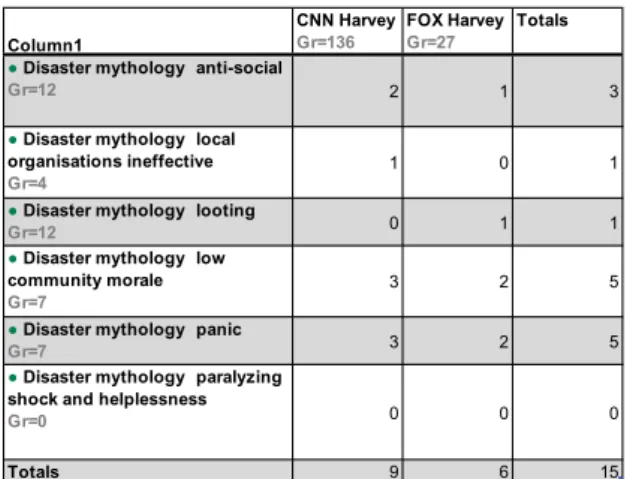
The myth of panic was another of the most used myths when examining the coverage of Harvey. This result was particularly surprising, especially given the heavy use of the looting myth when reporting on Hurricane Katrina. CNN made use of the looting and antisocial myth in their coverage of Irma, primarily using the myths when reporting on regions outside the United States.
CNN was more inclined to use a human interest frame when reporting on Harvey; while FOX also focused on Harvey's economic framework.
Findings and Conclusions
Prevalence of disaster myths in news coverage
Impact of disaster myths on framing and representation
The myth of low community morale was one of the most commonly used myths when researching reports about Harvey. The myth of low community morale and the use of the political framework seem to be related to important individuals showing solidarity with those affected after disasters. FOX only used the anti-social myth to argue against the validity of the claims.
The consequences of perpetuating these myths can very well lead to real-life consequences such as reluctance to evacuate due to the perceived threat of looting or panic, and.
Limitations of the study
Residents of Houston were never actually given a mandatory evacuation order, with the mayor apparently alluding to panic and the fact that the evacuation would be uncontrollable. Although this research does not seek to understand why disaster myths arise, ultimately the media's role is to report disaster events in a responsible manner. Authors Wegner and Friedman (1986:48) ask "how many articles are needed to prove that the media perpetuates disaster mythology?".
The number of articles about looting, panic and other forms of anti-social behavior certainly seems to perpetuate the disaster mythology.
Recommendations for further research
Local and national media coverage of disaster: A content analysis of the print media's treatment of disaster myths. But no one is coming," said Leroy Webb, a resident of St. Maarten, which is the Dutch part of the island. The French side of the island is St. 34; I don't even know how long it will take until people here are not. get food.
The US territory was largely deserted in the aftermath of the deadly storm, she said.