Furthermore, the study is situated within an interpretive paradigm to understand teachers' constructions of student-centered practices and the extent to which their personal enactment of student-centered practices enabled meaningful learning. The teachers emphasized the importance of group work in their personal implementation of “student-centered” practices.
OVERVIEW OF THIS CHAPTER
BACKGROUND OF THE STUDY
Student teachers believe that when a math lesson is student-centered, meaningful learning occurs. It is not surprising to find that student teachers associate student-centered teaching with meaningful learning.
STATEMENT OF THE PROBLEM
Therefore, meaningful learning was included in the study because of its interrelationship with learner-centered approaches. Therefore, the study sought to explore mathematics teachers' constructions of student-centered practices, and the extent to which their personal enactments of "student-centered" practices are.
RESEARCH QUESTIONS
However, no researcher has undertaken research specifically on the construction and implementation of learner-centered practices in a single study.
DELIMITATIONS OF THE STUDY
The study was limited to three urban schools in the Shiselweni region of Eswatini, which has only four urban schools in Nhlangano town.
AIMS AND OBJECTIVES OF THE STUDY
RATIONALE FOR THE STUDY
SIGNIFICANCE OF THE STUDY
ORGANISATION OF THE THESIS
INTRODUCTION
This happens in part when teachers need to use group work as a strategy to improve student-centered instruction. This in itself requires the professional capacity of the teacher to use group work to facilitate student-centred teaching.
LEARNER-CENTRED TEACHING STRATEGIES INFLUENCE IN
Qualities of an effective teacher
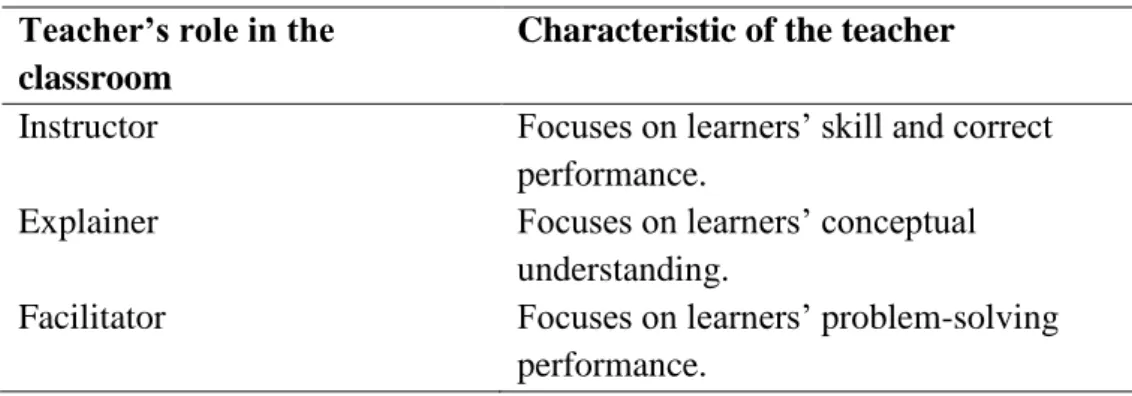
The last characteristic of an effective teacher identified by Hattie is about influencing learners' outcomes. For the teacher to facilitate learners' conceptual understanding of Mathematics, he/she must have knowledge of the subject and effective teaching strategies.
TEACHERS ENACTING LEARNER-CENTRED PRACTICES… 26
According to Shulman (1987), pedagogical content knowledge refers to the teacher's competence in knowledge of the material and knowledge of instructional practices. The teacher must develop his questioning skills to improve student performance.
THE GAP IN LITERATURE
However, in rote learning, current knowledge is not related to prior knowledge, so there is no meaningful learning. Clements and McMillen's (1996) arguments suggest that not all manipulations are sufficient to ensure meaningful learning.
INTRODUCTION
THEORETICAL CONSIDERATION
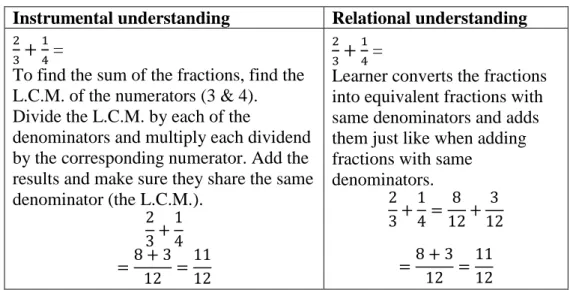
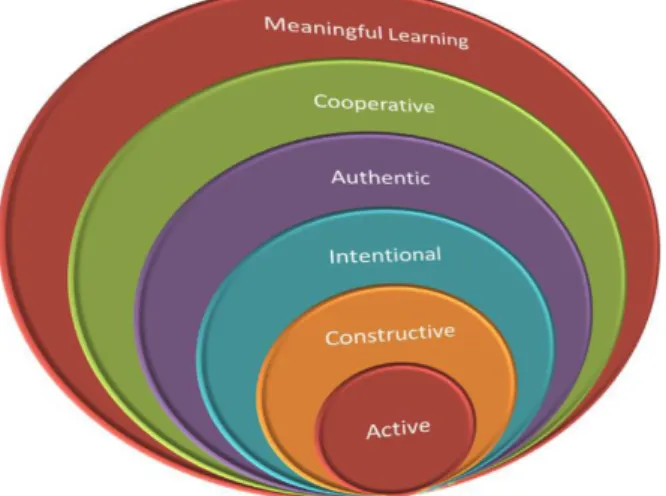
The question now arises: what is the relationship between learner-centered practices and the concept of meaningful learning. The diagram below illustrates a framework that integrates learner-centered practices and meaningful learning.
MEANINGFUL LEARNING
- Piaget learning theory
- The process of assimilation…
- The process of accommodation
- Ausubel’s view of meaningful learning
- Understanding
- Intellectual need
- Realistic Mathematics Education …
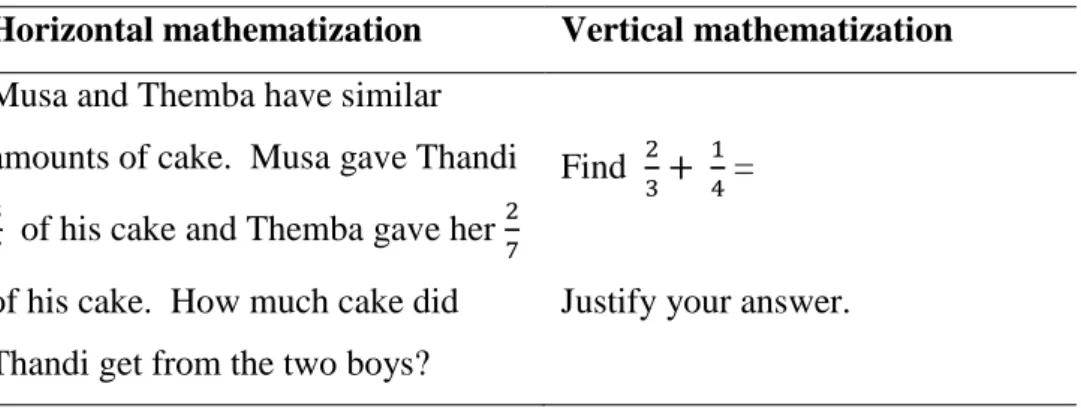
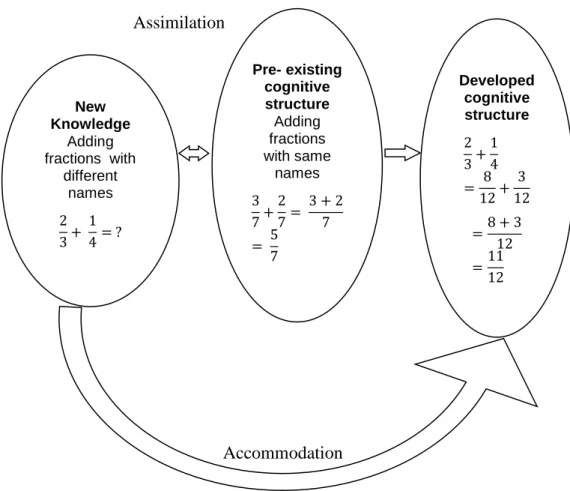
The student's cognitive structure is therefore expanded due to new knowledge that is integrated with existing knowledge. In the diagram above, the student must conceptualize the addition of fractions with different names. This means that prior knowledge must interact with relevant existing knowledge in the learner's cognitive structure for meaningful learning to occur.
RELEVANCE OF SOCIO-CULTURAL THEORY
CONCLUSION
INTRODUCTION
In the following sections, the researcher will focus his discussion on the aspects of the research design and methodology regarding mathematics teachers.
THE RESEARCH PARADIGM
As an interpretive researcher, I also conducted an in-depth interview with each of the three teachers on an individual basis to augment and triangulate the recorded information. According to Angen (2000), one of the characteristics of the interpretive paradigm is that interpretive approaches rely heavily on naturalistic approaches such as observations and interviews. In order to get answers to the research questions, the study was conducted in a classroom environment, which I believe is a natural environment for both student learning and teacher teaching.
RESEARCH DESIGN AND METHODOLOGY
To gain an in-depth understanding of the phenomenon of mathematics teachers' constructions and implementations of student-centered practices, the study employed a case study design. For example, Bell (2010) argues that the value of studying single events, such as in a case study, is questionable. On the other hand, Maree (2007) points out that a case study research is unable to provide a generalizing conclusion.
METHODS OF DATA COLLECTION
Sample and participants of study
Ethical Issues
In this study, I addressed a number of research ethics issues relevant to this study by seeking permission to conduct the research in the Shiselweni region. Director of the Eswatini Ministry of Education and Training, where I explained the purpose of the study and its educational benefits. The purpose, purpose, and educational benefits of the study were explained to all participants.
The Research Instruments
- Classroom Observations
- The interviews
I sat in the back of the classroom and observed the lesson as each of the teachers taught. Whether the teaching methods used by the teachers are inspired by the student-centered approach. The teachers' reasoning about certain incidents observed during lessons that may or may not have led to meaningful learning by the students.
Data Analysis
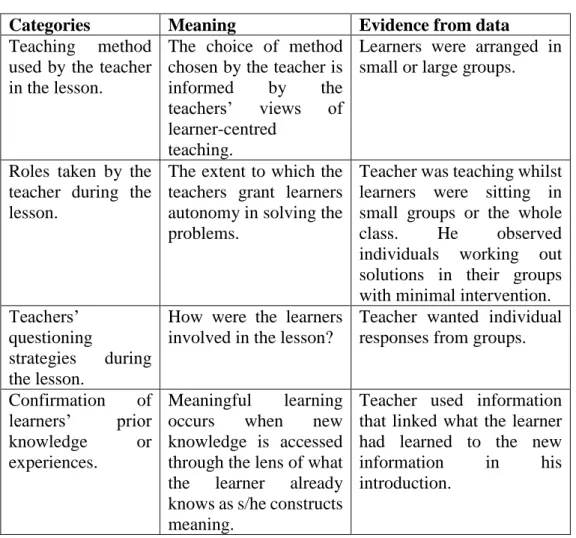
In this study, the purpose of the narrative account was used to gain an in-depth understanding of teachers' beliefs and practices regarding student-centered teaching and meaningful learning. By familiarizing myself with the data, particularly the narrative account, and by re-reading the transcripts of the one-on-one interviews with the teachers, the following broad categories were initially interrogated. The pitfall, however, is that the researcher may have difficulty deciding which aspects of the data set to focus on because the things that can be said about it are broad (Braun & Clarke, 2006).
Reliability and validity
Reliability
These are presented in Chapter 5. 2000) defines triangulation as the use of two or more data collection methods in research. The lesson plans for the observed lessons of each of the three teachers were created after they had taught. In addition to lesson observations and interviews with teachers, field notes and teachers' lesson plans for the observed lessons were also used in the data analysis.
Validity
Triangulation improves the objectivity of the study by using multiple data collection methods in one study of a single phenomenon to build on a single construct in qualitative research (Yeasmin and Rahman (2012). Excerpts from the transcripts were used to to substantiate claims and this contributed to the reliability of the study. In the current study, for example, theoretical validity was obtained by deriving and providing clear descriptions of the constructs learner-centred teaching, and meaningful learning by using the literature as a basis.
LIMITATION
CONCLUSION
Teacher interview transcripts of the interviews I conducted with each of the teachers immediately after they had taught their lessons. Below is each of the teacher's lessons where the focus was on the narrative account of his observed teaching. This was followed by the analysis of the interviews of each of the teachers and the main core of the analysis is the teaching philosophy of each.
MILTON’S TEACHING
- Background
- The research school
- Milton’s lesson
- Interview with Milton…
- The philosophy of teaching
- Learning practices
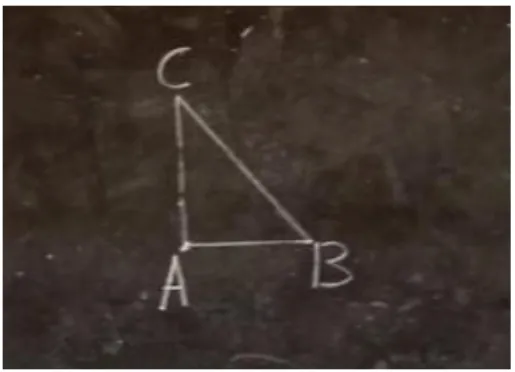
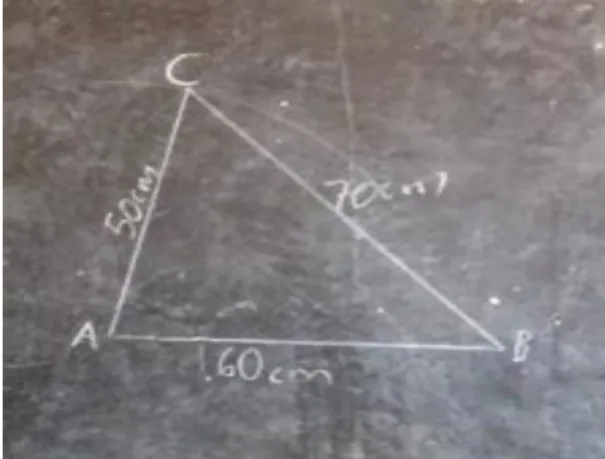
At the beginning of the lesson, all students sat in their normal classroom position, facing the chalkboard. Milton then began explaining to the class how to construct the other sides of the triangle. So he continued to construct the other dimensions of the triangle (AC=50 cm and BC=70 cm) while the students watched.

THEMBA’S TEACHING
Background
But when I interviewed him about using prior knowledge, he didn't necessarily mention that it was about meaningful learning. It is clear that Milton's construction of meaningful learning did not relate to the notion of relating the learner's previous ideas to existing ideas.
The research school
Themba’s lesson
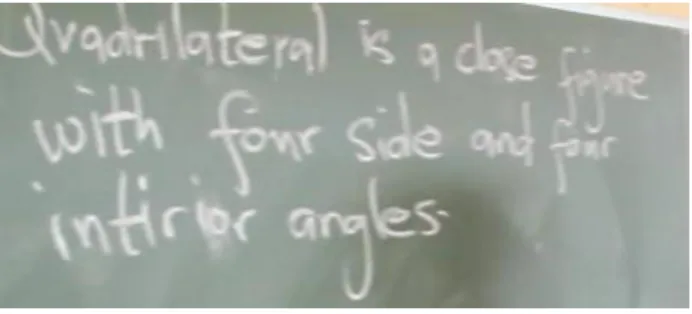
One of the students gave the meaning of inner angle and Themba seemed pleased with her answer. He then wrote the meaning of the term diagonal under the shape [diagonal is an inclined line connecting opposite corners of a flat shape]. In the above discussion, Themba eventually helped students arrive at the generalization that the sum of the interior angles of a quadrilateral is 3600, using Figure 5.19 that he drew on the board.
Interview with Themba
- The philosophy of teaching
- Learning practices
His concept of student-centered teaching seemed to be consistent with his teaching practices. In my interview with Themba, I also asked him about the problems he encountered while using student-centered teaching. According to Themba, the demonstration method is consistent with student-centered teaching because the teacher had to guide the students.
SABELO’S TEACHING
Background
The research school
Sabelo’s lesson
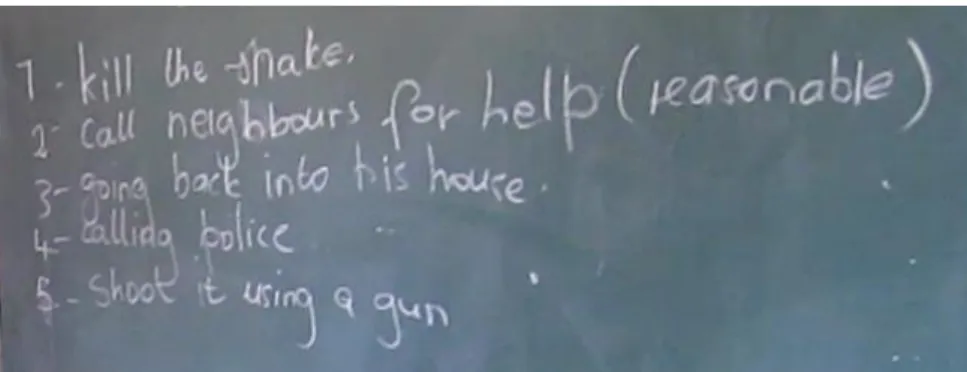
The students then began raising their hands and giving him their solutions to the problem the man was facing. Sabelo went to the blackboard to list the stages of the problem-solving model, as you can see in Figure 5.30 below. Here he tried to emphasize to them the stages of the problem-solving model.
Interview with Sabelo
- The philosophy of teaching
- Learning practices
I think learner-centered teaching is when the teacher is not the master of the class. And the role of the teacher in learner-centred teaching is to observe the learning and help the learners to do their learning. The role of the teacher in learner-centred teaching is to observe the learning, guide the learners and help them to do their learning.
INTRODUCTION
The teachers in the study embraced group work as a strategy to facilitate learner-centred teaching. In the study, the teachers recognized the value of using group work to facilitate learner-centred teaching of Mathematics. The teachers' perceptions of their learner-centred teaching is that the teacher takes on the role of a guide.
ANSWERS TO RESEARCH QUESTION 1
The teachers’ perceptions of their learner-centred teaching is that the
Sabelo similarly argued that the teacher's role in student-centered instruction is to observe the learning process and help students as they work through the problem. The essence of learner-centered instruction is that the teacher guides the students as they work on the task. This belief that the teacher takes on the role of guide in implementing student-centered instruction was shared by three teachers.
The teachers’ understanding of the role of the learner in learner-
It is clear that all three teachers articulated their understanding of learner-centered teaching as the teacher guiding students and helping them during the learning process. In retrospect, the teacher takes on the role of facilitator in learner-centered instruction, as Jansen (1999b) mentioned in Outcomes-Based Education. In this study, three teachers believed that student-centered teaching is about the teacher guiding and helping students as they engage in the task.
The teachers believed that group work was an important component of
A limitation of the interview I had with the teachers about their meaning of student-centered teaching was that I should have asked them more questions about the roles of students during student-centered teaching to get more of their ideas about it. Therefore, Milton, like Themba and Sabelo, believed that group work was an integral part of learner-centered teaching. But teachers did not effectively use the concept of using group work during student-centered instruction.
ANSWERS TO RESEARCH QUESTION 2
The teachers’ personal philosophy of learner-centred teaching did not
And the teacher encourages learners to collaborate in their learning by asking them to discuss and participate in their small groups (Brodie et al., 2002b). In my interview with Sabelo, he mentioned that in learner-centred teaching the teacher is not the master of the class and similarly in his lesson he watched how the groups work on a task as can be seen in Figure 5.32. In other words, he did not interfere with the groups as they worked on the problem he gave them, but during the interview he argued that the role of the teacher in learner-centered instruction is that of a guide.
Teachers used ‘hybrid’ group work management strategies
The teachers had recognized that group work is a tool to facilitate their student-centered practices. Therefore, group work is one of the strategies that teachers should use to facilitate student-centered teaching. What emerged in the study was that teachers developed alternatives to group work management strategies in their student-centered practices.
The teachers’ actions were modelled on how they were taught at
The teachers' actions related to the management of group work as a means of facilitating student-centered teaching revealed their weakness in promoting collaborative discussions among students. Therefore, one would expect them to encounter difficulties in using group work as a strategy to facilitate learner-centred teaching. However, the paper does not suggest how teachers should manage group work as a strategy to facilitate student-centred teaching.
ANSWERS TO RESEARCH QUESTION 3
- The teachers displayed narrow conceptions of meaningful learning
- The teachers tried to emphasize the role of prior knowledge in their
- The teachers emphasised the use of group work in their teaching
- The teachers instinctively used principles of RME in their
- The teachers made their personal enactment of learner-centred
In the study, the teachers differed in the way they perceived meaningful learning in them. In the study, the teachers demonstrated narrow conceptions of meaningful learning in their personal enactments of "learner-centered" practices. Therefore, the teachers believed that using prior knowledge in their "learner-centered" practices basically enabled meaningful learning.
INTRODUCTION
SUMMARY OF FINDINGS
The teachers conducted student-centered lessons on their own without direction from the department. The study found that teachers understood their learner-centered teaching as the teacher taking on the role of guide without making clear the extent to which he offered guidance to students. The teachers believed that student-centered teaching is about the teacher guiding the students as they engage in the task.
CONCLUSIONS FROM THIS EMPIRICAL STUDY
CONTRIBUTION OF THE STUDY
LIMITATIONS OF THE STUDY
RECOMMENDATIONS FOR ACTION
RECOMMENDATION FOR FUTURE STUDIES