MEDIUM TERM
REVENUE AND EXPENDITURE FRAMEWORK
2013/2014 TO 2015/2016
Table of Contents
No. Section description Page
1 Abbreviations & Acronyms 1
2 Map of eThekwini Area 2
3 Organisational Structure 3
4 Mayor’s Report 4
5 eThekwini Municipality Profile 5
6 Budget Overview: Executive Summary 10
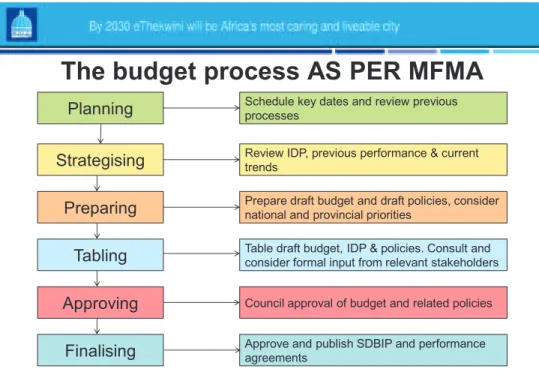
7 Budget Process 31
8 Budget Assumptions 34
9 Measurable Performance Objectives and Indicators 40 10 Budget Related Policies: Overview and Amendments 42 11 Alignment of Budget with Integrated Development Plan 44
12 Overview of Budget Funding 48
13 Disclosure on Implementation of MFMA & Other Legislation 57 14 Service Delivery and Budget Implementation Plan 58
15 Statistical Information 58
16 Budget Related Resolutions 66
17 Consolidated Budget 74
18 Parent Municipality 174
19 Municipal Entities 196
20 Municipal Manager’s Quality Certificate 219
1
Abbreviations and Acronyms
CPIX Consumer Price Index DCM Deputy City Manager DoRA Division of Revenue Act
DOHS Department of Human Settlements
DPLG Department of Provincial and Local Government DTPC Dube Tradeport Corporation
EMA EThekwini Municipal Area
EXCO Executive Committee
GDP Gross Domestic Product
GRAP Generally Recognised Accounting Practice IDP Integrated Development Plan
IRPTN Integrated Rapid Public Transport Network
IT Information Technology
Kl Kilolitre
Km Kilometre
kWh Kilo watt hours
KZNPA KwaZulu-Natal Provincial Administration MFMA Municipal Finance Management Act MPRA Municipal Property Rates Act MSFM Municipal Services Financial Model
MTREF Medium-term Revenue and Expenditure Framework
MW Megawatt
NERSA National Electricity Regulator South Africa
NT National Treasury
PPP Private Public Partnership
SALGA South African Local Government Association SDBIP Service Delivery and Budget Implementation Plan TEU Twenty-foot Equivalent Unit
TIKZN Trade and Investment KwaZulu-Natal
2
Map of Ethekwini Area
ETHEKWINI MUNICIPALITY
3 EXCO
CITY MANAGER
DCM
COMMUNITY & EMERGENCY SERVICES
DCM
PROGRAMME MANAGEMENT
DCM FINANCE
DCM GOVERNANCE &
INTERNATIONAL RELATIONS
DCM
CORPORATE & HUMAN RESOURCES DCM
HUMAN SETTLEMENTS &
INFRASTRUCTURE DCM
ECONOMIC DEVELOPMENT &
PLANNING
4
4. MAYORS REPORT (BUDGET SPEECH)
Cities are the lifeblood of nations. The prosperity and future growth of nations is inextricably linked with the growth and development prospects of their Cities. If South Africa is to prosper and grow into the future, its success is dialectically connected with the performance of its cities. If KZN is to prosper as a Province, this will only become possible if its cities are doing well. It is therefore a truism that the performance of eThekwini Municipality is one of the central barometers for measuring the development and growth prospects of not only the people of eThekwini, but also the province as a whole and logically the country at large.
This Budget Speech takes place against the backdrop that South Africa will be celebrating 20 Years of Freedom in April 2014. This is an historic milestone since the birth of our democracy. Within this period, we can count significant achievements in terms of service delivery. At the same time we do acknowledge that there still remain a bigger challenge of further expanding these services and infrastructure to those who have not yet been fortunate to access them. It is for this reason that the Theme of this Year’s Budget Speech is: “Positioning ourselves to meet unmet needs and aspirations as we move towards the 20th Anniversary of our Freedom.”It is this recognition about the importance of our performance as a City that has informed how we have structured our priorities and budget for the Mid-Term Expenditure Framework and the annual budget for 2013/2014 Financial Year.
ACHIEVEMENTS:
The achievements of the 19 years of democracy can be enumerated. In fact, evidence is there for everyone to see.
It is only prudent that we should reflect on some of the achievements and challenges over the past 10 years.
Our service delivery achievements include (amongst others) the following:
- 125 669 housing units have been built between 2002 and 2012 - which is a record unsurpassed by any local government in the country.
- 67 946 new electricity connections have been achieved between 2008 and 2012
- Solid waste services have been extend to 945 910 formal and 687 000 informal houses (100 % coverage) - Water Supply to 730 650 formal customers
- 253 000 houses with free basic sanitation - 518 200 houses with free basic water
- Provision of 106 lane km of new roads and 110 lane km of gravel to ‘black-top’ roads. In addition, we are rehabilitating some major roads which are assets to the City as their economic impact is huge.
- Construction of 305 km of sidewalks - And Construction of 46 pedestrian bridges
Over the years we have seen a number of major projects that have changed the face of the City. These include the opening of the new King Shaka International Airport, the development of the Dube Tradeport, the construction of flyover bridges in the Warwick Junction that have made access in and out of the City simpler as well as the investment on the beachfront upgrade. Investments in facilities like the Inkosi Albert Luthuli International Convention Centre (ICC), UShaka Marine Theme Park and the iconic Moses Mabhida stadium have assisted the City in gaining international exposure through the hosting of high level international events like the World Cup, COP 17 Climate Change Conference and most recently the BRICS Summit, to mention but a few.
Mr Speaker, these are the tangible achievements that we should all be proud of and this should encourage us to work even harder to extend these services and infrastructure to all our people. On top of that the Municipality has received a number of awards from different institutions in recognition of the service delivery progress. These include:
SALGA awards for the following :
o Human Settlement award – best delivery of houses o Blue Drop Status- clean water category
COGTA KZN Awards for the following : o Best Integrated Development Programme
o Best own Metro in the District Municipality Category o Best Innovative Infrastructure
Top Business Portfolio Award
o Winner for Promotion of Sustained economic growth
Govan Mbeki Human Settlement Awards by the National Department of Human Settlement o Recognition for delivering of houses
o South Africa’s “Greenest “ City Award
Fellow Councillors,
Despite our best effort to deliver services, the outlook of the South African society still reflects an unhealthy picture of inequality, dualism and marginalisation. We still have a dual economy, one for the poor who still require the provision of basic services and the other for those who are well off whose main concern is about the level of service that they receive. In fact to be brutally frank and honest, there are still a number of people who remain dissatisfied and impatient about our progress because they feel that many of their needs and aspirations remain unfulfilled, their dream deferred! Across the length and breadth of our glorious City, we can hear their cries of anguish and calls for help. From our own visit to different Wards, we can physically identify with their needs and feel their pains.
ZANELE’S STORY
At this stage I wish to share with you an anecdotal account of the life of 13 year old, Zanele, who lost her parents and lives with her siblings on the outskirts of Durban. Life is a daily struggle for her as she has to fend for herself and her little siblings. At such a tender age she has taken over the role of a parent and has to attend to household chores before going to school. The only regular source of food for her is the school feeding scheme as well as donations from Good Samaritans and neighbours.
The life of this 13-year-old girl reflects the kind of life that is being endured by scores of children in many parts of the City and in the country as a whole. It is a sad reality that we have to keep in mind in all our plans and actions, and should propel us to utilise every available resource to address the service delivery backlogs. However, it is such stories that have led our Honourable Premier, Dr Zweli Mkhize, to come up with an intervention programme like Operation Sukuma Sakhe, through which we have managed to intervene in desperate situations. There are many real stories to tell about the successful interventions that we have made to assist those that are vulnerable and less fortunate.
During the Mayoral Izimbizo last year we visited KwaSanti where we found Gogo Meyiwa who was living in a dilapidated shack which could fall on her at any minute. The condition of that house was so bad that one could hardly be able to stand while inside.Today I’m happy to tell you that through Operation Sukuma Sakhe we were able to mobilise resources, and a house has been built for the elderly citizen.
We did the same for the Mkhize siblings from Clermont, who lost four family members after they had eaten poisonous mushrooms. 18-year-old Siphelele and Siphamandla (9) were the only survivors in their family and on March 15th this year we managed to hand them keys to a new two-bedroomed house in KwaNdengezi, that was built using the new housing technology which we hope to utilise to deal with the housing backlog and to eradicate informal settlements. There are many other similar cases where we have intervened successfully.
Honourable Speaker, we continue to endure a lot of hazardous situations in our informal settlements. A week does not pass by without us receiving reports of a fire having left scores of people destitute. We have been working closely with the Provincial Department of Human Settlements to intervene in such situations by providing interim relief as well as building material to allow those affected to rebuild their dwellings.
Just in the past week I visited the Khayelisha Informal Settlement in Clairwood where over 240 shacks were razed by the fire, and over 500 people were left destitute. I and Councillor William Zenzile coordinated efforts to bring relief to the affected people, and within a few hours graders and dump trucks were on scene to remove all the debris and level the ground for people to start rebuilding immediately. We did this using our own Municipal resources which did not necessarily require us to go through protracted tender processes. Housing officials also assisted in ensuring that the rebuilt shacks were constructed in an orderly manner to allow spaces in between the houses. What this said to me was the fact that with better coordination and cooperation between us as political leadership and officials we can make a difference.
PRIORITIES AND PRIORITIES OF PRIORITIES
Mr Speaker, this budget has been informed by inputs from different stakeholders and these have been captured and reflected in our Integrated Development Plan (IDP). As the Council we have identified the following priorities in the IDP:
• Service delivery backlogs;
• Human settlements;
• Economic development
• Financial sustainability;
• Mitigation and adaption of the municipality for climate change;
• Water crisis;
• Access to public transport;
• Human capital development;
• Energy crisis;
• Health of society;
• Food security;
• Sustainable spatial form;
• Rural development;
• Infrastructure degradation;
• Undermining natural capital;
• Safer city
However, we have also gone further to identify priorities of priorities. These are priorities that rank as critical challenges in our pecking order and therefore requiring urgent interventions. Our priorities of priorities have been influenced by the feedback received from Mayoral Izimbizo, Zonal Budget Hearings, Masakhane and Operation Sukuma Sakhe programmes. These are:
Eradication of transit camps;
Water crisis affecting western and northern areas of the City;
Slum clearance
Provision of sanitation in both rural and informal settlements;
Electrification of rural areas and informal settlements
Rehabilitation of existing housing stock in the R293 and ex-Own Affairs areas
And as such it is only prudent that I should deal with each one of these priorities of priorities. We believe that if successfully implemented these will set us on a sound footing as we head towards the third decade of our democracy.
Eradication of transit camps and slums clearance
During the Mayoral outreach programme we visited several transit camps that were created as a stop gap measure to house people who were either on the way of development or found themselves left out of in situ upgrade projects. There are about 10 400 people living in these transit camps. However during our oversight visits we have seen the horrible conditions that these people are living under. It is also unfortunate that some of them have stayed in these camps, which were supposed to be transit sites, for more than seven years. As the Council we have taken a bold decision to get rid of these camps and to fast track the relocation of people living in these dwellings.
We have set aside R10-million for the piloting of the alternative housing technology programme and we will be launching the project next month in June. Pieces of land have been identified for this purpose as well as for the broader project of eliminating slums.
Electrification and provision of sanitation to informal settlements and rural areas
As the Executive Committee and Council we have taken several bold decisions that will assist us in dealing with some of the challenges of access to services for people living in informal settlements. A pro-active and broad-based programme aimed at providing a range of basic interim services to a number of prioritised informal settlements within the Municipality has been developed with a view to addressing these basic issues. The Municipality is working with the Department of Energy to provide electricity to about 300 000 informal dwellings in eThekwini as part of the Integrated National Electrification Programme (INEP). The Municipality recently approved R750 million for the provision of electricity to informal settlements as part of the overall project to provide interim services to informal settlements that are not on the list of upgrade in the short term. There are 16 informal settlements that have been earmarked for this programme. And as part of that programme we have also seen the roll out of the provision of water and sanitation services, including stand pipes and ablution facilities.
Water crisis
Honourable Speaker, as we are moving with speed to unlock development and expand services especially in northern parts of the City, this also means added pressure on our infrastructure. Coupled with other reasons, this has led to the shortage of water supply in many parts of the City, especially in the north and western areas. With the focus of development moving towards the north and a number of projects mushrooming, this will create further constrains on our resources. While we are awaiting the completion of the Western and Northern Aqueducts, it is incumbent upon every citizen to use water sparingly and we urge them to report leaking pipes. For those areas where we still lack capacity we have made provision for the purchase of extra water tankers to supply water to those communities and 10 000 Jojo tanks for water harvesting. This is also part of the campaign to save water which was launched recently by the Minister of Water Affairs, Edna Molewa.
GOOD GOVERNANCE
EThekwini Municipality has since its formation in December 2000 continued to receive unqualified audit outcomes with other matters of emphasis. This signifies progress in terms of good governance. However, it is important to note that there were instances where lapses were uncovered in the past through the Manase Report whose recommendations are being implemented currently. In 2013/2014, our commitment is to raise the bar by receiving Clean Audit Outcome. This will entail amongst others:
Cutting irregular spending to zero and strengthening our governance framework in respect of Information and Communication Technology environment;
Improving the maturity levels of the implementation of the eThekwini Enterprise Risk Management Framework;
Strengthening the capacity of our Internal Audit Unit and the City Integrity and Investigations Unit and continuing the path of zero tolerance against fraud and corruption and improving internal control and performance monitoring and evaluation environment so as to bring us closer to a clean audit outcome; and Strengthening our oversight role as Councillors.
Mr Speaker, under your stewardship and guidance, we have established Ward Committees in 101 Wards with the exception of Ward 1 and 7. I want to urge you Mr Speaker to expedite the finalisation of the launch of these Committees in the affected Wards. During the Medium-Term Expenditure Framework we are going to focus primarily on three strategies:
Firstly, at ensuring that Ward Committees are capacitated to strengthen their effectiveness in the quest to build a developmental and capable state. We will do this by taking them through a training programme which is accredited by the South African Qualifications Authority;
Secondly, to drive the process of ensuring that every ward has its own Ward-Based Plan developed through the community based planning model, which informs the City-wide integrated development planning; and Thirdly, to ensure that Ward Committees are a central nerve for operationalising effective War Rooms and the implementation of Operation Sukuma Sakhe thus ensuring proper co-ordination of development interventions at a local level.
Ward committees are going to be the basic nucleus of public participation for councillors as enshrined in the legislation and Constitution
Honourable Speaker I am delighted to pronounce that there has been a formal gazetting in terms of Section 81 of the Municipal Structures Act, where it has been determined that 17 traditional leaders that have jurisdiction in the eThekwini area will participate in Council proceedings. We are glad to acknowledge the presence of Amakhosi AseNdlunkulu today. We regard their role as critical in driving rural development as you are aware that almost 60 percent of eThekwini land is rural. And also with a view to expanding customer services to all areas, we will increase the services offered at the Sizakala Information Centres especially the ones located in rural areas. We will also initiate discussions with the 12 other Traditional Leaders regarding the establishment of Sizakala Information Centres in their Tribal Courts.
INFRASTRUCTURE-LED DEVELOPMENTAL STATE
President Jacob Zuma has launched an unprecedented capital expenditure programme on infrastructure and as such eThekwini is set to be one of the major beneficiaries of this multi-billion-rand investment. To highlight the importance of infrastructure in development I wish to extract a quote from Price Waterhousecoopers, Cities of the Future: Global Competition, Local Leadership:
I quote:“The enormous complexity of cities today means that the demands on their infrastructure are relentlessly challenging. Not only are the ‘basic needs’ of transport, housing, water and energy under strain, but new demands for effective communication make the supply of, for example, broadband and electronic networks an increasingly important element of infrastructure provision.”
Consistent with this public policy stance, during the Medium-Term Expenditure Framework, as eThekwini Municipality we plan to invest over R17 billion in public infrastructure to propel economic growth, address backlogs, facilitate small micro and medium enterprises, reducing poverty, joblessness and inequalities. More of this investment will see us unlocking bottlenecks in order to create an environment that is conducive to attracting investors. EThekwini is at the centre of national government’s Strategic Infrastructure Programme (SIP2) and we are preparing ourselves to fully participate in this process, especially those projects that a linked to the Port expansion and the King Shaka International Airport.
There are currently a number of programmes and projects being undertaken as part of the City’s priorities in a range of sectors most of which align with National Governments focus on infrastructure development and job creation. Several major infrastructure projects that form part of the SIP’s announced by Government, include the second phase of the 55 km Western Aqueduct, the Aerotropolis, Dube Trade Port, King Shaka International Airport, dig-out port, logistics hub development, dedicated rail and links, Durban to Gauteng rail upgrades - all multibillion rand projects, which are key infrastructure developments of the Provincial Growth and Development Strategy. In support of the expansion around the Port of Durban and the Durban-Free State-Gauteng corridor development, the Municipality has developed a Draft Back of Port Local Area Plan which proposes changes to the future land use and zoning in areas or precincts around the extended Port. The Bridge City Rail Link, the largest rail infrastructure development project in the Durban area is on schedule. Cato Ridge is also one of the strategic areas on the borders of the N3 transport artery. The Cato Ridge Local Area Plan which includes a Cato Ridge Industrial Precinct Plan and a Cato Ridge Village Precinct Plan was recently approved by Council. Cato Ridge will be developed as a support location for the Dube Trade Port and Durban Harbour. Over the next three years the Municipality will be investing in the upgrade of bulk infrastructure in Hammarsdale. This is to improve capacity to accommodate the inflow of recent interest shown in both industrial and business developments in the area. Construction of the Hammarsdale Junction, a retail shopping centre is currently underway and will be opening for business in the near future.
We are also moving with speed to unlock development challenges in the flagship Cornubia mixed use human settlement development project, which is expected to yield about 25 000 housing units, as well as industrial development in close proximity. Strategically located, Cornubia also presents an opportunity to deal with informal settlement eradication, local economic development, job creation and poverty eradication all in a totally integrated and innovative manner. We are happy to learn that the private sector has responded positively to the available investment opportunities as part of the Cornubia development.
Some of the major capital projects that have been catered for in the MTEF are:
Water loss intervention programme – R150 million R1,864 billion is set aside for Electricity Infrastructure
R1,96 billion is budgeted for low cost housing and infrastructure R380 million for the Northern Aqueduct
R924 million for the Western Aqueduct
Roads Rehabilitation and Reconstruction, and new access road - R1,925 billion R2.148 billion for upgrade and Expansion of Wastewater Treatment Works New Central Library has a budget of R321 million
R440 million is set aside for economic development projects
R703 million is made available for the provision of ablution blocks in informal settlements.
INTEGRATED RAPID PUBLIC TRANSPORT NETWORK (IRPTN)
One of the goals for transport in eThekwini is to implement an effective, efficient, sustainable and safe public transport system. To achieve a sustainable public transport system, it will be necessary in a number of areas to prioritize public transport upgrades and budget at the expense of car users. To this end and in line with legislative provisions, the eThekwini Transport Authority (ETA) has developed a “wall to wall” integrated rapid public transport network (IRPTN) plan for the entire eThekwini municipal area that responds to the demand of the existing and forecasted activity patterns in accordance with the municipality’s spatial development framework.
The integrated network comprises a system of trunk, feeder and complementary routes that connect bus/minibus services to key nodes on the trunk routes. The IRPTN network will be within 800m (10-15 minute walk) of more than 85 percent of the municipality’s population. The plan will be implemented in a phased approach over the next 10 to 15 years to provide various forms of priority infrastructure for bus trunk services including: transfer stations;
park and ride facilities; information, communication technologies; fleet; non-motorised transport facilities; and depots and control centres.
Detailed planning has already begun on phase 1 road and rail corridors. The road based routes start from Bridge City to Warwick, Bridge City to Pinetown, Bridge City to Umhlanga Corridor and the rail corridor starts from Bridge City and Kwamashu via Berea Road to Umlazi and Isipingo. The construction work for phase 1 will start in the next financial year.
The Integrated Freight and Logistics Strategic Framework and Action Plan for eThekwini aims to develop an efficient and integrated freight and logistics system that will ensure regional economic stability. The region’s transportation system requires the optimum integration of the different modes of transport that includes road, rail, aviation, maritime and pipeline with the appropriate modal balances. The integrated freight and logistics strategic framework and action plan for eThekwini will look to develop a multi-dimensional approach to freight planning, infrastructure and operations in the city by developing interventions over a 20 year period that relate to:
Infrastructure: freight routes and roads;
Operational: operational interventions that can ease the port-city-private sector interfaces and breaks in the logistics chain;
Regulatory: legislative and enforcement that would promote compliance in the logistics and freight sector;
Communication and network: it solutions, as well as stakeholder interactions that would ensure information sharing and ongoing management.
The formulation and implementation of this plan will involve a number of stakeholders and agencies in government and the private sector. A detailed set of interventions ready for implementation will be completed by December 2013, and these will form part of the sip2 national government interventions along the Durban – Free State – Gauteng corridor.
HOUSING
The provision of proper housing remains one of the top priorities of our Municipality. We have seen a number of protests around the City in recent times and at the centre of the people’s complaints is the issue of proper housing.
Fellow Councillors, we remain committed to our long term plans to eradicate informal settlements in eThekwini.
Like all other big Metropolitan Councils, we are faced with a huge backlog when it comes to housing delivery, which stands at over 410 000units and there were 638 informal settlements scattered around eThekwini which we have managed to reduce to 476. We also have over 10 400 people living in transit camps. I would advise all listening to this speech that the numbers I am referring to are hard to keep down – the reason being that our success in the delivery of services attracts more people who want settle within our Municipality. This year we are planning to deliver 8500 houses and we are targeting a total of 32 000 by 2016/2017. This is in direct response to a call by the Premier who has set a target of 40 000 houses in the Province, and more than half of these are expected to come from eThekwini. A budget of R 1.9 billion has been set aside over three years for housing delivery and related infrastructure.
Mr Speaker, I am happy to report that the finalisation of the first phase of the Cornubia Human Settlement development is progressing well and we expect the relocation to houses for Phase 1 A to commence in mid July 2013. A number of infrastructure will be upgraded to enable this massive development to be accessible. Cornubia Phase 1B will yield more that 1500 services sites. The Industrial Business Park has sold 70% of 80 hectares of platform to businesses. This indicates the true integration and new job opportunities that will be realised by the communities within that radius. A Social Economic Development Plan is being conceptualised to maximize on the opportunities that will be presented by this development.
I’m also happy to report that upgrades of R293 houses is expected to commence in July 2013.
Through the Storm Damage Programme we have intervened and assisted many families whose houses were destroyed by the inclement weather across the City. Many of these families are found in rural areas and townships, and the impact of this intervention is visible. We are still engaging with the MEC for Human Settlements, Honourable Ravi Pillay to give us more resources in order to deal with the backlog in the repair of houses and infrastructure damaged by the storms.
Let me also take this opportunity to address some of the misconceptions that have been peddled in some quarters related to the housing allocation list. I wish to reiterate what has been pointed out before, the fact that there is no housing waiting list in eThekwini. However we do have a data base that we use to track the number of people living in informal settlements and other structures. We are guided by an allocation policy when it comes to the allocation of houses to beneficiaries, and Councillors are not involved in this process. We hope that this matter will now be put to rest.
CLEAN MY CITY PROGRAMME
On the second of May 2013, I launched the comprehensive and integrated maintenance programme under the theme “Clean My City.” This is in response to our observation that notwithstanding the resources we spent on maintaining our City, the outcomes have not been pleasing. We have observed that a number of challenges remain:
Our CBD, secondary CBD’s and towns, bus and taxi ranks, areas where there is street vending, train stations and railway servitudes are filthy;
Absence of ablution facilities within the CBD, secondary CBD’s and towns Illegal dumping
Drainage systems Pavements Potholes
Street and traffic lights Outages
Over-grown verges and trees
Unsafe and hazardous buildings Crime and drug abuse
Bad and hijacked buildings
Through this programme we aim to address all of these challenges. The emphasis will be on ensuring that we get value for money from all contractors and co-operatives employed by the City and increase management and supervision of our staff to achieve higher productivity. We also plan to increase enforcement of our by-laws and to introduce new by-laws to tighten the noose around those who have the propensity to litter our streets and to disregard acceptable norms and practices. We therefore call upon all communities, businesses, schools and other educational institutions, trade unions, community-based organisations, religious organisations and the media to join us on this historic Clean My City journey to reclaim our streets, settlements, suburbs and villages. Towards October, a major stakeholders’ summit will be convened with a view to soliciting public responses on how we need to sustain our interventions and to devise strategies for modifying people’s attitudes and behaviour towards littering in the City.
ECONOMIC DEVELOPMENT
TOWNSHIP DEVELOPMENTS 2013/2014
The formation of the eThekwini Municipality in 2000 was coupled with the finalisation of the Long Term Development Framework, that has set as one of its objectives; the unwinding of the Apartheid Legacy. Firstly I must acknowledge the contribution of my predecessor, the former Mayor Councilor Obed Mlaba, who emphasized that development in under-serviced areas was critical for the stability of the City.
Whereas eThekwini Municipality successfully secured grant funding from the Neighbourhood Development Partnership Grant in order to stimulate development in former R293 townships; in this Medium Term Expenditure Framework eThekwini will focus a lot on improving access to and from townships, develop and support development nodes along priority corridors within townships, in order to integrate and normalise those communities as well. As we speak, eThekwini has allocated approximately R20 million towards the Mpumalanga Town Centre in the 2013/2014 financial year. This is in addition to the R30 million and R12 million already invested by National Treasury and KZN COGTA respectively, in the recent past.
At the KwaMnyandu node in Umlazi, eThekwini Municipality has allocated R12 million towards upgrading the public realm, in preparation for the KwaMnyandu Shopping Centre and other developments earmarked for that node. I am particularly proud of the KwaMnyandu Node development, in so far as: it has demonstrated the real potential of both the public and private sector in addressing pro-actively, the challenges associated with broad based empowerment. I sincerely hope that other developers interested in developing in eThekwini’s townships will learn from the Fundamentum Asset Management Group’s approach.
However, I do acknowledge that, due to the high levels of poverty, unemployment, inequality and opportunistic behavior of a few individuals found in our townships, township development requires far greater community facilitation. In rolling out the KwaMashu Furniture Incubator, I will personally ensure that there is sufficient and extensive community consultation in order for this project to be realized and finalized.
I will be expecting quarterly progress reports from the Heads of: eThekwini Transport Authority, Engineering Services and Economic Development, with regards access into and out of townships. The structural economy and settlement patterns found in townships; has to transform and promote sustainable development.
GREEN ECONOMY PROGRAMMES
A green economy is one that results in improved human well-being and social equity, while significantly reducing environmental risks and ecological scarcities. In its simplest expression, a green economy can be thought of as one which is low carbon, resource efficient and socially inclusive. Given the threats to human life that are associated with climate change, habitat fragmentation, and large scale biodiversity loss, it is clear that we are walking an increasingly tenuous path. In order to adapt, survive and ultimately thrive, the eThekwini Municipality needs to engage in much more meaningful way in the Green Economy. This will need to be achieved through a strategic and
focussed approach, and also requires integrated strategies that effectively balance the economic, environmental and social development initiatives. This balance requires carefully crafted policies and frameworks geared towards practical action.
In order to support the green economic growth plan, additional research and development will need to be initiated and embedded into city programmes. This will allow for effective monitoring and validation of projects undertaken ensuring that correct targets are being met. Importantly, all citizens of the Municipality need to understand that we have no option but to manage our natural resources in a sustainable way, and we can only hope to achieve this by fully embracing the green economy. The eThekwini Municipality, together with various partner organisations is already piloting a Community Ecosystem-based Adaptation (CEBA) initiative. This catchment-based initiative is bringing businesses and residential communities together around the common cause of ecosystem restoration and protection.
We now understand that by protecting our natural environment and ecosystems, we also ensure optimal resilience for communities that face the negative effects and impacts of climate change. The initiative ensures that skills development and small business support are at the forefront of work undertaken. This model has recently been recognised at the international level as being the most innovative and productive. The initiative ensures that green jobs are promoted in all relevant sectors, and particularly in those which relate to alternative energy, sustainable transport, green buildings, sustainable consumption and production, green cities and towns, and ecosystem services. Green jobs are defined as those which reduce the environmental impact of enterprises and economic sectors, ultimately to levels which are sustainable.
The eThekwini Municipality’s reforestation programme, initiated in November 2008 is creating a carbon sink to help offset carbon dioxide emissions associated with Durban’s hosting of several large events such as Fifa’s 2010 Soccer World Cup. The holistic reforestation approach works to address the full scope of climate change mitigation and adaptation, rural development, poverty alleviation and biodiversity conservation. The approach is also directly in line with the low carbon, resource efficient and socially inclusive prerequisites listed as part of South Africa’s objectives for a Green Economy.
Durban’s ‘edge’ is that the reforestation projects demonstrate exceptional benefits to local community members, who grow the trees. These people, referred to as ‘treepreneurs’, are able to exchange their trees for food-stuffs, household goods, building materials, bicycles, or even school fees. The project also employs full-time and part- time staff, as well as a large number of other staff on short-term contracts. Reforestation has demonstrated clear benefits in this regard and Durban is now a recognised global leader in the field. This year the Development Bank of Southern Africa approved grant funding for the eThekwini Municipality. The Municipal reforestation budget, for the forthcoming three years, amounts to almost R 27 million and the grant funding, from the National Green Fund, amounts to almost R 40 million. The grand total thus available for the reforestation programme, for the coming three years is just over R 66 million.
In addition to these initiatives, we are committed to projects that will further the greening agenda for our City. As such over the next three years we are committed to plant as much as 300 000 trees in all parts of the City. This will provide additional job opportunities, especially for our youth and women, while at the same time instilling a sense of pride in our environment.
TOURISM AND EVENTS
Tourism remains at the centre of our strategy to grow the City’s economy and create employment opportunities.
Our City has built a reputation of hosting major events and in recent times we have hosted the Africa Cup of Nations Tournament, the BRICS Summit, TAFI-2013 International Travel Convention, the MTV Africa All-Star, Tourism Indaba and the African Renaissance Conference and Festival. Other events coming up include the Durban July, the Top Gear festival and the Manchester City Tour which will form part of the Nelson Mandela Birthday celebrations in July.
Ladies and gentlemen, the number of events that we are hosting as the City is in line with our strategy of having an all year round events calendar, which assists in opening up opportunities for not only the tourism sector, but also other related industries including the hospitality and restaurants. We do not just host these events for the sake of expediency, like it has been suggested by some people. We do this because we believe that events tourism has a
a huge potential of unlocking the stubborn unemployment rate due to the enormous spin offs for our economy. The recognition of Durban’s reputation as Africa’s Sports and Events Capital also shows that we are reaping the benefits of investing in world class facilities like the Inkosi Albert Luthuli International Convention Centre (ICC), Ushaka Marine Theme Park, the iconic Moses Mabhida stadium as well as the upgrades of the beachfront promenade.
BUDGET
The 2013/2014 Medium Term budget proposes a total consolidated budget of R 33.8 billion, which is comprised of a R 5.4 billion capital budget that continues to reflect consistent efforts to address backlogs in basic services and the renewal of the infrastructure in the City and an operating budget of R 28.4 billion that will make provision for the continuation of the services provided by the Municipality.. This includes the provision of costs to address service delivery backlogs, bulk purchases of water and electricity accounting for 28.4% of the operating expenditure, repairs and maintenance of infrastructure, employee related costs as a result of filling of vacancies and provision for salary increases and the impact of capital spending on the operating expenditure. The provisions in this budget continue to support Government’s commitment to broadening service delivery and expanding investment in infrastructure, while taking into account the constrained fiscal environment. EThekwini has one of the best service delivery programmes in Africa, and we have ensured that over 75 % of residents have access to basic services.
Nationally, our Municipality is used as a financial model for financial governance and we are making great strides environmentally.
RATES and TARIFFS
When rates, tariff and other changes were revised local economic conditions, input costs and the affordability of services were taken into account to ensure the financial sustainability of the City. As a way of cushioning the blow on our ratepayers, the Municipality has kept electricity increases to a minimum and I am pleased to announce that tariff increases for electricity will be an average of 5.5%, down from the initial proposal of 8%.
Other tariff increases are as follows:
SERVICE 2013/2014 2014/2015 2015/2016
Assessment Rates 6.9 % 6.9% 6.9%
Water
- Residential - Business
9.5 % 12.5 %
7%
9%
6.5%
7.5%
Electricity 5.5 % 8% 7.5%
Sanitation 6.9 % 9% 8.6%
Refuse 6.9 % 5.7% 6.2%
LIFE LINE FOR THE INDIGENT
The Municipality recognises the tough economic conditions facing the poorest of the poor. It is for this reason that we continue to develop and implement policies that are meant to cushion the poor from these tough times. A social package totalling approximately R2,7 billion rand is catered for in this budget. The basket of Life Line package for the indigent is a as follows:
Properties valued up to R 185 000 will be exempt from paying rates.
All other properties valued above R 185 000, the first R 120 000 no rates charged
Pensioners, child-headed households, disability grantees and the medically boarded are exempt from paying rates on the first R460 000 of their property value (This amount is inclusive of the R120 000 mentioned above). For pensioners there is a cap of R3 million rands of property value.
No rates levied on first R 30 000 value of vacant land
The first 9kl of water is free to households with property values under R 250 000.
The first 50kwh of electricity is free to residents using less than 150kwh per month in Eskom reticulated areas
The first 65kwh of electricity is free to residents using less than 150kwh per month in eThekwini reticulated areas
Residential property valued up to R 250 000 exempt from domestic refuse removal tariff The first 9kl of effluent disposal is exempt for all properties with values under R 250 000
Honourable Speaker, this brings me to a point where I want to talk about some of the challenges that are having a negative impact on development. These include non-revenue water, theft of electricity and cable theft as well as land invasion.
Non Revenue Water
The Municipality loses approximately R400-million in water that is lost and unaccounted for, either through leakages and illegal connections. This totals about 36 percent of the total bulk water purchased from Umngeni Water. While strategies are being put in place to deal with this challenge, especially in terms of infrastructure upgrade and detection of leaks, it is however unacceptable that our people continue to connect onto our mains illegally. We believe that the relief package that the Municipality offers now makes it possible for every poor family to have a legal connection, as long as they are disciplined to utilise the water sparingly. I therefore wish to extend a call to all residents of eThekwini who have illegal water connections to come to our offices so that they could be regularised through the water amnesty which makes it possible to be legal without losing your metre, provided that you come forward and pay a minimum fee of R250.
THEFT OF ELECTRICITY
The Municipality is losing about R40 million a year because of illegal electricity connections and we are also concerned about the number of deaths caused by electrocution due to dangerous connections. This is more so prevalent in areas adjacent to informal settlement. The Municipality continues to implement anti-theft campaigns, including covert operations in informal settlements. The municipality has also used protective structures to secure its electricity meters to prevent unauthorized access to the meters. The rolling out of interim services to informal settlements, including electrification programme will assist in eliminating this challenge. We urge our people to be patient and not connect themselves as this is not only illegal but results in loss of life and limb.
CABLE THEFT
Cable theft continues to pose a serious risk on our electricity network and negatively impacts on the assurance of supply of electricity. This scourge has caused unplanned outages to many parts of the City resulting in serious disruptions to people’s lives and the economy of the city. We call upon our people and stakeholders to report incidents of cable theft to the police or the municipality and to name and shame businesses that are engaged in illicit trade in cable. We call upon the criminal justice system to impose harsher sentences on those found guilty of this odious crime.
LAND INVASION
A worrying trend of the invasion of land by people who are desperate has grown over the past few months. We have taken a firm stand on this issue because we do not want to see any further proliferation of informal settlements which could run out of control if not stopped. We once again appeal to people who are homeless to be patient as
we are exploring every avenue to speed up housing delivery. We urge them to be vigilant and not to allow themselves to be used by people who have their own agendas.
INTERNATIONAL RELATIONS
Our international relations programme has seen about 16 cooperation agreements signed with different cities across the globe. We also have a focus on Africa and NEPAD. We have accords with the cities of Bulawayo in Zimbabwe, Port Harcourt in Nigeria, Maputo in Mozambique, Libreville in Gabon and Mombasa in Kenya. We are also a designated NEPAD City and we keep in close contact with the NEPAD programme under the Department of International Relations. The Sister City relations have seen programmes in the following areas:
Capacity building
Urban renewal programmes Urban transport planning Housing and infrastructure Economic Development Trade and Investments Tourism
Sports, Arts and Culture
We are still to intensify our efforts in this area to yield even more returns for the developmental objectives as a City. In the coming year we are going to have 35 programmes that are going to be run with these Sister Cities. We also have been nominated as a BRICS Partner City by the Honourable Premier of the Province, Dr Zweli Mkhize and we have been directed to convene the next Partner Cities Summit by May next year. The BRICS Partner Cities are St Pietersburg in Russia, Sao Paulo in Brazil, Mumbai in India, and Quingdao in China.
YOUTH DEVELOPMENT
Addressing youth unemployment remains a critical objective of our investments as the City. The recent Census Report has confirmed what we have known for a long time, the fact that the majority of those who are unemployed are young people. It is for this reason that we must continue to invest in programmes and projects that would yield employment opportunities for this sector. To further explore other opportunities for young people, as the Mayor of eThekwini I will be convening a youth summit during the course of this year. We want to create an opportunity to engage young people and to get recommendations from them on how to best address unemployment and skills development.
Part of the intervention over the next three years, include the roll out of a healthy lifestyle programme, through which we intend to provide gym facilities and equipment in the 17 Zones of the Metro. We want to explore the utilisation of the community halls and sporting facilities as gyms venues. We applaud those community members that are already taking an initiative in this regard.
We will continue to invest in sports development as well as in arts and culture programmes that will assist in keeping our youth occupied and open up employment opportunities. The creative industry is one of our focus areas in terms of unleashing the vast talents, especially in townships. We are investing about R4,6 million in the Durban Film Office so that we can continue to encourage local productions. The Zibambele Poverty Alleviation programme has been allocated R 75m as part of the Expanded Public Works programme (EPWP), through which we intend to empower local cooperatives.
The Municipality as an employer is also committed to giving our young people an opportunity to get exposed to the work environment through learnerships. As such we have taken a bold decision to drastically increase the amount of student intake from the current 200 to 2000. This number will be increased as and when funding becomes available.
HIV/AIDS AND TEENAGE PREGNANCY
Our youth continue to suffer most from communicable diseases like HIV and AIDS and TB. Through the eThekwini Aids Council we are continuing to implement programmes that now reach Ward level. Working together with the Department of Health in the province we are committed to defeat the scourge of HIV and Aids and the new
4.12
innovations and results do show that our country is heading in the right direction towards an AIDS free society.
Some of these achievements in the health sector include the increase in the life expectancy of South Africans to 60 years, the introduction of a single-dose anti-retroviral treatment and the continued reduction in the mother-to- child transmission of HIV which has been reduced from 22 percent to 2.1 percent. While these should be applauded, however, it remains a worry that we continue to get new cases of infections and the number of young girls checking in for ante-natal care is no cause for celebration.
This clearly shows that despite the high levels of awareness, people are still not adhering to the preventative measures. I must re-emphasise the message that was delivered to us recently by the MEC for Health, Dr Sibongiseni Dlomo, when he addressed the special sitting of Council, when he called on us as community leaders to take the lead in educating our youth as well as encouraging people to test for HIV. We must also expose Sugar daddies who prey on young and vulnerable girls, thereby increasing chances of getting infected.
ALCOHOL AND SUBSTANCE ABUSE
The War Against Substance Abuse is the next challenge, more difficult and costly than the fight against HIV/AIDS.
The extent of this problem can be seen right at our doorstep, at the Albert Park, where an area has become known as Whoonga Park. The young people who have given up on life to become Whoonga addicts, tell horrifying stories of how they left their homes and prefer to live in squalor conditions in order to satisfy their addiction; because the drug is freely available and cheaper at the park. They are now chasing whoonga instead of chasing for their dreams of creating a better life for themselves and their families. Besides the law enforcement interventions that we have implemented, the story of Whoonga Park reflects a societal challenge that requires us to take urgent steps in order to save our youth.
The rape and abuse of women and children remains another worrying trend, which at face value is directly linked to substance abuse. In recent times we have witnessed horrifying incidents of rape and murder of young children, women and the elderly. Our hearts goes out to those who have been adversely affected by this scourge and we pledge our support to initiatives aimed at addressing this challenge. As part of our intervention as the Municipality we have ordered responsible departments to ensure that the thick bushy areas, especially around schools are cut in order to eliminate hideouts for criminals.
OPERATION SUKUMA SAKHE
We are speeding up the opening and launching of War Rooms in different parts of the Municipality as we seek to roll out the Operation Sukuma Sakhe Programme in every ward within the eThekwini Municipal Area. Of the 103 Wards in eThekwini, over 90 of them already have operational and fully functional War Rooms. We want every corner of the Municipality to be covered. Since we started with this programme we have made several telling interventions to assist those who are vulnerable, and some of them are cited in the case studies I mentioned earlier.
We are also going ensure that we mainstream youth and gender issues into all the programmes of the City throughout the different Clusters, especially where it relates to job creation and economic empowerment.
VOTER REGISTRATION AND ID CAMPAIGN
As mentioned earlier, next year will mark the 20th anniversary of our democracy and as such it is also an important election year for the country. We have already seen an increase in electioneering activities by political parties.
With this election also comes a phenomenon of new voters who were born after the attainment of freedom and they will be casting their ballot for the first time, the so-called Mandela’s children. We need to encourage these young people to ensure that they have the necessary Identity Documents and that they register to vote. I also encourage those who are already registered to ensure that they check their names on the Voters roll. People living in informal settlements, which are prone to fires, are encouraged to look after their important documents like IDs and children’s birth certificates. We are supporting the ID campaign led by the Department of Home Affairs to ensure that every qualifying citizen obtain the correct documentation. This has been an ongoing campaign and is not only linked to the elections.
4.13 CONCLUSION
Compatriots, as we table this budget for adoption by Council, we are proud of the enormous achievements that have been brought by this democratic government over the past 19 years. Many of our people now have access to basic services and the face of many of the previously disadvantaged areas has improved for the better. On the other side we have acknowledged that the aspirations of many others remain a dream.
It is for this reason that we are gearing up to fulfil those dreams of owning a house, having a job, access to clean running water, electricity connection, clean ablution facilities, sport and recreational facilities, health, education, crime free environment as well as safer and healthier communities.
We will utilise all available resources to satisfy the aspirations of the vast majority whose dreams remain deferred.
As the ANC led Municipality we take direction from the programmes endorsed by the governing party. The January 8 Statement of the African National Congress’s National Executive Committee, delivered here in Durban by His Excellency President Jacob Zuma, commands us as follows:
I quote; “We remind all ANC deployees that where infrastructure and resources exist to deliver services, there can be no excuse for these services not to be delivered. We now know where the gaps exist and it is time to deliver the services that will improve the lives of our people.”
Fellow Councillors, it is my honour to table the MTEF and 2013/2014 Budget for adoption by this full Council.
I thank you.
5
5. ETHEKWINI MUNICIPALITY PROFILE
Rich in cultural diversity, Durban is a fast growing metropolitan city with many kilometres of pristine beaches, iconic buildings, vibrant cultures, exceptional creativity and famous hospitality. Durban is a world-class tourist destination offering a wide range of experiences both within the city and in the surrounding countryside. It has a magnificent beachfront along the Indian Ocean with a promenade which stretches for several kilometres.
5.1 VISION OF THE MUNICIPALITY
By 2030, eThekwini Municipality will be Africa’s most caring and liveable city.
5.2 MISSION
The purpose of the eThekwini Municipality is to facilitate and ensure the provision of infrastructure, services and support, thereby creating an enabling environment for all citizens to utilise their full potential and access opportunities, which will enable them to contribute towards a vibrant and sustainable economy with full employment, therefore creating a better quality of life for all.
5.3 LOCAL ECONOMY
The eThekwini Municipal Area is home to Africa’s first multi-model logistics platform and international passenger airport, boasting the largest port in Africa, a global conferencing, sporting and tourist destination. It is the central engine of the regional economy, and plays a major role in the South African economy. It ranks as the third largest economic centre and a very promising global competitor.
5.4 CLIMATE
The eThekwini metropolitan has mild sub-tropical climate with sunshine for the most of the year.
5.5 LAND USE
The municipality is unique amongst major urban centres in that only 35% of the metropolitan area is predominantly urban, with over 60 000 households living in traditional rural style dwellings.
5.6 STATE OF THE ECONOMY 5.6.1 OVERVIEW
In the fifth year after the outbreak of the global financial crisis, global growth has decelerated and unemployment has started to increase again. Over the medium term, the global economy is expected to recover, but growth will not be strong enough to bring down unemployment quickly. The South African Reserve Bank has downgraded its growth forecasts on the back of the weak global demand and production disruptions indicating that economic prospects may not be as strong as was thought previously. Inflation could break the top end of its official target range next year based on new calculations of price data. The household sector continues to be negatively impacted by high unemployment, low savings and high level of debt, resulting in a low level of consumer confidence.
Household Consumption Expenditure (HCE) growth should remain moderate this year, at 3.3% year on year. The labour market has deteriorated with the unemployment rate rising to about 25 per cent in the third quarter of 2012. However, National governments large infrastructure package as part of the National Development Plan which sets out an integrated strategy for accelerating growth and eliminating poverty will augur well for a positive investment climate in years to come. Locally, some major private and public sector projects may assist greatly in boosting eThekwini’s growth trajectory above the usual 3% and also help to reduce the burden on unemployment.
5.6.2 ETHEKWINI GDP PERFORMANCE
The region’s estimated GDP of R 208, 6 billion during 2012 represents a 2.7% increase over the previous year. This lower increase may be in line with the negative impacts resulting from the global crisis still affecting the national economy with the national projection having being adjusted downward.
5.6.3 PORT OF DURBAN
Import activity relating to containerised- and dry bulk cargo decreased between 2011 and 2012. Vehicle movement showed annual increases of 4.1% for imports and 12.5% for exports. This confirms the automotive sector as one of the country’s strong globally competitive sectors. The decrease in exports for containerised, dry, and break-bulk cargo is indicative of the global drop in demand for goods and other commodities, especially from South Africa’s key trading partners such as the Eurozone.
Table 2: Cargo Handling Imports
Cargo 2011 2012 Percentage Change
Containerised cargo 1,378,238 1,301,790 -5.5%
Dry bulk cargo 4,325,350.5 3,959,290.3 -8.5%
Liquid bulk cargo 24,172,200.5 25,460,976.9 5.3%
Break-bulk cargo 1,552,506.8 1,556,156.1 0.2%
Vehicles 280,284 291,838 4.1%
Table 3: Cargo Handling Exports*
Cargo 2011 2012 Percentage Change
Containerised cargo 1,342,677 1,266,334 -5.7%
Dry bulk cargo 6,179,186.1 5,534,430.4 -10.4%
Liquid bulk cargo 2,675,732.1 3,097,189.0 15.8%
Break-bulk cargo 1,543,305.4 1,200,147.5 -22.2%
Vehicles 146,545 164,865 12.5%
5.6.4 AIRCRAFT MOVEMENT
The King Shaka International Airport is currently handling in excess of five million passengers annually. The general trend in terms of visitor numbers tends to mirror the city’s tourism profile viz. more domestic than international visitors. Major international events at the City’s International Conference Centre have continued to show an increase in international passengers in 2012. However passenger volumes to the beginning of this year have shrunk and the airports company puts this down mainly to the decrease in leisure travel. In the 3rd quarter of 2012, the terminal processed 1,447,543 kg of import- and 410,798 kg of export cargo.
5.6.5 TOURISM
Tourism spend in recent years still appears to mirror the impact of the recent financial crisis and the corresponding impact on consumers for both international and domestic tourists. The graph shows a dip in 2011 following an increase between 2009 and 2010.
Tourist activity is still dominated by domestic visits to the city. There was a decrease in the number of trips for domestic tourists between 2010 and 2011, and this may be due to the high cost of living where consumers are prioritising on budgeting for food, debt-financing and other necessities to shoulder the effects still being felt by the global financial crisis. There was a slight increase of 0.42% of international tourists over the same period.
5.6.6 BUILDING PLANS PASSED
The graph below shows the building plans completed for office, retail and industrial space in the eThekwini region during the years 2006 to 2012.
There were steady increases in building plans completed for office, retail and industrial space since 2006 up until 2008/09 and the effects of the global crisis can be evidenced from the performance of all three sectors since.
However, there were slight recoveries in the office and industrial sectors.
In terms of the residential component, according to the ABSA Housing price index, the average nominal house prices in KwaZulu-Natal fell by 11.3% during the second quarter of 2012 year-on-year. Economic growth, employment, inflation, interest rates, household income and debt and consumer confidence is expected to remain key factors to the housing market.
5.7 ECONOMIC / SOCIAL DEVELOPMENT
In a highly global economy where competition for investment has intensified, only those economies that continuously improve their comparative and competitive advantages will weather the economic storm. The revised 2013/14 Spatial Development Framework has identified spatial regions in order to address some of the Spatial Development scenarios and pressures. These include logistics support, trade and investment centre, coastal tourism and recreation, agricultural support etc. The city has several comparative and competitive advantages and has in recent years enhanced these in a bid to stay ahead of the competition for investment. The municipality is on the expansion trail, with a number of strategic areas earmarked for rapid development to fit in with the city’s aim of becoming a regional power house. The second phase of the 55 km Western aqueduct pipeline is underway and will be rolled out over a seven year period. It is expected to significantly strengthen the capacity of bulk water supply to the Western regions, ultimately boosting water supply to the north of the city. There are currently a number of programmes and projects being undertaken as part of the city’s priorities in a range of sectors most of which align with national governments focus on infrastructure development and job creation. Further enhancing the provinces comparative and competitive advantages are several major infrastructure projects that form part of the Strategic Infrastructure Projects (SIP’s) announced by government. Aerotropolis, Dube Trade Port, King Shaka International Airport, dig-out port, logistics hub development, dedicated rail and links, Durban to Gauteng rail upgrades-all multibillion–rand projects, which are key infrastructure developments of the Provincial Growth and Development Strategy.