THE ROLE OF PARENT GOVERNORS IN SCHOOL FINANCIAL DECISION-MAKING: EXPERIENCES OF PARENT GOVERNORS IN NDWEDWE RURAL SCHOOLS
BY
QAPHELISANI OBED KHUZWAYO
A Dissertation Submitted in Partial Fulfillment of the Academic Requirements for the Degree of Masters of
Education
in Educational Leadership, Management and Policy
UNIVERSITY OF KWAZULU-NATAL: EDGEWOOD CAMPUS; DURBAN, SOUTH AFRICA
JANUARY 2009
SUPERVISOR'S STATEMENT
This dissertation has been submitted with/without my approval.
Dr V. Chikoko January 2009
1
DECLARATION
I, Qaphelisani Obed Khuzwayo, declare that this research report, "The Role of Parent Governors in School Financial Decision-making: Experiences of Parent Governors in Ndwedwe Rural Schools" is my own work and all sources I have quoted have been acknowledged. The University of KwaZulu-Natal has certified ethical clearance for this study.
"
DEDICATION
This work is dedicated:
To my late mother, Funani who passed away on 10.11.2008 and my father, Muntukayise J. Khuzwayo, who displayed a high sense of altruism to me, despite their low level of schooling and through sugar-cane farming, nurtured me to become what I am.
To my late and beloved wife, Phumzile Adority Khuzwayo who passed away on 17.12.2008, the proposed eve of submitting this study. Despite her critical cancer illness, she always encouraged me to moil and toil for the completion and success of this work. From whom I shall never tire to continue drawing inspiration.
III
ACKNOWLEDGEMENTS
I feel highly indebted to God who has been with me through the mill and odds trying to give this study its meaningful shape.
It may be practically impossible to pass with silence over the sterling professional guidance and immeasurable support, I received from my kind and straightforward supervisor, Dr V. Chikoko. I sincerely thank him for generously lending me his books, for humorously assisting me to fine-tune every chapter, for carefully coaching me to blend the relevant literature review with the other existing research reports, for empathically comforting me to look with an optimistic eye the nature of my wife's illness and for presenting this paper on my behalf at the "COMMONWEALTH COUNCIL FOR EDUCA TIONAL ADMINISTRATION AND MANAGEMENT CONFERENCE 2008 (CCEAM). Really, I am short of appropriate words to thank him.
I record my sincerest thanks to Dr Jenni Karlsson for lending me her book
"DEMOCRA TIC GOVERNANCE OF PUBLIC SCHOOLING IN SOUTH AFRICA"
and providing moral support in respect of the 'RESEARCH METHODOLOGY CHAPTER'.
I thank the education officials of Ilembe District and the principals of the selected schools who allowed access to conduct this research. I also thank the ten selected parent governors for their understanding, willingness and patience during data collection process.
IV
I am very grateful to our children, Siphumelele Thobile for imparting computer skills to me, Zanokuhle Praise-God for fixing and programming my computer in order to type and print my work, Senanyisiwe Pretty-Rose for typing and her words of encouragement and Godwin Ophezukonke Thuthukani for his kind and loving support. May this piece of work also give them the indeterminate inspiration to turn a tide against all odds in their life and schooling system.
v
ABSTRACT
This study focused on parent governors' experiences In school financial decision-making. Whilst the South African Schools Act, 1996, endorses decentralisation of finance control to all School Governing Body members, this is not commonly the case with Ndwedwe rural School Governing Body parent representatives in particular. It is argued that decentralised financial powers could increase parent governors' democratic participation in the school financial governance. However, reports from some parent governors in Section 20 and Section 21 status schools indicated that parent governors still face severe challenges in making financial decisions. In this regard, the study investigated the voices of parent governors regarding school financial decision-making. The study drew on a qualitative interpretive approach of parent governors' experiences in a small sample of schools selected by means of purposeful sampling. For the purpose of data collection, an interview schedule was designed to allow flow of probing, clarifying and motivating the respondents where necessary. Document analysis informed subsequent data collection from the interviews. The findings indicated that the majority of parent governors in the schools studied were still dependent on their principals, had language difficulties and faced huge challenges in the' No Fee' paying schools. The study concluded that in the schools selected, school financial governance was not taking place as it should. To achieve quality in financial governance, continuous support of rural SGBs on financial decision- making is necessary, effective SGBs should twin with ineffective SGBs, financial documents must also include IsiZulu versions and the Department of Education should lift the restrictions on allocated funds.
VII
TABLE OF CONTENTS
SUPERVISOR'S STATEMENT---
DECLARATION--- 11
DEDICATION--- III ACKNOWLEDGEMENTS --- IV ACRONYMS--- VI ABSTRACT--- --- VII CHAPTER ONE: INTRODUCTION --- 1
1.1 Background and purpose of the study --- 1
1.2 Statement of the problem --- 3
1.3 Research questions --- 4
1.4 Significance of study --- 4
1.5 Definitions of terms --- 4
1.5.1 Parent --- --- 4
1.5.2 Governors --- 5
1.5.3 South African Schools Act --- 5
1.5.4 Financial decisions --- 6
1.5.5 Stakeholders --- 6
1.5.6 ex-officio --- 6
1.6 Organisation of the study --- 6
CHAPTER TWO: UTERATURE REVIEW --- 8
2.1 Introduction --- 8
VII I
2.2 Exploring concepts --- 8
2.2.1
Governance ---9
2.2.2
School governance ---10
2.2.3
~anagement ---11
2.2.4
Schoo I management ---12
2.2.5
Financial management and financial governance ---13
2.3 Policy frameworks --- 14
2.3.1
Section 20 status ---14
2.3.2
Section 21 status ---16
2.3.3 The'No Fee' school Policy ---
18
2.4 Some research in school finances --- 22
2.5 Theoretical frameworks --- 24
2.5.1
Participatory Democracy Theory ---25
2.5.2
The Policy-Practice Dichotomy Theory ---31
2.5.3
Political Theory ---33
2.6 Conclusion --- 36
CHAPTER THREE: RESEARCH DESIGN AND METHODOLOGY ---
37
3.1 Introduction --- 37
3.2 Research design--- 37
3.3 Respondents --- 38
3.4 Data collection instruments--- 39
3.5 Data collection process--- 41
3.6 Gaining entry --- 42
3.7 Ethical considerations--- 43
IX
3.8 Validity and reliability--- 44
3.9 Data analysis--- 45
CHAPTER FOUR: DATA PRESENTATION AND DISCUSSION--- 46
4.1 Introduction --- 46
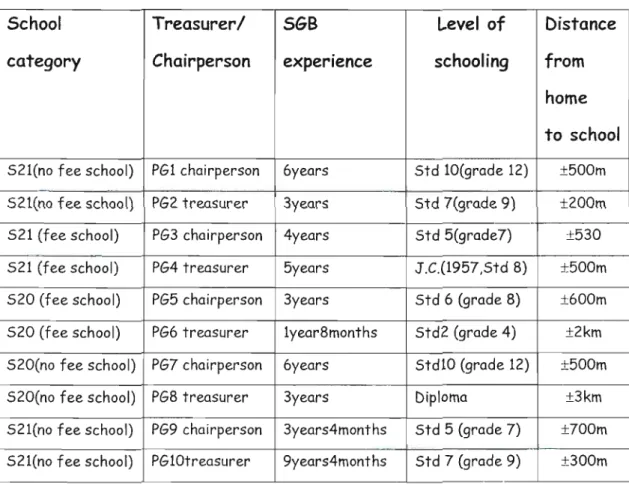
4.2 Biographical profiles of the SGB parent governors studied ---- 46
4.3 Election of parent governors to school governing body --- 49
4.4 Parents' experiences of financial decision making in both Section 20 and non-section 20 status schools--- 51
4.4.1 Fundraising--- 51
4.4.2 School budgets--- 52
4.4.3 Financial expenditure--- 54
4.4.4 Finance committee--- 58
4.4.5 Financial reporting--- 59
4.5 Challenges emerged as a direct result of the 'No Fee' policy---- 62
4.6 School governing body capacity building--- 64
4.7 Emergl ng Issues--- 66
CHAPTER FIVE: SUMMARY, CONCLUSIONS, RECOMMENDATIONS AND LIMITATIONS --- 72
5.1 Introducti on--- 72
5.2 Summary--- --- 72
5.3 Conclusions--- 75
5.4 Recommendations--- 76 X
5.5 Limitations of the study--- 76
REFERENCES--- 79
APPENDICES---
87
APPENDIX ONE: Ethical clearance certificate --- 87
APPENDIX TWO: Letter to school heads --- 88
APPENDIX THREE: Informed consent letter --- 90
APPENDIX FOUR: Interview schedule--- 92
XI
CHAPTER ONE
Introduction
1.1 Background and purpose of the study
Democratic school governance in South Africa is a direct result of the South African Constitution Act 108 of 1996 which created the South African Schools Act 84 of 1996 (hereafter called SASA). This Act provides for democratic school governance through school governing bodies (hereafter called SGBs) in the national public schooling system.
It is inclusive of various stakeholders such as parents of learners at the school, learners in the eighth grade or higher, educators, an ex- officio member (the principal) and non-educators (SASA, 1996, p.18).
Amidst the key governance areas to be performed by such stakeholders, parents with others are tasked with the full control of school finances and they are legally bound to play a fundamental role in participating in school financial decisions.
However, reports from parent governors in some rural areas, suggest that they face severe challenges such as lack of participation in finance committees, partial involvement in school budgetary matters and little involvement in fundraising efforts. Some lowly educated rural SGB chairpersons and treasurers, who are parents, are still required to sign blank cheques. Another problematic issue is the Act that generalizes the financial school governance powers to all public
school governors at the expense of rural parent governors who were marginalized and have no financial competencies. With such little financial expertise, if any, they are expected to make financial decisions in different types of school categories such as section 20 schools, section 21 schools and handle efficiently the requirements of the 'No Fee' policy. This shows that school governance in general and school financial governance in particular are complex and problematic issues in most South African rural schools. The study focuses on the voices, experiences, challenges faced by parent governors in school financial governance issues.
Ngubane, (2002) claims that an effective school governing body is expected to establish sub-committees namely finance committees, fundraising committee, tuckshop committee, resource committee and so on. Expanding this notion, SASA, Act 84 (1996, p.22) states that the head of each sub-committee should be a member of the school governing body, preferably a parent who is a treasurer. Bearing the point of little financial experience the rural parents encounter, it should hardly be a surprise that it is difficult for them to meet their commitments to shoulder school financial governance matters. This suggests that school financial governance is failing despite democracy on school governance in all South African public schools.
According to Carrim, (2001), legally, parents in the school governing body must be in the majority by more than one member because they have a direct stake in the school affairs. They are empowered to determine, within the framework of the National Constitution, what is
in the best interests of their children. However, in the case of some schools in ex-Ndwedwe circuit now restructured as
Ilembe
South, the majority of parents seem to walk long distances to and from schools for meetings or workshops. This may hamper the zeal to offer high quality financial services to school governance. Given the circumstances that may block the participation of parent governors on school decision-making, it is noted, therefore, that rural parents struggle to meet commitments to school governance (Ministerial Review Committee, 2004, pA8). The study attempts to investigate how such parent governors cope with such complexities.1 .2 Statement of the problem
The study is on parent governors' experiences In school financial decision-making. The majority of parents are expected to take on governing responsibilities including governance on finance; however, they have little financial expertise (Ministerial Committee Review, 2004, p.10). According to Motha's (2003) research on financial accountability of primary schools, finance is a main responsibility of all governing bodies in South Africa but there is limited material on the way in which financial management and governance actually work. This demonstrates that there is a dire need to research governing bodies' experiences particularly parents.
1 .3 Research questions
This study attempts to respond to the three questions on the next page:
1.
How do parent governors experience financial decision-making in Section 20 and Section 21 schools respectively?2. What challenges, if any, do parent governors face in 'No Fee' paying schools?
3. How can parent governors' participation In school financial governance be enhanced?
1.4 Significance of study
The study seeks to identify the gap in the literature, namely the failure of available research to capture the direct experiences of rural parent governors in particular in the matters that pertain school financial decision-making. In this instance, the study addresses parents' experiences in making sound school financial decisions in both section 20 and 21 schools and it investigates the challenges that parent governors face in the 'No Fee' paying schools. Such experiences will help the Department of Education to improve the nature of school governance policy frameworks regarding financial governance in particular.
1.5 Definition of terms
1.5. 1 Parent
South African Schools Act 84 (1996, pA) defines parent as:
a) the
parent
or guardian of alearner,
b) the person legally entitled to custody of a learner, or
c) the person who undertakes to fulfill the obligations of a parent towards the learner's education at school.
This suggests that 'parent' in the case of school, may be a person who is responsible for the provision of educational needs (payment of school fees or other educational requirements) of a learner. The study adopts the term 'parent' the external person who has the learners at the school or has the legitimate right to the learner custodianship.
This person works alongside with others in the school governing body for making school decisions,
inter alia,
financial school decision- making.1 .5.2 Governors
Anderson and Lumby (2005) refer to 'governors' as parents, learners, educators and others who have roles to play in the school governing body. They argue that educators or learners are governors who have roles that are clearly internal to the school whilst parents and others are external stakeholders who play the role of a school governor to the school. This clearly demonstrates that the term 'governors' is widely used in the South African context to mean a group of people at schools who have power to provide governance support to the learning organization (school). The term 'governors' in this study refers to one group of people (parent governors) who have power over making decisions on school resourceS such as finance in particular.
1.5.3 South African Schools Act 84 Of 1996
It refers to the Act or a legal document that applies to school education in the Republic of South Africa. It is Act number 84 of 1996 that is a direct result of the South African Constitution Act 108 of 1996. The study adopts SASA because it frames the democratic
rights of school governors in ensuring that schools implement their (school governors') decisions effectively.
1.5.4 Financial decisions
Financial decisions refer to an act of deciding on monetary matters.
1 .5.5 Stakeholders
Thurlow (2003) defines stakeholders as all those who have a legitimate interest in continuing effectiveness and succeSS of institution such as school. The author argues further that stakeholders are those who have immediate or direct effect on the school and exercise statutory or other control over resources and policy. Bush and Heystek (2003) concur with Thurlow in mentioning that the concept of stakeholders is based on the notion that certain groups and individuals have interest, or stake in the activities of an institution. Stakeholders in this study also refer to a group of people as mentioned in section that describes governors.
1.5.6 ex-officio
It is a Latin word which means that a person acts by virtue of his or her capacity in an office e.g. school principal in his or her capacity as the school officer. School principal as an ex officio member in this study refers to an official figure with the absolute authority of playing a dual role both in school governance and day-to-day school operational duties.
1 .6 Organisation of the study
The study consists of five chapters organised as follows. Chapter one describes the background and purpose of the study on the role of parent governors in school financial decision -making. It also outlines the key issues to be addressed in the statement of the problem, the research questions, significance of the study, definition of terms and organisation of the study. Chapter two presents definitions of key terms, reviews the relevant literature and frames the study into three theories. Chapter three presents the methodology adopted in the study that helped to answer the three research questions listed in this study. Chapter four discusses data presentation. Chapter five concludes the study by presenting a summary of the main findings, conclusions, the recommendations of such findings for the attention of relevant authorities in the Department of Education and the limitations of the study.
CHAPTER TWO LITERATURE REVIEW
2.1 Introduction
Chapter one introduced the study. In that chapter I argued that whilst SASA provides for democratic school governance and includes various stakeholders in school governance, SGB parents are still experiencing and facing severe challenges in terms of implementing the governance policies in general and financial governance policies in particular.
This chapter reviews literature around rural parent governors' experiences in making school financial decisions. In this regard, firstly, the chapter explores five key concepts namely governance, school governance, management, school management, financial management and financial governance. Secondly, policy frameworks namely Section 20 (S20), Section 21 (521) and the' No Fee' Policy are reviewed. Thirdly, researches in school financial governance are reviewed. Fourthly, theoretical frameworks that inform the challenges the parent governors face are discussed at length. Lastly, the summary for the chapter will be provided.
2.2 Exploring concepts 2.2.1
GovernanceGovernance, according to Tulloch (1993) refers to the act or manner of ruling or controlling with authority or conducting the policy and the
affairs of an organisation. Smith, Paquette and Bordonaro (1995) define governance as the act or manner of governing or the formal system for controlling the behaviour of those to whom the governance is generally directed. According to Webster (1977), governance means the exercise to control and direct the making of policies. It implies that in a government structure, things roll out through the designed policies and there are people who are accountable for policy-making.
In the case of a schooling system, the accountable police-makers are school governing bodies. Legally, the composition of school governing bodies (SGBs) in South Africa, as indicated in Chapter One, places parents in the majority by one member. This kind of 5GB composition does not necessarily exclude other stakeholders, but it suggests that parents have the biggest stake in decision-making process. Therefore, based on this definition of governance parents as part of school governors are at the central point in the governance fora where school governance decisions are taken. However, this study explores whether parent governors in rural public schools are actually enjoying their front seat and overall authority in the decision-making process.
Niekerk, Van der Waldt and Jonker (2001) view governance as a means of ordering a group, community or society by public authority. They further argue that the purpose includes the maintenance of law and order, the defence of society against external enemies and the advancement of what is thought to be the welfare of the group, community, society or state itself. Coming closer to this study the public authority and the welfare of the community suggest that SGBs have overall powers (public authority) to control over school finances
(group's welfare). According to the Ministerial Review Committee (2004), school financial decision-making forms the major welfare of the SGBs. This is informed by the assumption that no schools can basically function without finances. Italso assumed that governance in general, exists in public offices such as schools for creating orders (policies). This study explores how school governors exercise the authority to control the governance areas that include school financial aspects.
2.2.2 School governance
According to Sithole (1995), school governance refers to the institutionalised structure that is entrusted with the responsibility and authority to formulate and adopt school policy on a range of issues such as mission and ethos of the school, budgetary and development priorities. Potgieter, Visser, Van der Bank, Mothat,a and Squelch (1997) define school governance as an act of determining policy and rules by which a school is controlled, organized and effectively carried out. According to the Department of Education (1999), school governance refers to a process of making decisions in schools about the functioning of the school.
Such definitions of governance and school governance seem to have two commonalities such as governance that takes place at schools and it focuses on formulation and adoption of policies. However, they (governance definitions) are less concerned with who actually is involved in the process. Bush and Heystek (2003) address this issue when they claim that school governance means the schooling system that is inclusive of various stakeholders such as parents, learners, educators and other community members who must participate in the
affairs of the school. So, this study adopts school governance as the school structure that involves some external key players (parent governors) to the school with the legal authority to formulate policies in different governance areas that include school finances.
2.2.3 Management
Van der Westhuizen (1991) conceptualises management as an act of achieving objectives through utilizing the necessary people or materials, as a series of consecutive actions (planning, organizing, guiding, supervising and controlling to reach the set goals), as an act of decision-making which involves making the right decisions to achieve set goals through certain actions, as co-ordination of diverse tasks, as leading and guiding people to willingly strive towards achieving the goals of the group. It implies that management generally is the manner which people are influenced to getting things done in order to achieve organizational goals. Drawn from this concept are critical issues such as goal setting that make an organisation succeed and people who commit such plans into action. Apparently, the two critical issues twin management with governance in the sense that, in governance also school governing bodies are expected to make right decisions in order to achieve quality education. This management definition sharpens the quest of exploring the experiences of necessary people (parent governors) who are legally required to make the right decisions such as finance.
2.2.4 School management
Sithole (1995) views school management as an act that is responsible for the day-to-day running of the school by ensuring effective teaching and learning and efficient use of the school's human and material resources. This illustrates that educators and learners at school management level implement on a daily basis the policies as formulated and adopted at the school governance level by the members of the SGBs. This signifies the interdependence between school management and school governance. The assumption is that whilst management is concerned with making decisions on day-to-day matters, school governance provides immeasurable support. For example, school management compiles mini-budgets drawn at micro- political school levels (various school sub-structures) to enable school governance in drawing the school budget. In turn, management applies such school budget decision model in purchasing, utilizing and maintaining resources or school infrastructure (Sithole, 1995, p.106).
Anderson (2005, p.136) defines school management beyond daily operationalisation:
School management requires managers to be pro-active, forward- looking and responsIble for steering the educational organisation in such a way as to achieve agreed vision rather than working on a day- to-day, operational basis and leaving the longer term outcomes to chance.
The school management and school governance definitions suggest that schools need to be run by visionary managers who always check
how consensual policies are carried out. This implies that, though, school governance and school management are distinct areas of school basic functionality, they are sequentially related activities. The study adopts the definitions of school management to argue that management people cannot be policy implementers devoid of school governors' (policy formulators) rigorous assistance.
2.2.5 Financial management and financial governance.
Bisschoff (1997) defines financial management as the manner in which schools generate more and more money to be used, administered and managed as school funds. It entails an accurate system for recording financial transactions which are necessary for sound financial control.
This definition of financial management is silent on who actually at school decides in managing finances. People in school management or in school governance structures? However, Bisschoff and Thurlow (2005, p.12) in Potgieter, Visser, Van der Bank, Mothata and Squelch (1997, p.38) address this issue when they point out that:
Each 5GB must make plans to obtain more and more money and other facilities to improve the quality of education at the school. It must take all reasonable steps with its means to supplement or add to the amount of money that the state can afford to give the school.
In the light of the above claim, it is clear that financial governance concerns with the manner in which SGBs in South Africa plan for generating sufficient income to provide the school with adequate teaching and learning equipment.
Anderson and Lumby (2005), claim that in each 5GB, there are external stakeholders like parents who do not have direct day-to-day responsibility, hence day-to-day activities fall under school management. It is this complexity that makes Wessels and Nortier (2003) reflect on a general consensus that doing the job (implementing financial resources) requires good school management which is accountable to school governance for the results achieved (making financial resources available to school).
So, the inquiry adopts school financial governance to understand how fully engaged are parents on providing financial resources (money available to requisition teaching and learning materials) to school. The school governors' experiences are investigated in this regard.
2.3 Policy frameworks
The study is informed by three legal frameworks namely Section 20 status schools, Section 21 status schools and the
'No
Fees' school policy. The literature on the emergence of such financial policy frameworks is informed by what the State suggests are issues to redress the imbalances of the past and catering for the neediest learners in the country (Department of Education, 2006). To achieve such purpose, the State decided to allocate funds to public ordinary schools.2.3.1 Section 20 status
According to Government notice 29179 (2006), section 20 status implies that school governing bodies are given the powers to perform
their procurement duties, however, school allocation is centrally controlled by Head of Department (HOD) at provincial level. In this manner, Central control of school funds suggests that Provincial Education Departments (PEDs) embark on a common system to procure resources in bulk that are equivalent to the size of the school allocations for Section 20 schools. In S20 status, the service providers are not known at school level. In this instance, PEDs undertake to pay them (suppliers) on the basis of the orders received from schools. In exercising this approach, the Department of Education is aiming at developing the school governing bodies' capacity to conduct their own expenditure inputs in line with the relative size of their school funding and put in place the control measures to prevent embezzlement of financial resources (Government Notice 29179,2006, p.38).
Section 20 status is informed by what literature points out as lack of transparency at the platform of policy consumers (SGB parent members). To illustrate, Tshifura (2002) argues that where there is lack of transparency and suppression in school financial resources, the likelihood is mistrust between figureheads involved in the process.
The assumption in S20 schools is that schools place orders through the so-called 'EC 72 forms, however, the unit price is not known at institutional level and this result in schools receiving items with exorbitant prices which seems to aggravate levels of mistrust between schools and PED's' finance procurement officials.
To expand on this, Scott (2000) argues that the procurement and management of school deliveries occurs at the level of the Department. The author summarizes this approach as centrally
controlled, one-way, directive and binding the schools to wait for the procured goods that do not reach some schools on time and, at times wrong and unusable material reach the school. This sends a picture that school governing bodies, like in the past, are still placed at the far back in decision-making processes and denied the constitutional right to participate directly in financial decisions. Thus, this study explores their experiences around Section 20 policy framework.
2.3.2 Section 21 status
According to SASA (1996) Section 21 status is legitimately framed around the functions that are allocated by the Head of Department (HOD) to the school governing bodies of public schools. It entails that public school governing bodies are now more accountable and responsible for the effective management of recurrent expenditure.
To realize effective management of such recurrent expenditure, SGBs are given authority over financial decision-making powers which include rights to maintain and improve the school's property or buildings, to purchase textbooks and educational school materials and to pay for services of the school to service providers directly (Government Notice 29179, Section 115, 2006, p.34 and Section 21 (a), (c) and (d) of SASA, 1996, p.16). S21 functions also refer to a single monetary transfer to schools that are informed by their national quintile as discussed broadly in this section under the 'No Fee' school policy, their enrolment and other national school allocation conditions that allow the schools to receive such funds.
Ministerial Review Committee (2004) argues that the HOD may decide to withdraw the Section 21 autonomy to handle funds. In this manner,
the withdrawal of Section 21 status is characterised by two major critical elements of school financial management namely failure to submit the required financial certificates timeously and lack of potential to keep expenditure documents. In terms of Sections 45 and 43(5) of SASA, (1996), Section 21 schools are required to keep documents for both learning and teaching support material (LTSM) and non-learning and teaching support material (Non-LTSM) expenditure monitoring as well as submitting compliance certificates, written assuranceS and audited annual financial statements to the Department of Education within six months after the end of each year. So, failure to comply accordingly results in each school being viewed in a serious light and has its status reviewed and discontinued (KwaZulu-Natal Department of Education, KZNDoE, 2008). This suggests that adequate financial skills and timeous submission of financial documents are pre-requisites for Section 21 status SGBs as reported above.
The assumption is that, generally, Section 21 SGBs are financially competent in terms of holding financial meetings, engaging in a process of obtaining at least three quotations and choose the quality and cheapest quotation out of the three, keeping financial sound documents and making shared financial decisions. However, owing to the nature of SGB members as pointed out in chapter one, obviously, the demands of S21 status can be problematic to sustain their effective functioning. So, the study seeks to investigate parent governors' experiences in implementing efficiently Section 21 legal innovation in rural public schools.
2.3.3 The 'No Fee' school policy.
According to Government Notice 29179 (2006), the 'No Fee' school policy is the legal approach that warrants schools to refrain from charging compulsory school fees. Literally, it means the removal of school fees in schools that are surrounded by poorest communities.
Ndebele (2008) argues that the 'No Fee' policy intends to benefit learners in the poorest
40/0
of schools, to improve accesS to learning opportunities, particularly in indigent communities. This suggests that this policy framework is intended at providing access to education for all learners who are in pro-poor communities.To achieve the above, the literature suggests that indigent communities are used as the barometer for schools' catergorisation which leads to placing South African public ordinary schools into five groups (Quintile system). Considering that poverty around the schools in South Africa is not equally the same in all communities, schools in the most poor areas fall under quintile one, the second poorest schools fall under quintile two and so on. The assumption is that the government through quintile ranking, decides to spend more on education for the poorest learners in South Africa. For the Ndwedwe indigent groups, quintile ranking may assist in providing learning opportunities to every learner. As the parent governors under study are in schools of the poorest communities, the study seeks to understand their financial operationalisation at such quintiled 'No fee' schools.
Emerging issues around the 'No Fee' policy are based on the complexities in schools which may fuel the uneasiness of SGBs'
participation in financial decision-making. To illustrate, Maiga in Mali (2007) argues that above all, to address the deficits created by the abolition of school fees, rigorous planning of expenditures is necessary. This shows that repealing compulsory school fees posits challenges which are globally experienced by public school governors like in South African pro-poor schools. Legitimately, the monetary transfer that SGBs receive to fill in the gap that is created by the removal of compulsory school fees is part of the Norms and Standards allocation (Government Notice 29179, 2006). Ironically, SGBs cannot utilize such transferred funds for expenditure items that fall outside the category of inputs that are funded through the Norms and Standards. The assumption is that SGBs are now unable to pay for security guards, transport and incentives to volunteers that provide services such as cooking in respect of school nutrition or groundsmen where they are needed. However, the literature around wiping off compulsory school fees, allows SGBs to charge school fee voluntary contributions to cater for such uncovered expenses (KwaZulu-Natal Provincial Education Department, 2006).
By contrast, my experience is that parent governors including lay parents in rural areas fail to understand the necessity of charging school fee voluntary contributions despite lengthy explanations and agreements reached from their fully apprised financial meetings.
Consequently, perpetuating charging voluntary contributions creates conflicts in some schools. Ordinary parents still believe that it is the influence of the SGB to keep them paying school monies.
To illuminate further, the conflict bred from charging school fees' voluntary contributions arises despite the dictates of the law that requires all pro-poor schools with indicators of poverty such as income, dependency ratio and literacy rate not to be charged school fees (Government notice 29179,2006). However, granting the 'No Fee' school status to such schools does not take place in all schools in the same poor geographical area at the same time. Subsequently, such differences create the challenge that parents in schools that are still charging school fees doubt the school governance and management of the school. In turn, they opt to transfer their children to schools where school fees are not charged. In this instance, SGBs for the 'No Fee' schools receiving such overwhelming number of learners may suffer the floor space problem to accommodate unbudgeted influx learners. Moreover, money transfers do not cover also the construction of new buildings which fall under capital expenditure costs (Government notice 29179, 2006, p. 25). To address the problem of the overcrowding, SGBs are required to apply for new additional classrooms to the provincial Department of Education (Government notice 19347, 1998). In contrast, the department at times takes years to practically respond. This shows that the 'No Fee' school policy in South Africa, deposits critical flaws that make SGBs parent governors in particular, experience difficulties in implementing the policy as desired. In the past, such SGBs would use school fund and other contributions to build classrooms.
Reports from some the 'No Fee' schools that require the payment of voluntary contributions illustrate that some parents refuse to
contribute as agreed. This compels school governors to cut down the number of no fee-uncovered expenses. So, all the challenges which come into light as a result of the 'No Fee' school policy motivate this study to examine how SGBs particularly parent governors address such fi nancial complexities.
The second emerging issue is what SASA (1996) suggests as a strategic means to supplement the restricted funds to pay for the uncovered expenses. Such financial additional measures are aiming at improving the quality of education provided by the school to all learners. To realise this task, SGBs are given powers over such key financial issues as fundraising and budgeting as pointed out in chapter one. To assist in achieving their objectives, SGBs establish fundraising and budgeting committees that involve 5GB chairpersons and treasurers who are parents, educators who are involved in teaching subjects that involve finances and non-teaching personnel with accounting skills (Department of Education, 1998).
The third emerging issue out of the 'No Fee' policy is banking and school cheques signing procedures which aim at increasing accountability to three 5GB members with signing authority (Department of Education, 1996). To ensure accountability, in this regard the government indicates school details required for schools to qualify as the 'No Fee' schools. Such details include school Education Management Information System numbers (EMIS), names of schools that have an active commercial bank account and physical addresses of schools (SASA, Section 39(9), 1996). To be supported in choosing a
commercial registered and most reputable bank, the SGB structure is required to consult members of the community and get advice from knowledgeable people, preferable co-opted members with accounting knowledge who would decide which bank offers the best rates (KwaZulu-Natal Provincial Education Department, 2007).
Based on this legal framework, the school governing body chairperson or treasurer and the principal at the school, as noted earlier, are expected to follow closely the rules for writing cheques such as effecting consistent signature, crossing the cheque, checking information on the counterfoil and reading cheque details before signing. The alluded financial duties are informed by the assumption that some parent governors under study neither write nor read and do not understand the law of signi ng cheques. The bank does not accept cheques with inconsistent signatures and alterations. Signing using a cross (X) bears unnecessary fraud. In this regard, the study investigates whether parent governors under this study
per se,
are financially competent to deal with such financial complexities.2.4 Some research in school finances.
The work that follows reviews literature around school financial governance undertaken between 2002 and 2004.The first research conducted by Tshifura (2002) was on the roles of SGBs in public schools and their interpretation of Sections 20, 21 and 24 functions in SASA Act 84 of 1996. Section 24 deals with the categories of people to be on the SGB of a public school. The author argued that there is little participation from parent members. Research also indicated that
school principals and 5GB chairpersons appeared to play the dominant role in financial decision-making. Secondly, The Centre for Education Policy Development (CEPD), (2003) researched on the functioning of SGBs amongst twelve schools. This study indicated, amongst other financial issues, the lack of SGB participation in fundraising and poor attendance at meetings. Thirdly, Bush and Joubert (2004) investigated the value of training on the aspects of policy-making including clarifying the respective roles of SGB and principal and on financial aspects of governance such as budgeting and funding. The authors discovered that financial management including fundraising and budgeting were the most significant training needs. Fourthly, The Ministerial Review Committee (2004) conducted a survey in the Mpumalanga Department of Education (MDoE) schools that were awarded Section 20 status and found out that such schools were not coping with such status accorded on them. Fifthly, Bembe (2004) also explored the responsibilities of SGBs in Mpumalanga four schools. The author reported many governance problems which included mismanagement, parental illiteracy and weak attendance at parents' meetings. Sixthly, Mestry (2004) conducted research on governing bodies' competencies and commented on SGBs' lack of experience to play an active role in school budgeting.
Emerging from the above alluded to research are the following issues:
Many research suggest that there is SGBs' participation on school financial governance issues namely fundraising school budgeting and Section 21 status. However, such participation is inadequate and it is not clear how school financial decisions are taken. Researches
conducted in Mpumalanga Provincial Education Department showed that lack of SGBs' participation in school financial governance is a national issue. Some research indicates that parent illiteracy and insufficient SGB training are major causes of SGBs' uncertainties when executing school financial governance issues. So, research conducted give the premise that there is a developing literature on school financial governance and finance seems to be a main responsibility of all governing bodies in South African public schools.
However, such research is silent on the experiences of school governing bodies on implementing new financial governance policy frameworks such as the 'No Fees' school policy, Section 20 and Section 21 statuses. Hence, one of the research questions provided in chapter one is framed around the parent governors' experiences on implementing the 'No Fees' school policy. This shows that further research on SGBs' participation and implementation of the financial frameworks at different school categorizations in rural contexts, is necessary. Whilst taking into cognizance the problematic factors such as illiteracy as discussed in researches conducted, the study explores the basic school functionality of the parent component under study.
2.5 Theoretical frameworks
This study is framed within three theoretical frameworks of management theories around the issues of educational change. Such theories are Participatory Democracy Theory (PDT), which is synonymous with Inclusive Theory (ID, Policy-Practice Dichotomy Theory (PPDT) and Political Theory (PT).
2.5.1 Participatory Democracy Theory
The Participative Democracy Theory is an approach that is utilized to check genuine and effective participation of all citizens in the matters that affect them (Carrim, 2001). The author argues that this theory is inclusive in the sense that it encourages the commitment of all stakeholders in an organisation like the school in particular.
Concomitantly with the idea of Carrim, Lemmer and
Van
Wyk (2004) also define the Participatory Democracy Theory as the theoretical framework that allows freedom of participation for all citizens in the affairs that affect them. They argue that this theory has the tendency to encourage people to assume their responsibilities as citizens of a democratic state through the fulfillment of such basic responsibilities. Concurring with the above arguements, Stoll and Fink (1996) argue that parents who feel like partners in the education system listen to school people and act as critical friends. This suggests that schools ought to create parent user-friendly programs to enhance high quality of parent participation. On this note, Inclusive theory enriches this study in the sense that school financial matters form the basic responsibilities for every school governor to sustain basic quality education for all learners. In this manner, the basic quality education for all learners connects Inclusive Theory to the Bill of Rights which spells out that the voices of the majority citizens must be heard. The Bill of Rights is one chapter in the South African Constitution Act 108 of 1996 (The National Social Contract) that provides the principles of democracy, accountability, co-operation, maximum participation, inclusion, consultation and partnership (Carrim, 2001 and Sithole, 1995). This shows that the South AfricanConstitution Act 108 of 1996 is rooted in the Participatory Democracy Theory. However, the assumption is that all the basic principles of participatory democracy as reported above are practiced to some South African public schools excluding the schools under study. Thus, the study examines the parent governors' experiences in this regard.
Legally, public school parent governors execute financial responsibilities concomitantly with professional (educators) and non- professional staff (administration officials, security officers, etc) (Department of Education, 1996). In this regard, the legal framework does not divorce rural parent governors from other parent members in other areas and other education key players. In this effect, Inclusive Theory refers to the approach that allows the full participation of all interest groups who were excluded in the past in school governance issues. The effect of such inclusion is that no one stakeholder feels dominated by another and eliminates all forms of unnecessary bureaucratic over centralisation of deliveries.
While Participatory Democracy Theory points out the essence of parent governors' participation in school activities, it is arguable how they operate under Section 21 status schools under study where sound financial competencies are necessary key factors. In this regard, this theory seeks to provide a theoretical lens for addressing one of the critical questions of this study:
What are parent governors' experiences in making school financial
decisions in Section 21 schools?
Participatory Democracy Theory is informed by what Carrim (2001), Lemmer and Van WYK (2004) and Suzuki (2002) suggest are basic principles of stakeholders' participation, transparency and accountability. Carrim (2001), Lemmer and Van Wyk (2004) factor in the freedom of participation for all citizens in their activities as the issue that is rooted on the notion of active citizenry. Though citizens in general refer to members of the state with different human rights to enjoy in that country, in this study in particular, they (citizens) refer to a group of people who constitute the school governing body and play a pivotal role in governance issues that include, amongst many, financial responsibilities. This study utilizes Inclusive Theory to check the participation of parent governors in the SGB as the important citizens who should have the loudest voice in the governance affairs of their schools (Carrim, 2001).
According to (Suzuki, 2002), Participatory Democracy Theory is also informed by the principle of transparency in schools. The author argues that this theory serves to install accountability mechanisms on stakeholders in respect of shouldering governance responsibilities such as financial responsibilities in particular. Diallo (2001) concurs with the basic notion of this theory through arguing that there is a need for greater accountability for the empowerment of communities to participate in educational decision-making. Theoretical terms such as transparency in schools and accountability for stakeholders to participate in a democratic decision-making process sound appropriate to democratic school governance; however, discrepancy arises on Section 20 status schools. The best example of such complexity is
around the control of Section 20 monies at the higher level of the department of education. By contrast, schools are held accountable for the prices of deliveries which are centrally controlled at the level of provincial procurement section. Based on this premise, the assumption is that Inclusive Theory generates fluid participation which weakens parent governors' genuine participation and absolute accountability in making financial decisions in Section 20 status schools under study (Bush 2003). So, the study investigates the reality of this theory in the context of public schools under study.
The fitness of the Participatory Democracy Theory at public schools may also be hampered by what literature indicates are social, academic and economic contextual constraints at the level of policy implementation. To Lemmer and
Van
Wyk (2004), Heystek (1999), Legotlo, (1994),Van
der Westhuizen and Legotlo (1996), such shortcomings of participatory democracy are aggravated by the financial constraints the parents have and consequently they don't have money to pay for transport to attend school meetings. Owning their transport is extremely difficult. Secondly, some black rural parent members live far away from the school they serve. Thirdly, some parents are not healthy enough to travel long distances on foot like their children do. Fourthly, majority of parents who are illiterate do not understand financial terminology and, as such, they feel inferior to the academically better-qualified professional staff which results to limited contributions they offer on matters pertaining to financial governance. Fifthly, some black rural parents lack adequate training in order to understand their roles and such dearth of financial capacity provokes them to stay aloof from financialgovernance activities. Lastly, long finance meetings with unclear straightforward agenda demotivate them and exacerbate unnecessary absences.
The assumption is that the threats alluded to above may also affect the democratic values of participation for the researched participants under study. To sharpen this postulation, in the context of the black rural area where this study is located, the study investigates such assumption which may block participation in school financial decisions and results into financial decisions being taken at the level of school management in spite of devolved powers to the majority of parents.
Additional to the shortcomings of Participatory Democracy Theory noted already, literature on this theory suggests that participating in decision-making is affected by time-constraints and participants' reluctance. To illuminate, Poo and Hoyle (1995) view participating to decision-making as a slow process. They argue that participative decision-making involves some elements of dialogue, disagreement, uncertainty, risk and conflict between different points of views by stakeholders. As such, the purpose of engaging into disagreement and dialogue revolves around reaching decisions through consensus. In the context of this study, disagreement and uncertainty may squander time to reach consensual decisions. So, the study explores the survival of consensual financial decisions under such conditions.
According to Steyn and Squelch (1997), participatory constraints seem to be a direct result of what is perceived as reluctance to share decision-making power and working an extra-mile when necessary. The
authors pinpoint stakeholders' unwillingness in participating to management and governance activities if such efforts to such participation involve extra hours. At face value, reluctance on the side of parent members in this study appear to be inevitable when considering that such stakeholders are neither residing in the school nor within the school proximity.
Parallel to the idea of Steyn and Squelch (1997), Bush (2003) argues that principals are required by law to share decision-making power with other education role-players. The location of such decision- making power is informed by the legal framework that principals form the cross-link between management and governance matters and they have the most professional knowledge for pioneering such decisions (SASA, 1996). By sharp contrast, Bush (2003) claims that in spite of such powers vested in principals, they seem to be adamant not to share legitimate front-line decision-making powers. Compatibly with Bush's (2003) view for sharing decision-making powers, in England and Wales, some principals used accountability and responsibility at the final end as the scapegoats for keeping aside parents on financial planning ( Grant Lewis and Motala in Chisholm, 2004). McPherson and Dlamini (1998) hint foreign language as the major cause for eyeing down sharing of decision-making powers between parents and principals. This shows that sharing decision-making powers amongst stakeholders is a global issue. Given such shortcoming of Participatory Democracy Theory, the study investigates the parent governors' experiences if they are sidelined in sharing financial decisions.
2.5.2 The Policy-Practice Dichotomy Theory
The Policy-Practice Dichotomy Theory (PPDT), as viewed by Jansen (2001) refers to the gap that exists between education policy intention and reality at policy implementation stage. The author argues that in post-colonial states, such theory commonly refers to the lack of fit between the education policy and the actual practice which is usually characterised by three policy implementation problematic elements namely lack of resources, the legacy of the past and shortage of potential to transfer policy vision into actual practice. To J ansen, the dearth of coherence between education policy and practice which should transfer the former (education policy) into contextual reality holds a powerful view that is hard to refute. The reason is that the policy is lodged in an extreme view that the policy- makers in a particular country are pre-conceived that it will exist within the school's environment that is stable, yet this is not always the case. Secondly, it is assumed that policy moves logically and naturally from intention to implementation. In the light of this, Jansen (2001) challenges the simple linear view of policy and practice because policy craft may be clouded with primary intentions that are totally opposed to change practice.
Concurring with Jansen's (2001) challenge abut the lack of cohesion between education policy and practice, Bush (2003) fits together the Policy-Practice Dichotomy Theory with the Theory-Practice 'divide' which suggests that theory is perceived as esoteric and far away from practice, and yet the crux of theory is its applicability to practice.
The crux of theory suggests that it can be useful and relevant if it
explains practice and provides its consumers with a guide to action.
The assumption is that the gap between theory and practice can be filled so long as the former (theory) has relevance to the latter (practice) in education (Hughes and Bush, 1991).
Failure to translate policy vision into reality as alluded to above warrants Thurlow and McLennan (2003) to define such theory as the kind of policy theory that begets disjuncture when it fails to yield its intentions. Bush (2003, p, 43) defines PPDT as two kinds of education issues that are uneasy, uncomfortable bedfellows particularly when the education policy does not blend with the complexities of human behaviour in the organizational settings. This theory relates to the present study in that school governing bodies in the rural school settings arise from the politically sanctioned groups who have been never exposed to the school financial governance to say the least. This indicates that policy does not always lend on the environment of its beneficiaries (policy consumers who are parent governors in this study) which is often fertile.
In attempting to understand the experiences of parent governors they implement the three financial policy frameworks in this study, I utilise the Policy-Practice Dichotomy Theory. The assumption is that the policy such as the 'No Fee' policy posits confusion if basically it seeks to achieve regularity, uniformity (Morrison, 1998 and Bush 2003) and squarely provides education for all poorest learners on the one hand, but it fails on the other, to satisfy the needs of all learners around the similar poverty-stricken communities.
Reports from schools suggest that on the era before the 'No Fee' policy, schools were able to utilise meagre school fees to pay all expenditure inputs including payment for personnel for essential services. However now, the opposite trend occurs. This is what Thurlow and McLennan (2003) refer to as clash between policy focus and actual practice as indicated earlier on in this section.
In the scenario of Section 20 status, SGBs are faced with the dilemma of being not directly involved in their finances but held accountable at the final end. This is the kind of complexity that makes 520 status an airy fairy theory, as pointed above, and causes dilemmas during implementation stage. In the case of some Section 21 status schools, there may be shortage of capacity on the policy actors to handle lump-sum transferred funds. So, such policy shortfall at the implementation stage may threaten the survival of policy framework (Section 21 status) in the schools under study. This necessitates the dire need to explore the experiences of 5GB parent members in the context of rural public schools in this regard.
2.5.3
Political theoryDrawing on the ideas of Bush (2003), Bolman and Deal (1984) and Baldridge (1971) to understand the conflicting issues that might threaten financial decision-making in public schools as organisations, the study adopts the Political Approach to organisations.
The Political Theory is characterised by what available literature suggests members of organisations engage in political activity In pursuit of their own interests (Bush, 2003). The author argues that
interaction exists between groups with a variety of interests. To illustrate, Baldridge (1971) argues that individuals and groups might have different objectives which lead to conflict between them.
5eddon, Billet and Clemans (2004) provide analysis on three forms of conflict. They argue that
interest conflict
stems from the interests and identities involved in social partnerships. If such conflict arises as a result of activities and tensions between partners at a day-to-day level, they refer to it asrole conflict.
According to Griffiths (2000),regime conflict
is a kind of conflict that exists if individuals with sovereign rights meet as equals in collaborative decision-making processes. According to Bolman and Deal (1984),interest conflict
further exists if people view schools as organisations that house in a variety of individuals and interests groups with different lifestyles, values, needs and political preferences to influence the goals and decision-making of the system.In this study, the political interest groups with different objectives may be school governing bodies who, among other duties, are legally empowered to control school finances, however, on the other side, may have unsound goal to utilise such finances. The example, in this regard, is based on Provincial Education Department's (PED) bulk monies that are allocated and transferred to school bank accounts which may be a temptation to some 5GB members, leading to illegitimate making a loan out of it.
As the literature around Political Approach continues to emphasize the presence of conflict in schools, this section utilizes this
theoretical approach to understand the type of conflict that emerges around the context under study. My experience as the 5GB District Master Trainer in schools under this study, suggests that school financial governance faces serious conflict such as some 5GB chairpersons and treasures who dismiss unpaid learners to return home. In this scenario,
role conflict
set in because the people who undertake to perform the duty of dismissing learners are not legally qualified to do so. Bolman &Deal (1984) cite the dearth of appropriate resources in organisations as one of the causes ofrole conflict.
In the case of ring-fenced school allocation and no money to build new classrooms (legally cited as one of the capital expenditure key inputs), no financial resources to pay for transport to meetings; conflict is bound to happen when 5GBs decide to engage in voluntary contribution discourse. The assumption is that the overwhelming number of learners crowded into few classrooms and different perspectives from parents in supplementing funds, flout quality teaching and learning goals. So, the Political Theory is used in this study to address the question of how parent governors make effective financial decisions where school allocation is only restricted to specific non- capital expenditure items.By contrast to the definition of
regime conflict
noted earlier on, the advancement ofrole conflict
will be inevitable if schools may have 'life-time 5GB chairpersons' who keep cheque books and 5GB minute books at their homes, certain 5GB chairpersons or treasurers who are made to sign blank cheques as reported in chapter one. Should it be found out during research fieldwork that some professional staffmembers take over the 5GB financial responsibilities because of the prejudice they have against parents in taking financial decisions, then this will suggest the abuse of 5GB autonomous power to take decisions on equal footing. The study will investigate the experiences of such 5GB parent components in this scenario.
2.6 CONCLUSION
The concepts explored add value for comprehending the content of this chapter. Policy frameworks discussed are emergent legal financial policies within school governance which the government utilizes to address the social and education imbalances of the period before 1994. They warrant research because they are the crucial governance financial instruments to measure the efficiency of school governance as well as the success of quality education in schools. Hence the Department of Education decentralizes governance decision-making powers to school governing bodies. Some research was reviewed to weigh up the necessity for further research on financial school governance. The chapter unpacked three theoretical frameworks for analysing the rural school parent governors' experiences in financial decision-making. They form the critical resources that may assist the research efforts by mapping domains of understanding the actual policy practice in schools by people (parent governors) with supreme powers to do so.
CHAPTER THREE
RESEARCH DESIGN AND METHODOLOGY
3.1 Introduction
This chapter describes the research design and methodology of the study. First, the chapter explains the qualitative research design the study adopts. Second, it describes the respondents. This is followed by a description of data collection instruments, gaining entry, ethical considerations, validity and reliability. Finally, the chapter concludes with the process of data analysis.
3.2. Research design
The study adopts a qualitative interpretive approach. Henning, Van Rensburg and Smit (2004) define qualitative inquiry as a research approach that has the potential to convert raw empirical data to a thick description that gives an account of the phenomenon. To expand, the above authors refer to qualitative inquiry as a research strategy that fits in the ideas of the researched in an open-ended way. Drawing from the idea of Denzin and Lincoln (1998), qualitative researchers are basically concerned with understanding the social phenomenon from the respondents' perspective. They attempt to interpret the data in order to make sense of the respondents' experiences. This qualitative study adopts a case study design. According to Merriam (2002), a case study is an intensive description of a single unit that is utilized to gain an in-depth understanding of the situation of those
involved. In line with Merriam (2002), McMillan and Schumacher (1997) argue that a case study data analysis focuses on one phenomenon. In this study, a case of ten parent governors is chosen to investigate their experiences of financial governance duties in
Ndwedwe
schools. So, financial decision-making is the phenomenon for the study.In this light, the case study design is used to provide a thick description of how financial decisions are taken in Section 20 status, Section 21 status and the 'No Fee' schools. The case study is most appropriate to examine and obtain a detailed account of school financial governance decision-making and it will assist me to harness the experiences of parent governors while they are engaged in school financial activities in different settings.
3.3 Respondents
Selecting research participants (sampling) involves a variety of sampling approaches, however, this qualitative research study adopts a purposive sampling approach which aims at increasing the utility of information obtained from small samples (McMillan and Schumacher, 1997). Purposive sampling is an approach that includes selecting information-rich cases for in-depth study and it is used by qualitative researchers to understand something about the cases without needing to generalise to all such cases (Patton/ 1990, McMillan and Schumacher/ 1997). In concurrence with the above authors, Marshall and Rossman/ (1995), Le Compte and Prissle/ (1993)/ Merriam/ (1998)
and Henning, Van Rensburg and Smit, (2004) claim that the purposive sampling approach looks towards the people who fit the criteria of desirable participants which derives from the participants' knowledge of the topic.
In this study, data will be collected from selected school governing body chairpersons and treasurers in their field of practice i.e. rural school setting. These respondents are chosen on the grounds that they represent other parents in the SGB finance committee as indicated earlier on and they are expected to be knowledgeable and informative about the school financial practices which form the phenomenon of the study and legally, the law places them at the central point of the finance committee where such financial decisions are practiced.
Ndwedwe
rural schools form the site of the respondents because they are densely populated with 5GB parent members who were denied democratic participation in school governance financial activities in the past. Moreover, they are required to be financially competent to manage school deliveries of Section 20 and handle bulks of Section 21 monies.3.4 Data collection instruments.
The study adopts the two instruments for data collection namely semi-structured interviews and documents analysis. Johnson (2002), McMillan and 5chumacher (1997) define data collection as a process that involves both interactive and non-interactive strategies. They
elaborative that both participant observation and interviewing data collection tools have the elements of interactive approaches whereas document study occurs when qualitative researchers are immersed only in obtaining clues noted down about the present or past occurrences. Henning, Van Rensburg and Smit, (2004) argue that in the semi-structured interviews, it is easier for the researched to rub shoulders with the researcher than to write responses in the questionnaires. Concurring with these authors, Cohen, Manion and Morrison, (2000) claim that semi-structured interviews involve a two- person conversation initiated by the researcher for a specific purpose of obtaining research relevant information. In this instance, I opt to use the semi-structured interviews because in such research situation, the researcher is present with the researched and can be able to provide clarity.
Semi-structured interviews are informed by the interview schedule which is a set of questions asked in predetermined order throughout the investigation. McMillan and Schumacher (1997) claim that interview schedule can be flexible, adaptable and can be used with many types of persons such as those who are illiterate or too young to read and write. This links to the nature of my respondents who are not too young to read and write, however, they are lowly educated.
Being lowly educated suggests that participants can find it difficult to provide answers if they had been provided with other collection instruments such as questionnaires. Secondly, in this study, the
"interview schedule enables the researcher to gain an opportunity to make a follow up, clarify ambiguities, motivate where necessary,
and attempt to achieve specific responses or capture the experiences of parent governors in financial decision-making process under emerging recent financial governance policies. This suggests that there will be questions which are based on financial governance issues namely taking decisions in raising funds, buying educational equipment and handling the 'No Fee'school policy funds.
Henning, Van Rensburg and 5mit (2004) argue that certain types of documents are the main source of data. As discussed in this section, document analysis as one non-interactive data collection form will be used to compliment semi-structured interview. In this study, the official documents to be analysed are finance committee minute books, 5GB minute books and 5GB parents' minute books. These official documents are necessary to assess signs of consensual financial decisions.
3.5 Data collection process
Depending on the places of residence for my respo