The jurisprudence of the courts highlights the many factors that hinder the realization of the right to access health care. The Health Professions Council of South Africa (HGBSA)7 has developed and implemented a non-punitive program to assist disabled doctors.8 The focus of this program is the care and rehabilitation of disabled doctors.
Aims and objectives
The situation facing medical practice is constantly confronted with ethical issues that require professional consideration to form the basis for policy formulation and implementation. However, referral to this system is less than optimal.9 A similar non-punitive program to assist disabled physicians is also in use in America.10 To date and in many countries, the medical profession faces ethical questions regarding how best to deal with impaired physicians in practice.11 Therefore, a better understanding of doctors' perception of impaired colleagues is required and cannot be overemphasized.
Statement of the problem
17 Many impaired doctors fail to use the rehabilitation program offered by the HPCSA due to a lack of referral of suspected impaired doctors to the program by colleagues in the medical fraternity. The non-existence of a culture (among doctors) committed to the well-being of impaired doctors in our hospitals and clinics forms the 'core' of the problem which is the focus of this study.
Research methodology
Furthermore, the quality, validity and reliability of the data were improved by presenting the collected data in the form of transcripts to the interviewees for review and correction of factual inaccuracies. This process includes providing copies of the draft research report to research participants and soliciting written comments on the report's findings.
Ethical consideration
As a measure of the quality, validity, and reliability of the data, a peer review was conducted, where the researcher and those directly involved had the same questions answered by an independent peer. There was also the process of member checking, where the interviewees would review, corroborate and verify the researcher's interpretation and conclusions so that the facts are not misinterpreted.
Assumptions and limitations of study
Sequence of chapters
Definition
Extent of the problem
For example, when afflicted by mental illness, they may fail to actively seek help for reasons ranging from:. a) 'Lack of insight into their psychiatric illness. They may deny the fact that they are actually suffering from such a disease.
Classification of impairments in doctors
Obtaining an informed consent from the patient prior to visiting him becomes not only essential but also mandatory. The patient's family and relatives can also sue the doctor for loss of support if the patient dies.
Identifying the impaired medical practitioner
Any person who answers yes to two or more of the questions in the questionnaire is more likely to have a serious alcohol consumption problem. Furthermore, an American body called 'the Committee on Physician Health of the Medical Association of the State of New York' has outlined the following clinical characteristics for the identification of a disabled physician:. a) 'Unkempt or disheveled appearance, including neglect of personal hygiene.
Risk Factors Contributing to Doctors Becoming Impaired
Therefore, "the increased incidence of malpractice observed in physicians as a group can be attributed to both the high and intense stress associated with medical work and the easy access and availability of scheduled medications in most health facilities".76. Due to the experience gained through education and practice, it is difficult for the doctor to realize or accept his disability.
The HPCSA strategy for handling impaired physicians
All reports to the HPCSA about alleged harm to council-registered doctors are assessed and investigated by the health committee. If the practitioner does not;-. a) Report to the council the injury of a student or other practitioner if he/she was convinced that this student or other practitioner was impaired as defined by law;.
Intervention
Formal evaluation remains the primary goal of any intervention involving the physician with a disability.101 Before any intervention, specific and detailed plans and treatment should be outlined. At the start of the intervention process, the disabled doctor cannot continue his/her medical practice.
Conclusion
Early identification and the establishment of appropriate interventions remain crucial in this regard, as this provides a window of opportunity for healing and successful restoration of the personal life and career of injured physicians. An overview of the approach used for information collection and data analysis activities is provided.
Study Design
This section of the study focuses on describing all the different approaches and techniques used to process, analyze and interpret the results emerging from the study. In this regard, issues related to study design, study population, study sample, and sampling process and procedures are clearly defined.
Study population
The qualitative approach was deemed appropriate and was therefore used in the conduct of this study. Moreover, the qualitative method of information gathering is most suitable for exploring and uncovering unexpected information.3.
Research sample, sampling, and size of sample .1 Sample
Management of data .1 Collection of data
Although the process of transcription was a difficult and time-consuming process, it gave the researcher the opportunity to become familiar with the very important internal contents of the interview. The researcher identified and developed the most important recurring ideas, themes, and patterns during the data analysis process.
Validity of the study
The inductive approach9, a form of reasoning that involves generating new theory from the data, was used to analyze the information obtained during the interviews. The themes generated emerged from the data and not the other way around.10 The categorization of the themes with their illustrative extracts was organized using NVIVO, a computer software package for qualitative data analysis (version 8 2008).
Reliability
The questions included in the questionnaires were kept simple and aligned well with the 'conceptual framework' of the research study. A concise description of the role of the researcher, the characteristics of the study population, the research setting and the methodology used were clearly provided.
Bias
Furthermore, based on his experience, the researcher has his own views on the way doctors with disabilities are treated in Durban.
Ethical issues
The purpose and objectives of the study were fully explained to respondents prior to their participation in the study. Full explanation of the purpose, objectives, methods and duration of the study was provided to participants.
Conclusion
In addition, the respondents were guaranteed the confidentiality and anonymity of all information that they will provide in the answers to the research questions. This chapter is focused on presenting the results of the interviews obtained with the doctors who participated in the research.
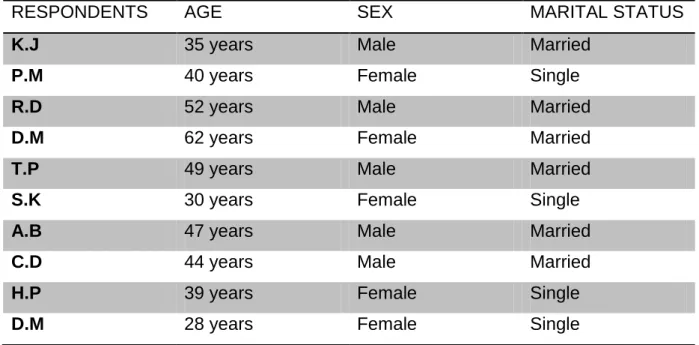
Sample Demographics
Physicians were specifically selected for interviews because they have a significant role to play in the identification, management and appropriate referral of suspected disabled colleagues. Standard demographic data of the participants is provided and interview reports in the form of themes generated from the analysis of the responses in the interviews are presented.
Theme 1: Implications of the Practising Impaired Doctor
The fact that few medical accidents occur is unfortunately publicized in the media, resulting in enormous reputational damage for the medical profession. Four participants expressed a lot of negativity about having a disabled doctor in the workplace.
Theme 2: Physician impairment: a major unaddressed issue
Some respondents were concerned about the consequences that could arise from reporting a disabled doctor to the authorities and the HPCSA. The HPCSA must do more in terms of transparency and communication with doctors.
Theme 3: Consequences of the Legal Duty to Report
Stigmatization is one of the important social consequences associated with impairment in physicians. Somehow we hold back and do not report to the authorities because we are afraid that the doctor will be labeled and stigmatised'.
Theme 4: Other Impediments Associated with uptake into the HPCSA Program for Handling Impaired Doctors
Being in solo practice can result in a long delay in the identification and subsequent referral to a physician with impairments. Early detection and immediate referral for professional help are missed because colleagues and colleagues do not recognize subtle signs of impairment.
Conclusion
I suppose in the public sector it's a little easier because we have EAP programs.. we work closely with colleagues.. but if you're in a specialized private practice, that's more difficult.. the anesthetist. If you look at private practice, the high rate of dependency among doctors, especially those who are anesthesiologists, is worrying.
Implications of Impairment in Doctors
Disruptive behavior in the impaired physician negatively affects the safety and security of patients in hospitals and clinics. Unprofessional conduct and behavior by the injured physician generates a sense of uncertainty and fear in the injured physician's patients.
Physician Impairment: A major unaddressed issue .1 Lack of impairment awareness and support
Ignorance and complete ignorance of disability by doctors as a disease process can contribute to the process of stigmatization. Stigma associated with impairment is a recognized barrier to reporting impairment among Australian physicians.20 It is believed that inaccurate documentation and reporting of the prevalence of impaired physicians is usually a result of colleagues ignoring or providing protection to the impaired physician by avoiding ' marking' the affected doctor with a potentially harmful diagnosis. 21.
Consequences of the Legal duty to Report
Obstacles to uptake into HPCSA intervention program .1 Denial
Being in private private practice was identified by participants as a barrier to early entry into the HPCSA program for treating impaired physicians. Consequently, the intervention process is delayed or stalled due to the unavailability of interested colleagues to help facilitate the 'confrontation and coercion' process needed to assist engagement in the HPSCA intervention program for treating impaired physicians.
Conclusion
The duty of professional colleagues in providing care to disabled doctors has been set out by the HPSCA. The failure of the 'affected doctor' to self-report or engage in the intervention process that would benefit him is a major problem.
Recommendations
World Health Organization 'Preamble to the Constitution of the World Health Organization as adopted by the International Health Conference in New York Pp. Preamble to the Constitution of the World Health Organization, as adopted by the International Health Conference, New York, p.
CONSENT FORM
The purpose of this study is to investigate and analyze the impact of impaired/disabled doctors/physicians in the delivery of quality health care in South Africa with specific reference to Durban doctors. Please note that your response will be kept confidential during and after this survey.
Question 1
Question 2
Question 3
Question 4
Question 5