i
UNIVERSITY OF KWAZULU-NATAL
The Performance and Management of International Students at the Faculty of Management Studies, University of KwaZulu-Natal
By
Dhanwanthie Revashunkar
Student Number:
201509735
A dissertation submitted in partial fulfilment of the requirements for the degree of Master of Business Administration
Graduate School of Business and Leadership College of Law and Management Studies
Supervisor: Dr Mihalis Chasomeris
2012
ii
DECLARATION
I Dhanwanthie Revashunkar, Student Number: 201509735, declare that
(i) The research reported in this dissertation, except where otherwise indicated, is my original work.
(ii) This dissertation has not been submitted for any degree or examination at any other university.
(iii) This dissertation does not contain other persons’ data, pictures, graphs or other information, unless specifically acknowledged as being sourced from other persons.
(iv) This dissertation does not contain other persons’ writing, unless specifically
acknowledged as being sourced from other researchers. Where other written sources have been quoted, then:
a) their words have been re-written but the general information attributed to them has been referenced;
b) where their exact words have been used, their writing has been placed inside quotation marks, and referenced.
(v) Where I have reproduced a publication of which I am an author, co-author or editor, I have indicated in detail which part of the publication was actually written by myself alone and have fully referenced such publications.
(vi) This dissertation does not contain text, graphics or tables copied and pasted from the Internet, unless specifically acknowledged, and the source being detailed in the dissertation and in the References sections.
Signed ………Date ……….
iii
ACKNOWLEDGEMENT
This study is conducted with gratitude, respect and thankfulness to the Faculty of Management Studies and the University of KwaZulu-Natal in that I have earned my living and gained my education from this great institution.
My special thanks go out to my loving family for their love and support and utmost faith in my capabilities. Your immense support, love and encouragement have got me to this point. The best family ever!
Gratitude goes out to my supervisor, Dr M Chasomeris and the staff at the Graduate School of Business, my friends and colleagues for all the support, guidance, encouragement and patience towards my studies.
Last but not least, my sincere thanks and appreciation goes to Mr Lennard Wood of the Division of Management Information at UKZN, without you my work could not have been completed.
Thank you for all the support.
iv
ABSTRACT
The aim of this study was to investigate the profile and performance of international students at the Faculty of Management Studies (FMS) at the University of KwaZulu-Natal (UKZN) across the Westville and Pietermaritzburg campuses. The exploratory study provides a conceptual framework on the profile and performance of a class of international students from 2006 to 2010 with the view that interested stakeholders would benefit from the value added and that this study assists UKZN in achieving part of it’s goals. One of the Faculty of Management Studies stated goals is to attract and retain quality students in meeting the planned enrolment target figures each year. The FMS has the capacity to admit between 1200 to 1500 first year students into the Faculty, and 15% of this quota can be international students. However, in 2009 and 2010, according to UKZN’s statistical reports, the international quota was only 5%.
This study investigated a sample of international students which was made up by taking 50% of the total number of actual enrolments into the FMS from 2006 to 2010 to examine:
• the number of applications received by the FMS during this period
• what the offer and acceptance rates were
• which countries these students came from
• their gender statuses
• and, since mathematics is one of the main predictors used by the FMS in the admissions entrance criteria, their academic achievements in their first year of studies on computational modules within their degree curriculum.
Statistical methods using mean, mode, median, range and standard deviation were used to examine and analyse the findings. The results of the analysis showed that the sample of international students compared relatively well against class averages on the computational modules and on average in their first year modules studied. The results showed that the number of applications outweighed the number of offers made to international students. This resulted in
v
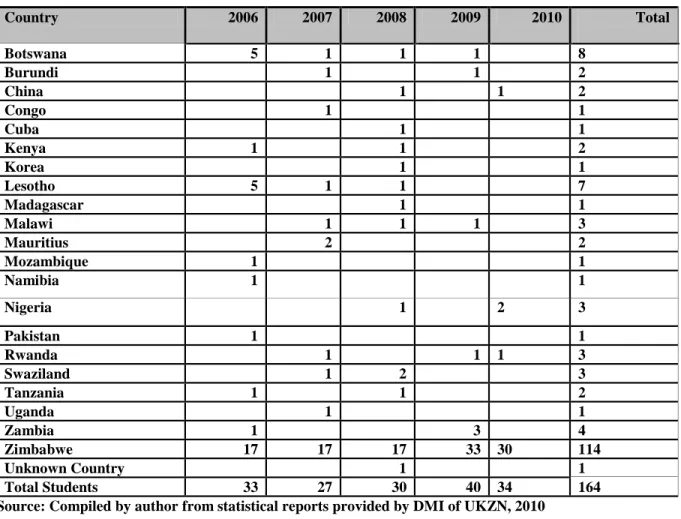
an even lower up-take of these offers which resulted into enrolments across 2006 to 2010. The results also showed that, over the years, the sample came from various countries in small numbers of between 1 to 8 students, and in a larger number from Zimbabwe. The sample of international students’ gender statuses showed that there were more male than female students that enrolled at the FMS over the years. The admissions entrance criterion applied to international and local applicants was scrutinised. The samples of international students were tracked to find out the recruitment, retention, graduation and drop-out rates of this class of students. The results from the analysis on retention rate of the sample students showed that the majority of these students remained in the system and continued with their studies, graduated and enrolled for higher studies. A comparison was done on the sample students that entered the Faculty on the strength of possessing a full/complete matriculation and on ‘other’ matriculation types (which is highly disfavoured at the FMS). The results showed that both categories of students achieved academic success in their studies. UKZN should consider the benefits that could be derived from this study to significantly increase the intake of international students. An increase in international students would assist UKZN to align this action with another one of its stated goals, that is, “to attract and retain students from Africa and beyond”. Another benefit for UKZN to increase its international student intake is to meet its future enrolment.
vi
TABLE OF CONTENTS Page
TITLE i
DECLARATION ii
ACKNOWLEDGEMENT iii
ABSTRACT iv
TABLE OF CONTENTS vi
LIST OF FIGURES xii
LIST OF TABLES xii
ABBREVIATIONS xiii
CHAPTER ONE – INTRODUCTION AND BACKGROUND 1
1.1 Introduction and Context 1
1.2 Research Questions and Methodology 4
1.3 Definition of Terms Used 7
1.4 Limitations, Scope and Delimitations 8
1.5 Overview of Study 9
1.6 Conclusion 11
CHAPTER TWO - LITERATURE REVIEW 13
2.1 Introduction 13
2.2 International Student Enrolment at UCT and WITS 14 2.3 Recruitment and Retention Rate of Students at Educational Institutions 15 2.4 A Decline in Student Numbers at Educational Institutions 18 2.5 Academic Success and Progression of International Students 21 2.6 Satisfaction with Life Among International Students 23
2.7 Benefits of Proficiency in English Language 29
2.8 Boom in the Demand for Higher Education 30
vii
CHAPTER TWO - LITERATURE REVIEW continued… 31
2.9 Recent Survey on International Students at U.S. Campuses 31
2.10 Diversity and Culture 32
2.11 Conclusion 35
CHAPTER THREE - RESEARCH METHODOLOY 37
3.1 Introduction 37
3.2 Population and Sample Selection 37
3.2.1 Sample 38
3.3 Research Design 40
3.4 Research Questions and Methodology 44
3.5 Informed Consent 49
3.6 Statistical Tools – Descriptive Statistics 49
3.7 The Validity and Reliability of Information 51
3.8 Conclusions 52
CHAPTER FOUR - FINDINGS AND RESULTS 53
4.1 Introduction 53
4.2 What is the Profile of International Students in the Faculty of Management
Studies from 2006 to 2010? 53
4.2.1 Trend in International Application Statuses from 2006 to 2010 53 4.2.2 Findings on Application, Offers and Enrolments - 2006 to 2010 54 4.2.3 Summary on International Applications, Offers and Enrolments 55 4.3 Trend in Gender Profile of Enrolled International Students in 2006 to 2010 56 4.3.1 Findings on Trend on Gender of International Enrolments, 2006 to 2010 57 4.3.2 Summary of Trends on Gender of International Student Enrolments,
2006 to 2010 57
viii
CHAPTER FOUR - FINDINGS AND RESULTS continued… 58
4.4 International Enrolments by Campus and Degree Programmes 58 4.4.1 International Student Enrolments at Pietermaritzburg and
Westville Campuses 60
4.4.2 International Student Degree Choice, 2006 to 2010 60 4.4.3 Summary on Campus and Degree Choices by International Students 62 4.5 International Student’s Country of Origin, 2006 to 2010 64
4.5.1 Student Enrolments from Various Countries 64
4.5.2 Summary on Students from Various Countries 65
4.6 Retention, Drop Out and Graduation Rates of International Students 65 4.6.1 Findings on Internationals Students that Dropped or Continued
with Studies and Graduated 67
4.6.2 Summary on Student Retention, Drop Out and Graduation Rates 67 4.7 Comparison of Entrance Criteria for Local and International Students 68 4.7.1 Degree Entrance Requirements Applicable to Local Applicants 69 4.7.2 Entrance Requirements Prescribed for International Students 70 4.7.3 Comparison on Entrance Criteria Prescribed for International
and Local Applicants 70
4.7.4 Summary and Comparison of Prescribed International and
Local Entrance Criteria 71
4.8 What are the Academic Performance Levels of International
Students in the Faculty of Management Studies, 2006 to 2009? 71 4.8.1 The Success Rate of First Year International Students on full/complete
and ‘other’ Matriculation Type Certificates 71
4.8.2 Full or Complete Matriculation Exemption 72
4.8.3 ‘Other’ Matriculation Type 73
4.8.4 Summary on Matriculation Types 73
ix
CHAPTER FOUR - FINDINGS AND RESULTS continued… 73
4.9 International Students Achievements on Computational Modules 73
4.9.1 Summary on the Computational Modules 77
4.10 Which Countries do Higher Performing Students Originate from? 78 4.10.1 Mean, Median and Range of International Students 79 4.10.2 International Students Academic Achievements on Pass A to Pass D 79
4.10.3 International Students Failure Rate 80
4.10.4 Summary on the Academic Performance Rates of International
Students 80
4.11 Chapter Summary on Results 81
CHAPTER FIVE- DISCUSSION OF RESULTS 84
5.1 Introduction 84
5.2 Discussion on International Student Profile in the FMS, 2006 to 2010 85 5.3 International Students’ Gender Profile, 2006 to 2010 87 5.4 International Student’s Campus Choice and Degree Programme 87 5.5 International Applicants from Various Home Countries 88 5.6 Prescribed Entrance Criteria for Local and International Applicants 89 5.7 International Student’s Academic Achievements on full Matriculation
versus other Matriculation Types 90
5.8 International Students Success on Computational Modules 91 5.9 Student Retention, Drop Out and Graduation Rates 92 5.10 Academic Performance Rates of International Students 93
5.11 Conclusion 93
x
CHAPTER SIX -CONCLUSION AND RECOMMENDATIONS 96
6.1 Introduction 96
6.2 Conclusion on Total Applications, Offers and Actual Enrolments 96 6.2.1 Recommendations on International Applications, Offers
and Actual Enrolments 98
6.3 Conclusion on Degree Programme and Campus Choice by
International Students 99
6.3.1 Recommendations on Degree Programme and Campus Choice
by International Students 100
6.4 Conclusion on the Trend in Gender of International Student
Enrolments to the FMS 101
6.4.1 Recommendations on the Trend in Gender of International Student
Enrolments to the FMS 102
6.5 Conclusion on International Students from Various Countries 102 6.5.1 Recommendation on International Students from Various Countries 103 6.6 Conclusion on Prescribed Entrance Criteria for Local
and International Applicants 103
6.6.1 Recommendation on Prescribed Entrance Criteria for Local
and International Applicants 104
6.7 Conclusion on Full Matriculation versus Other Matriculation Types 105 6.7.1 Recommendation on Full Matriculation versus Other Matriculation Types 105 6.8 Conclusion on International Students Success Rate on First Year
Computational Modules 106
6.8.1 Recommendation on International Students Success Rate on First
Year Computational Modules 107
6.9 Conclusion on the Academic Performance Rates of International
Students from Various Countries 107
6.9.1 Recommendation on the Academic Performance Rates of International
Students from Various Countries 108
xi
CHAPTER SIX -CONCLUSION AND RECOMMENDATIONS continued… 108
6.10 Conclusion on Student Retention, Drop Out and Graduation Rates 108 6.10.1 Recommendation on Student Retention, Drop Out and Graduation Rates 109
6.11 Suggestions for Future Studies 109
REFERENCES 111
Appendix: A Confirmation of English Language Competency 116 Appendix: B Email Confirmation on Scholarship for Zimbabwean Students 117
Appendix: C Ethical Clearance Certificate 118
xii
LIST OF FIGURES 54
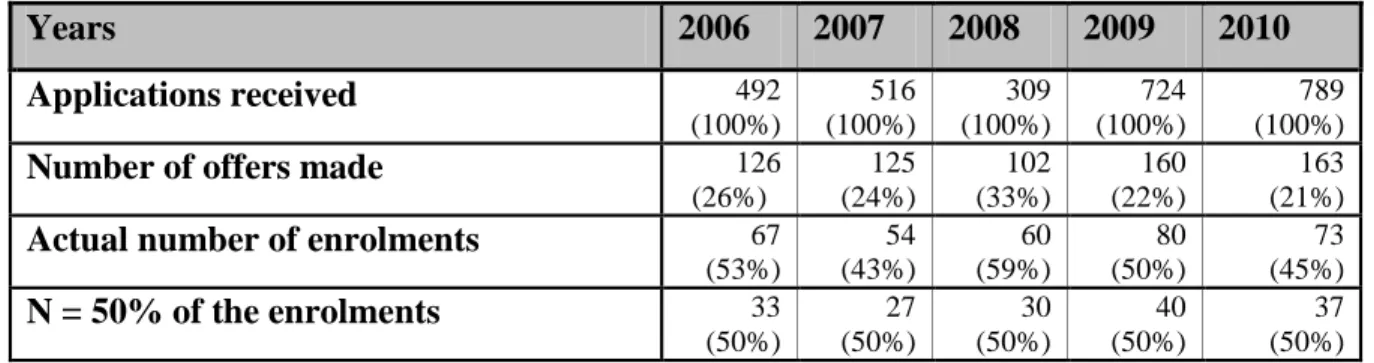
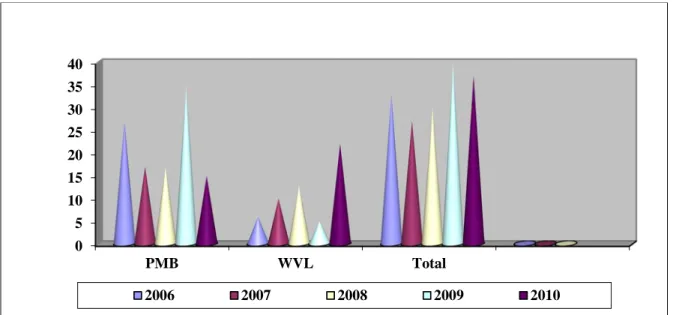
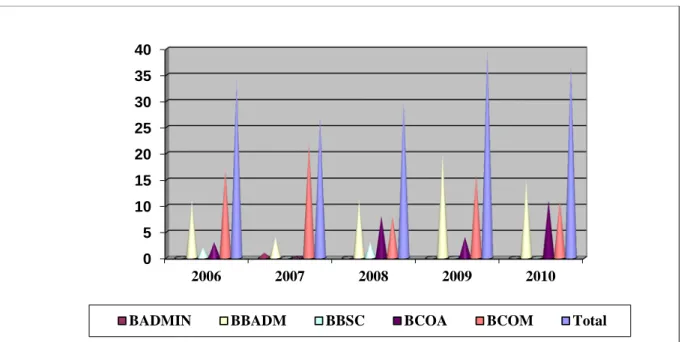
Figure: 4.1 International Application Statuses, 2006 to 2010 54 Figure: 4.2 International Enrolments by Gender, 2006 to 2010 56 Figure: 4.3 International Student’s Choice of Campus, 2006 to 2010 59 Figure: 4.4 International Enrolments by Degree Program, 2006 to 2010 59 Figure: 4.5 International Enrolments – Retention, Drop-out and Graduation Rates 66 Figure: 4.6 Academic Performance of Students on Full/complete and other
Matriculation Types, 2006 to 2009 72
Figure: 4.7 Students Individual Mean Scores, 2006 to 2009 79
LIST OF TABLES 47
Table 3.1 Classification of Results 47
Table 4.1 International Students’ Application Status, 2006 to 2010 54 Table 4.2 Enrolled International Students Gender Status, 2006 to 2010 56 Table 4.3 International Students Campus and Degree Choices, 2006 to 2010 58 Table 4.4 The Total Number of International Students from Various
Countries 64
Table 4.5 Retention, Drop-Out and Graduation Rates, 2006 to 2009 66 Table 4.6 Entrance Criteria to Degree Programmes Applicable to Local
Students at the FMS 68
Table 4.7 Entrance Criteria Applicable to International Students 69 Table 4.8 International Students Matriculation Type and Pass Category,
2006 to 2009 72
Table 4.9 International Student Class Average Achievements in
Accounting Modules, 2006 to 2009 74
Table 4.10 International Student Class Average Achievements in
Statistic Modules, 2006 to 2009 76
Table 4.11 International Students Country and First Year Achievements
at the FMS 78
xiii ABBREVIATIONS
CA Class Average
CAO Central Applications Office
DMI Division of Management Information HESA Higher Education of South Africa BCOM Bachelor of Commerce
BCOA Bachelor of Commerce (Accounting) BBADM Bachelor of Business Administration BADMIN Bachelor of Administration
BBSC Bachelor of Business Science UKZN University of KwaZulu-Natal
IS&T Information Systems and Technology ITS Integrated Tertiary Systems
MAL Malawi
BOT Botswana
NIG Nigeria
MAU Mauritius
ZIM Zimbabwe
CHI China
CUB Cuba
CON Congo
GAN Ghana
PAK Pakistan
UGA Uganda
SADC Southern African Development Community FMS Faculty of Management Studies
ACCT101 Accounting 101 ACCT102 Accounting 102 Maths130 Mathematics 130
xiv Maths137 Mathematics 137
Stats137 Statistics 137
SPStats Specialised Statistics
SAQA South African Qualifications Authority
1
CHAPTER ONE
INTRODUCTION AND BACKGROUND
1.1 Introduction and Context
The UKZN in the 2011 to 2013 planning document proudly informs the public that the institution strives to be the number one university in the country (see www.ukzn.ac.za). The UKZN has been placed in third position with the University of Cape Town (UCT) and University of Witwatersrand (WITS) in first and second positions respectively in a recent survey done on national universities by Academic Ranking of World Universities (ARWU) (see www.en.wikipedia.org/wiki/Rankings_of_universities_in_South_Africa).
One of the important aspects of this study is to find out the quality and success rates of international students who enrolled at the FMS in 2006 to 2009. This has a direct impact in relation to one of the UKZN’s goals to recruit and retain quality students both locally and internationally. The stated goals of the UKZN can be found on it’s website and on the 2011 Prospectus. (www.ukzn.ac.za). Closely analysing the data of past students enrolled at the FMS in 2006 to 2010, a coherent picture emerges to partially represent the quality of UKZN’s recruitment and retention initiatives on the sample of students used in this study.
The aim of this study is to investigate the profile of international students within the Faculty of Management Studies over a period of five years, that is 2006 to 2010, and the academic performance of these students is examined over a four year period, namely, 2006 to 2009. The Admissions Office deals mainly with student admissions into the Faculty of Management Studies at the UKZN. The Faculty can take up to 15% of international students for degree studies. This quota, however, was not met in 2009 and 2010. International students (historically) have been accepted on the Faculty’s published entrance criteria for undergraduate studies, but since 2009, changes were effected by the Faculty on the entrance criteria prescribed to international candidates.
2
Prior to 2009, the Faculty on the Westville campus considered international applicants based on full matriculation exemption and on ‘other’ matriculation types. Full matriculation exemption is an approved qualification endorsed by Higher Education of South Africa (HESA) on application.
Provided candidates who apply for full exemption matriculation certificates meet the minimum subject requirements on their highest school leaving certificates, they will qualify for and be issued with, a full matriculation exemption certificate from HESA. In addition to highest school- leaving certificates with the necessary subjects, HESA also considers candidates on further studies they may have embarked upon at a university or higher education institute in their home country or outside their home country (see [email protected]).
‘Other’ is a word used to group the various matriculation types (excluding the full matriculation exemption type). ‘Other’ matriculation types include; Foreign Conditional Exemption, Age Exemption, Senate Discretionary Exemption and Ordinary Conditional Exemption. ‘Other’
matriculation certificates are granted by HESA, usually, with some condition that candidates must fulfil and then re-apply to HESA when the conditions are met for issue of full matriculation exemption. Candidates on ‘other’ matriculation certificate types are allowed entrance to degree studies at universities although, at UKZN, the Faculty intake of international candidates with this type of certificate is limited, especially with the entrance selection criteria changes in recent years. In the experience of the Admissions officer, the new changes were implemented sooner at the Westville campus than at the Pietermaritzburg campus. Reasons for this could be that certain staff members between the two campuses have contrasting views on the changes, and the issue of entrance criteria of international applicants is frequently debated. This is one of the integral focus areas in the research study.
The points systems applies to local matriculation certificates and are used in the selection criteria in the Faculty at UKZN in making offers to local candidates and does not apply to international applicants. At the University of Cape Town and Witwatersrand, university points scored for matriculation subjects are calculated and awarded to international applicants on their
3
matriculation subjects, and they are selected based on meeting the minimum subject entrance requirement and minimum score level, as prescribed by those institutions. One of the changes effected by FMS on the entrance criteria for degree studies from international applicants, is that these candidates must have full matriculation exemption certificates with mathematics and English language subject requirements at the prescribed levels.
Certain applicants have, however, been considered via the Dean’s discretion route. A Dean’s panel discusses and considers applicants who do not fully meet the entrance criteria to degree studies, but such applicants may have potential to excel in their studies. Many such cases were accepted on ‘other’ matriculation type certificates mainly at the PMB campus. A comparative analysis, based on international students’ academic performance, was done in this study on students who enrolled for studies with full matriculation exemption to those with ‘other’
matriculation certificate type at FMS, UKZN. The outcome of results are presented in Chapter Four illustrated by graphs and they reveal the potential of both classes of students and highlight differences on pass types categorised as class Pass A to D. Staff responsible for recruitment of international students will find this information very useful, and FMS may increase their enrolment figures of international students by welcoming and affording study opportunities to students on ‘other’ matriculation exemption certificates, and on full matriculation exemption certificates.
February of each year is the start of another academic year at UKZN which attracts droves of new and returning students to the campus. During the summer period, the campus is busy with academic activities as students queue up in long lines outside each Faculty to complete necessary registration processes. Students are keen to begin their studies, but more often than not the registration process is much easier for returning students than it is for first year students, especially those who are international students.
4
There are many factors that influence the study lives of international students. According to Putman (1991, pp. 42-46) language, finances, adaptability, institution’s qualifications and orientation are factors that play a role in some way in how these international students fare in their studies. The researcher is an employee at FMS, UKZN and has interaction with international students. Given the type of questions and enquiries from these students regarding university entrance, it is no surprise that many of them take some time before they can settle down to studies and academic life. Thus, it can be assumed that the transition stages, for some international students, are often a difficult and challenging time.
The pressure becomes overwhelming when staff is required to repeatedly explain reasons for the applicants’ unsuccessful status. Furthermore, the University receives a high volume of international applicants each year. International applicants display a high level of tenacity towards gaining entrance to degree studies at the Faculty of Management Studies even where they do not meet the entrance requirements. It is how well these international students have performed once afforded the opportunity to study at FMS, that has raised the interest of this study to follow through with the research questions presented in this chapter.
1.2 Research Questions and Methodology
This study examined and analysed the data on the sample of students during 2006 to 2010 in order to find out trends in applications made by international candidates that expressed interest to study for undergraduate degrees at the FMS. The focus of this study continued from the trends in applications of international students to find out the trends in student enrolments across degrees and campuses. The study then examined the success and failure rates of the students in the sample from 2006 to 2009 only (as the sample of student data was unavailable for 2010).
This was done to determine the worthiness of admitting international candidates to study at the FMS, UKZN since the Faculty is focused on attracting and retaining quality students. This study has three main research questions and several related sub-questions as follows:
5
1. What is the profile (2006 to 2010) and academic performance (2006 to 2009) of international students in the Faculty of Management Studies?
• What is the demographic profile of international students within the FMS and should the Faculty strategise to recruit students from specific countries and of a specific gender?
• What is the academic performance levels and quality (in terms of academic success) of international students in the Faculty of Management Studies from 2006 to 2009?
• Which countries did the higher performing achievers originate from in 2006 to 2009?
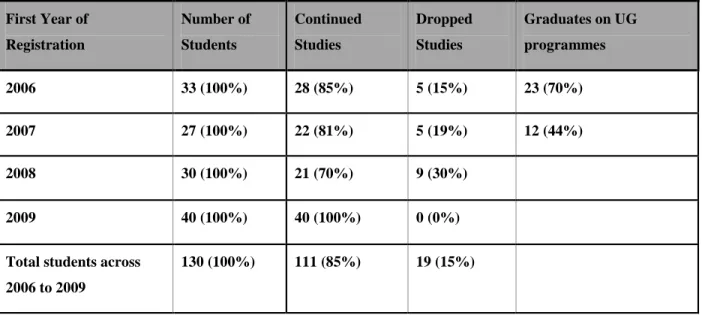
2. What is the retention rate of those international students of the class of 2006 to 2009?
• What percentage of undergraduate international students continued or dropped out of tertiary studies?
• What percentage of students graduated from their undergraduate studies?
• What percentage of international students enrolled for higher studies and graduated from higher studies?
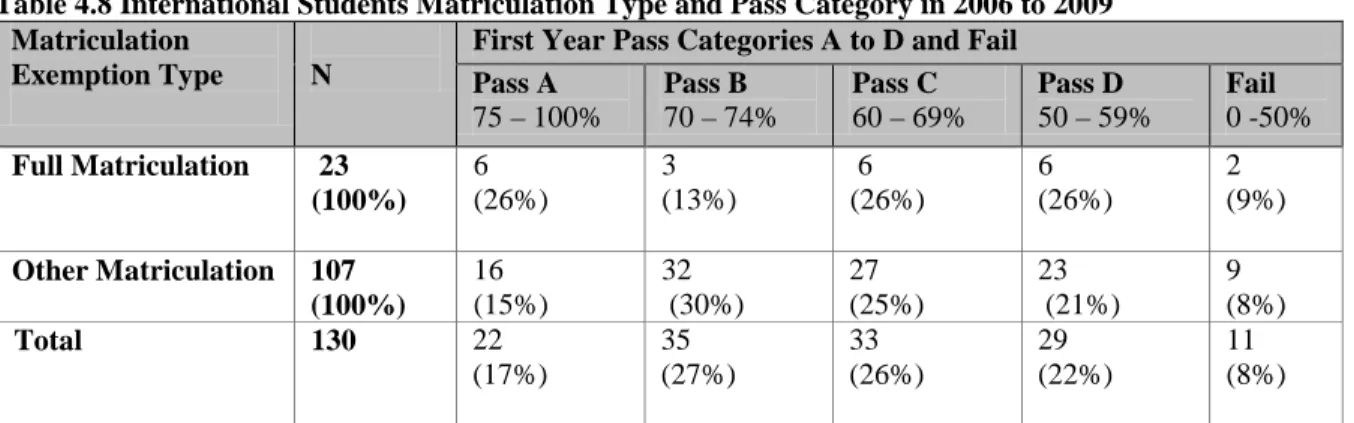
3. What is the academic performance level of international enrolments on full matriculation exemption in comparison to those on ‘other’ matriculation exemption type certificates?
• How well did international enrolments on full matriculation exemption fare against international enrolments that enrolled on ‘other’ matriculation exemption
6
platforms? (The FMS was not always keen to enrol international applicants with
‘other’ matriculation exemption certificates).
The methodology used to generate the results on the demographic profile of international students within FMS, was to obtain the biographical international student data of the sample set and re-arrange this data into Excel spread sheets under specific headings. The headings on the Excel spread sheets were set-up to organise and separate the information to become more meaningful. Once the Excel spread sheets were completed with the input of data, the necessary information was transferred to specifically drawn up tables to show the results and address each question of this study. This data was then analysed, using descriptive statistics focussed on the research questions, to find the results on international students’ application to acceptance and enrolment rates and percentages, student gender status, the number of students from various countries, students’ preferred degree and campus choices.
To find the results of international students’ academic performance and to determine the quality of students in terms of their academic success, these students’ academic records were printed from the ITS system by keying in the respective student numbers. Thereafter, the results of each student’s first year modules were taken from the academic records and captured directly onto the first set of Excel spread sheets used to address question 1 and the sub-questions thereunder.
This same methodology was used to determine the results of international students’ academic achievements on computational modules at first year level. Once the information was transferred onto a table, calculations were made on the figures to show the results in terms of academic performance levels of the sample of international students in comparison to the rest of the class that wrote examinations on specific computational modules in their first year of study at the FMS. The examination results were separated and put into categories to show the pass/failure rate levels of international students.
To find out the results of the sample of international students’ country of origin, another table was set up and the information was transferred from the Excel spread sheets. This helped to
7
separate the information and show the results of the top-most international achievers and the various countries from which these students originated.
The methodology used to determine the percentage of undergraduate international students that continued or dropped out of studies in their first year, was obtained by examining each student’s academic record and by capturing the relevant data against specific headings onto the Excel spread sheets. The necessary data was then extracted and put into tables to show the results.
These Excel spread sheets continued to be built on with more information that was extracted from ITS from each international students data on the system. It was then transferred into another table where these international students were tracked to find out whether or not they:
• continued or dropped their studies,
• graduated from undergraduate studies and enrolled for higher studies, and,
• thereafter, graduated from higher studies.
The same methodology was used to identify and separate international students who enrolled for studies on various matriculation types. Information was extracted from the Excel spread sheets and put into a table to show the results. Graphs were used to clearly show the trends that emerged from the arranged data in many of the tables for the questions addressed in this study.
1.3 Definition of Terms Used
Definition of pertinent terms used in this study is provided for clarity. 1. FMS means Faculty of Management Studies. 2. ‘Foreign’ or ‘international’ refers to students from countries outside South Africa. 3. DMI means Division of Management Information that exists in the University of KwaZulu-Natal. 4. UKZN means University of KwaZulu-Natal. 5. ITS means Integrated Tertiary Systems – a programme used by the University of KwaZulu-Natal to record student data from the time a candidate applies to the University to the time he/she graduates.
6. HESA is the Higher Education of South Africa which is an organisation that evaluates matriculation or highest school leaving certificates to confirm equivalency to the local South
8
African matriculation for applicants to be able to enter a university for higher education. 7.
SAQA means South African Qualifications Authority an organisation that evaluates international applicants’ tertiary level studies. 8. SADC means Southern African Development Community.
Degree descriptions have been shortened, for example, Bachelor of Commerce Degree is 9.
BCOM Degree and 10. Class Average is ‘CA’ listed in specific tables, figures and used in the context of this study. Modules make up the curriculum for a particular degree programme.
Graduation is when students have fulfilled all the requirements on the degree programme they enrolled on and then graduate from this level of study. Postgraduate mean higher studies above that of undergraduate studies. Countries used in this study in a table are shortened, for example, 11. BOT means Botswana, so that information could be accommodated on tables. All shortened terms used in the study are explained on the abbreviations list.
1.4 Limitations, Scope and Delimitations
This study focused on the profile and performance of international students at the FMS, UKZN, and in so doing, led to information that was examined resulting in a number of findings. The work of many authors relating to recruitment and retention rates, academic progression and successes, the advantages of international students having English language proficiency, importance and benefits of hosting international students at educational institutions outside their home countries, are discussed in this chapter. However, there were limitations to this study as indicated below.
• This study was limited to the Faculty of Management Studies at UKZN on investigating the profile and performance of international students, and did not include students from any other Faculties within the University;
• Due to limited time to complete this study other institutions such as WITS, UCT, Stellenbosch and Pretoria were excluded. UKZN was used as a backdrop to the study with focus on the Faculty of Management Studies only. Encompassing all faculties at UKZN in a similar type of study could be an area for future research.
9
• This study did not consider short-term exchange international applicants and enrolments that may have come to FMS, UKZN for one semester or for one year of study. This study has only considered international undergraduate degree applicants and enrolments at FMS, UKZN.
• The sample of students used in this study was tracked to find out how many of these students continued on to postgraduate studies. The postgraduate degrees were not specifically mentioned.
• This study has used secondary data sourced from ITS. The use of questionnaires in future studies would gather useful data to probe causal reasons on factors that had a negative or positive impact on the study lives of international students in the FMS.
1.5 Overview of Study
Chapter One provides a framework of the entire study introducing the topic and reasons why the author embarked on this study showing the relevance and importance of current research. This first chapter details the focus and context of this study. The main research questions and the objectives of the study are presented within Chapter One. This chapter covers the problem statement, purpose, significance and overview of the study. The research questions are listed and briefly discussed in this chapter. The validity, reliability and limitations are also discussed in the first chapter.
Chapter Two is the literature review. It appears that there is very little contemporary and relevant research available in this field of profile and performance analysis, nevertheless, relevant literature has been reviewed. The literature review discusses the three main questions and the sub-questions of this study. The purpose of the literature review is to provide a conceptual framework for the importance of recruiting and retaining international students at educational institutions. Some of the topics covered include:
10
• recruitment and retention rate of students at educational institutions,
• the increase and decline in student numbers at educational institutions,
• academic progression and success of international students at various institutions,
• the benefits of proficiency in the English language, and,
• understanding culture and diversity.
The answers to the research questions are found in Chapter Four of this paper. Graphs are used to identify trends and patterns evident in the data analysis and tables are used for grouping and separating complex data.
Chapter Three discusses the research methodology. This chapter covers:
• research design,
• research questions,
• sample size,
• confidentiality,
• data collection,
• data organization and analysis.
It is comprised of the discussion on both quantitative and qualitative techniques that are used in this study. Statistical measures using mean, medium and range were used on the population of international student’s academic performance results for both individual performances and class averages based on modules taken by students in their first year of study at the FMS, across a range of undergraduate degrees.
Chapter Four presents the findings and results of the data examined in this study. Tables and Figures are used to professionally show the results. Spread sheets using Microsoft Excel are used to organize the data. Chapter Five presents the analysis on the findings of this study.
Chapter Six presents conclusions, recommendations and implications of this study.
11 1.6 Conclusion
This is a study directly related to the researcher’s field of interest and functional line of work.
The opportunity to explore aspects of the problem statement directed towards international students has presented itself and proved that it was a worthy cause for investigation and examination. Since the University has merged, one of the targets of FMS is to continue to provide excellent service, meet enrolment targets and standardise study disciplines and procedures at operational levels at both the Pietermaritzburg and Westville campuses. Some aspects of standardisation have proved to be challenging. One such challenge is the entrance criteria used for the intake of international applicants having had changes implemented to it by the Faculty since 2009, and having been effected and adopted at a higher rate at the Westville campus as opposed to the Pietermaritzburg campus.
This Chapter discussed the research focus and context within which the relevant questions of the study were highlighted. The backdrop of the study is UKZN and the focus is on the FMS’ intake of international students into that Faculty. The research objectives focused on the profile and performance of international students at FMS, UKZN, providing an important focus for due consideration in the growth and expansion of student intake in this regard.
This chapter also covered aspects relating to:
• the purpose of the study,
• significance and nature of the study,
• research questions,
• definition of terms used,
• assumptions,
• the validity and reliability of information used in this study, and,
• limitations.
The potential and academic success and failure rate of international enrolments in the population of this study with and without full exemption are discussed and explored in Chapter Five of the
12 study.
It is hoped that the study will benefit interested stakeholders based on the research questions and outcomes of the study. There could also be some changes in adapting or changing the entrance criteria policy used by the FMS in the future. This could set a background for changes towards how international students make applications for study purposes to UKZN. There could be effective changes in the University and the Faculty’s marketing drive and management could use the outcome of the study for enhancing decision-making in this regard in the future.
The management of FMS can use the information from this study in future decision-making on the recruitment and enrolment of international students. Since UKZN is focused on being the number one university in the country by 2013, the results from this study can add value to the institution in pursuing this goal and in exploring some of the outcomes from this study in future studies. This study does add value to the work the researcher does as an admissions officer at the FMS and may bring changes in increasing study opportunities and lowering barriers. For example, such as providing residences to accommodate international students on the campuses and make their stay as comfortable as possible, applying an improved entrance criteria policy, etcetera for international candidates. The Faculty could draw from the results and findings of such a study and use the outcomes to its advantage in increasing the intake of international applicants into the Faculty. This would increase revenue, boost internationalisation efforts, meet with UKZN’s goals and the increase the Faculty’s enrolment figures in the future. Chapter Two follows with a discussion of the literature review.
13
CHAPTER TWO LITERATURE REVIEW 2.1 Introduction
Chapter Two comprises a review of the literature that relates to this study. Books, journal articles and websites were sourced to find related materials. There have been no studies undertaken by any writer or author directly related to this topic; however, there are aspects where the studies and works of other authors discussed in this chapter do relate indirectly to and highlight the importance of a study such as this one. In order to determine customer profile and needs, it is imperative to understand who your customers are and what products and services they require (Don, E, and Schultz, Philip, J. Kitchen, (2000). It would be beneficial for UKZN to consider the outcome of this study on international student profile and academic performance, as one step in further understanding the international customer profile at UKZN.
Educational institutions that understand internationalisation in totality and apply effective policies and processes to manage the complexities in recruitment and retention of international students, would be the ones that reap the rewards and benefits of being sensitive, knowledgeable and aware of the needs of international students. Obtaining a worthy education from a recognised institution is also beneficial in the self-development and confidence of students.
Talented and educated human beings are an asset, not only to themselves and their families, but also to their community, country and to any organisation they serve. Bagshawe (2011, p. 20) made a very valid point on people making a contribution, where he stated that it is important for most people to have a sense of contributing something to others, as an individual or as a group for the environment or to society and this gives people a sense of joy in making a difference to the world. In support of Bagshawe’s point on people making a contribution to the environment or society, this can be more readily achieved by individuals that are talented, educated and knowledgeable in how and when they make a difference to the world (Bagshawe, 2001).
14
This chapter looks at the work of various authors and writers on a number of factors that underlie the importance for educational institutions to focus on areas affecting either positively or negatively on international student recruitment. In some of the literature reviewed, cited in this chapter, the academic performances of international students were investigated with use of prepared questionnaires to obtain the relevant data used in providing the outcome of a set of results to increase the reader’s knowledge. In order for UKZN to take steps in achieving its goal to be the number one university in the country it must pay attention to the marketing strategies of its competitors namely, University of Cape Town and Witwatersrand who are nationally ranked at positions number one and two respectively (see www.ukzn.ac.za.). UCT and WITS currently have a larger market share with respect to undergraduate international students. How this information was obtained, is discussed and highlighted in this chapter (see www.uct.ac.za and www.wits.ac.za).
2.2 International Student Enrolment at UCT and WITS
Contact was made with the University of Cape Town’s Admission Officer on 12 August 2011 to ascertain the number of international students who come to UCT each year. Ms Maseko provided the information that UCT, Faculty of Commerce has exceeded the quota set aside for undergraduate international student intake year on year for the past few years. Ms Maskeo was not willing to give a figure as to what the UCT’s quota was set at. The author made another telephonic enquiry on 12 August 2001 to Witwatersrand University and received confirmation from Inge at the international office that Witwatersrand also exceeded in international undergraduate commerce student intake annually. The set quota for Witwatersrand was not divulged.
There could be a number of reasons contributing to the success of UCT and WITS positions at first and second place among national universities. For UKZN to improve its position from third to first position on the ranking of national universities, it will have to examine a number of factors that contribute to the success of the institution and identify areas of weaknesses that need to be improved. One such factor is for UKZN to take note of whether or not the institution is meeting its enrolment targets. In the experience of the author of this paper, UKZN is focused in
15
meeting student enrolment targets throughout the university and places a lot of effort, such as, hosting open days and career events, to attract local students into the institution. International students are recruited by the staff in the university’s international office however, specifically looking at the quality and number of international students into the FMS may have been overlooked since the Faculty is not meeting it’s target of international student enrolments. In this study, the enrolment target of international students in the FMS can be viewed in Chapter Four. The causal reasons for patterns and trends that emerged were not investigated in this study, but do create a platform for exploration in a future study of this nature.
2.3 Recruitment and Retention Rate of Students at Educational Institutions
This study covered the first step in investigating the recruitment and retention rate of international students in the sample, without probing for causal reasons of this state. Causal reasons can be explored by further studies using this study as a foundation. Any number of reasons contribute to retention and attrition rates as is evident in a study by Murtaugh, Burns and Schuster (1999, p. 355). It was found that attrition increased with age and decreased with increasing high school Grade Performance Averages (GPA) and first-quarter GPA.
Murtaugh (et al., 1999, p. 356), used ‘survival analysis’ to model the retention of 8867 undergraduate students at Oregon State University between 1991 to 1996, using a proportional hazards regression model to predict a student’s probability of leaving school which was based on these demographic and academic variables. Murtaugh (et al., 1999, p. 356), did a longitudinal study using secondary data from a computerised database called the Oregon State University (OSU) student Data Warehouse on first time freshmen enrolments in the fall (autumn) quarters of 1991 to 1996. The outcome of Murtaugh (et al’s., 1999, p. 368), study has helped to guide Oregon University’s efforts to improve retention through marketing, recruitment, and development of orientation and other programmes. One of the objectives from the outcome of this current study is for UKZN to improve retention through marketing and recruitment and in the orientation of international students. A key opportunity was identified whereby the Oregon State University made efforts to orientate new students to increase the likelihood of success during the students first three terms at the institution.
16
In Murtaugh (et al’s., 1999, p. 368) study, the possible reasons for poor retention of out-of-state students were further explored. It appeared that possible causes were found in a lack of scholarship opportunities and timing of orientation programmes that were inconvenient for out- of-state students. At UKZN, there is no financial aid assistance or scholarships that are granted to international students who enrol on full time studies. Murtaugh’s (et al’s.,1999, p. 368) study found that an additional area of concern was in the retention of black and other minority students whereby, as a direct result of the analysis, a marketing plan aimed at high achieving black students in Oregon was developed. The study also found that non-residents had higher attrition rates than those students at residence, as well as international students, and that there were statistically significant associations of retention with ethnicity/race and college at first enrolment.
The benefits of this study cannot be underestimated but can be further explored to add value to UKZN as Oregon University has from Murtaugh’s (et al’s.,1999, p. 368) study in the institutions marketing, recruitment and retention initiatives. In a related study by Poole (2001, p. 395) a lecturer in Management at the School of Management, University of Western Sydney, Australia, entitled “Moving towards professionalism: The Strategic Management of International Education Activities at Australian Universities and their Faculties of Business”, focused on the entrepreneurial activities of international students. Factors such as finance and quality of lectures received, among other such activities of these students at Australian campuses, found Australian universities received A$770 million in 2000 from international student fees, therefore, it was crucial for such universities to manage international activities in an efficient, effective and sustainable manner and this was critically important to virtually every institution in the Australian higher education sector (Murtaugh, et al., 1999).
Poole’s (2001, p. 396) study shows that there was an increase in international students to Australian Universities from 1990 to 2000 by 20 000 international students to 120 000 international students. No doubt that one of the reasons for the successful increase in international students at Australian Universities is found in Poole (2001, p. 396) who quoted that
17
“Higher education has become one of Australia’s biggest and most important services export, and its universities have successfully exploited the boom in demand for their services”. This is an important point for UKZN in that international applications have increased year on year indicating a high level of demand for education. Thus, UKZN, should pay attention to successor recruitment strategies of international students when revising its current strategies or implementing new ones in the future. Increasing the intake of international student enrolments would naturally increase the future income generation for the institution.
People have so many more options to choose from than in the past, when it comes to their education. There is global competition from institutions across countries that compete to attract foreign student enrolments. This is no different for UKZN, who is striving to be the number one university in the country by 2013. This information was found in the UKZN 2011 to 2013 planning documentation and is being made known to all concerned stakeholders who play a role in building a better university for the future (www.ukzn.ac.za). The benefits for UKZN, who is aiming to be the number one university in the country, to be at an advantageous position over other world leading educational institutions and competitors in its recruitment and retention strategy of international students, would pay dividends in the future.
According to Poole (2001, p. 395), when businesses, such as universities, become international, they are faced with the need to manage the complexities, risks and challenges associated with international operations. Poole (2001, p. 398) has used Thompson and Strickland’s 1999 strategic management framework model (1999, p. 4) in emphasising the five tasks of strategic management. These are highlighted as follows:
1. Developing a business mission and strategic vision;
2. Setting objectives;
3. Crafting a strategy to achieve the objectives;
4. Implementing and executing the strategy; and
5. Evaluating performance, monitoring new developments and initiating corrective adjustments.
18
Tasks 1, 2, 3 or 4 as required are to be used as ‘diagnostic tools’ in developing and understanding university international strategies and management processes, to guide and provide the strategic management frameworks outlined by Thompson and Strickland (1999, p. 4). This model would be a useful tool to be considered by UKZN stakeholders, interested in strategic management.
The objective and findings of Poole’s (2001, p. 421) study strengthens the assertion of this dissertation in that it is vital for any institution to recognise the importance of internationalisation and to effect strategies in this direction. (Poole, 2001). Andrade (2006, p. 133) stated that international students and their dependants supply over US$13 billion dollars annually to the US economy. Andrade (2006, p. 133) also found that Australia has benefited from skills of international students and those that opted to stay in the country and work, in the fields of information and communications technology and engineering. The implications of recruitment are for nations to set strategies to attract international students but consider the educational and cultural experiences of these students in the destination country. In order for UKZN to ensure that current support programmes for international students are successful, research needs to be conducted to identify grey areas and implement changes (Andrade, 2006).
The author of this study supports Andrade’s (2006, p. 133) view that international students should not be taken for granted and seen as ‘cash cows’. Appropriate information, services, and programmes are critical to helping international students have positive experiences and to fulfil their educational goals and return home as satisfied customers. By analysing the data in this study, the academic success in terms of first year achievements, graduation rates, and retention rates is an indicator of the success of international students at the FMS, UKZN.
2.4 A Decline in Student Numbers at Educational Institutions
One of the concerns in the conceptualisation of this study was that the FMS had not met its 15%
target on international enrolments in 2009 and 2010 and generally declining student numbers at institutions is a real concern to stakeholders in the education fraternity as is evident from researchers across many educational institutions worldwide, some of which are cited in this chapter. The reasons for this decline in international student numbers have not been
19
investigated by the FMS. In a study by Oduleye (1985, p. 17) of the Department of Biological Sciences, University of Ilorin, Nigeria, entitled “Decline in Nigerian Universities” the reasons for decline in student numbers were found in the management and administration of these universities that remained unchanged for the past three decades despite major changes in the environment. Oduleye (1985, p. 17), found that over the years there was no alignment with the changes effected in the environment and that university administrators’ conservative thinking of this phase of negative growth was entirely attributable to external rather than internal factors.
Oduleye’s (1985) study was done many decades ago, on the decline of students in Nigerian universities specifically; however, today this problem of declining student numbers at educational institutions still exists, as is evident from some of the more recent literature cited in this section.
Although, there is the aspect of inadequate funding as a major factor in the Nigerian University’s present decline, management aspects were highlighted in Oduleye’s (1985, p. 17) study that may have also contributed to this decline in student enrolment. Oduleye’s (1985, p. 17) further confirms that the impact of student decline fell more on areas of academic function than on supportive functions of the university. The relevance of Oduleye’s (1985) work in line with this study is to create awareness that the FMS has fallen short in meeting its enrolment target of 15%
in recent years on international student intake and were short in the overall target of local students over the past few years, making this an area for concern and investigation for UKZN and to look at the effectiveness of management and administration in order to improve recruitment and retention of international students into the institution (Oduleye, 1985).
The good news found on World Education News and Reviews, (2007), gives insight into an article entitled ‘International Student Mobility: Patterns and Trends’ by Verbik, Hobsons and Lasanowski (2007), has also emphasized the importance of international student mobility over the past 10 to 15 years, which has become an important part of the global higher education landscape. Tertiary education numbers worldwide at educational institutions in 2005 have increased to 2.7 million making this a 61% increase since 1999, a high growth in a short space of time due to significant changes in the infrastructures and capacity of higher education systems across the world.
20
Verbik, Hobsons and Lasanowski (2007), stated that the large majority of national governments have allocated more funds to higher education to improve quantity and quality of tertiary education offered within the borders of their countries. Students from rapidly growing economies are able to participate in higher education abroad, making the worldwide tertiary enrolments 40% higher than they were seven years ago, with more people participating in higher education than ever before. This in itself confirms that there is a market to attract international students into UKZN, more especially into the FMS. (World Education News and Reviews, 2007).
Reasons for concern for educational institutions in South Africa and UKZN, in particular, from more news in this article confirmed that the United States, United Kingdom and Australia have all experienced a decline or slump in enrolments when compared with the growth experienced in previous years. This fact is an important point for UKZN to note, considering that these overseas countries have “superior” educational institutions favoured by many international students, yet they have experienced a decline in student enrolments.
In another more recently related article that appeared in The Economist (2010), entitled “Foreign University Students: Will they still come?” written by an unknown author, gave insight into world leader countries like Britain and United States of America, that strategise to compete in the intake of international students, because the world is fast becoming a smaller place with many more choices and opportunities afforded to citizens. It was found that that over a million students went outside their home countries to seek education abroad and two decades later the figure almost doubled and less than a decade thereafter the figures tripled. The findings were that the lack of good institutions was in short supply. This makes it a good opportunity for UKZN to work towards gaining a larger market share of international students into the University in the future. This study provides insight into the quality and quantity of students from various countries. It could, therefore, pave the way to increase recruitment and retention initiatives in countries that are untapped (The Economist, 2010).
21
2.5 Academic Success and Progression of International Students
Another objective of this study was to investigate the academic success of international students in the population by analysing and categorising the first year examination results of these students. Similarly, a study conducted by Putman (1991, p. 44) entitled “The Academic Performance of Foreign Students”, found that to predict academic success at United States universities, test scores and previous grades were used as basic standards in determining probable success of their own students and by international students.
UKZN uses matriculation final examination marks on specific subject requirements as part of the entrance criteria to degree programme studies. Putman (1991, p. 44) is of the view that verbal, cultural and mechanical factors make it impossible to judge foreign students’ scores by the usual American norms. Therefore there is less certainty of the meaning of foreign students’ previous grades than that of United States local students. Putman (1991, p. 44) conducted a previous study on 546 foreign graduate students who had enrolled at Columbia University from 1945 to 1950 and found that only two admission criteria had practical value for prediction of foreign students’ success. One was grades in previous academic work where the marks from foreign institutions were converted to Columbia terms by a series of conversion scales devised for this purpose, the average of these converted marks correlating significantly with Columbia grade averages.
The other significant factor was English test scores. A functional knowledge of English was found to be a determining factor in the success of foreign students although, inevitably, English is a problem for the majority of foreign students. Putman (1991, pp. 44-45) confirms that very often a student who thinks highly of his English is shocked to find, upon arriving in the United States, that he can neither understand nor be understood. English and mathematics are the two main predictors used for selection of international students into the Faculty of Management Studies at UKZN. Within this study, the academic performances of all international students enrolled on full and ‘other type of matriculation certificate in the first year of their studies were
22
analysed against individual performances, against class averages and comparisons on academic success.
Putman (1991, p. 44) has confirmed that Universities in the United States found it difficult to determine scores of international students and what they fully mean to an institution. It is often the case that UKZN cannot fully determine every set of results received from all countries by international applicants. HESA is the matriculation authority that UKZN uses to determine whether or not applicants have satisfied the minimum requirements with respect to full matriculation exemption or ‘other’ matriculation certificate types. (Putman, 1991).
While this study has focused on the academic performance of undergraduate international students it has examined and tracked data to investigate the progress of these students onto postgraduate studies. The author, therefore, found an interesting study done by Yang and Lu, (2001) entitled ‘Predicting Academic Performance in Management Education: An Empirical Investigation of MBA Success’. Yang and Lu (2001, p. 15) used a prediction model developed with multiple regression and results show that undergraduate grade point average and scores on the Graduate Management Admissions Test had significant impact on several precedent variables on the academic performance in an accredited MBA programme. The author of this paper did not investigate causal reasons for academic performances on international students as a questionnaire is not part of this study. However, the average scores of international students’
first year examinations marks were analysed and the statistical mean applied to obtain an indication on academic performances at the FMS, UKZN. This study also covers the comparison of international students’ module performances to that of class average performances. (Class average performances include both local and international students across the campuses that wrote examinations on the computational modules.)
Yang and Lu (2001, p. 19) stated that international students can be a valuable asset for any graduate MBA programme, because these students can help Faculty members to enhance awareness of international implication and global perspectives and this can be the same for UKZN. As in so many other studies done on international students, these authors also inform
23
that international students have language barriers to overcome. A strong recommendation from Yang and Lu (2001, p. 19) is that business educators should take a proactive role in increasing our international perspective and examine the global implications of their business area.
Although, Yang and Lu (2001, p. 19) used MBA students in their study, the key recommendations relating to international students came through strongly on the importance of the intake of international students and the author of this study agrees that the intake of international students into any institution is important towards building and strengthening international ties with other countries and in meeting with the international student quota of the institution. (Yang and Lu, 2001).
2.6 Satisfaction with Life Among International Students
A study conducted by Lackland (2001, p. 315) entitled “Satisfaction with Life among International Students: An Exploratory Study” investigated a sample of 304 international students, made up of 159 males and 145 females at the University of Bergen, Norway, and it was found that these students, on the whole, had satisfaction with life, meaning that students were happy people in terms of the number of friends they had, their financial status and were not affected by discrimination issues. These students were satisfied with the information they received prior to enrolling for studies at external universities. However, students from Europe and North America were more satisfied than their peers from Africa and Asia. Factors such as the number of friends, finances, discrimination and information received prior to the foreign sojourn, significantly affected the student life satisfaction. This is something that is not specifically known about the FMS’s international students at UKZN. A further study could be done in this area to find out from past and current international students at UKZN, their satisfaction levels upon receiving the necessary information from the institution and in making their choice to study here, as well as their approval of campus life and lectures and any other similar factors.
Lackland (2001, p. 315) found that language proficiency with respect to English languages did not show a significant effect on student life satisfaction of international students. Sam (2001, p.319) confirms that a number of studies from English-speaking host countries have suggested
24
that international students’ overall ability in English is closely related to their academic success and overall adaptation (Barratt & Huba, 1994; Crano & Crano, 1993; Lewthwaite, 1996; Ying &
Liese, 1990). Crano and Crano’s (1993) study entitled “A Measure of Adjustment Strain in International Students” was undertaken to develop a reliable and valid measure of the stresses that international students faced in adjusting to their new environment. Crano and Crano (1993, p. 277) conducted their studies in two phases to measure adjustment strains of their sample of international students sojourning in the United States. In phase 1 a self-concept scale was administered to the sample of students 3 to 4 months prior to their departure from their home countries and in phase 2, that was 6 months later, the same measures were re-administered to the sample of students together with a general information questionnaire. (Crano & Crano, 1993, pp.
270-271). Crano and Crano (1993, p. 268) felt that international students into the U.S educational system held importance and, therefore, it was necessary to understand the factors that affected the quality of these students adjustment. (Lackland 2001). (Lewthwaite, 1996).
Ying and Liese, 1990). (Crano and Crano, 1993).
Lewthwaite (1996) conducted a study entitled “A Study of International Student's Perspectives on Cross-cultural Adaptation” with the aim of the study to discover and describe how international students experience and adapt to their new academic, social, cultural and linguistic environment. The author used questionnaires and interviews on 12 post-graduate international students to gather useful information to conduct the study and found that there were high levels of frustration, stress and even depression among these students on the lack of deep integration with New Zealanders as well as irritation with aspects of their host culture. It was found that the greatest block to adaptation was lack of intercultural communicative competence (Lewthwaite, 1996, p. 167). The 12 students in Lewthwaite's study originated from Indonesia, Taiwan, Thailand and Japan and were chosen to study at a university in New Zealand because they had initial introduction to New Zealand and university life at the University's English Language Centre, and had passed the English Language Proficiency test (Lewthwaite, 1996, p. 172).
Students were asked to comment on various aspects that have aided or hindered them in adapting to their new environment to which there was bemusement and anger by sponsored students at the lack of substantial information and preparation for cross-cultural adjustment given prior to their
25
departure. Students found that it was difficult to meet with New Zealand people outside of their study context even though the desire and motivation was there to do so, the academic workloads made it increasingly difficult to do so (Lewthwaite, 1996, p. 175).
The findings from Lewthwaite's study revealed three aspects regarding international students academic life:
(1) the important role of their academic supervisors in their adaptation, (2) their general satisfaction with the quality of their coursework, and
(3) the stress generated by producing written essays and producing spoken discourse in tutorial or lecture situations (Lewthwaite, 1996, p. 177).
These international students felt great frustration on their lack of confidence in their English language ability to contribute in lectures or seminars, although, they did have a strong motivation to do so. Problems were identified in these students understanding of the lectures, taking notes, reading academic literature and understanding the informal New Zealand variety of English of both the staff and students (Lewthwaite, 1996, p. 178). The findings and points made in Lewthwaite’s (1996) are worthy of note especially the value of English language. It is no wonder therefore, that UKZN and most South African Universities such as Witwatersrand and Cape Town are stringent on the English language admissions criteria when selecting students to study on degree programmes although, as found in Lewthwaite's study, foreign students that had an acceptable level of English proficiency, still experienced difficulty in communication and receiving of lectures at their host countries. (Lewthwaite, 1996).
Lackland (2001, p. 319) further confirms that in an 11-nation study among international students, financial difficulties were found to rank as the greatest problem in all countries (Klineberg &
Hull, 1979). (Lackland, 2001). Klineberg and Hull (1979, pp. 3-4) claimed that the study they conducted was a truly international investigation in which the same techniques were applied and the same questions asked of their respondents in a number of different countries and that their study was the most ex