COPYRIGHT NOTICE
Please note:
The material contained in this document can be used
for study/research and therefore can be copied but
only for use.
ONLY personal
personal
Any form of copying for distribution purposes requires
copyright permission from author/university.
UNIVERSITY OF KWAZULU-NATAL
How the ISO 9001:2008 Quality Management System affects the Rubber and Plastics Industry of South Africa.
By
Vinodachandra Gowda 201296572
A dissertation submitted in fulfillment of the requirements for the degree of Master of Business Administration
Graduate School of Business Faculty of Management Studies
Supervisor: Mr. Danny McCabe
2011
ii
DECLARATION I, Vinodachandra Gowda declare that:
(i) The research reported in this dissertation/thesis, except where otherwise indicated, is my original research.
(ii) This dissertation/thesis has not been submitted for any degree or examination at any other university.
(iii) This dissertation/thesis does not contain other persons’ data, pictures, graphs or other information, unless specifically acknowledged as being sourced from other persons.
(iv) This dissertation/thesis does not contain other persons’ writing, unless specifically acknowledged as being sourced from other researchers. Where other written sources have been quoted:
a) Their words have been rewritten but the general information attributed to them has been referenced.
b) Where their exact words have been used, their writing has been placed inside quotation marks, and referenced.
(v) This dissertation/thesis does not contain text, graphics or tables copied and pasted from the internet, unless specifically acknowledged, the source being detailed in the dissertation/thesis and in the references section.
Signature:
iii
ACKNOWLEDGEMENTS
I should like to thank the following people and organizations that have made it possible for me to conduct this research. First of all, to my wife, Geethavinod, for her support, as also that of my two loving children, Rachanvinod and Archanvinod, in encouraging me to complete this study.
Sincere thanks to my supervisor, Mr. Danny McCabe, for his assistance, direction and patience in furthering my studies.
Special thanks go to Dr. J.K. Pillay for her motivation, moral support and proof- reading of this document.
Mr. Gonasagren Govender’s assistance has also proved invaluable.
Thanks are also due to the managing directors of rrt medcon, Mr. Clive Kohrs and Mrs.
Vera Kohrs, for facilitating the completion of this study.
Lastly, thanks go to Mrs. Lydia Weight for final proof-reading of this dissertation.
iv
ABSTRACT
The International Organization for Standardization is one of the most popular quality management systems in the modern business environment. The International Organization for Standardization (ISO) and Total Quality Management (TQM) interface the quality management systems within an organization. Over the last decade, the International Organization for Standardization has established a variety of quality management systems such as ISO9001:2008; ISO14001:2004; ISO10002:2007; ISO13485:2003; ISO9000:2005, ISO 9000:2008, ISO14971:2007; ISO18000:2007, and other ISO quality management systems are facilitating many professionally-run the businesses. This research topic, however, investigates how the ISO 9001:2008 quality management system affects the rubber and plastics industry of South Africa.
This research is based on the qualitative and quantitative methods used to ascertain how the ISO 9001:2008 quality management system affects the rubber and plastics industry of South Africa. Samples are selected randomly at 95% confidence levels with a margin of error of 5%. The study was also retrospective in that it relied on the data collected from individuals who had been exposed to the ISO9001:2008 quality management system in the rubber and plastics industry in a South African manufacturing environment.
The ISO 9001:2008 quality management system distinguishes between the end results and the means of achieving organizational objectives. The final recommendation after the in- depth discussion in Chapter Six is aimed at improving levels of product and service quality; the reduction of product cost; an improvement in the working relationship between employer and employee; increasing customer satisfaction; offering confidence to suppliers, competitors, investors and in business ventures in general, while attaining greater profitability in the rubber and plastics industry of South Africa in particular.
v
TABLE OF CONTENTS
Declaration Statement ii
Acknowledgements iii
Abstract iv
Table of Contents v - ix
List of Figures x
List of Tables xi - xii
CHAPTER ONE
1.1 Introduction 1-2
1.2 Motivation for the Study 2
1.3 Focus of the Study 3 - 4
1.4 Problem Statement 4 - 5
1.5 Research Questions 5 - 6
1.6 Objectives 6 - 7
1.7 Limitations of the Study 7
1.8 Summary 7
CHAPTER TWO
2.1 Introduction 8
2.2 Definition of the ISO 9001:2008 Quality Management System 8 - 10 2.3 Overview of the ISO 9001:2008 Quality Management System 10 - 11
2.3.1 ISO 9001:2008 Certification Process, 12 - 13
2.3.2 Advantages of the ISO 9001:2008 Quality Management System 13 - 14
2.3.3 ISO 9001:2008 Disadvantages 14 - 16
vi
2.4 ISO 9001:2008 Quality Management System’s processes 16
2.4.1 Customer Focus 16 - 18
2.4.2 Leadership 18 - 20
2.4.3 Involvement of people 20 - 22
2.4.4 Systems approach to management 22 - 23
2.4.4.1 Goals 24
2.4.4.2 Outputs 24
2.4.4.3 Processes 24
2.4.4.4 Feedback 24 - 25
2.4.4.5 Input 26
2.5 Employee relationship ISO 9001:2008 Quality management system 26 - 27 2.6 ISO 9001:2008 How Quality Management Systems affect employers. 27
2.7 Process approach and continual improvement. 28 - 29
2.7.1 Management Responsibility 29 - 30
2.7.2 Resource Management 30 - 31
2.7.3 Product Realization Processes 31 - 33
2.7.4 Measurement, Analysis and Improvement Processes 33 - 34
2.7.5 Continual Improvement 34 - 35
2.8 Customer Satisfaction 35 - 36
2.9 Summary 36
2.10 Conclusion 37
CHAPTER THREE
3.1 Introduction 38
3.2 Aim and Objectives of the Study 38
vii
3.3 Data-Collecting Strategy 38 - 39
3.3.1 Formulating Questionnaires 39
3.3.2 Data- collection method 39 - 40
3.3.3 Random sampling 40 - 41
3.4 Research Design & Method 41 - 42
3.4.1 Qualitative versus Quantitative 43 - 44
3.4.2 Choice of Methodology 44
3.4.3 Description and Purpose 45
3.4.4 Construction of the Instrument 45 - 46
3.4.5 Recruitment of Study Participants 46 - 47
3.4.6 Pre-testing and Validation 47 - 49
3.4.7 Administration of the Questionnaire 49
3.5 Analysis of data 49 - 51
3.6 Summary 51
CHAPTER FOUR
4.1 Introduction 52
4.2 Research Objectives 52
4.3 Descriptive Statistics 52 - 53
4.4 Inferential Statistics 53
4.5 Background Analysis 53 - 56
4.6 Analysis of Study Objectives 56
4.7 First Objective: Resource Management 57 - 61
4.8 Second Objective: Product Realization 61 - 66
4.9 Third Objective: Measurement Analysis and Improvement 66 - 72
viii
4.10 Pearson's correlation 72 - 80
4.11 Regression Analysis; 81 - 84
4.12 Conclusion 84
CHAPTER FIVE
5.1 Introduction 85
5.2 Resource management and product realization. 86
5.2.1 Question1; Employee recruitment process *Question 6: product quality.
86 - 87
5.2.2 Question 2; Resource management *Question7: Product development.
87 - 88
5.2.3 Question3; Employee turnover *Question 6: Good manufacturing practices.
88 - 89
5.2.4 Question5; Top management strategy * Question 10: Product delivery time.
89
5.3 Product realization and measurement analysis and improvement. 90 5.3.1 Question 6; Product quality *Question 11: Internal auditing 90 5.3.2 Question 7; Product development *Question 12 Corrective and
preventative measures.
91 - 92
5.3.3 Question8; Good Manufacturing Practices *Question 13: Customer feedback.
92
5.3.4 Question9; Product cost *Question14; Quality control & Quality assurance.
92 - 93
5.4 Measurement analysis and improvement; resource management 93 5.4.1 Question 16; Customer satisfaction * Question 1: Employee
recruitment
94
5.4.2 Question4; People management *Question14: quality control and 94
ix
quality assurance.
5.4.3 Question5; Top management strategy *Question15; Employee and employer relationship (continual improvement).
94 - 95
5.5 Customer satisfaction 95 - 96
5.6 Continual Improvement 97 - 98
5.7 Conclusion 98
CHAPTER SIX
6.1 Introduction 99
6.2 Has the problem been solved? 99
6.3 Implications of this research 99 - 100
6.4 Recommendation for improving Quality Management Systems 101 - 102
6.4.1 Management responsibility. 102
6.4.2 Resource management 103
6.4.3 Product realization 103 - 104
6.4.4 Control of monitoring and measuring equipment 104
6.5 Recommendations for future studies 105
6.5 Conclusion 105 - 106
x
LIST OF FIGURES
No Description Page
2.1 Systems approach 22
2.2 ISO 9001:2008 Quality Management System process approach 28
4.1 Personnel functional experience 56
4.2 Employee recruitment process 57
4.3 Company resource management 58
4.4 Employee turnover 59
4.5 People management: i.e. the ‘Right people in the right place’ 60
4.6 Top management strategy 61
4.7 Improving product quality 62
4.8 Improving product development 63
4.9 Improving good manufacturing practices 64
4.10 Reducing product cost 65
4.11 Improving delivery time 66
4.12 Internal audit 67
4.13 Corrective and preventative action 68
4.14 Customer feedback. 69
4.15 Quality control and quality assurance 70
4.16 Continual Improvement 71
4.17 Customer Satisfaction 72
6.1 Fish-bone diagram 101
xi
LIST OF TABLES
Table No Description Page
2.1 The evolution of the ISO 9001:2008 Quality Management System. 12
3.1 Qualitative versus Quantitative 43
4.1 Age of respondents 53
4.2 Background information of respondents 54
4.3 Regression analysis: background information of respondents 55 4.4 Employee recruitment process & product quality. 73
4.5 Resource management & product development 74
4.6 Employee turnover and good manufacturing practices 74 4.7 People management (right people in the right place) & product cost 75
4.8 Top management strategy: product delivery time 75
4.9 Product quality & internal audit 76
4.10 Product development; corrective & preventive actions; 76 4.11 Good manufacturing practices & customer feedback 77 4.12 Product cost & quality assurance; quality control 77 4.13 Product delivery & continual improvement 78 4.14 Customer satisfaction & employee recruitment 78 4.15 Internal audit & employee recruitment process 79 4.16 Resource management & corrective and preventive action 79 4.17 People management (right people in the right place) & quality
management
80
4.18 Top management strategy and continual improvement 80 4.19 Customer satisfaction; 81
xii
4.20 Continual improvement 83
Bibliography 107 - 123
Appendix 1 Questionnaire 124 - 127
Appendix 2 Ethical Clearance 128
CHAPTER ONE Overview
1.1 Introduction
In today’s quality-driven market, it is not the product or service itself that matters most, but the perceived value to the customer of the entire relationship with product quality. The way companies measure the quality of their product and services has evolved from internal and external customer satisfaction. The ISO 9001:2008 quality management system is an integrated management system involving both the customer and the organization.
Furthermore, every chapter highlights the research objectives and how the ISO 9001: 2008 quality management system affects the rubber and plastics industry of South Africa.
Chapter one sets out a brief introduction of each chapter of the research study, with the motivation behind the study followed by the focus of the study. A problem statement is then explored, followed by the objectives of the study. Limitations of the study are articulated; the relevance of the remaining five chapters of the study are detailed and expounded upon regarding the reliability and validity of the study.
The literature review in Chapter Two expanded on the background to the ISO 9001:2008 quality management system and how the concept resulted in an organization to establish standards and techniques ensuring the quality of products leaving the factory. Further-more looked at ISO 9001:2008 quality management system benefiting product performance, features, reliability, conformance, durability of the products, serviceability, aesthetics, and other quality-related elements. The literature review outlined how management systems interacted with resource management systems, product realization, measurement analysis and improvement. The effect of the ISO quality management system on an industry is also highlighted in this chapter.
Chapter Three discussed the sampling strategy and how the research method deployed qualitative and quantitative methods. The Qualitative data-collection strategy for this study was put together by carefully considering the data sources, data instrument, and measurement questions that appeared on the questionnaires - this provided valid and
reliable data. The literature review in Chapter Two was completed by using primary data comprising ISO quality-management journals, books, SABS, ISO9001:2008 registered companies and internet sources.From these sources, qualitative information was gleaned, thereby improving the structured, quantitative questionnaire. The secondary data was established by a theoretical background to the study on the effect of the ISO 9001:2008 quality management system on management and employees in the rubber and plastics industry of South Africa.
Chapter Four presented data on the reliability and validity of the survey in the form of descriptive and inferential statistics. The results were presented in the form of graphs, cross-tabulations and problem statements of the data. These results indicated that the ISO 9001:2008 quality management system has a significant effect on the rubber and plastics industry in South Africa.
Chapter Five discussed the research finding of ISO9001:2008 - elements such as resource management, product realization, measurement analysis and improvement and continual improvement in an organization, provided an in-depth relationship of the study objectives.
Chapter Six outlined the implication of the research, recommendations for future study and the conclusion of the research study within the rubber and plastics industry of South Africa.
1.2 Motivation for the Study
The motivation for this study was that an ISO9001:2008 quality management system could assist certified companies suffering with poor-quality production, unrest between employees and employers as well as customer dissatisfaction.
This study focuses on the ISO 9001:2008 quality management system elements influencing quality production in improving the overall performance of an organization. The ISO 9001:2008 quality management system elements, such as continual improvement of performance standard goals, achievement of a zero defect- customer requirement, are focused on.
1.3 Focus of the Study
In this chapter the following will be addressed: the problem statement, the purpose of the study, the significance of the study and the research objectives. The focus of the study is the various elements of the ISO 9001:2008 quality management system.
An ISO 9001:2008 Quality Management System identifies various processes and techniques that are required, in order to establish a sound platform for the interaction between;
• Top management commitment: ISO clause 5;
• Resource management: ISO clause 6;
• Product realization: ISO clause 7;
• Measurement analysis and improvement; ISO clause 8;
• Continual improvement, discussed throughout the study.
The above five elements, the driving force, were judged to be the most dominant and influential within the ISO 9001:2008 quality management system of the rubber and plastics industry of South Africa.
This study is unique, owing to all these elements covered being related to the rubber and plastics industry, analysed and detailed for use by the ISO 9001:2008 quality management system. This study offers feedback from the overall perspective of the rubber and plastics industry of South Africa.
The research methodology focuses on the collection of data from the rubber and plastics industry. The respondents were sourced primarily from interaction with those who worked in the rubber and plastics industry from whence the relevant data was obtained. Qualitative data-gathering was established; phenomenological discussions were held on results of the questionnaire conducted between September 2010 and October 2010 and obtained from 105 respondents (Appendix One).
The focus of the research is on both quantitative and qualitative perspectives in order to ascertain the effects of the ISO 9001:2008 quality management system on an industry. In developing these substantive studies, the researcher has drawn upon work experience in the field, which knowledge contributed to the topic in question, assisting in understanding quality management systems in national and international operations.
This is empirical work in that new, primary data from survey (questionnaire) was collected for analysis in this study. To relate to what follows, this research offers a qualitative and quantitative paradigm with a methodological approach, underpinned by a realistic, scientific result for the rubber and plastics industry.
1.4 Problem Statement
The problem statement revolved around ISO9001:2008 quality management systems. The ISO 9001:2008 Quality management systems is a major focus of business throughout the world where various organizations develop. The ISO standards and guideline terms such as Quality Management Systems, quality control, and quality assurances have acquired different, sometimes conflicting meanings from country to country; within a country and even within an industry.
Technological invention, globalization and external affects the current business environment by influencing the product quality, cost, delivery, and availability in the market place. This situation creates a major challenge for employees and employers to meet customer requirements. Customer requirement is an important component of the business environment, as both employees and employers try to design operating systems that produce outputs having the attributes desired by the customer. The attributes of organizational outputs - product quality, cost, availability and features determined by the organization’s operating management systems, have become more problematic.
Furthermore sub problem such as Human Resource issue; Employee recruitment issue;
Company resource issue; People management issue; Company future strategy; Product development; Corrective and preventive cost; Internal Auditing cost; Customer satisfaction these issues are interacting in daily basis in to-day’s business environment.
The focus of this research is on how an ISO 9001:2008 quality management system affects the rubber and plastics industry of South Africa. Today most companies have an ISO9001:2008 quality management system in place, nevertheless industry is suffering from high employee turnover; product quality becomes a key strategic objective issue, these factors affecting company profitability.
The ISO 9001:2008 quality management system elements support continual improvement of every aspect of an organization’s operations at the professional level, equally, the sustainability of both employers and employees meeting customers’ requirement. This includes every activity, every decision, every element of behaviour of every employee and employer. This presents severe challenges to the traditional thinking of management, bringing to it the human dimension as seen in resource management, product realization, measurement analysis and improvement.
1.5 Research Questions
The research questionnaire covered the following aspects of the ISO 9001:2008 quality management system elements:
• Resource management (HR, training, employee turnover, people management).
• Product realization (planning, quality and product development issue) Good manufacturing practices( product cost, time ).
• Measurements analysis and improvement (Internal audit, corrective and preventive measures, customer feedback method).
The purpose of the research questionnaire is to meet the study objectives. There are two types of research method that can be associated with various types of research design.
These are the quantitative and the qualitative methods. These research methodologies establish the nature of the relationship between theory and research and the degree to which the natural science approach is an appropriate framework for the study of businesses.
The quantitative data-collection strategy for this study was decided upon after carefully considering the data sources, data instrument, and measurement questions that appeared on the questionnaires, which provided valid and reliable data. The literature review in Chapter Two was completed by using secondary data which comprised ISO Quality Management Systems journals, books, SABS, ISO9001:2008 registered companies and internet sources, all of which provided the qualitative information and improved the structured quantitative questionnaire.
Bryman & Bell (2007) stated that quantitative approach deals with numerical measurements. It is typical of the mainstream scientific approach to psychology, the preferred methodologies of this discipline being empirical, hypothetic, deductive and experimental psychology. Trochim (2006) discussed that the Likert-style questionnaire is one which is able to show that each item of the questionnaire has a similar psychological weight in the respondent’s mind, and that each item is making a statement about the same structure (Bryman & Bell 2007).
The structure of the Likert scale used was based on responses such as ‘Strongly agree’,
‘Agree’. ‘Disagree’ and ‘Strongly disagree’ which defined in (Appendix one).
1.6 Objectives
The performance of the rubber and plastics industry is a measure of the product’s primary operating characteristics, since performance can usually be measured in specific quantitative terms. A product’s performance characteristics are often compared with company resource management, product realization, measurement analysis, together with continual improvement in an organization.
The main study objectives focused on the following aspects of the ISO 9001:2008 quality management system’s principles; that required an improved working relationship between employer and employee; product quality and continual improvement of an operation to meet customer and stakeholders’ requirements based on:
• Resource Management. (Human Resource issue; Employee recruitment issue;
Company resource programme; People management issue; Company Future Strategy).
• Product Realization.(Product quality, Product development, Product cost, Product delivery).
• Measurements analysis and improvement (Corrective and Preventive cost; Internal Auditing benefit; Customer satisfaction).
1.7 Limitations of the Study
This research was non-experimental in that there was no intervention in the ISO 9001:2008 quality management systems process; the study was, however, retrospective in that it relied on the data collected for individuals who had been exposed to the ISO system in the rubber and plastics industries in the South African manufacturing environment.
The main limitation of the study has been the time and cost, which did not meet the recommended variables such as sampling techniques, target respondents, administration of questionnaires and sample error. To access information from the South Africa Bureau of Standards (SABS) such as contact details (email addresses and telephone numbers) proved to be another limitation.
1.8 Summary
This chapter introduced the broad field of the study and also explored the need or motivation for the study and identified those who would benefit from the study. The chapter set out the broad parameters or focus of the study and identified what would not be covered by this study. A problem statement to be addressed was offered and research objectives articulated. The study highlighted how an ISO 9001:2008 quality management system affected the rubber and plastics industry of South Africa. This research covered various elements of the Quality Management System such as resource management systems, product realization, measurement analysis and improvement and continual improvement. The next chapter focuses on a review of the related literature study of an ISO 9001:2008 quality management system and its effects on the rubber and plastics industry.
CHAPTER TWO Literature Review
2.1 Introduction
This Chapter will focus on how the ISO 9001:2008 quality management system affects the rubber and plastics industry of South Africa. ISO 9001:2008 quality management system is process approach towards achieving high-quality products throughout the operation.
Furthermore these process approaches will interact between internal and external customer satisfaction and also meet statutory and regulatory requirements will be given rubber and plastics industry of South Africa.
The aim of this study is to enhance customer satisfaction through the effective application of the ISO 9001:2008 quality management system, to the benefit of both employers and employees. The ISO 9001:2008 quality management system comprises five principles:
management responsibility, resource management, product realization, measurement analysis and improvement, and continuous improvement.
ISO Standards… (9001:2008) stated that quality management systems are designed to focus on the process approach method. This method develops process implementing, while improving the effectiveness of quality management systems interfacing with ISO 9001:2008 Clauses 4 to 8 of the (ISO Standards…9001:2008).
2.2 Definition of the ISO 9001:2008 Quality Management System
The ISO 9001:2008 Quality Management System (QMS) has become a popular tool, guiding business practices in a variety of areas of quality management.
David & Michael (2008) stated that the ISO 9001:2008 quality management system approach is not left to a few quality controllers; each employee has the responsibility for ensuring that the product that is produced within any industry using ISO standards is of top quality, in other words, that the outputs are of a very high standard and are fit for usage (David & Michael 2008).
Michael (2008) stated that the effect of the ISO 9001:2008 Quality Management System is to set employee and employer behaviour in relation to a process which embraces everyone within an organization. This determines their relationship with the outside world;
customers, suppliers, competitors, society and the external environment (Michael 2008).
Mark, Nicholas & Richard (2003) stated that the ISO 9001 Quality Management System (QMS) displaying the behavioural relationship between employee and employer distinguishes between the end results and the means of achieving them. The end result should be the continual improving of levels of quality, product and service, thus continuously reducing cost and providing increasing levels of customer satisfaction, which together lead to greater profitability (Mark, Nicholas &Richard 2003).
Plames (2006) stated that to achieve this objective, people must interact with the process.
This interaction will lead to attaining the end of customer satisfaction, stemming from meeting the need of the consumer. The ISO 9001:2008 quality management system interacts with and encompasses the determination of the customer needs, combining this with delivering a quality product (Plames 2006).
Koc (2007) stated that the ISO 9001:2008 quality management system affects employees and employers equally; this includes the goals and objectives of every aspect of an operation based on the fastest pace that the employee and management can sustain. This includes every activity, every decision, every element of behaviour of every manager and every employee. This brings together both product quality and the human dimension, presenting severe challenges to our traditional thinking of management. In 2000, ISO 9001 standards were revised significantly so that their structures were helpful to the way in which organizations are managed (Koc 2007).
William (2005) stated that the wording of the ISO 9001:2008 standard was made generic so that it is applicable to a wider variety of business sectors, including government services, business enterprises, manufacturing and service industry. All effective organizations recognize that the real value of pursuing certification is internal. In order to
achieve certification, the organization must develop the discipline necessary to sustain performance excellence in the rubber and plastics industry of South Africa (William 2005).
2.3 Overview of the ISO 9001:2008 Quality Management System
Naveh & Erez (2006) stated that the International Organization for Standardization (ISO) is the world’s largest standards-developing organization. The development of the International Organization for Standardization (ISO) took place originally in 1947, and is still being updated to the present day. The ISO organization has published more than 18 000 International Standards, ranging from standards for activities such as agriculture and construction, through mechanical engineering, to medical devices and information technology (Naveh &Erez 2006).
Maliah & Nik (2004) stated that ISO is a non-governmental organization forming a bridge between the public and the private sectors. The many members and institutes are part of both individual entities and governmental structures of their respective countries, or entities that are mandated by their government. In addition, other members have their roots uniquely in the private sector, having been set up by national partnerships of industry associations. ISO systems therefore enable a consensus to be reached on solutions meeting both the requirements of business and the broader needs of society (Maliah &Nik 2004).
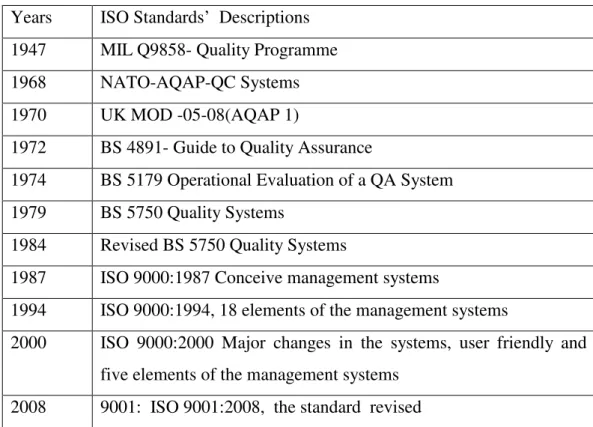
Donna (2009) stated that the continued growth within international trade has revealed a need for a set quality standard to facilitate the relationship between suppliers and purchasers. The creation of the ISO 9000 series of international standards began in 1979 with the formation of a technical committee, with participants from 20 countries, named the international organization for standardization. This Geneva-based association developed and continues to revise and update the standard. The nickname ISO has its origin in the Greek word 'isos', meaning 'equal'. The intent is to make equal comparisons between industries (Donna 2009).
Heras & Gavin (2002) stated that the ISO standards facilitate the multinational exchange of products and services by providing a clear set of quality systems meeting both public and government requirements. Steve (2000) discussed that the ISO created quality management
systems standards in 1987. They were the ISO 9000:1987 series of standards comprising ISO 9001:1987, ISO 9002:1987 and ISO 9003:1987; which were applicable to various types of industry, based on the type of activity or process: designing, production or service delivery. The standards are reviewed every five years by the International Organization.
Bamford & Deibler (2003) discussed the version in 1994. It was termed the ISO 9000:1994 series, consisting of the ISO 9001:1994, 9002:1994 and 9003:1994 versions. The last major revision was in the year 2008 and the series was called the ISO 9000:2000 series (Heras & Gavin 2002).
Gorden (2003) stated that the ISO 9002 and 9003 standards were integrated into one single certifiable standard: ISO 9001:2008. After December 2003, organizations holding ISO 9002 or 9003 standards had to complete a transition to the new standard. The ISO released a minor revision, i.e. ISO 9001:2008 on 14 October 2008. This contains no new requirements. Many of the changes were to improve consistency in grammar, facilitating translation of the standard into other languages for use by over 950,000 certified organizations in 175 countries. As at December 2007 the ISO 9004:2009 document gives guidelines for performance improvement over and above the basic standard ISO 9001:2000 (Gorden 2003).
The Evolution of ISO Standards
Years ISO Standards’ Descriptions 1947 MIL Q9858- Quality Programme 1968 NATO-AQAP-QC Systems 1970 UK MOD -05-08(AQAP 1)
1972 BS 4891- Guide to Quality Assurance
1974 BS 5179 Operational Evaluation of a QA System 1979 BS 5750 Quality Systems
1984 Revised BS 5750 Quality Systems
1987 ISO 9000:1987 Conceive management systems
1994 ISO 9000:1994, 18 elements of the management systems
2000 ISO 9000:2000 Major changes in the systems, user friendly and five elements of the management systems
2008 9001: ISO 9001:2008, the standard revised
Table 2.1 The Evolution of ISO 9001:2008 Quality Management Systems.
2.3.1 ISO 9001:2008 Certification Process,
Owen (2002) stated that many countries have formed accreditation bodies which authorize certification, and audit organizations applying for ISO 9001 compliance certification.
Although commonly referred to as ISO 9000:2000 certifications, the actual standard to which an organization's quality management can be certified is ISO 9001:2008. The accreditation bodies and the certification bodies charge fees for their services. The various accreditation bodies have mutual agreements to ensure that certificates are issued by one of the accredited bodies recognized worldwide (Owen 2002).
Jackson & David (2005) stated that the organization applying for accreditation must be assessed. Such accreditation must be based on an extensive sample of its sites, functions, products, services and processes and a list of problems, corrective action requests, or non- compliance must be made known to the management. Steve (2000) argued that the accreditation body will (if there are no major problems on this list, or after it receives a
satisfactory improvement plan from the management of the applying organization showing how any problems will be resolved) issue an ISO 9001certificate for each geographical site it has visited (www.iso.org). The ISO9001 certificate is not a once-for-all award, but must be renewed at regular intervals recommended by the certification body, usually about every three years (Jackson & David 2005).
2.3.2 Advantages of the ISO 9001:2008 Quality Management System
Terlaak & King (2006) stated that organizations having successfully received ISO 9001:2008 quality management systems, can list a wide variety of advantages. Terlaak &
King (2006) argue that three of these are universal. By achieving the ISO 9001:2008 quality management system, organizations are laying down the foundation of good quality systems. Maintaining an ISO 9001:2008 quality management system means that systems and processes are reviewed regularly through organizational discipline. This will be beneficial for both employees and employers. As an internationally-recognized standard, ISO 9001:2008 provides access to markets and suppliers worldwide (Sharma 2005).
Organizations that have achieved quality management systems cite increased revenue as a major benefit, through increased retention of satisfied customers in the rubber and plastics industry of South Africa (Terlaak & King 2006).
Gorden (2003) stated that another advantage of the ISO 9001:2008 quality management system, recognized globally, is that the ISO 9001:2008 quality management system allows companies to expand their geographic market, gaining new business investment, organizational profitability, employee benefits, customer satisfaction and avoidance of litigation (Barnes2008).Another advantage is that the new customer who requires the ISO 9001:2008 quality management system will be in compliance with their suppliers. The ISO 9001:2008 has become particularly necessary as companies purchasing their supplies worldwide have had to deal with inconsistent quality products (Gorden 2003).
Palmes & Paul (2009) discussed that the advantage, of the ISO 9001:2008 quality management system is as a link between their suppliers and their customers in order to create a continual quality-improvement chain. Michael (2008) argued that existing customer benefits from the ISO 9001:2008 quality management system, also the ISO
9001:2008 requirements have been improved product and service quality (Palmes & Paul 2009).
Tague (2005) states that the ISO 9001:2008 quality management system’s high cost is counterbalanced by the advantage an organization receives when using the requirements as a guide to improve their processes. Quality becomes more consistent and the percentage of first-time jobs correctly done increases when applying the ISO standard…(2008), The advantage of the quality procedure: upgraded record keeping and the removal of redundant operations also dramatically improves an organization’s effectiveness while facilitating international trade (Tague 2005).
Davis, Aquilano & Chase (2004) stated that the ISO 9001:2008 quality management system’s advantages revolved around internal organizations’ benefiting from reduction of costs, minimizing of rework, improved customer satisfaction, reduced customer support costs, improved productivity, reduction of corrective and prevention cost, and ultimately providing both internal and external customer satisfaction in the rubber and plastics industry of South Africa (Davis, Aquilano & Chase 2004).
2.3.3 ISO 9001:2008 Disadvantages
Dearing (2009) stated that the common criticism of the ISO 9001: 2008 quality management system is the amount of money, time and paperwork that is required for registration. (Barnes 2008; Donna 2009) discussed that obtaining the ISO 9001:2008 quality management system is a time-consuming and costly process, depending on the current state of an organization’s quality system, employees’ training hours, production down time and cost of preparation of the process (Dearing 2009).
Greene (2002) stated that the disadvantage of maintaining the ISO 9001:2008 quality management systems in the organization is the risk of failure depending on the size of the company, the strength of the organization’s existing quality systems, and the number of plants within the company requesting quality management systems and also major process improvement. A further disadvantage of the management system is the extra burden of
paperwork; also, top management, without an understanding of the ISO 9001:2008 quality management systems’ information, can find itself beset by problems (Greene 2002).
Steven (2004) stated that the disadvantage of the ISO 9001:2008 quality management system is that the standardized procedures such as the quality manual (QM) are not maintained. Standard operation procedure (SOP), work instruction (WI) product specification (PS) and organized information go a long way towards preventing errors leading to poor quality products and services (Steven 2004).
Hooper (2002) stated that one of the disadvantages of the ISO 9001:2008 is that it promotes the focus on specification, control, and procedures rather than understanding and improvement. The ISO 9001:2008 is effective as a guideline, but promoting it as a standard misleads companies into thinking that certification means better quality, undermining the need for an organization to set its own quality standard. The reliance on the specifications of ISO 9001 does not guarantee a successful quality system. The added cost to certify and then maintain certification may not be justified if the product end-users do not require ISO 9000. The cost can actually put a company at a disadvantage when competing against a non-ISO 9001:2008 quality management system company (Hooper 2002).
Roger (2007) stated the standard 9001:2008 is seen as especially prone to failure when a company is interested in certification before quality. The ISO 9001:2008 quality management system is in fact often based on customer contractual requirements rather than on a desire actually to improve quality. Roger (2007) also stated that "If you just want the certificate on the wall, chances are, you will create a paper system that doesn't have much to do with the way you actually run your business," Greene (2002) stated that the ISO's certification by an independent auditor is often seen as the problem area because the top management strategy issue is the business interaction (Roger 2007).
Liebesman (2006) stated that in the final process the company or organization that has been independently audited and certified to be in conformance with ISO 9001 may publicly state that it is ‘ISO 9001:2008 certified or ISO9001 registered’(ISO Standard …2008). The
certification to an ISO 9001:2008 standard does not guarantee any quality of end products and services; rather, it certifies that formalized business processes are being applied (Liebesman 2006).
2.4 ISO 9001:2008 Quality Management Systems Process
Sharma (2005) stated that the ISO 9001:2008 is the process-orientated approach. The standards focus on a quality- management system requiring the identification of quality management processes as well as their sequence and their interactions with key business processes. King & Lenox (2001) discussed the quality management system, describing the organizational structure, procedures and resources necessary to manage quality and to afford customer satisfaction. The 9001:2008 requirements are described in “what a company must accomplish in order” to meet customer expectations (Brumm 2003). How these goals are accomplished, however, is left to the particular company (Sharma 2005).
The ISO 9001:2008 quality management system integrates processes encompassing both customer and company. The integration process applies the following principles helping organizations to run both effectively and systematically:
• Customer focus
• Leadership
• Involvement of people
• Systems approach to management
• Process approach & continual improvement approach
These are the five ISO management-system principles. The ISO 9001:2008 standards are based on these five business principles as defined by the ISO 9001:2008 document (ISO Standard …2008); these principles focus on business processes relating to different areas of the operation.
2.4.1 Customer focus
Hooper (2002) stated that in today’s customer-driven market it is not the product or service itself that matters most, but the perceived value to the customer of the entire relationship
with a company and the way companies measure the quality of their products and services.
There has been an evolution from internal quality assurance to external customer satisfaction; this process integrates the ISO 9001:2008, quality management systems (Hooper2002).
Leonard (2008) argued that the current global business environment is extremely competitive. Quality is a dynamic component because today’s consumers are more than willing to switch from supplier to supplier looking for a better service or better product availability and price or for several other reasons. To retain customers, effective organizations need to focus on determining and then providing customer requirements.
Schiller (2009) discussed that today’s micro/macroeconomic, situation demands that customers’ needs, wants and expectations are met (Leonard 2008).
Lakhal, Pasin & Liman (2006) discussed that the customer focus is a most important element in the 9001:2008 quality management system, Clause 5.2, ISO standard…(2008) defined that the employer / top management focuses on efforts to serve the needs of its customers. This means that the organization must monitor how its external customer requirements may be changing; also how customers perceive the quality of its products and service in relation to those of its competitors in the rubber and plastics industry of South Africa (Lakhal, Pasin & Liman 2006).
Rao, Ragu, & Solis (2009) stated that the customer focus depends on quality based on the customer’s actual experience of the product, as evidenced by processes such as conformance, reliability, durability and aesthetics (Rao, Ragu & Solis, 2009) ‘Customer focus’ includes two meanings (Foster 2007) defined the characteristics on the ability to satisfy needs while keeping products free of deficiencies. Furthermore, Dr. W. Edwards Deming defines quality as ‘non-faulty systems’. Dr. Joseph Juran describes quality as
‘fitness for use’. Dr. Armand Feigenbaum’s definition states that “quality is a customer determination based on the customer’s actual experience with a product or service and its requirements” (Rao, Ragu, & Solis 2009).
Davis, Aquilano, & Chase (2004) stated that the ISO 9001:2008 quality management system customer satisfaction and customer perception of the quality must be taken into
account in setting acceptable quality levels. The translating of customer quality demands into specification requires marketing to determine accurately what the customer wants;
product designers must develop a product that can consistently achieve that desired level of quality (Davis, Aquilano & Chase 2004).
Rao, Ragu & Solis (2005) stated that product designer an understanding of various dimensions of product realizations process including the voice of the customer specifications. The quality of its design product is the quality of its conformance to that design process. The design quality’s inherent value of the product in the market place is thus a strategic conformance quality refers to the degree to which products meet design specifications (Rao, Ragu & Solis 2005).
Plames (2009) discussed that the operation function and the quality management system within organizations are primarily concerned with quality conformance. Achieving all the quality specification for manufacturing products is typically the responsibility of management. Both design quality and conformance quality should provide products that meet the customer’s objectives for such products. This is often termed the product’s fitness for use and entails identifying those dimensions of the products that the customer wants, developing ISO 9001:2008 quality management system programme to ensure that these dimensions are met (Plames 2009).
2.4.2 Leadership
George & Jones (2006) stated that leadership is a powerful tool if used properly.
Leadership is the process by which a person exerts influence over other people and inspires, motivates, and directs their activities to help achieve organizational goals. Leaders provide direction to improve the performance of man and machine to raise the quality, to increase output and simultaneously to bring pride of workmanship to people (Kreitner&Kinicki 2008). The ISO 9001:2008 quality management system’s clause 6, ISO standard… (2008) detailed problems relating to people and their improvement. These problems are usually very complex, owing to extreme factors that are involved e.g., their background and culture of diverse peoples, ethnic and technological inventions and how these affect quality. The leadership process should be the compelling way in which an
organization manages change while meeting customer requirements. The commitment to quality management systems can come only from leaders (George & Jones 2006).
Smith & Cronje (2007) argued that for an organization to be committed to an ongoing focus of providing customer satisfaction, its leadership must align this expectation to three levels: the overall organizational goals and objectives; the organization’s processes; and the performance of individuals during their day-to-day activities. The leadership must define systems and ISO standards that support the overall organizational goals and quality, with the objective of improving customer satisfaction (Smith & Cronje 2007).
Kreitner & Kinicki (2008) stated that leaders provide direction and purpose for an organization. Leaders are the people who realise that there is compelling reason to change the way an organization operates. Employees can learn that co-operation can be established if groups of staff members stand under the command of an individual leader (Smith &
Crowje 2007). Leadership, therefore, presupposes that one individual has the ability or knowledge to influence others on a continuous basis and to act in a specific, desirable way in order to achieve the quality objective such as customer satisfaction, customer perception, production performance and organizational profitability Kreitner & Kinicki 2008).
Ehlers & Lazenby (2007) stated that leadership starts at the executive level and cascades down the whole organization. (Sharma 2005) stated that leadership is a strategic rather than an operational commitment made by top management: the strategic management team is a driving force behind the transformation of their business through the ISO 900:2008 quality management system. Their culture is defined as a pattern of shared beliefs and values that provide the members of an organization with rules of behaviour when conducting operations. George &Jones (2006) stated that the effective leader applies a missionary passion to the job, thereby creating an organizational culture focused on creating value for their customers (Ehlers & Lazenby 2007).
Hellriegel, Jackson, Slocum, Staude, Amos, Klopper, Louw & Oosthuizen (2006) stated that leadership is not something for which a formula can be drawn up, through systems
such as the ISO 9001:2008 quality management system. This is mainly owing to the requirements for leadership that are derived from the specific situations in which action has to take place; because situations differ. Kreitner & Kinicki (2008) argued that leadership takes a decision-strategic approach from top management, owing to the ISO 9001: 2008 quality management system’s dictation of the integration process between the organizational process and customer requirements (Hellriegel et al .2006).
Pinho (2008) stated that leadership and the ISO 9001:2008 quality management systems are integrated into the process, thus encouraging people to create value for their organization. The organization’s strategic objectives include willingness to undertake a process of learning that will challenge employees’ preconceived notions of good management practice, with management willing to change personal behaviour, willing to support and coach others through a journey of self-discovery. The manager undertakes to demonstrate commitment by action; he is a patient leader who uses his talent to train staff, supplying skills to serve the rubber and plastics industry in South Africa (Pinho 2008).
2.4.3 Involvement of people
Leonard &Mc Guire (2007) stated that people involvement is the most important part of the ISO9001:2008 quality management system approach. The involvement of people includes employee trust, communication, motivation, leadership, team building and respect. As these factors change, many employees seek changes in fringe benefits (Leonard
&McGuire2007).
Terlaak & King (2006) stated that communication is an important part of the ISO standards clause 5.5.3; (ISO standards…2008) stated that the employer’s job should be to supply a direct personal link between the employees and management at higher levels. An employer has a clear responsibility to communicate downwards to staff and an employee has the responsibility to communicate upwards to his superior. Smith & Cronje (2007) stated that employers must obtain and pass on sufficient relevant information about the job, the department and the organization as a whole. The communication will clearly outline how to work intelligently and with enthusiasm in order to maintain the effectiveness of the ISO 9001:2008 quality management system. Rajan & Tamimi (2003) stated that top managers
must take the lead by demonstrating their personal commitment to continual improvement.
This can be done by effective communication based on listening; and employer-training programmes based on employees’ behaviour and attitudes. When management behaves in a manner consistent with the values and beliefs implicit in a quality management system, only then can management expect its workforce to improve in behaviour (Terlaak & King 2006).
Benner & Veloso (2008) stated that the ISO 9001:2008 quality management system affected the employer’s behavioural component which is concerned with building an environment in which people can realize their full potential through mutual trust, respect and mutual support between employer and staff. Leonard & McGuire (2007) stated that the quality management system starts at the top but should permeate the workplace.
Management will fail, however, without the full involvement of employees. Since it is understood that workers know more about their jobs than management does, their input is vital to improving the ISO 9001:2008 quality management system. It is a manager's responsibility continually to train employees, motivating them in the methods of the Quality Management System (QMS), thereby involving them in management decisions.
Management must also listen to their suggestions for system change, working to implement those changes (Benner & Veloso 2008).
Barnes (2008) Deming management philosophy suggested an environment that promotes unity, creating a comfortable environment for discussing problems and suggesting solutions. Managers need to work at breaking down barriers between departments, so that interactive discussion can take place. The perception of fear of personnel’s interaction with management must be eliminated. Russell (2007) argued that managers should focus on a way that assists the company to achieve its goals, while meeting the customer’s requirements, encouraging competition between workers, so that they can focus on individual results rather than process results: employers should empower the people in that organization (Barnes,2008).
Jay & Barry (2008) stated that the ISO 9001:2008 quality management system motivated the organization to promote quality and product standardization, providing information,
guidance and education in this connection, with a view to promoting the general and
‘material welfare of everyone concerned’ (Rao, Ragu & Solis 2005) discussed that to achieve the organizational objective, human performance is crucial. An organization does not function well without competent people. Neither does it excel without competent, motivated employees and employers (Jay & Barry 2008).
Smith & Crowje (2007) stated that people involvement is the key issue in the ISO 9001:2008 quality management system; the integrating process in the human resources management is relevant. In clause 6.2 within ISO 9001:2008 the necessity of competence is stated, when personnel perform work affecting product quality. Training must be provided in order to satisfy these needs; to evaluate the effectiveness of the action taken to the achievement of the quality objective and to meet the customer requirement (ISO Standard 2008). Sipley (2003) argued that effective organizations seek out and employ effective people. These employees are the ones who understand how their jobs fit into the overall scheme of providing products and services to the customer. Their knowledge, skills and efforts are invaluable to the rubber and plastics industries of South Africa; for this the human resources selection is important, which means “the right people in the right place to perform the task” (Mc Guire, 2008). The ISO 9001: 2008 quality management system integrates human resources processes to achieve involvement of people and company objectives; all team members should understand the goals while committing to the process approach method (Smith & Cronje 2007).
2.4.4 Systems approach to management
Feedback
Figure 2.1 Systems approach
Adapted from: Hunter.C, 2000, Managing people in South Africa, 2nd ed. July 2000.University of Natal Pietermaritzburg.
Input Process Output Goal
Figure 2.1 demonstrates the main components of a systems approach to management, with a process that converts the inputs and the outputs from the system, the feedback of energy and information and the elements making up the systems as a whole. Figure 2.1 demonstrates the best way of explaining a management systems approach.
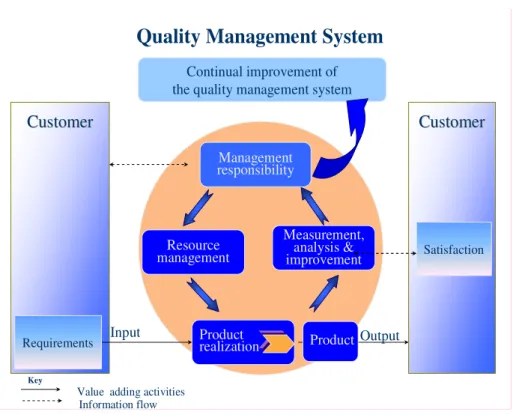
Smith & Crowje (2007) stated that the systems approach to management started developing during the 1950s; to a large extent it formed the basis for the development of more recent approaches such as Total quality management (TQM) and the ISO 9001:2008 quality management system, which focuses on achieving a very high level of quality and customer satisfaction. Robbin (2007) stated that during the 1990s, ISO developed and popularized the learning organization, which is in many ways a development of TQM and the ISO 9001:2008 quality management system. The latest South African systems approach should be widely adopted for the re-engineering of jobs and the organization as a whole, to achieve competitiveness (Russell 2007). The ISO 9001:2008 quality management system’s framework as depicted in Figure 2.2 is a helpful way of viewing, from a systems approach, organizations and people that work in such organizations. It illustrates a framework for managing people, helping in the understanding of relevant concepts and terminology (Smith & Crowje 2007).
Russell (2007) argued that the process approach has ‘input’ with customer requirement and employee involvement as well as ISO 9001:2008 requirements such as a quality plan, quality objectives, and employer commitment. The ‘process’ which converts the inputs into products (systems approach to managements) are the ‘output’ of the ISO 9001:2008 quality management system. This output must be produced in sufficient qualitative and quantitative measures, ensuring that the system can achieve its company goals (internal and external customer satisfaction) through the organizational profit-making in the rubber and plastics industry of South Africa. In order to maintain ‘feedback’ systems the ISO 9001:2008 quality management system facilitates the process which will benefit both employers and employees in an organization (Russell 2007).
2.4.4.1 Goals
Staw & Epstein (2005) stated that an organization exists for the purpose of achieving specific goals so as to meet customer satisfaction. The ISO 9001:2008 sub-clause 5.2 stated that customer focus clearly defined goals for the organization as a whole. The organizational goals should first be set; the department and individual employees’ goals should be based on organizational goals so that everybody in the organization works in unity to achieve the organization’s objectives (Staw & Epstein 2005).
2.4.4.2 Outputs
Greene (2002) stated that the output is the improvement component of the ISO9001:2008 quality management system, starting not with the inputs or the process, but with customer requirements and the extent to which the outputs can meet those needs. In order, therefore, to satisfy customer needs, the outputs are products that must be supplied in the required quality and quantity and at the right time and cost (Greene 2002).
2.4.4.3 Processes
Sharma (2005) stated that the ISO 9001:2008 quality management system integrates the conversion processes - these are all activities involved in producing and delivering the outputs, i.e. the method and technique used for manufacturing. The ISO Standard talks about the ‘first step’. ISO 9001:2008 standards sub-clause 7.5 mentions which steps will help the organization to survive in the long term. The process objective, however, must be clear to employees, i.e. to achieve quantity and quality while remaining cost effective less rework must be involved; while customer satisfaction must be upheld; this, rather, than the organization’s being intent only on making profit. The ‘second step’ in the ISO 9001:2008 standards sub-clause 7.4, is efficient purchasing method processes, in the sense that the best use is made of the inputs. The third step in the ISO 9001:2008 standards sub-clause 5, 5.1 is processing methods which are constantly reviewed and improved where necessary to ensure high levels of efficiency and productivity (Sharma 2005).
2.4.4.4 Feedback
Tague (2005) argued that the feedback mechanism within the ISO 9001:2008 quality management system comes in a variety of forms and from various sources, these being
given in ISO sub-clause 8 - measurement analysis and improvement, ISO section 8.2 - monitoring and measurement, 8.3 - control of non-conforming products, 8.4 - analysis of data; improvements - this includes revenue and information from the market place. This feedback mechanism is critical for the survival of the industry, e.g. Without income generated, the business will become bankrupt; also, without day-to-day employee information, business may be negatively affected in that it will not be able to react quickly enough to changing circumstances (Tague 2005).
Serenko, Bontis & Hardie (2007) stated that in order to evaluate the degree of success or failure of an organization, management and employees must compare the information that is fed back to them with set standards such as forecasts or budgeted sales volumes and revenue, so that action can be taken where necessary to ensure that standards are met.
Sandford (2005) argued that the ISO 9001:2008 quality management system principles such as the systems approach management are essentially the controlling functions of employees and management, dependent on accurate and quick feedback of information in the rubber and plastics industry of South Africa (Serenko, Bontis & Hardie 2007).
Kumar, Choisne & U Kumar (2009) argued that the feedback mechanism is important in ensuring the success of the rubber and plastics industry of South Africa. The feedback must be in place: the ISO 9001:2008 quality management system sub-clause points out: 4,2 Documentation requirement, 4.2.2 Quality manual, 4.2.3 Control of documentation, 4.2.4 Control of records, 8.5 Improvement of measuring and recording the information similar to ISO Sub-clause 5.6 Management review. This information is required by various departments, managers and employees - how much raw material is wasted in a production department; all such waste needing to be weighed each day and a record kept of these figures. Both employees and employers concerned should have up-to-date knowledge of these figures (the feedback) so that they are aware of any problems, taking corrective action to resolve them. Other feedback includes customer focus; the ISO standards sub- clause 5.6.2 suggests review of input and feedback from products, service and quality. The systems approach to recording both positive and negative customer reactions, is important, giving a balanced picture of what customers feel about products and services; this information should be fed back to as many employees in the organization as possible,
enabling the rubber and plastics industry to become more customer-orientated in South Africa (Kumar, Choisne & U Kumar 2009).
2.4.4.5 Input
Jacobs, Chase & Aquilano (2009) stated that inputs vary according to operational factors such as materials, money, people, land, buildings, management technology, information etc. (Jacobs, Chase & Aquilano 2009).
2.5 Employee relationship ISO 9001:2008 Quality Management System
Leonard (2008) stated that the ISO 9001:2008 quality management system integrates the relationship between the internal and external customer. The internal customer relationships are the ways in which people react or behave in understanding one other.
Levinson (2001) pointed out that the process-approach management concept of relationship includes formal business transactions between departments within organizations and between people in the organization as well as the numerous ways in which people interact informally. The ISO standards clause 6.2 (Resource Management) stated that the ways in which people relate to one another depends on a wide variety of factors such as their attitudes towards others, their values, goals and simply whether they like one another or not. The ISO 9001:2008 quality management system describes relationships that can be negative, thereby decreasing the production efficiency and effectiveness of the organization. Relationships can of course, conversely, be positive, depending on customer feedback (Leonard 2008).
Thomas (2005) stated that the ISO 9001:2008 quality management system chooses a positive interpersonal relationship which helps the organization to achieve its goals and to be competitive. Having positive relationships, however, does not mean that there will never be any conflict, but that, if there is conflict between people, this conflict would be resolved constructively rather than destructively, to the benefit of the rubber and plastics industry (Thomas 2005).
Faster (2007) stated that the ISO 9001:2008 quality management system focuses on the important aspect of relationships in networking, referring to the way in which