i
i
STUDENT DECLARATION
THE ROLE OF FIRE AND FIRE-RELATED FACTORS ON GERMINATION AND GRASSLAND SPECIES GROWTH
I HABTEAB MESGHINA GHEBREHIWOT, student number 201511868 declare that:
(i) The research reported in this dissertation, except where otherwise indicated, is the result of my own endeavours in the Research Centre for Plant Growth and Development, School of Biological and Conservation Sciences, University of KwaZulu-Natal Pietermaritzburg;
(ii) This dissertation has not been submitted for any degrees or examination at any other University;
(iii) This thesis does not contain data, figures or writing, unless specifically acknowledged, copied from other researchers; and
(iv) Where I have reproduced a publication of which I am an author or co-author, I have indicated which part of the publication was contributed by me.
Signed at ………Pietermaritzburg…….. on the ………..……….. day of
………, 2010. __________________________
SIGNATURE
ii
DECLARATION BY SUPERVISORS
We hereby declare that we acted as Supervisors for this PhD student:
Student’s Full Name: HABTEAB MESGHINA GHEBREHIWOT Student Number: 201511868
Thesis Title: THE ROLE OF FIRE AND FIRE-RELATED FACTORS ON GERMINATION AND GRASSLAND SPECIES GROWTH
Regular consultation took place between the student and ourselves throughout the investigation. We advised the student to the best of our ability and approved the final document for submission to the Faculty of Science and Agriculture Higher Degrees Office for examination by the University appointed Examiners.
_________________________
SUPERVISOR: PROFESSOR J. VAN STADEN
________________________
CO-SUPERVISOR: PROFESSOR K. P. KIRKMAN
iii
FACULTY OF SCIENCE AND AGRICULTURE DECLARATION 1 - PLAGIARISM
I, HABTEAB MESGHINA GHEBREHIWOT, student number: 201511868, declare that 1. The research reported in this thesis, except where otherwise indicated, is my
original research.
2. This thesis has not been submitted for any degree or examination at any other university.
3. This thesis does not contain other persons’ data, pictures, graphs or other information, unless specifically acknowledged as being sourced from other persons.
4. This thesis does not contain other persons' writing, unless specifically acknowledged as being sourced from other researchers. Where other written sources have been quoted, then:
a. Their words have been re-written but the general information attributed to them has been referenced
b. Where their exact words have been used, then their writing has been placed in italics and inside quotation marks, and referenced.
5. This thesis does not contain text, graphics or tables copied and pasted from the Internet, unless specifically acknowledged, and the source being detailed in the thesis and in the References sections.
Signed: ………
Declaration Plagiarism 22/05/08 FHDR Approved
iv
FACULTY OF SCIENCE AND AGRICULTURE DECLARATION 2 - PUBLICATIONS
DETAILS OF CONTRIBUTION TO PUBLICATIONS that form part and/or include research presented in this thesis (include publications in preparation, submitted,
in press and published and give details of the contributions of each author to theexperimental work and writing of each publication)
PUBLISHED ARTICLES FROM THIS THESIS
Publication 1:
GHEBREHIWOT, H. M., KULKARNI, M. G., KIRKMAN, K. P., VAN STADEN, J.(2008).
Smoke-water and a smoke-isolated butenolide improve germination and seedling vigour of
Eragrostis tef (Zucc.) Trotter under hightemperature and low osmotic potential. Journal of Agronomy and Crop
Science 194: 270-277. This paper comprises Chapter 4 of this thesis.Contributions: The series of experiments in this study were designed, set and data collected by the first author. The manuscript was written by the first author under the supervision of all the other authors. The second author helped in statistical analysis of the data and preparation of the graphs.
Publication 2:
GHEBREHIWOT, H. M., KULKARNI, M. G., KIRKMAN, K. P., VAN STADEN, J.(2009).
Smoke solutions and temperature influence the germination and seedling growth of South African mesic grassland species.
Journal of Rangeland Ecology and Management 62: 572-578. This paper comprisesChapter 3 of this thesis.
Contributions: The series of experiments in this study were designed, set and data collected by the first author. The manuscript was written by the first author under the supervision of all the other authors. The second author helped in statistical analysis of the data and preparation of the graphs.
Publication 3:
GHEBREHIWOT, H. M., KULKARNI, M. G., LIGHT, M.E., KIRKMAN, K. P., VAN STADEN, J. (2010).Germination activity of smoke residue in soils following a
v
fire.
Biology and Fertility of Soils (in review). This paper comprisesChapter 5 of this thesis.
Contributions: The experiments in this study were designed by
Dr. LIGHT, M.E. and Prof.VAN STADEN, J.
Soil samples were collected, extracted and analysed for germination activity by the first author. The second author helped in statistical analysis of the data and preparation of the graphs. The manuscript was written by the first author under the supervision of all the other authors.
Publication 4:
KULKARNI, M. G., GHEBREHIWOT, H. M., KIRKMAN, K. P., VAN STADEN, J.(2010).
Response of grass seedlings to smoke-water and smoke-derived butenolide in the absence of nitrogen, phosphorus and potassium. Journal
of Arid Environments(in review). This paper comprises Chapter 6 of this thesis.
Contributions: The series of experiments in this study were designed by the first author.
The experiment was set and data collected by the second author. The manuscript was written by the first and second authors under the supervision of all the other authors.
Publication 5:
GHEBREHIWOT, H. M., KULKARNI, M. G., KIRKMAN, K. P., VAN STADEN, J.(2010).
Smoke and heat: influence on seedling emergence from soil seed bank of mesic grassland site in South Africa. (in prep.). This paper comprises Chapter 7 of this thesis.
Contributions: The experiments in this study were designed, set and data collected by the first author. The manuscript was written by the first author under the supervision of all the other authors. The second author helped in statistical analysis of the data and preparation of the graphs.
Signed: ……… Date:………/………/………
Declaration Publications FHDR 22/05/08 Approved
vi
Fire, natural or of anthropologic origin is a recurrent phenomenon in South African mesic grasslands. The species composition of these grasslands is sensitive to fire frequency and there exists a permanent fire-species relationship syndrome. The shift follows a general trend where, in the absence of fire for longer periods, the native grass species, possibly the most economically important grass species, give space to relatively less desirable and invasive species accompanied by significant decline in basal cover. Though much is known as to how the floristic composition of the grassland changes in response to fire, the underlying mechanisms responsible for changes in plant vigour and species composition are not fully understood. There exists limited information on germination requirements of the local flora and how recruitment of the species is influenced by fire, fire-related factors and the interaction of these factors among themselves is virtually unknown.
Since the discovery by DE LANGE and BOUCHER (1990), plant-derived smoke
is being widely studied as an important germination cue and the theme has been the
subject of intense experimental research and theoretical work. Germination studies
conducted on South African Fynbos, Californian Chaparral, and Australian species have
illustrated the widespread ability of plant-derived smoke in promoting germination of
species from both fire and non-fire prone habitats. Studies have also showed that plant-
derived smoke plays a significant role in vegetative growth of many plants including
horticultural and agricultural crops, though mechanisms of smoke action in enhancing
germination and promoting plant growth are still under active research. This study
sought to gain insight into the role of fire and fire-related cues and other related factors
on germination and seedling growth of key grass species from fire-prone grassland in
South Africa. In this study, various investigations were conducted on different aspects
related to smoke-induced seed germination. Furthermore, in depth examinations were
ABSTRACT
vii
conducted on the effects of fire-related factors such as smoke, heat, soil and nutrients on seed germination and seedling growth of representative key mesic grassland species from South Africa.
Laboratory-based germination and vigour experiments were conducted using smoke solutions. The aim was to examine if the strong fire-species relationship syndrome we encounter in post-fire mesic grassland in South Africa is related to the effect of plant-derived smoke on germination and seedling growth. In addition, the interaction of plant-derived smoke solutions with temperature was examined by incubating seeds at a range of temperatures. Treating seeds with smoke-water and butenolide, the germination rate (GR) and final germination percentage (FGP) were greater in 3 of the 6 species.
Themeda triandra Forssk. and Tristachya leucothrixTrin.
ex Nees showed the greatest response, with final germination increased from 43% to 67% and 35% to 63% respectively. These smoke solutions have also significantly enhanced germination in Eragrostis tef (Zucc.) Trotter from 62% to 80%. The degree of responsiveness varied from species to species and across different temperatures.
Findings from this study suggested that plant-derived smoke and its interaction with temperature significantly influence the germination and seedling growth of the South African mesic grassland species, which can further impact on the grassland composition.
To characterise the role of plant-derived smoke on certain economically
important seed traits, the effect of smoke-water and a smoke-isolated butenolide on
seed germination and seedling growth of
Eragrostis tef (grass species which hasmoderately good tolerance to east African drought) was investigated at a range of
temperatures, light conditions and osmotic potentials. Smoke-water (1:500 v/v) and
butenolide (10
-8M) treatment of the seeds increased percentage germination, seedling
vigour and imbibition from high to low osmotic potential. These results suggested that
smoke solutions have characteristics with overriding effects toppling stresses exerted
from high temperature and low osmotic potential, thereby widening the temperature and
moisture zone over which germination can occur. Furthermore, these findings
viii
suggested that the mode of smoke action in promoting seed germination is likely to be linked to the role of smoke in facilitating water uptake by seeds (imbibition).
A simple and rapid bioassay was implemented to detect the germination activity of extracts from soils in pre/post-burn status. Soil samples taken from burnt, unburnt and adjacent plots at depths of 0-2, 2-4, 4-6 and 6-8 cm before and after burning mesic grassland in South Africa were analysed for germination activity over an eight-week period. Soil samples were extracted using dichloromethane and bioassayed using Grand Rapids lettuce (Lactuca sativa L.) achenes. The Grand Rapids lettuce seeds exhibited several-fold greater germination percentages when treated with extracts from burnt soil compared to the other plots. The magnitude of such an activity declined through time since burn. The Grand Rapids lettuce seeds also showed significantly greater germination percentage when treated with unburnt soil extracts compared to the control (distilled water) which indicates the existence of other factors controlling germination in unburnt soil. Germination percentage was negatively influenced in the adjacent plots which reflected the inhibitory role of smoke on adjacent plots neighbouring the burn. Findings from this study suggested that the germination activity of a burning plant-material (smoke) indeed diffuses into the soil and its persistence declines with time. Furthermore, the findings implied that fire and smoke may significantly influence the germination of the soil seed bank of mesic grassland in South Africa.
The effect of smoke solutions of various concentrations and their interaction with soil macronutrients NPK in influencing seedling growth of three selected grass species namely, Eragrostis curvula, Panicum maximum and Themeda triandra was investigated.
These grass species were selected on the basis of the contrasting response they previously showed to smoke treatments. Results showed that the interaction between species, treatment and nutrients for seedling vigour index was highly significant (P <
0.001). In the absence of NPK elements, the smoke solutions generally enhanced
seedling growth in
Themeda triandra, while suppressing seedling vigour indices of Eragrostis curvulaand Panicum maximum. It is ecologically significant that not only
ix
smoke but also its interaction with soil macronutrients appears to be important in structuring the post-fire regeneration and colonisation processes.
To examine the effect of fire-associated cues of smoke and high temperature on germination and seedling emergence from the mesic grassland soil seed bank in South Africa, and disentangle responsible factors, the effect of heat and smoke-water on seedling emergence and the resultant effect on biomass production was examined in a greenhouse tray experiment over 90 days. Soil seed bank samples obtained from 0-5 cm top soil were treated with smoke-water solution (SW 1:500 v/v), heat (H = 100 °C for 15 min) and heat + smoke-water (H = 100 °C for 15 min + SW = 1:500 v/v) combined.
Significantly, the highest number of seedlings emerged from soil seed bank samples treated with heat + smoke-water combined followed by smoke-water alone. Heat + smoke-water treatment of soil seed bank samples also significantly enhanced the rate of seedling emergence and total dry biomass production. Heat treatment by itself was not statistically different from the control in many respects. Generally, these results suggest that both heat and smoke are important germination cues and play a curial role on germination and seedling emergence from the mesic grassland soil seed bank. A greater number of fire-loving
Themeda triandra seedlings emerged from soils treatedwith smoke, though this was not statistically significant. Seedling emergence indicators showed that seedling emergence was favoured more by smoke and smoke + heat treatments compared to the control. Seedling growth indicators also showed that soil samples treated with smoke or smoke + heat combined produced significantly higher biomass than untreated samples.
In general, findings from this comprehensive study suggest that plant-derived
smoke and its interaction with temperature (heat) and soil nutrients significantly
influences seed germination and seedling growth of South African mesic grassland
species differently, this can further influence the grassland composition. The association
of certain fire-climax species with the re-occurrence of fire can partly be explained due
to the association of such species with fire-induced changes in the habitat. Post-fire
conditions of low nutrient (NPK) availability, presence of high heat and smoke cues in
the habitat may favour the competitive ability of native short and smoke-responsive
x
species such as
Themeda triandra and Tristachya leucothrix over those characteristicspecies of fertile habitats such as
Eragrostis curvula and other non-smoke-responsivespecies.
xi ACKNOWLEDGEMENTS
The accomplishment of this thesis would not have been possible without the kind collaboration and encouragement of many people.
Hence, I would like to thank the following:
· First and foremost I want to thank my supervisor,
PROF. JOHANNES VAN STADEN (Director of the Research Centre for Plant Growth and Development at UKZN). It has been an honour to be his PhD student. His excellent leadership, supervision and friendship were so invaluable that without his guidance and persistent help this thesis would not have been possible. I appreciate his contributions of time, ideas and funding to make my PhD experience productive and stimulating. Beyond science, his excellent principles of efficient living and qualitative organisation level have enabled me develop a better understanding of the academic pursuit.
· Many thanks to my co-supervisor,
PROF. KEVIN KIRKMAN (former head of Grassland Science and present Dean of the Faculty of Science and Agriculture at UKZN) for his advice and guidance throughout the study. As ever, his contribution to this thesis and the peer-reviewed articles published from this thesis was invaluable.
· My heartfelt thanks and appreciation goes to
Dr. MANOJ KULKARNI for his assistance, and advice from the alpha to the omega of this research work. He was there for me always for statistical analysis and interpretation of the data.
· Thank you very much
Dr. MARNIE LIGHT for all the help and friendship you
showed us at the Research Centre for Plant Growth and Development at UKZN.
xii
Thank you for all the questions you have answered tirelessly to me and all other colleagues. Only few people live the way you do! Keep up these good traits.
· Thank you
All Members of the RCPGD. The group has been a source of friendships as well as good advice and collaboration. It was great opportunity to know each and everyone of you. Thank you for creating a comfortable working atmosphere. Your fun company will never be forgotten. JUDY and LEE, thank you for all the patience you showed in listening to my excuses. Thanks HALIMA ABDILLAHI and MAYASHREE CHINSAMY for the laughter.
· I am deeply indebted to my wife
AKBERET KEBEDE, my mom LUEL TESFAMICHAEL HAYELOM, HARNET MESGHINA, GHIRMAI MESGHINA, MEBRAQ MESGHINA and ZUFAN MESGHINA for their sincere prayers and encouragements for my success.
· Thank you all friends,
Dr. DANIEL TECLU, Dr. YOSIEPH ASSEFA, Dr.
MICHAEL BAIRU, MEHARI SIUM, NEGASI TESFATSION (QESHI), SIMON TESFALIDET and YOSSIEF FESHAYE for their friendship, company and encouragement.
·
Dr. ASHWELL NDLALA, Dr. GARY STAFFORD, Dr. HAFIZ ABDELGADIR, Dr.
GLENDON ASCOUGH and Mr. JERRY NAIKEN well deserve a word of thanks and appreciation for driving me to the wild vegetation around Pietermaritzburg while collecting plant and soil samples. My word of thanks and appreciation also goes to Dr. CHRISTINA POTGIETER (John Bews Herbarium at UKZN) for her advice and assistance in plant species identification.
· As ever, most gratitude goes to the almighty three in one,
THE FATHER, THE
SON and THE HOLY SPIRIT, who offered me the opportunity to see this
wonderful world, South Africa and the beautifully crafted mosaic of life it holds.
xiii
STUDENT DECLARATION ... i
DECLARATION BY SUPERVISORS ... ii
DECLARATION 1 - PLAGIARISM... iii
DECLARATION 2 - PUBLICATIONS ... iv
ABSTRACT ... vi
ACKNOWLEDGEMENTS ... xi
CONTENTS ... xiii
LIST OF FIGURES... xix
LIST OF TABLES ... xxiii
LIST OF ABBREVIATIONS ... xxv
CHAPTER ONE ... 1
Introduction ... 1
1.1 SMOKE AS A GERMINATION CUE ... 1
1.2 FIRE IN THE SOUTH AFRICAN MESIC GRASSLANDS ... 2
1.3 AIMS AND OBJECTIVES ... 4
1.4 GENERAL OVERVIEW ... 5
CHAPTER TWO... 9
Literature review... 9
2.1 INTRODUCTION ... 9
2.2 THE ROLE OF FIRE IN PLANT SUCCESSION... 10
2.2.1 Mechanisms of plant succession: how important is seed germination? ... 12
2.2.2 Why do we need to predict vegetation change in response to disturbances? 14
2.2.3 Seed germination and plant community organization ... 15
CONTENTS
xiv
2.3 THE ROLE OF FIRE IN SEED GERMINATION ... 16
2.3.1 Post-fire regeneration ... 16
2.3.2 Effects of fire on seed germination ... 17
2.3.2.1 Physical effects of fire on germination ... 20
2.3.2.2 Chemical effects of fire on germination ... 22
2.4 GERMINATION RESPONSE TO SMOKE ... 24
2.4.1 The discovery of smoke as a germination cue ... 25
2.4.2 The interaction of smoke and heat in influencing seed germination ... 28
2.4.3 The interaction between plant-derived smoke and soil nutrients in influencing plant growth ... 29
2.5 POST-GERMINATION EFFECTS OF SMOKE AND BUTENOLIDE ... 30
2.6 POSSIBLE MODE OF ACTION OF SMOKE-STIMULATED GERMINATION ... 34
2.7 CURRENT APPLICATIONS OF PLANT-DERIVED SMOKE IN VARIOUS FIELDS OF PLANT SCIENCES ... 35
2.7.1 Agriculture... 35
2.7.2 Horticulture ... 36
2.7.3 Habitat restoration and conservation ... 37
2.7.4 Weed control... 38
2.8 ECOLOGICAL STUDIES USING SMOKE-STIMULATED GERMINATION ... 39
2.9 SMOKE-STIMULATED SEED GERMINATION AND SOME IMPORTANT CONSIDERATIONS FOR PLANT ECOLOGY ... 40
CHAPTER THREE ... 43
The effect of smoke solutions and temperature on germination and seedling growth of South African mesic grassland species ... 43
3.1 INTRODUCTION ... 43
3.2 MATERIALS AND METHODS... 45
xv
3.2.1 Species, Seed Source and Storage ... 45
3.2.2 Brief description of the study species ... 46
3.2.3 Smoke-water and butenolide solutions ... 46
3.2.4 Seed germination and seedling growth experiments ... 47
3.2.5 Statistical analysis ... 48
3.3 RESULTS ... 48
3.4 DISCUSSION ... 52
3.5 MANAGEMENT IMPLICATIONS AND CONCLUSION ... 56
CHAPTER FOUR ... 57
The role of smoke-water and butenolide in overcoming stress due to high temperature and low osmotic potential ... 57
4.1 INTRODUCTION ... 57
4.2 MATERIALS AND METHODS... 59
4.2.1 Seed source and viability testing ... 59
4.2.2 Smoke-water and smoke-compound (butenolide) solutions ... 59
4.2.3 Seed imbibitions ... 60
4.2.4 Polyethylene glycol (PEG) solutions ... 60
4.2.5 Germination and seedling growth experiments ... 60
4.2.6 Statistical analysis ... 61
4.3 RESULTS ... 61
4.4 DISCUSSION ... 70
4.5 CONCLUSIONS ... 72
CHAPTER FIVE ... 73
Does fire (burning) affect the soil smoke chemistry? Germination activity of smoke residue in soils following a fire ... 73
5.1 INTRODUCTION ... 73
xvi
5.2 MATERIALS AND METHODS... 75
5.2.1 Site description, burning and the soil samples ... 75
5.2.2 Fuel load and fuel moisture... 77
5.2.3 Soil extraction methods ... 77
5.2.4 Seed source and the lettuce seed bioassay ... 78
5.2.5 Statistical analysis ... 79
5.3 RESULTS ... 79
5.3.1 Fuel load and fuel moisture content ... 79
5.3.2 Germination activity of the soil extracts ... 79
5.4 DISCUSSION AND CONCLUSIONS ... 83
CHAPTER SIX ... 87
Growth responses of grass seedlings to smoke-water and smoke-derived butenolide in the presence or absence of NPK nutrients ... 87
6.1 INTRODUCTION ... 87
6.2 MATERIALS AND METHODS... 90
6.2.1 Seed collection and germination ... 90
6.2.2 Nutrient, smoke-water and butenolide solutions ... 91
6.2.3 Plant growth experiments ... 91
6.2.4 Statistical analysis ... 92
6.3 RESULTS ... 92
6.4 DISCUSSION AND CONCLUSIONS ... 98
CHAPTER SEVEN ... 102
Smoke and heat: influence on seedling emergence from mesic grassland soil seed bank in South Africa ... 102
7.1 INTRODUCTION ... 102
7.2 MATERIALS AND METHODS... 105
xvii
7.2.1 Study site ... 105
7.2.2 Soil collection and the treatments applied ... 105
7.2.3 Seedling emergence trial ... 107
7.2.4 Plant measurements and observations ... 108
7.2.5 Statistical analysis ... 109
7.3 RESULTS ... 109
7.3.1 Seedling emergence ... 109
7.3.2 Seedling growth indicators ... 116
7.4 DISCUSSION ... 116
7.5 CONCLUSIONS ... 121
CHAPTER EIGHT ... 123
General discussion and conclusions ... 123
8.1 INTRODUCTION ... 123
8.2 The effect of plant-derived smoke solutions on mesic grassland seed germination and seedling growth ... 125
8.3 The ecological relevance of smoke and butenolide in the natural environment .... 126
8.4 CONCLUSIONS ... 127
8.5 Future research avenues ... 128
REFERENCES ... 130
APPENDICES ... 167
Appendix 1 ... 167
Examples of grass species (Poaceae) which showed a significant germination response to various smoke treatments. ... 167
Appendix 2 ... 169
Examples of grass species (Poaceae) which did not show a significant germination response to various smoke treatments. ... 169
Appendix 3 ... 171
xviii
Electro-microscopic photos of the seeds of the six grass species used in this
study. Bar indicates1000 µm. ... 171
xix LIST OF FIGURES
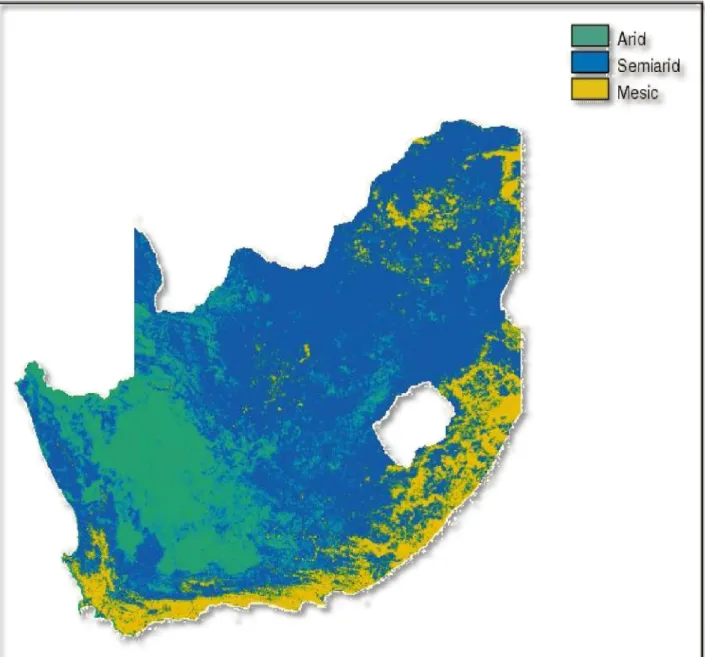
Figure 1.1: Map of South Africa showing the distribution of the arid, semi-arid and mesic areas (ACOCKS, 1988). ... 3
Figure 2.1: Diagram showing the relationship between the physical and chemical cues from fires within the seed environment (Diagram taken from VAN STADEN et al., 2000). ... 19 Figure 2.2: Chemical structure of the bioactive compound (3-methyl-2H-furo[2,3- c]pyran-2-one) from smoke that promotes seed germination (1) and (3,4,5-trimethylfuran-2(5H)-one) that inhibits seed germination (2) (LIGHT et al., 2010). ... 27
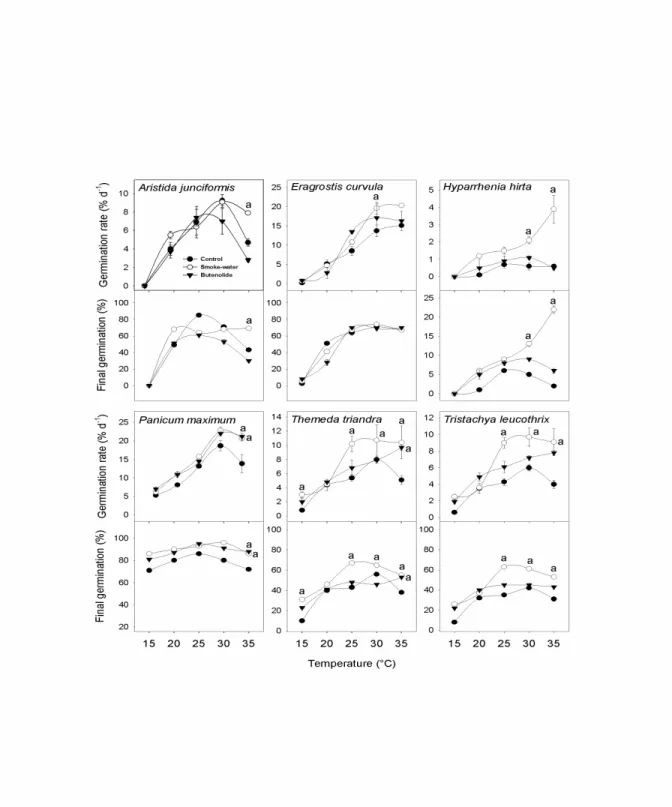
Figure 3.1: Effect of smoke solutions (smoke-water 1:500 v/v and butenolide 10
-8M) on seed germination rate and final germination percentage of six mesic grassland species at constant temperatures under 16:8 h light:dark conditions. Symbol (±SE) with letter ‘a’ is significantly different from control according to Tukey’s test (P < 0.001). NS = Non- significant. ... 50 Figure 3.2: Effect of smoke-water (1:500 v/v) and butenolide (10
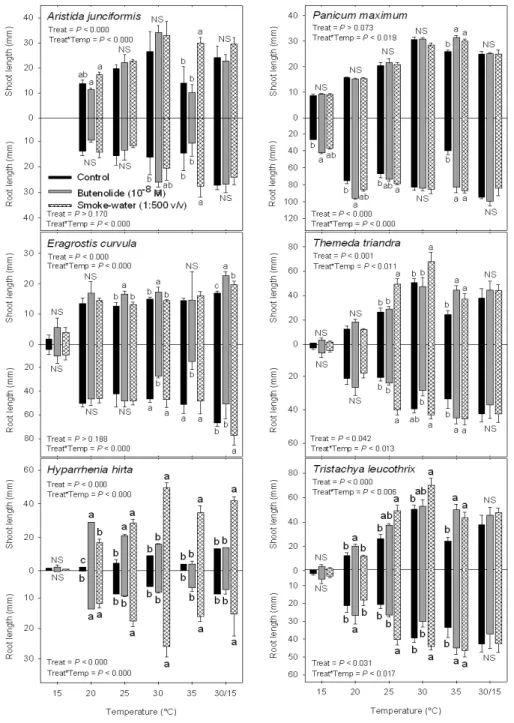
-8M) on shoot and
root length (mm) of six mesic grassland species at different temperatures under 16:8 h light:dark conditions. Bar (±SE) with different letter(s) is significantly different according to Tukey’s test (P <
0.001). NS = Non-significant; Treat X Temp = Interaction between treatment and temperature. ... 51 Figure 3.3: Effect of smoke-water (SW 1:500 v/v), butenolide (B 10
-8M) and Control
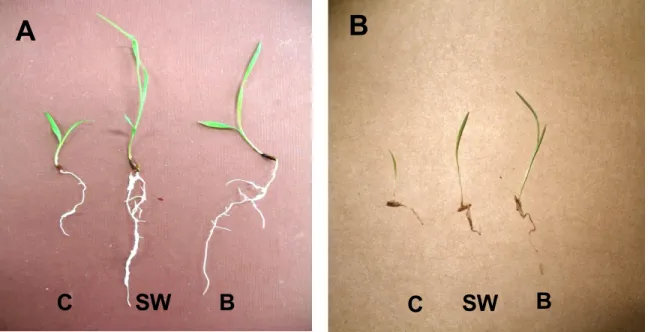
(C) on seedling growth of Themeda triandra Frossk (A) and Hyparrhenia
xx
hirta (B). The photos were taken after incubating the seeds for 16 days
at 30 °C under 16:8 h light:dark conditions. ... 55
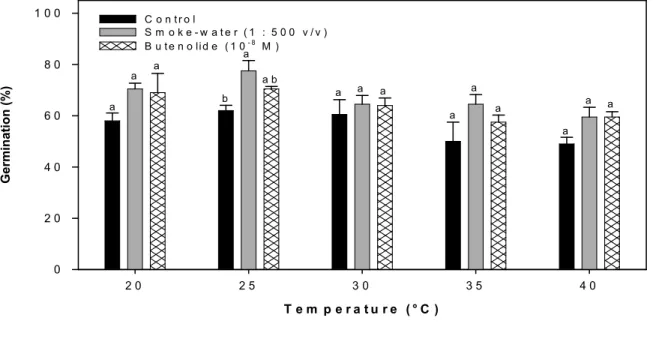
Figure 4.1: Effect of smoke treatments (±S.E.) on seed germination of Eragrostis
tef at different temperatures under 16:8 h light:dark conditions. Barswith different letters indicate significant differences within treatments (P < 0.05). ... 62 Figure 4.2: Effect of smoke-water (1:500 v/v) and butenolide (10
-8M) on seedling
growth of Eragrostis tef after incubating for 16 days at 30 °C under 16 :8 h light:dark conditions. Bar indicates 10 mm. ... 63 Figure 4.3: Effect of distilled water (C), smoke-water (SW 1:500 v/v) and
butenolide (B 10
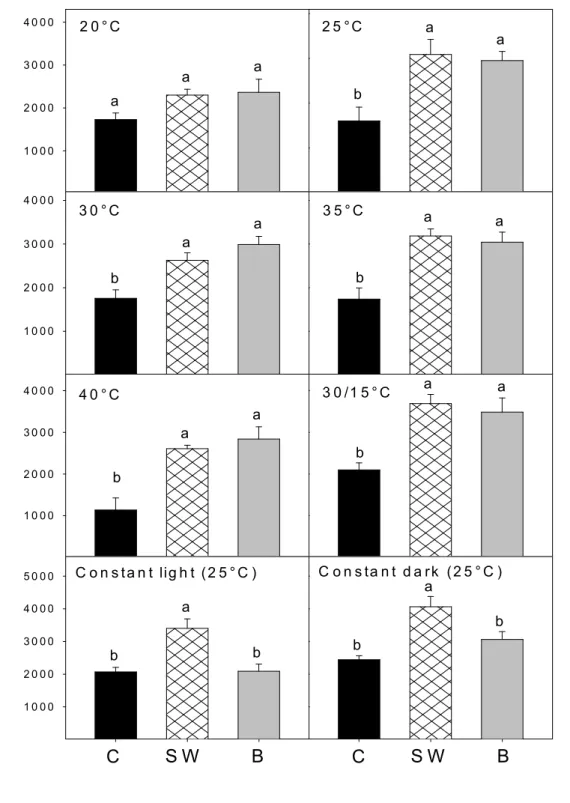
-8M) on seedling vigour index (±S.E.) of Eragrostis tef after incubating for 16 days at different temperatures (16:8 h light:dark) and light conditions. Bars with different letters indicate significant differences within treatments(P<0.05). ... 65 Figure 4.4: Effect of smoke-water (1:500 v/v) and butenolide (10
-8M) solution on
seedling growth of Eragrostis tef after incubating for 7 days at -0.15 MPa osmotic potential at 25 °C and 16:8 h light:dark conditions. Bar indicates 1mm. ... 66 Figure 4.5: Imbibition curves for Eragrostis tef seeds treated with smoke-water
(SW 1:500) and butenolide (B 10
-8M) solutions at various osmotic potentials using PEG 6000 as the osmoticum. Distilled water was used to prepare the solutions for control seeds and all treatments were incubated at 25 °C. Bars indicate standard error. ... 67 Figure 4.6: Effect of smoke treatments on seed germination (±S.E.) of Eragrostis
tef at different osmotic potentials at 25 °C and 16:8 h light:dark
conditions. Bars with different letters indicate significant differences within treatments (P < 0.05). ... 68 Figure 4.7: Effect of smoke-water (SW 1 : 500 v/v) and butenolide (B 10
-8M) on
seedling vigour index (±S.E.) of Eragrostis tef after incubating for 7
days at different osmotic potential at 25 °C and 16:8 h light:dark
xxi
conditions. Control = C. Bars with different letters indicate significant differences within treatments (P < 0.05). ... 69
Figure 5.1: A) Typical mesic grassland in South Africa on fire, B) Simulated rain (water) is being applied on earmarked treatment plots. ... 76 Figure 5.2: Germination of Grand Rapids lettuce seeds imbibed in Smoke-Water
(SW1:500 v/v), Butenolide (B 10
-8M), Dichloromethane (D) and Distilled- water (W) after 24 h incubation at 25°C in the dark. Asterisks denote a significant (P < 0.05) difference from distilled-water and dichloromethane control. Error bars indicate SE. ... 80 Figure 5.3: The effect of various soil extracts at three dilution levels on the
germination of Grand Rapids lettuce seeds 24 h in the dark at 25 °C. a) in the 0 week after burn; b) in the 2
ndweek after burn; c) in the 4
thweek after burn; and d) in the 8
thweek after burn. Asterisks denote a significant (P < 0.05) difference from the other plots. Error bars indicate SE. ... 82
Figure 6.1: Effect of different concentrations of smoke-water (SW) and butenolide (B) on shoot and root growth of grass species in the absence of N, P or K under greenhouse conditions. Bar (±SE) with asterisk symbol is significantly different to the respective control by Tukey’s test (P<0.05).
... 95 Figure 6.2: Effect of different concentrations of smoke-water (SW) and butenolide
(B) on seedling vigour index of grass species in the absence of N, P or K under greenhouse conditions. Bar (±SE) with different letters is significantly different by Tukey’s test (P < 0.05). ... 97
Figure 7.1: Mean seedling emergence (±SE) of the germinable soil seed bank samples (0-5 cm) in response to four different fire-related treatments.
Shared alphabet letters indicate no significant difference between
xxii
treatments according to Duncan’s multiple range test at 5% level of significance. ... 110 Figure 7.2: Total number of grass seedlings (Poaceae) emerged from the
germinable soil seed bank of mesic grassland site in South Africa in response to four different fire-related treatments. Asterisks denote a significant (P < 0.05) difference from other treatments... 111 Figure 7.3: Total number of forb seedlings emerged from the germinable soil seed
bank of mesic grassland site in South Africa in response to four different fire-related treatments. Asterisks denote a significant (P < 0.05) difference from other treatments. ... 112 Figure 7.4: Emergence and establishment of seedlings over the 90 days trial in
response to the four, fire-related treatments applied on the mesic
grassland soil seed bank samples... 115
xxiii
Table 2.1: Examples of studies investigating the post-germination effects of plant- derived smoke and butenolide on various aspects of plant growth. ... 32
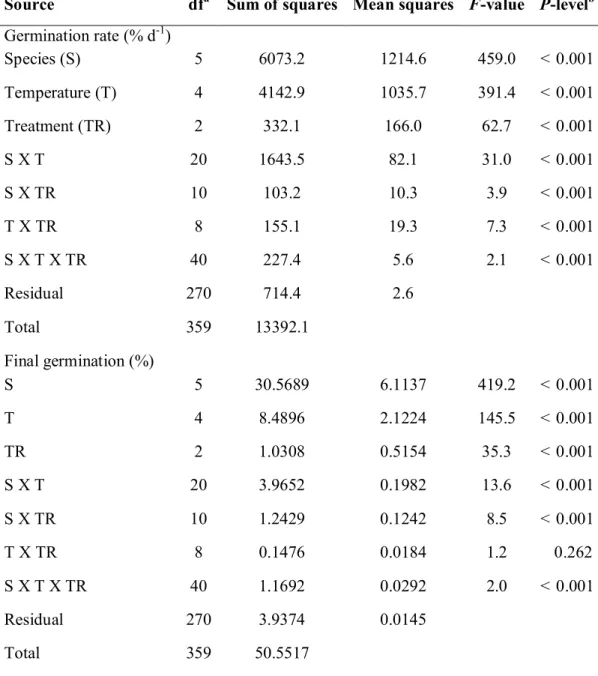
Table 3.1: Source and viability of the seeds of six South African mesic grassland species used in this study. ... 45 Table 3.2: General analysis of variance (ANOVA) with main effects and their
interactions for six mesic grassland species. Treatments at constant temperatures were control, smoke-water (1:500 v/v) and butenolide (10
-8M). ... 53
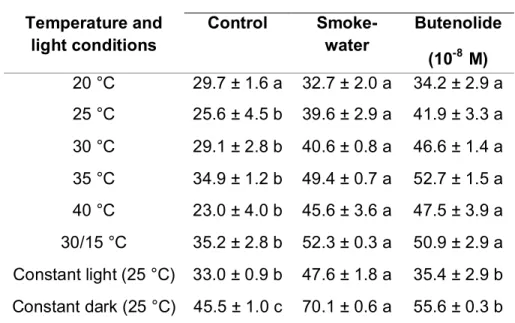
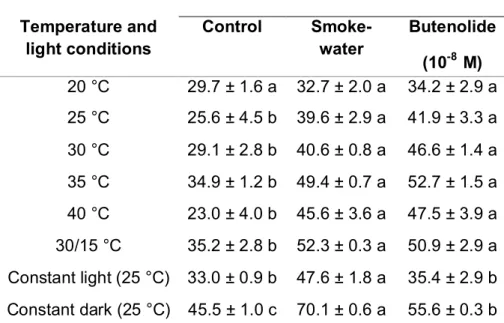
Table 4.1: Effect of smoke treatments on seedling growth of Eragrostis tef after incubating for 16 days at different temperature and light conditions.
Mean value (±S.E.) in the row with a different letter is significantly different (P < 0.05). ... 63 Table 4.2: Effect of smoke treatments on seedling growth of Eragrostis tef after
incubating for 7 days at different osmotic potentials at 25 °C and 16:8 h light:dark conditions. Mean value (±S.E.) in the row with a different letter is significantly different (P < 0.05). ... 66
Table 5.1: Soil core samples collected before and after burning mesic grassland sites in South Africa. ... 78 Table 5.2: General analysis of variance (ANOVA) with main effects and their
interactions for the 3 burning treatments, 3 concentration levels, 4 soil
depths and 4 time periods (weeks). ... 83
LIST OF TABLES
xxiv
Table 6.1: Effect of nutrient solution (50% Hoagland’s) with or without N, P or K on seedling growth parameters of grass species grown under greenhouse conditions. ... 93 Table 6.2: Effect of different concentrations of smoke-water (SW) and butenolide
(B) in absence of N, P or K on seedling growth parameters of grass species under greenhouse conditions. wt. = weight; vol. = volume. ... 96 Table 6.3: General ANOVA with main effects and their interactions for seedling
vigour index of grass species under greenhouse conditions. ... 99
Table 7.1: The heat and smoke-water treatments applied on soil seed bank samples collected from classic mesic grassland site in South Africa. 107 Table 7.2: One-way analysis of variance for seedling emergence in response to
the four treatments applied. ... 110 Table 7.3: Total number of seedlings emerged per treatment from the soil seed
bank collected from mesic grassland in South Africa after heat and smoke-water treatment (heat, smoke-water and heat + smoke-water). 114 Table 7.4: Seedling emergence indicators from mesic grassland soil seed bank
samples under four different fire-related treatments in a greenhouse
trial. The indicators considered were: MNSE: mean number of seedling
emerged; SOE: speed of emergence (plants per week); MED: mean
emergence date (week); ERI: emergence rate index (per week). Growth
indicators FW and DW represent fresh and dry weights respectively. 115
xxv LIST OF ABBREVIATIONS
AN………. Ammonium Nitrate ANOVA……….Analysis of Variance B………Butenolide
FGP…………...Final Germination Percentage GR……….Germination Rate
LAN…………...Limestone Ammonium Nitrate
NPK…………..Nitrogen, Phosphorus and Potassium PEG…………..Polyethylene Glycol
SA……….Smoke Aerosol SW …………...Smoke-Water
UKZN...University of KwaZulu-Natal
1
Introduction
"Great is the art of beginning, but greater is the art of ending"
Henry Wadsworth Longfellow (1807 – 1882)
1.1 SMOKE AS A GERMINATION CUE
The history of fire and smoke on earth is as old as the earth itself. Hence, fire has
been part of the ecosystem for millions of years, and its role as a major
evolutionary force on shaping global vegetation pattern is one of the oldest
observations of the natural world. The role of fire in the origin, maintenance and
distribution of terrestrial plant communities has also been well recognised since
long (CLEMENTS, 1916; PHILLIPS, 1931; SOUSA, 1984; GLENN-LEWIN and
VAN DER MAAREL, 1992). It has been commonly assumed that certain plant
species are frequently eliminated by the physical heat of burning which changes
the relative frequency of species occurrence, and new plant species adapted to fire
are introduced into burned ecosystems (TAYLOR, 1973; KREFTING and
AHLGREN, 1974). Fire also creates opportunities for exotic plant species to
establish successfully in a foreign habitat, and to outperform dominating native
species. Since the early 1990,s however, fire has been identified as hosting an
important chemical germination cue (i.e. smoke) (DE LANGE and BOUCHER,
1990), and hence smoke-stimulated germination as a new factor influencing seed
germination, seedling establishment and colonisation processes has received
CHAPTER ONE
2
considerable global attention (KEELEY et al., 1985; BOND and VAN WILGEN, 1996; KEELEY and KEELEY, 1987; KEELEY and FOTHERINGHAM, 2000;
CLARKE and FRENCH, 2005). Benchmark studies conducted on South African Fynbos species (BROWN, 1993a; BROWN, 1993b) reported that plant-derived smoke triggers seed germination of certain species. It is fascinating topic which holds great potential for applications in various fields of plant science (LIGHT and VAN STADEN, 2004). Certainly, the discovery has provided new opportunities for promoting germination and seedling growth in agriculture, horticulture, habitat restoration and weed control programmes. It is ecologically significant that smoke- stimulated germination is also serving as a remarkable tool for scientific investigation into the action of fire in ecosystems. Presently, smoke has been shown to induce germination in a comprehensive and indicative selection of species known to be smoke-responsive species (DIXON et al., 2009). This indicates that not all species are responsive to smoke or the degree of the responsiveness may differ from species to species and across a wide-range of environmental settings. Therefore, such a notion may further influence concepts of fire-induced ecological succession, competitive interaction and hence plant community organization (BROWN and VAN STADEN, 1997; LIGHT and VAN STADEN, 2004).
1.2 FIRE IN THE SOUTH AFRICAN MESIC GRASSLANDS
South Africa is a land of fire and smoke of natural or anthropologic origin (SCOTT,
1971). The eastern part of the country is particularly prone to natural fires
(lightening) with one of the highest lightening incidences in the world (MARNY and
KNIGHT, 1986). Frequent and/or predictable fires occur in South African grassland
and savannas; consequently, fire is an integral part of these ecosystems (SCOTT,
1971; TAINTON, 1978). The present study focused on one of the most fire-
dependant/fire influenced biomes in South Africa, known as southern Tall
Grassland (ACOCKS, 1988). South African mesic (fire-climax) grasslands owe
their very origin to fire which occur in a large part of the higher-lying eastern region
3
of the country, supporting a rich flora of high conservation interests (Figure 1.1).
These grasslands support substantial quantities of livestock and wildlife, which are the primary subsistence of a large portion of the indigenous population and for commercial purposes (FOTHERINGHAM, 1981).
Figure 1.1: Map of South Africa showing the distribution of the arid, semi-arid
and mesic areas (ACOCKS, 1988).
4
The grassland community under discussion is mainly composed of perennial herbaceous species with sparsely situated
Acacia trees. The original dominantgrass species are inherently short species largely composed of Themeda triandra,
Heteropogon contortus and Tristachya leucothrix(ACOCKS, 1988). The species composition of the grassland is however, sensitive to fire frequency and intensity that fire tolerant/favoured species are often encountered (to be discussed further in Chapter 3). Therefore, an understanding of the mechanisms responsible for such fire-induced changes in species composition is essential for the ecology and successful management of the grasslands.
The principal objective of this study has been promotion of predictive understanding of the role of fire and fire-related factors mainly light, heat, nutrients and smoke on grassland species germination and growth. While the role of fire on vegetation dynamics is one of the best studied subjects, previous studies have resulted in contradictory understanding, with some reporting that fire has negative impacts on germination (ZACHARIAS et al., 1988; DREWES et al., 1995;
MUCUNGUZI and ORYEM-ORIGA, 1996), whilst others reported stimulatory effects (BOND and VAN WILGEN, 1996; KEELEY and FOTHERINGHAM, 2000;
VAN STADEN et al., 2006) and still others reporting neutral or no effects (ADKINS and PETERS, 2001; BUHK and HENSEN, 2006). Therefore, if fire and smoke are to be useful as management tools, promotion of predictive understanding of the effects across a wide range of species and environmental setting is needed. In addition to this, promoting the current knowledge on smoke as a germination cue and as a new factor in plant growth was one of the major goals in this study.
1.3 AIMS AND OBJECTIVES
The overall aim of this study was to provide some answers to questions related to
the role of fire and fire-related factors mainly smoke on grassland species
germination and growth. This was achieved through different investigations on
aspects related to fire, smoke, soils and grass species germination. The specific
objectives of this study were the following:
5
1. Improve our understanding of the eco-physiological effect of fire and smoke on grassland species germination and growth, and its implications for mechanisms regulating the dynamics of species and vigour change in response to fire (burning);
2. Provide a means of developing models for predicting the dynamics of key grass species and grassland structure in relation to the eco-physiological effects of fire and smoke on plant growth and development and;
3. Promotion of the existing knowledge on smoke as a germination cue and as a factor in plant growth;
1.4 GENERAL OVERVIEW
Germination requirements and germination rate are amongst the most important seed traits associated with plant fitness and are key components in the ecology and evolution of plant life histories (HARPER, 1977). The importance of seed germination as a plant trait leading to successful establishment and persistence of individual plants and populations is well discussed by VAN DER VALK (1992).
Germination is a complex process which is governed and influenced by many
factors and slight changes in the physical and chemical environment can lead to
different outcomes. Hence, it is often argued that germination ecology of species
cannot be fully understood by laboratory-based studies alone (BASKIN and
BASKIN, 1998). This notion partially holds true, as there are many more
unforeseen factors which influence germination
in situ. The reverse notion is alsoavailable in that in plant communities, often slight differences in the physiological
characteristics and life history features of the species involved and the diverse
nature of successional environments can influence trends in succession
replacements (GRIME, 1979; TILMAN, 1988). Due to this fact, designing and
analysing ecological experiments in the field as tests of ecological theory are often
6
viewed as insurmountable and challenging (VAN DER VALK, 1992). Hence, experimental laboratories are often used as instruments for investigating ecological questions not easily answered through the analysis of field data (HARPER, 1977;
GRIME, 1979; VAN DER VALK, 1992; BAZZAZ, 1996).
The research presented in this thesis brings together a variety of different laboratory, greenhouse and field-based studies related to the subject of “the role of fire and fire-related factors on germination and growth of grassland species”.
Although in some respects the experiments may seem unrelated, together they begin to provide some insight towards a greater understanding of the role of fire and smoke on germination and seedling growth of some representative grassland species which are currently used as livestock feed and/or directly or indirectly for human consumption.
Chapter 2 provides a comprehensive literature review on the topic of fire mediated vegetation changes and the role of smoke as a germination cue. This Chapter also attempts to cover the most recent advances in the role of smoke in different fields of science i.e. agriculture, horticulture and ecological studies. This Chapter concludes with a short discussion on the ecological significance of smoke- stimulated germination and some important considerations for vegetation ecology.
Chapter 3 presents results from the experiments conducted on the effects of plant- derived smoke solutions and the interaction with temperature on germination and seedling growth of six common grassland species from mesic grassland in South Africa. The results from this experiment showed that smoke solutions and its interaction with temperature significantly influence the germination and seedling growth of South African mesic grassland species which in the long-run can impact on grassland composition (GHEBREHIWOT, KULKARNI, KIRKMAN and VAN STADEN, 2009).
Chapter 4 provides results from an experiment which was conducted to test the
role of smoke solutions on germination and seedling vigour of Eragrostis tef (Zucc.)
Trotter under high temperature and low osmotic potential. The purpose of this
7
study was to understand the mode of smoke action in facilitating germination. The results from this experiment demonstrate that smoke-water and butenolide treatment of Eragrostis tef seeds significantly improved germination and seedling growth. This study also revealed that smoke solutions play a significant role in facilitating water uptake by seeds (imbibition) and override stresses exerted from sub-optimal temperature and low osmotic potential. Importantly, this Chapter gives evidence that smoke-water and butenolide are able to widen the environmental range over which germination can occur (GHEBREHIWOT, KULKARNI, KIRKMAN and VAN STADEN, 2008).
Chapter 5 presents the results of the “lettuce seed bioassay” conducted to assess the effect of fire (burning) in altering the soil-smoke chemistry and the biological activity of burnt soil extracts on the germination of Grand Rapids Lettuce seeds.
The aim of this study was to examine the germination activity of smoke residue in soils following a fire event. Results from this experiment showed that fire (burning) affects the soil smoke chemistry with regards to the germination activity of smoke which can further influence the germination of seeds contained at a moderate depth in the soil seed bank. (GHEBREHIWOT, KULKARNI, LIGHT, KIRKMAN and VAN STADEN, 2010).
Chapter 6 presents the results of an experiment conducted to assess the role and interactive effect of smoke solutions of various dilution levels with soil macronutrients i.e. nitrogen (N), phosphorus (P) and potassium (K) on seedling growth of three grass species of contrasting response to smoke treatments.
Results showed that irrespective of nutrient (NPK) presence, the smoke solutions of various dilution levels enhanced seedling growth of Themeda triandra. Seedling growth in
Eragrostis curvula was more responsive to the presence or absence ofsoil nutrients (mainly N). Seedling growth of
Panicum maximum was negativelyinfluenced by the interaction of the smoke solutions with soil macronutrients.
Findings from this study demonstrate that the interaction of plant-derived smoke
with soil nutrients is an important factor in species growth (KULKARNI,
GHEBREHIWOT, KIRKMAN and VAN STADEN, 2010).
8
Chapter 7 provides the results of greenhouse experiment conducted to assess the effects of plant-derived smoke and heat on soil seed bank stimulation of mesic grassland in South Africa. Findings from this study highlight the potential role of plant-derived smoke in stimulating the soil seed bank of the mesic grassland and the potential use of plant-derived smoke in speedy restoration of degraded grasslands (GHEBREHIWOT, KULKARNI, KIRKMAN and VAN STADEN 2010).
Chapter 8 (General discussion and conclusion) and Chapter 9 (References) are
followed by three appendices compiled from the surveyed literature. Appendix 1
provides a list of Poaceae species which showed a positive germination response
to smoke treatments. In contrast, Appendix 2 provides a list of Poaceae species
which did not show a positive germination response to any type of smoke
treatment. Appendix 3 shows electro-microscopic photos of the grass seeds used
in this study. These electro-microscopic photos demonstrate the difference in size,
shape and the nature of the seed coat of the seeds used in this study.
9
Literature review
״ Vegetation is the basic instrument the creator uses to set all of nature in motion "
Antoine-Laurent de Lavoisier (1743–1794)
2.1 INTRODUCTION
Fire is a common disturbance regime world-wide, which derives processes that induce vegetation change through direct effects on biota and/or indirect effects on the environment (SOUSA, 1984; WESTOBY et al., 1989; BOND and VAN WILGEN, 1996; BUHK and HENSEN, 2006). In fire-prone ecosystems and through the evolutionary time scale, many plants have evolved adaptations that protect them from being extirpated by fire or allow them to survive, thrive, and even require fire for survival (EVERSON and TAINTON, 1984; SOUSA, 1984;
EVERSON et al., 1988; BOND and VAN WILGEN, 1996). Species adaptations to
fire can be thought of as the evolution of morphological and behavioural traits
which allow for reproduction and the continuance of species. Regeneration
strategies related to fire include morphological and physiological traits such as the
production of propagules (seeds, tillers and rhizomes) capable of surviving,
germinating, sprouting and flowering following after a fire event
(DANCKWERTS, 1984; ZACHARIAS et al., 1988; EVERSON, 1994). Hence,
promotion of the understanding we have on how seed germination and seedling
establishment of the local flora (as important plant traits in community structure)
are influenced by fire and fire-related factors is of paramount significance. Indeed,
CHAPTER TWO
10
knowledge of the regeneration mechanisms and their interrelation with ecological factors such as fire, smoke and nutrients is essential for the interpretation of the high spatio-temporal variability found in post-fire species performance (BOND and VAN WILGEN, 1996; BUHK and HENSEN, 2006; CHAKRABORTY and LI, 2009).
The aim of the review is firstly, to give a concise overview on subjects related to the role of fire and fire-related factors that influence seed germination, and consequently play a significant role in shaping plant communities. It is generally true that such a topic may inevitably host the entire question of fire ecology and fire-induced ecological succession. In plant ecology, succession is a broad topic and hence discussions around the subject may radiate out into endless directions.
On account of the broadness of the subject and in the interest of the study under discussion therefore, this review discusses narrowly on the most relevant issues related to the ecological role of fire and fire-related factors which cause vegetation patterns and the underlying mechanisms governing plant succession. Secondly, it was desirable that smoke as a germination cue and a new factor in plant growth the current applications of smoke-biotechnology in various fields of agriculture, horticulture and ecological studies, and the suggested possible modes of smoke action in facilitating germination and promoting growth are sufficiently discussed.
This review concludes by raising some importance considerations on issues linking the discovery of the plant-derived smoke germination cue and its ecological implications for the development of a theoretical framework of vegetation ecology.
2.2 THE ROLE OF FIRE IN PLANT SUCCESSION
It has been recognised for centuries that apparently repeatable patterns in plant community composition and structure in relation to climate, topography, soils and various forms of ecological disturbances is common in nature (CLEMENTS, 1916).
In other words, plant communities are not stable assemblages; they are rather
dynamic both in time and space. The mechanisms responsible for such spatial and
temporal changes in the community composition are commonly thought to be
11
related to the physiological tolerance of the plants to various physical and chemical factors (e.g. soil pH, salinity, aridity, fertility, biomass removal, grazing) and competition with other species. On the other hand, ecological disturbances (perturbation) of different forms which impact both the plant and the environment (resource flux) may play a significant role in structuring plant communities (BAZZAZ, 1983; SOUSA, 1984).
Hence, plant communities are established through gradual development and for each community a characteristic pattern in which a definite stage (sere) can be recognised. Such a gradual progressive and at times retrogressive development of vegetation through a series of different plant groupings has been termed succession (CLEMENTS, 1916). In simple terms, succession is a universal phenomenon of changes in the abundance and dominance of different species over time. These changes can involve species replacements, shifts in population structure, and changes in the availability of resources such as light, soil moisture and soil nutrients (GRIME, 1979; TILMAN, 1988; BAZZAZ, 1996). Succession is divided into two distinct forms which are recognised as: primary and secondary succession. Primary succession occurs in a situation when plants gradually emerge in areas not previously vegetated because of lack of soil development, e.g.
when lichens colonise a bare parent material such as a rock surface. In contrast, secondary succession occurs in areas previously vegetated but have had the pre- existing vegetation destroyed due to disturbance(s). The major causes of secondary succession are fires, cultivation, landslides, volcanic eruptions, floods and wind storms among others. Consequently, depending on the type, intensity and frequency of the causes, succession takes different forms (SOUSA, 1984;
PICKETT et al., 1987). Though the full array of ecological disturbances that lead to
a successional change is countless, the most influential and best studied
disturbance regimes worldwide are those associated with wildfires. Fire is a type
of chemical disturbance caused by the rapid combustion of biomass of an
ecosystem, often causing shifts in species composition of plant communities
(SOUSA, 1984; BAZZAZ, 1996; BUHK and HENSEN, 2006). Fires destroy part or
all of the plant community and leave a barren landscape open to new growth,
12
vegetation, and re-colonization of plant species (TROLLOPE, 1984; BAZZAZ, 1996). The germination of seeds on the surface and/or from the soil seed-banks is thought to be enhanced by fire (BOND and VAN WILGEN, 1996; KEELEY and FOTHERINGHAM, 2000).
The ecological role of fire as a disturbance factor and a cause in successional change has been recognised since the turn of the last century.
CLEMENTS (1916) considered fire as one of the natural sources initiating succession. He viewed fire as a retrogressive process that sets back the sequential development of vegetation to the climax. Hence, CLEMENTS (1916) considered the post-fire ecological recovery process which manifests in a regenerating vegetation as a type of secondary succession. Succession is a very broad topic in plant ecology which evolves many processes (RAYNAL and BAZZAZ, 1973;
GRIME, 1979). As such fire ecology (fire-induced succession) is an extensive topic which encompasses complex interaction between the major products of fire (heat, light, smoke, nutrients and moisture). The complexities of the processes of succession, such as seed dispersal, germination and survival, leading to the establishment and persistence of individual plants and populations are well discussed in the literature (e.g. VAN DER VALK, 1992, BAZZAZ, 1996).
2.2.1 Mechanisms of plant succession: how important is seed germination?
Mechanisms of vegetation regeneration and dynamics (succession) are thought to be the efficient causes that contribute to vegetation change (PICKETT et al., 1987). For several decades, ecologists have been speculating and hotly debating about the mechanisms of plant succession (CLEMENTS, 1916; MCINTOSH, 1980;
PICKETT et al., 1987; TILMAN, 1988). The scientific literature around the subject
contains an extensive work done in identifying the general and unifying causes of
vegetation change (MCINTOSH, 1980; MCCOOK, 1994; BAZZAZ, 1996). Despite
the large volume of work, there is yet no single universal and unifying cause or
model of plant succession. This is because each habitat has its own unique
aspects of environmental circumstances and each plant species has its own
13
unique physiological and morphological features which makes it difficult to find one unifying generalisation of the concept (TILMAN, 1988). General tendencies in vegetation change however, involve the dominance of species with greater maximum size, better germination, vigorous establishment and growth (GRIME, 1979; MCCOOK, 1994; BAZZAZ, 1996). One of the most popular models of succession is that of PICKETT et al. (1987). These authors in their attempt to systematically model plant succession, suggested a three-level hierarchy that completely enumerates all causes of vegetation succession. In this three-level causal hierarchy of vegetation succession; the highest level defines the general conditions or causes of succession. The intermediate-level consists of ecological factors or processes describing the causes of the highest level. In the intermediate-level factors such as germination and establishment together with seed availability, seed dispersal mechanisms, life history strategies, mode of reproduction, germination requirements, and response to environmental stress factors are considered as important in fire-induced vegetation change (PICKETT et al., 1987).
Often, questions arise if seed germination and related traits are responsible
for the observed patterns of plant distribution in the post-fire habitat (MCINTYRE et
al., 1999; BUHK and HENSEN, 2006; BUHK et al., 2007; CHAKRABORTY and
LI, 2009). Studies conducted on monitoring and predicting post-fire successional
changes of various vegetation types reveal that in many instances, difference in
seed germination in response to fire may cause major differences in colonisation
and establishment success of species which leads to the creation of vegetation
patterns (BUHK and HENSEN, 2006; BUHK et al., 2007; CHAKRABORTY and
LI, 2009). In particular, fire-stimulated germination and recruitment as an
effectual mechanism in species change has been demonstrated as being important
for several vegetation types worldwide (GO´MEZ-GONZA´LEZ et al., 2008).
14
2.2.2 Why do we need to predict vegetation change in response to disturbances?
Understanding and quantifying revegetation in response to disturbance is one of the major goals for basic research and ecological restoration, conservation and rehabilitation purposes (GRIME, 1979; SOUSA, 1984; GLENN-LEWIN and VAN DER MAAREL, 1992; BAZZAZ, 1996). Disturbances are commonly thought to come through fires, wind storms, landslides, volcanic eruptions, diseases, cultivation, overgrazing, climate changes and many other forms of human actions which interfere with the normal functioning of a given biological system (VAN ANDEL and VAN DEN BERGH, 1987). Such disturbances are believed to modify trends in ecological succession through changes in the environment and within the plants themselves (GRIME, 1979; VAN ANDEL and VAN DEN BERGH, 1987;
GRUBB, 1988). Disturbances differ in their type (i.e. physical or chemical), extent, duration, magnitude and space (SOUSA, 1984; PEET, 1992). Hence, depending on the intensity and timing thereof, species diversity and population growth oscillate through factors linked to demographic processes such as seed production, dispersal, perdition, germination characteristics, stand establishment and adult plant longevity (GRIME, 1979; BAZZAZ, 1996; CZARNECKA, 2004).
Predictive understanding of plant community response to fire (burning) is the
basis for sound management which in turn greatly relies on our understanding of
the patterns and processes of disturbance-mediated vegetation change (GLENN-
LEWIN and VAN DER MAAREL, 1992; BAZZAZ, 1996). Predicting community
composition from life history patterns such as seed germination and growth
response to environmental changes is a useful tool and common in ecological
studies (GRIME, 1979; BAZZAZ, 1996). Identifying traits that may be responsible
for species response to various changes in the environment are thought to facilitate
the generalization of results from specific studies to a larger range of environments
(MCINTYRE et al., 1999).
15
2.2.3 Seed germination and plant community organization
A seed contains an embryonic plant in an inactive condition and seed germination is a process by which inactive seed begins to sprout and grow into a seedling under the right growing conditions. It is a complex physiological process which is governed by a specific moisture level, light conditions, temperature fluctuations and concentration of certain gasses (GRIME, 1979; RICE, 1984; VAN DER VALK, 1992). More importantly, seed germination can be affected by several fire-related factors such as heating temperature (ZACHARIAS et al., 1988), ash (HENIG- SEVER et al., 1996; REYES and CASAL, 1998), nitrogen availability (BRONCANO et al., 1998; PÉREZ-FERNÁNDEZ and RODRÍGUEZ- ECHEVERRÍA, 2003), plant-derived smoke (KEELEY and FOTHERINGHAM, 1998; PÉREZ-FERNÁNDEZ and RODRÍGUEZ-ECHEVERRÍA, 2003), and ethylene (NE’EMAN et al., 1999).
Different species of plants have different requirements and strategies for germination and successful establishment of seedlings. The significance of germination strategies in community composition has been discussed by GRUBB (1977); PICKETT and WHITE (1985); PICKETT and BAZZAZ (1978), and GRIME (1979). Seed germination requirements of species determine the distribution of adult plants in the landscape. Especially, in predominantly grass dominated communities, germination is believed to be a major determinant of species composition and hence community structure (GULMON, 1992). Often, species which germinate early in the growing season are thought to pre-empt resources in a patch and thus establish competitive dominance (ROSS and HARPER, 1972;
RICE, 1984; BAZZAZ, 1996). Therefore, germination patterns may influence the subsequent interactions among plants.
The use of germination characteristics in predicting community change is
well reviewed by BAZZAZ (1996). According to BAZZAZ (1996), predicting
community change from a single germination or growth response to environmental
changes such as moisture and temperature fluctuation would not be a useful
16
parameter. However, physiological response of species to the combined effect of temperature, soil disturbance and fire (smoke) would predictably determine the composition of a given community.
2.3 THE ROLE OF FIRE IN SEED GERMINATION
Fire is a major environmental selective force that controls many structural and functional properties of plant communities, and is a key factor initiating and terminating plant succession (SOUSA, 1984). Fire as disturbance factor directly or indirectly affects plant growth, survival and reproduction and also influences seed germination and seedling dynamics (BOND and VAN WILGEN, 1996; KEELEY and FOTHERINGHAM, 2000). A phenomenon common to nearly all grassland communities worldwide is the flush of new growth that follows a burn (WHELAN, 1995; SNYMAN, 2005). Post-fire increases in germination and seedling emergence may be due to the high resource availability and/or low competition after a fire, but it may also be explained by fire-stimulated germination (i.e., dormancy breakage) (KEELEY et al., 1985). Fire-stimulated germination is attributable to many fire-related variables. From the literature surveyed, the most commonly cited variables are; a) the heat from fire, b) the charred wood left on the ground after fire c) the greater light intensity that would reach the seeds once the canopy has burned d) nitrogenous compounds (KEELEY et al., 1985;
KEELEY, 1987; KEELEY and KEELEY, 1987), and smoke (BROWN, 1993a;
BROWN, 1993b; VAN STADEN et al., 2000). Hence these variables may act, individually or in combination, as a cue (s) for stimulating the post-fire seed germination (KEELEY et al., 1985).
2.3.1 Post-fire regeneration
Post-fire regeneration as an issue related to fire frequency, fire intensity (i.e. heat
release), fire type (i.e. crown vs. ground fire), fire season (i.e. timing or season) or
fire size (i.e. spatial coverage) in combination with certain climatic factors and other
1