Their aim is to raise awareness of children's rights as set out in the international declaration on the rights of the child. Due to the extremely poor conditions of the roads on the island, transport is limited to two tractors. In addition to the researchers bias, the complexities of the island society and the complicated.
Traditional, Northern-dominated, 'top-down' aid has failed to deliver lasting improvements in the lives of the poor. The North provides resources and training and both partners are involved in the management, planning, monitoring and evaluation of the project or program. The level of participation of different actors influences the outcome of the project or program.
In other words, it attempts to transfer some control of the process to the community. This increases the community's accountability to the NGO by ensuring their acceptance and involvement in the project. These councils act as gatekeepers and help determine what is and what is not in the best interest of the NGO.
Such an action would question the independence of the NGO and could have negative effects on the community.
CHAPTER 3 CASE 1
Promotion and empowerment of the national partner (RE) in its advocacy activities and in fulfilling the project's objectives. As lead implementer, RE's task was to manage and implement both components of the project. The following section looks at the relationship between RE and Medico Internacional describing their involvement in various aspects of the project.
Despite many setbacks, RE was able to train and contract personnel to implement various aspects of the project. Medico Internacional had to be accountable to its donors for the financial aspects of the project, so they built RE capacities for these funds. They never took ownership of the project and looked at it more like an employer-employee relationship.
Increasing pressure from activists and the community to focus on material elements sapped energy from the psychological component of the project. The ability of NGO staff to encourage the participation of activists and youth in the project was limited by their limited experience and time as RE staff members. Furthermore, the large increase in NGO staff, in such a short time, limited their capacity to participate in project management.
In the initial stages of the project, RE tried to integrate both psychotherapy and (social) support strategies for survival. The director also admitted that the psychosocial segment of the project played a smaller role than he had initially planned. He attributed this in part to material support and training taking precedence over other aspects of the project.
RE had intensive contact with the donor, but this always concerned the financial aspects of the project. The termination of the project was clearly outlined in the project documents, but RE was disappointed and in some ways surprised that it ended. The end of the project and the termination of financing by Medico Internacional plunged RE into an organizational crisis.
CASE 2
Strengthening government and community capacity on children's rights as defined in the UN Convention. 34; Special emphasis should be placed on the healthy and harmonious development of the child in the family. The government also recognizes that household poverty is one of the key factors in the destabilization of family life" (Translated from Redd Barna's National Strategy.
On the substantive side of the project, Acc;ao Social staff were trained in a United Nations-based package on children's rights. Within the parameters set out in the 1998-2001 Strategic Plan, both RBM and its partners participate in the planning, programming and implementation of the programme. Some at Acc;ao Social have begun to question the focus of the Redd Barna program based on the current economic and social realities in the country.
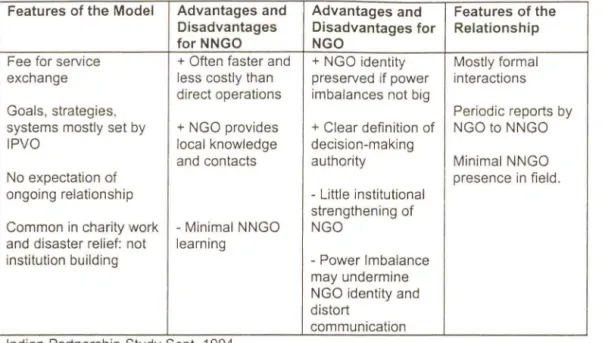
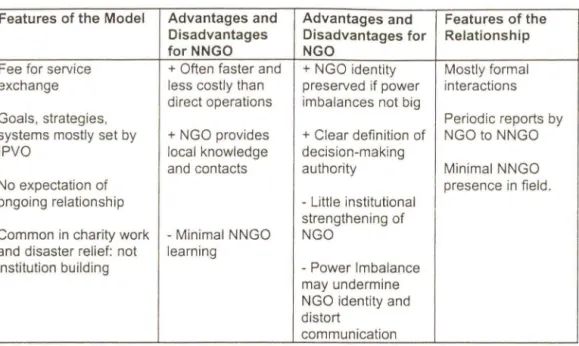
One can justify Redd Barna's program focus on the commitment the government made by signing the international agreement on the rights of the child. The following is a description of the advantages and disadvantages encountered by both Medico Internacional and RE during their project. Characteristics of the model Advantages and advantages and characteristics of the disadvantages Disadvantages for relationship.
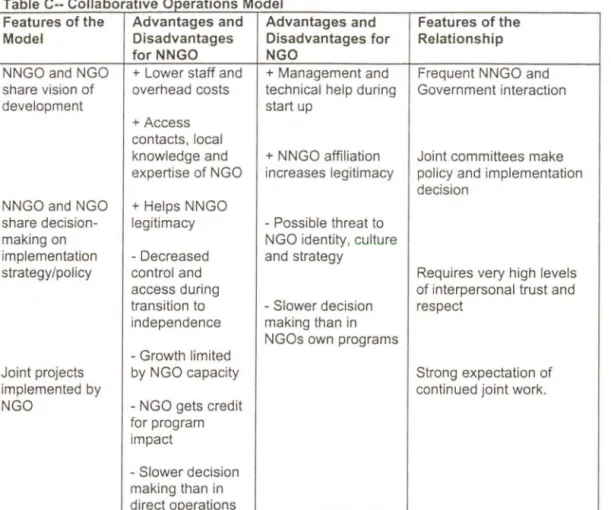
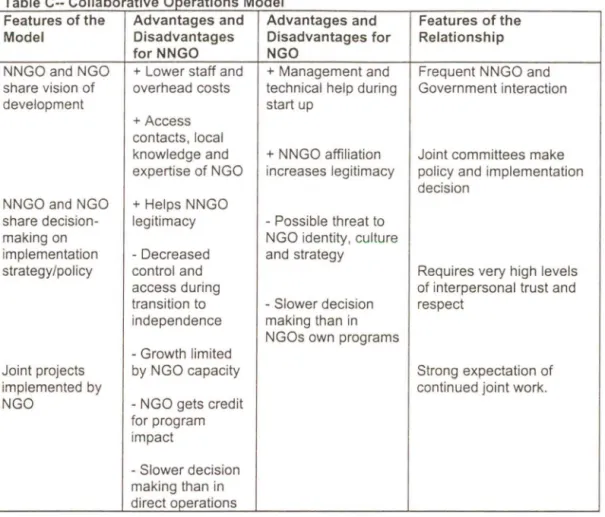
In the beginning, Acc;ao Social worked closely with Redd Barna to achieve then common objectives, such as controlling the program. Below is an analysis of the advantages and disadvantages encountered by both RBM and AC<{<3o Social during their program. The disadvantages for ACyao Social were found not so much with the projects or the relationship with Redd Barna Mozambique, but with the focus of the program itself.
There was a divergence between Acc;ao Social's perception of the most important areas to address and Redd Barna's views. Although partners were consulted in the strategic planning process at the national level, they were not involved in some of the most important areas related to Redd Barn Norway's policy making. Their activities in the province have encouraged local ownership of projects related to implementation.
Acc;:ao Socially on one level, this last statement raises important questions about the depth of the partnership. What level of participation did RE have in the design and planning of the project.
Mozambique