i | P a g e Walking at the intersection of Seamon’s place ballet and Relph’s insideness:
Understanding how students experience the university as a place through their everyday habitual walking
Thesis submitted to Rhodes University in fulfilment of the requirements for the degree of Doctor of Philosophy in Political and International Studies
By Siyathokoza Monwabisi Mtolo Supervised by Professor Louise Vincent
May 2019
ii | P a g e Abstract
Walking as a way to experience a place is a relatively understudied area of phenomenological study. Furthermore, globally (the world) and locally (South Africa) the study of the experience of tertiary education institutions as walked environments is minimal (see Puig-Ribera et al., 2008; Speck et al., 2010; Mtolo, 2017). However, the events of the South African #MustFall moment – especially the #RhodesMustFall part of the moment and how it began with the desecration of a statue that was walked past and found to be a misplaced artefact in a society that is in postcolonial/post-Apartheid times and space – highlighted the pressing need to study the experience of the university as a place through which habitual walking takes the student through moments of movement, rest, and encounter that are a highly consequential way in which placeness is experienced. This study is a way to document how students at Rhodes University experience the university’s placeness quality, through habitual walking, in an example of the way in which a place is experienced through moments of movement, rest, and encounter. For this study in-depth mobile interviews were conducted with 12 student participants from Rhodes University. The interviews were video-recorded as the participants talked while traversing through habitually walked areas of the campus that are the meaning- infused spaces which make up the Rhodes University that they traverse through on a daily basis. The dissertation found that in the experience of Rhodes University, through habitually walking its placeness, people experience moments of movement, rest, and encounter that are highly targeted and personalised. The experience of the Rhodes University campus is an experience of people and the built-up and decorated environment along similar lines. People bring to the experience of their walked space past experiences which inform consequentially how any space that is walked is experienced. People further employ strategies to ensure that the experience of walking a space is more to their desired quality as an experience, which ends up being meaningful and most likely to affect future instances of walking through meaning- infusing and meaning-infused space. Ultimately, the habitual walking of Rhodes University consequentially informs the relationship between students and Rhodes University’s placeness, as the walking is a way of learning how to be within a placeness that is engaged through alternating moments of movement, rest, and encounter that incrementally ‘open’ for experience Rhodes University in such a targeted manner that every student eventually has their personal and customised Rhodes University by virtue of it being just those sites and situations which have been engaged through habitual walking.
iii | P a g e List of Tables
Table 1: South African Enrolment Numbers by Gender (2000 – 2005) Table 2: South African Enrolment Numbers by Gender (2010 – 2015) Table 3: South African Enrolment Numbers by Race (2000 – 2005) Table 4: South African Enrolment Numbers by Race (2010 – 2015)
Table 5: Rhodes University student numbers (Undergraduate and Postgraduate) Table 6: Rhodes University Student Numbers (by Race)
Table 7: Rhodes University Student Numbers (by Gender) Table 8: Rhodes University Residence Life Item Results
Table 9: Rhodes University Safety and Security Item Results by Gender 2013
Table 10: Rhodes University Sexism, Racism, Xenophobia and Homophobia Item Results Table 11: Themes and subthemes
iv | P a g e List of Pictures
Picture 1: A collage of pictures taken by myself Picture 2: A collage of pictures taken by participants Picture 3 – Picture 23: Pictures taken by participants
v | P a g e Acknowledgements
To Professor Louise Vincent: Thank you for always being there when I needed assistance in all things. Without your guidance I could not have done any of this work.
To my participants, Khanyi, Raul, Neville, Michelle, Anelisa, Tadala, Phumi, Andile, Athenkosi, Tebogo, Margaret, and Lehlogonolo: without your participation in this research undertaking there would be no such study to speak of. I will forever be grateful for the tremendous help you were when you agreed to talk to me and basically make my research.
The financial assistance from the Mellon Institutional Culture Scholarship towards this research is hereby acknowledged. Opinions expressed and conclusions arrived at, are those of the author and are not necessarily to be attributed to Rhodes University or the donor.
vi | P a g e Table of Contents
Abstract ... ii
List of Tables ... iii
List of Pictures ... iv
Acknowledgements ... v
Table of Contents ... vi
Chapter One: Introduction ... 1
1.1 Background and Context ... 1
1.2 Personal Motivation ... 4
1.3 Rationale... 5
1.4 South African Higher Education Landscape as Placeness ... 8
1.5 Method, Technique and Procedure of the Research ... 9
1.6 Scope of the Study... 11
1.7 Thesis Structure ... 11
Chapter One: Introduction ... 11
Chapter Two: Background and Context ... 11
Chapter Three: Literature Review ... 12
Chapter Four: Theoretical Framework ... 12
Chapter Five: Methodology, Procedures and Techniques ... 12
Chapter Six: Movement – Part One of Place Ballet ... 13
Chapter Seven: Rest – Part Two of Place Ballet ... 13
Chapter Eight: Encounter – Part Three of Place Ballet ... 13
Chapter Nine: Conclusion ... 14
Chapter Two: Background and Context ... 15
2.1 Introduction ... 15
2.2 Overview: Higher Education in Africa ... 16
2.3 Overview: Higher Education in South Africa ... 19
vii | P a g e
2.3.1 South African Higher Education in a post-Apartheid Environment... 19
2.3.2 South African Higher Education Numbers ... 22
2.3.3 General Challenges within post-Apartheid South African Higher Education ... 27
2.3.4 Qualitative Research within the post-Apartheid South African Higher Education Landscape ... 28
2.3.5 Flashpoint 2015: #RhodesMustFall and #FeesMustFall ... 30
2.4 Context: Rhodes University ... 32
2.4.1 Overview: Historic Rhodes University ... 32
2.4.2 Overview: Contemporary Rhodes University ... 34
2.4.3 Research on Contemporary Students of Rhodes University ... 39
2.5 Conclusion ... 48
Chapter 3: Literature Review ... 49
3.1 Introduction ... 49
3.2 Place Studies and the Social Geographies... 49
3.2.1 Place and Attachment ... 50
3.2.2 Place and Sense of Place ... 52
3.2.3 Place and Identity ... 53
3.3 Place Studies and experience through walking ... 54
3.3.1 Walking and the (built) environment ... 54
3.3.2 Walking and particular built environment ... 58
3.4 The university as place, social geographies, and walking... 60
3.5 Gap in the literature ... 61
Chapter Four: Theoretical Framework... 63
4.1 Introduction ... 63
4.2 David Seamon and Emplacement ... 63
4.2.1 The body in space ... 67
4.2.2 The resultant place ballet as movement, rest, and encounter ... 70
viii | P a g e
4.3 Edward Relph and Emplacement ... 76
4.3.1 The spaces... 78
4.3.2 Insideness... 84
4.4 Conclusion ... 88
Chapter Five: Methodology, Procedures and Techniques ... 90
5.1 By way of preamble ... 90
5.2 Being-in-the-world back to the things themselves ... 92
5.2.1 Existence and its (given and primary) preoccupation ... 93
5.2.2 Talking, walking, and video-recording... 97
5.3 The participants ... 100
5.3.1 Participants’ introductory information ... 101
5.3.2 Participants with the camera ... 103
5.3.3 Confidentiality ... 105
5.3.4 The interview engaged ... 106
5.3.5 Rigour and trustworthiness ... 110
5.3.6 Limitations of research design ... 112
5.4 Conclusion ... 113
Chapter Six: Movement – Part One of the Place Ballet ... 114
6.1 Introduction ... 114
6.2 Routine ... 117
6.3 Walking ... 122
6.3.1 Walking from point A to point B ... 124
6.3.2 Walking Convenience... 128
6.4 Familiarity ... 136
6.5 Conclusion ... 146
Chapter Seven: Rest – Part Two of the Place Ballet ... 148
7.1 Introduction ... 148
ix | P a g e
7.2 Comfort ... 150
7.2.1 Comfort and the built environment ... 151
7.2.2 Comfort and the people environment ... 157
7.3 Attachment to place ... 162
7.4 At homeness ... 167
7.5 Conclusion ... 176
Chapter Eight: Encounter – Part Three of the Place Ballet ... 179
8.1 Introduction ... 179
8.2 Visual Aesthetics ... 181
8.2.1 General Aesthetics ... 183
8.2.2 Comparative Aesthetics ... 187
8.2.3 Aesthetic Contestation ... 192
8.3 The social environment ... 196
8.3.1 Social Signalling ... 198
8.3.2 Social Connections ... 201
8.4 Safety ... 207
8.5 Conclusion ... 216
Chapter Nine: Conclusion ... 219
A Recommendation ... 228
References ... 230
Appendix A: Informed Consent Agreement ... 284
Appendix B: Interview Questions ... 286
Appendix C: Categories Emerging ... 288
Appendix D: Categories and Definitions ... 325
1 | P a g e Chapter One: Introduction
1.1 Background and Context
The world over, there is a vast collection of literature on higher education institutions (see Barnett, 1992; Kanji et al., 1999; Nguyen and LeBlanc, 2001; Velazquez et al., 2005; Wu and Wu, 2008; Hazelkorn, 2015). The collection of literature spans such themes as higher education quality (see Seymour, 1992; Gumport, 2000; Biggs, 2001; Marginson and Van der Wende, 2007), transformation (see Clark, 1998; Garrison and Kanuka, 2004; De Boer et al., 2007;
Molesworth et al., 2009), and other miscellaneous subtopics (see Ramsden, 2003; Collins and Mowbray, 2005; Knight, 2008; Brown et al., 2013). The amount of literature is an indication of the high importance that the study of higher education institutions has historically gained.
In Africa, as in the rest of the world, there has been a vast collection of literature studying the higher education landscape (see Mazrui, 1975; Saint, 1992; Ajayi et al., 1996; Alidou and Mazrui, 1999; Teferra and Altbach, 2003; Bloom et al., 2006; Castells, 2009; Mohamedbhai, 2014). This literature spans such themes as African higher education and colonialism (see Brock-Utne, 2002; Mazrui, 2003; Assie-Lumumba, 2006; Mbembe, 2016), transformation (see Aina, 1994; Imam et al., 1997; Sawyerr, 2004; Mamdani, 2008), and various other subthemes (see Mama, 2003; Sawyerr, 2004; Essack, 2012; Mohamedbhai, 2014). Higher education in Africa has been the subject of much study as the continent has found the sector to be of much importance for the rest of society.
In South Africa the study of the higher education institution landscape has followed global trends in that it has been historically increasing (see Jansen, 2002; Cloete et al., 2004; Akoojee and Nkomo, 2007; Badat, 2009; Hall, 2010; Sehoole, 2013; Vincent and Idahosa, 2014;
Munyuki, 2015; Chiwandire and Vincent, 2017). The collection of literature spans such themes as access (see Boughey, 2003; Howell, 2006; Bitzer, 2010; Luescher et al., 2017), transformation (see Reddy, 2004; Walker, 2005; Badat, 2010; Nyamnjoh, 2016), and various other subthemes (see Anthony et al., 2000; Kruss, 2004; Jaffer et al., 2007; Lazarus et al., 2008). Post-Apartheid higher education has been the subject of much internal study.
2 | P a g e This present study is a contribution to the literature on the South African higher education landscape. However, unlike most of the literature focusing on this sector, the current study does not zoom in on just one realm of the academy, i.e. I do not simply look at only transformation or only access. Instead the current study focuses on South African higher education institutions as being primarily ‘places’ – places being realities which are geographic and that within them contain people within built-up and decorated environments of some disposition that are meaning-infused and meaning-infusing for the occupants and inhabitants (see Tuan, 1974;
Relph, 1976; Seamon, 1979). In other words, I look at South African tertiary institutions primarily as places with buildings and people who walk between those very buildings – walking and engaging in all types of behaviours.
I do a study of walking within a tertiary education institution in South Africa, inspired by the events of the country’s #MustFall moment. The events of especially the #RhodesMustFall part of the moment highlighted to me an often-overlooked part of tertiary education study in South Africa. This overlooked part is that of the populations of tertiary education institutions being primarily people that physically walk within the boundaries of the university space.
#RhodesMustFall started at the University of Cape Town and began when someone walked past a statue of Cecil John Rhodes, felt that the statue had no reason to remain erected in an allegedly postcolonial space and time, and decided that the statue had to be desecrated by himself and ultimately removed (see Murris, 2016; Chaudhuri, 2016; Bosch, 2017; Mbembe, 2016). The protests that ensued showcased how it was that people could experience places – strictly from their built-up and decorated environment with its accompanying ideas and social interactions – so differently when all the while the thought prevails that people always experience places in the same manner. This current study looks at how people who walk within the very same geographic boundary can often have highly diverging experiences of said ultimately phenomenological reality.
The research which has been done on South African higher education has often focused on targeted, isolated issues. For example, most of the research focuses on South African higher education being in a postcolonial space and time (see Badat, 1994; Mamdani, 1998; Gultig, 2000; Jansen, 2002; Cassim, 2005; Portnoi, 2009; Wangenge-Ouma, 2010; Sehoole, 2013;
Heleta, 2016). However, such research only interrogates the current higher education landscape
3 | P a g e as a space of transformation (see Walker, 2005; Badat, 2010), in regard to accessibility (see Howell, 2006; Bitzer, 2010), and in terms of other such targeted study areas (see Jaffer et al., 2007; Lazarus et al., 2008). This research may be argued to lead to a bifurcation of study. The bifurcation leading to there never being a view of the higher education landscape as more than the sum of its parts. My research simply looks at people – without knowing their biography beforehand – experiencing a place (in its entirety without isolating anything) entirely through their walking as moments of movement, rest, and encounter.
What the majority of the post-Apartheid study of higher education in South Africa does highlight is that the academy has realities which prevail and are of importance. For instance, such study does highlight that historically South African higher education was exclusionary (see Boughey, 2003; Howell, 2006), put parts of the population at a disadvantage (see Vincent and Idahosa, 2014; Chiwandire and Vincent, 2019), and is a place in need of change (see Badat, 2010; Nyamnjoh, 2016). These realities do affect large numbers of the university population.
This is why the country’s ministries of education historically looked to re-engineer some parts of the academy to be more in line with the wishes of a country which has done away with past policies which often overlooked certain parts of the country’s population.
In the seminal document by the country’s Department of Education entitled “Education White Paper 3: A Programme for the Transformation of Higher Education” (1997:6-7) it is argued that the transformation of the higher education system and its institutions requires:
Increased and broadened participation. Successful policy must overcome an historically determined pattern of fragmentation, inequality and inefficiency. It must increase access for black, women, disabled and mature students, and generate new curricula and flexible models of learning and teaching, including modes of delivery, to accommodate a larger and more diverse student population.
Responsiveness to societal interests and needs. Successful policy must restructure the higher education system and its institutions to meet the needs of an increasingly technologically-oriented economy. It must also deliver the requisite research, the highly trained people and the knowledge to equip a developing society with the capacity to address national needs and to participate in a rapidly changing and competitive global context.
Cooperation and partnerships in governance. Successful policy must reconceptualise the relationship between higher education and the state, civil society, and stakeholders, and among institutions. It must also create an enabling institutional environment and culture that is sensitive to and affirms diversity,
4 | P a g e promotes reconciliation and respect for human life, protects the dignity of individuals from racial and sexual harassment, and rejects all other forms of violent behaviour.
The above-stated requirements highlight the main realities that the ministries of education have historically thought to be in existence in the country’s higher education institutions. The prevalence of these realities can be argued to still exist, posing a challenge even in the current environment, as conflicts over the state of things in the academy are pervasive (see Badat, 2010; Vincent and Idahosa, 2014; Nyamnjoh, 2016; Chiwandire and Vincent, 2019). The students who participated in this study exist and walk in an environment characterised by the above realities and more.
1.2 Personal Motivation
I have always been interested in how people experience being in a place. From my personal experience I have always noticed how places seem to have particular effects on me. My very existence has included moving between many places within my life. My schooling has been highly indicative of this existence. I have never spent more than four years at any one school and at one time I spent just four months at one school. It has always been my contention that these schools have quite different atmospheres and are all together most different in terms of their built environments. Academically I came across the study of place during my Masters’
thesis. I had come to know of a university research unit that dealt with issues of institutional culture, transformation, and equity. Within the unit was a subsection focusing on place studies.
Pursuing the study of place was in line with my own interests in learning about how most people experience what can only be termed as ‘placeness’.Placeness is at its simplest how a space, once meaning-infused, takes a quality of being a place for the individual who is within the meaning-infused space.
There were theorists within the field who became rather important to me. The theorist Henri Lefebvre remains perhaps the theorist who is always on my mind when it comes to the experience of place. In Lefebvre’s theory of the production of space (Lefebvre and Nicholson- Smith, 1991) the argument is that places are produced through what is termed a spatial triad that people experience within that particular space. This spatial triad involves things such as
5 | P a g e the built-up and decorated environment, what people do within the environment, and what the environment looks like on an abstract level being consequential influences in how the place is ultimately experienced. Other important theorists were Tim Ingold, Jo Lee Vergunst, and Gary Bridge. These theorists focused on walking as a way in which people are mostly emplaced.
Ingold and Vergunst (2008) in their ethnographic study argued for walking as a way in which memories and emotions are placed and lived on particular spots of a meaning-infused space;
Bridge (2013) focused on how the human mind and body negotiate being within a meaning- infused space as a being that consequentially lives within what has been meaning-infused by itself and by others.
The authors above, alongside my own experience of places, encouraged me to attempt to capture the experience of placeness through talking to people who walk within meaning- infused space and get to experience the meanings infused through the subjective reality of simply being within placeness and uncovering at their own pace the consequences of walking through placeness realities. I simply wish to see how walking consequentially informs how placeness is experienced. I will be using the experiential framework of the place ballet to document this experience. The place ballet is at its simplest a theory that argues that people experience places through three states of being within the place, viz. rest, encounter, and movement. In other words, people rest, encounter, and move within a place.
1.3 Rationale
This study locates itself in the debates that look at the experiences of being within higher education institutions in South Africa. It is the case that most studies of the experience of higher education institutions in South focus on either the experiences of the historically excluded and disadvantaged individuals or upon issues of transformation (see Tait et al., 2002; Hay, 2008;
Mgqwashu, 2009; Petersen et al., 2009) and other attempts at reconfiguring institutions so as to be more in line with the wishes of a country that is in postcolonial times (see Badsha and Harper, 2000; Woods, 2001; Sennett et al., 2003; Walker, 2005; Pattman, 2007). It is seldom the case that studies focus on the experiences of all different kinds of people within higher education – what I mean here is focusing on not only the previously disadvantaged or only the disabled but to have the research focus on no particular group of people (see Schrieff, 2004;
6 | P a g e Cross and Johnson, 2008; Cross et al., 2009; Sartorius and Sartorius, 2013). My argument is that there is no university that is exclusively just a space of transformation, or exclusively a place occupied by the previously disadvantaged. No place is a vacuum and thus all places are multifaceted and deserve to be studied as such. In all places there are the disadvantaged (across the disadvantage spectrum), the advantaged (the full spectrum), the previously excluded (the full spectrum), and the included (across the spectrum of inclusion), and all such themes ought to be considered as encompassing transformation in all its realities. The place that is the university is thus never one place but many places and it is this phenomenon of the multiplicity of place that I seek to illuminate here.
In the year 2015 there was the highly tense and publicised conflict over the profile of the higher education landscape of South Africa. Students along with some staff members protested what they deemed to be a tertiary education landscape that was not suited for the postcolonial context of the country. In other words, there were protests over the sort of places that the country’s tertiary education institutions were. The #MustFall moment -- inclusive of such themes as
#RhodesMustFall, #FeesMustFall, #OutsourcingMustFall, and numerous other such political statements – was a moment wherein there was a highly publicised clash over how universities should be for their current occupants and inhabitants (see Lemon, 2016; Mamdani, 2016;
Nyamnjoh, 2016). The #RhodesMustFall part of the #MustFall moment focused on the part of placeness that is mostly ignored, i.e. the built-up and decorated environment which form part of the institutional culture that consequentially informs the sort of meaning-infused space a place is. That part of the #MustFall moment started with the ‘desecration’ of the Cecil John Rhodes statue that used to be located at the University of Cape Town’s ‘Jammie’ steps (see Murris, 2016; Chauduri, 2016; Bosch, 2017). The #RhodesMustFall moment was a look at the built-up and decorated environment of the South African higher education landscape in the everyday experience of participants.
It was a lucky accident that the moment was sparked by someone walking past a statue and deciding to do something to (and about) that statue. The #RhodesMustFall movement forced the higher education population to think of their personal experience of the built-up and decorated environment. People from all walks of life experience the built-up and decorated environment they find themselves in, in specific ways (see Relph, 1976; Seamon, 1979; Tuan,
7 | P a g e 2001). Furthermore, the #MustFall moment showed people that higher education institutions are the same as any places in the world, i.e. they are made up of certain features (buildings, decoration, preoccupation, unspoken, etc.) that give meaning to the numerous realms of their existence. In other words, the #MustFall moment highlighted that in the built-up and decorated environment there is an experience to be had – an experience that is of equal importance to everyone within the meaning-infused and meaning-infusing space. I aim to use the realities of the moment in order to better understand how it is that any person within a higher education institution might experience that institution.
Meaning-infused spaces are places (refer to Casey, 1996:17). Places have a particular existence for individuals. It is within places that individuals have experiences which stay with them for the duration of their lives (see Tuan, 1975; Buttimer, 1976; Seamon, 1979; Lefebvre and Nicholson-Smith, 1991; Wylie, 2006; Ingold and Vergunst, 2008). To think of higher education institution as places like any other places in the world is rational because these ‘spaces’ have just the same make-up as any of the other spaces that make up a country’s geographic unit, i.e.
they have a mixture of geographic, human, and relational features. A phenomenological study will unpack some of the essences of experiencing such an existence as an individual in a higher education landscape and which is made up of all the same features as those that make up any particular meaning-infused and meaning-infusing space.
In this study my focus is on the student population. The students remain the biggest occupiers and inhabitants of higher education institutions. Volumes of research have been conducted on students as the main population of the country’s higher education institutions (see Kraak, 2000;
Akooge and Nkomo, 2007; Waghid, 2008; Badat, 2009). However, the research has often neglected the study of the experience of higher education institutions as places characterised by more than the coexistence of the previously disadvantaged with the advantaged and the struggle over such themes as transformation and equity. I look to university placeness, as an object of study, as an openness to the experiences of human beings -- who walk through scenes of experience that call on their particular existence and experience -- as subjectivities that are strategically and tactically called upon as the main medium of experience. In other words, I look at students in the sense of their having conversations with their environments, not as
8 | P a g e environments of just any general features but those features which pop up and are uncovered in action making up students’ own habitual walking.
1.4 South African Higher Education Landscape as Placeness
Human beings are always in place (see Tuan, 1977; Seamon, 1979; Pred, 1984; Casey, 2000;
Bridge, 2013; Cresswell, 2014). People are beings who exist within a space. This space is meaning-infused and meaning-infusing (Tuan, 1979:407). The space exists as a geographic, social, and relational reality in which individuals are emplaced. From this emplacement there come experiences which the individual goes through (refer to Buttimer, 1976). From these experiences the individual has a particular view of the sort of place that their emplacement site and situation is.
South African higher education institutions are places in the same manner that all other spaces of geographic and human existence are places. The institutions are made up of features both animate and inanimate that make them spaces of some placeness (refer to Lefebvre and Nicholson-Smith, 1991). These animate and inanimate features work together for there to be a lively existence of place with people that experience meaning-infusion and do their own meaning-infusing activities which affects their experience of placeness. From the built-up and decorated environment to the people who populate the space arise place-based transactions that lead to an overall personal experience of what it is like to be in that particular space that is known as that specific institution for that particular individual with specific subjectivities stemming from experience (Bridge, 2013:307). In other words, placeness is a phenomenological reality of being in place and having an experience of that place as meaning- infused and meaning-infusing.
In the post-Apartheid South African tertiary education research environment there has been a focus on particular parts of the placeness of universities. For instance, there has been a focus on transformation and moving the university space to be more in line with the realities of the current postcolonial environment (see Kraak, 2000; Akooge and Nkomo, 2007; Sehoole, 2013;
Mbembe, 2016). Although a noble cause, such research normally mistakes a part of the entity for the whole. For instance, disability access is a part of place experience but it is not the whole;
9 | P a g e the experiences of the previously disadvantaged are part of the experience of place but this too is not the whole. Such research will look at too little a part of the experience of higher education institutions as places. However, research that focuses on the disabled and poor at the same time would cover a greater part of place experience as it would include not just more people but also people with overlapping experiences that are instructive. Under such rationalisation then focusing on the experiences of any and everyone is putting yourself in a better position to document the experiences which are shared and interact within placeness as people from all walks of life do in fact (at moments) share and interact within placeness.
Place experiences do exist on a continuum from the strictly exclusively personal (see Tuan, 1974; Low and Altman, 1992; Wylie, 2005) to the group-based and sometimes confrontational (see Cresswell, 1996; Ingold and Vergunst, 2008; Di Masso et al., 2011). There are realities of place experience which appear to be spread through all forms of place experience as a consequential phenomenological reality of human existence. In other words, people, wherever they might be, are often bound to have some experience of being in that meaning-infused and meaning-infusing space.
For this research undertaking I looked to focus on students in a university – how the students who are the participants walk the university into being. My study is a way of contributing to the documentation of how universities – as areas of particular placeness – are walked and experienced in the manner in which they are. I look at how students, through habitually walking, basically make their very own university experience that is consequentially informed by this very habitual walking. In this way I seek to problematize the taken-for-granted understanding of the university as a place and seek instead to show how it is many places, brought into being through the ways in which its inhabitants experience it, make it, walk it and relate within it.
1.5 Method, Technique and Procedure of the Research
The study employs a phenomenological approach to answering the research question (see Giorgi, 1985; Merleau-Ponty, 2005; Dowling, 2007). My aim was to document the experience
10 | P a g e of placeness in a manner such that its essences were laid bare and it could be better understood how and why people have the qualities of experiences of places that they have (Van Manen, 2016:23). In other words, the phenomenological approach would allow me to ask questions that would give me answers that I could then analyse to capture what may be thought of as the anchoring essences of experience of a particular place.
The research participants were asked in-depth questions on their experiences of Rhodes University as the place within which they are emplaced. In-depth interviews are often lauded as the best way in which the essences of experience that phenomenology looks for can be gained (see Miles and Huberman, 1994; Patton, 2002; Mason, 2010; Lewis, 2015). The interviews look at the participants’ own understandings of their experience as people of particular dispositions and subjectivities. It is advised that such interviews often exhaust the number of essences to be found within the data collection process when a range of five to 15 interviews are conducted (Patton, 2002:104; Guest et al., 2006:61). The essences are arrived at through the rigour of the in-depth questions that strategically probe to ensure that the most detailed accounts of experience are gained from the participants of the research. For this thesis the questions asked sought to understand how the participants experience their habitual walks as a most consequential way in which the placeness of their current area of emplacement is engaged as an experience. The questions posed to the participants looked at their habitual walking not simply as motion through a space but as a way in which people end up in particular areas within the space and having experiences of such areas that end up determining the overall experience of the university as a place.
The data I collected was analysed using phenomenological methods. I coded the data in cycles of coding. To code is to capture the essences of experience in the words that participants have used in the interviews (Charmaz, 2006; Saldana, 2013). For the first cycle of coding, to keep in line with the wish to capture experience as close to the participants’ own voices as possible, I coded the interviews using the In Vivo method initially (Saldana, 2013:22). There were numerous codes generated in this manner. From these codes I then went on to the second cycle of coding which then highlights the categories and themes under which the participants’
reflections fall (Saldana, 2013:213). With this cycle of coding I have in essence highlighted the main areas of experience and how they are constructed by the participants. From here on I can
11 | P a g e then compared and contrasted the essences of experience between the participants and advanced my documentation of the realities that consequentially inform experiences of placeness as people who are emplaced and walk into being a place’s quality of placeness.
1.6 Scope of the Study
This study focuses on the experiences of the students at Rhodes University in South Africa. I looked at the students as they are the people who make up the bigger share of the university population and they also are the people who walk the most within the university space. I looked at people who walk most of the time. I was interested in documenting how people who habitually walk the university see it as an experience. I was particularly interested in the phenomenological reality of people experiencing what can be argued to be a university of their own making as it is their habitual walking which exposes them to particular things about the university – things such the make-up of the built-up and decorated environment within which social interactions are housed. I was looking at placeness as experienced through habitual walking that engages said placeness.
1.7 Thesis Structure
Chapter One: Introduction
In this chapter I introduced the dissertation as an important addition to the prevailing literature on the experiences of the higher education landscape both locally and internationally. I also give my personal motivation, rationale, the conceptual framework, methods and procedures, and the scope of the study.
Chapter Two: Background and Context
This chapter places the study more firmly within African research literature on the documented experiences of the tertiary education landscape. It starts off with a look at the study of the experiences of tertiary education in Africa and the main themes which come from such
12 | P a g e research. The chapter then looks at South African studies of the experiences to be found within the tertiary education landscape. Finally, the chapter focuses on Rhodes University as the university within which this study was conducted.
Chapter Three: Literature Review
This chapter looks at the literature on walking as a way to experience place. Walking is looked at in terms of where and when it was used as a tool to look at place experience. The walking literature is organised into themes and subthemes. As the chapter shows, very little work exists on walking and place in the South African literature.
Chapter Four: Theoretical Framework
This chapter details the theories which have to been used in order to anchor the study. I begin by highlighting phenomenological outlooks as the best way in which to gain insights into experience. This approach is utilised in tandem with the theories of David Seamon (the place ballet) and Edward Relph (placeness) to look at walking – in particular encompassing moments of movement, rest, and encounter -- as a way to experience a place.
Chapter Five: Methodology, Procedures and Techniques
This chapter looks at all the methods and procedures I utilised in my management of this research undertaking. I detail here my usage of the qualitative research paradigm, the manner in which I collected data, and the way in which I analysed the data that informs the dissertation.
This study is a phenomenological documentation of the experiences of Rhodes University as a place through habitual walks that make the place an event for the qualitative experiences of movement, rest, and encounter. I conducted mobile interviews with 12 students from the university. The interviews were then qualitatively coded and I stopped collecting data once analysis revealed that no new information was being received from the participants.
13 | P a g e Chapter Six: Movement – Part One of Place Ballet
This chapter looks at the experience of movement as a way in which the placeness of Rhodes University is engaged by, and engages, the participant. The chapter looks at the walking dynamics, the quality of the routine, and the instances of familiarity which consequentially inform the overall experience of Rhodes University’s placeness. I argue here that movement is subject to targeted traversals of the environment that end up being a way in which an individual learns to be within the placeness of Rhodes University because these call upon the individual to (re)negotiate their relationship with place along lines that they find individually useful.
Chapter Seven: Rest – Part Two of Place Ballet
This chapter looks at the experience of rest as a way in which the placeness of Rhodes University is engaged by and engages the participant. The chapter looks at the experiences of comfort, place attachment, and at homeness as instances that consequentially inform the overall experience of Rhodes Universitys’ placeness. I argue here that rest is both reflective and reflexive in that people are here most likely to look for moments of rest which they have experienced in places deemed similar to how Rhodes University feels to them, at the same time as making their very own way into rest as a sort of ‘live’ interaction with placeness.
Chapter Eight: Encounter – Part Three of Place Ballet
This chapter looks at the experience of encounter as a way in which the placeness of Rhodes University is engaged by, and engages, the participant. The chapter looks at experiences of Rhodes University’s aesthetics, the people environment, and safety realities and concerns as events which are encountered by individuals that in turn consequentially inform the overall experience of Rhodes University’s placeness. I argue here that encounter depends much on reactive perception. People perceive the environment and from this perception engage in judgments that result in relationships with placeness that depend on targeted perception that is informed by the experiences of the individual doing the perceiving.
14 | P a g e Chapter Nine: Conclusion
In this chapter I conclude based on the findings of the study. I also give a single recommendation for the way forward in terms of appreciating the insights from better understanding the manner in which places and their placeness are experienced through habitual walking.
15 | P a g e Chapter Two: Background and Context
2.1 Introduction
All research into the essences of the realities experienced within the lifeworld needs to be contextual. It is through contextualising the research that a better appreciation as to those elements which make up the experience under research consideration is gained (refer to Schutz, 1962; Denzin and Lincoln, 1994; Terre Blanche and Durrheim, 1999; Earle, 2010). The context becomes the scope and scale within which the experience of a lifeworld can be bounded and which make it what it is to the individual who experiences its subjective reality.
In what follows, I lay out the context within which the current research undertaking unfolded.
Through this contextualising exercise I will engage the context and its realities within which my research took place (refer to Giorgi, 1985; Patton, 1999; Van Manen, 2003). In this context two things will be occurring. Firstly, I will be locating my research undertaking in its geography. Here I will be placing the research in Africa and South Africa. Secondly, I will be looking to place my research undertaking within the scope of African and South African research on the experience of higher education’s possibly numerous lifeworlds. Through these two ways of contextualising there will be the unmistakable placing of my research within a niche not before explored within the phenomenological research area of the experience of higher education in South Africa.
I start off contextualising my research undertaking with a brief overview of the African higher education landscape. For this section I look at African higher education and how it is as a landscape. I will be looking at the issues which dominate the landscape. These issues are indicative of the (sometimes) phenomenological kind of research pertaining to the experience of higher education in Africa. I will then delve into a deeper exploration of South African higher education. I will be looking at the issues within the landscape. These issues, just as with the rest of Africa, consequentially influence what sort of research is conducted on the landscape. The argument arising from this contextualisation is that the issues which dominate the higher education landscape may (and can) at times affect the experience of the lifeworld of
16 | P a g e the higher education landscape as a place within which a person lives in Africa and South Africa.
2.2 Overview: Higher Education in Africa
Higher education in Africa is historically related to the colonial experience and project. Higher education in Africa is in many cases connected to the period of colonialism and the institutions which colonialism imposed upon Africa and its many dominated societies (see Yesufu, 1973:
23; Ajayi et al., 1996; Teferra and Altbach, 2004; Assie-Lumumba, 2006; Muller and Cloete, 2017). Owing to the imposition of these realities of higher education upon the colonised societies of Africa, certain realities became invigorated during and post colonialization that consequentially became connected to the African higher education landscape.
Many countries within Africa got introduced to higher education during their colonial experience. During such an experience, higher education in Africa was as exclusionary and discriminatory as was greater society, which was dominated by the wishes of the colonising minorities (see Mama, 2003; Sawyerr, 2004:6; Shizha and Makuvaza, 2017:19). In all cases, the majority of the individual country’s population was excluded from the higher education experience in such a manner that only the elite and those designated to be beneficiaries of colonialism were to be found within higher education in Africa.
With the end of colonialism and its discriminatory policies - which were active upon the higher education landscape either directly through colonial government policy or indirectly through making the (formerly) colonised countries weak and unable to preside over a successful country with many higher education institutions - came changes to the landscape (see Ajayi et al., 1996;
Mama, 2003:104; Lihamba et al., 2006; Morley et al., 2008). In other words, as the African higher education landscape moved beyond being beholden to the whims of colonial domination, new realities had to be dealt with in this landscape now free of the shackles of colonialism.
17 | P a g e One of the character traits of African higher education as a postcolonial institution has been its efforts to undo the injustices of the past. What such a disposition does to an institution is to make it a reflective institution, i.e. make it look critically at its past (refer to Mamdani, 2008;
Shizha and Makuvaza, 2017:205). This backward-looking stance signals an institution willing to reinvigorate itself with a better understanding and appreciation of what the past brought to its present (see Aina, 1994; Imam et al., 1997; Sawyerr, 2004; Assie-Lumumba, 2006:83;
Mamdani, 2008). In other words, reflectively looking at the past is a way in which the present can be shifted so as to be more in line with the desired state of affairs than one which may be problematic because it has not learnt from its previous dispositions.
Owing to the relationship between the African higher education experience and colonialism, most contemporary invigoration of higher education in Africa falls into the category of efforts to undo the past, namely its exclusion of the majority of the country’s population from higher education, and research (often government-encouraged) into this state of affairs may be consequentially informed by the past being what it was. In other words, there is a vast collection of literature on African higher education being in a postcolonial era with its own realities that owe much of their existence to the colonial experience and what this era meant for the landscape (see Coleman, 1994:335; Teferra and Altbach, 2004; Assie-Lumumba, 2006; Muller and Cloete, 2017:95). Owing to such a researching reality, there are general consistencies within the study of the higher education landscape of Africa.
African governments have acted in ways which have sought to shift the profile and experience of higher education within their postcolonial societies (refer to Muller and Cloete, 2017:19).
These postcolonial societies are seen as in need of government encouragement in their move towards having a higher education landscape in line with the supposed wishes of greater society -- basically amounting to the transition of this landscape to the postcolonial era rather than being stuck in the same realities as during colonial times. Owing to this reality of being in a postcolonial space within the African landscape, there have been issues which have been consistent across the different countries’ experiences (see Mama, 2003; Sawyerr, 2004;
Mamdani, 2008; Shizha and Makuvaza, 2017:163). For instance, individual country daily realities such as access and the inclusion of new experiences within the African higher
18 | P a g e education landscape have proven quite topical for an improved understanding and appreciation of what (and how) the landscape currently is.
Access to higher education in Africa has historically been an issue (refer to Teferra and Altbach, 2004). On account of colonialism mass exclusion from higher education prevailed.
With the end of colonialism there was the inevitable rise in access because, unlike in the past, the rest of society was encouraged to experience higher education (refer to Kwesiga, 2002:98;
Essack, 2012; Mohamedbhai, 2014). This obviously shifted the compositional profile of the higher education landscape. From being mostly made up of faces consistent with the wishes of colonial benefactors the higher education landscape began progressively including the formerly excluded.
Improved access opened the way en masse for people who had historically not had their realities recognised within the higher education landscape. An example would be women.
Women have historically been a minority in the African higher education landscape (see Ajayi et al, 1996; Mama, 2003: 102). With the end of colonialism, and most democratic governments looking to be seen as supporters of women within higher education, for a number of reasons, the inclusion of women within higher education has been encouraged. Women inevitably brought in their own gender-influenced experiences of the lifeworld (refer to Ajayi et al., 1996).
With the realities of increased access and the inclusion of new subjectivities within the higher education landscape in Africa there has been a plethora of accompanying research into such realities (see Lebeau, 2000; Musisi and Muwanga, 2003; Altbach, 2010; Mohamedbhai, 2014;
Shizha and Makuvaza, 2017). For instance, access has encouraged reflection on its results for the academy and the experience of those who have historically been within the academy (refer to Altbach et al., 2010). Access and the shifting profile and experience of African higher education are inextricably linked. Increased access not only shifts the compositional profile of higher education; increased access also leads to a shift in who gets to interact with whom and under what circumstances (refer to Ajayi et al., 1996; Sawyerr, 2004; Muller and Cloete, 2017).
This is argued the daily reality of higher education in a postcolonial Africa. There are shifts within the landscape that lead to shifts in the possible realities within the landscape.
19 | P a g e The state of higher education in Africa then is that of a place wherein some people were historically excluded from participation en masse but in time changes saw these people encouraged to come in (refer to Muller and Cloete, 2017; Shizha and Makuvaza, 2017). As such the spatial reality is that of a place with more people and a more diverse group currently than previously. Those in the higher education landscapes of African countries have had to engage in research to document accompanying sentiments, finding there to have been phases which have changed the sector’s realities relatively drastically -- from exclusion to mass inclusion of people and experience.
My research is placed within the South African higher education landscape. I now discuss at some length the South African landscape and how my research is placed therein.
2.3 Overview: Higher Education in South Africa
To contextualise the research being undertaken within the wider South African higher education research landscape requires the acknowledgement of the realities which are contemporary and historical to this very landscape. The process involves looking at the issues of the day and how the issues of the day are being engaged throughout South Africa by people in positions to do so. Ultimately, looking at the South African higher education landscape involves acknowledgement of its historical position and how this historical position has been engaged by those within the academy in attempts to capture its essence. In other words, I am to look at the general (often historical) challenges to be found within the higher education landscape of South Africa and what output has come out of the engagement of these realities and proven to be mainstays.
2.3.1 South African Higher Education in a post-Apartheid Environment
Due to the socio-political reality of South Africa being just 24 years into its existence as a non- racial democracy, after its first elections wherein all the country’s races were allowed to vote, it is the case that the South African higher education landscape has to be looked at as one which
20 | P a g e has only recently become open to all the country’s population. In essence, South African higher education since then has been and is looked at in the same light as the rest of the country after the momentous year of 1994, i.e. as being some years into being a democratic landscape (refer to Badat, 1994; Cloete and Bunting, 2000; Pandor, 2005). South African higher education was, before the latter days of Apartheid, highly exclusionary and often in accordance with the dictates of the government of the day.
From this position of higher education being some 24 years into democracy, the South African higher education landscape often finds itself being reflective (refer to Department of Education, 1997, 2001). In other words, the landscape often looks at itself -- as having a past wherein it was in many instances exclusionary and a present climate in which it finds itself attaining degrees of universality (refer to Badat, 2005; Matshedisho, 2007). When it comes reflective presence within the South African tertiary education landscape, however, there is scarce a document more instructive than the Education White Paper 3 of 1997 from the Department of Education which is needed to anchor the current realities of the higher education landscape of South Africa. Owed to such a communicated reality in contextualising the current conditions of South African higher education, in this section, I am to quote extensively from the Education White Paper as instructive of the aims and wishes of the present regime for South African higher education.
The Education White Paper 3 of 1997 starts off with the acknowledgement that it is a paper for a South Africa just after the end of Apartheid and its exclusionary policies. The higher education landscape is seen as existing in an area of South African post-colonial reality in need of changes. To illustrate the aims of the Paper, it is subtitled “A Programme for the Transformation of Higher Education”. According to the White Paper (1997:3):
South Africa's transition from apartheid and minority rule to democracy requires that all existing practices, institutions and values are viewed anew and rethought in terms of their fitness for the new era. Higher education plays a central role in the social, cultural and economic development of modern societies. In South Africa today, the challenge is to redress past inequalities and to transform the higher education system to serve a new social order, to meet pressing national needs, and to respond to new realities and opportunities. It must lay the foundations for the development of a learning society which can stimulate, direct and mobilise the creative and intellectual energies of all the people towards meeting the challenge of reconstruction and development.
21 | P a g e With such an opening statement the Paper acknowledges its aims in a general manner while also acknowledging the interplay between the higher education landscape and the historically exclusionary policies of Apartheid. From such an opening statement it is made clear that, owing to the socio-political reality of Apartheid having made South African higher education exclusionary and disadvantageous to some, the contemporary higher education landscape is in need of “transformation”. Ultimately, it is argued that there needs to be a change in the landscape.
The “transformation” of the higher education landscape is also seen as connected to the greater improvement of South African society. Throughout the Paper connections are made between higher education realities and their outcomes for the rest of South Africa. In a sense, higher education is seen as a positive decisive stakeholder for what realities prevail in greater society.
In other words, a democratic and caring higher education landscape is a positive contributor to wider life outside the academy.
The Education White Paper 3 then advances what it believes to be a transformed higher education landscape. According to the Paper (1997: 7), the Department of Education aims for a landscape that will:
• promote equity of access and fair chances of success to all who are seeking to realise their potential through higher education, while eradicating all forms of unfair discrimination and advancing redress for past inequalities
• meet, through well-planned and co-ordinated teaching, learning and research programmes, national development needs, including the high-skilled employment needs presented by a growing economy operating in a global environment
• support a democratic ethos and a culture of human rights by educational programmes and practices conducive to critical discourse and creative thinking, cultural tolerance, and a common commitment to a humane, non-racist and non- sexist social order
• contribute to the advancement of all forms of knowledge and scholarship, and in particular address the diverse problems and demands of the local, national, southern African and African contexts, and uphold rigorous standards of academic quality.
From the above list of aims that the White Paper 3 lays out it is the case that there is a goal set out to be reached by the Department. This goal is that of opening the higher education landscape up to realities which were seldom seen before the transition to democracy by South
22 | P a g e Africa (refer to Department of Education, 2001; Carrim, 2002; Badat, 2004). In the above vision for higher education, it is argued that there is a need for a landscape that is almost like a community wherein all the diverse ideas and realities of the community are taken into consideration and are influential to the overall phenomenological reality of the community. In other words, higher education simultaneously needs to be less insensitive to the lived experiences of people who were historically excluded while also keeping in mind the interests of those who have historically been within the walls of the academy as they too are within the landscape (refer to Badsha and Harper, 2000:16).
Throughout this subsection I have been looking at the Education White Paper of the year 1997 as a document that is directed at a ‘landscape’ that is ‘an area’ of greater South Africa. For the purposes of the current research undertaking, the way the White Paper looks at higher education is clearly as a place in need of “transformation” for many reasons related to the injustices of the past under colonialism and Apartheid. I now look at contemporary South African higher education numbers.
2.3.2 South African Higher Education Numbers
To continue with the thought of higher education in South Africa being a ‘landscape’ that is by extension ‘an area,’ it is instructive to treat it, for now, as a space/place in the geographic sense.
In the study of Geography it is often crucial to look at the numbers for inhabitants within the geographic space under study. Looking out for such numbers often tells of the size of the space, and when the numbers are engaged further, demographics and the profile of who lives within the space/place. For this subsection I will be looking at the higher education population numbers. It is in these numbers that I will be illustrating the size of the landscape and the profile of who inhabits it.
Furthermore, illustrating the numbers and profile of higher education will display the historic development of the landscape. This will in turn provide what is often thought of as a part of the aims of transformation within the landscape. In other words, the numbers are often argued to be connected to transforming the landscape - in the case that transforming is thought of
23 | P a g e reflectively and in line with how far along the country is in rectifying the exclusionary policies of the past as they related to higher education. I am to look at the numbers as related to gender and race as these compose the overall higher education landscape.
Table 1: South African Enrolment Numbers by Gender (2000 – 2005)
Gender/Year 2000 2001 2002 2003 2004 2005
Female 289 555 321 653 344 979 366 465 403 832 401 019
Male 265 525 283 014 298 257 317 944 340 657 333 906
Total 555 080 604 667 643 236 684 409 744 489 734 925 Data Source: Report of the Ministerial Committee on Transformation and Social Cohesion and the Elimination of Discrimination in Public Higher Education Institutions, 2008.
Table 2: South African Enrolment Numbers by Gender (2010 – 2015)
Gender/Year 2010 2011 2012 2013 2014 2015
Female 512 573 542 997 554 840 573 694 564 784 574 677
Male 380 350 395 117 398 367 409 988 404 365 410 523
Total 892 936 938 201 953 373 983 698 969 154 985 212 Data Source: Higher Education Management Information System of the South Africa Department of Higher Education and Training.
For the above two tables displaying enrolment numbers by gender for the periods 2000 to 2005 and 2010 to 2015 it is clear to note that South African higher education enrolment numbers have been increasing. Furthermore, it is clear to note that females have constituted the student body in greater numbers than their male counterparts. Female numbers increased at a rate faster than male numbers during this same time period -- females moving from 289 555 in the year 2000 to 512 573 in 2010 as compared to males moving from 265 525 to just 380 350 for the same period. Additional to such relationships between the two genders in enrolment, it is also noticeable that when there is a decrease in numbers for enrolment overall both the genders decrease in their contribution to the number.
These numbers can be argued to fall positively into the quantitative realm of transformation.
In other words, in the Education White Paper 3 there was the vision of the increasing inclusion
24 | P a g e of females within the higher education landscape (refer to Department of Education, 2001;
Council on Higher Education, 2004; Barnes, 2007). Female enrolment numbers were historically lower than male enrolments. When transformation is thought of as a shift in composition numbers then the gender numbers have shown a shift in terms of who constitutes the greater contributor to the higher education numbers in terms of gender enrolment.
Another set of figures which show historical shifts and need to be looked at when looking at South African higher education and its focus on transformation (quantitative transformation in this case) are the figures for the racial composition of the student body. Such figures are used to look at the profile of quantitative transformation as it relates to the race of the student body within the academy since people have also been historically excluded from (some parts of) the higher education landscape based on their race.
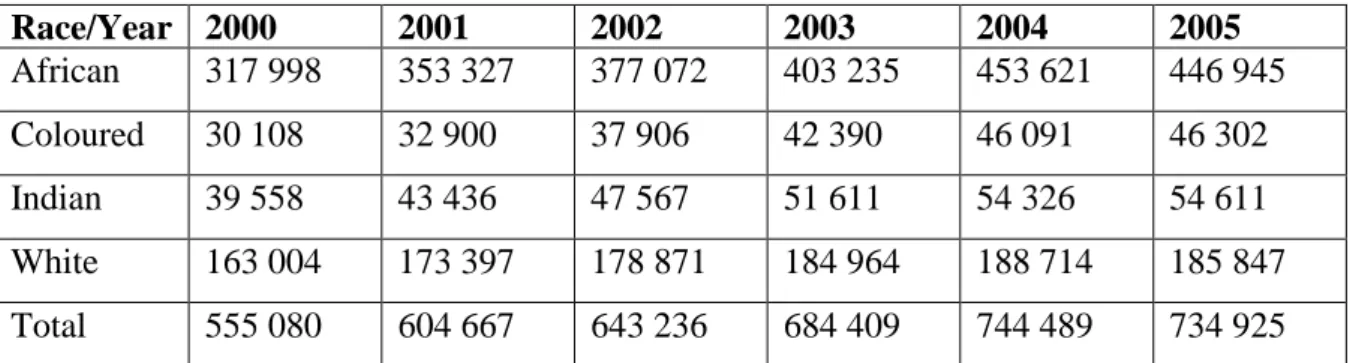
Table 3: South African Enrolment Numbers by Race (2000 – 2005)
Race/Year 2000 2001 2002 2003 2004 2005
African 317 998 353 327 377 072 403 235 453 621 446 945
Coloured 30 108 32 900 37 906 42 390 46 091 46 302
Indian 39 558 43 436 47 567 51 611 54 326 54 611
White 163 004 173 397 178 871 184 964 188 714 185 847 Total 555 080 604 667 643 236 684 409 744 489 734 925 Data Source: Report of the Ministerial Committee on Transformation and Social Cohesion and the Elimination of Discrimination in Public Higher Education Institutions, 2008.
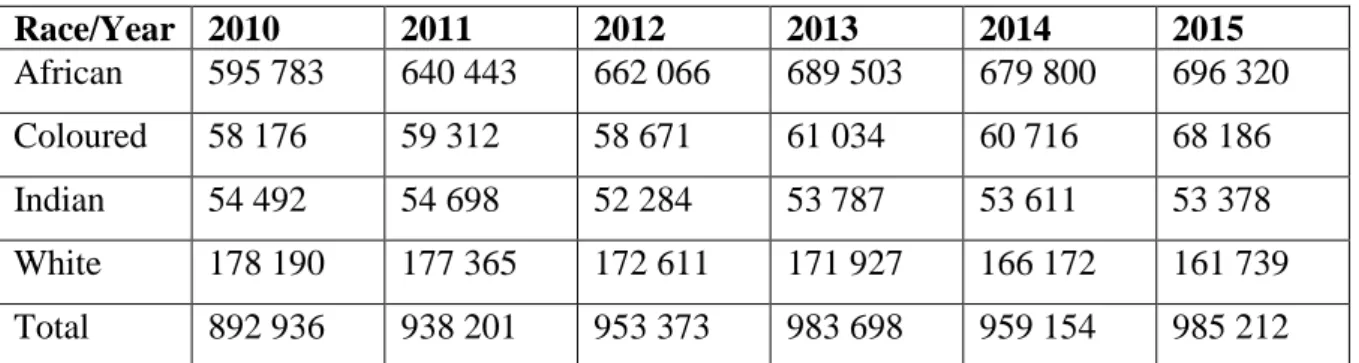
Table 4: South African Enrolment Numbers by Race (2010 – 2015)
Race/Year 2010 2011 2012 2013 2014 2015
African 595 783 640 443 662 066 689 503 679 800 696 320
Coloured 58 176 59 312 58 671 61 034 60 716 68 186
Indian 54 492 54 698 52 284 53 787 53 611 53 378
White 178 190 177 365 172 611 171 927 166 172 161 739 Total 892 936 938 201 953 373 983 698 959 154 985 212 Data Source: Higher Education Management Information System of the South Africa Department of Higher Education and Training.
25 | P a g e From the above two tables on the racial composition of the South African higher education landscape for the periods 2000 to 2005 and 2010 to 2015, it is clear that the landscape is now composed largely of African students. The number of African students has generally been increasing along with the total numbers of enrolment. These numbers for African students have also been increasing at a rate higher than the other racial groups. It is also important to note that at the same time that the African numbers have been increasing, the number of White students declined over time -- a trend it is following alone as the other groups’ numbers increase and decrease in line with total enrolments whereas the White numbers have been progressively decreasing even when total enrolments have been increasing.
The racial composition numbers are contentious when it comes to their contribution to the transformation debate (refer to Jansen, 2002; Prinsloo, 2009; Badat, 2014). To illustrate the precarious stance of the numbers, the numbers can be argued to be a step in the direction both of inclusion and exclusion along race lines. For instance, the numbers show growing African student numbers while at the same time showing decreasing White student numbers. Whereas the increasing African student numbers can be argued to further transform the profile, the decreasing White student numbers mean that White students are now decreasing in their contribution to the composition of the higher education landscape.
Owing to the nature and shortfalls of only looking at quantities when considering transformation, those probing the higher education landscape have also looked to engage the numbers in a qualitative sense that will give a better feel of the sentiments within the landscape (refer Cele and Menon, 2006; Akoojee and Nkomo, 2008; Bere, 2013). In other words, researchers within the higher education landscape have looked to engage in qualitative research so as to get a deeper look at what the change in quantities might mean for the experience of the landscape. In such an undertaking, researchers have often looked to engage those realities within the higher education landscape that they consider most pressing in terms of overall challenges within the country’s higher education.
With this purpose in mind, a momentous document entitled the “Report of the Ministerial Committee on Transformation and Social Cohesion and the Elimination of Discrimination in
26 | P a g e Public Higher Education Institutions” was produced. Colloquially referred to as the Soudien Report of 2008, after its chair Professor Crain Soudien, this report looked more qualitatively at the experience of the higher education landscape by those who were historically within its corridors and by those who in many cases had been historically excluded from the institutions.
In other words, the report was a look at the interactions between historic culture and new entries into this culture. The report was a look at the sentiments within the country’s institutions by those versed in the vision and need for transformation within the higher education landscape.
The Soudien Report looked at a plethora of issues within the South African higher education landscape. There was a look into how institutions had manoeuvred so as to be more in line with the visions of the Department of Education in transforming the landscape (Soudien, 2008:10).
There were varying degrees of success throughout the institutions and the need for improvement was noted. There was also a look at individuals’ (mostly historically excluded individuals) experience of institutions that were policy-bound to be transformative and in line with new realities that the academy found itself operating in. Ultimately, here too was a need for improvement so as to lead to an experience in line with the government’s aims for the higher education landscape experience (refer to Soudien, 2008:14).
What the Soudien Report acknowledged was that the South African higher education landscape was a place wherein transformation was to change not only the compositional profile of the space but also in many cases to be an event which would probably consequentially shift the scope of the experience of the space. In other words, the higher education landscape was an experience beyond simply its numbers. The experience of higher education was its numbers and what these numbers do as a collection of many subjectivities (Jansen, 2002:11; Soudien, 2008). In other words, the numbers were living a life in the lifeworlds within higher education.
In living this life, the numbers were invigorating and animating the different parts of the South African higher education landscape’s placeness. Ultimately, what the Soudien Report illustrated was the qualitative profile of there being general challenges within the South African higher education landscape. I now briefly discuss the general challenges often posted out to be the qualitative profile of South African higher education.
27 | P a g e 2.3.3 General Challenges within post-Apartheid South African Higher Education
The general challenges to be found within post-Apartheid South African higher education are inextricably linked with the way the country was during Apartheid (refer to Department of Education, 1997, 2001; Soudien, 2008; Badat, 2014). As the country’s higher education landscape was largely exclusionary during Apartheid years -- years which included many of the country’s higher education institutions partaking in the exclusionary policies of