
The area is known for its propensity for violence, and in schools teachers have to deal with many acts of violence on a daily basis. They identified the following as causes of violence: teachers, friends, physical characteristics, the home, prefects, rivalry and sexuality.
CHAPTERl
INTRODUCTION
Background to the study
First of all, it is necessary to know what children say about violence in elementary school, that is, about children's discourse. We also hope that by the end of this dissertation, the researcher will be enlightened enough to understand what children say about violence in relation to adults' views on violence.
Rationale for the study
This research examines what children say about violence at school, and documents and analyzes what they say. This prompted the researcher to conduct a study into what young children say about violence at school.
Context of the study
Rosewood is located in the residential area of Newlands East, Durban with access to community resources such as the Newlands East Municipal Library and Community Center (approximately 2 km away), the Glen Earl Community Clinic, the Gardenia Sports Grounds, the Newlands Swimming Pool (approximately 2 km away). 3 km away) and the Beechwood Nature Trail. Newlands East Number One was the first school to be developed when schools for Colored people were built in the area.
Significance of the study
The research question
Sub-research questions
Format of dissertation
Conclusion
This chapter reviews the types of studies that have been conducted in South Africa and internationally on issues of violence. According to these definitions, any action that results in harm is inherently an act of violence.
Violence in schools
These categories are physical coercion and physical injury, verbal aggression and cruelty and mental harassment." All the above evidence suggests that school is an environment in which children are often exposed to gang violence, robberies and assaults, which it makes schools places where drugs, thugs and guns can move freely through the gates as students (Human Right Watch, 2001, p.34).
Study conducted ID South Mrica and around the world
South Africa's written contribution to the World Education for All Forum, an assessment of the state of education in the country, identified student possession of weapons, sexual abuse, use of alcohol and drugs on school grounds and burglary as problems (Human Rights Watch , 2001, p.32). It has also been reported that neither the national government nor education departments systematically monitor incidents of violence in schools (Human Rights Watch, 2001, p.6).
Aspects of violence that have been studied and reported
In a seventh-grade class, the children talked about hijackings, burglaries, a father being murdered, a car accident, an uncle being shot in taxi violence and the death of a grandparent. It is difficult in South Africa to find a child who is not afraid of violence.
Who is studied ID relation to violence?
Once again, this study focused on teachers' perceptions, the violation of their rights, and the measures they typically take to curb violence in their schools. The aspects of violence explored included: violence in South African schools, the global perspective of the causes of violence, a focus on teachers as victims and the theoretical perspectives of violent behavior.
Recommendations that have been made
From literature reviews, the researcher has noted that teachers are used to study violence in schools. As an educator who works with children, the researcher wants to know how children define violence.
Victims and perpetrators of violence
Children's behavior, attitudes and actions are always studied by adults as they are understood by adults. At a societal level, the apartheid government's use of violence to systematically remove people from the land on which their families had lived for generations is another form of violence (Swartz et ai, 2004, p.305).
Interventions
- Individual-level interventions
- Small group-level interventions
- Community-level interventions
- Societal-Ievel interventions
This involves bringing together people living in a particular area and establishing a neighborhood watch and also organizing local awareness campaigns and public information campaigns. These may include intensive awareness and information campaigns and also accompanying special training for police officers and social workers so that they can identify potential problems and respond effectively to reduce crime and violence.
Gaps and silences
Key concepts emerging
- Bullying
- Emotional violence
- Physical violence
- Psychological violence
- Epistemic Violence
Children's emotions are linked to their state of mind, therefore one must have a thorough understanding of physical violence. Physical violence is the use of bodily actions and weapons to threaten, punish, dominate, restrain, control or harm another person (Lissetle & Krauss, 2000, p.12).
Conclusion
RESEARCH DESIGN AND METHODOLOGY
- Introduction
- Context of the study
- The approach
- Interpretivist paradigm
- Case study methodology
- The sample
- Data collection and analysis procedures
- Focus groups as an interviewing method
- Trustworthiness
- Validity
- Key research question
- The role of the facilitator
- Producing data
- Ethical considerations
- Limitations and delimitations
- Conclusion
To address the issue of power relations between the researcher and participants, the researcher was not part of the focus group discussion. The focus of the next chapter will discuss the emerging themes that emerged from the focus group discussions.
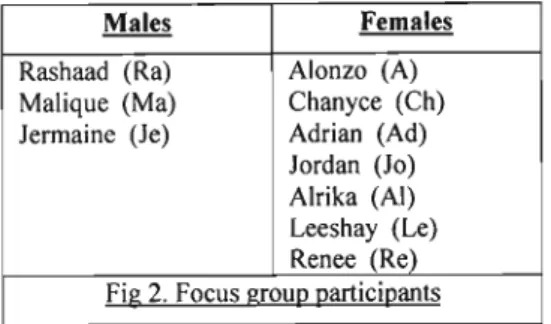
DATA ANALYSIS
Teasing IS violence
The children tease each other about physical characteristics such as the weight of their parents. It could be that the children are teasing each other to explore the limits of the power they may have over others at school.
Swearing and joking is violence
Perhaps it is the malicious intent that makes young children understand that teasing is a form of violence. It is clear from the children's answers that they sometimes make fun of each other and that such behavior does not make sense to them.
Reporting to the teacher is violence
Alonzo: There is one boy in our class, his name is Quron, and he started. Calling is a form of rejection that IS often painful and long remembered by children (Klewin et al, 2003).
Being bullied is violence
Reporting to the teacher can also make one vulnerable to acts of violence as suggested by Jermaine. Bullying is the most overt form of violence and is a common occurrence in most schools.
Being betrayed by friends is violence
According to Alrika, Mikayla fraternized with boys of her own accord, but reported her (Alrika) to her father as the "bad" influence. These untruths to justify her actions to her parents destroyed friendships and are seen by Alrika as acts of violence.
Being competitive IS violence
Rashaad: I think there is violence in the school because some kids want to carry things from the past and then they spread it to other kids and then when it comes back to the kid they were talking about, it becomes a fight. Jordaan: Some kids play wrestle at school and when like one kid hits another hard and then they fight over that one thing.
Fighting over "nonsense" is violence
They start playing at home with older children who are not necessarily at school (Ad 12). Adrian: Because some kids when they go home they play with other kids who can beat them and so they bring it to school and they think they can beat all the kids because at home bigger kids beat them.
Jealousy is violence
The children often hit and threaten each other when bad behavior is reported to the teachers. Innocent games such as children playing with tips and wrestling can lead to physical violence at school.
Graffiti is violence
Children deliberately write words and children's names on the toilet walls at school. The way children behave in one culture is sometimes completely unacceptable to children in another culture.
Homosexuality IS linked to violence
According to the children, teachers give other children reasons to call their friends names. Children feel that teachers take advantage of children if they are younger than other students of the same age.
Friends as a cause of violence
She took all my biscuits so she said she would buy me something and she never bought me anything and we started arguing and arguing.
Physical characteristics as a cause of violence
According to the girls, the type of hair and the color of their hair often lead to fights. Chanyce: Some kids fight because of the color of their hair and the color of their skin.
Events at home as a cause of violence
Sometimes the children fight when the prefects and the scholar patrol do not do their duty at school. There is a marked difference between the children who have and the children who do not.
Gender relations as a cause of violence
An example is when Leeshay talks about being chased out of the classroom for laughing. At home, children may see their parents gambling and therefore try to imitate them.
Conclusion
CONCLUSION
Introduction
What, according to children IS violence?
Physical violence experienced by children in this study included hitting by friends and teachers, sexual abuse, and substance abuse. From the themes emerging in this study, it is also evident that the children's experiences have negatively affected them.
How does violence differ when seen from an adult's point of view?
- What adults may regard as trivial are real concerns for children
- Teachers are unwittingly implicated in the generation of violence at school
- Gateway behaviours are early indicators of violence
- Violence in the home is re-enacted in school
- Joking and playing games can lead to violence
- Friendship can lead to violence
- Schools can be dangerous spaces for young children
- Gender, race, class and culture are associated with violence
- Children bring possessions to school which sometimes leads to violence
- Smoking and graffiti are associated with violence
At school, the children learn to bully each other and steal, and sometimes they get away with it. Although smoking is a form of substance abuse and graffiti is associated with art, the children in this study see this as a form of violence.
Recommendations for further research
Conclusion
Rashaad: I think there is violence in school because some kids will carry things from the past and then they spread it to other kids and so. Rashaad: I think there is violence in school because people hear things and they take it the wrong way and then it spreads to everyone and it all becomes something big. Adrian: There is violence in schools because some people will be too big and then they will tell you this, you that.
UNIVERSITY OF K~'AZULU-NATJ
A copy of this letter is sent to district leaders and school principals or sector leaders where targeted interviews will be conducted. The KZN Department of Education fully supports your commitment to research: What children say about school violence.
KWAZUlU-NATA
PRINCIPAL CONSENT FORM
For the first focus group discussion, students will be asked to "Talk about violence in your school". This will ensure that the anonymity of your school and students, including the confidentiality of the research, will be respected at all times.
DECLARATION
LEARNER AND PARENT/GUARDIAN CONSENT FORM
Your child/guardian will not be obliged to talk about the violence and will be free to withdraw from the study at any time. Data will be stored securely for a period of three years, after which it will be properly disposed of.
