How to pay for a dam
The public and private benefit and payment
instrument options for the Waimea Community Dam
NZIER report to Tasman District Council 22 October 2014
L13 Grant Thornton House, 215 Lambton Quay | PO Box 3479, Wellington 6140 Tel +64 4 472 1880 | [email protected]
© NZ Institute of Economic Research (Inc) 2012. Cover image © Dreamstime.com
NZIER’s standard terms of engagement for contract research can be found at www.nzier.org.nz.
While NZIER will use all reasonable endeavours in undertaking contract research and producing reports to ensure the information is as accurate as practicable, the Institute, its contributors, employees, and Board shall not be liable (whether in contract, tort (including negligence), equity or on any other basis) for any loss or damage sustained by any person relying on such work whatever the cause of such loss or damage.
About NZIER
NZIER is a specialist consulting firm that uses applied economic research and analysis to provide a wide range of strategic advice to clients in the public and private sectors, throughout New Zealand and Australia, and further afield.
NZIER is also known for its long-established Quarterly Survey of Business Opinion and Quarterly Predictions.
Our aim is to be the premier centre of applied economic research in New Zealand.
We pride ourselves on our reputation for independence and delivering quality analysis in the right form, and at the right time, for our clients. We ensure quality through teamwork on individual projects, critical review at internal seminars, and by peer review at various stages through a project by a senior staff member otherwise not involved in the project.
Each year NZIER devotes resources to undertake and make freely available economic research and thinking aimed at promoting a better understanding of New Zealand’s important economic challenges.
NZIER was established in 1958.
Authorship
This paper was prepared at NZIER by Peter Clough
Key points
This report considers how to deal with the provision for environmental flows in the proposed Waimea (Lee Valley) Community Dam, and also the provision for future demand for water from irrigation, residential and industrial growth. Both these provisions incur costs for which there is no clear owner, raising the question of whether Tasman District Council (and its ratepayers) have a role in funding on behalf of the community that benefits.
Guiding principles for funding infrastructure services with a high proportion of fixed costs from their high initial construction cost include:
Each unit of use should recover the marginal cost imposed by that use (which will be low and insufficient to cover the fixed costs)
Fixed costs can be recovered by supplementary charges in the least
distortionary way possible, either based on exacerbator pays or beneficiary pays or a combination of the two
The base on which charges are set – land area, water volume or value enabled by water – materially affects the distribution of costs across the dam’s contributors.
Enhanced environmental flows can provide a range of valuable services to amenity, biodiversity retention, cultural and recreational activities, but these are not readily valued with either market or non-market valuation methods. Many of these services do have the characteristics of economic public goods, so it is efficient for them to be funded by a local council that can tax the community that benefits.
The dam will enable the minimum flow for environmental purposes to be raised to 1100 litres / second from the 800 litres / second in the new rules without the dam.
This discretionary environmental enhancement is the marginal benefit of the dam for environmental purposes. This enhancement requires 30% of the dam’s design capacity, but the marginal cost may be less than 30% of cost if there are economies of scale.
Dams are long lived structures for which it is easy for current generations to pay most of the cost while benefits extend into a long term future, creating an inter- generational transfer from current generations to future generations. That can be countered by taking on long term debt so that future generations pay more towards the benefits they receive from the infrastructure.
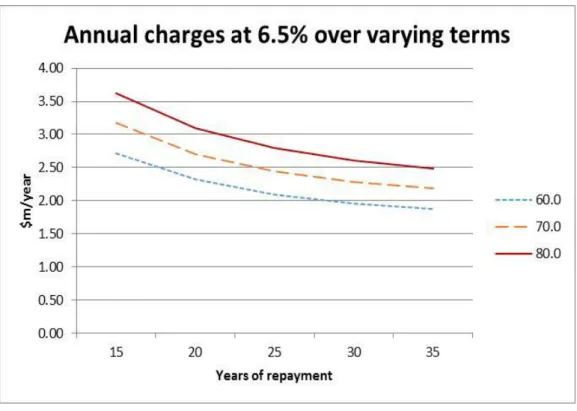
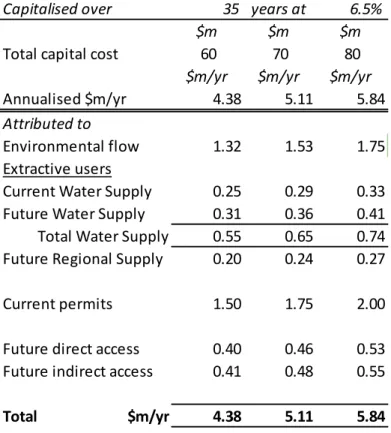
Extending the term of debt from 25 to 35 years, other things held equal, would reduce the costs for TDC on environmental flows and current and future water supply by 11%. This applies whatever the total dam cost, and whatever the share of those costs attributed to environmental flows.
Figures used in this report are illustrative, but they do show that there are substantial cost implications for TDC in the cost allocated for environmental flows and the timeframe over which the dam is paid for. Principles outlined are relevant to determining the share of costs to be split between users now and in the future.
Contents
1. Introduction ... 1
1.1. The issue in brief ... 1
1.2. The context ... 3
2. Paying for long lived infrastructure ... 4
2.1. The value of environmental benefits ... 5
2.2. Role of public goods ... 9
2.3. Options for efficient pricing of infrastructure ... 11
2.4. Role of intergenerational transfers ... 12
3. Application to Waimea Dam ... 15
3.1. Cost allocation matters ... 16
3.2. How to charge ratepayers ... 22
3.3. Sensitivity to changes in underlying assumptions ... 23
3.4. Summing up ... 26
4. Conclusions ... 27
Appendices Appendix A References ... 29
Figures Figure 1 Natural value: types of ecosystem services ... 6
Figure 2 Components of Total Economic Value ... 7
Figure 3 Changing costs with varying terms ... 21
Tables Table 1 Availability of water from dam in irrigated area equivalents ... 1
Table 2 Implications on dam cost recovery of attributing costs to environmental purposes ... 2
Table 3 Public good characteristics of infrastructure ... 10
Table 4 Distribution of capital costs ... 15
Table 5 Choices of charging instruments ... 22
Table 6 Sensitivity to length of time for cost recovery ... 24
Table 7 Sensitivity to share of cost for environmental purposes ... 25
1. Introduction
Tasman District Council has approached NZIER for advice on the attribution of costs of the proposed Waimea Community Dam, in particular the 30% of the cost proposed to be borne by TDC ratepayers for the public benefit of securing environmental flows.
TDC has also asked for advice on how funding for the dam could be split across different contributors in the district, e.g. between general rates on a differentiated or undifferentiated basis, or uniform charges based on water consents or actual use;
and about how the costs for providing capacity in the dam for future users should be paid for and by whom.
1.1. The issue in brief
There are two fundamental questions in this request: a) what proportion of the cost of the dam to attribute to the community to cover the “public good” improvement in environmental flows, and b) what instrument would best recover those costs from within the TDC residents (including provision for future use)?
The current proposals provide for allocation of capacity on hydrological considerations, as outlined in Table 1 below.
Table 1 Availability of water from dam in irrigated area equivalents
Source: NZIER, from data supplied by Tasman District Council
Current and future uses of water for urban consumption and irrigation purposes have been expressed as equivalent hectares of irrigated land at 300 m3/hectare/week. The
Allocated to:
% of Dam
Capacity Current Future Current Future
Environmental
Environmental flow 3,328 30% 3,328
Extractive users Urban Water Supply
Current Water Supply (TDC) 620 6% 620 6%
Future Water Supply (TDC) 780 7% 780 7%
Future Regional Supply (NCC) 515 5% 515 5%
Total Urban Water 1,915 17%
Other Users (Irrigators) Direct Access to Aquifer
Current permits 3,800 34% 3,800 34%
Future Capacity 1,000 9% 1,000 9%
Total direct access 4,800 43%
Indirect Access to Aquifer Current permits
Future Capacity 1,050 9% 1,050 9%
Total indirect access 1,050 9%
Total Other Users 5,850 53%
Total extractive users 7,765 70% 4,420 3,345 40% 30%
Total Dam (User+Environment) 11,093 100% 7,748 3,345 70% 30%
Dam Capacity Equivalent hectares
increment of storage required to provide the desired environmental flow of 1100 litres/second at Appleby Bridge has been expressed in similar manner to be 3,328 hectares equivalent, 30% of the total irrigable area equivalents provided by the dam storage. A further 30% of that capacity is being provided for future potential uses, comprising 12% for future urban supply for Tasman and Nelson councils, and 18% for future irrigation. Securing water for TDC’s current urban water supply accounts for 6% of capacity, and current permitted irrigation accounts for 34%.
The dam was originally proposed as a co-operative company with voluntary subscription, but this faced problems in covering costs that are unattributable to current users. One way of attracting subscription would be to lower the costs to be recovered by attributing portions of the dam’s capacity to environmental uses, to be covered by ratepayers as public goods. Table 2 shows the implications of attributing varying portions to environmental uses, drawing from an economic assessment undertaken by Northington Partners in 2010, which estimated the cost of installing the dam at $41.6 million, with a further $0.4 million in annual operations and maintenance. Annualised over 25 years at a rate of 7.2% (Northington’s estimate of TDC’s weighted average cost of capital) this amounts to an annual cost to recover from the dam of $4.03 million, which would imply a charge of $519.55 recovered from each equivalent hectare of use from the dam. This level of charges has raised objections from the growers who would be expected to pay them, as they are high relative to the gross margins per hectare earned from some irrigated land uses (e.g.
field vegetables), raising questions about their continued viability and what land use activities would replace them.
Table 2 Implications on dam cost recovery of attributing costs to environmental purposes
Source: NZIER, drawing on Northington (2010) and TDC
Since the 2010 report the estimated costs of the dam have been revised, and a recent TDC press release stated them to be around $69 million in 2017 when the dam is expected to be built. Annualised on the same basis as the 2010 figures, this would result in a combined annual cost of $6.5 million which equates to $840 per hectare equivalent served by the dam. Excluding costs on environmental grounds lowers the cost per irrigated hectare equivalent to be recovered from the 7,765 hectares equivalent of extractive users. This is illustrated in the right hand columns of Table 2, which suggest it would require more than 40% allocation to environmental flow to recover the increased costs at an annual charge per hectare equivalent at a similar level to that in the 2010 report.
Northington TDC Excluding environmental shares of
2010 2014 10% 20% 30% 40%
$m $m $m $m $m $m
Cost of installing dam 41.6 69.0 62.1 55.2 48.3 41.4
Annualised over 25 years @ 7.2% 3.63 6.03 5.43 4.82 4.22 3.62
Annual operations & maintenance 0.40 0.50 0.50 0.50 0.50 0.50
Combined annual cost 4.03 6.53 5.93 5.32 4.72 4.12
Annual charge per irrigated hectare $519.55 $840.69 $763.06 $685.43 $607.80 $530.17
The proposal now is to provide the dam as a council controlled operation, to enable funding through the Council’s revenue raising powers and also access to the Public Works Act for compulsory purchase of land. TDC would bear the risk of development but recover costs allocated to different users and activities benefiting from the dam.
1.2. The context
This advice is prepared in light of the Local Government Act 2002 Section 101, which requires councils to consider the following in funding their activities and projects.
(3) The funding needs of the local authority must be met from those sources that the local authority determines to be appropriate, following consideration of —
(a) in relation to each activity to be funded —
(i) the community outcomes to which the activity primarily contributes; and
(ii) the distribution of benefits between the community as a whole, any identifiable part of the community, and individuals; and
(iii) the period in or over which those benefits are expected to occur;
and
(iv) the extent to which the actions or inaction of particular individuals or a group contribute to the need to undertake the activity; and
(v) the costs and benefits, including consequences for transparency and accountability, of funding the activity distinctly from other activities; and
(b) the overall impact of any allocation of liability for revenue needs on the community.
New Zealand Treasury guidelines (2002) recognise two bases on which common costs of services may be recovered: beneficiary pays and exacerbator pays. The Act’s section 101(3)(a)(ii)-(iii) reflects the “beneficiary pays” principle, that costs should be borne in proportion to the benefits created by the shared infrastructure. Section 101(3)(a)(iv) expresses the “exacerbator pays” principle, that costs should be borne by those whose actions necessitate the building and maintenance of infrastructure.
The question of who should pay for the environmental flow component of the Waimea Dam also needs to be seen in the context of the Resource Management Act and its purpose (as expressed in Part II) of sustainable management of natural and physical resources, which the Act defines as enabling communities to provide for their well-being while observing certain environmental constraints. The affordability of new infrastructure affects the current consumption possibilities of residents/ratepayers, so is relevant to consideration of community well-being.
This paper proceeds by
Setting out general economic principles and considerations in the provision and payment for long-lived infrastructure;
Applying those principles to the particulars of the Waimea Dam proposals.
2. Paying for long lived infrastructure
The Waimea Dam is being proposed to provide security of water supply, to both extractive users like irrigators and the reticulated water supply system for residential and industrial users, and in-stream “environmental” use. If built it will have the following characteristics:
A large piece of infrastructure which would be difficult and costly to replicate in the context of the Waimea catchment – i.e. it would occupy a virtual monopoly in provision of water augmentation in the catchment
Its scale means it affects a broad range of users, both extractive and non- extractive “passive use” beneficiaries
If the dam is to secure funding to proceed it needs to generate revenue flows to allow it to at least break even.
The building of any large long-lived infrastructure faces the problem of paying for the initial investment. Economics has established principles for applying to infrastructure like dams, flood-banks, roads and reticulation networks. It uses discounted analyses in economic assessment to account for effects that occur at different time periods, and to draw conclusions about the efficiency of resource uses.
Efficiency looms large in economic assessments, because it is both capable of being measured and it provides guidance on how to make the most of available resources.
Other criteria that can enter into economic considerations include the equity or
“fairness” of an arrangement: this depends on socio-political value judgements about which economics has no clear contributions to make, beyond identifying how actions affect the distribution of costs and benefits across the economy. Another criterion is that of sustainable management of natural and physical resources, as stated in section 5 of the RMA, which can be approached in economics by considering how actions affect the probability of natural and environmental resources surviving as a source of value to future generations.
Government guidance on recovery of shared costs from public investments suggest using the exacerbator pays or beneficiary pays principles, or a combination of the two. These guidelines are reflected in legislation, including the Local Government Act (see s 1.2 above), the RMA and the EEZ and Continental Shelf (Environmental Effects) Act. Exacerbator pays provides a floor for cost attribution, for it would be clearly inefficient to charge a group less than the costs they impose on the environment or infrastructure in question. Similarly it would be inefficient to charge the group more than the benefits it obtains from the infrastructure. These guidelines provide a fairly wide band within which efficient cost allocation of joint costs across groups will fall, but little precision of just how much to allocate to whom.
The economic principles that are particularly relevant to the provision and cost recovery for a dam include:
The nature of environmental benefits and their value
The characteristics of public goods and their implications for decision- making and provision
The principles of efficient pricing of infrastructure services
The role of intergenerational transfers in optimal provision and funding of infrastructure.
We outline the main points and principles here, to guide the expectation of what might be an efficient means of paying for the Waimea Dam.
2.1. The value of environmental benefits
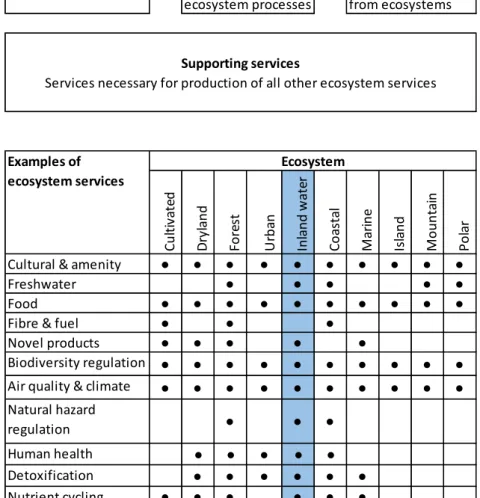
Although environmental effects are often not traded in markets they still have economic value. Changes in environmental condition can be assessed following the approach of the Millennium Ecosystem Assessment (MEA 2005),1 which sees the environment as a collection of natural assets delivering a number of services of value:
provisioning services (e.g. sufficient water), regulatory services (such as waste assimilation and nutrient recycling), cultural services (e.g. creating settings valued for their amenity, recreational or cultural uses) and supporting services (e.g. general ecosystem functioning that supports the other service flows) (Figure 1).
This framework suggests freshwater resources can be important for all the categories of ecosystem service except fibre and fuel – and in view of the kinetic energy stored by a head of water, they can be viewed as contributing to “fuel” for motive power and electricity generation. More obviously they provide supporting services (waste assimilation, detoxification and nutrient cycling), regulatory services (biodiversity retention, micro-climate regulation through soil moisture replenishment) provisioning services (as source of food products and water) and cultural services (through creating settings for recreation, amenity and cultural associations).
Under the MEA approach environmental effects are not services but factors that affect services. As the RMA is oriented towards managing effects on the environment, effects need to be translated into their service impact to assess their likely economic value.
1 Millennium Ecosystem Assessment, (MEA 2005) Ecosystems and Human Well-being: Synthesis. Island Press, Washington, DC.
Millennium Ecosystem Assessment, (MEA 2003) Concepts of Ecosystem Valuation Chapter 6 in Ecosystems and Human Well- being: a Framework for Assessment; Island Press http://www.maweb.org/documents/document.304.aspx.pdf
Figure 1 Natural value: types of ecosystem services
Source: Millennium Ecosystem Assessment 20052
As environmental effects are not traded in markets there are no readily observable monetary values to be attached to them. But economic values for such non-market effects can be inferred in various ways, such as:
The avoidable tangible costs caused by environmental effects on activities:
for example, a river’s curtailment of damage caused by droughts
The cost of the next best alternative means of providing the same service as the environment (e.g. cost of alternative supply of water other than in situ natural sources and flows)
2 Millennium Ecosystem Assessment, (MEA 2005a) Ecosystems and Human Well-being: Biodiversity Synthesis. World Resources Institute, Washington, DC. http://www.maweb.org/documents/document.354.aspx.pdf
Millennium Ecosystem Assessment, (MEA 2005b) Ecosystems and Human Well-being: Synthesis. Island Press, Washington DC.
Provisioning services Regulating services Cultural services
Products obtained Benefits obtained Non-material
from ecosystems from regulation of benefit obtained ecosystem processes from ecosystems
Examples of ecosystem services
Cultivated Dryland Forest Urban Inland water Coastal Marine Island Mountain Polar
Cultural & amenity ● ● ● ● ● ● ● ● ● ●
Freshwater ● ● ● ● ●
Food ● ● ● ● ● ● ● ● ● ●
Fibre & fuel ● ● ●
Novel products ● ● ● ● ●
Biodiversity regulation ● ● ● ● ● ● ● ● ● ●
Air quality & climate ● ● ● ● ● ● ● ● ● ●
Natural hazard
regulation ● ● ●
Human health ● ● ● ● ●
Detoxification ● ● ● ● ● ●
Nutrient cycling ● ● ● ● ● ●
Supporting services
Services necessary for production of all other ecosystem services
Ecosystem
Value inferred from the price of associated marketed goods (e.g. the
“revealed preference” approaches such as inferring a value premium in property prices in proximity to clean waterways)
Estimating public willingness to pay to secure environmental outcomes from direct questioning of a sample of those affected – the “stated preference” approach - which depends on clear articulation of an environmental change to which the surveyed population can respond.
The value to people of ecosystem services has a number of components which are not often separable. The “Total Economic Value” of natural assets comprises “use values” (such as the value of current fish catches), “future use values” (such as the option value of retaining fish stocks for future catches) and “non-use or passive-use values” (an expressed preference for continued existence of a resource, irrespective of expectations of use) (Figure 2).
Figure 2 Components of Total Economic Value
Source: NZIER, Pearce & Warford 1993, Pagiola 20043
Stated preference non-market valuation methods have received a lot of attention for capturing future use and non-use components of value which are not fully covered by other valuation methods. Such methods received wide recognition following the 1989 Exxon Valdez oil spill, as a result of which the so-called “NOAA” panel4 of experts (including two Nobel laureate economists) provided a set of
3 Pearce DW & Warford JJ (1993) World without end, Oxford University Press; Pagiola S, von Ritter K & Bishop J (2004) Assessing the economic value of ecosystem conservation; The World Bank, Washington DC
4 NOAA stands for the US National Oceanic and Atmospheric Administration www.noaa.gov
Total Economic Value
Active Use Values Non-Use Value
Direct Use Value
Indirect Use Value
Future Use Value
Existence Value Consumptive
and non- consumptive uses
Ecological support functions
Option and bequest values
Knowledge of continued existence
recommendations for valuations suitable for use in judicial settings.5 The practical usefulness of this endorsement of stated preference methods divided opinion at the time6 and continues to do so.7
Over a hundred non-market valuation studies of willingness to pay for environmental attributes are recorded on the New Zealand Non-market Valuation Database at Lincoln University8. They address the economic value of terrestrial sites or species, recreation or water quality, but most are site- or species-specific, with results which vary with methods used and contextual factors. Such non-market valuation studies commonly result in high values for obscure species relative to what New Zealanders are observed to pay towards conservation, and the techniques may be distorting responses and deriving values that are not strictly comparable with other costs used in economic assessments.9 Very few have been relied on in policy decisions in New Zealand to date. More attention to validating results against observed behaviour is required to provide greater confidence in the results.
Although some researchers advocate using results of non-market valuation studies in one setting to infer values applied in similar settings elsewhere – a process known as
“benefit transfer” – this depends on the existence of sufficient reliable studies and details of their implementation from which to control for the contextual factors that influence the result. Reliable, precise estimates of non-market values for environmental flows in this case do not exist and would be costly and time- consuming to obtain.
The economic value of the augmented flows in the Waimea will be a composite of tangible effects (value for irrigation, replenishment of aquifers) and less tangible components (retention of habitat for biodiversity, fishing or hunting). The non- market component will have a mix of use and non-use value, but there is little evidence in New Zealand of how big they might be.
5 Arrow K, Solow R, Portney PR, Leamer EE, Radner EE & Schuman H (1993) “Report of the NOAA Panel on Contingent Valuation”: Federal Register, 58(10) 4601-4614
6 Diamond, P.A and Hausman, J.A (1994) ‘Contingent valuation: is some number better than no number?’; J. Econ.
Perspectives 8(4), 45-64.; Portney P (1994) ‘Contingent valuation debate: why economists should care’; J. Econ. Perspectives 8(4), 3-17
7 Carson R (2012) ‘Contingent valuation: a practical alternative when prices aren’t available’; Journal of Economic Perspectives, 26(4) 27-42; Haussman J (2012) ‘Contingent valuation: from dubious to hopeless’; Journal of Economic Perspectives, 26(4) 43-56; Kling CL, Planeuf DJ & Zhao J (2012) ‘From Exxon to BP: has some number become better than no number?’; Journal of Economic Perspectives, 26(4) 3-26;
8 Lincoln University (2012) New Zealand Non-market valuation database; http://www2.lincoln.ac.nz/nonmarketvaluation/
9 Clough P (2010) Realistic valuations of our clean green assets, NZIER Insight 19/2010 http://nzier.org.nz/sites/nzier.live.egressive.com/files/NZIER%20insight%2019%20-
%20Realistic%20valuations%20of%20our%20clean%20green%20assets.pdf
2.2. Role of public goods
Public goods in economic terms are those that are both non-rival and non-excludable in consumption: non-rival because once provided, they are available for all to use without detracting from their availability for others’ use and non-excludable because it is impracticable to monitor and charge for use and exclude non-payers from enjoying the benefits. If private firms cannot exclude users or make them pay for services, private investment in public goods will be less than the socially optimal level, so governments commonly intervene in such goods’ provision, recovering their costs by taxing the community that benefits.
Taxing current generations will reduce their private saving and capital accumulation for future use, so public investment is both an antidote to a market failure caused by public good characteristics and a substitute for private capital. Public capital is efficient as long as the public investments are chosen carefully and the return from public capital exceeds that which would have been earned from private capital.
The classic examples of public goods are defence at national level, and street-lighting at local level, as each provide a service that is non-rival and non-excludable for the scale at which they occur. Historically many more services have been provided as if they were public goods than are now recognised as such, including infrastructure such as power generation and transmission facilities which are delivering a service (electricity) which is clearly rival in consumption. There are also now recognised to be variants on the pure public good e.g.:
Non-pure or congestible goods, where consumption is non-rival up to the point where capacity is fully utilised, but they become rival in consumption and congested beyond that point – in effect the marginal cost of adding an extra user is close to zero below the threshold of congestion, but can be quite costly beyond there. Roads are an example of a congestible good.
Common pool goods have high rivalry but low excludability, as exemplified by marine fisheries which are prone to over-capitalisation (too many boats) and a wasteful race for fish unless restrained by property rights to the fisheries defined through such measures as individual transferrable quota.
Toll goods are highly excludable but exhibit low rivalry most of the time, as exemplified by wastewater networks and long distance power transmission.
A variant of toll goods are so-called club goods, where use may be non-rival or congestible but the assets that provide the goods are excludable at reasonable cost. This is a characteristic of club facilities, where it is feasible to exclude non-members, but where facilities themselves are often non-rival for much of the time and may not warrant the transaction costs of fee charging. It is also a characteristic of many local government services such as parks and streets which are excludable by virtue of distance which excludes non-residents from receiving much benefit from them.
Infrastructure services are generally not pure public goods as they display varying degrees of rivalry in consumption (congestion), but both their large scale and low marginal costs per unit of use give them characteristics similar to public goods. In addition, some infrastructure may provide spin-off benefits that more closely fit the
public good definition, such as river management that is adapted to maintain natural habitats in particular conditions.
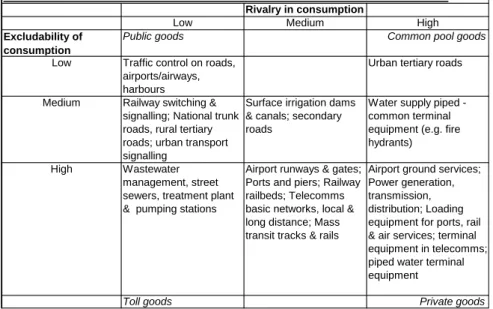
Table 3 illustrates a division of infrastructure facilities in terms of their varying degrees of rivalry and excludability in consumption. Those towards the bottom right hand corner of the table are close to private excludable goods and provide little basis for provision as public goods. Those towards the top left hand corner have more of the collective characteristic of public goods and have been provided as if they were public goods. Common pool goods are those that have high rivalry but low excludability, i.e. it is impractical to charge for individual use, but they are still subject to congestion. Toll goods are more in the nature of “club goods”, in which use is excludable at reasonable cost and they are less likely to suffer congestion.
Table 3 Public good characteristics of infrastructure
Source: NZIER, adapted from Kessides 1993
Dams occupy a middling position in the table, for although they provide services that are largely excludable and rival in consumption (water allocation) they also perform functions that are not (river flow regulation). The determining characteristics are of the services provided rather than the physical infrastructure itself, and dams have a wider range of externality effects than other infrastructure as they are an integral part of a wider “infrastructure” of naturally occurring water bodies.
Even where infrastructure services have characteristics similar to public goods, this does not mean they are necessarily best provided through a public agency. Taxpayer subscription may be necessary to obtain the socially desired level of service, but this could be channelled through a publicly owned entity or contractual arrangements with private suppliers, depending on the capabilities, costs and risks of the options, and their likely effectiveness, efficiency and equity in practice.
Against these characteristics the condition of natural environmental resources, like the quantity and quality of in-stream water in natural watercourses, has the
CHARACTERISTICS OF INFRASTRUCTURE SERVICES: RIVALRY AND EXCLUDABILITY Rivalry in consumption
Low Medium High
Excludability of consumption
Public goods Common pool goods
Low Traffic control on roads, airports/airways, harbours
Urban tertiary roads
Medium Railway switching &
signalling; National trunk roads, rural tertiary roads; urban transport signalling
Surface irrigation dams
& canals; secondary roads
Water supply piped - common terminal equipment (e.g. fire hydrants)
High Wastewater
management, street sewers, treatment plant
& pumping stations
Airport runways & gates;
Ports and piers; Railway railbeds; Telecomms basic networks, local &
long distance; Mass transit tracks & rails
Airport ground services;
Power generation, transmission, distribution; Loading equipment for ports, rail
& air services; terminal equipment in telecomms;
piped water terminal equipment
Toll goods Private goods
appearance of a public good. Environmental quality is often under the control or regulation of public or government agencies, and the cost of those agencies’
activities is commonly covered by their respective taxpayers. But that does not necessarily mean the full costs of providing for environmental quality are covered in that way: the cost of regulation commonly falls on those being regulated. Identifying something as a local public good is not sufficient to conclude that its full costs should be covered by local taxpayers.
2.3. Options for efficient pricing of infrastructure
Efficient pricing of goods and services arises when price is set at the marginal cost of the goods and services used, but this does not work well with infrastructure services where high initial costs translate to high fixed costs incurred irrespective of use. The marginal cost per use is very low, so pricing at marginal cost for such infrastructure would not ensure sufficient revenue to cover its costs. A supplementary charge component is needed to recover the fixed costs if the project is to break even. There are various choices:
Average charge per user: this averages the total cost of service supply in the year by some measure of the benefitting population. However, this is generally not efficient as it means some people will have to pay more than the marginal value they get from the service. If payment is voluntary, the high price can deter use and lead to deficit in revenues, and also in less of the service being used than would maximise the value from the underlying assets. Even if people have to subscribe to the service (as in public infrastructure) inefficiency remains as people are required to pay more than their marginal benefit.
Fully distributed costs (FDC): the charge per user aims to recover the marginal (variable) cost of use plus a share of fixed costs distributed according to some measure of use or interest in the infrastructure – e.g.
water allocated or used. This is more efficient than average cost pricing to the extent that the method of distribution more closely matches individual users’ benefits received or contribution to exacerbation, but it is still inefficient in charging some more than their marginal benefit gained. The distribution of cost recovery across the population depends on the base used to determine the fixed cost recovery – different results will be obtained if distributing according to the volume of water used, the amount of demand in irrigated hectare equivalents, or the value of production gained from the augmentation of water supplies.
Ramsey pricing: the charge per user recovers the marginal cost of use plus a share of fixed costs, where the latter are loaded onto each charge in inverse proportion to the users’ demand elasticity – i.e. those whose demand is most price sensitive pay least towards fixed costs, and vice versa for the least price sensitive. This is more efficient than average cost or FDC pricing as it is less distorting to use of service and ensures better utilisation of capacity. But it is difficult to determine the price elasticities to implement this precisely.
Multi-part pricing: this has explicitly separate charges for use (covering marginal cost) and access/membership (contribution to fixed costs). It is the most efficient because the use charge is closest to marginal cost and least distorting of use. The access charge can also be based on Ramsey principles, differentiating between the most and least price-sensitive users seeking access to the infrastructure. This is an approach commonly used for club facilities, with a membership fee and charges for congestible facilities used.
Optional multi-part pricing: this also enables a range of charge options to be offered so that users can choose the method that suits their use patterns best, increasing the volume of use and the range of users over which to spread the fixed costs. Examples include any service that offers season tickets or individual use charge options, car hire companies that offer payment by kilometre or daily rates with unlimited kilometres, and telecommunications companies offering a range of plans and pre-pay options with varying mixes of use charge and access charge.
One further characteristic of infrastructure pricing is that it is common to charge higher for use at peak times, as it is use in the peak that causes congestion and drives the need for upgraded capacity. This is partly an expression of exacerbator pays – charge more for those whose peak use necessitates costly upgrades – but also partly beneficiary pays, as peak prices will only be paid by those willing to pay the higher prices who get benefit from use in the peak periods, while others may find it worthwhile to shift their use out of peak periods. Peak pricing both raises revenue and regulates use by incentivising demand restraint at periods when the infrastructure supply is tightest relative to demand.
This brief review of price options suggests that setting a charge at a flat rate per unit of irrigable land, although administratively simple to apply, is unlikely to be the most efficient means of recovering costs for infrastructure such as a dam. As a pricing mechanism it is likely to distort water use behaviour, encouraging land use changes to higher yielding (and more water intensive) enterprises than the current mix in the district, creating costs and disruption in the transition. It would be more efficient (although administratively more complex) for dam charging to recognise that the costs of the dam are necessitated by growing demands for water in the peak summer period when water flows are lowest, and use charges that, at least in part, differentiate by actual water use and individual contributions to peak demands.
2.4. Role of intergenerational transfers
Infrastructure often consists of very long-lived assets, so decisions on what to build and how to fund it have inter-generational implications. There is in principle a
“Golden Rule” level of investment at which the present value of consumption is maximised across present and future generations. There can be too much capital accumulation if investment costs are borne mostly by current generations, reducing their consumption for the benefit of future generations. Conversely there can be too little capital accumulation if current generations consume too much, increasing costs borne by the future (as in the case of deferred maintenance of capital in favour of current consumption). The correct balance is an empirical question and depends on assumptions made about discount rates and the contribution of infrastructure to
future incomes. However, the Reserve Bank of New Zealand has estimated that a range of investments in property, shares, farms and fixed interest instruments have had higher rate of return than New Zealand’s long term rate of economic growth, suggesting that New Zealand does not suffer from over-accumulation of capital (Coleman 2012).
If all the benefits of a public investment are captured by the generation that builds it, it is efficient for that generation to tax itself to the point where the return from public investments is equal to the opportunity cost of private investment forgone.
However, in the case of durable public goods that create benefits captured by subsequent generations, such a pattern would be unduly restrictive on current consumption and give future generations a partial free ride on the infrastructure they inherent. Private investment can also be less than optimal, so it can be efficient for governments to intervene to achieve a more socially optimal level of investment. It is efficient for the current generation to spread the cost into the future by incurring debt, leaving more in their pockets for other private investment and current consumption, and shifting to future generations more of the cost of infrastructure they use, reducing the inter-generational transfer.
The stock of public capital can be raised with little decrease in local private capital accumulation if debt is purchased by foreign rather than local lenders. If increases in long lived public infrastructure are funded directly on a pay as you go basis, the first generation pays a disproportionate share of the cost, creating implicit transfer to future generations. If funded by debt repaid by taxes, future generations face more of the cost of infrastructure and there is less inter-generational transfer.
Enduring natural and environmental resources are capital assets with inter- generational significance. An economically sustainable resource usage path is one in which the present value of current and future welfare derived from resources is non- declining over time. This depends on the assumption that when one generation uses natural resources it can create sufficient inter-generational assets to improve the well-being of future generations as well: e.g. it can create artificial capital of equivalent or greater value than the natural resources it is depleting.10 As natural or environmental capital becomes increasingly scarce, its social value rises and it becomes worth giving up more value from further depleting the resource to secure the current use, future use and non-use benefits of its conservation.
A society can consume too much of a natural or environmental resource if its price is too low relative to its social cost, as is the case of resources that have poorly defined or unenforceable property rights or characteristics of open access giving rise to the well-known “tragedy of the commons” – too many resource users with incentive to exploit a fixed stock of resource before others do leads to excessive expenditure of effort on exploiting the resource, in turn causing overuse, degradation and too little conservation for the future. If a society depletes its natural resources too quickly, or
10 Depletion of natural resource creates an “economic rent” or value in excess of its costs of use, and in theory this rent can be invested in other capital to create a sustainable flow of income into the future from which current and future generations equally benefit. In practice this is rarely done, and examples such as Norway’s sovereign wealth fund from the royalties from its oil production are notable as exceptions rather than the rule.
pollutes too much, there is an inter-generational transfer which can leave the future worse off and with no redress on previous generations whose decisions caused this outcome. To the extent that environmental degradation is capitalised into property values, some of the future costs of clean-up will also be borne by current generations, but this will not be efficient if the adverse effect on property value is spread more widely than those whose actions have most impact on causing the degradation. In principle depletion of environmental resources or natural capital should be “priced” directly to reflect the societal cost of that depletion, so every decision on resource use faces the full social cost of that use.
Although taking on debt can be contentious for councils and other public bodies, it is efficient to build up debt to pay for well-chosen investment in long-lived assets that will benefit future ratepayers. While sound public finance requires that the current account should be run in balance, deficits are okay if they indicate net investment in capital projects that yield long term net benefits. Work done by Local Government New Zealand indicates that New Zealand Councils are fiscally responsible on the whole – if anything too cautious in paying too much from current ratepayers and too little on future loan repayments on long lived assets.11 Although there may be uncertainty about the long term growth of population and the rating base to fund future repayments that should not preclude the use of debt to fund future-oriented infrastructure which can generate future revenue streams.
11 http://www.lgnz.co.nz/assets/Publications/Fiscal-measures-parameters-and-benchmarks.pdf
3. Application to Waimea Dam
In this section we consider how the principles outlined in section 2 can be used to inform the attribution of costs of the Waimea Dam to Tasman District Council (TDC), and what choices the Council has among instruments and timing of repayments for distributing costs among its current and future residents. This assessment is stylised and high level rather than focusing on the detail of who gets to pay what, in order to focus on the direction of cost allocation and its efficiency and inter-generational consequences.
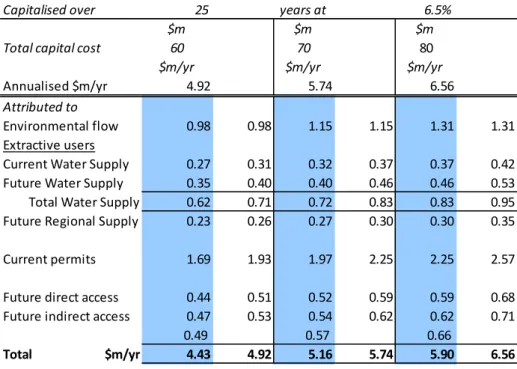
We understand the likely cost of the Waimea Dam is currently uncertain until actual tenders for building have been received, but that TDC currently expects a cost of around $69 million and is likely to use figures of $60 million, $70 million and $80 million in public consultation. We use this range of costs as our starting assumption for the cost of the dam, annualised at 6.5% over 25 years, as summarised in Table 4.12 We also follow the convention of assuming that any costs incurred to date in considering the future dam are “sunk” costs of no relevance to the decision on whether to commit future spending on implementation of the dam.
Table 4 Distribution of capital costs
Source: NZIER
12 The annualisation is based on a table loan formula that has a constant repayment throughout the term, and is different from TDC’s practice of repaying a constant annual portion of principal plus interest, with declining annual repayments over time.
Capitalised over 25 years at 6.5%
$m $m $m
Total capital cost 60 70 80
$m/yr $m/yr $m/yr
Annualised $m/yr 4.92 5.74 6.56
Attributed to
Environmental flow 1.48 1.72 1.97
Extractive users
Current Water Supply 0.27 0.32 0.37
Future Water Supply 0.35 0.40 0.46
Total Water Supply 0.62 0.72 0.83
Future Regional Supply 0.23 0.27 0.30
Current permits 1.69 1.97 2.25
Future direct access 0.44 0.52 0.59
Future indirect access 0.47 0.54 0.62
Total $m/yr 4.92 5.74 6.56
Following the physical capacity proportions in Table 1 above, environmental flows are allocated 30% of the dam costs, current water supply is allocated 6% and future water supply use for TDC is allocated 7%. On the same basis percentage shares are allocated to regional future supply (potential Nelson City demands) and both current and future irrigation uses. Assuming TDC can recover the costs of current and future uses from the users and ratepayers that stand to benefit from the dam, this still leaves the environmental flows and regional future demands as unattributable to specific beneficiaries in Tasman District. These amount to 35% of the cost of the dam and, in the absence of funding from outside (e.g. Nelson City Council) would fall on TDC’s general ratepayers by default. On the same basis current irrigators would meet 34% of the cost and future irrigators 18% of the cost.
The TDC Long Term Plan 2012-2022 gives details of prospective income, expenditures and balance sheet changes over an 11 year period (including provision for the dam at a lower cost from year 4). This shows the council relies on rates for about 60% of its income, with a share rising from 56% in 2011/12 to 62% in 2021/22. The rates split between general and targeted rates changes from 52:48 at the start of that period to 49:51 at the end, with a slight increase in share of total rates attributable to targeted water rates. Total rates rise from $60.4 million in 2012/13 to $101.9 million in 2021/22, at an average annual rate of increase of 6.1%. The average annual increase of general rates is 4.3%, of targeted water rates 9.0%, and of other targeted rates 7.7%.
Against this background and the three cost levels for the dam shown in Table 4, the annualised costs of TDC’s share of the dam are equivalent to an additional 3-4% of its total rates in 2013/14, and respectively to 21%, 25% and 29% of annual finance charges, and 11%, 13% and 14% of the Council’s current and non-current public debt.
These are significant additions to the accounting figures. The Council does not have depreciation reserves to soften the impact on its ratepayers.
3.1. Cost allocation matters
3.1.1. What are the costs to be allocated?
Table 1 in section 1 above indicates the derivation of the proposal that 30% of the cost of the dam should be attributed to environmental flow enhancement, and by implication to TDC’s general ratepayers as a local public good. The proposal is based on the assumption that provision for environmental flow enhancement is an additional or marginal cost imposition on the dam project to be allocated accordingly, but that depends on the correct identification of the marginal or incremental component.
In their 2010 report to the Waimea Water Augmentation Committee (WWAC), Northington Partners on page 5 describe the reasoning behind provision for
environmental flows in the storage capacity.13 This assumes a minimum in-stream environmental flow of 600 litres/second at Appleby Bridge could be met with 8.2 million m3 capacity while meeting unrestricted demand in the design drought. WWAC has elected to provide enhanced stream flow of 1100 litres/second, raising the storage requirement to 12 million m3, leaving an incremental storage capacity of 3.8 million m3, approximately 30% of the overall live storage volume.
Since that report was written, Commissioners have considered a range of flow/rationing and allocation combinations including 500, 650 and 800 litres / second, to compare the best minimum flows for the full range of values of the river.
The Commissioners’ PC 45-48 Hearing Report made recommendations on the strength of which TDC has adopted changes to the Tasman Resource Management Plan with new rules for water allocation, based on a minimum flow of 800 litres/second without the dam, or 1100 litres/second with the dam. The low flows of 500 and 650 litres/second were not considered to provide sufficient protection to all extractive and in-stream uses of the river, and even 800 litres / second was considered a compromised environmental flow. However, as 800 litres/second is an acceptable minimum without the dam, the incremental gain in environmental flows from the dam would be the 300 litres / second additional flows to meet the higher minimum, a 37% increase. The additional storage required to meet this new minimum indicates the incremental cost of the environmental flow.
The incremental cost of extra capacity
The foregoing discussion has been based on the expectation that 30% of capacity translates to 30% of the cost, but this may not be the case. There are economies of scale in dam construction such that increments of capacity can be added at less than proportional increments of cost: much of the cost is in securing the foundations for the dam and associated structures which can be enlarged and strengthened at relatively low cost.
The relationship between scale and construction cost is a matter for engineers to determine, and may already exist in estimates of variants of the current proposal.
3.1.2. Public and private goods in cost allocation
As indicated in section 2.2 above, public goods are those things which are non-rival and non-excludable in consumption and best provided with support from a public authority able to tax the community that benefits. Maintaining increased river flows for environmental enhancement provides services that fit the description of a public good in that they are practically non-excludable and non-rival, with benefits widely enjoyed across the community. But it may also provide services that produce private benefits that are not public goods.
13 Northington Partners (2010) Financial and Economic Assessment of Water Augmentation in the Waimea Catchment; report to Waimea Water Augmentation Committee
Such private benefits can arise if the enhanced river flows improve soil moisture, raise the water table and aid recharge of aquifers in land adjacent to the river. These are private benefits because they can reduce drought stress on plant and animal production which will raise outputs or reduce costs for private land uses. How significant these are for an incremental increase in minimum flow from a statutory minimum of 800 l/s to 1100 l/s is a matter for hydrologists and agronomists to determine, before attempting to attach an economic value to this service of the dam.
If it does result in a significant value gain for landowners, it would in principle be efficient to charge them up to the expected value gain from the flow, although in practice it would be difficult to determine a level of charge appropriate for different land uses, given the variation in soil types and current land uses in the valley. We have no way of determining how significant these benefits might be, but suspect they may be less than the margin for error around estimating them.
Public good benefits include improvements in amenity, in biodiversity habitat, in the cultural associations of healthy rivers and enhancement of the river as a setting for recreation and related activities (e.g. fish harvesting). In principle there is an economic value from enhancements in environmental flows, which may be manifested in changes in the price of properties alongside improved stretches of waterway, the implicit value of increased recreational activity along such stretches (where value is obtained by such things as savings in travel costs incurred to access alternative sites),14 or the more intangible sense of well-being from knowing the river is in better health and providing habitat for wildlife.
We have not found much evidence of uses of the Waimea River that could quantify the non-market values. The Waimea River Park Management Plan (2010) describes the Council’s policies towards maintaining the river berms primarily for soil conservation. It notes the park as a rare accessible strip of natural surroundings in an intensely developed rural landscape and it identifies a wide range of recreational uses in and along the river, including swimming, walking, fishing, hunting, horse- riding, cycling, boating and four-wheel driving, but it gives no indication of the scale of this activity or its sensitivity to water flows in the river.
As indicated in section 2.1 above, there are no readily available economic values to apply to the environmental flow improvement caused by the Waimea Dam. In such cases authorities commonly do not explicitly value such improvements in economic terms, but rather implicitly weigh up the change in bio-physical conditions in other ways. The economic question then becomes, is the improvement “worth” the opportunity cost of resources used or regulation employed to achieve the improvement? This comes down to a value judgement that may be informed by what value has been inferred in similar situations elsewhere, but is rarely dependent on such comparisons because other situations are not exact analogies and have distinct contextual characteristics that can influence the result.
14 Note that although changes in property value or in recreational travel costs are also “private” values, non-market valuation does not use them directly, but rather inputs them into econometric analysis to infer a value for the environmental service being examined. The result is therefore a generalised value to non-specific people for the amenity or recreational benefit provided by the environmental feature which is used as an indicator of value of the public good.
Priorities among water uses
There is a question for legal interpretation of where the RMA would see the onus of responsibility lying for additional storage capacity required to ensure environmental flows. For instance, there are two basic options for viewing whether the environment, or the needs of communities, have the prior claim to water flows e.g.:
In one view, the natural river flows exist and the minimum flows
determined by the regional or unitary authority must be maintained, so any extractive use is constrained by the limits that creates on water availability, and any augmentation is primarily caused by and attributable to the extractive users;
In another view, the natural river flows are a resource to be utilised through allocations authorised by the regional or unitary authority, so the
imposition of a minimum in-stream flow is a restriction on those allocations and the economic potential they provide, so the costs of augmentation are attributable to the change in rules driven by community views of the importance of water, with costs attributable to that community.
The first bullet is most aligned to an excerbator pays position that would be seeking funding for the dam in proportion to measures of the costs imposed on the natural environment. Such an approach might consider collecting more from those who use water in peak periods when demand is highest relative to natural flows, as it is use in the peak which generally drives expansion of capacity in collective infrastructure.
Such an approach however would face practical difficulties in monitoring use in the peak which could change as land uses change. That in turn creates a risk of a mismatch between revenue collection and costs needing to be met.
It is the second bullet that appears implicit in the current proposal that the community of Tasman District ratepayers should pay 30% of the Waimea Dam to cover the cost of providing additional capacity to secure environmental minimum flows. The current proposals are more aligned to the beneficiary pays principle. As some allocation of minimum flow is provided for through statutory processes (as described in section 3.1.1 above) it is only the 300 litres / second incremental enhancement of the minimum flows that is open to question.
To value this increment it is necessary ideally to consider the biophysical effects of the increment on services to amenity, biodiversity, cultural and recreational use, attach values to each of these incremental gains and compare these combined totals with the incremental cost. For instance, if data on river flows and associated water quality indicators exist, it would be possible to determine how many days in the year were not suitable for non-market uses such as recreation or biodiversity retention, how that would change with the higher water flow, and what that implies for the value of the improvement in terms of the consumption of recreation or reduced risk to biodiversity. In practice we have found neither the values nor biophysical effects with which to do such calculation.
3.1.3. Cost recovery over time
As indicated in Table 1 above, about 30% of the capacity of the dam is being provided for future use, including 7% for TDC’s urban and industrial uses, 5% for regional use