©Daffodil International University i
STUDENT CAREER GUIDANCE RECOMMENDATION SYSTEM USING MACHINE LEARNING ALGORITHMS
BY
NORUL MOKTADER SHAHED ID:162-15-8250
MD.FAZLAY RABBY ID:162-15-8231
AND
MONISHA SARKER ID:162-15-7929
This Report Presented in Partial Fulfillment of the Requirements for the Degree of Bachelor of Science in Computer Science and Engineering
Supervised By
Dr. Syed Akhter Hossain
Professor and Head Department of CSEDaffodil International University Co-Supervised By
Md. Tarek Habib
Assistant Professor Department of CSEDaffodil International University
DAFFODIL INTERNATIONAL UNIVERSITY DHAKA, BANGLADESH
OCTOBER 2020
©Daffodil International University ii
APPROVAL
This Project titled “STUDENT CAREER GUIDANCE RECOMMENDATION SYSTEM USING MACHINE LEARNING ALGORITHMS”, submitted by Norul Moktader Shahed ID:162-15-8250, Md. Fazlay Rabby ID:162-15-8231, Monisha Sarker ID:162-15-7929 and to the Department of Computer Science and Engineering, Daffodil International University, has been accepted as satisfactory for the partial fulfillment of the requirements for the degree of B.Sc. in Computer Science and Engineering (BSc) and approved as to its style and contents.The presentation has been held on October 2020.
BOARD OF EXAMINERS
Dr. Syed Akhter Hossain
Professor and Head Department of CSE
Faculty of Science & Information Technology Daffodil International University
Chairman
Md. Zahid Hasan Assistant Professor Department of CSE
Faculty of Science & Information Technology Daffodil International University
Internal Examiner
Most. Hasna Hena Assistant Professor Department of CSE
Faculty of Science & Information Technology Daffodil International University
Internal Examiner
Dr. Mohammad Shorif Uddin Professor
Department of Computer Science and Engineering Jahangirnagar University
External Examiner
©Daffodil International University iii
DECLARATION
We hereby declare that this project has been done by us under the supervision of Dr. Syed Akhter Hossain, Professor and Head of Department of CSE Daffodil International University. We also declare that neither this project nor any part of this project has been submitted elsewhere for the award of any degree or diploma.
Supervised by:
Dr. Syed Akhter Hossain Professor and Head
Department of CSE
Daffodil International University
Co-Supervised by:
Md. Tarek Habib Assistant Professor
Department of CSE
Daffodil International University
Submitted by:
Norul Moktader Shahed ID:162-15-8250
Department of CSE
Daffodil International University
Md. Fazlay Rabby ID:162-158231 Department of CSE
Daffodil International University Monisha Sarker
ID:162-15-7929 Department of CSE
Daffodil International University
©Daffodil International University iv
ACKNOWLEDGEMENT
First, we express our heartiest thanks and gratefulness to Almighty God for His divine blessing makes us possible to complete the final year project/internship successfully.
We are really grateful and wish our profound our indebtedness to Prof. Dr. Syed Akhter Hossain and Md. Tarek Habib, Department of CSE Daffodil International University, Dhaka.
Deep Knowledge & keen interest of our supervisor in the field of “Data Science” to carry out this project. His endless patience, scholarly guidance, continual encouragement, constant and energetic supervision, constructive criticism, valuable advice, reading many inferior drafts and correcting them at all stages have made it possible to complete this project.
We would like to express our heartiest gratitude to Prof. Dr. Syed Akhter Hossain, Head, Department of CSE, for his kind help to finish our project and to other faculty members and the staff of CSE department of Daffodil International University.
We would like to thank our entire course mate at Daffodil International University, who took part in this discussion while completing the course work.
Finally, we must acknowledge with due respect the constant support and patience of our parents.
P a g e |
©Daffodil International University v
ABSTRACT
Career Counseling is a major topic for our student to choose the appropriate field of study after completion of high school. Student always hesitate to choose their field of study which is a crucial part for their life, because their jobs and work is depended on it. The field of study will be chosen by knowing the students interest and their background study. This will be focused on Bangladeshi student. In this paper we proposed a Machine Learning data mining technique to recommend the student in which field of study they should continue their career. We have used dummy datasets to complete our research. Two algorithms are used here to compare which can give better accuracy in our career recommendation system. Naïve Bayes gave 60%
accuracy and k-NN gave us 64% accuracy which is quite unsatisfactory. However, with real world datasets we can identify the field of study for a student more accurately. Finally, our research can be of real help not only for Bangladeshi students but also for the educational institution and other enterprises.
©Daffodil International University
TABLE OF CONTENTS CONTENTS PAGE
Board of examiners………...
i
Declaration………
ii
Acknowledgments……….………...
iii
Abstract……….
iv
CHAPTER PAGE
CHAPTER 1: INTRODUCTION 1-3
1.1 Introduction……… 11.2 Motivation………... 1
1.3 Rationale of the study……….. 2
1.4 Research Questions……….. 2
1.5 Expected Outcome….……….. 2
1.6 Layout of the Report……...……….. 3
CHAPTER 2: BACKGROUND STUDY 3-7
2.1 Introduction………... 42.2 Related Works ……….……… 4-5 2.3 Research Summary ……….………. 5-6 2.4 Scope of the Problem………... 6
2.5 Challenges………. 6-7
CHAPTER 3: RESEARCH METHODOLOGY 8-15
3.1 Introduction……….………... 83.2 Research Subject and Instrumentation……… 8 3.3 Dataset Description………. 8-10
©Daffodil International University
3.4 Data Preprocessing……….. 10-11
3.5 Proposed Methodology………. 11-12
3.6 Machine Learning Algorithm……… 13-15
3.7 Implementation Requirement……….
15
CHAPTER 4: EXPERIMENTAL RESULTS AND DISCUSSIONS
16-21
4.1 Introduction ……….………4.2 Experimental Results ……… 4.3 Descriptive Analysis ………. 4.4 Summary ………...
16 16 17-20
21
CHAPTER 5: SUMMARY, CONCLUSION, RECOMMENDATION &
IMPLICATION FOR FUTURE RESEARCH
22-23
5.1 Summary of the Study……….………….………. 22
5.2 Conclusion……….……….……… 22
5.3 Recommendations……… 23
5.4 Implication for Further Study……….……….
23
APPLENDICES……….. 24
REFERENCES……… 25
PLAGIARISM REPORT…....……… 26
©Daffodil International University
LIST OF TABLES
TABLES PAGE
Table 2.3.1 Summary of previous researches………... 5-6
Table 3.3.1 Data Statistics ……… 9
Table 4
.
3.1 Accuracy Table………...… 18
©Daffodil International University
LIST OF FIGURES
FIGURES PAGE
Figure 3.3.1 Various discipline data distribution ……… 10
Figure 3.5.1 Proposed methodology of our work ………. 12
Figure 3.6.1 Data example for K-nearest neighbor algorithm……… 15
Figure 4.3.1: Accuracy comparison of machine learning algorithm……….. 19
Figure 4.3.2: Accuracy comparison for different field of study………. 20
Figure4.3.3:Confusion matrix for k-NN………. 21
@Daffodil International University P a g e | 1
CHAPTER 1
INTRODUCTION
1.1 Introduction
In this modern era, there are various field of study according to their own personal interest.
Most students don’t fully comprehend their career options because they don’t fully comprehend themselves and their personal interests. To sort out this problem many organizations are currently working on student counseling. The counseling services can help them identify their own personal interest of study. If a student is not sure which is the best suited career path for him then these counseling can really help them a lot.
There is a lot of researches that are aimed to identify for career counseling. The selection for career path in graduation subject choosing is the main concern. A recent survey of 115,000 people from 33 various countries identified that around 50% of people has admitted that they have chosen wrong career path. In Bangladesh young generation are extremely suffering for this problem. To sort this problem in our research we are going to solve career related problems for students. This research intends to give proper guidance for student to choose their career by using machine learning algorithms.
1.2 Motivation
Students in Bangladesh are extremely hesitating for career selection and what career is best suited for them. There are some career counseling organization but they are costly and they do not always focus on student’s own interest of career choice. According to Bangladesh perspective no work has been done for career guidance for student. In our research we will be using machine learning algorithms to solve the career related confusions for a student which can later help them to work with his own field of study. An automatic career guidance can help a student to choose their field of study on graduation. By this we wanted to solve the confusions of career selection problem for the students.
@Daffodil International University P a g e | 2
1.3 Rationale of the Study
As mentioned earlier, according to Bangladesh perspective no work has been done previously for career guidance solution. For this reason, student in our country are always hesitating to choose the best career path. That is why we became interested in this work. Now, we wanted to predict the subject or field of study by asking some questions related to his own interest in life and work. By our research students do not need to be hesitated about their career and in future, they can work happily with their own interested field of study.
1.4 Research Questions
• Can we use popular machine learning techniques to identify career guidance recommendation system?
• What is the best algorithm for career guidance solution?
1.5 Expected Output
• Predicts field of study for student by using machine learning algorithms
• Compare machine learning algorithms to get the best output.
• Publish a research paper based on findings.
• Help student to get their field of study according to their own lifestyle and interest in work or study.
@Daffodil International University P a g e | 3
1.6 Layout of the Report
• Chapter one demonstrates an introduction to the project with its motivation, rationale of the study, research questions, and expected outcome.
• Chapter two discusses related works, research summary, scope of the problem and challenges.
• Chapter three contains research subject and instrumentation, data collection procedure, and statistical analysis.
• Chapter four covers experimental results and some relevant discussions.
• Chapter five draws a conclusion and discusses limitations and future works.
CHAPTER 2
BACKGROUND STUDY
2.1 Introduction
To solve the problem of career choosing some questions need to be developed by which students career can be identified through their personal interest, hobby, current study and their future dreams. There was some similar work has been done in other countries on their student’s perspective. In Bangladesh, we wanted to do our research for the students in Bangladesh. For
@Daffodil International University P a g e | 4
this reason, we need to analyze student’s behavior and job opportunities in Bangladesh. The works that has been considered most similar will be discussed in section 2.2 and in section 2.3 we will give a summary of the related works. In challenges section, we will be discussing the problems that we faced in by doing our research and how we can increase our accuracy.
2.2 Related works
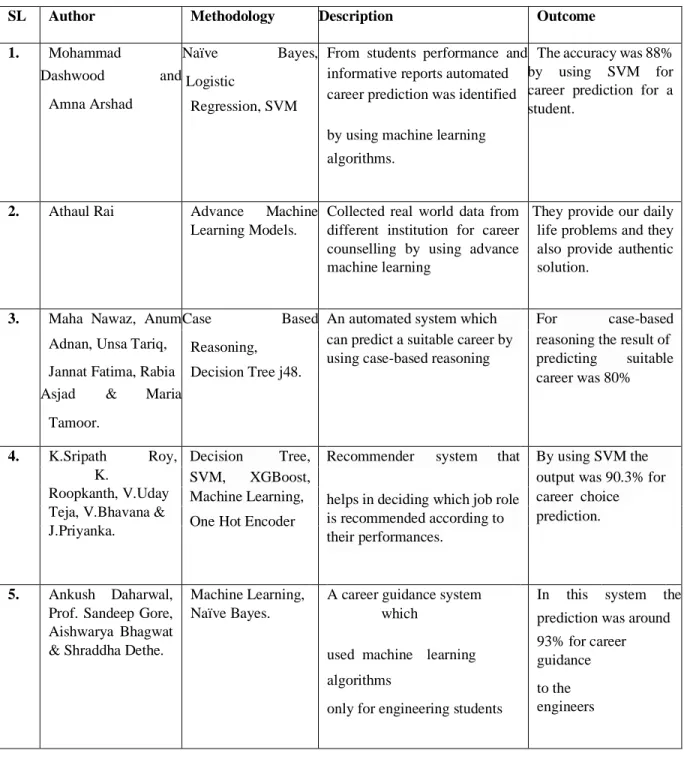
There are respective works has been done in this topic. Mohammad Dashwood has designed an automatic prediction method for career for the students [1]. In this process, surveys will be taken and from them machine learning algorithm will be used to choose their career according to student’s performance and informative reports. Their score was 88% which was quite a good outcome.
Athaul Rai has made a completion of similar work of career counselling by using advanced machine learning by student’s performance to reach out their career destination. In this case they have collected real world data from different institution.
Maha Nawaz has done a computerized career counselling system for pupils by using cased base reasoning and decision tree j48 . In this paper, different machine learning algorithms was used. For cased base reasoning the accuracy was around 80% which was optimistic.
A journal was published by K.sripath Roy for student career estimation using advanced machine learning techniques. This journal was only for computer science students and the accuracy was 90.3% with SVM.
A similar journal by Ankush Daharwal, Prof. Sandeep Gore was published and it was for career guidance for the students of computer science and information technology. A huge dataset was used here and by using naïve bayes they got 93% accuracy.
Another journal was proposed by Min Nie and Lei Yang, to forecast the students career choices based on the behaviors of students in the campus.
@Daffodil International University P a g e | 5
2.3 Research Summary
Table 2.3.1: SUMMARY OF PREVIOUS RESEARCHES
SL Author Methodology Description Outcome
1. Mohammad
Dashwood and Amna Arshad
Naïve Bayes, Logistic
Regression, SVM
From students performance and informative reports automated
career prediction was identified by using machine learning algorithms.
The accuracy was 88%
by using SVM for career prediction for a student.
2. Athaul Rai Advance Machine Learning Models.
Collected real world data from different institution for career counselling by using advance machine learning
They provide our daily life problems and they also provide authentic solution.
3. Maha Nawaz, Anum Adnan, Unsa Tariq, Jannat Fatima, Rabia
Asjad & Maria Tamoor.
Case Based
Reasoning,
Decision Tree j48.
An automated system which
For case-based
can predict a suitable career by reasoning the result of using case-based reasoning predicting suitable
career was 80%
4. K.Sripath Roy, K.
Roopkanth, V.Uday Teja, V.Bhavana &
J.Priyanka.
Decision Tree,
Recommender system that
By using SVM the
SVM, XGBoost,
helps in deciding which job role is recommended according to their performances.
output was 90.3% for
Machine Learning,
One Hot Encoder
career choice prediction.
5. Ankush Daharwal, Prof. Sandeep Gore, Aishwarya Bhagwat
& Shraddha Dethe.
Machine Learning, Naïve Bayes.
A career guidance system which
used machine learning algorithms
only for engineering students
In this system the prediction was around
93% for career guidance to the engineers
@Daffodil International University P a g e | 6
6. Min Nie, Lei Yang, Jun Sun, Han Su, Hu Xia, Defu Lian &
Kai yan
Big data Predict students career choice for college students
Data driven
framework for predicting student career choice on graduation based on their performances.
7. Claudia crisan, Anisora Pavelea &
Oana Ghimbulut.
Career counselling,
Screening research
For the development of career guidance programs in the University environment.
Data interpretation of student’s professional status and their career information.
2.4 Scope of the problem
All the previous work that has been done before in this field was done for a specific country’s student’s perspective or in a single field of study. After analyzing previous work and researches we decided to complete our research according to Bangladeshi student’s perspective and with multiple field of study.
2.5 Challenges
We have had several challenges in this research. First issue was that we have problems during the collection of data so we have used dummy data in this research. For this reason, it was quite challenging for models to imply because for using dummy data our models were overfitting.
That is why we have to choose our model empirically.
We have to use a lot of machine learning algorithm to find out which will do better performance. We were not familiar with all those algorithms; however, we have to use it to get the best outcome. However, after trying various algorithms our outcome went pretty good lately and it gave us quite a good output, furthermore, we were enjoying a lot by doing this.
@Daffodil International University P a g e | 7
CHAPTER 3
RESEARCH METHODOLOGY
3.1 Introduction
Our proposed methodology works on predicting career guidance for students according to Bangladesh perspective. For career recommendation, we have used several machine learning algorithms and among them we have chosen two algorithms for comparison because other models were overfitting or having troubles to find out the output. We have compared Naïve Bayes and k-nearest neighbors algorithms for showing the comparison of the result. Among these best results has been taken for each individual field of study.
The outcome of predicting field of study were not that much satisfactory by using Naïve Bayes and k-NN respectively as we have been using dummy datasets for implementation.
3.2 Research Subject and Instrumentation
The topic we have worked on is a concern of machine learning. As described earlier, that several machine learning techniques were used and among them Naïve Bayes and k-nearest neighbor algorithm is used to show the comparison. We have used our datasets and applied these algorithms to get the career recommendation for student.
3.3 Dataset Description
@Daffodil International University P a g e | 8
As we have had troubles with datasets collection that is why we have used dummy datasets.
These datasets were made by Bangladeshi career perspective. Dummy data does not contain any useful information but it can serve to reserve the places of real data. It can be used for both operational and testing purposes. We have used dummy datasets for testing purposes. In here, we have made some questions which is related to student’s interest, study and environmental situation. By knowing those answers we can predict, which field of study is suited for a specific student. In here, various fields of study have been added so that students can have their own choice of study by answering some questions to machine. These can also determine their future jobs related to their own interest of work.
Data Statistics
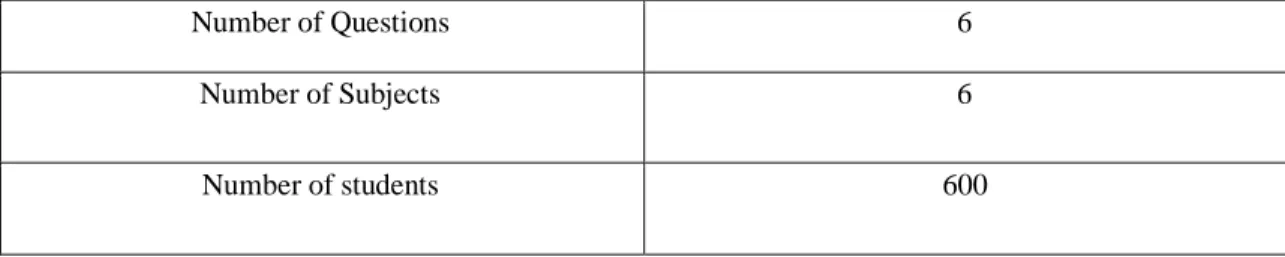
Our dataset statistics is illustrated below
Table 3.3.1: DATA STATISTICS
Number of Questions 6
Number of Subjects 6
Number of students 600
Our dataset has various kinds of disciplines for students to choose their field of study.
@Daffodil International University P a g e |
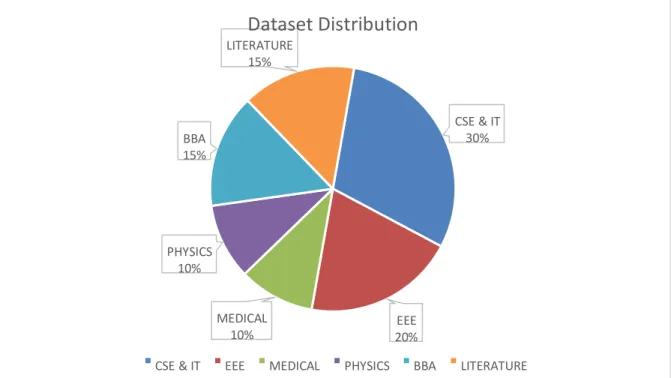
In figure 3.3.1 the illustration of our dataset has been given below:
Figure 3.3.1: Various discipline data distribution
In here, we have used six classes by which we can recommend the best recommended field of study for each student. It is seen from the above data distribution chart that we have used six different field of study in our dummy dataset to get that recommended output for student.
3.4 Data preprocessing
As we have used dummy data so we have to process the data in such a way that our model can identify the output with a good performance. To preprocess the data, we have to go through with some following steps.
First, we needed to do one hot encoding. In here we have encoded categorical features into one-numeric array. This encoding is needed for feeding categorical data to many scikit-learn estimators and it is also needed to apply the datasets in linear models or other machine learning models.
CSE & IT
%
30
EEE
%
20
MEDICAL
10 %
PHYSICS
10 %
BBA
%
15
LITERATURE
15 %
Dataset Distribution
CSE & IT EEE MEDICAL PHYSICS BBA LITERATURE
@Daffodil International University P a g e | 10
9 Then we have removed all unnecessary data by using pandas library. After removing them we have separated our input and output variables into different columns for further training into machine learning algorithms.
Finally, we have split the datasets into 80 percent for training and 20 percent for validation data.
3.5 Proposed Methodology
Choosing out the best algorithm for implementation is quite tiresome work. If we apply algorithms on datasets without preprocessing them then it gave us quite bad results. For this reason, we have to preprocess the datasets first so that we can apply machine learning algorithms. However, after trying out different algorithms and models we have used two machine learning algorithms for final comparison. After comparing them we chose k-nearest neighbor with higher accuracy.
@Daffodil International University P a g e | 11
In figure 3.5.1 the steps of our proposed methodology are illustrated below:
Form the illustration of our proposed methodology of work it is seen that first we need to prepare the data and then preprocess the data as per described above. After the completion of preprocessing we will apply algorithms to our dataset to get the recommendation of career for the students. After applying algorithms, we will compare the algorithms and pick the best among them.
@Daffodil International University P a g e | 12
3.6 Machine Learning Algorithms
Naïve Bayes
It is a classification technique based on Bayes’ Theorem with an assumption of independence among predictors. In simple terms, a Naive Bayes classifier assumes that the presence of a particular feature in a class is unrelated to the presence of any other feature. Naïve Bayes algorithm can be used in various application. It can be used to find out real time prediction, multi class prediction, text classification, sentiment analysis, recommendation system. Bayes theorem provides a way of calculating posterior probability P(c|x) from P(c), P(x) and P(x|c).
Look at the equation below
𝑃(𝑥|𝑐)𝑃(𝑐) 𝑃(𝑐|𝑥) =
𝑃(𝑥)
𝑃(𝑐|𝑋) = 𝑃(𝑥1|𝑐) × 𝑃(𝑥2|𝑐) × … .× 𝑃(𝑥𝑛|𝑐) × 𝑃(𝑐)
Above,
• P(c|x) is the posterior probability of class (c, target) given predictor (x, attributes).
• P(c) is the prior probability of class.
• P(x|c) is the likelihood which is the probability of predictor given class.
• P(x) is the prior probability of predictor.
As we need to make a recommendation system so this algorithm is a good choice for our datasets. k-NN Algorithm
@Daffodil International University P a g e | 13
k-NN can be used for classification and regression predictive problems. In industry it mostly used for classification problems. It is a supervised machine learning algorithm. K-NN algorithm calculates the distance between the data points and for this it uses Euclidean Distance formula.
𝑑
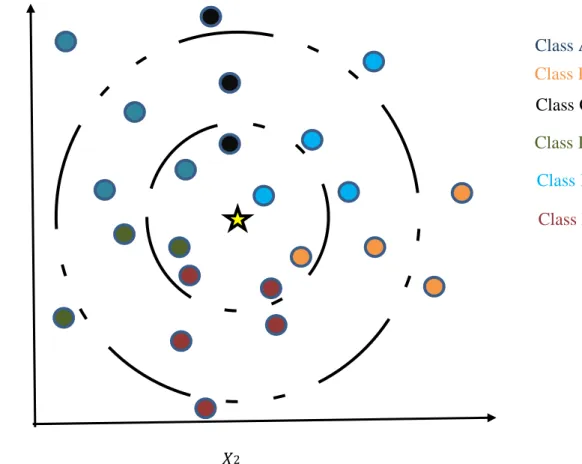
In here n number of dimensions are taken which is used to extract the features from datasets in machine learning. The data points those are located at minimum distance are considered to be in the same class. The above formula works in n number of dimensions, and it can be used with n number of features. The working method of k-NN is described with an illustration
In figure 3.6.1 Data example for K-nearest neighbor algorithm is given below:
@Daffodil International University P a g e | 14
Figure 3.6.1: Data example for K-nearest neighbor algorithm
In here the yellow star illustrates the test data point which is our target. The test data points are surrounded by the colorful dots which are of different classes. In here, each class defines different field of study. Now, we need to find out the distance between each dot from the test data point. As there could be many distances. So, we identify the lowest distance and assume that it belongs to the same class of its nearest neighbor. If a green dot is closest to the test data point then we predict the green dot has the best similarity to the output class.
In some cases, we can get two distances which is exactly the same. For this situation we need to consider a third data point to calculate its distance from the test data. In the above diagram there are plenty of classes those are close to the test data point. For this reason, finally we considered that the distance from the output variable to the input variable, there is a seventh data point and predicted our test data class of sky blue.
𝑋 2
𝑋 1
Class A Class B Clas s C Class D Class E Class F
@Daffodil International University P a g e | 15
3.7 Implementation Requirements
After analyzing all the necessary statistical or theoretical concepts and methods, we created a list of Hardware, Software and developing tools we need predicting career recommendation.
Hardware/Software Requirements
• Operating System (Windows 7 or above)
• Ram (more than 4 GB)
• Web Browser (preferably chrome)
Developing Tools
• python 3.7
• Anaconda
• Jupiter notebook
• NLTK
• Pandas
• Sklearn
@Daffodil International University P a g e | 16
CHAPTER 4
EXPERIMENTAL RESULTS AND DISCUSSIONS
4.1 Introduction
In this chapter, we will be discussing the description of our research and we will provide our experimental result. Then we will compare our algorithms to choose the best algorithm for prediction and then we will visualize the output with confusion matrix. Finally, we will close the chapter with a summarization of result.
4.2 Experimental Result
We had 600 dummy datasets of various field of study. For each of them we had set different questions to analyze the recommendation field of study for a student for their better career and job. Our dataset contains 6 different attributes for various kinds of questions to be asked related to the student’s personal life and interest. The output or result by asking these questions will be the recommendation of a student career field of study. Finally, in this process we wanted to predict the career recommendation or the expected field of study for each student depending on the student’s interest and study according to Bangladeshi environment perspective. Our output class is Discipline or field of study. We have picked 6 field of study here and those are Computer Science and Engineering or Information Technology, Electrical and Electronics Engineering, Physics, Bachelor of Business Administration, Medical and Literature. To find them out according to the questions perspective we have used two machine learning models and those are Naïve Bayes and k-NN on our datasets. They have produced different results and the results were unsatisfactory but It will give better accuracy if we have real world datasets.
4.3 Descriptive Analysis
@Daffodil International University P a g e | 17
For each algorithm that we have implemented it provides accuracy for 6 disciplines that we have in our dummy datasets. For each class we need to identify the output. The accuracy of an output can be found by the following equation
𝑇𝑁 + 𝑇𝑃
𝐴𝐶 =
𝑇𝑁 + 𝐹𝑃 + 𝐹𝑁 + 𝑇𝑃
5.1 Summary of the study
Our work has been divided into several parts. First, we have to prepare our dataset. In our study, we have 6 field of study choices for career recommendation. As we did not have a realworld dataset, that is why we have to use dummy dataset in our research. First, we have preprocessed our datasets so that it can fit into our machine learning algorithm. Then we have applied various algorithms and by doing comparison we have reached at a decision for choosing the perfect algorithm for our work. After choosing k-NN as our final algorithm, for different field of study choices we have applied our algorithm and got various accuracy for this.
5.2 Conclusion
Our career recommendation system is for Bangladeshi students those who are hesitated to choose a subject for graduation. Students always fail to choose their field of study according to their own interest and choices. This research can help students to choose their field of study and it can also help further to get a job in future with his own interest. By doing so, not only the students will be benefited from this but also our country and the industries who will assign these pupil in work will be benefited as well.
@Daffodil International University P a g e | 18
5.3 Recommendations
There are many work has been done before in career recommendation. It was done according to Bangladeshi environment perspective.
• Our research can help the student to choose their job.
• This research can help educational institution.
• As student can choice their own interested field of study so their upcoming job will be at their own interest. For this reason, industries and organizations will be highly benefited for this research as well.
5.4 Implication for further study
Few implications for further study with this research are
• As we are doing our research with dummy datasets our first future work will be to use real world dataset in our work.
• Adding more field of study in our research work.
• Deploy our research in an android and website application.
• Publish a publication with our research work.
@Daffodil International University P a g e | 19
APPENDICES
Appendix A: Research Reflections
Prior to this work, we had no knowledge about application of machine learning in recommendation system. We had to search and gather knowledge for it. Our very kind and helpful supervisor helped us choose our research topic and gave the complete guideline needed to get our research done. Throughout our journey, we have learned a lot of things, as well as developed some new ideas about our future works. Our research was not just confined to using some algorithms or methods, rather we needed a lot of studies educational system, interest of students and we also had to study the job field of students, some medical terms and issues, and many more.
Appendix B: Related Issues
When we started our research, we had no prior knowledge about scikit-learn, pandas and other machine learning algorithm nor did we have any hands-on experience with machine learning algorithms. We took a good amount of time to learn them all, practice and get them ready for work. First, we applied them on a different dataset just to test if we are doing it right. Then we started working with the main dataset to see our expected outcomes.
One thing we have learned from our first research is, once you get the complete picture of your work in your head, and already know how to do it, it will not take that long to finish.
@Daffodil International University P a g e | 20
REFERENCES
1. Mohammad Dashwood & Amna Arshad,
“Career Counselling For Better Future Studies Using Machine Learning”, Book publication, july 2018.
2. Athaul Rai, “Career Counselling Classification Using Advanced Machine Learning”, National Symposium on Artificial Intelligence and Computer Science (NSAICS-2019, At IQRA University, April 2019.
3. Maha Nawaz, Anum Adnan, “Automated Career Conselling System For Students Using
CBR and J48” , TextRoad Publication, 2014.
4. K. Sripath Roy, K. Roopkanth, “Student Career Prediction Using Advanced Machine Learning Techniques”, International journal of engineering and technology, 2018.
5. Ankush Daharwal, Prof. Sandeep Gore,
“Career Guidance System using Machine learning For
Engineering Students”, International journal of engineering and technology, june 2020.
6. Min Nei, Lei Yang, “Advanced forecasting of career choices for college students based on campus big data”, Springer, Frontiers of computer science 12,494-503,2018.
7. Claudia Crişan , , Anișoara Pavelea , “A Need Assessment on Students’ Career Guidance”, Elsevier Ltd, 2015.
8. Yuguang Huang , Lei Li , “Naive Bayes classification algorithm based on small sample
9. set”, IEEE International Conference on Cloud Computing and Intelligence Systems, 2011
10. Yun-lei Cai , Duo Ji , Dong-feng Cai , “A KNN Research Paper Classification Method Based on Shared Nearest Neighbor” , Proceedings of NTCIR-8 Workshop Meeting, 2010
11. Kedar Potdar , Taher S. Pardawala , Chinmay D. Pai , “A Comparative Study of Categorical Variable Encoding Techniques for Neural Network Classifiers” , International Journal of Computer Applications (0975 – 8887) Volume 175 – No.4, October 2017
12. Sofia Visa , Brian Ramsay , Anca Ralescu ,
Esther van der Knaap , “Confusion Matrixbased Feature Selection”, Proceedings of The 22nd Midwest Artificial Intelligence and Cognitive Science Conference
2011, Cincinnati, Ohio, USA, April 16-17, 2011
@Daffodil International University P a g e | 2
@Daffodil International University P a g e | 3
@Daffodil International University P a g e | 4