EFFECT OF SPACING AND FOLIAR APPLICATION OF CHITOSAN ON THE GROWTH AND YIELD OF
CABBAGE
MST. AYSHA SIDDIKA ASA
DEPARTMENT OF HORTICULTURE
SHER-E-BANGLA AGRICULTURAL UNIVERSITY DHAKA-1207
JUNE, 2021
EFFECT OF SPACING AND FOLIAR APPLICATION OF CHITOSAN ON THE GROWTH AND YIELD OF
CABBAGE
By
MST. AYSHA SIDDIKA ASA REGISTRATION NO.: 14-05990
A Thesis
Submitted to the Faculty of Agriculture, Sher-e-Bangla Agricultural University, Dhaka
in partial fulfillment of the requirements for the degree of
MASTER OF SCIENCE (MS) IN
HORTICULTURE
SEMESTER: JANUARY-JUNE, 2021
APPROVED BY:
………..……...……… … ………
Prof. Dr. Md. Ismail Hossain Prof. Dr. Mohammad Humayun Kabir Department of Horticulture Department of Horticulture SAU, Dhaka SAU, Dhaka
Supervisor Co-supervisor
…….………
Prof. Dr. Khaleda Khatun Chairman
Examination Committee
DEPARTMENT OF HORTICULTURE
Sher-e-Bangla Agricultural University
Sher-e-Bangla Nagar, Dhaka
CERTIFICATE
This is to certify that the thesis entitled ‘EFFECT OF SPACING AND FOLIAR APPLICATION OF CHITOSAN ON THE GROWTH AND YIELD OF CABBAGE’ submitted to the Faculty of Agriculture, Sher-e-Bangla Agricultural University, Dhaka, in partial fulfillment of the requirements for the degree of MASTER OF SCIENCE (MS) in HORTICULTURE, embodies the result of a piece of bonafide research work carried out by MST. AYSHA SIDDIKA ASA, Registration number: 14-05990, under my supervision and guidance. No part of the thesis has been submitted for any other degree or diploma.
I further certify that such help or source of information as has been availed of during the course of this investigation has duly been acknowledged.
Dated: Prof. Dr. Md. Ismail Hossain
Place: Dhaka, Bangladesh Department of Horticulture Sher-e-Bangla Agricultural University
Sher-e-Bangla Nagar, Dhaka- 1207
Supervisor
Dedicated to My Beloved
Parents
i
ACKNOWLEDGEMENTS
All praises to Almightly and Kindful trust on to “Omnipotent Creator” for His never-ending blessing, the author deems it a great pleasure to express profound gratefulness to her respected parents, who entitled much hardship inspiring for prosecuting her studies, receiving proper education.
The author would like to express her heartfelt gratitude and most sincere appreciations to her Supervisor Prof. Dr. Md. Ismail Hossain, Department of Horticulture, Sher-e-Bangla Agricultural University, Dhaka, for his valuable guidance, advice, immense help, encouragement and support throughout the study.
Likewise grateful appreciation is conveyed to Co-supervisor Prof. Dr. Mohammad Humayun Kabir, Department of Horticulture, Sher-e-Bangla Agricultural University, Dhaka, for his constant encouragement, cordial suggestions, constructive criticisms and valuable advice to complete the thesis.
The author wishes to express her sincere gratitude and respect to all of the respected teachers of the Department of Horticulture, Sher-e-Bangla Agricultural University, Dhaka, for their invaluable teaching, sympathetic cooperation, and inspirations over the course of this study and research.
The author wishes to express her heartfelt gratitude to her classmates and friends for their eager assistance, as well as their enthusiastic cooperation and support throughout the experimentation period.
The author wishes to express her heartfelt gratitude to her parents and family, without whose love, devotion, inspiration and sacrifice this work would not have been completed.
Finally, the author wishes to express her gratitude to the personnel of the Department of Horticulture, Sher-e-Bangla Agricultural University Horticulture Farm staff, Dhaka, who assisted her during her studies.
The Author
ii
EFFECT OF SPACING AND FOLIAR APPLICATION OF CHITOSAN ON THE GROWTH AND YIELD OF CABBAGE
ABSTRACT
The experiment was carried out at the “Horticulture Farm” of Sher-e-Bangla Agricultural University, Dhaka, Bangladesh during November, 2019 to March, 2020 to study the effect of spacing and foliar application of chitosan on the growth and yield of cabbage. The experiment consisted of two factors. Factor A: Three spacing viz., S1= 60
× 35 cm, S2= 60 × 45 cm and S3= 60 × 55 cm and Factor B: Four levels of foliar application of chitosan viz., C0= Control, C1= 100 ppm, C2= 150 ppm and C3= 200 ppm.
The experiment was laid out in a Randomized Complete Block Design (RCBD) with three replications. Data were recorded on growth, yield components and yield of cabbage and significant variation was observed for most of the studied characters. In case of spacing, the tallest plant height, maximum spreading of plant, number of loose leaves per plant, weight of loose leaves per plant, fresh weight of plant, diameter of head, thickness of head, fresh weight of head, dry matter percent and cabbage yield (60.90 t ha-1) was observed from the treatment S2 (60 × 45 cm) and minimum was from the closest spacing 60 × 35 cm (S1). In case of foliar application of chitosan, the highest plant height, maximum spreading of plant, number of loose leaves per plant, weight of loose leaves per plant, fresh weight of plant, diameter of head, thickness of head, fresh weight of head, dry matter percent and yield of cabbage (63.23 t ha-1) were observed from the treatment C3 (foliar application of chitosan at 200 ppm) and minimum was from control (C0) treatment. In case of combined effect of spacing and foliar application of chitosan, S2C3 (60 × 45 cm + foliar application of chitosan at 200 ppm) gave the highest yield of cabbage (70.06 t ha-1) and least from the S1C0 (60 × 35 cm + control) treatment combination. So, the treatment combination S2C3 (60 × 45 cm spacing with foliar application of chitosan at 200 ppm) was found to be most suitable combination for the potential yield of cabbage.
iii
LIST OF CONTENTS
Chapter Title Page No.
ACKNOWLEDGEMENTS i
ABSTRACT ii
LIST OF CONTENTS iii
LIST OF TABLES vi
LIST OF FIGURES viii
LIST OF APPENDICES ix
LIST OF ACRONYMS x
I INTRODUCTION 1-3
II REVIEW OF LITERATURE 4-14
2.1 Literatures on spacing 4
2.2 Literatures on chitosan 9
III MATERIALS AND METHODS 15-22
3.1 Description of the experimental site 15
3.2 Climate and weather 15
3.3 Soil characteristics 15
3.4 Plant material 15
3.5 Treatments under investigation 16
3.6 Experimental design and layout 16
3.7 Raising of seedlings 16
3.8 Preparation of main field 17
3.9 Application of fertilizers 17
3.10 Transplanting of seedlings in the main field 17
3.11 Intercultural operations 17
3.11.1 Irrigation and drainage 18
3.11.2 Gap filling 18
3.11.3 Weeding 18
3.12 Pest and disease control 18
3.13 Harvesting 19
3.14 Recording of data 19
iv
CONTENTS (Cont’d)
Chapter Title Page No.
3.15 Procedure of recording data 20
3.15.1 Plant height 20
3.15.2 Plant spread 20
3.15.3 Loose leaves plant-1 20
3.15.4 Weight of loose leaves plant-1 20
3.15.5 Fresh weight of plant 20
3.15.6 Lateral roots plant-1 20
3.15.7 Length of root plant-1 20
3.15.8 Fresh weight of root plant-1 20
3.15.9 Length of stem 21
3.15.10 Diameter of stem 21
3.15.11 Fresh weight of stem 21
3.15.12 Diameter of head 21
3.15.13 Thickness of head 21
3.15.14 Fresh weight of head 21
3.15.15 Dry matter percent 21
3.15.16 Yield 22
3.16 Data analysis technique 22
IV RESULTS AND DISCUSSION 23-47
4.1 Plant height 23
4.2 Plant Spreading 26
4.3 Loose leaves plant-1 29
4.4 Weight of loose leaves plant-1 29
4.5 Fresh weight of plant 30
4.6 Lateral roots plant-1 31
4.7 Length of root plant-1 35
4.8 Fresh weight of root plant-1 35
4.9 Length of stem 36
4.10 Diameter of stem 36
4.11 Fresh weight of stem 39
4.12 Diameter of head 40
v
CONTENTS (Cont’d)
Chapter Title Page No.
4.13 Thickness of head 41
4.14 Fresh weight of head 44
4.15 Dry matter percent 44
4.16 Yield 45
V SUMMARY AND CONCLUSION 48-50
REFERENCES 51-57
APPENDICES 58-62
vi
LIST OF TABLES
Table No. Title Page No.
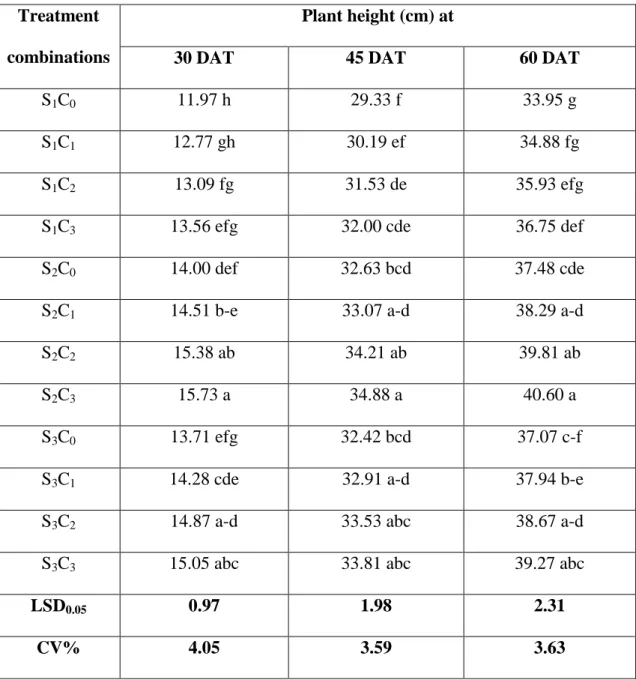
1 Combined effect of different spacing and foliar application of chitosan on plant height at different days after transplanting of cabbage
25
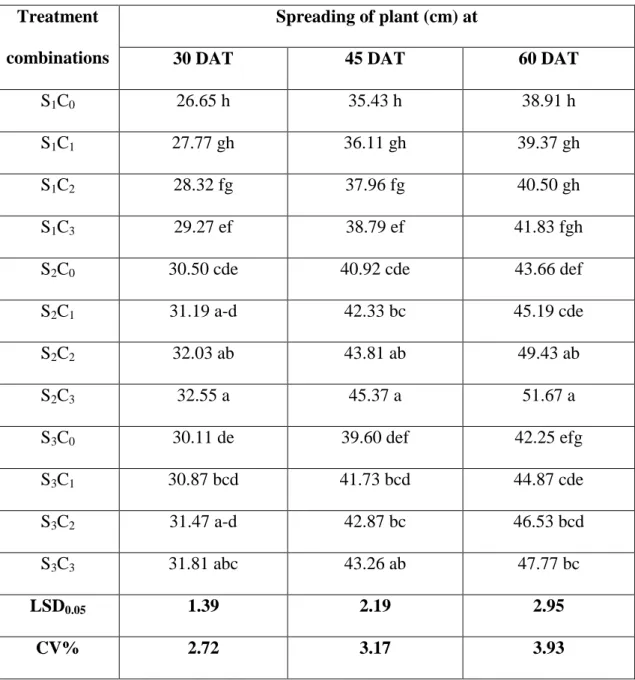
2 Combined effect of different spacing and foliar application of chitosan on spreading of plant at different days after transplanting of cabbage
28
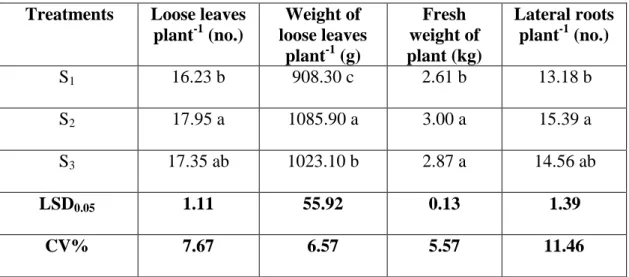
3 Effect of different spacing on loose leaves plant-1, weight of loose leaves plant-1, fresh weight of plant and lateral roots plant-1 of cabbage
33
4 Effect of foliar application of chitosan on loose leaves plant-1, weight of loose leaves plant-1, fresh weight of plant and lateral roots plant-1 of cabbage
33
5 Combined effect of different spacing and foliar application of chitosan on loose leaves plant-1, weight of loose leaves plant-1, fresh weight of plant and lateral roots plant-1 of cabbage
34
6 Effect of different spacing on length of root plant-1, fresh weight of root plant-1, length of stem and diameter of stem of cabbage
38
7 Effect of foliar application of chitosan on length of root plant-1, fresh weight of root plant-1, length of stem and diameter of stem of cabbage
38
8 Combined effect of spacing and foliar application of chitosan on length of root plant-1, fresh weight of root plant-1, length of stem and diameter of stem of cabbage
39
9 Effect of spacing on fresh weight of stem, diameter of head and thickness of head of cabbage
42
10 Effect of foliar application of chitosan on fresh weight of stem, diameter of head and thickness of head of cabbage
42
11 Combined effect of spacing and foliar application of chitosan fresh weight of stem, diameter of head and thickness of head of cabbage
43
vii
TABLES (Cont’d)
Table No. Title Page No.
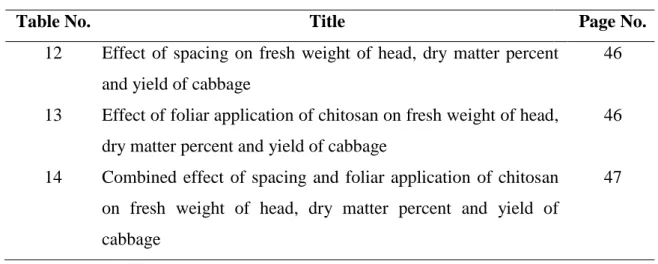
12 Effect of spacing on fresh weight of head, dry matter percent and yield of cabbage
46
13 Effect of foliar application of chitosan on fresh weight of head, dry matter percent and yield of cabbage
46
14 Combined effect of spacing and foliar application of chitosan on fresh weight of head, dry matter percent and yield of cabbage
47
viii
LIST OF FIGURES
Figure Title Page No.
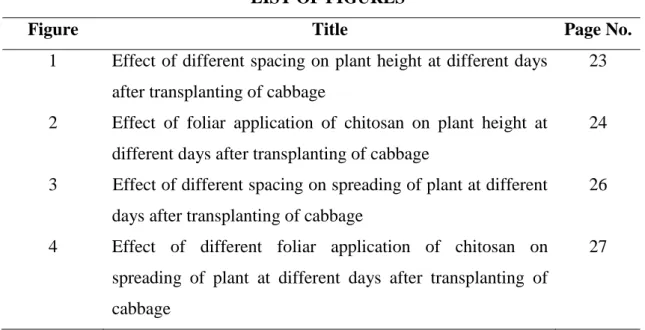
1 Effect of different spacing on plant height at different days after transplanting of cabbage
23
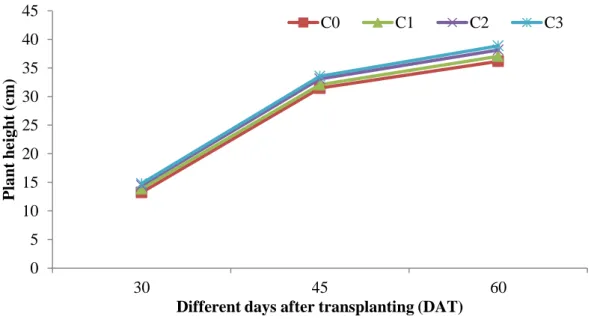
2 Effect of foliar application of chitosan on plant height at different days after transplanting of cabbage
24
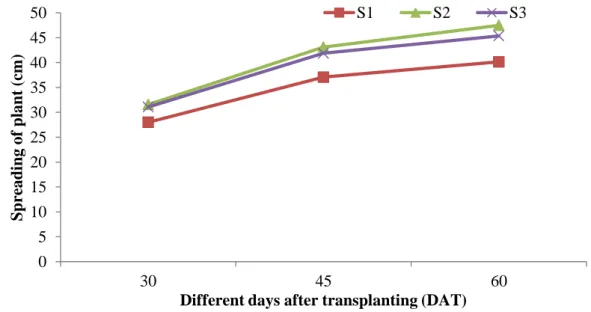
3 Effect of different spacing on spreading of plant at different days after transplanting of cabbage
26
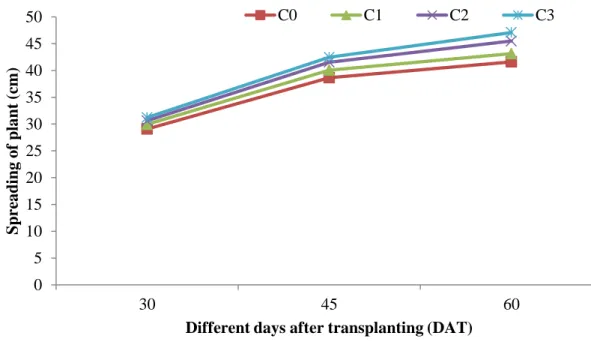
4 Effect of different foliar application of chitosan on spreading of plant at different days after transplanting of cabbage
27
ix
LIST OF APPENDICES
Appendix Title Page No.
I Agro-Ecological Zone of Bangladesh showing the experimental location
58
II Monthly records of air temperature, relative humidity (RH) and rainfall during the period from November 2019 to March 2020
59
III Characteristics of experimental soil analyzed at Soil Resource Development Institute (SRDI), Farmgate, Dhaka
59
IV Layout of the experimental field 60
V Mean square values of plant height at different days after transplanting of cabbage
61
VI Mean square values of spreading of plant at different days after transplanting of cabbage
61
VII Mean square values of number of loose leaves plant-1, weight of loose leaves plant-1, fresh weight of plant and number of lateral roots plant-1 of cabbage
61
VIII Mean square values of length of root plant-1, fresh weight of root plant-1, length of stem and diameter of stem of cabbage
62
IX Mean square values of fresh weight of stem, diameter of head and thickness of head of cabbage
62
X Mean square values of fresh weight of head, dry matter percent and yield of cabbage
62
x
LIST OF ACRONYMS
Acronyms Full word
AEZ = Agro-Ecological Zone
% = Percent
0C = Degree Celsius
BARI = Bangladesh Agricultural Research Institute
cm = Centimeter
CV% = Percentage of coefficient of variance
cv. = Cultivar
DAT = Days after transplanting
et al. = And others
FAO = Food and Agriculture Organization of the United Nations
g = Gram
ha-1 = Per hectare
kg = Kilogram
LSD = Least Significant Difference
MoP = Muriate of Potash
N = Nitrogen
No. = Number
NPK = Nitrogen, Phosphorus and Potassium
PGRs = Plant Growth Regulators
SAU = Sher-e-Bangla Agricultural University SRDI = Soil Resources and Development Institute
t = Ton
TSP = Triple Super Phosphate
viz. = Videlicet (namely)
Wt. = Weight
CHAPTER I
INTRODUCTION
1 CHAPTER I INTRODUCTION
Cabbage (Brassica oleracea var. capitata) is a popular vegetable grown in almost every country and belongs to the Cruciferae family. It is a biennial herbaceous plant that is widely grown in Bangladesh during the winter season. A 100-gram serving of cabbage contains 1.8 g of protein, 0.1 g of fat, 4.6 g of carbohydrate, 0.6 g of mineral, 29 mg of calcium, 0.8 mg of iron, and 14.1 mg of sodium (Singh and Naik, 1988). It also contains a lot of vitamins A and C (Prabhakar and Srinivas, 1990 and Tiwari et al., 2003). It can be used in slaws, salads, and even cooked dishes (Andersen, 2000).
Cabbage is one of the five best vegetables in the world. Cabbage is one of the world’s leading vegetables (Rashid, 1999). It is a popular winter leafy vegetable in Bangladesh. At the present, it is cultivated in an area of 22.26 thousand hectares, which is increasing day by day, with a production of 384 thousand metric tons, and the average yield of cabbage in Bangladesh is 17.32 t ha-1 (BBS, 2020), which is very low compared to other countries in the world (Japan 41.70 t ha-1, South Korea 71.18 t ha-1, United States of America 41.17 t ha-1 and India 22.82 t ha-1) (FAO, 2019). This low yield can be attributed to a large extent to the farmers low production management practices.
Some factors must be considered in order to maintain or even improve cabbage production. One such necessary factor for successful vegetable production is the production of vigorous transplants (Cantliffe and Karchi, 1992). Again, correct cultural practices such as adequate fertilizer application (Everaarts and De Moel, 1998) and optimum plant spacing must be followed in order to achieve good yields in cabbage production (Singh and Naik, 1988; Lecuona, 1996; Singh, 1996; Sandhu et al., 1999; Kumar and Rawat, 2002).
Spacing is another factor that has been reported to have an effect on cabbage production. Widders and Price (1989) defined spacing as the distance between plants in a row and between rows of planted crops. Ghanti et al. (1982) observed maximum results of yield contributing characters (head diameter, gross and net mass of cabbage head) at greater spacing and a decrease as plant spacing decreased.
2
Plant spacing is an important aspect of crop production that must be considered in order to maximize yield (Aquino et al., 2005). It aids in the growth of leaves, branches, and healthy foliage. Crops that are densely planted obstruct proper growth and development. Wider spacing, on the other hand, meets the basic requirements but reduces the total number of plants as well as total yield. Crop yield can be increased by up to 25% by using optimal spacing. The vigorous development of the growth attributes (branches and leaves plant-1) eventually increased the dry matter accumulation per plant and higher plant density produced taller and lesser branched plants and their lower leaves had not received sufficient solar radiation to accelerate photosynthetic activities, thus become lower leaves parasitic due to high rate of respiration in which larger quantities of stored photosynthates were consumed than produced in photosynthesis. Closer spacing (60 × 50 cm) would be more economically profitable for cauliflower or cabbage seed production in North- Western part of Bangladesh (Hossain et al., 2015).
Plant growth regulator (PGR) application appears to be one of the most important practices in terms of convenience, cost and labor efficiency. The importance of PGRs in agriculture for better crop growth and yield has recently been recognized on a global level. PGRs have long been used to increase crop yield in developed countries such as Japan, China, Poland, and South Korea. The physiological mechanisms of tomato growth, like those of other crop plants, are hormonally mediated. Plant growth regulators (PGRs) are a type of hormone that regulates plant growth and yield.
Chitosan, a new plant growth regulator similar to GA3, may have a variety of applications for improving plant growth, yield, and yield attributes.
Chitosan is a linear polymer of β-(1-4)-linked N-acetyl-2-amino-2-deoxy-D-glucose (acetylated) and 2-amino-2-deoxy-D-glucose (deacetylated) (Kaur and Dhillon, 2014). It is generally obtained by partial deacetylation of chitin (Kumar, 2000), which is the second most abundant polysaccharide in nature after cellulose (Elieh-Ali-Komi and Hamblin, 2016). Chitin is a major component of the cuticle of insects, exoskeleton of crustaceans and fungal cell walls. Chitosan has been described as elicitor of plant defenses (Yin et al., 2016) and hormones of food security crops such as tomato (Iriti and Faoro, 2008; El-Tantawy, 2009). Chitosan also propitiates accumulation of auxin [mainly indole acetic acid (IAA)] in the apex of plant roots (Lopez-Moya et al., 2017). Chitosan is a natural carbohydrate polymer modified from
3
chitin, which comes from the shells of crustaceans like crabs and shrimp. It's been described as a high-potential biomolecule that boosts plant yield and growth. Chitosan is an environmentally friendly product that has been widely used in agricultural applications, primarily for improving soil characteristics that are conducive to plant growth and plant defense stimulation. It's been used to coat seeds, leaves, fruits, and vegetables, as well as a fertilizer and in controlled agrochemical release systems (Ibrahim and Ramadan, 2015). Chitosan is a non-toxic material that has antifungal properties against a variety of plant pathogens. It has also been reported to cause resistance to soil-borne fungi. Chitosan applications in medicine, food, chemical engineering, pharmaceuticals, nutrition, environmental protection, and agriculture have gotten a lot of attention in recent years. Chitosan has been shown to improve the growth of a variety of crops. Effects on plant physiological processes such as nutrient uptake, cell elongation, cell division, enzymatic activation, and protein synthesis could be the underlying mechanisms for this plant growth-promoting action (Amin et al., 2007). Application of chitosan enhances growth and yield contributing characters in rice (Liu et al., 2007) and soybean (Chibu et al., 2002).
Therefore, the study has been undertaken to identify the effect of spacing and foliar application of chitosan with following objectives:
i. To determine the effect of spacing on the growth and yield of cabbage;
ii. To determine the effect of foliar application of chitosan on the growth and yield of cabbage; and
iii. To find out the combined effect of spacing and foliar application of chitosan for better growth and yield maximization of cabbage.
CHAPTER II
REVIEW OF LITERATURE
4 CHAPTER II
REVIEW OF LITERATURE
An attempt was made in this section to collect and study relevant information available in the country and abroad regarding the effect of plant spacing and chitosan as foliar application on growth and productivity of cabbage to gather knowledge helpful in conducting the present research work.
2.1 Literatures on spacing
Manasa et al. (2017) conducted a field experiment to evaluate the effect of different plant spacings on yield and yield attributes of red cabbage. Plant density is an important variable for achieving maximum yields and uniform vegetable maturity.
Optimal plant density can be achieved by establishing appropriate distances both between the rows as well as in the rows of plants. In this study, increasing the distance between plants caused an increase in number of heading leaves (19.57) with a low percentage of abnormal heads. However, there was no significant difference between different spacings regarding the number of loose leaves per plant. The most favorable parameters characterizing yield per plot (23.80 kg), marketable yield (183.69 q ha-1) along with the highest available soil N (157.47 kg ha-1), P (44.36 kg ha-1) and K (259.97 kg ha-1) were found at closer spacing (45 × 45 cm).
Haque et al. (2015) carried out a study with cabbage during October 2012 to February 2013 at the Horticulture Farm of Sher-e-Bangla Agricultural University, Dhaka, Bangladesh. Four levels of nitrogen: viz. 0, 150, 250 and 350 kg ha-1 and three plant spacings: 50 × 30, 50 × 40 and 50 × 50 cm were applied in a Randomized Complete Block Design with three replications. Nitrogen @ 250 kg ha-1 with the spacing of 50 × 50 cm was more effective and produced the highest fresh weight of head (2.17 kg), marketable head yield (86.93 t ha-1). This treatment was also more profitable than the rest of the treatments while the lowest profit was in N0S1.
Moniruzzaman (2011) directed a field experiment on cabbage (Brassica oleracea var.
capitata to find out the optimum plant spacing and suitable cabbage variety(s). Green Rich, Green-621, Green Coronet, Summer Warrior, Rare Ball, Atlas-70, Southern Treasure, Laurels, K-K Cross, and K-S Cross were used in the experiment, which had two plant spacings of 60 × 40 cm and 60 × 45 cm and ten hybrid cabbage varieties of
5
Green Rich, Green-621, Green Coronet, Summer Warrior, Rare Ball, Atlas-70, Southern Treasure, Laurels, K-K Cross, and K-S Cross. In comparison to a closer spacing of 60 × 30 cm, a wider spacing of 60 × 45 cm resulted in a significantly higher number of folded leaves and head weight (without unfolded leaves). Green Coronet had the highest plant height, number of unfolded leaves, length of the largest loose leaf, widest leaf, head height, and head weight of all the varieties tested (with unfolded leaves). This variety took the highest duration (119 days), while Green-621 took the lowest duration for harvest (105 days). Although Green Coronet grew vigorously, it did not produce the highest head yield. All the varieties had good head compactness except Laurels and Green Coronet which had medium and less compactness, respectively. The combination of 60 × 30 cm spacing with variety Southern Treasure and K-S cross produced the highest head diameter, but wider spacing of 60 × 45 cm accompanied by Southern Treasure produced the highest head weight without unfolded leaves followed by K-K Cross in both the years. The pooled analysis showed the highest marketable head yield (73.32 t ha-1) in the combination of 60 × 40 cm spacing with K-K Cross, which was closely followed by Southern Treasure (71.71 t ha-1) and Laurels (71.56 t ha-1). The variety Green-621 was found suitable for early harvest with reasonable yield (67.82 t ha-1).
Aquino et al. (2005) conducted a field experiment in Minas Gerais, Brazil, from September to December 2002 to determine the effect of plant spacing (80 × 30, 60 × 30, and 40 × 30 cm) and nitrogen rate (0, 75, 150, 225, and 300 kg ha-1) on the yield of cabbage cv. Kenzan. N was applied at a rate of 20% during transplantation, 20% at 20 days after transplantation (DAT), and 30% at 35 and 50 days after transplantation (DAT). Fresh head mass per area, fresh head mass, area of external leaves, leaf area index, harvest precocity, and returns were all recorded. Under spring conditions, spacing of 80 × 30 cm and 253 kg N ha-1 were the most suitable treatments for cabbage cultivation.
Khatun (2008) carried out a study at Sher-e-Bangla Agricultural University Horticulture Farm in Dhaka-1207 to investigate the effects of spacing and potassium on the growth and yield of cabbage. With three replications, the experiment was set up in a Randomized Complete Block Design (RCBD). Factor A: three different plant spacings; S1 (60 × 30 cm), S2 (60 × 40 cm), and S3 (60 × 60 cm); Factor B: four different potassium levels; K0 (control), K1 (90 kg ha-1), K2 (120 kg ha-1) and K3 (150
6
kg ha-1). The highest plant height (37.70 cm), maximum diameter of head (19.05 cm), fresh weight head (1.87 kg), gross yield (71.20 t ha-1) and marketable yield (53.97 t ha-1) were recorded from 60 × 40 cm spacing at 60 DAT, according to the results of the experiment.
Ullah et al. (2013) led a field experiment at Sher-e-Bangla Agricultural University Horticultural Farm in Dhaka-1207 from October 2010 to March 2011 to investigate the impact of planting time and spacing on cabbage growth and yield. With three replications, the experiment was set up in a Randomized Complete Block Design (RCBD). Factor A: three different planting times; T1 (7 November), T2 (21 November) and T3 (5 December) in 2010, and Factor B: three different plant spacings;
S1 (60 × 40 cm), S2 (60 × 45 cm) and S3 (60 × 50 cm) in 2010. The highest plant height (31.5 cm), maximum diameter of head (19.4 cm), and highest fresh weight (1.00 kg) were found in S3 (60 × 50 cm) at 80 DAT, while the lowest weight (0.86 kg) was found in S1 (60 × 40 cm). T1 treatment resulted in the tallest plant height (35.9 cm), maximum diameter of head (20.4 cm), and highest weight of head (1.28 kg) at 80 DAT, while T3 treatment resulted in the lowest weight (0.53 kg). T1S1 had the highest fresh weight of head (1.36 kg) and T3S3 had the lowest fresh weight of head (0.4 kg). They came to the conclusion that the spacing (60 × 40 cm) and planting date of November 21 were both suitable for growth and yield of cabbage.
Kumar (2000) studied the effects of N (0, 50, 100, 150, and 200 kg ha-1 as urea) and spacing (30 × 60 cm, 45 × 60 cm and 60 × 60 cm) on the quality and yield of cabbage cv. Pride of India in a field experiment in Udaipur, Rajasthan, India, in 1997-1998.
With 200 kg N ha-1, the highest total soluble solid (8.80%), chlorophyll (0.29 mg/g), and head diameter (14.30 cm) were obtained. However, the highest mean head weight (1127.22 g) and head yield came from 150 kg N ha-1 (312.42 q ha-1). The widest spacing (60 × 60 cm) resulted in the highest mean total soluble solid (8.77%) and chlorophyll (0.24 mg/g) contents and mean head diameter (13.95 cm) and weight (1184.33 g). A spacing of 30 × 60 cm gave the highest head yield (303.09 q ha-1).
Kumar and Rawat (2002) investigated the effects of nitrogen and spacing on the quality and yield of cabbage (Brassica oleracea L. var. capitata) at the Horticulture Farm, Rajasthan College of Agriculture, Udaipur, in 1997-98. The dry matter percentage was found to be unaffected by spacing. At wider spacing, the maximum
7
head diameter and mass were measured. Wider spacing was thought to provide more space and less competition between available nutrients for plants. As a result, the diameter and mass of the head increased.
Meena (2003) directed an experiment in Rajasthan, India during the rabi season of 1997-98. There were 72, 48, and 36 plants at each of three spacing levels: (30 × 45 cm), (45 × 45 cm) and (60 × 45 cm). At all stages of crop development, increasing plant spacing had no effect on plant height. At 30 and 60 days after transplanting, the number of leaves per plant grew dramatically as the space between plants increased (DAT). At 30 DAT, the percent increase in leaf number per plant was 8.3, and at 60 DAT, it was 9.9. The diameter of the stem expanded dramatically as the spacing increased. The diameter of the stem was 1.28 cm, while the diameters of the leaves were 1.15 cm and 1.00 cm, respectively. At harvest, the largest leaf area was 315.41 cm2 and the lowest was 310.83 cm2. The average head weight ranged between 831.3 g and 766.3 g. The rise in head weight was 8.5 %. There was a large increase in biological and economic yield. The percent harvest index ranged between 71.3 and 70.3. Closer spacing produced a higher biological and economic return.
Farzana et al. (2016) carried out an experiment to determine the influence of organic manures and spacing on cauliflower growth and yield during the summer season. In this study, the treatment included three organic manures: F0: no organic manure, F1: cowdung and F2: vermicompost as well as three spacings: S1 (60 × 30) cm, S2 (60 × 40) cm, and S3 (60 50) cm. Because of the spacing at different days after transplanting, significant differences in all parameters were detected. Cauliflower yield was best (11.25 t ha-1) when spacing was 60 × 30 cm and lowest (10.57 t ha-1) when spacing was 60 × 50 cm. The investigation discovered that organic manure and spacing were positively correlated with summer cauliflower growth and yield. White beauty cultivars, on the other hand, can be grown in the summer, and the application of vermicompost with 60 × 50 cm spacing would be useful to farmers.
Puiatti et al. (2005) studied the effects of three spacings (80 × 30 cm, 60 × 30 cm and 40 × 30 cm) and five rates of N (0, 75, 150, 225 and 300 kg ha-1) on the qualitative aspects of cabbage cv. Kenzan in Minas Gerais, Brazil. The seedlings were produced in trays of 128 cells, under polyethylene cover greenhouse and transplanted after 28 days. The rates of N were divided as follows: 20% of the total rate at transplantation
8
and at 20 DAT, and 30% at 35 and 50 DAT. Plants were harvested from 65 to 83 DAT. The average fresh head weight, transverse and longitudinal diameters, volume of head and total protein content were evaluated, aside from the postharvest losses during storage.
Singh et al. (2007) conducted an experiment in Allahabad, Uttar Pradesh, India during winter season of 2000-2001 to evaluate the effects of N (0, 40, 80 and 120 kg ha-1) and spacing (30 × 45 cm and 30 × 60 cm) on the growth and yield of cabbage (B.
pekinensis). Yield and yield components increased with increasing N levels.
Maximum curd weight plant-1 (1.68 kg) was obtained with N at 120 kg ha-1. Spacing at 30 × 60 cm resulted in maximum values (38.20, 12.20, 12.20 15.9 and 34.35 cm) for plant height, leaf number, leaf width, midrib length, and plant spread, respectively.
Tendaj and Kuzyk (2001) investigated if higher plant density in cultivation of late red cabbage cultivars affected head size, yield, and weight. Seedlings of three cabbage cultivars, Langenkijker Pol, Rodima, and Roxy, were planted at 30 × 45 cm, 40 × 45 cm, 50 × 45 cm and 60 × 45 cm spacing, resulting in densities of 7.4, 5.5, and 3.7 plants m-2, respectively. It was shown that different plant density had no significant influence on the size of the marketable yield of heads, but it did have a significant effect on their weight. The highest marketable yield was obtained at densities of 4.4 and 5.5 plants m-2, corresponding to spacings of 40 × 45 cm and 50 × 45 cm, respectively (on average 61.9-63.9 t ha-1). Such plant density was advantageous for forming heads of rather low weight on average (1017-1250 g).
Singh and Naik (1988) researched in India and revealed that the influence of three spacings, N at 60-120 kg ha-1 and P2O5 at 30-90 kg ha-1 on cabbage cv. yield and characteristics. They found that the closest spacing (45 × 30 cm) produced the most marketable heads and thus the highest yield. At 60 × 45 cm spacing, the head weight was at its highest. Nitrogen at 180 kg ha-1 enhanced output and the quantity of marketable heads substantially. The highest yield, average head weight, and number of heads/ha were obtained when P was applied at 60 kg ha-1.
Hossain et al. (2015) conducted field experiment at Regional Agricultural Research Station, Ishurdi, Pabna to find out the appropriate sowing date and optimum plant spacing for seed production of cauliflower (BARI Phulcopi-1). Four sowing dates viz.
20 September, 1 October, 10 October and 20 October and three plant spacing viz. 60 ×
9
50 cm, 60 × 60 cm and 60 × 70 cm were used as treatment variables. Significant variation in seed yield and yield contributing characters of cauliflower were observed due to execution of different plant spacing. Closer spacing (60 × 50 cm) produced the highest seed yield (315.88 kg ha-1) and the wider spacing (60 × 70 cm) produced the lowest seed yield (254.07 kg ha-1). So, early sowing with closer spacing (60 × 50 cm) would be economically profitable for cauliflower seed production in North-Western part of Bangladesh.
Esmail (2004) conducted two field experiments to study the effect of 2 cultivars, 3 densities and 7 sowing dates on the growth and yield of Chinese cabbage. The cultivars Chinese Express and Tropical Delight were raised from 7 sowing dates (5, 20 July; 5, 20 August; 5, 20 September and 5 October) and transplanted in the field on 10, 25 August; 10, 25 September; 10, 25 October and 15 November, respectively.
Three different planting densities were compared for each cultivar, i.e. 20000 (70 × 30 cm), 15000 (70 × 40 cm) and 12000 (70 × 50 cm) plants/feddan. Plant population had a significant effect on marketable yield. Head weight decreased as plant population increased. The most suitable density for this crop was 20000 plant/feddan. This density increased the marketable yield and decreased the percentage of unmarketable heads. The influence of sowing date on yield was mainly related to the duration of the growing period. However, under the condition of the experiments 10, 20 September and 10, 25 October sowing was the most appropriate for cabbage. Sowing in these dates increased the length, width, weight and yield and gave rise to minimum values of total defects. There was a significant interaction between cultivar, plant density and sowing date. The most satisfactory result was observed on China Express at spacing of 70 × 30 cm and sowing date of 25 September, which recorded the highest marketable yield, while the lowest value was obtained on Tropical Delight at 70 × 50 cm and sown on 15 November.
2.2 Literatures on chitosan
Supachitra et al. (2011) investigated the effects of chitosan on plant growth in Thai indica rice (Oryza sativa L.) cv. Leung PraTew 123. Rice seedlings were treated with Oligomeric chitosan at a concentration of 40 ppm with an 80 percent degree of deacetylation by seed soaking overnight before sowing, followed by spraying on 2-
10
week and 4-week old seedlings, respectively. Plant height was increased with oligomeric chitosan.
Ghoname et al. (2010) investigated and compared the enhancing effects of three different biostimulation compounds on the growth and production of sweet pepper plants (Capsicum annuum L.) cv. California Wonder over two seasons in 2008 and 2009. Plants were sprayed with any of the individual chitosan (2, 4, or 6 cm/L) three weeks after transplanting. All of the solutions used promoted plant vegetative growth, as measured by plant height, number of leaves and branches, and fresh and dry weights. There was a positive relationship between the applied concentration and the response of all plant growth parameters within each solution treatment.
Mansour et al. (2015) carried out a study in two successive seasons of 2013 and 2014 at the Experimental Farm, Desert Research Center, Ras Sudr Region, South Sinai Governorate, Egypt, to study the effect of addition of humic acid (potassium humate) at the rates 0, 2, 4 and 6 kg/fed and foliar application of chitosan rates (0, 100, 150 and 200 ppm) on growth, yield and quality as well as chemical constituents of okra plants El Balady cultivar. Results showed that okra plants grown with humic acid at 6 kg/fed or chitosan at 200 ppm had the highest height, number of leaves, fresh and dry weight per plant, leaf minerals (N, P and K), fruit number/plant, mean fruit fresh weight, plant yield, total yield/fed, total protein, P and K values of fruit and the least dietary fiber of fruit as compared to other treatments. The highest productivity of okra under Ras Sudr conditions could be obtained by application of 6 kg humic acid per feddan combined with 200 ppm chitosan.
Martinez et al. (2007) stated that in general, the best response was obtained when seeds were treated with 1 mg/L chitosan during four hours, as this concentration stimulated significantly plant dry weight, although the other indicators were not modified.
Chibu and Shibayama (1999) investigated the effects of chitosan on the early development of four crops: soybean, lettuce, tomato, and rice. The results revealed that chitosan at 0.1 or 0.5 % reduced the dry weight of soybean, lettuce, and rice leaves, while chitosan at 0.1 % increased the dry weight of tomato leaves.
11
Malek et al. (2012) conducted pot and field experiments to investigate the effect of foliar application of chitosan, a growth promoter, on morphological, growth, biochemical, yield attributes and fruit yield of okra cv. BARI Dherosh-1 in Bangladesh Institute of Nuclear Agriculture, Mymensingh, during March to June 2010 and 2011. The experiment comprised of five levels of chitosan concentrations viz., 0 (control), 50, 75, 100 and 125 ppm. The chitosan was sprayed three times at 25, 40 and 55 days after sowing. The pot experiment was laid out in a completely randomized design and the field experiment in a randomized complete block design, both with four replicates. Results revealed that most of the morphological (plant height, leaf number plant-1), growth (total dry mass plant-1, absolute growth rate, relative growth rate), biochemical parameters (nitrate reductase and photosynthesis) and yield attributes (number of fruits plant-1 and fruit size) were increased with increasing concentration of chitosan until 25 ppm, resulted the highest fruit yield in okra (27.9% yield increased over the control). However, the increment of plant parameters as well as fruit yield was not significant from 100 ppm of chitosan.
Therefore, foliar application of chitosan at 100 or 125 ppm may be used at early growth stage to achieve a maximum fruit yield in okra.
BINA (2005) also discovered that using NAA on rice reduced the number of unfilled grains, resulting in higher grain yield. BINA (2004) used GA3 (50, 100, 150, and 200 ppm) on mustard and found that it increased mustard reproductive efficiency.
According to Mohamed et al. (2011) chitosan has recently received a lot of attention as a potential polysaccharide resource. Although several attempts to prepare functional derivatives of chitosan through chemical modifications have been reported, few have been successful in achieving antimicrobial activity against plant pathogens, which improves growth and yield in the vegetable field.
Alam (2007) conducted an experiment with lentil and applied Miyodo at 30 DAS at the rate of 2.0, 3.0, 4.0 and 5.0 mg/L and reported that pod length increased in Miyodo applied plant over control and the highest pod length was recorded in 4 mg/L.
Asghari-Zakaria et al. (2009) investigated the effects of soluble chitosan on plantlets before transferring them to the greenhouse and evaluating mini tuber yield parameters. The culture medium failed to solidify at chitosan concentrations of 750 and 1000 mg/L. The application of 500 mg/L soluble chitosan increased shoot fresh
12
weight, but lower concentrations had no effect on this trait (P<0.05). The concentrations of soluble chitosan of 5 and 15 mg/L resulted in a significant increase in root fresh and dry weight, whereas higher concentrations, particularly 500 mg/L, resulted in a significant decrease in root fresh weight of plantlets. When compared to the control, the application of 500 mg/L chitosan resulted in improved acclimatization of plantlets in the greenhouse, as evidenced by a significant (P<0.05) increase in mini tuber number and yield.
Boonlertnirun et al. (2007) conducted greenhouse experiments to determine the effect of chitosan on rice drought recovery and grain yield. The results showed that chitosan applied prior to drought treatment resulted in the highest yield and yield components, as well as good recovery.
Boonlertnirun et al. (2008) conducted a study on the use of chitosan in rice production. The results showed that chitosan application via seed soaking and soil application four times during the cropping season significantly increased rice yield compared to the other treatments.
Darwis (2010) reported that the Oligo-chitosan GP was tested in the field for soybean (Mitani and Rajabasa varieties) in the Indralaya District of South Sumatra. The results showed that the productivity of both soybean varieties treated with Oligo-chitosan was higher than the productivity of the control. Productivity for Rajabasa and Mitani varieties has increased by approximately 40%.
El-Mougy et al. (2006) proposed that chitosan can be used commercially to control tomato root rot diseases in the field. According to Boonlertnirun et al. (2006), rice yield cultivar Suphan Buri-1 increased significantly over the control (no chitosan) after application of polymeric chitosan at a concentration of 20 ppm. Nonetheless, the precise mechanism(s) by which chitosan affects plant growth and production has yet to be determined. On the other hand, the beneficial effects of dry yeast application on many vegetable crops have been repeatedly reported. Moreover, Gomaa et al. (2005) reported that, foliar treatment with yeast significantly increased vegetative growth and tuber yield of potato plants.
FNCA (2010) presented reports and detailing their activities for 2010 and research plans for 2011-2012 where Dr. Darmawan Darwis, National Nuclear Energy Agency
13
(BATAN), delivered a lead speech on summary results of PGP field tests.
Oligochitosan Plant Growth Regulator/Promoter was created by irradiating chitosan with 75-100 kGy gamma radiation. Oligo-chitosan application to soybean plants was tested in the field. The results showed that soybean productivity increased by 40% in both varieties treated with Oligo-chitosan when compared to the control. Dr.
Darmawan Darwis of the National Nuclear Energy Agency (BATAN) delivered a keynote speech on the summary results of PGP field tests. Chitosan was irradiated with gamma radiation at 75-100 kGy to produce oligo-chitosan Plant Growth Regulator/Promoter. Total N, P uptake by plant, and yield/production will be measured. Dr. Naotsugu Nagasawa of the Japan Atomic Energy Agency (JAEA) delivered a speech to all participants in which he stated that it is necessary to manage planting and harvesting, and that oligo-chitosan affects crop yield, length, weight, and other parameters when sprayed and controlled.
Sultana (2010) from BAEC, Bangladesh, reported on the usage of oligo-chitosan as a plant growth stimulant. The effects of Oligo-chitosan on the growth and productivity of Maize (Zea mays L.) plants were studied in the lab. The morphological characteristics of maize were tested at random in various pots. Oligo-chitosan (molecular weight 7,000 Da) foliar spraying at concentrations of 25, 50, and 75 ppm was used. The growth and productivity of these Oligo-chitosan-treated Maize plants were compared to control Maize plants. The effects of oligo-chitosan on maize growth and productivity were studied in terms of plant height, cob weight, and seed weight. The results demonstrated that the application of Oligo-chitosan at a concentration of 75 ppm had a substantial effect on plant height, cob weight, and seed weight/Maize. These findings point to its potential application as a growth stimulator in agriculture.
Khan et al. (2002) reported that application of chitosan increased key enzymes activities of nitrogen metabolism (nitrate reductase, glutamine synthetase and protease) and improved the transportation of nitrogen (N) in the functional leaves which enhanced plant growth and development.
Walker et al. (2004) found that chitosan application resulted in yield increases of nearly 20% in two out of three tomato trials, but no significant difference in yield or average weight of individual carrots in the organic carrot trial. There were no
14
significant differences in yield between cucumber, capsicum, beet-root, or peas plants treated with any of the treatments; however, the chitosan foliar treatment had a tendency to yield more than the other treatments. In tomato trials, foliar applications of chitosan resulted in a significant improvement in powdery mildew disease control, as well as a nearly 20% increase in tomato yield.
From the above review of literature it is evident that spacing has a significant influence on growth and yield of cabbage. The literature suggests that higher spacing rather than optimum spacing reduces the yield of cabbage which is directly related to the growth and yield of cabbage. From the above review of literature it is apparent that chitosan application as foliar application itself influenced the growth and yield of cabbage. The literature revealed that accurate knowledge of the optimum doses of chitosan application for any particular cabbage variety at a particular area is critical to achieve a higher head yield of cabbage.
CHAPTER III
MATERIALS AND METHODS
15 CHAPTER III
MATERIALS AND METHODS
The experiment was conducted at the “Horticulture Farm” of Sher-e-Bangla Agricultural University, Dhaka to study the effect of spacing and foliar application of chitosan on the growth and yield of cabbage. Materials used and methodologies followed in the present investigation have been described in this chapter.
3.1 Description of the experimental site
Geographically the experimental field was located at 23° 77' N latitude and 90° 33' E longitudes at an altitude of 9 m above the mean sea level. The soil belongs to the Agro-Ecological Zone “Modhupur Tract” (AEZ-28). The experimental site has been shown in the Map of AEZ of Bangladesh in Appendix- I.
3.2 Climate and weather
The climate of the locality is subtropical which is characterized by high temperature and heavy rainfall during Kharif season (April-September) and scanty rainfall during Rabi season (October-March) associated with moderately low temperature. The prevailing weather conditions during the study period have been presented in Appendix- II.
3.3 Soil characteristics
The land topography was medium high and soil texture was silty clay with pH 5.6.
The morphological, physical and chemical characteristics of the experimental soil have been presented in Appendix- III.
3.4 Plant material
Seed of cabbage cultivar Autumn- 60 was used in the experiment and the seeds were collected from a commercial seed trader named Manik seed traders, Siddique Bazar, Dhaka, Bangladesh.
16 3.5 Treatments under investigation
There were two factors in the experiment namely spacing and foliar application of chitosan as mentioned below:
A. Factor-1: Different plant spacing (3):
a) S1= 60 × 35 cm b) S2= 60 × 45 cm c) S3= 60 × 55 cm
B. Factor-2: Foliar application of chitosan (4):
a) C0= Control (no chitosan) b) C1= 100 ppm
c) C2= 150 ppm d) C3= 200 ppm
A total of 12 treatment combinations:
S1C0 S1C1 S1C2 S1C3
S2C0 S2C1 S2C2 S2C3
S3C0 S3C1 S3C2 S3C3
3.6 Experimental design and layout
The experiment was laid out in Randomized Completely Block Design (RCBD) design having 3 replications. There were 12 treatment combinations and 36 unit plots.
The unit plot size was 4.20 m2 (3.50 m × 1.20 m). The blocks and unit plots were separated by 1.0 m and 0.50 m spacing, respectively.
3.7 Raising of seedlings
The seedlings were raised at “Horticulture Farm” of the Sher-e-Bangla Agricultural University, Dhaka under special care in a 1 m × 1 m size seedbed for the cultivar. The seedbed soil was thoroughly ploughed with a spade and prepared into loose friable dry masses with good tilth to create a suitable environment for the robust development of young seedlings. The previous crop’s weeds, stubbles, and dead roots
17
were removed. The seedbed was sun-dried to kill the soil bug and prevent the new plants from damping off disease. Cupravit fungicide was used to combat damping off disease. At a rate of 10 t ha-1 decomposed cowdung was added to the prepared seedbed. Cabbage seeds were immersed in water for 48 hours before sowing.
3.8 Preparation of main field
The experimental land was opened with a power tiller on 15th October, 2019.
Ploughing and cross ploughing were done with this tiller followed by laddering. Land preparation was completed on 22th October, 2019 and was made ready for transplanting the cabbage seedlings according to the treatments.
3.9 Application of fertilizers
The Urea, TSP, MoP, Gypsum and ZnSO4 were applied @ 160 kg ha-1, 200 kg ha-1, 200 kg ha-1, 100 kg ha-1 and 30 kg ha-1, respectively. All the fertilizers were applied during final land preparation except urea. A half portion of urea was applied during final land preparation and the rest half was applied at 20 and 30 DAT in all plots. All fertilizers were applied by broadcasting and covered with soil by laddering.
3.10 Transplanting of seedlings in the main field
Healthy and uniform sized seedlings were transplanted in the main field as par treatments. The seedlings were uprooted carefully from the seedbed to avoid any damage to the root system. To minimize the roots damage of the seedlings, the seedbed was watered one hour before uprooting the seedlings. Transplanting was done in the afternoon carefully. A considerable number of seedlings were also planted in the border of the experimental plots for gap filling if necessary later on.
3.11 Intercultural operations
After raising seedlings, various intercultural operations such as gap filling, weeding, earthing up, irrigation, pest and disease control and so on were completed to ensure the cabbage seedlings growth and development.
18 3.11.1 Irrigation and drainage
After transplanting, a watering can was used to provide light watering every morning and afternoon. Following transplanting, it was continued for a week to ensure that the transplanted seedlings established quickly and well. Aside from that, a routine irrigation was performed at three-day intervals.
3.11.2 Gap filling
The transplanted seedlings in the experimental plot were carefully monitored. Only a few seedlings were injured after transplanting, and those that were replaced by new seedlings from the same source. Planted earlier on the boundary of experimental plots same as with the planting time treatment. To reduce transplanting stock, those seedlings were transplanted with a large mass of dirt with roots. Replacement was carried out with a healthy seedling with an earthen boll, which was likewise planted on the same date at the side of the unit plot. For proper establishment, the transplants were shaded and watered for 7 days.
3.11.3 Weeding
Weeding was done to keep the plots free from weeds, easy aeration of soil, which ultimately ensured better growth and development. Breaking the crust of the soil was done when needed.
3.12 Pest and disease control
Insect infestation was a major issue during the seeding establishment period in the field. Despite the use of Cirocarb 3G during final land preparation, a few young plants were damaged by mole cricket and cut worm attacks. Cut worms were controlled mechanically as well as by spraying Dursban 20 EC @ 3%. Alternaria leaf spot diseases caused by Alternaria brassicae infected some of the plants. To prevent the spread of the disease, Rovral was sprayed in the field at a rate of 2 gm per liter of water. The diseased leaves were also collected and removed from the infested plant.
Nightingales (common Bulbuli) and other pest birds were frequently spotted in the cabbage field. In the morning and afternoon, the nightingale visited the fields. The
19
birds were found to frequently puncture the soft levels and newly initiated head and were controlled by striking a kerosene tin of metallic container during the day.
3.13 Harvesting
Harvesting of cabbage was not possible on a specific or specific date because head initiation and marketable head size in different plants were not uniform. Only the compact marketable heads with fleshy stalks were harvested with a sharp knife. The compactness of the cabbage head was tested before harvesting by pressing with the thumbs.
3.14 Recording of data
The data were recorded on the following parameters i. Plant height
ii. Spreading of plant iii. Loose leaves plant-1
iv. Weight of loose leaves plant-1 v. Fresh weight of plant
vi. Lateral roots plant-1 vii. Length of root plant-1 viii. Fresh weight of root plant-1
ix. Length of stem x. Diameter of stem xi. Fresh weight of stem xii. Diameter of head xiii. Thickness of head xiv. Fresh weight of head
xv. Dry matter percent xvi. Yield per hectare
20 3.15 Procedure of recording data
3.15.1 Plant height
The height of plant was recorded in centimeter (cm) at 30, 45 and 60 days after transplanting (DAT) or above in the experimental plots. The height was measured from the attachment of the ground level up to the tip of the growing point.
3.15.2 Plant spread
The horizontal distance covered by the plant was measured on a meter scale as the spread of the plant. At 30, 45, and 60 days after transplanting, data were collected from ten randomly chosen plants and the mean value was counted and expressed in centimeters (cm).
3.15.3 Loose leaves plant-1
Total number of loose leaves per plant was counted at harvest.
3.15.4 Weight of loose leaves plant-1
Weight of loose leaves per plant was recorded in grams (g) with the help of a digital balance.
3.15.5 Fresh weight of plant
The fresh weight of plant was recorded at harvest including the stem, roots and loose leaves were measured in kilogram.
3.15.6 Lateral roots plant-1
The number of lateral roots per plant was counted after harvest of the plant.
3.15.7 Length of root plant-1
The distance from the base to the top of the root was measured after harvest of the plant in centimeter (cm) with the help of a scale for the determining the length of root.
3.15.8 Fresh weight of root plant-1
The fresh weight of root per plant was recorded in grams (g) with the help of a digital balance after harvest of the plant.
21 3.15.9 Length of stem
The distance from the base of the folded leaves to the level of the root was measured after harvest of the plant in centimeter (cm) with the help of a scale for determining the length of stem.
3.15.10 Diameter of stem
Diameter of stem was measured in centimeter (cm) with the help of a slide calipers as the horizontal distance from one side to another side of stem.
3.15.11 Fresh weight of stem
The fresh weight of stem was recorded in grams (g) with the help of a digital balance after harvest of the plant.
3.15.12 Diameter of head
After sectioning the head vertically at the middle position, the diameter of the head was measured in cm using a scale as the horizontal distance from one side to the other.
3.15.13 Thickness of head
The thickness of the head was measured in centimeters using a scale as the vertical distance from the lowest to the highest level of the head after sectioning vertically at the middle position of the head.
3.15.14 Fresh weight of head
At harvest, the fresh weight of the head, excluding the stem, roots, and loose leaves, was recorded in kilograms.
3.15.15 Dry matter percent
After recording the fresh weight of each head, 100 g of head were taken from the central portion of each head and dried in an oven at 70°C for 72 hours after sun drying for two days. The final weight of the sample was taken. The dry matter percent of the
22
head was computed by the simple calculation from the weight recorded by the following formula:
Dry matter percent of head (%) =
3.15.16 Yield
Cabbage yield per plot was measured in kilograms and yield per hectare was calculated in tons excluding the stem, roots, and loose leaves.
3.16 Data analysis technique
The data obtained for different characters were statistically analyzed to find out the significance of the difference for spacing and foliar application of chitosan on growth, yield contributing characters and yield of cabbage. The mean values of all the recorded characters were evaluated and analysis of variance was performed by the help of a computer package program MSTAT-C and the mean differences were adjusted by Least Significance Difference (LSD) test at 5% level of probability (Gomez and Gomez, 1984).
CHAPTER IV
RESULTS AND DISCUSSION
23 CHAPTER IV
RESULTS AND DISCUSSION
The experiment was conducted to study the effect of spacing and foliar application of chitosan on the growth and yield of cabbage. The results have been presented and discusses with the help of table and graphs and possible interpretations given under the following headings listed below.
4.1 Plant height
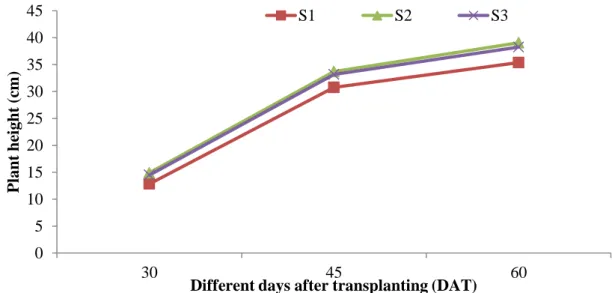
Plant height exhibits an important morphological attribute that acts as a potential indicator of availability of growth resources in its approach. Significant influenced was exerted on plant height by different spacing at different growth stages (Appendix V). From the results of the experiment showed that the tallest plant height (14.91, 33.70 and 39.05 cm at 30, 45 and 60 DAT, respectively) were observed from S2 (60 × 45 cm) treatment where the shortest plant height (12.85, 30.76 and 35.38 cm at 30, 45 and 60 DAT, respectively) were obtained from S1 (60 × 35 cm) treatment (Fig. 1).
The results showed that the plant height at different spacing was increased with the increasing of spacing. This might be due to receiving sufficient amount of light and nutrients. The trend of the present results was agreed to that of Khadir et al. (1989);
Singh et al. (2007); Khatun (2008) and Ullah, (2011). The present result does not agree with the finding of Meena (2003) where the author reported that there was no significant affect by increasing levels of spacing at all crop growth stages.
Fig. 1. Effect of different spacing on plant height at different days after transplanting of cabbage
Here, S1 = 60 × 35 cm, S2 = 60 × 45 cm and S3 = 60 × 55 cm 0
5 10 15 20 25 30 35 40 45
30 45 60
Plant height (cm)
Different days after transplanting (DAT)
S1 S2 S3