INFLUENCE OF STARTER SOLUTION AND MULCHING ON GROWTH AND YIELD OF BROCCOLI
MUTASIM FUAD SHUVO
DEPARTMENT OF HORTICULTURE
SHER-E-BANGLA AGRICULTURAL UNIVERSITY DHAKA-1207
JUNE, 2020
INFLUENCE OF STARTER SOLUTION AND MULCHING ON GROWTH AND YIELD OF BROCCOLI
BY
MUTASIM FUAD SHUVO REG. NO. 12-04834
A Thesis
Submitted to the Faculty of Agriculture Sher-e-Bangla Agricultural University, Dhaka
In partial fulfillment of the requirements for the degree of
MASTER OF SCIENCE IN
HORTICULTURE
SEMESTER: JANUARY- JUNE, 2020
Approved by:
Prof Dr. Mohammad Humayun Kabir Department of Horticulture
Sher-e-Bangla Agricultural University, Dhaka-1207 Co-Supervisor Prof. Dr. Khaleda Khatun
Department of Horticulture Sher-e-Bangla Agricultural
University, Dhaka-1207 Supervisor
Prof. Dr. Md. Jahedur Rahman Chairman
Examination Committee
It is a fact that the remembrance of Allah brings peace in the heart. It is better to ponder over the verses to bring us even closer to Allah (swt).
DEDICATED TO- MY BELOVED PARENTS
Department of Horticulture Sher-e-Bangla Agricultural University
Sher-e -Bangla Nagar, Dhaka-1207
CERTIFICATE
This is to certify that the thesis entitled “INFLUENCE OF STARTER SOLUTION AND MULCHING ON GROWTH AND YIELD OF BROCCOLI” submitted to the Department of Horticulture, Sher-e- Bangla Agricultural University, Dhaka, in partial fulfillment of the requirements for the degree of MASTER OF SCIENCE in HORTICULTURE, embodies the result of a piece of authentic research work carried out by Mutasim Fuad Shuvo, Registration No. 12-04834 under my supervision and guidance. No part of the thesis has been submitted for any other degree or diploma.
I further certify that any help or source of information, received during the course of this investigation has been duly acknowledged.
Dated:
Place: Dhaka, Bangladesh
………..
Prof. Dr. Khaleda Khatun Department of Horticulture Sher-e-Bangla Agricultural University
Sher-e-Bangla Nagar, Dhaka- 1207 Supervisor
i
ACKNOWLEDGEMENT
Author is prostrated before Almighty Allah, most merciful and beneficent, for giving the strength and courage to successfully complete the research work.
The author would like to express his sincere appreciation and gratitude to his Supervisor Professor Dr. Khaleda Khatun for her guidance and constant encouragement during his research. Her support and inspiring suggestions have been precious for the development of this thesis content.
The author also indebted to his Co-supervisor Prof. Dr. Mohammad Humayun Kabir and all teachers of Department of Horticulture, Sher-e-Bangla Agricultural University, who have been a constant source of encouragement and enthusiasm, not only during this thesis work but also during the two years of my masters program.
The author would like to express his deepest respect and boundless gratitude especially to Prof. Dr. Md. Jahedur Rahman, Chairman, Department of Horticulture, Sher-e-Bangla Agricultural University, Dhaka for his active help and moral support in pursuing the study.
His deepest gratitude goes to his family for their unflagging love and unconditional support throughout his life and his studies. They made him live the most unique, magic and carefree childhood that have made him who he is now.
Finally, the author wishes to thank all his fellow for being there in all the hard work and sharing his joys and sorrows.
- Author
ii
INFLUENCE OF STARTER SOLUTION AND MULCHING ON GROWTH AND YIELD OF BROCCOLI
BY
MUTASIM FUAD SHUVO ABSTRACT
A field experiment was accomplished in the Horticulture farm of Sher-e-Bangla Agricultural University, Dhaka during the period from October 2018 to March 2019 to study on influence of starter solution and mulching on growth and yield of broccoli. The experiment comprised of four levels of starter solution viz., S0
(Control), S1 (1% Starter solution), S2 (1.5% Starter solution) and S3 (2% Starter solution) and four levels of mulching viz., M0 (no mulch), M1 (Black polythene), M2
(Water hyacinth) and M3 (Rice straw) were used in this experiment arranged in Randomized Complete Block Design (RCBD) with three replications. Data on different growth and yield attributes parameters were taken in which all the treatment showed significant variations. In the case of starter solution, maximum plant height (71.41 cm), number of leaves (15.35), canopy spread (78.86 cm) and weight of primary curd (416.41 g) were recorded from S3 (2% urea solution) treatment. In the case of mulching, maximum plant height (73.02 cm), number of leaves (16.00), canopy spread (80.81 cm) and weight of primary curd (442.24 g) were recorded from M1 (Black polythene) treatment. The maximum yield (19.67 t/ha) was recorded from S3 (2% Starter solution) and on the other hand, the lowest yield was 14.83 t/ha) obtained from S0. Significantly higher yield (21.00 t/ha) was recorded from M1 (Black polythene) while the lowest yield (12.88 t/ha) M0
treatment. In the case of the combination effects the maximum yield (24.07 t/ha) was recorded from the treatment combination of S3M1 while the lowest yield was (11.87 t/ha) recorded from S0M0 treatment. The economic analysis revealed that 2%
starter solution with Black polythene treatment was the best combination in respect of net return (604339 Tk.) with a benefit cost ratio of (2.69), it was apparent from the above results that the treatment combination of S3M1 was more profitable than rest of treatment combinations.
iii
CHAPTER Title Page No.
ACKNOWLEDGEMENT i
ABSTRACT ii
TABLE OF CONTENT iii-iv
LIST OF TABLES v
LIST OF FIGURES vii
LIST OF APPENDICES viii
ABBREBRIATION ix
I INTRODUCTION 1-3
II REVIEW OF LITERATURE 4-17
2.1 Review on influence of starter solution and
mulching on the growth and yield of broccoli 4
III MATERIALS AND METHODS 18-27
3.1 Experimental site 18
3.2 Climate 18
3.3 Soil 18
3.4 Plant materials 19
3.5 Treatment of the experiment 19
3.6 Design and layout of the experiment 19
3.7 Land preparation 20
3.8 Application of manures and fertilizers 20
3.9 Preparation of starter solution 22
3.10 Raising of seedlings 22
3.11 Transplanting and after care 22
3.12 Gap filing 22
3.13 Intercultural operation 23
3.13.1 Weeding 23
3.13.2 Irrigation 23
3.14 Pest and Disease control 23
3.15 Harvesting 23
3.16 Methods of Data collection 24
3.16.1 Plant height 24
3.16.2 Number of leaves per plant 24
3.16.3 Leaf length 24
3.16.4 Leaf breadth 24
3.16.5 Plant canopy 25
3.16.6 Stem length 25
3.16.7 Stem diameter 25
3.16.8 Weight of primary curd 25
3.16.9 Diameter of primary curd 25
iv
3.16.10 Number of secondary curds per plant 25
3.16.11 Weight of secondary curd 25
3.16.12 Yield per plant 26
3.16.13 Yield per unit plot 26
3.16.14 Yield per hectare 26
3.17 Statistical Analysis 26
3.18 Economic analysis 26
IV EXPERIMENTAL RESULTS 27-61
4.1 Plant height 28
4.2 Number of leaves per plant 31
4.3 Leaf length per plant 35
4.4 Leaf breadth 38
4.5 Canopy spread 41
4.6 Stem length 44
4.7 Stem Diameter 47
4.8 Diameter of primary curd 49
4.9 Weight of primary curd 50
4.10 Number of secondary curd per plant 53
4.11 Weight of secondary curd 53
4.12 Yield per plant 54
4.13 Yield per plot 55
4.14 Yield per hectare 57
4.15 Economic analysis 60
4.15.1 Gross return 60
4.15.2 Net return 60
4.15.3 Benefit Cost Ratio 60
V SUMMARY AND CONCLUSION 62-63
REFERENCES 65-72
APPENDIX 73-77
v
LIST OF TABLES Table
No.
Title Page
No.
1 Effect of starter solution on plant height of broccoli at different days after transplanting
29 2 Effect of mulching on plant height of broccoli at different days
after transplanting
30 3 Combined effect of starter solution and mulching on plant
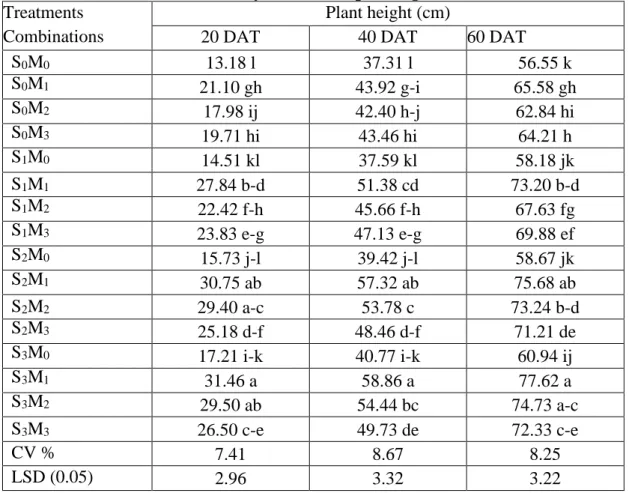
height of broccoli at different days after transplanting
31 4 Combined effect of starter solution and mulching on number of
leaves per plant at different days after transplanting (DAT) of broccoli
35
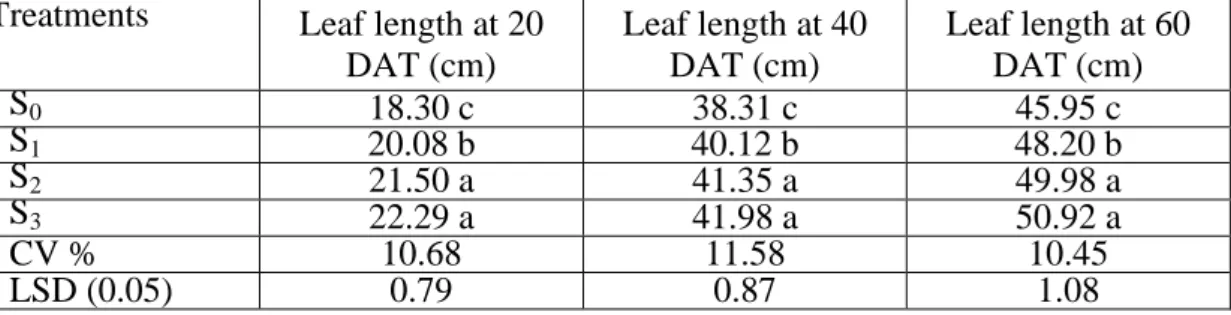
5 Effect of starter solution on leaf length of broccoli at different days after transplanting
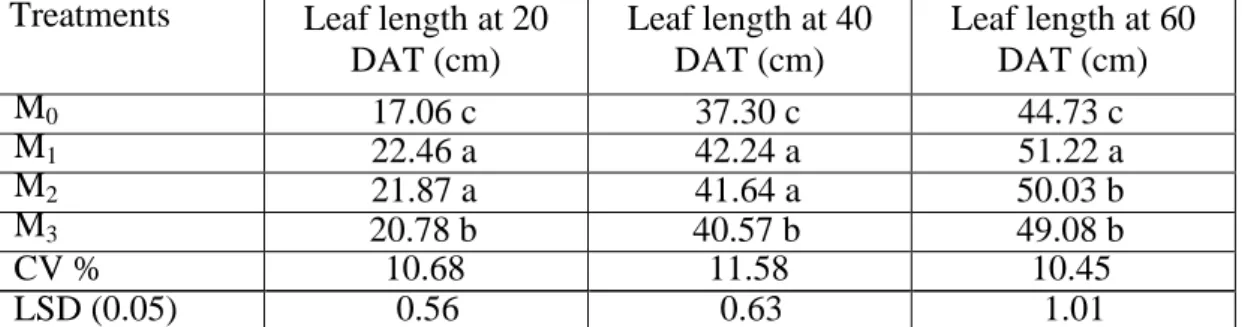
37 6 Effect of mulching on leaf length of broccoli at different days
after transplanting
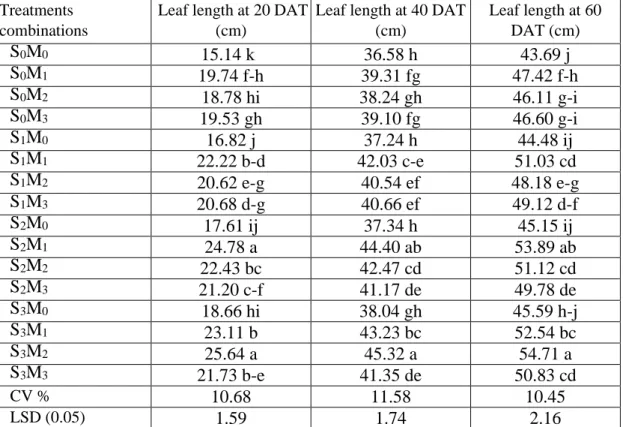
37 7 Combined effect of starter solution and mulching on leaf length
of broccoli at different days after transplanting
38 8 Effect of starter solution on leaf breadth of broccoli at different
days after transplanting
40 9 Effect of mulching on leaf breadth of broccoli at different days
after transplanting
40 10 Combined effect of starter solution and mulching on leaf
breadth of broccoli at different days after transplanting
41 11 Combined effect of starter solution and mulching on canopy
spread of broccoli at different days after transplanting
44 12 Effect of starter solution on stem length of broccoli at different
days after transplanting
46 13 Effect of mulching on stem length of broccoli at different days
after transplanting
46 14 Combined effect of starter solution and mulching on stem
length of broccoli at different days after transplanting
47 15 Effect of starter solution on stem diameter of broccoli at harvest 48 16 Effect of mulching on stem diameter of broccoli at harvest 48 17 Combined effect of starter solution and mulching on stem
diameter of broccoli at harvest
49 18 Effect of starter solution on primary curd weight, primary curd
diameter, no. of secondary curd per plant and weight of secondary curd of broccoli at different days after transplanting
51
19 Effect of mulching on primary curd weight, primary curd diameter, no of secondary curd per plant and weight of secondary curd of broccoli at different days after transplanting
52
vi Table
No.
Title Page
No.
20 Combined effect of starter solution and mulching on primary curd weight, primary curd diameter, no. of secondary curd per plant and weight of secondary curd of broccoli at different days after transplanting
52
21 Effect of starter solution and mulching on yield per plant, yield per plot and yield
56 22 Cost and return of broccoli cultivation as influenced by starter
solution and mulching
56 23 Effect of starter solution and mulching on yield per plant, yield
per plot and yield
59 24 Cost and return of broccoli cultivation as influenced by starter
solution and mulching
61
vii
LIST OF FIGURES
Fig. No. Title Page No.
1 Layout of the experimental field 21
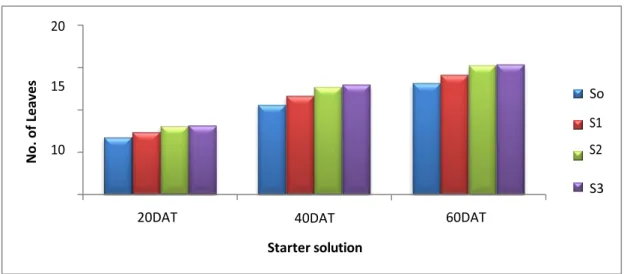
2 Effect of starter solution on number of leaves of broccoli at different days after transplanting
32
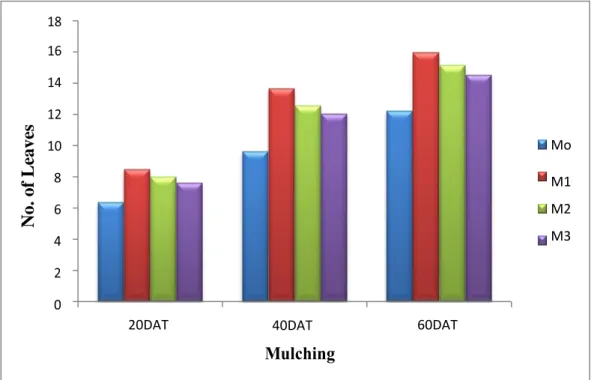
3 Effect of mulching on number of leaves of broccoli at different days after transplanting
33
4 Effect of starter solution on canopy spread of broccoli at different days after transplanting
43
5 Effect of mulching on canopy spread of broccoli at different days after transplanting
43
6 Effect of starter solution on yield of broccoli at harvest 57 7 Effect of mulching on yield of broccoli at harvest 58
viii
LIST OF APPENDICES
Appendix
No. Title Page
No.
1 Monthly record of air temperature, rainfall, relative humidity and sunshine of the experimental site during the period from October 2018 to February 2019
73
2 Characteristics of Horticulture Farm soil as analyzed by Soil Resources Development Institute (SRDI), Khamar Bari, Farmgate, Dhaka.
73
3 Analysis of variance on plant height and number of leaves per plant of broccoli
74 4 Analysis of variance on leaf length and leaf breadth of broccoli 75 5 Analysis of variance on canopy spread, stem length of broccoli 75 6 Analysis of variance on stem diameter, primary curd weight,
primary curd length and primary curd diameter of broccoli
76 7 Analysis of variance on number of secondary curd per plant,
weight of secondary curd, yield per plant, yield per plot and yield per hectare
76
8 Cost of production of broccoli per hectare 77
9 Overhead cost of broccoli per hectare 77
ix
ABBREVIATIONS AND ACCORONYMS
AEZ Agro-ecological Zone Agric. Agricultural
ANOVA Analysis of Variance
BARI Bangladesh Agricultural Research Institute Biol. Biology
CV Coefficient of variance DAT Days After Transplanting et al. And others
Ex. Experiment
FAO Food and Agriculture Organization of the United Nations
g Gram
Hort. Horticulture i.e. That is
J. Journal
Kg Kilogram
LSD Least Significance difference
mm Millimeter
RCBD Randomized Complete Blocked Design Res. Research
SAU Sher-e-Bangla Agricultural University Sci. Science
spp. Species
Technol. Technology
UNDP United Nations Development Programme Viz. Namely
% Percent
LAI Leaf Area Index RGR Relative Growth Rate NAR Net Assimilation Rate
MSTAT Michigan State University Statistical Package for Data Analysis etc. Etcetera
1 CHAPTER-I INTRODUCTION
Broccoli (Brassica oleracea var. Italica L) is an important winter vegetable crop under Brassicaceae family, which is originated from west Europe. It ranks at fourth place after cauliflower, cabbage and knolkhol among the Cole crops. In Bangladesh it was introduced about two decades ago. It is a minor vegetable in Bangladesh and commercial cultivation of broccoli has been increased especially in the area of Dhaka, Rajshahi and Gazipur districts. Broccoli is fairly rich in vitamin A and C and contains appreciable amounts of calcium, phosphorus, riboflavin, thiamin, niacin, and iron (Thompson and Kelly, 1997 and Lincoln, 1987). Watt (1983) reported that broccoli is more nutritious than any other cole crop such as cabbage, cauliflower and kohlrabi.
In our country, the average per capita vegetable consumption in a day is less than 50% to the recommendation. As population of our country increase rapidly, so to fulfill the demand of this increasing population we need to cultivate huge amount of good quality broccoli. Moreover, broccoli is environmentally better adapted and withstand comparatively at higher temperature than cauliflower. It can be grown on a wide range of soil types, ranging from light sand to heavy loam or, even clay that are well supplied with organic matter. Its cultivation is highly profitable as well. So, this research will play a vital role in improving the socio-economic condition of the farmer and attaining food security in Bangladesh.
Broccoli produces smaller flowering shoots (side curd) from the leaf axil after the harvest of main apical curd. Consequently, a broccoli may be harvested over a considerable period of time. Its has wider environmental adaptability, higher nutritive value, good taste, less risk of crop failure and various biotic and abiotic factors indicate that there is enough scope for its large-scale cultivation.
2
It is grown in Bangladesh during the cool or rabi season. Its cultivation has not been expanded much beyond the farms of different agricultural organizations.
This is mainly due to lack of awareness regarding its nutritional value and method of production. Broccoli is environmentally better adapted than cauliflower and reported to withstand comparatively higher temperature than cauliflower (Rashid, 1976). Its preference to the consumers is increasing day by day.
Successful production of broccoli depends on various factors where fertilizer management and mulching both are important that contribute in the production and yield of broccoli. Starter solutions are mixtures of soluble fertilizer and water that facilitates the young plants to have a good start. Starter solution provides a ready source of nutrition near the absorbing zone of the seedlings just after transplanting & provides a quick recovery of transplanted seedlings. The time between uprooting and establishment of young and tender seedings in the fields is very critical. Cabbage, cauliflower, tomato responded better to starter solution in minimizing the transplanting shock and are encouraged to a quick growth (Chhonkar and Jha, 1963).
Though Bangladesh is one of the highly precipitated areas of the world with an average yearly rainfall of 200 cm, the distribution of the rain is not even in respect of time and place. Broccoli is generally cultivated in Bangladesh during the winter season when rainfall is scanty. But for the whole growing period broccoli requires 250-300 mm water with more emphasis to transplanting and curd formation stage (Ahmed and Shahjahan, 1991).
In most of the time irrigation expenses and increase the cost of production. The necessity of irrigation is not only costly but also its facilities are inadequate.
Therefore, mulching in this regard may be helpful in conserving soil moisture of the preceding season.
3
Any practice that acts as a barrier to the evaporation of water or heat from the soil surface can be defined as mulching. Artificial mulching, covering the soil surface with plant species, crop residues or polythene sheet, which are generally used in the production of horticultural crops like potato, onion, zinger cabbage, cucurbits etc (Wilhoit et al., 1990). The hay or rice straw of the previous crops can also be used as mulching. This practice suppresses weeds resulting in higher yield and quality produce
Therefore, mulching in this regard may be exploited to produced broccoli successfully particularly where rainfall and irrigation facilities are scarce and even where irrigation is available, mulching may be used as the substitute to minimize the cost of production. Mulching can minimize the requirement of water and helps in retaining moisture (Amal et al. 1990). Mulches also reduce the water loss from the soil by evaporation and reduce the irrigation requirements (Prihar et al. 1986). Mulching improves soil physical conditions by enhancing biological activity of soil flora and fauna and increase soil fertility (Lal, 1978).
Considering the above facts, the present experiment was undertaken to study the effect of starter solution and mulching material on the following objectives-
• To determine the effect of starter solution on growth and yield of broccoli.
• To select the appropriate mulching material for broccoli production as an alternative to irrigation.
• To evaluate the combined effect of starter solution and mulching material on growth and yield of broccoli with evaluate the relative cost and return in broccoli production.
4
CHAPTER-II
REVIEW OF LITERATURE
A brief review of the literature pertaining to the “Influence of starter solution and mulching on growth and yield of broccoli” is presented in this chapter. An attempt has been made to cite all available literature on broccoli but due to paucity of adequate published information, research work on other related vegetable crops has also been reviewed.
2.1 Review on influence of starter solution and mulching on the growth and yield of broccoli
Starter solution influences quick recovery of transplanted seedling and quicker establishment. Early setting or quick recovery of transplanted seedling using starter solution has been studied and reported by a number of workers.
Roy et al. (2010) conducted an experiment with starter solution and GA3 at the Horticulture Farm of Bangladesh Agricultural University, Mymensingh during the period from October, 2001 to February, 2002 to study the effect of starter solution and GA3 on growth and yield of cabbage. The two-factor experiment consisted of four levels of starter solution, viz., 0, 1.0, 1.5 and 2.0% of urea, and four concentrations of GA3, viz., 0, 25, 50 and 75ppm. The application of starter solution and different concentrations of GA3 influenced independently and also in combination on the growth and yield of cabbage. The highest yield (104.93 t/ha) was obtained from 1.5% starter solution which was significantly different from other solutions, and the lowest yield (66.86 t/ha) was recorded from the control. Significantly the highest yield (104.66 t/ha) was found from 50 ppm GA3, while the lowest yield (66.56 t/ha) was recorded from control. In case of combined effect, the highest yield of cabbage (121.33 t/ha) was obtained from the treatment combination of 1.5% starter solution + 50 ppm GA3 followed by 1.5% starter solution + 75 ppm GA3 (115.22 t/ha), while the lowest yield (57.11 t/ha) was produced by the control treatment. Economic analysis revealed that
5
1.5% starter solution + 50 ppm GA3 treatment was the best treatment combination in respect of net return (Tk. 173775.00) with a benefit cost ratio of 3.5.
Islam et al. (1989) conducted an experiment with starter solution on cabbage and found that starter solution has a significant effect on the production of marketable yield of cabbage. They also found that the highest marketable yield was obtained from the treatments of 1.5% and 2% urea solution and while the untreated seedlings gave the lowest yield.
Kadam et al. (1983) observed that a commercial starter solution named ‘Suphala’
was used on cabbage gave maximum yield compared to the non- treated control.
Shi et al. (1984) observed that addition of nitrogenous fertilizer in the starter combinations resulted in initiating modification in the root system of transplanted autumn cabbage seedlings through the associated micro flora in the soil and ultimately increased the growth. They found that the starter solution increased the marketable yield of cabbage.
Patil et al. (1979) revealed that starter solution used by dipping the roots of seedling in the solution was effective in minimizing the shock of uprooting of seedling, vigorous growth and bigger head formation which ultimately increased the total yield. They also used urea solution alone in different concentration as starter solution on “Golden Acre” variety of cabbage. They found that a significant increase in yield was obtained due to early recovery and non- mortality of cabbage seedlings occurred.
Henmis et al. (1973) reported that sodium nitrate (NaNO3) or ammonium sulphate as starter solution improved the early growth and yield of broccoli.
6
Mohanty and Nema (1970) conducted an experiment with starter solution on cabbage and reported that the application of starter solutions, NAA and IBA alone or in various combinations at transplanting time had beneficial effects on the growth, yield and quality of cabbage. Of a number of treatments applied the highest yield of heads (420.35 q/ha) resulted from 0.1 p.p.m. NAA plus a 1: 1: 2 solutions of urea, K2SO4 and single superphosphate. This treatment also advanced maturity by 13 days.
Chhonkar and Sharma (1966) reported that using urea in combination with single superphosphate and potassium chloride at the ratio of 1:2:1 and also ammoniumsulphate and single superphosphate at the ratio of 1:2 as starter gave minimum number and larger size of outer leaves, bigger and heavier heads. They found that increased marketable yield of cabbage due to starter solution treatment.
Chhonkar and Jha (1963) reported that the transplanting operation of the seedling disturbs the soil root relationship, and crops like cabbage, cauliflower, tomato and chilies responded well when treated-with starter solution and plant growth regulators. They found that use of starter solution on cabbage increased as much as 150 percent of yield in cabbage over control.
Chaudury and Singh (1960) reported that starter solution has influence on vigorous growth of both underground and aerial part and also cabbage head.
Chhonkar (1959) conducted an experiment with starter solution and found positive effect on early recovery, vigorous growth of root and shoot.
El-Afifi et al. (2014) conducted two experiment at a Farm in El-Shahyna Village Kafrelsheikh Governorate (North Delta), Egypt, during the two successive winter seasons of 2012 and 2013 to study the effect of starter solutions of NPK fertilizers in soil and foliar application of some stimulants (amino acids and
7
seaweed extract) as well as their interactions on growth and yield of Chinese cabbage plants (Brassica rapa L. subsp. pekinensis) cv. (Manoko). Four starter fertilizers treatments included three sources of N, i.e., ammonium sulfate (20.5
% N), ammonium nitrate (33.5 %) and urea (46%) as well as without starter solution and two sources of stimulants. The results indicated that, starter solutions treatments resulted in highly significant increases in stem length, stem diameter, whole stem weight, number of total leaves/ plant and fresh weights of outer leaves (inedible), inner leaves (edible), total leaves / plant and weights of total yield (whole head) and marketable yield (edible head) compared with the control treatment (without starter solution) in both seasons.
Stone (2000) reported that a higher maximum yield was obtained with starter fertilizer. Starter fertilizer (N) was supplied as an N was applied as ammonium phosphate or urea ammonium nitrate. There was no difference in fresh weight when comparing starter fertilizer of N with broadcasted N at 120 kg N ha-1 which gave the highest yield. At lower levels of applied N starter fertilizer gave a higher yield than broadcasted N. This is a reduction by ¾. Starter containing ammonium phosphate with 20 kg N ha-1 gave identical yield as 240 kg N ha-1 broadcast which is a huge reduction. This shows a much higher efficiency of starter fertilizer than broadcasted N
Soniya (2018) conducted field experiments to study effect of starter solution and age of seedling on growth and yield of broccoli (Brassica Oleracea Var. italica) and she found that the highest yield (24.32 t/ha) was obtained from S2 (2% urea) treatment, whereas the lowest yield (13.21 t/ha) was recorded from S0 (0% urea) treatment. For three level of age of seedling the highest yield (20.75 t/ha) was obtained from A2 (30 days old seedling) treatment and the lowest yield (15.48 t/ha) was recorded from A3 (40 days old seedling) treatment. In case of combined effect the highest yield (26.91 t/ha) of broccoli was obtained from the treatment combination of S2A2 while the lowest (13.41 t/ha) was obtained from S0A3
treatment combination. Economic analysis revealed that S2A2 treatment
8
combination was the best in respect of net return (3,24,890) with benefit cost ratio of 2.5. So it may be concluded that 2% starter solution and 30 days age seedling was best for growth and yield of broccoli.
Shimaa and Abd-ElKader (2016) conducted field experiments to study effect of starter fertilizer as soil application, calcium nitrate as foliar application and its interaction on the growth, yield and chemical components of cabbage. The results showed that soil application starter solution increased the vegetative growth and head yield characters of cabbage plant and nutrition quality of cabbage head.
An experiment was conducted by Ma and Kaib (2006) at AVRDC to evaluate the effects of starter solutions in combination with inorganic and organic fertilizers on the initial growth and overall yield of cabbage, cherry tomato, sweet pepper and chili pepper. Small amounts of inorganic fertilizer were prepared as a liquid fertilizer and applied immediately after transplanting and/or at critical periods during crop growth. These applications significantly boosted early growth and overall yields of all vegetables tested. It also enhanced the release of nutrients from organic composts.
Stone (2006) conducted an experiment on the effects of starter and found that starter fertilizer improved early growth and maintaining yield and quality of cauliflower.
Mitra et al. (1990) reported that increasing nitrogen rates increased head weight from 127 to 159 g, increased head width from 8.0 to 9.7 cm, increased length and width of hollow stem, but did not significantly increase the incidence of hollow stem. They also reported that the increase in total chlorophyll content was resulted from increasing rates of N application. It was reported that, increasing rates of N gave higher yield, but decreased sugar and dry matter contents.
9
However, the external quality of the curd and ascorbic acid content was not affected by the rates of N.
Roy et al. (1990) investigated the effect of mulching using water hyacinth, straw and sawdust mulch on production of cabbage and reported significant increase in crop growth rate (CGR). Net assimilation rate (NAR). And leaf area index (LAI). Water hyacinth significantly increased the content of chlorophyll-b along with the growth of cabbage.
Lourduraj et al. (1996) obtained maximum plant height (81.5 cm) and number of laterals (8.6 per plant) in tomato cv. CO-3 with the application of black LDPE mulch as compared to use of organic mulch and control (without mulch).
Kalisz and Cebula (2001) reported that the application of plastic covers considerably improved plant growth i.e. increase in plant height, rosette diameter, and the total number of leaves. Area build-up were observed when soil mulch was spread 1-2 days before beginning of field experiment. When using the soil mulching with polythene black film and plant covering with non-woven polypropylene and perforated polythene film on the growth and yield of four cultivars of Chinese cabbage (Akala F1, Optico F1, Sumiko F1 and Parkin F1).
Moniruzzaman et al. (2007) conducted a field experiment on cauliflower var.
Rupa for two consecutive years from November, 2000 to March, 2002 in sandy clay loam soil at Agricultural Research Station, Raikhali, Rangamati Hill District to observe the effect of irrigation intervals and mulch materials on its yield, yield attributes and profitability. Twenty combinations of treatments consisting of four levels of irrigation i.e. (no irrigation = control, irrigation at 7, irrigation at 14 and irrigation at 21 days interval) and five levels of mulching (no mulch (control), black polythene mulch, rice straw mulch, sun grass mulch and mango leaves`
mulch) were used for this trial. Result showed that irrigation at 7 days interval and mulching with black polythene independently as well as in combination
10
produced maximum values for yield attributes and marketable yield of cauliflower. The highest curd yield 30.38 t/ha was obtained from 7 days irrigation interval with black polythene mulch.
Juan Diaz-Perez (2009) studied the effect of color of plastic film mulch (black, blue, gray on black, red, silver on black, and white on black mulches) and bare soil and observed that colored plastic film mulches affected root zone temperature and the accumulation of soil degree-days. Mean daily RZT (Root Zone Temperature), maximal daily RZT (21 °C up to 25 °C) and degree day accumulation in the soil were highest in dark colored mulches (blue, black, red, and gray) and lowest in light-colored mulches (silver and white). However, minimal daily RZT was found highest in silver and white mulch. The colored plastic mulches also affected plant growth and yield of broccoli significantly.
Parmar et al. (2013) studied the effect of different mulching materials on growth, yield and quality of water melon cv. Kiran and found that all the plant growth characters i.e. number of branches per vine (14.90), number of fruits per vine (3.23), fruit weight (3.61 kg), fruit yield (35.37 t/ha) were found superior with silver colour on black polyethylene mulch.
Nakaande (2013) conducted an experiment on “Fertigation and mulching incabbage (Brassica oleracea var. capitata L.). Scheduling of irrigation at 60 per cent Ep resulted in significantly higher plant height. However plant spread, number of non-wrapping leaves and wrapping leaves were highest at 80 per cent Ep. Mulching also significantly improved plant height, wrapping leaves and plant spread. Interaction of irrigation and mulching had significant effect on all other vegetative characters of cabbage.
Kwambe et al. (2014) reported that use of different mulches provide essential benefits in crop production. This study was carried out to determine the effect of organic and inorganic mulches on green bean (Phaseolus vulgaris L.) growth,
11
development and yield on a clay loam soil of Matsapha, Swaziland. The study indicated that black polythene; clear polythene and grass mulches significantly (P < 0.05) affected the growth of green bean on a clay loam soil. However, black polythene mulched plants exhibited highest growth parameters as compared to other mulch treatments.
Jasim et al. (2014) studied Influence of polyethylene, soil mulch and foliar application of urea complete fertilizers, seaweed in alleviating salt stress of Broccoli (Brassica Oleracea var. Italica) and found that the interaction between soil mulch and foliar treatments found highly significant and effect which resulted in increased leaf area as compared to control.
Mohammed et al. (2016) conducted an experiment to assess the effect of mulching and organic fertilizer on growth, yield and quality of Broccoli (Brassica oleracea var italica) and observed that the mulching significantly increased plant height, leaf area, leaves number/plant, number of branches/plant as compared to control.
Halappa and Sreenivas (1973) harvested 75 per cent yield of cauliflower over black polythene mulched plots in first 3 weeks, while they collected only 32 per cent yield in the control during the same period. The yield increase observed in case of 100, 200 and 300 gauge film mulches over control were 39.5, 41.01 and 44.9 per cent, respectively.
Gattorman (1992) studied the effects of plastic film mulch on yield of cabbage and found that single layer of polythene and propylene resulted either in an earlier or higher yield than that of double layer in chinese cabbage.
Burnette et al. (1993) studied the economic implications of nitrogen fertilization, drip irrigation and plastic culture on cole crops and tomato grown sequentially.
Black plastic mulch treatment tended to produce higher yield of greater broccoli
12
than non-mulched treatment. The soil nitrate concentration was also found higher throughout the growing season in the mulched plots as compared to non- mulched plots.
Poll and Geven (1996) studied the effect of mulches (black paper, black polythene and straw) on iceberg and butter head lettuces, leeks, Cichorium intybus, chinese cabbage and paksoi crops in the Netherlands. They reported that mulches significantly reduced the incidence of Phytophthora porri in leek and increased yield of iceberg and butter head lettuce and winter leek. Mulch application was economically beneficial for leek, but not for lettuce. The nitrogen leaching to ground water was decreased with application of mulches.
Hossain (1999) observed that maximum gross and marketable yield (116.67 t/ha and 97.53 t/ha) were obtained from black polythene mulch and the lowest from control.
Campiglia et al. (2000) studied the effect of mulches and observed that mulching with polythene increased soil temperature at all depths compared with non- mulched soil. They also reported that mulch significantly reduced weed density (70per cent) but not the weed biomass compared with the control.
Runham et al. (2000) reported that use of paper mulch resulted in increased soil moisture levels in non-irrigated courgettes but not in irrigated celery compared to non-covered soil. They also found that both paper and plastic mulches gave similar or higher mean head weight in broccoli. From another experiment they concluded that soil temperature beneath the paper mulch was lower than both the non-mulched and black polythene-covered plots.
Islam et al. (2002) reported the effect of planting time, mulching and irrigation intervals on growth and yield of cabbage cv. Atlas-70. The treatments consisted of 3 planting times, i.e. 15 November, 30 November and 15 December and 10
13
levels of mulching and irrigation, i.e. no mulch and no irrigation (control), irrigation at 15 days interval, irrigation at 30 days interval, irrigation at 45 days interval, ash mulch, straw mulch, sawdust mulch, water hyacinth (Eichhornia crassipes) mulch, black polyethylene mulch, and rice husk mulch. The results indicated that highest gross yield (71.85 kg/plot) was obtained from the black polyethylene mulch followed by water hyacinth mulch (65.99 kg/plot).
Considering marketable yield, both black polyethylene (103.01 t/ha) and water hyacinth mulch (90.99 t/ha) exerted statistically similar effects followed by irrigation at 15 days interval (85.86 t/ha).
Sarker et al. (2003) conducted an experiment to assess the effect of different source of nutrients and mulching on growth and yield of cabbage. The experiment consisted of four levels of nutrients and three mulching material and observed that the use of black polythene sheet mulch produced maximum marketable yield (70.24 t/ha). The treatment combination of organic + inorganic fertilizers with black polythene sheet mulch gave highest marketable yield (97.83 t/ha) of cabbage.
Ali (2004) carried out an experiment to study the effects of mulching and different levels of nitrogen on growth and yield of broccoli and reported that maximum average yield (16.4 t/ha) was obtained from 220 kg N/ha with black polythene mulch.
Faruque (2004) carried out an experiment to study the effects of different sources of nutrients and mulching on growth and yield of broccoli and observed that maximum average yield (18.2 t/ha) was obtained from organic + inorganic fertilizer with black polythene mulch while minimum yield was observed in without fertilizer + mulch and irrigation treatment.
Singh and Mir (2005) carried out a trial to investigate the effects of different types and colours of mulches on yield and yield-attributing traits of cabbage cv.
14
Pride of India and observed more head weight per plant with black and red polyethylene mulches as compared to control. The black polyethylene also suppressed drastically the weed growth by 96.82 per cent and also recorded maximum net returns of Rs 1,19380.00/ha, followed by the red polyethylene mulch (Rs 115992.00/ha).
Kashyap et al. (2005) conducted a field trial to study the effect of drip irrigation at different levels of evaporation replenishment rate (EPR; 60, 80, 100 and 120 per cent of USWB class A pan evaporation), with or without black plastic mulch.
They reported highest broccoli yield of 25.14 t/ha under drip irrigation treatment at 120 per cent EPR with black plastic mulch, while the lowest yield of 9.22 t/ha was recorded in the furrow-irrigated plants.
Gandhi and Bains (2006) observed that tomato crop under straw mulch produced higher number of branches (8.7), fruit weight (28.08 g) and total yield (496.3 q/ha) as compared to without mulch.
Moniruzzaman et al. (2007) conducted a field experiment on cauliflower (var.
Rupa) to observe the effect of irrigation and mulch materials on its yield, yield attributes and profitability and found that irrigation at 7 days interval and mulching with black polythene independently as well as in combination of both produced maximum values for yield attributes and marketable yield of cauliflower. The maximum curds yields of 30.38 and 29.40 t/ha were obtained from 7 days irrigation interval with black polythene mulch.
Kashyap et al. (2009) investigated the effect of different irrigation regimes and polythene mulch on yield, quality and water use efficiency in broccoli variety Pusa KTS-1. Treatments constituted with four drip irrigation regimes viz., 60, 80,100 and 120 per-cent of evaporation replenishment rate and two levels of mulching viz., without mulch and mulch with black polythene along with a furrow irrigation treatment. Broccoli was irrigated fortnightly based on available
15
soil moisture depletion. Result revealed that the head diameter (20.25 cm) and head weight (603.50 g) were maximum under drip irrigation at 120 percent evaporation replenishment with black polythene mulch.
Easmin et al. (2009) studied the effect of different levels of nitrogen and mulching on growth of chinese cabbage and reported that highest marketable yield per hectare of Chinese cabbage (123.27 t) was recorded in black polythene mulch and lowest yield (76.51 t) was recorded in control (without mulch). In each and every case maximum yield contributing characters and yield was observed in 250 kg N/ha and black polythene mulch and the reverse result was recorded in control condition i.e. without nitrogen and mulch.
Carvalho et al. (2011) studied the response of mulching material and different irrigation intervals with moderately saline water and found that mulching and irrigation intervals (12 hr) affected the cabbage yield with maximum water use efficiency (110.49 Mg/ha/mm).
Diaz-Perez et al. (2012) found that marketable and total floret yield and individual floret weight of broccoli were maximum with the application of wheat straw as mulch material and minimum in control.
Nakaande (2013) conducted an experiment to assess the respone of fertigation and mulching on cabbage (Brassica oleracea var. capitata L.)” and reported that treatment combination of F3M1 (75 per cent of fertilizer dose + silver-black polythene mulch) recorded significantly higher net head weight. Mulching with silver-black polythene sheet proved to be a very good practice for overall growth and yield of cabbage.
Yaghia et al. (2013) found that use of black plastic mulch enhanced vegetative growth of cucumber and significantly increased its productivity (70, 53 and 17 per cent) under the influence of all drip irrigation treatments (transparent plastic
16
mulch, black plastic mulch and without mulch) as compared to the surface furrow irrigation.
Masarirambi et al. (2013) reported that the white plastic and sawdust mulches conserved moisture when ‘Savoy’ baby cabbage grown during the warm season and based on the results of study they recommended mulching with white plastic or sawdust in order to realise near perfect growth and yield, as well to conserve soil moisture and weed suppression by white plastic.
Deshmukh et al. (2013) reported that the crop yield was found maximum under black plastic mulch with 80 per cent of CWR (Crop Water Requirement) through drip irrigation system, followed by paddy straw mulch and without mulch with drip system in a split plot design. The benefit cost ratio was found maximum (2.14) with 80 per cent of CWR through drip irrigation system and black plastic mulch.
Kosterna (2014a) conducted an experiment to find out the effect of different types of straw mulches on weed-control in vegetables cultivation and observed that the application of higher dose of rye and buckwheat straw in broccoli, corn and rape seed in tomato cultivation reduced number of weeds compared to control.
Kosterna, (2014b) conducted a field experiment to study the yield and quality of broccoli grown under flat covers with soil mulching and reported that increase of the content of chemical components as a result of plants covering amounted to 1.76 per cent for dry matter, 2.50 mg/100 g fresh matter (FM) for ascorbic acid, 0.65 per cent FM for total sugar and 0.15per cent FM for monosaccharides.
All kinds of straw contributed to an increase in the broccoli yield and yield attributing characters.
17
Saloom and Sahaf (2016) carried out an experiment to investigate the effect of organic and mineral fertilization and soil mulching on quality characteristic of broccoli and found the superiority of black plastic mulch M1 with respect to higher TSS per cent, Vitamin C content, high Folic acid, carbohydrate and protein content in curd (8.8 %), (89.62 mg./100g), (54.80 mg./100g), (7.06 %) and (26.77 %), while low nitrate content of curd (0.76 mg/g), respectively compared with control (M0).
18
CHAPTER-III
MATERIALS AND METHODS
This chapter deals with the materials and methods that were used in execution of the experiment. It includes a short description of experimental site, characteristics of soil, climate, materials used, data collection, statistical analysis and cost and return analysis. The details of these are described below.
3.1 Experimental Site
The experiment was conducted at the Horticulture Farm of Sher-e- Bangla Agricultural University, Sher-e-Bangla Nagar, Dhaka, during the period from October 2018 to February 2019. The experimental site was previously used as vegetable garden and recently developed for research work. The location of the site is 23° 74'N latitude and 90° 35' E longitude with an elevation of 8.2 meter from sea level (Anon, 1981).
3.2 Climate
The climate of the experimental site is subtropical, characterized by heavy rainfall during the months from April to September (Kharif season) and scanty rainfall during rest of the year (Rabi season). The total rainfall of the experimental site was 218 mm during the period of the experiment. The average maximum and the minimum temperatures were 24.52°C and 13.86° C respectively. Rabi season is characterized by plenty of sunshine. The maximum and minimum temperatures, humidity and rainfall during the study period were collected from the Bangladesh Meteorological Department (climate division) and have been presented in Appendix I.
3.3 Soil
The soil of the experimental area belongs to the Madhupur Tract. The analytical data of the soil sample collected from the experimental area were determined in SRDI, Soil Testing Laboratory, Dhaka and presented in appendix II.
19
The experimental site was a medium high land and pH of the soil was 5.6. The morphological characters of soil of the experimental plots as indicated by FAO (1988) are given below – AEZ No. 28, Soil series – Tejgaon, General soil- Non- calcarious dark grey.
3.4 Plant materials
The test crop used in the experiment was broccoli variety Premium and the seeds were collected from Siddique Bazar, Dhaka.
3.5 Treatment of the experiment The experiment consisted of two factors:
Factor A: Different level of starter solution (Urea) S0= 0% Starter solution (control)
S1= 1 % Starter solution S2= 1.5% Starter solution S3= 2% Starter solution Factor-B (Mulching)
M0 =No Mulching (Control) M1= Black polythene
M2=Water hyacinth M3=Straw
There were 16 (4 × 4) treatments combination such as S0M0, S0M1, S0M2, S0M3, S1M0, S1M1, S1M2, S1M3, S2M0, S2M1, S2M2, S2M3, S3M0, S3M1, S3M2, S3M3.
3.6 Design and layout of the experiment
The two factors experiment was laid out in Randomized Complete Block Design (RCBD) with three replications. The total area of the experimental plot was 181.56 m2 with length 26.7 m and width 6.8 m. The total area was divided into three equal blocks. Each block was divided into 48 plots where 16 treatments combination was allotted at random. There were 48 unit plots altogether in the
20
experiment. The size of each plot was 1.8m × 1.2m. The distance maintained between two blocks and two plots were 0.7 m and 0.5 m, respectively. The layout of the experiment is shown in Fig. 1.
3.7 Land preparation
The selected plot of the experiment was opened in the 2nd week of October, 2018 with a power tiller, and left exposed to the sun for a week. Subsequently cross ploughing was done five times with a country plough followed by laddering to make the land suitable for transplanting the seedlings. All weeds, stubbles and residues were eliminated from the field. Finally, a good tilth was achieved. The soil was treated with insecticides (cinocarb 3G @ 4 kg/ha) at the time of final land preparation to protect young plants from the attack of soil inhibiting insects such as cutworm and mole cricket.
3.8 Application of manures and fertilizers
Manures and fertilizers were applied to the experimental plot considering the recommended fertilizer doses of BARI (2005).
Cow dung = 10 ton ha-1 Urea = 300 kg ha-1 TSP = 250 kg ha-1 MoP = 200 kg ha-1
The total amount of cow dung, TSP and MOP was applied as basal dose at the time of land preparation. The total amount of urea was applied in three installments at 10, 30 and 50 days after transplanting.
21 Fig 1. Layout of the experimental field
S0M0
S0M0
S0M0
S0M1
S0M1
S0M1
S0M2 S0M2
S0M2
S0M3
S0M3
S0M3
S1M0
S1M0
S1M0
S1M1
S1M1
S1M1
S1M2
S1M2
S1M2
S1M3
S1M3
S1M3
S2M0
S2M0
S2M0
S2M1
S2M1
S2M1
S2M2
S2M2
S2M2
S2M3
S2M3
S2M3
S3M0
S3M0
S3M0
S3M1
S3M1
S3M1
S3M2
S3M2
S3M2
S3M3
S3M3
S3M3
1.8m 1.2m
6.8m
26.7m
Factor A: Different level of starter solution S0= 0% urea solution (control) S1= 1 % urea solution
S2= 1.5% urea solution S3= 2% urea
Factor-B (Mulching) M0 =No Mulching (Control) M1= Black polythene M2=Water hyacinth M3=Straw
Experimental Layout:
plot to plot distance =0.5 m block to block distance =0.7m plot size =1.8m x 1.2m
1
replication =3 N
W E
S
22 3. 9 Preparation of starter solution
At first, 1, 1.5 and 2 g of urea were weighted and were dissolved in distilled water taken in three beakers. The solutions were then made to volume up to 100ml by water. The beakers were leveled and the solutions were ready for use.
3.10 Raising of seedlings
The seedlings of broccoli were raised at Horticulture Farm, Sher-e-Bangla Agricultural University (SAU), Dhaka, under special care in four seed beds each of 3m × 1 m size. For raising seedlings, the soil was ploughed and converted into loose friable and dried masses. All weeds, stubbles and dead roots were removed.
Cow dung was applied to the prepared seed beds at the rate of 10 t/ha. The seeds were sown in the seed beds of 2.5m x l m size on 21th October 2018. After sowing, the seeds were covered with a thin layer of soil. When the seeds germinated, shade by bamboo mat (Chatai) was provided to protect the young seedlings from scorching sun-shine and rain. Light watering, weeding and mulching were done as and when necessary. No chemical fertilizers were applied for raising the seedlings. Seedlings were not attacked by any kind of insects or diseases. The healthy 25 days old seedlings were transplanted in the experimental field on 19 November 2018.
3.11 Transplanting and after care
Healthy 25 days old seedlings were transplanted on 19th November, 2018 in the afternoon and light irrigation was given around each seedling for their better establishment. Each unit plot accommodated 9 plants. A number of seedlings were planted in the border of the experimental plots for gap filling.
3.12 Gap filing
Dead, injured and weak seedlings were replaced by new healthy seedlings from the stock kept on the border line of the experiment.
23 3.13 Intercultural operation
3.13.1 Weeding
Weeding was done three times in each plot to keep clear.
3.13.2 Irrigation
Light irrigation was given just after transplanting of the seedlings. A week after transplanting the requirement of irrigation was envisaged through visual estimation. Wherever the plants of a plot had shown the symptoms of wilting the plots were irrigated on the same day with a hosepipe until the entire plot was properly wet.
3.14 Pest and Disease control
Few plants were damaged by mole crickets and cut worms after the seedlings were transplanted in the experimental plots. Cut worms were controlled both mechanically and spraying Diazinon 60 EC @ 0.55 Kg per hectare. Some of the plants were infected by Alternaria brassicae. To prevent the spread of the disease Rovral @ 2g /liter of water was sprayed in the field. Bird pests such as Nightingale (Common Bulbuli) visited the fields from 8 to 11 a.m. and 4 to 6 p.m. The birds were found to make puncture in the soft leaves and initiating curd and they were controlled by striking of a metalic container.
3.15 Harvesting
The harvesting was not possible on a particular date because curd initiation as well as curd maturation period in different plants were not similar probably due to use of different manures and genetic characters of varieties. The compact mature curds were only harvested. After harvesting the main curd, secondary shoots were developed from the leaf axils, and produced small secondary curds.
Those were harvested over a period of time. The crop under investigation was harvested for the first time on January 15, 2019 and the last harvesting was done on February 08, 2019.
24 3.16 Methods of Data collection
The data pertaining to the following characters were recorded from six (6) plants randomly selected from each unit plot, except yield of curds which was recorded plot wise. Data on plant height was collected on 20, 40 and 60 days after transplanting and also at harvest. All other parameters were recorded at harvest.
3.16.1 Plant height
Plant height was measured in centimeter (cm) by a meter scale at 20, 40, and 60 days after transplanting (DAT) and at harvested from the ground level up to the tip of the longest leaf.
3.16.2 Number of leaves per plant
Number of leaves per plant of six randomly selected plants were counted at harvest. All the leaves of each plant were counted separately. Only the smallest young leaves at the growing point of the plant were excluded from counting.
3.16.3 Leaf length
A meter scale was used to measure the length of leaves. Leaf length of six randomly selected plants were measured in centimeter (cm) at harvest. It was measured from the base of the petiole to the tip of the leaf. All the leaves of each plant were measured separately. Only the smallest young leaves at the growing point of the plant were excluded from measuring.
3.16.4 Leaf breadth
Leaf breadth of six randomly selected plants were measured in centimeter (cm) at harvest from the widest part of the lamina with a meter scale and average breadth was recorded in centimeter (cm). All the leaves of each plant were measured separately. Only the smallest young leaves at the growing point of the plant were excluded from measuring.
25 3.16.5 Plant canopy
Plant canopy was measured by taking the diameter of the canopy of an individual plant in several directions with a meter scale and finally the average was taken and was expressed in centimeter (cm).
3.16.6 Stem length
Stem length was measured from the base of the curd to the tip after harvest. A meter scale was used to measure the stem length of curd and expressed in centimeter (cm).
3.16.7 Stem diameter
The diameter of the stem was measured at the point where the central curd was cut off Stem diameter was recorded in three dimensions with scale and the average of the three values was taken in centimeter (cm).
3.16.8 Weight of primary curd
The weight of primary or central curd per plant was recorded in gram (g) by a beam balance.
3.16.9 Diameter of primary curd
The diameter of primary curd was measured in several directions with meter scale and the average of all directions was finally recorded and expressed in centimeter (cm).
3.16.10 Number of secondary curds
When the secondary curds reached marketable size. They were counted; the small shoots were not taken into consideration.
3.16.11 Weight of secondary curd
Weight of secondary curd was recorded by weighing the total axillary curds of an individual plant and was expressed in gram (g).
26 3.16.12 Yield per plant
The yield per plant was calculated by adding the weight of central curd and the weight of the secondary curds harvested and the yield was weighed in gram (g).
3.16.13 Yield per unit plot
The yield per unit plot was calculated by adding the weight of central curds and the weight of the secondary curds. The yield of all plants in each unit plot was recorded and was expressed in kilogram (kg).
3.16.14 Yield per hectare
The yield per hectare was calculated by converting the per plot yield data to per hectare and was expressed in ton (t).
3.17 Statistical Analysis
The data obtained for different characters were statistically analyzed by using MSTAT-C computer package program to find out the significance of the difference for starter solution and mulching on yield and yield contributing characters of broccoli. The mean values of all the recorded characters were evaluated and analysis of variance was performed by the ‘F’ (variance ratio) test.
The significance of the difference among the treatment combinations of means was estimated by Duncan’s Multiple Range Test (DMRT) at 5% level of probability (Gomez and Gomez, 1984).
3.18 Economic analysis
The cost of production was analyzed in order to find out the most economic combination of starter solution and mulching. All input cost included the cost for lease of land and interests on running capital in computing the cost of production.
The interests were calculated @ 13% in simple rate. The market price of broccoli was considered for estimating the cost and return. Analyses were done according to the procedure of Alam et al. (1989). The benefit cost ratio (BCR) was calculated as follows
Gross return per hectare (Tk) Total cost of production per hectare (Tk)
X 100 BCR =
27
Plate 1. Seed sowing in seedbed Plate 2. Preparation of starter solution
Plate 3. Transplant of seedling Plate 4. Mulching operation
Plate 5. Data collection of harvested broccoli
28
CHAPTER-IV
RESULTS AND DISCUSSION
Results of the experiment entitled “Influence of starter solution and mulching on growth and yield of broccoli”, conducted during Rabi season 2018-19 at Horticulture Farm, Sher-e-Bangla Agricultural University, Dhaka are presented in this chapter. The observations pertaining to growth and yield attributes of sprouting broccoli recorded during the course of investigation were statistically analyzed and significance of results verified. The analyses of variance for all data have been presented in Appendices I to X. The results of all the main effects and only significant combination have been presented in succeeding paragraphs.
Some of the characters have also been represented graphically to show the treatment effect wherever necessary to provide better understanding of the results.
4.1 Plant height
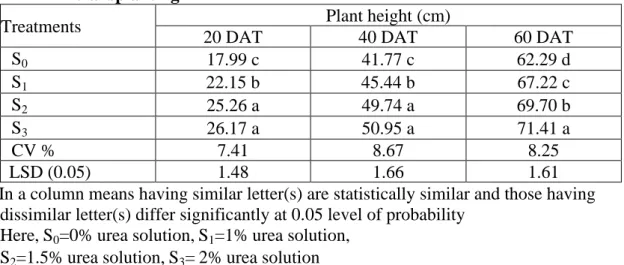
Plant height increased significantly with the increased percentage of starter solution at 20, 40 and 60 DAT (Table 1). At 20 DAT, the maximum plant height (26.17 cm) was recorded from S3 (2% starter solution) treatment and minimum plant height (17.99 cm) was observed from S0 (control) treatment (Table 1). At 40 DAT, the tallest plant (50.95 cm) was recorded from S3 (2% starter solution) treatment. On the other hand, the lowest plant height (41.77 cm) was observed from S0 treatment. At 60 DAT, the tallest plant (71.41 cm) was recorded from S3
(2% starter solution) treatment followed by S2 (69.70 cm) treatment while the lowest plant height (62.29 cm) was observed from S0 (control) treatment. Plant height was found statistically different at 20 DAT to 60 DAT. This might be due to the fact that starter solution i.e. urea solution minimized the transplanting shock and increased urea uptake for the plant that has helped the plant to start a good beginning. The present result of the study is supported by the findings of Chhonkar and Jha (1963).
29
Table 1: Effect of starter solution on plant height of broccoli at different days after transplanting
Treatments Plant height (cm)
20 DAT 40 DAT 60 DAT
S0 17.99 c 41.77 c 62.29 d
S1 22.15 b 45.44 b 67.22 c
S2 25.26 a 49.74 a 69.70 b
S3 26.17 a 50.95 a 71.41 a
CV % 7.41 8.67 8.25
LSD (0.05) 1.48 1.66 1.61
In a column means having similar letter(s) are statistically similar and those having dissimilar letter(s) differ significantly at 0.05 level of probability
Here, S0=0% urea solution, S1=1% urea solution, S2=1.5% urea solution, S3= 2% urea solution
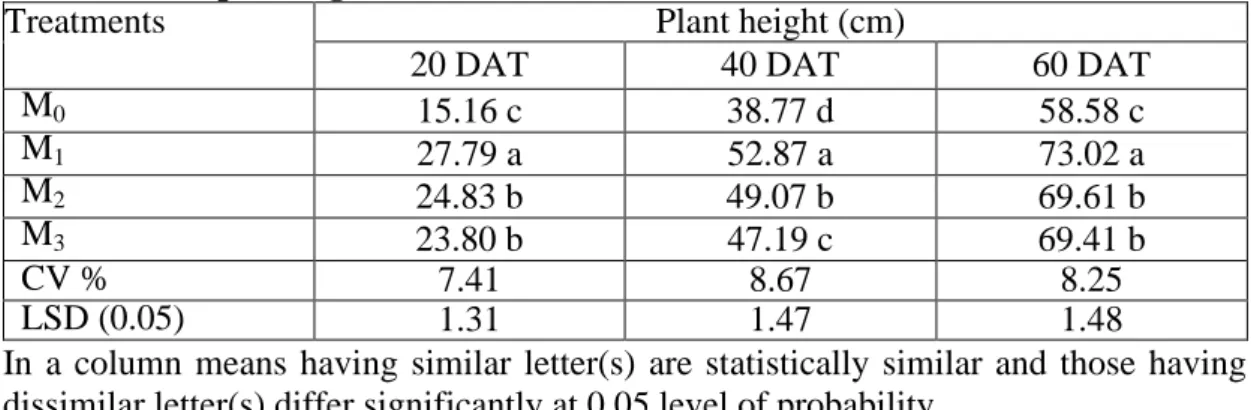
Application of mulching showed significant influence on the height of broccoli plants at 20, 40 and 60 DAT (Table 2). At 20 DAT, the maximum plant height (27.79 cm) was measured from M1 (Black polythene) treatment followed by (24.83 cm) M2 (water hyacinth mulch) treatment and the minimum plant height (15.16 cm) was recorded from M0 (control) treatment. Again at 40 DAT, the maximum plant height (52.87 cm) was recorded from M1 (Black polythene) treatment followed by M2 (49.07 cm) treatment. On the other hand, the minimum plant height (38.77 cm) was recorded from M0 (no mulch) treatment.
At 60 DAT, the maximum plant height (73.02 cm) was measured from M1 (Black polythene) treatment followed by M2 (69.61 cm) treatment and the minimum plant height (58.58 cm) was recorded from M0 (control) treatment. It was revealed that the plot covered by mulching gave better plant height then control.
This might be due to mulching increased crop growth rate (CGR), net assimilation rate (NAR), leaf area index (LAI) and relative growth rate (RGR).
Similar result was found by Roy et al. (1990) on growth of cabbage.