No. 82 November 2018
Rumana Ali Raihana Azim Upoma
Hasne Ara Begum Ashrafuzzaman Khan
Mohammad Rafi Mrinmoy Samadder
Gender Climate of BRAC
An Assessment
Gender Climate of BRAC
An Assessment
Rumana Ali Raihana Azim Upoma
Hasne Ara Begum Ashrafuzzaman Khan
Mohammad Rafi Mrinmoy Samadder
November 2018
BRAC Research and Evaluation Division
Copyright © 2018 BRAC November 2018
Edited by: AM Shamsuddula
Copy editing, printing and publication Altamas Pasha
Cover design Sajedur Rahman Layout design Md Abdur Razzaque
ISSN 2414-3367
Published by
BRAC Research and Evaluation Division
BRAC Centre | 75 Mohakhali | Dhaka 1212, Bangladesh Tel: (88-02) 9881265, 9846448, 9844180-7
Fax: (88-02) 9843614 | Web: www.research.brac.net
BRAC/RED publishes research reports, scientific papers, monographs, working papers, research compendium in Bangla (Nirjash), proceedings, manuals and other publications on subjects relating to poverty, social development and human rights, health and nutrition, education, gender, environment and governance
Printed by
CONTENTS
Acknowledgements Abstract
Chapter 1. Background 1
1.1 Conceptualisation of gender climate
1.2 BRAC’s journey for promoting gender equality and women empowerment
3 7
Chapter 2. Objectives of the study 11
2.1 Operational definition of gender climate
2.2 Definition and explanation of the key concepts of the study 2.3 Measuring the gender climate in brac: key areas of
interventions
11 12 13
Chapter 3. Methods 15
3.1 Study design, area and population 15
Chapter 4. Findings 21
4.1 Background of respondents 4.2 Gender responsive workeplace 4.3 Career and professional development 4.4 Work and life balance
4.5 Affirmative action and special needs of female staff 4.6 Overall assessment of workplace
21 27 42 47 60 64
Chapter 5. Discussion and conclusion 71
References 75
Annexes 79
ACKNOWLEDGEMENTS
Several people contributed with their support, advice and assistance for the study. We would particularly like to thank them. We are grateful to Late Dr.
Mohammad Rafi, former Head of Research, BRAC Research and Evaluation Division for his intense guidance and valuable comments from the designing stage to field implementation of the study. We are also thankful to Mr Samir Ranjan Nath, Programme Head, Education Research Unit of RED for his valuable guidance to finalise the report. In addition we want to show our heartfelt gratitude to Ms Anna Minj, Director, Community Empowerment Programme (CEP), Integrated Development Programme (IDP) and Gender Justice and Diversity (GJD) Programme and GJ&D team for their support and valuable comments from the beginning to end of this study. This research would not have been possible without their guidance and valuable inputs.
We express our heartiest gratitude to Dr Nazmunnessa Mahtab, Professor, Department of Women and Gender Studies, University of Dhaka for reviewing the paper intensively. Our sincere gratitude goes to AM Shamsuddula, Senior Manager, Knowledge Management for extensively editing the report.
Mr. Altamas Pasha, Manager Knowledge Management Unit also deserves special thanks for taking care of rest of the work of this research monograph.
Mr Abdur Razzaque also deserves thanks for formatting the report for publication. We are grateful to Professor Abdul Bayes, former Director, RED, for allowing us the publication as a monograph.
Last but not least, we are grateful to all of our respondents who are also our colleagues for making this work possible by providing us with all the required information. We felt privileged to have their trust on us that allowed them to share their very personal experiences with us.
ABSTRACT
BRAC strives for achieving gender equality through the empowerment of women and the transformation of gender relations within the organisation and communities. Therefore, BRAC’s commitment towards gender equality is manifested in policy procedures, systems and mechanism and within interventions at the communities in various ways. Objectives of this study was to see the workplace environment of the organisation offers to its staff from the gender perspective. It was a cross-sectional study designed to understand the perception of gender climate among the BRAC staff working in Bangladesh. The data was collected during November 2015 to July 2016.
A total of 37,552 employees were involved in different stages of the official operations of BRAC and the data was collected from the representative sample. The study employed a complementary method of blending qualitative and quantitative approaches in relevance to the key intervening areas and objectives. A structured questionnaire was employed to collect quantitative data, and for qualitative data, in-depth interviews were applied.
The BRAC’s efforts of offering an equal workplace to all staff regarding equal pay and capacity building opportunity to ensure justice in the workplace for all employees have been reflected in the findings of the study. On the other hand, the study revealed female respondents’ struggle to make their places in terms of respect, recognition and valuation within and outside the organisation. In terms of sexual harassment, the study indicates that most of the respondents have no such experience at their workplace. Majority of the respondents reported having the positive relationship with their supervisors and senior colleagues. However, compared to their male counterparts, female respondents have a lower level of positive reflection on the issues of equal opportunity and professional development, salary, benefit, rewards and promotion. Moreover, although majority of the respondents of both gender, show positive expression about their workplace, the challenges they reporting regarding their workplace should be addressed to ensure a positive gender climate.
Keywords: Gender equality, workplaces, sexual harassment, gender policy
CHAPTER ONE
BACKGROUND
Gender is determined by the conception of tasks, functions and roles attributed to women and men in the society and public and private life (SDC 2003). It is a socially and culturally constructed relationship between men and women (Oakley 1972). It shapes- how we identify ourselves and view the world and how others identify and relate to us, and how we are positioned within social structures. Since the relationship is hierarchal in the traditional patriarchal system feminists and development activists, work to make the relationship equal by ensuring equal rights and treatment for both sexes in all sphere, both in private and public. Although the effort of establishing equality and women’s rights started earlier, the focus on the issue of workplace equality was manifested in the feminist agenda in the 1960s. Since then feminists are working against gender inequalities in the workplace, where in most cases the victims are women due to their subordinated position in the status quo.
Renzetti and Curran (1998) described the various forms of gender inequalities women face in the workplace: occupational sex segregation, the glass ceiling and the male-female earnings gap. There is a tendency among women and men to be concentrated in different types of jobs in the labour market. The situation of the labour market is such that men tend to be concentrated in occupations labelled as ‘masculine’ while women in those considered as
‘feminine’ (De Meyer et al. 1999). Although this type of segregation results in limited opportunities of employment for both sexes, the consequence is more negative for women since jobs associated with women or femininity usually carry less prestige and rewards, and by maintaining this segregation women are kept locked into these jobs, and thus in the lower level of job hierarchy. Moreover, women are prevented by creating invisible barriers to hold the managerial position in spite of having motivations, ambitions and capacity for that position of power and prestige. This situation has been termed as glass ceiling that has been defined as “a transparent barrier that kept women from rising above a certain level in corporations. ...It applies to
women as a group who are kept from advancing higher because they are women (Morrison et al. 1987: 13)”.
Despite increased rate of women’s participation in the workforce, the available literature indicates that women are victims of gender discrimination in the workplace. The nature of gender discrimination at work environment is perceived based on the cultural component of gender ideology, the structural features of sex segregation and formal policies, and the behaviours of institutional actors who apply and enforce such policies in everyday work settings (Bobbit and Zeher 2011, p.765). Therefore, due to occupational sex segregation and glass ceiling the women remain at the bottom of the job hierarchy and earn less (Chevalier 2007; Taniguchi and Tuwo 2014).
Sexual harassment is one of the major indicators that confirm the existence of inequality in the workplace (MacKinnon 1979). Sexual harassment, the term coined by feminists in 1976 refers to “unwanted sexual advances, whether touches, looks, pressures to have sex, or even jokes” (Henslin and Nelson 1996, p.300). Many research on sexual harassment against women also found an inseparable relationship with masculinity which is not a given character; rather, it is learned through various cultural and historical periods. Connell’s (1987) theory of hegemonic masculinity provides a broad sociological framework for understanding harassment, gender and power. In the workplace context, sexual harassment can be explained as the act of policing “doing gender” in the workplace and of penalising gender nonconformity (West and Zimmerman 1987). Therefore, ideological positioning that individual’s experience is the condition that influences how they act, react, and exert power. Thus, ‘power’ cannot be separated from the experience of sexual harassment. Put in other way, both men and women can be the victim of sexual harassment if they fail to act according to social expectation, for example, men may become vulnerable if they are considered as feminine (DeSouza and Solberg 2004; Waldo, Berdahl, and Fitzgerald 1998), and women may be targeted if they are perceived to have challenged their subordinated position in the gender system.
BRAC considered its past gender equality achievements boosted women’s empowerment in areas of mass awareness raising, participation and decision-making through programme interventions. While, in organisation development, highest priority given to cultural shift in aligns with BRAC values. Although women have given more opportunities and priorities in developing BRAC’s policies, new programme interventions and in leadership vision; but BRAC organisational gender assessment still show significant areas need to address to transform a gender-responsive organisation culture (BRAC Gender Audit 2010). BRAC’s organisational commitment stated also in policy goal “to be responsive and to promote gender equity and equality within the organisation and ensure that all its programmes, intervention activities and research serve the needs and interests of women and men
equally and work to eliminate all forms of discrimination against women”
(BRAC Gender policy 2007, p.12). This policy document stands on the principles of sustainable development, men engagement as a development partner, empowerment of women, gender-responsive work environment and all individual BRAC staff will act as a change agent (pp.12-13). If we look at the gender equity efforts in organisation development of BRAC, it actually started during the 1990s, introducing gender training, women-friendly recruitment policy, emphasising more women recruitment and fast-tracking them in management. Until then BRAC leaders are seriously concerned with the issues of the gender-responsive work environment, cultural prejudices in male and female professional behaviours, attitudes, practices, and the issues of harassment/abuse.
Over the last decades, BRAC is trying to develop its own ‘institutional culture model’ which can transform traditional gender attitudes, behaviours and values. For that, BRAC is continuously trying to vacuum out the norms and values which are the product of social prejudices influenced and constituted organisational culture as well as track the organisational drive for promoting a gender-responsive work environment.
1.1 CONCEPTUALISATION OF GENDER CLIMATE
The “gender climate” is relatively a new discourse amidst the gender and development sectors and most probably a completely new paradigm in Bangladesh. To define the term, a wide range of available literature (documents review, programme reports, and online based literature) had been speculated to generate an understanding on the perceptions of gender climate with respect to gender and gender-related issues in order to initiate the objectives of this study.
Defining gender climate within an institutional environment, Buchana et al. (2013) had emphasised on few aspects such as an equitable and fair standard of promotion, opportunities for career and professional development, flexible working hours, respect and dignity in the workplace, learning environment, and a secured workplace without sexual harassment.
To interpret the conception of gender climate, scholars had also referred to a congenial working environment, which contributes to equal recognition of men and women.
Similarly, the Calvin College, 2013, had stated that gender climate refers to an equitable gender balance in the institution that provides a welcoming working environment, which recognises and supports to the varying needs of employees in balancing work and family responsibilities. It has also indicated that “family-friendly benefits” which includes interventions such as
such as flexible work schedules, childcare referrals, and leaves of absence that constitute a productive working environment in an organisation.
Feminists stand in favour of the equal workplace as well as of equality in the public sphere in broader term has been reflected in feminist theories.
Liberal and poststructural feminism demands attention in the discussion of workplace equality. Liberal feminism advocates for equal pay and insists on making policies and practice that in turn creates sa level playing field for both sexes to compete on an equal footing (Donovan 2000). This liberal feminist view is predominantly used to create gender-equitable workplaces.
Liberal feminism urges to eliminate legislation and social convention that hinders women to enjoy equal opportunities in the workplace. They advocate for affirmative action, equal pay, and pregnancy benefits for female workers, maternity leaves and the establishment of childcare centres to ensure fairness in the workplace for all employees regardless of sex. Affirmative action is one of the liberal measures that need to be highlighted here. This measure aims to ensure equal employment opportunity specifically granting special consideration to racial minorities and women who have been historically disadvantaged to compete with men in the professional field or workplace.
While viewing gender climate in an educational institute, Bryant (2006), has pointed out that a cordial campus climate offers an environment that prizes equity and congeniality is far preferred over one that is discriminatory and inhospitable because it provides women’s safety and well-being of all constituents namely women, individuals with disabilities, and people with diverse ethnic backgrounds. The egalitarian attitudes toward gender roles in the workplace are amenable to the success and well-being. Trevino et al. (2005) have also indicated to having a pluralistic campus climate that is welcoming to all and that recognise and capitalise on the benefits of having diversity in terms of recruitment of different ethnic origins, sexual orientation, disabilities, and free from discrimination/harassment, which is conducive to cordial interactions among many groups. Khare and Owens (2006) have also indicated that climate survey is significant to assess a workplace environment (climate) in terms of liking, disliking, and productivity because it helps the campus to develop a cohesive plan to benefit all faculty members.
Furthermore, Paris and Schutt (2004) have defined gender climate as the following:
“Behaviors within a workplace or learning environment, ranging from subtle to cumulative to dramatic, that can influence whether an individual feels personally safe, listened to, valued, and treated fairly and with respect (Cited in Paris and Schutt 2004, p. 3) ”.
Organisational climate is the shared perceptions of the employees concerning the policies, practices and procedures that get rewarded and supported in a particular setting (Scandura and Lankau 1997). Gender climate refers to the
to interpersonal, learning and professional interactions.Organisational climate study also lead to several factors that can increase employee satisfaction commitment and understanding on factors that can guide organisational leaders in implementing strategies to improve work environment (Study Group on University Diversity 2008).
Work Climate affects productivity and effectiveness of employees, as well as their ability to provide an ideal professional learning environment for employees and to serve their community. It affects individuals’ opportunities to grow professionally and personally. One recent study of a selected group of leaders identified and prioritised workplace issues most important to attract, motivate, and retain future employees (Kroth and Peutz 2010). Fair treatment is an important factor in employee satisfaction and commitment (Ingram 2006). Some research suggests that intrinsic motivation and the opportunity for flexible schedules are likely to increase satisfaction and organisational commitment for women (Scandura and Lankau 1997). Positive climate results in better job satisfaction, better retention rates, and better human resource management practices. Positive climate has repeatedly been proven to have these effects on job satisfaction and employee retention (August and Waltman 2004).
Moreover, organisation culture is also broad term represents all aspects of organisational values and actions and how employees perceive the management of those aspects (The Health Foundation 2011). Climate assessment can address diverse areas and solicit anonymous opinion, attitude and suggestions from employees. There is no uniform standard format of study/ assessment instrument or administered process rather the construction of instrument depends on the purpose or objectives of the assessment/study.
Despite the fact that the number of women taken outside employment but still the majority of educated middle-class women are confined to domestic activities. The women experienced certain advantages over women who are not working in professional jobs, privileges that they share with the men of their class. Two of these are material in the broadest sense, the economic benefits of financial independence and the social benefit of increased autonomy and control over their own lives. The other two are psychological and concern self- identity, and increased esteem from others (Liddle and Joshi 1987, p72).
The material benefits have an impact on women’s sense of self. In terms of recognising benefits, the vast majority of women has raised how the job encourage the growth of self-confidence, enable them to achieve some self- identity apart from being the daughter or wife of a man, how they could keep in touch with the world.
An inclusive organisation embraced many women to be involved in the job market, non-traditional nature of work. That also has an influence on the gender distinctions and the interactions, portion of women and men in the family and society beyond the workplace. Sex discrimination at the workplace has found that equal opportunities continued to be hampered by women’s double burden of unpaid work at home combined with paid work outside. Moreover, a working woman has to face discrimination on the work front also. While they received equal pay with their male colleagues for equal work, however, at the time of promotions few women may reach to the higher positions. Further, the experience of working in a private/ NGO and the experience of a Government organisation may differ from individual to individual. If the organisation is gender sensitive, that will be reflected in policy and practices. This experience of an individual can develop their gender views as well as it can reflect through personal life to another sphere.
The focus has given on how the employees are treated differently in all the areas of working atmosphere with the change of organisation type. Another aspect is also considered, how a person experiences gender discrimination in the different organisations.
On the other hand, nature of a job gives individuals different experience on gender behaviour. The experiences can be gathered from the societal level, how they have taken the particular job and their perception reflected the individual. On the other hand, in work sphere, the nature of job can give different attitude to the individual, people who are around him/her. This attitude may be different for the same type of job for male and female.
Moreover, in any organisation, individuals are getting an environment, which can give them, negative or positive feeling about their work sphere. The working environment can give a person job satisfaction. The working environment is a more micro level factor among the broader concept of work sphere. In the same organisation, an individual can experience exploitation.
The nature of exploitation may be different for male and female in the same working environment. Here an organisational gender climate was assessed by conceptualising that organisation with gender-sensitive policies, how the individual attitude and behaviour differ and how male-female experienced gender discrimination as well as exploitation in different ways in the same working environment. Thus, gender climate and attitude assessment addresses diversified areas and solicit anonymous opinion, attitude and suggestions from employees. Furthermore, this could include the approach how gender has been translated into development planning and policy, at the level of institutional activities, in terms of addressing the internal dynamics of development organisation: policies, structures, systems and procedures;
and at the level of operational activities: including the reorientation of programmes and the nature of the work that organizations are engaged in (Rao et al. 1999).
Kabeer (1999) and Martin (2003) described how both men and women’s work experiences are affected by the dynamics of power structures, gendered norm dynamics and gender relations. Furthermore, these dynamics imbue all systems, structures, organisational and institutional cultures. As such, Ahmed and Khan (2016) suggest that in case of BRAC it had been difficult for women to be accommodated within the ‘male’ space of a office, particularly in the rural areas. Meanwhile, Rao and Kelleher (1998:124) noted that BRAC did respond to specific women-staff related issues, but only as they arose. Rather than looking at what special provisions women might have needed. Here, Ahmed and Khan (ibid) argue that the range of issues highlighted for women-staff were primarily based on biological needs, such as a lack of female toilets, issues of mobility and ‘desk leave’ during menstruation. Despite these attempts to accommodate women into BRAC, the organisational culture, space and ways of working still privileged men (Paris and Schutt 2004). Rao and Kelleher’s (1998) case study shows that although attempts were made to accommodate women into a male orientated set up, work was not undertaken to address the counter-culture values that surfaced nor had any planning taken place in terms of how BRAC would respond to the gendered changes that would accompany the introduction of women into these spaces, especially equal participation, personal growth, and professional advancement and ensure a sexual harassment-free work environment.
1.2 BRAC’s JOURNEY FOR PROMOTING GENDER EQUALITY AND WOMEN EMPOWERMENT
BRAC strives for achieving gender equality through the empowerment of women and the transformation of gender relations within organisations and communities. Over the last decades, BRAC’s commitment towards gender equality is manifested in policy procedures, systems and mechanism and within interventions at the communities in various ways. The following major steps have been taken towards achieving gender equality priorities of BRAC.
The 1980s: the decade of women as rural professionals.
The programmes or interventions like the Oral Rehydration Therapy Programme (OTEP), Microcredit, Legal Aid contributed to a huge social transformation where women act as an agent from household to community reached around 13 million households. Those also facilitated women’s greater mobility and spaces at public places reached the poorest and most vulnerable women for income generation and non-traditional professions in areas of entrepreneurship, health volunteers, barefoot lawyers etc. This decade had greater contribution to change women conditions and positions in the families and communities.
The 1990s: The decade of applying gender equality principles inside BRAC
The decade contributed to enhancing women participation and decision- making in organisational structures and formed Women’s Advisory Committee (WAC) to identify, help and redress barriers for women staff effective’ participation in BRAC. The effort also places in developing capacity and skills of different professional categories to facilitate analysis, capture gender inequality issues and forward problem solutions. Gender Quality Action Learning (GQAL) programme launched for all staff to improve staff relations and the quality of BRAC programmes. The year 1995 was also the milestone year when “Women only” recruitment policy adopted; BRAC attended world women conference in Beijing and presented papers in nine thematic areas on BRAC’s programmes intervention.
BRAC contributed in drafting National Women Development Policy of Bangladesh. BRAC introduced optional eight months leave without pay for women staff in addition to the three months paid maternity leave. GQAL programme scaled up as per the decision of BRAC founder Chairperson Sir Fazle Hasan Abed, KCMG. BRAC introduced its Gender Policy, values training, Daycare centre- DOLNA at the head office in 1997.
The 2000s: Decade of institutionalization of gender transformation
So, many transformative changes initiated for fostering women and girls empowerment and equality, i.e., Adolescent Development Programme (ADP), The Employment and Livelihood for Adolescent (ELA) programme, GQAL with village organisation members and with Challenging the Frontiers of Poverty Reduction: Targeting Ultra Poor (CFPR-TUP) Programme. At the organisational level, Gender Equality & Diversity Team (GEDT) platform formed established the dedicated Gender Justice & Diversity (GJD) Section and Sexual Harassment Elimination (SHarE) Unit. At the same time, organisational policy for maternity leave increased from three to four months, and paternity leave increased up to seven days.
The 2010s: The decade of strategic changes
BRAC did the first systematic review to assess how far organisational policy, system and mechanism enabled women and men to work together in an equitable, effective and mutually respectful manner in 2010. First ever BRAC Governing Board gender retreat held in 2011 and BRAC endorsed Gender Equality Goal (GEG) and actions for the organisation and
equality directions placed in BRAC Strategy 2010-2015. Further, BRAC introduced gender strategy for 2016-2020, which is closely aligned with BRAC strategic priority. The key strategic shift is the coordinated actions and ownership building among programmes for reducing violence against women and children and engaging men and boys for gender equality and women empowerment.
CHAPTER TWO
OBJECTIVES OF THE STUDY
The broad objective of this study was to evaluate the gender climate in BRAC. To achieve this objective the study aimed to meet the following specific objectives:
1. Identify to what extent, BRAC staff evaluate their workplace in terms of gender-responsive work environment, career and professional development, work-life balance and affirmative action and special needs of female staff.
2. Explore how do BRAC staff experience their workplace in terms of the above mentioned indicators.
2.1 OPERATIONAL DEFINITION OF GENDER CLIMATE
The operational definition of a positive gender climate for this study had been set. According to this, a positive gender climate in an organisation has following characteristics:
1. Professional behaviours within a workplace where an individual feels personally safe, listened to, valued, and treated fairly and with respect and dignity.
2. A secured workplace for both men and women without the prevalence of any kind of abuses such as sexual harassment.
3. A congenial working environment which contributes to equal recognition of men and women.
4. An equitable working environment where fair standards of promotion, opportunities for career and professional development and learning environment is in practice and operational.
5. An equitable and gender friendly working environment which recognises and supports to the varying needs of employees in balancing work and family responsibilities.
6. A workplace that offers flexible work schedules, childcare referrals constitute a productive working environment in an organisation.
7. A diverse and inclusive working environment which provides women’s safety and well-being, hospitable to individuals with disabilities, and people with diverse ethnic backgrounds.
8. A positive gender climate where gender needs and voices are equally valued at all levels of decision-making, planning and implementation within the organisation
2.2 DEFINITION AND EXPLANATION OF THE KEY CONCEPTS OF THE STUDY
To demonstrate the study, several terms and concepts have been defined and explained to measure the gender climate in terms of gender responsive work environment, knowledge, and level of skills, career opportunities, work and life situation, attitudes and behaviour of the employees in the organisation By the term gender friendly or responsive working environment (Malla et al.
2005), this study emphasises on provision of certain policies and facilities, which includes safe and secure workplace for women, special arrangement of security measures for women workers, maternity and paternity leave, breastfeeding time, childcare room, equal wages, and arrangement of separate sanitation facilities for women and men staff in an organisation.
By the term Career and Professional Development, this study inclines to indicate that human resources are valuable assets of an organisation and it is expected that every organisation should encourage its employees to develop their full potential with equal opportunities (University of California 2015). In other words, career and professional development denote to increasing capabilities of staff through access to education and training opportunities in the workplace, through outside the organisation, or through watching others’ expertise of performing the job that helps to build and maintain a competent workforce in the organisation.
By the term work and life balance, this study intends to posit that work and life balance encompasses prioritising between work (including career
and ambition) on one hand and life (including areas such as health, leisure, family, pleasure and spiritual development) on the other. It is a comfortable state of equilibrium achieved between an employee’s primary priorities of their employment position and their private lifestyle.
Above mentioned four components were used frequently to implement the study. Those thematic issues were the key intervention areas on which the study was concentrated to measure gender climate in BRAC.
2.3 MEASURING THE GENDER CLIMATE IN BRAC: KEY AREAS OF INTERVENTIONS
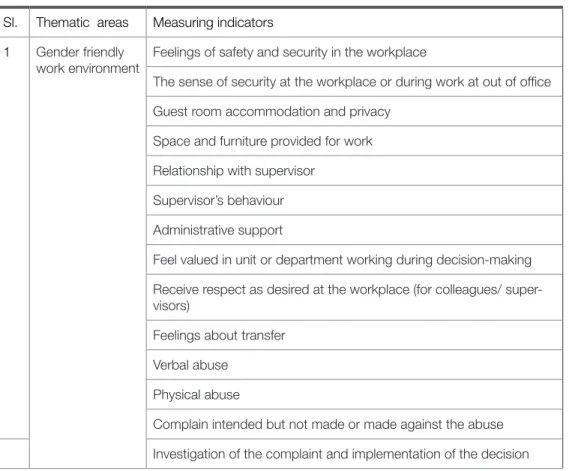
In order to meet the objectives of the study, the following thematic issues and concerning areas (Table 2.1) were covered to know the gender climate of BRAC through the survey.
Table 2.1 Indicators explored under major themes of assessing workplace
Sl. Thematic areas Measuring indicators 1 Gender friendly
work environment Feelings of safety and security in the workplace
The sense of security at the workplace or during work at out of office Guest room accommodation and privacy
Space and furniture provided for work Relationship with supervisor
Supervisor’s behaviour Administrative support
Feel valued in unit or department working during decision-making Receive respect as desired at the workplace (for colleagues/ super- visors)
Feelings about transfer Verbal abuse
Physical abuse
Complain intended but not made or made against the abuse Investigation of the complaint and implementation of the decision
[ Table 2.1 contd... ]
Sl. Thematic areas Measuring indicators
Preference received in the allocation of responsibilities in the job Inclusiveness in terms of disability, religion and other differences 2 Career and
professional development
Stereotypical practices in the division of labour at work Objectivity maintained in the promotion
Training opportunities for staff
Gender-related training provided to the staff Promotion/level change
Salaries and benefits and job responsibilities compatible with level and grades
Changes of designation and responsibilities go with financial incentives
Workload 3 Work and life
balance
Impact of work on the family:
Impact of the workplace on family life (children’s education, social life) Excessive work pressure
Enjoyment of weekend, vacations without worrying about office/
workload Health safety
Enjoyment of leave (earned, sick and maternity/paternity leave) BRAC’s role in domestic violence
Staff encourage friends and families to join BRAC 4 Affirmative action
and special needs of female staff
Flexi-time policy (Flexible working hours) during pregnancy, post- partum and lactation period
Provision of maternity and paternity leave as well as family leave Placement of staff convenient to maintain their family life The policy of flexibility during menstruation (desk work)
Consideration of family responsibilities in allocating work assignments by the managers
[ ...Table 2.1 contd ]
CHAPTER THREE
METHODS
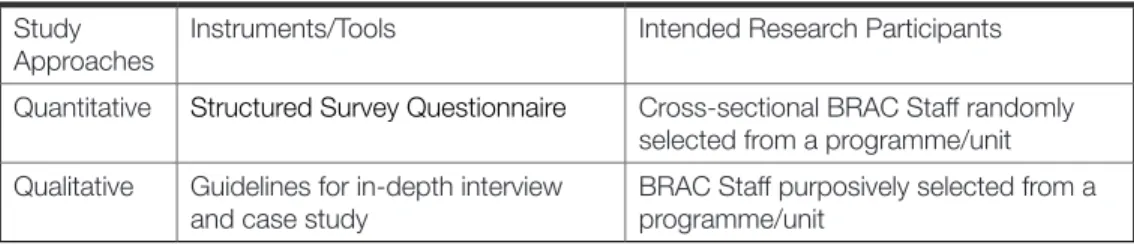
The study employed a complementary method of blending qualitative and quantitative approaches in relevance to the key intervening areas and objectives of the gender climate survey (Table 3.1). The study largely took qualitative approaches in its mode of data collection, analysis and presentation of the findings. Data gathered through structured questionnaire was core resources of the quantitative part. The following table described how the study was conducted.
Table 3.1 Study Approaches Study
Approaches Instruments/Tools Intended Research Participants Quantitative Structured Survey Questionnaire Cross-sectional BRAC Staff randomly
selected from a programme/unit Qualitative Guidelines for in-depth interview
and case study BRAC Staff purposively selected from a programme/unit
3.1 STUDY DESIGN, AREA AND POPULATION
It was a cross-sectional study designed to understand the perception of gender environment among the BRAC staff working in Bangladesh.
According to BRAC Human Resource department (2015) in Bangladesh, BRAC Head Office (HO) was covered by 112 regional offices, and these regional offices were again covered by 2949 area offices. A total of 37,552 employees were involved in different stages of the official operations; more precisely 1,727 employees were working at the HO level, 1,319 employees
were at the regional office level, and 34,506 employees were placed at the area office level. Two groups of respondents were interviewed for this study—male and female staff.
Sampling and sample size
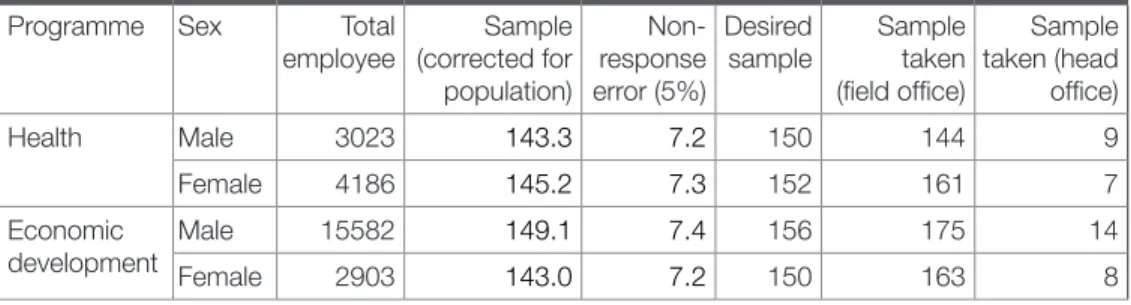
In a previous study conducted in 2006 on the perception of a campus climate with respect to gender and gender-related issues, about 11% of all employees had experienced sexual harassment by their supervisors at the workplace (SUNY Cortland, 2006). Using the single proportion formula, the calculated minimum sample size for each programme by sex is described in Table 3.2. Thus, we assumed
Desirable precision (%) : 5%
Expected prevalence (%) : 11%
Design effect : 0
Confidence level : 95 %
Sample size (first approximation) : 150.44
Based on the above approximation, the sample size was corrected by a number of employees of each programme category, and finally, the incremented sample was calculated considering non-response error (Table 2.2). Thus, the desired sample size was estimated as 1,470 employees.
In order to facilitate the study, programmes, divisions, and departments, henceforth referred to as units involved in the development and empowerment of the poor was considered in the study. The selection was made in a way that each of the ‘unit’ was considered and each gender had proportional representation in the sample. The sample was randomly selected from the staff list maintained by the Human Resource Division (HRD) of BRAC. The respondents for qualitative data collection were purposively selected to conduct the study.
Table 3.2 Allocation of the sample in five categories of programmes by employees’ sex
Programme Sex Total employee
Sample (corrected for population)
Non- response error (5%)
Desired sample
Sample taken (field office)
Sample taken (head office)
Health Male 3023 143.3 7.2 150 144 9
Female 4186 145.2 7.3 152 161 7
Economic
development Male 15582 149.1 7.4 156 175 14
Female 2903 143.0 7.2 150 163 8
Programme Sex Total
employee Sample (corrected for population)
Non- response error (5%)
Desired
sample Sample taken (field office)
Sample taken (head office)
Education Male 2577 142.1 7.1 149 136 7
Female 1923 139.5 7.1 146 106 13
Social empower- ment
Male 1339 135.2 6.9 142 143 15
Female 717 124.3 6.2 131 144 12
Support and others
Male 4152 145.2 7.3 152 152 209
Female 1150 133.0 6.7 140 129 56
All Male 26673 - - 751 750 254
Female 10879 - - 719 703 96
Both 37552 - - 1470 1453 350
This study followed a multi-stage cluster random sampling procedure.
Therefore, the sample had been selected by several steps. First, out of total 112 regional offices, 31 were selected randomly. Then, staff list in each regional office and also the list of staff worked in the area and branch offices under each regional office were collected. The area offices operated three or more than three programmes were singled out while in the case of branch offices, the required number of programmes for selection was four or more than four. Thus, the number of area office and branch office which met the criteria were 143 and 251 respectively. The initial plan was to collect data from seven field offices, in average, that made the number of total field office was 217, and it was 248 including 31 regional offices (31 regional offices X 7 field offices+ 31 regional office). Considering the total number of 217 field offices from which the data would be collected, a number of area and branch offices were calculated.
Therefore, the number of areas and branch offices were 79 and 138 respectively following the calculation as given below:
Number of area office = (143 area offices having 3 or >3 programmes X 217) 394 =79
Number of branch office = (251 branch offices having 4 or >4 programmes X 217) 394= 138
Total field office = 31 regional office + 68 area office + 118 branch [ ...Table 3.2 contd ]
office
= 79+138+31
= 248
Therefore, the data were collected from 248 field offices and head office. It must be mentioned here that, although our initial calculated sample size was 1,470 from both field and head offices, later it was increased to 1,803 for adjusting the gap, both sex and programme wise, found in some field offices during data collection by increasing the number of samples in head office, and also for including representative samples from the head office.
Data collection tools
A structured questionnaire was employed to collect data in the survey. It was a self-administered questionnaire containing 126 questions. A trained interviewer was present there with each interviewee to assist him/her if s/he needed any clarifications of any questions, although the questionnaires went through several field-test before it was employed for final data collection.
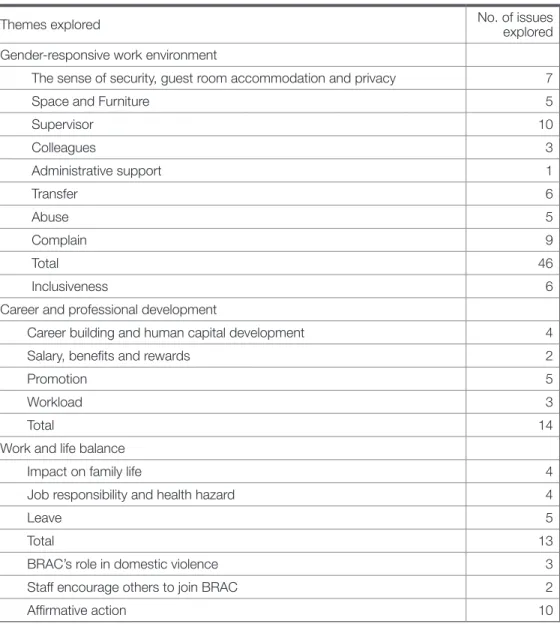
Ninety four questions were asked to know respondents’ feelings and experiences about their work climate in seven aspects: gender responsive work environment, career and professional development, work and life balance, BRAC’s role in domestic violence, work environment, affirmative action and inclusiveness. Out of total 126 questions, some questions aim to take respondents’ socioeconomic, educational and service related information, and few questions to know their stands about some issues, like their perception of the benefits of residential arrangement in office campus, impact of distance between residence and workplace on their work, variation in motivation of field visit by sex as well as their general feelings of the overall environment of their workplace, like whether they thought their workplace as women-friendly.
In-depth interview and observation had been conducted to know the real situation or experience of staff regarding the workplace.
Data analysis
Bivariate and multivariate analyses were done using SPSS version 17. The level of respondent’s perception about their workplace was measured by giving weight in each type of answer – where the maximum point for each question was three and the most negative answer regarding the workplace for each question contains zero points. In each case, a statement was given to respondents on which they were asked to give their opinion whether they agreed or not. Their opinions were captured in the four responses: completely positive, partially positive, and little positive, and fully negative.
Table 3.3 Issues explored to assess workplace environment from the gender perspective
Themes explored No. of issues
explored Gender-responsive work environment
The sense of security, guest room accommodation and privacy 7
Space and Furniture 5
Supervisor 10
Colleagues 3
Administrative support 1
Transfer 6
Abuse 5
Complain 9
Total 46
Inclusiveness 6
Career and professional development
Career building and human capital development 4
Salary, benefits and rewards 2
Promotion 5
Workload 3
Total 14
Work and life balance
Impact on family life 4
Job responsibility and health hazard 4
Leave 5
Total 13
BRAC’s role in domestic violence 3
Staff encourage others to join BRAC 2
Affirmative action 10
Total theme: 7, Sub-theme: 16, Total number of issues explored: 94
The scores of 94 questions, that reflected workplace situation, were summed up to know the respondents’ opinion and view about their workplace from the gender perspective. The score had been calculated for each broader theme to know the situation of each separately and then for all seven themes together to know the respondents’ overall perceptions of their workplace.
Therefore, the highest score for 94 questions was 282 while the lowest was
zero (0). The perception was seen by comparison between male and female respondents.
All the major themes were explored through several sub-themes, the mean score of each sub-theme by sex was also measured to know the situation from respondents’ viewpoint as well as to the difference they have in this regard by their sex.
Reliability and validity of the data collection
The study took some measures against biased data collection during the field survey. In order to receive cooperation and unbiased data from respondents it was important to take appropriate measures to overcome these problems, and accordingly, the study determined to take several measures:
• The intended respondents were briefed appropriately regarding the importance of the study.
• They were invited to give their consent in this study before collection of data.
• The study maintained confidentiality strictly during data collection.
All the respondents involved in the study remained anonymous.
• The respondents assured that the study would not disclose their identity during data collection process. Thus, the respondents were not worried about being identified and punished for expressing their feelings in the questionnaire.
• The respondents filled out the questionnaire by themselves without any interference by the researchers/field researchers.
• In the presence of the researchers/field researchers, the answer- sheet was preserved in a secured place to avoid exposure to any unanticipated research participants.
• The researchers/field researchers brought those to head office for data compilation and analysis.
CHAPTER FOUR
FINDINGS
It was mentioned earlier that both qualitative and quantitative data were collected to achieve the objectives of the study. This section starts with the discussion on a brief demographic profile of respondents followed by their service and residence-related information that will be relevant to understand the challenges and reality of their workplace. Next, the section will assess the workplace on the basis of themes mentioned earlier. In doing so, seven themes shown in Table 2.1 had been divided into four, bringing the similar issues together under one. For example, the findings related inclusiveness has been discussed under gender responsive workplace, and likewise, BRAC’s role in domestic violence and findings on respondents’ action of motivating others to take BRAC as the workplace has been described under the theme of work and life balance. Moreover, Exploration of the workplace through these criteria was explored in this study from the respondents’
perspective about the workplace they worked.
The survey was conducted among 1,803 staff of the head office and field office of BRAC, among that 55.6% were male while the rest were female.
4.1 BACKGROUND OF RESPONDENTS
This section started with the discussion on the demographic profile of respondents. The next section discussed their service related information in BRAC. Then, the section looked at limited residence related information of respondents considered as vital to provide an understanding of their assessment of the workplace.
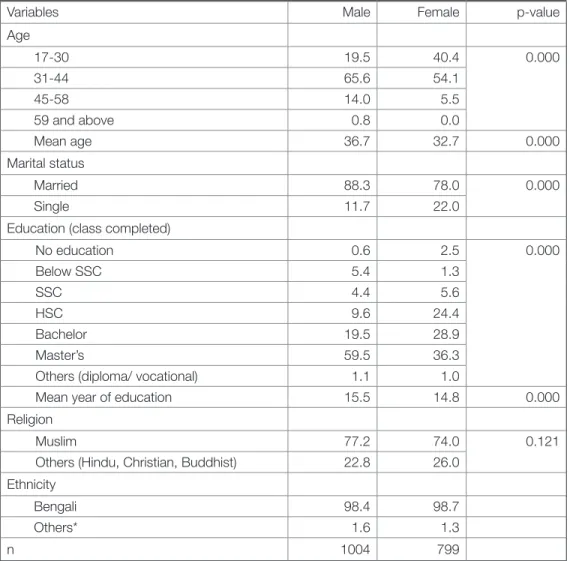
Highest per cent of respondents belonged to the age group of 31-44 years;
therefore, the mean age of male and female respondents were 36.7 and 32.7 years respectively. Regardless of sex, the majority of the respondents
were married, while in the case of unmarried respondents, per cent of female respondents were double of male respondents. Mean year of education of male respondents was higher than that of female respondents, and the difference between the groups, in this case, was found statistically significant. This fact reflects in the per cent of male and female staff educated up to Master’s level where nearly two-thirds of respondents having Master’s Degree were male.
Although few, a higher percentage of female than male respondents did not have formal education. Except a few, all of the respondents regardless of sex were Bengali by ethnicity, and were Muslim (Table 4.1).
Table 4.1 Demographic profile of respondents
Variables Male Female p-value
Age
17-30 19.5 40.4 0.000
31-44 65.6 54.1
45-58 14.0 5.5
59 and above 0.8 0.0
Mean age 36.7 32.7 0.000
Marital status
Married 88.3 78.0 0.000
Single 11.7 22.0
Education (class completed)
No education 0.6 2.5 0.000
Below SSC 5.4 1.3
SSC 4.4 5.6
HSC 9.6 24.4
Bachelor 19.5 28.9
Master’s 59.5 36.3
Others (diploma/ vocational) 1.1 1.0
Mean year of education 15.5 14.8 0.000
Religion
Muslim 77.2 74.0 0.121
Others (Hindu, Christian, Buddhist) 22.8 26.0 Ethnicity
Bengali 98.4 98.7
Others* 1.6 1.3
n 1004 799
*Others: Garo, Chakma, Monipuri, Urao, Saotal, Marma, Rakhain
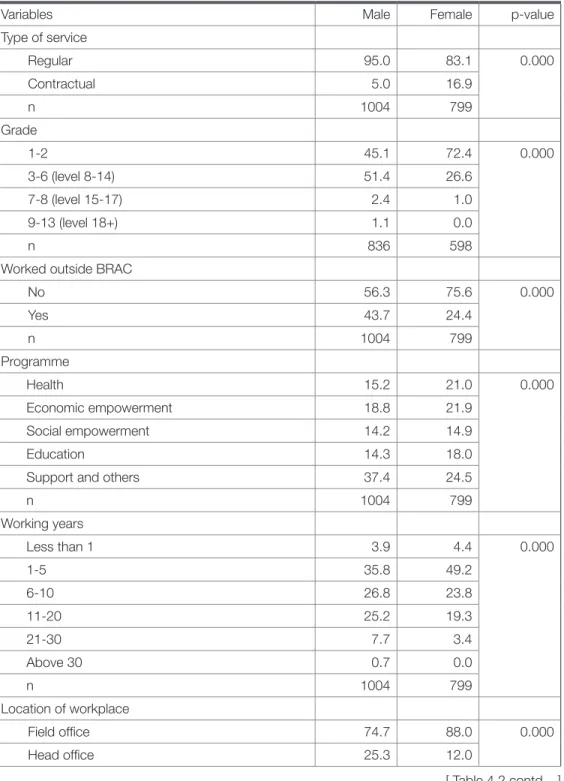
Majority of the respondents were the regular staff of BRAC. Male-female composition in terms of the types of the employment was statistically significant among the respondents (p<0.01). In the case of male respondents, the percentage of regular staff was higher than that of contractual staff, although the fact was similar in the case of female respondents, among the female respondents, the more was under contract than in the case of the male. In case of the regular staff, the majority of the female respondents belonged to the lowest grade (grade 1-2) while the highest concentration was found from grade 3 to 6 in the case of male respondents. Substantial portion of respondents from both groups had experience of other organisation than BRAC. The per cent was much higher in the case of male than that in case of female, and the difference in male-female composition regarding work experience outside BRAC was found to be statistically significant (p<0.01) (Table 4.2). Majority of the respondents regardless of sex worked under four programmes of BRAC, though the difference between male and female was statistically significant in this case (p<0.01), and substantial number of respondents came from other and support programmes like Finance and Accounts, Human Resources Department, Monitoring, Research and Evaluation and support staff working under various projects and programmes (Table 4.2).
Except few having less than one year and more than 30 years of experience in BRAC, the working years of BRAC for all respondents’ ranged from one to 30 years with the highest per cent having one to five years of experience.
The per cent of respondents were found to have dropped over time, but in general male respondents had spent longer period than female, and the difference between sexes was statistically significant (p<.01). Nearly half of the respondents received gender related training while considerably higher per cent reported that they did not receive any training focused on gender issues in their working period of BRAC to date. Despite, majority knew the fact that the organisation had Gender Policy; considerably higher per cent expressed their ignorance about it. Although knowing of the existence, many did not read or know the content (Table 4.2).
Although respondents might have worked under different supervisor during the period they worked in BRAC, at the time of data collection majority of the respondents worked under male supervisors, while some worked under female supervision. The case also reflects the fact that men mostly occupied the supervisory position. As mentioned in the sampling part, the majority of the respondents were taken from the field office, and majority experienced transfer from two to five times. Difference between the experience regarding transfer on the basis of gender was statistically significant (p<.01), and therefore, average number of transfer was higher for male than female respondents (4.5 compared to 3.5) (Table 4.2).
Table 4.2. Service related information
Variables Male Female p-value
Type of service
Regular 95.0 83.1 0.000
Contractual 5.0 16.9
n 1004 799
Grade
1-2 45.1 72.4 0.000
3-6 (level 8-14) 51.4 26.6
7-8 (level 15-17) 2.4 1.0
9-13 (level 18+) 1.1 0.0
n 836 598
Worked outside BRAC
No 56.3 75.6 0.000
Yes 43.7 24.4
n 1004 799
Programme
Health 15.2 21.0 0.000
Economic empowerment 18.8 21.9
Social empowerment 14.2 14.9
Education 14.3 18.0
Support and others 37.4 24.5
n 1004 799
Working years
Less than 1 3.9 4.4 0.000
1-5 35.8 49.2
6-10 26.8 23.8
11-20 25.2 19.3
21-30 7.7 3.4
Above 30 0.7 0.0
n 1004 799
Location of workplace
Field office 74.7 88.0 0.000
Head office 25.3 12.0
[ Table 4.2 contd... ]
Variables Male Female p-value Gender-related training
Received 52.6 48.2 0.06
Did not receive 47.4 51.8
n 1004 799
Sex of immediate supervisor
Male 89.2 82.9 0.000
Female 10.8 17.1
n 1004 799
Awareness about the existence of gender policy
Aware 89.1 85.6 0.026
Not aware 10.9 14.4
n 1004 799
Knowledge about gender policy
Yes 66.8 56.1 0.000
No 33.2 43.9
n 1004 799
No. of transfer experienced
1 18.4 29.4 0.000
2-5 51.8 51.0
6-10 23.8 17.8
11-15 4.6 1.6
Above 15 1.3 0.2
n 689 439
Average number of transfer 4.5 3.5 0.000
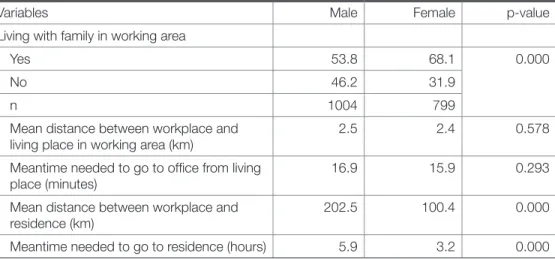
Factors that might influence the assessment of workplace were considered while collecting the background information of respondents. It was found that although the majority had their families with them in their working areas a considerably large number did not have. In this regard, more female lived with their families in their working area than male respondents. Although there was no difference between male and female respondents in terms of the distance between their workplace and living place in the working area, there was a significant difference found between the respondents of both sexes regarding the distance between their workplace and residence [ ...Table 4.2 contd ]
(where their families were settled). In this case, it was found that female respondents were posted in the workplace closer to their residence than male respondents were. Therefore, the time needed to travel was less in the case of a female (Table 4.3).
Table 4.3 Residence related information
Variables Male Female p-value
Living with family in working area
Yes 53.8 68.1 0.000
No 46.2 31.9
n 1004 799
Mean distance between workplace and
living place in working area (km) 2.5 2.4 0.578
Meantime needed to go to office from living
place (minutes) 16.9 15.9 0.293
Mean distance between workplace and
residence (km) 202.5 100.4 0.000
Meantime needed to go to residence (hours) 5.9 3.2 0.000
Knowledge about gender and gender policy: Major portion of the respondents think that the term ‘gender’ refers to the issues related to female only. While seeking the knowledge of respondents about gender and organisation’s existing gender policy, the interviewer got varied responses from male and female respondents. For example, when a male respondent was asked to talk about his idea about gender, he said - With the word gender we mean male and female. It means a person will do his or her assigned task. In other words, men will do their job and female will do theirs. When a female respondent was asked the same question, she said, With the word gender we understand both male and female but now gender means having equal right. She added that we cannot change the biological side of male and female, but if we can bring change in their mentality, then there will be gender equality. Some respondents said that gender means the inequality between the men and women. Most of the respondents said that although they know that there is a gender policy in BRAC, but they have not read or seen it yet.
They do not even know what policies are written there. While discussing about the training, the respondents could remember the content of the training such as sexual harassment, what was considered as discriminatory attitude, what will be the appropriate dress for men and women, the role of men and women at household level and so forth. Some male staff said that the female staff get the preference in terms of enrolling in the gender training
that is occasionally arranged at BRAC. Assessment of workplace regarding four major themes from the respondents’ perspective has been discussed below.
4.2 GENDER RESPONSIVE WORKPLACE
While exploring whether the respondents felt that their workplace was gender responsive or not several factors were considered during the survey.
The factors included sense of respondents’ job security, sense of security while being on duty, guest room accommodation and privacy, availability of space and furniture, their relationship with supervisors, supervisor’s behaviour, administrative support, experience and feelings of transfer, abuse and complaint (Matrix 1).
The average scores found in Table 4.4 in all cases, except in the case of a sense of security while being on duty, for both sexes, were above 70%, but the difference between the scores by sex was found to be statistically significant in most cases. The female respondents were less satisfied with the relationship with their supervisors and colleagues than their male counterparts were. The same was the case for the sense of security, availability of guest room and privacy, transfer and administrative assistance. However, the reverse was found in the case of respondents’ satisfaction over the availability of the office space and furniture, meaning higher percent of female respondents compared to their male counterpart expressed their full satisfaction over the space and furniture provided within their workplace (Table 4.5).
Table 4.4 Average score regarding gender responsive workplace by sex
Theme Mean score p-value
Male Female
Sense of security 69.2 66.7 0.005
Availability of space and furniture 79.6 82.1 0.000
Relationship with supervisors and supervisors’ behaviour 86.2 82.5 0.000 Relationship with colleagues and their behaviour 82.4 78.8 0.000
Administrative assistance 77.9 75.5 0.061
Transfer 77.3 74.7 0.002
Abuse 94.8 94.6 0.550
Mechanism to deal complain regarding sexual harassment 90.2 87.2 0.000
n 1004 799
Per cent respondents completely satisfied and completely dissatisfied over some themes explored under gender responsive work environment Issues ExploredFully Positivep-valueFully Negativep-value MaleFemaleMaleFemale nitureFurniture for the female63.765.20.521.51.40.836 Furniture for the male63.670.10.0041.01.40.454 Satisfied with the provided space57.961.00.1860.80.90.854 Timely getting office equipment 78.880.60.3420.90.80.735 Official relationship with the colleagues of opposite sex84.871.20.0000.30.40.000 Helping attitude of colleagues of opposite sex (when not asked)37.434.20.1625.39.60.000 Helping attitude of colleagues of opposite sex (when asked)58.455.20.1771.12.00.115 Does the work efficiency get effected by bureaucratic problem52.950.20.2542.83.00.786 Mentally sexual harassment (Supervisor)96.395.70.5360.20.10.702 Physically sexual harassment (supervisor)98.798.70.9350.20.10.702 Mentally sexual harassment (colleagues)96.894.90.0370.00.10.262 Physically sexual harassment (colleagues)98.898.70.9140.00.10.262 Is the workplace risk free and safe52.652.80.9245.46.00.566 Encourage to inform higher authority after sexual harassment92.992.1.5131.31.3.935 Appropriate action taken by management after sexual harassment82.779.8.1261.11.1.951 Possibility of receiving justice after complaining about sexual harassment81.778.3.078.4.9.196 Complaining about sexual harassment to harass colleague or supervisor61.869.2.0011.01.5.331 [ Table 4.5 contd... ]